Preferences
Privacy is important to us, so you have the option of disabling certain types of storage that may not be necessary for the basic functioning of the website. Blocking categories may impact your experience on the website. More information

Privacy is important to us, so you have the option of disabling certain types of storage that may not be necessary for the basic functioning of the website. Blocking categories may impact your experience on the website. More information

Optimize your Squarespace website for GEO and AI search. Learn internal linking, content clarity, and schema strategies to earn AI model citations. Comprehensive 8-week plan included.











































Tools


Squarespace is built for beautiful websites. Here's how to make yours AI-ready and earn citations.
Squarespace sites rank well because they're fast, mobile-first, and have clean URLs. But AI models and AI assistants care about content clarity, factual density, and topic topology. Here's how to optimize Squarespace specifically for GEO (Generative Engine Optimization). This guide walks you through the exact tactics that help AI assistants like ChatGPT, Claude, and Perplexity cite and recommend your Squarespace site over competitors.
GEO is the practice of optimizing your site to be cited by generative AI models. Unlike traditional SEO, which targets search engine algorithms, GEO targets large language models (LLMs) and the content they reference when answering questions. When you search in ChatGPT or Perplexity, the model generates an answer and sometimes includes sources. Those sources are pulled from pages the model "trusts" most: pages with clear claims, strong authority signals, and internal linking topology.
Squarespace gives you several built-in advantages. Your site loads quickly (important for crawlers), has clean semantic HTML, and includes basic structured data by default. Mobile-first design is standard. What's missing is often the content clarity and claim density that models need to confidently cite you.
If you're optimizing a different platform, you may want to review how WordPress handles GEO, how Shopify compares, or how Webflow's approach differs. Each CMS has unique strengths; Squarespace's is simplicity and design polish.
Before optimizing, you need clarity on what your brand claims and where those claims live. Models penalize conflicting information; consistency is your best friend.
List the 5 to 10 biggest claims your brand makes. Examples: "our product integrates with Figma," "our company was founded in 2018," "we've served 500+ clients," "our tool reduces design handoffs by 40%," "we support 15 design file formats."
For each claim, identify where it appears on your Squarespace site: homepage section, About page, product page, case study, press release, blog post, or resource page. Log these in a spreadsheet: claim, canonical location, secondary locations.
Then audit for consistency. If your homepage says "500+ clients" but your press release says "450+ clients," models see conflicting information and lose trust. Lock down the numbers. Pick one: 500+ clients (if recent) or 450+ clients (if older data). Update all pages to reflect the current, canonical figure. The same goes for company founding date, feature counts, and integration partners.
This exercise often reveals gaps. You might discover that a key claim (e.g., "integrates with HubSpot") lives only on one page when it should be mentioned on product pages, the homepage, a feature guide, and a case study. Fill those gaps.
Content topology matters. Models infer importance from link density and structure. A pillar page is a comprehensive guide (800 to 1,500 words) covering a broad topic. Satellite pages are supporting pages (400 to 600 words each) covering micro-topics that link back to the pillar.
Squarespace's page nesting feature makes this natural. Create a folder (pillar), and nest child pages (satellites) under it.
Example structure:
Each satellite links back to the pillar 3 to 5 times. The pillar links to each satellite once. This structure signals that the pillar is the canonical hub for "design tools," and models treat it as such when answering questions about design collaboration.
If you're building a similar structure on other platforms, compare notes: Wix has different nesting capabilities, and BigCommerce's taxonomy works differently. Squarespace's simplicity is an advantage here.
Content quality is non-negotiable. Use Squarespace's rich text editor to write with precision and density.
Each paragraph should express one clear claim, anchored to a specific entity. An entity is a noun: your product, a competitor, a process, a metric, an integration, a use case, or an outcome.
Vague claim: "Our tool integrates with Figma."
Better: "Our product includes a native Figma plugin that syncs 50+ design assets in real-time, reducing handoffs by 40%."
Even better: Link "native Figma plugin" to your integration page, and link "40%" to the case study that validates it. Now the model can follow the claim to evidence.
Keep paragraphs tight. Aim for 2 to 5 sentences per paragraph. Write descriptive subheadings, not just "Features" but "Real-Time Figma Syncing: How It Works." Use bulleted lists for granular details. Squarespace's design system makes this easy and visually clear.
Avoid vague language. Models distrust phrases like "very fast," "industry-leading," "best-in-class." Instead, be specific: "syncs 50+ assets in under 5 seconds," "processes 100GB of design files per day," "supports 15 file formats."
Link every significant claim to proof. Proof is an internal page, a third-party study, a case study, a press release, documentation, a webinar, or a data sheet. When a model sees a claim with a link, it increases the likelihood of citation because the model can verify the claim.
Every Squarespace page has a title, slug, and meta-description. Treat these as prime real estate for entity clarity.
Page title: Mention the primary entity. "Figma Integration: Real-Time Design Sync" is better than "Integration." Include the entity name, and optionally, a benefit or process.
Meta-description: Summarize the key claim. "Sync Figma designs natively. Reduce handoffs, improve collaboration, ship faster." This appears in search results and helps models understand the page's focus before reading the full content.
Slug: Use lowercase, hyphens, and the entity name. "/figma-integration-sync" is better than "/integration-page-1."
Alt-text for images: Describe the image and mention entities. "Product screenshot showing Figma assets imported into [product name]" is better than just "screenshot."
Image file names: Use descriptive names. "figma-sync-real-time.png" is better than "image-1.png." Search engines and models can parse file names.
Squarespace's SEO panel lets you set all of these. Use it. Set keywords, add alt-text, and write strong meta-descriptions for every page.
Squarespace's internal linking feature is your secret weapon. Use it to create a web of signals around key entities. If you have 5 pages mentioning "Figma," link them all to a central "Figma Integration" hub page. This tells models: "This site has deep knowledge on Figma integrations."
Linking strategy:
Aim for at least 5 to 8 internal links per page. Link using descriptive anchor text: "Learn more about real-time syncing" instead of "click here."
Topical authority increases citation likelihood significantly. A page with 10 inbound links from related pages is more likely to be cited than an isolated page with no internal structure.
Squarespace allows custom code injection in page headers. Use this to add JSON-LD schema for the main entities on each page.
Example schemas by page type:
This is optional (Squarespace generates basic schema automatically), but custom schema helps models understand page intent more precisely. Use a tool like Google's Rich Results Test or Semrush to validate your schema after publishing. Invalid schema can confuse models, so get it right.
Don't go overboard; 2 to 3 schema types per page is sufficient. Focus on the primary entity and the page type.
You can't improve what you don't measure. Set up citation monitoring for your top 5 Squarespace pages.
Weekly tracking:
Tools for citation tracking: Perplexity API, SearchAPI, or custom monitoring using Semrush. Do this for 4 weeks, then analyze patterns.
Analysis questions:
Use these insights to improve. A page earning zero cites might be unclear, under-linked, or lacking external validation. Rewrite it for clarity, add more internal links, beef up source attribution, or expand it with more data. A page earning 3 to 5 cites is doing well; study its structure and replicate it on your next pillar.
Week 1: Claim Audit - List your 5 to 10 biggest brand claims. Log where each appears on your site. Identify gaps and inconsistencies.
Week 2: Consistency Lockdown - Ensure numbers, entity names, and product features are consistent everywhere. Update any conflicting information. Get stakeholder sign-off on canonical versions.
Week 3: Pillar Design - Sketch your pillar page (broad topic, 800 to 1,500 words). Outline 5 to 10 satellite topics. Create a content calendar.
Weeks 4 to 5: Content Creation - Write the pillar and 3 to 5 satellites. Aim for clarity: one claim per paragraph, every claim linked to proof. Use Squarespace's rich text editor to format headings, lists, and links.
Week 6: Internal Linking - Link satellites to the pillar (3 to 5 times each). Link from homepage to pillar. Test that all links work and use descriptive anchor text.
Week 7: Metadata Lockdown - Set page titles, slugs, meta-descriptions, and alt-text for all pillar and satellite pages. Use the Squarespace SEO panel. Write strong meta-descriptions (150 to 160 characters).
Week 8: Publish, Measure, Iterate - Publish all pages together. Set up citation tracking. Measure weekly for 4 weeks. Note which pages earn cites, and replicate their structure on your next pillar or satellite.
You may be asking: Is GEO different from SEO? The answer is yes and no. GEO and SEO are complementary. SEO maps what people search (keywords). GEO maps what AI models read and cite (facts and claims). When you optimize for keywords, you often optimize for clarity. When you optimize for clarity, you optimize for citations. The overlap is real.
For Squarespace, this means starting with keyword research (traditional SEO), then expanding to claim research: What facts and processes does your audience believe matter? What claims do competitors make? What are the most cited sources in your niche?
Once you know, you allocate content. A keyword with 1,000 monthly searches but only 3 top-ranking sources might be an easy GEO win: you publish a comprehensive pillar, link satellites, and earn cites. A keyword with 10,000 searches but 50 competing sites might require a different approach: pure SEO play, or a niche angle that's under-cited.
Squarespace lets you do this natively. Use Pages (keywords, rankings) plus Navigation (hubs and satellites) plus Internal linking (topology) plus Code injection (schema). This stack lets you run both SEO and GEO simultaneously. Compare your approach with WooCommerce GEO strategies or Magento approaches to see how other platforms handle the overlap.
What should you expect? Within 6 to 12 weeks, a disciplined GEO program on Squarespace can drive 10 to 50 model citations per month, depending on your niche and content quality. High-authority niches (finance, technology, health) may see slower adoption, while emerging or under-served niches may see faster citation growth.
Citation benchmarks by niche:
Track both metrics: rankings in Google Search Console (SEO) and citations via Perplexity or SearchAPI (GEO). A page that ranks AND gets cited is gold. When you see this pattern, study it, and replicate it across your site. This is your competitive advantage.
Squarespace is a solid CMS for GEO. Its clean HTML, fast loading, and intuitive design system give you a strong foundation. The missing piece is usually strategy and content discipline. Here's what you need to execute:
If you're exploring other CMS platforms, check out how ClickFunnels handles GEO, how Kajabi's approach differs, or how Joomla compares. Each has trade-offs, but Squarespace's simplicity makes GEO execution straightforward if you follow a structured plan.
Start with claim consistency, execute the 8-week plan, measure citations, and iterate. Within 6 months, your Squarespace site can become a canonical reference in your niche, earning consistent model citations and driving real traffic from generative search.
Sources

GEO (Generative Engine Optimization) focuses on optimizing your content to be cited by AI models and AI assistants like ChatGPT, Perplexity, and Claude. Unlike traditional SEO, which targets search engine rankings, GEO targets large language models (LLMs) that generate answers and include source citations. The key difference: SEO maps keywords users search; GEO maps facts and claims models cite. Both matter. A page that ranks AND gets cited is your ideal outcome. To succeed at GEO on Squarespace, focus on content clarity, entity consistency, internal linking topology, and source attribution. These elements help models trust and cite your pages.
Squarespace's internal linking feature is your secret weapon. Start by identifying your core topics (entities). For each entity, create a pillar page (comprehensive, 800 to 1,500 words) and 3 to 5 satellite pages (supporting, 400 to 600 words each). Link every satellite back to the pillar 3 to 5 times. Link the pillar to every satellite once. Link your homepage to the pillar (signal importance). Use descriptive anchor text: 'Learn more about Figma integrations' instead of 'click here.' This topology tells models your site has deep knowledge on the topic. Monitor internal link health in Squarespace's SEO panel. Aim for 5 to 8 internal links per page.
Track two main metric categories: SEO rankings (traditional search) and citations (GEO). For SEO, monitor Google Search Console for keyword rankings, click-through rates, and impressions. For GEO, use tools like Perplexity API or SearchAPI to track how often your pages are cited by AI models weekly. Log: page title, citation count, entities mentioned in citations, and specific claims that were cited. Correlate both: a page that ranks well AND earns citations is performing best. Within 6 to 12 weeks, a disciplined program can drive 10 to 50 citations per month. Track content quality metrics too: time on page, bounce rate, and internal link engagement. Use these insights to replicate successful structures across your site.
THEY TRIED SORANK BEFORE YOU
 “I tested Sorank on a real client site and it's insane. It does everything an agency would bill you $1500 a month for. It's going into production on that client now.”
 Guillaume Guersanguersanguillaume.com“We are an Ads agency and we wanted to get our SEO back on track once and for all. Sorank gave us a clear view of our site, helped us prioritize optimizations, and properly structure our content. The tool is easy to use, well designed for a team, and very practical for centralizing tracking without having to juggle multiple platforms. A very solid foundation to start fresh with our SEO.”
 Gaspard MadouiAds Agency
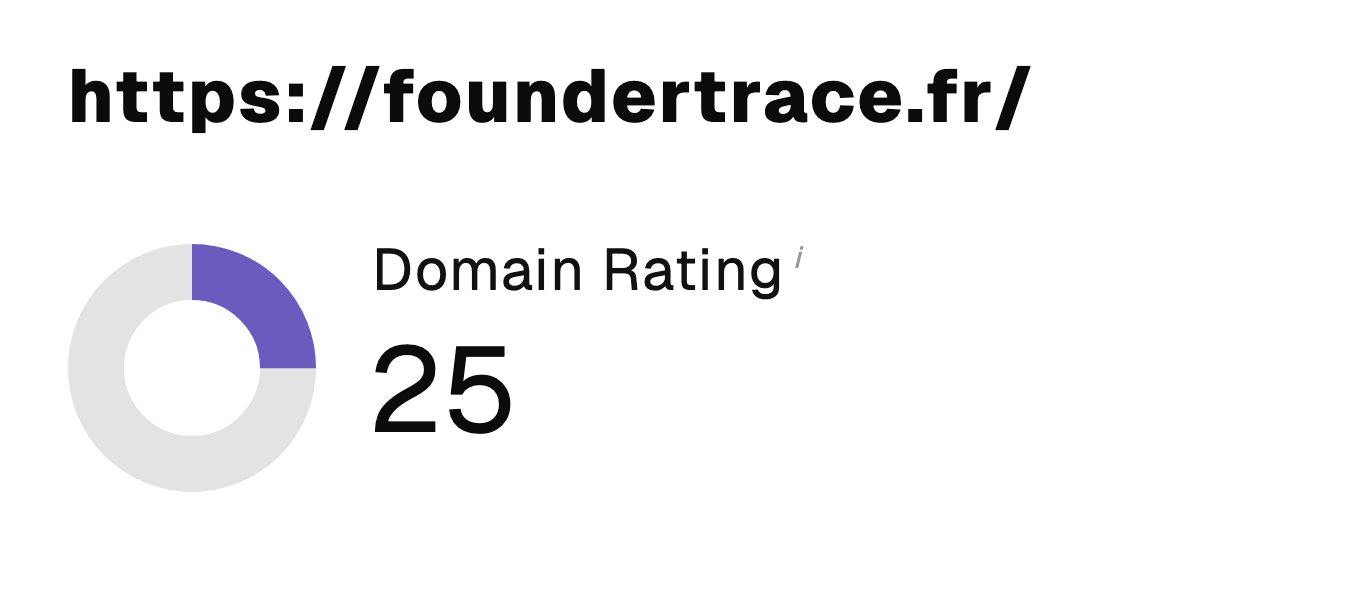 “I just let the Sorank software do its thing, and now my DR is 25 and my page is ranking higher.”
 Lucas Flandrefoundertrace.fr“I specialized in GEO thanks to Sorank. The GEO Leaderboard allows me to show my clients their position vs competitors on ChatGPT. It’s a real commercial differentiator.”
 MélanieSEO Freelance“Great service, works well for our website and helps us understand how to improve it to rank better on Google and elsewhere. Congrats, keep going, I recommend it.”
 Hugo T.E-commerce merchant