
Preferences
Privacy is important to us, so you have the option of disabling certain types of storage that may not be necessary for the basic functioning of the website. Blocking categories may impact your experience on the website. More information
Privacy is important to us, so you have the option of disabling certain types of storage that may not be necessary for the basic functioning of the website. Blocking categories may impact your experience on the website. More information

E-A-T is Google's framework of Expertise, Authoritativeness and Trustworthiness for judging content. Learn what it means and how to show it for SEO and GEO.








Founder Sorank, 7+ years in SEO.
Summary
E-A-T stands for Expertise, Authoritativeness, and Trustworthiness, the framework in Google's quality rater guidelines used to judge whether content is credible. In December 2022 Google added a second E for Experience, so the term became E-E-A-T. It is not a direct ranking factor, but its qualities shape the signals that Google and AI assistants reward.
Want to go further? Ask
E-A-T is the shorthand for Expertise, Authoritativeness, and Trustworthiness, the lens Google's human quality raters use to decide whether a page is credible and genuinely helpful. The idea is simple: show that the people and the website behind a page really know the subject and can be trusted on it. E-A-T is a mental model for content quality, not a score you can read in a tool.
Expertise is the knowledge and skill shown in the content and in the author's background. Authoritativeness is the reputation others give you, usually visible in mentions and links from respected sites in your field. Trustworthiness is accuracy, transparency, and safety: who stands behind the content, whether the facts are right, and whether visitors are protected.
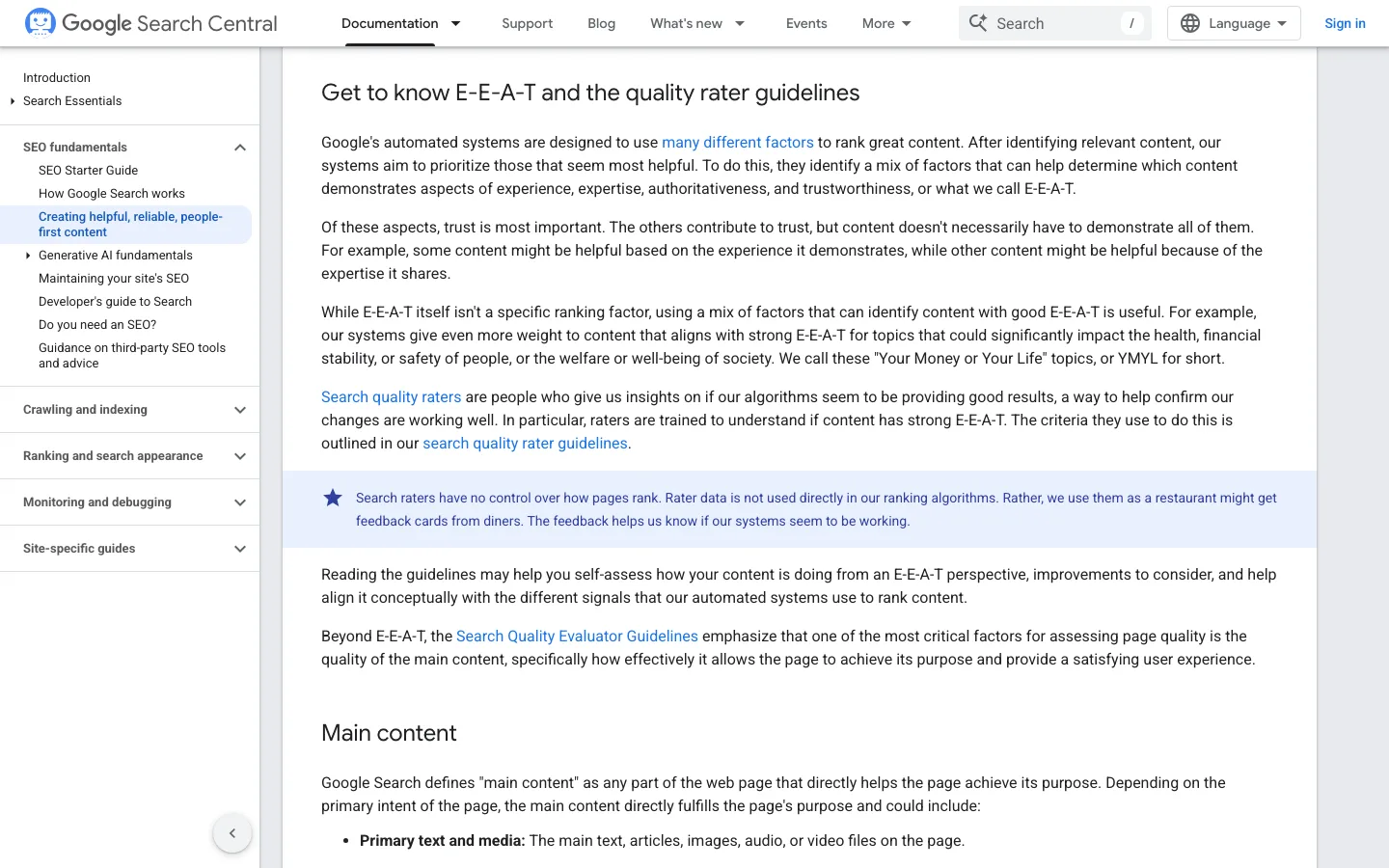
According to Google's guidance on helpful content, trust is the most important of these aspects, and the others contribute to it. A page does not have to show every quality to be helpful. Some content is useful for the experience it shares, and other content for the expertise it brings.
In its announcement of December 15, 2022, Google said E-A-T had gained an extra E for Experience. The question it asks is whether content was produced with first-hand involvement, such as actually using a product or visiting a place.
Google gives an example. Someone filling out a tax return should find content written by an accounting expert, while someone looking for reviews of tax software may be better served by people who have used the different services. Experience and expertise are different kinds of value, and either can be the right answer depending on the question.
Not directly. Google's guidance on helpful content states that E-E-A-T itself is not a specific ranking factor. The rater guidelines are the document human evaluators use to assess search results, and Google says rater data is not used directly in its ranking algorithms. The feedback helps Google check whether its systems seem to be working.
In practice, you cannot optimize an E-A-T score, because there is no such number. What you can do is align your content with the qualities the guidelines describe, which tend to match the content quality signals that Google's systems do reward. Treat E-A-T as a direction, not a setting.
Google gives more weight to strong E-E-A-T on Your Money or Your Life topics, the subjects that could significantly affect the health, financial stability, or safety of people. Inaccurate advice on these subjects can cause real harm, so the bar for expertise and trust is higher.
On YMYL topics, clear authorship by qualified people, citations to reputable sources, current information, and visible accountability carry extra weight. A casual, anonymous answer to a medical or financial question is unlikely to meet the standard Google describes, however well it is written.
Start with the page itself. Show first-hand experience where it is relevant, add a byline that names the author, and link that byline to real background such as credentials or past work. Google's guidance asks whether it is clear who created the content, and it strongly encourages accurate bylines wherever readers might expect one.
Authoritativeness grows over time. Publish consistently strong work on a clear subject, and earn mentions from respected sites in your niche. Sorank's content optimization checks every page of a site for titles, links, images, and structured data, so basic gaps are not left behind while the content improves. Consistent author authority helps the same way.
The most common mistake is treating E-A-T as a checklist. Adding an author box, a disclaimer, or a badge does little if the content itself lacks depth. Google's guidance also warns against deceptive authorship, such as fabricated creator profiles with made-up names, AI-generated headshots, or false credentials.
Another mistake is neglecting the trust basics: missing contact details, vague authorship, outdated facts, or an insecure site can undercut strong content. A third is writing for search engines first. Content made mainly to attract search visits, rather than to help the people who arrive, is not what Google says its systems reward.
For classic SEO, E-A-T sums up what Google tries to reward: credible, accurate content written for people, from sources users can trust. On competitive and sensitive subjects, the same qualities support more durable rankings.
For generative engine optimization, the same signals matter even more. AI assistants tend to cite sources they can treat as reliable, so clear expertise, recognized authority, and visible trust make a page a safer reference. The qualities behind E-A-T feed directly into helpful content that readers and AI assistants can rely on.
A real case shows the effect. LV3D, a French 3D printing specialist, already had recognized expertise, yet little of it lived on its website. After publishing articles built on that expertise, its organic traffic was multiplied by 4 in 5 months, as shown in its case study.
E-A-T, expanded to E-E-A-T with Experience, is Google's framework for judging whether content is credible and worth trusting. It is not a direct ranking factor, but it describes the qualities that search systems and AI assistants increasingly reward: first-hand experience, demonstrated expertise, earned authority, and above all trust.
To go further, read about YMYL, study the Google Search Quality Rater Guidelines in depth, and look at the LV3D case study to see how demonstrated expertise becomes organic traffic.
Sources
E-A-T stands for Expertise, Authoritativeness, and Trustworthiness, Google's original framework for judging content credibility. In December 2022 Google added a second E for Experience, making it E-E-A-T. Experience refers to first-hand involvement with a topic, such as actually using a product or visiting a place.
Not directly. Google's guidance says E-E-A-T itself is not a specific ranking factor, and the rater guidelines are used to evaluate results rather than to rank pages. You cannot optimize an E-A-T score, but aligning with its qualities tends to match signals Google's systems do reward.
Show first-hand experience and subject expertise, add clear author bylines with real credentials, and cite reputable sources. Build authority by publishing consistently strong content and earning mentions from respected sites. Reinforce trust with transparent contact details, an informative About page, and accurate information, especially on YMYL topics like health and finance.
 “I tested Sorank on a real client site and it's insane. It does everything an agency would bill you $1500 a month for. It's going into production on that client now.”

 Guillaume Guersanguersanguillaume.com“We are an Ads agency and we wanted to get our SEO back on track once and for all. Sorank gave us a clear view of our site, helped us prioritize optimizations, and properly structure our content. The tool is easy to use, well designed for a team, and very practical for centralizing tracking without having to juggle multiple platforms. A very solid foundation to start fresh with our SEO.”
 Gaspard MadouiAds Agency
 “I just let the Sorank software do its thing, and now my DR is 25 and my page is ranking higher.”
 Lucas Flandrefoundertrace.fr“I specialized in GEO thanks to Sorank. The GEO Leaderboard allows me to show my clients their position vs competitors on ChatGPT. It’s a real commercial differentiator.”
 MélanieSEO Freelance“Great service, works well for our website and helps us understand how to improve it to rank better on Google and elsewhere. Congrats, keep going, I recommend it.”
 Hugo T.E-commerce merchant



















