Preferences
Privacy is important to us, so you have the option of disabling certain types of storage that may not be necessary for the basic functioning of the website. Blocking categories may impact your experience on the website. More information
Privacy is important to us, so you have the option of disabling certain types of storage that may not be necessary for the basic functioning of the website. Blocking categories may impact your experience on the website. More information

The 8 generative engine optimization trends shaping AI search, with sourced data, a 30-day action plan and the mistakes that keep brands out of AI answers.
In short
Generative engine optimization trends are the shifts that decide which sources AI models such as ChatGPT, Gemini, Claude and Google AI Mode cite in their answers. The 8 that matter for 2027: AI answers as a main search surface, citations replacing clicks, query fan-out, off-site mentions, extractable content, crawler control, AI visibility reports and agentic shopping.
Want to go further? Ask
Quick quiz
Is SEO right for you, and how should you start?
Sorank matches your answers


Test it for 3 days on your own site and see where you stand on Google, ChatGPT and the other AIs.
Start 3-day free trial3 days free, then stop whenever you want. 90-day results guarantee, conditions apply.
This guide takes each trend in turn: what changed, the data behind it, and what to do this week. New to the topic? Start with our definition of generative engine optimization (GEO). For the classic search side, our overview of this year's SEO trends covers rankings, links and Google updates. Here, we stay on one question: how do you become a source that AI models quote?
AI answers now reach a mass audience, they send fewer clicks, and they pick sources with criteria that only partly overlap with Google rankings. Everything else follows from that. The first three trends change how you measure success, the next three change how you produce content and run your site, the last two change how you report and sell.
| Trend | What changed | Evidence | First action |
|---|---|---|---|
| 1. AI answers become a main search surface | Many buyers ask AI models instead of typing keywords | Google AI Mode passed 1 billion monthly users (Google, May 2026) | List the 30 to 50 prompts your buyers type |
| 2. Citations replace clicks | Fewer clicks when an AI summary is shown | 8% click rate with an AI summary vs 15% without (Pew Research, July 2025) | Track citations and mentions, not only sessions |
| 3. Query fan-out and long prompts | One question becomes many hidden sub-searches | AI Mode searches are about 3 times longer than classic queries (Google, May 2026) | Cover the sub-questions of each topic |
| 4. Off-site mentions outweigh backlinks | AI models trust what independent sources say about you | Web mentions correlate at 0.664 with AI Overview visibility vs 0.218 for backlinks (Ahrefs, May 2025) | Earn mentions in reviews, press and communities |
| 5. Content built for extraction | Passages with facts, quotes and sources get reused | Adding quotations raised visibility by about 41% (GEO study, KDD 2024) | Rewrite your top pages answer-first |
| 6. Granular crawler control | Search bots and training bots are now separate | OpenAI documents OAI-SearchBot and GPTBot as independent settings | Audit robots.txt bot by bot |
| 7. AI visibility gets its own reports | Google reports AI impressions separately | Search Console generative AI reports, live for all sites since August 31, 2026 | Set up a monthly AI visibility report |
| 8. Multimodal and agentic search | People search with images and voice, AI models start to buy | More than 1 in 6 US searches use voice or images (Google, May 2026) | Clean product data and image context |
AI answers are where a large share of your buyers now start their research. On May 19, 2026, Google's data science team reported that AI Mode passed 1 billion monthly active users, with AI Mode queries more than doubling every quarter since launch. In February 2026, OpenAI told TechCrunch that ChatGPT had reached 900 million weekly active users.
How big AI search became
Sources: Google, May 2026; OpenAI via TechCrunch, February 2026
Your buyers no longer see ten blue links and pick one. They see one answer that names a handful of brands or sources, and many stop there. If your brand is not in that answer, you are not on the shortlist. The work moves from "rank for this keyword" to "be one of the sources this answer is built from".
Each AI surface builds answers differently. Google AI Mode and AI Overviews draw on the Google index. ChatGPT search relies on its own crawler, OAI-SearchBot, and on search partners. Gemini grounds its answers in Google Search. Claude runs a web search when the question needs fresh facts. So the same prompt can cite different sources on each platform, and even differ from one run to the next. Test each platform, several times. Our guide to where AI search is heading details each one.
When an AI answer is shown, fewer people click. The Pew Research Center study by Athena Chapekis and Anna Lieb (July 22, 2025) followed 900 US adults and 68879 Google searches. Users clicked a classic result in 8% of visits with an AI summary, against 15% without one. Only 1% clicked a link inside the summary.
In Ahrefs' update of February 4, 2026, by Ryan Law, an AI Overview correlates with a 58% lower average click-through rate for the page in position 1. The study covers 300000 keywords and compares December 2025 with a forecast built on keywords without AI Overviews. In raw terms, position 1 CTR on these keywords fell from 7.3% to 1.6% in two years.
Position 1 CTR on keywords that show an AI Overview
Source: Ahrefs, February 2026 (300000 keywords, desktop Search Console data)
The click is not dead: it moves down the funnel. People who click from an AI answer have already read a summary that named you, so judge AI traffic on conversions, not volume. If your traffic fell, use our method to confirm an AI Overviews traffic drop before changing anything.

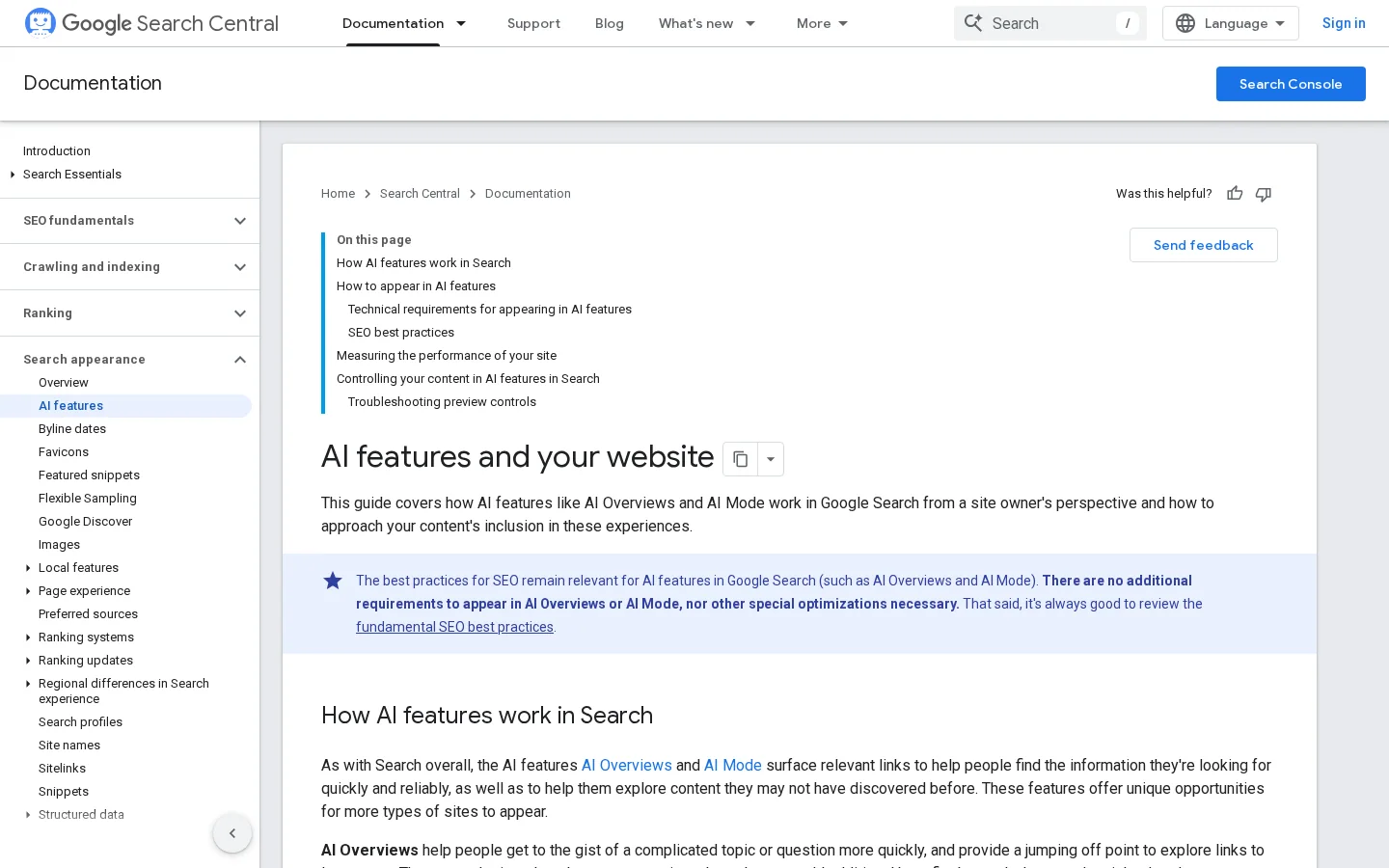
AI search engines no longer run your exact query. They split it into sub-searches, read the results and write one answer. Google's documentation on AI features and your website explains that AI Overviews and AI Mode may issue multiple related searches across subtopics and data sources. The same page says there are no extra requirements to appear: a page must be indexed and eligible to show a snippet.
Google's May 2026 data shows the average AI Mode search is about 3 times the length of a classic query, and planning queries grew 80% faster than AI Mode queries overall in six months. People type "which CRM should a 10-person agency choose if we use Google Workspace and need a client portal", not "best CRM". Each detail becomes a sub-search: integrations, team size, pricing, portal features.
Turn one prompt into a fan-out content plan
The concept is explained in our glossary entry on query fan-out. To see the real sub-searches an AI model runs on your topics, Sorank's query fan-out tracker records them so you can match each one to a page.
AI models trust what independent sources say about you more than what your own site says. In Ahrefs' study of 75000 brands by Louise Linehan (May 26, 2025), web mentions of a brand had the strongest correlation with AI Overview visibility. Backlinks came far behind.
Correlation is not causation, as Ahrefs notes. But a model that reads twenty sources and finds your brand in twelve has good reasons to name you. Focus on the sources AI models already cite in your niche: independent comparison pages, community threads (our data on how often AI models cite Reddit shows their weight), review platforms and directories, trade press and podcasts.
Models build a picture of your brand as an entity: what you do, for whom, at what price. If ten sources call you "a CRM for agencies" and two call you "a project tool", the model repeats the majority. Use the same short description everywhere: About page, directories, press kit, founder bios. See our page on entity consensus, and our guide to finding unlinked brand mentions to spot the ones that already exist.
Links still help, because they help pages get crawled and ranked, and Google's AI features draw on its index. Sorank's natural backlink acquisition places contextual links from sites in your niche, which serves both rankings and mentions.
AI models reuse passages, not pages. A clear answer, a sourced fact or a quote from a named expert is easier to lift into an answer. The original paper, "GEO: Generative Engine Optimization" by Pranjal Aggarwal and co-authors, accepted at KDD 2024, tested nine methods and measured how visible each source became in generated answers.
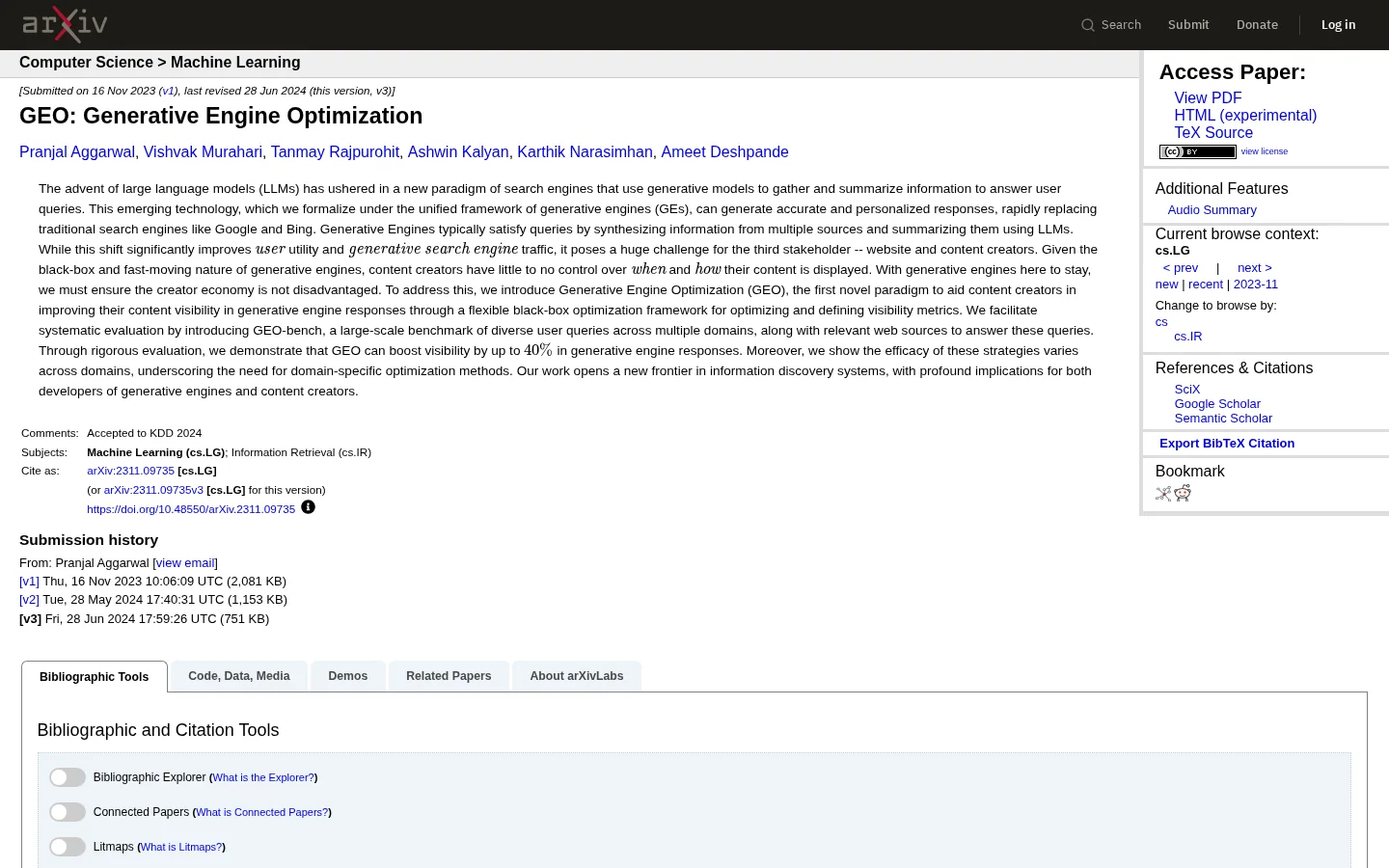
Lower-ranked sources gained the most. For sources in position 5 of the search results, citing sources raised visibility by 115.1%, while the top source lost visibility with the same method. The authors explain that rankings depend on backlinks and domain history, while generative engines judge the content itself. Well-sourced content can win citations before it wins rankings.
The same paragraph, before and after a GEO rewrite
A quick test: paste one section of your page alone into a document. If it needs the paragraph above to make sense, a model will struggle to quote it.
Tip
Run your most important page through our free LLM readability checker. It scores how easily an AI model can extract answers from it, so you know which sections to rewrite first.
You no longer choose between "open to AI" and "closed to AI". Platforms now separate the bots that train models from the bots that fetch pages for answers. One wrong line can remove you from ChatGPT search.
OpenAI's crawler documentation lists separate user agents, each with its own robots.txt setting. Changes take about 24 hours to show in ChatGPT search.
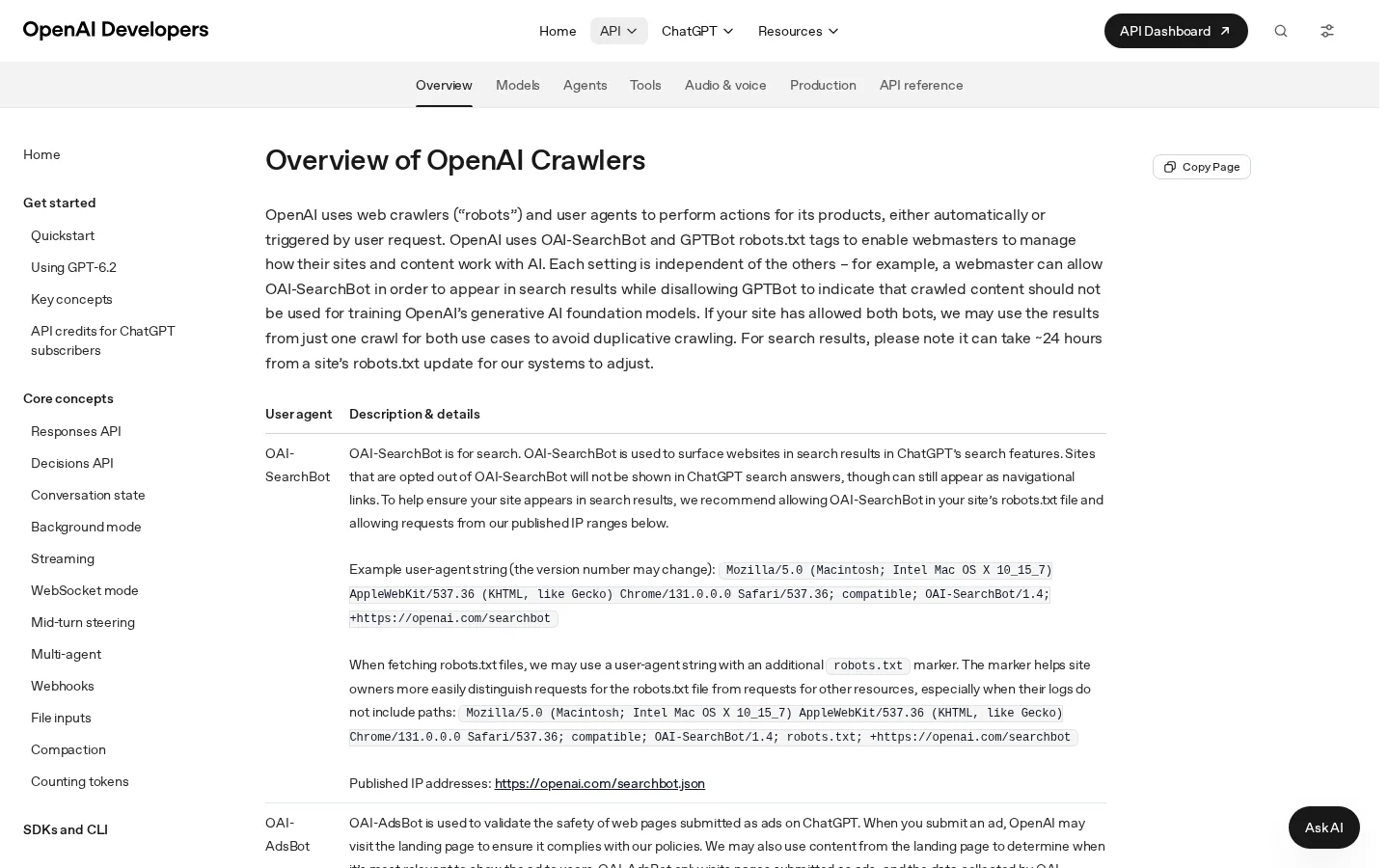
| User agent | Owner | Purpose | If you block it |
|---|---|---|---|
| OAI-SearchBot | OpenAI | Finds pages to show in ChatGPT search answers | Your pages drop out of ChatGPT search answers, apart from plain navigational links |
| GPTBot | OpenAI | Collects content that may train future models | Signals your content should not be used for training; search is not affected |
| ChatGPT-User | OpenAI | Fetches a page when a user asks ChatGPT to | Robots.txt may not apply, since a person started the visit |
| Googlebot | Crawls for Google Search, including AI Overviews and AI Mode | You drop out of Search and its AI features |
A common setup for a business that wants AI visibility but not model training:
# Allow ChatGPT search to show your pages
User-agent: OAI-SearchBot
Allow: /

# Opt out of training future OpenAI models
User-agent: GPTBot
Disallow: /

# Keep Google Search and its AI features open
User-agent: Googlebot
Allow: /
Google has no robots.txt switch for AI Overviews. Its documentation points to snippet controls: nosnippet, max-snippet, noindex, or data-nosnippet on a block you do not want quoted:
<div data-nosnippet>
  <p>Prices updated every morning.</p>
</div>llms.txt is a proposed file listing your key pages for AI models. Google's documentation now says you do not need AI text files or special markup to appear in AI Overviews or AI Mode. Create one if it takes ten minutes, but do not expect it to change your citations. Read what the llms.txt file does and its limits, and our full technical GEO checklist.
Warning
Many security plugins and CDN settings block "AI bots" as one group. Check yours with our free robots.txt checker with AI crawler access: it shows, bot by bot, who can read your site.
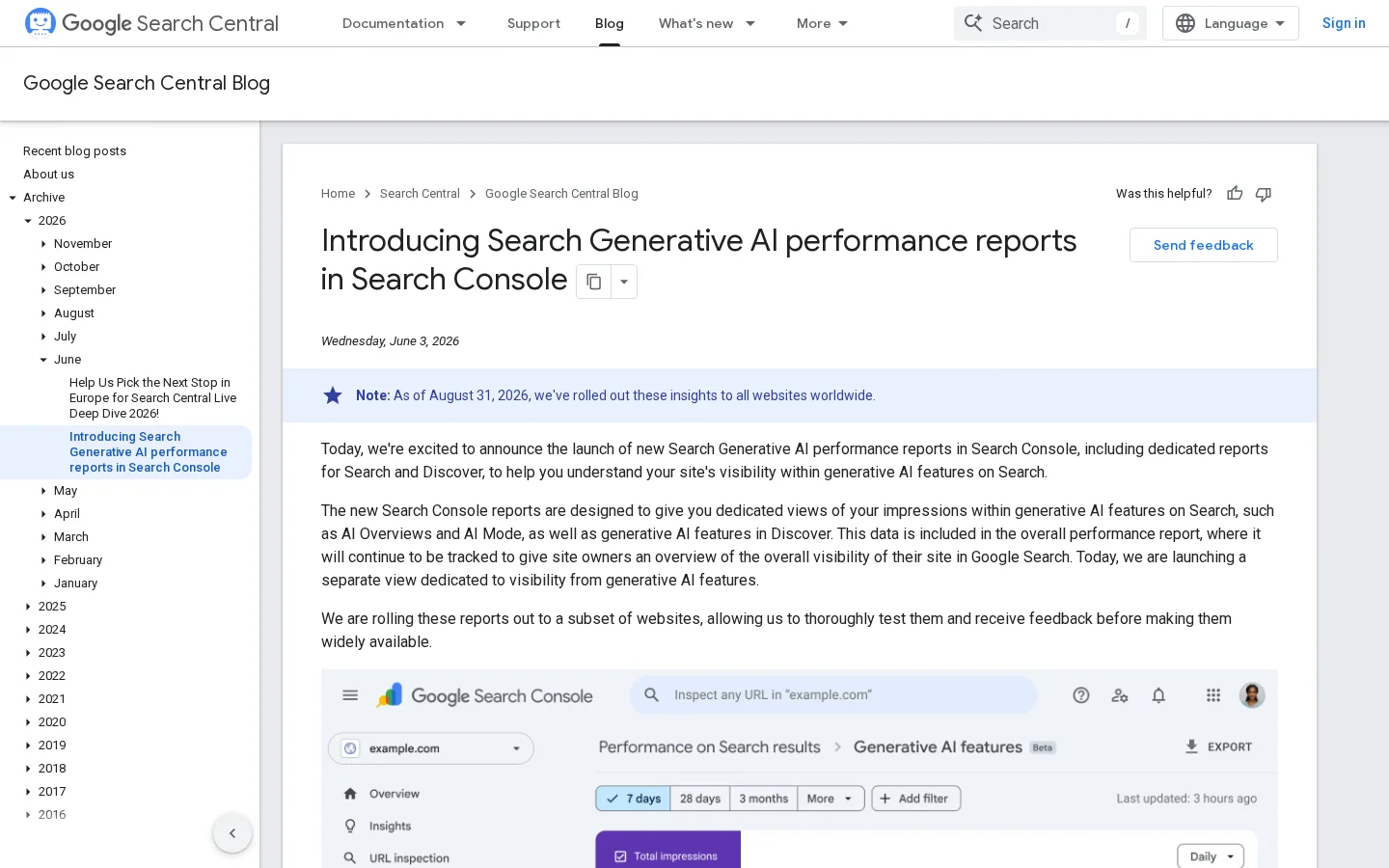
AI visibility is now measured, not guessed. On June 3, 2026, Google's Search Central blog announced Search Console generative AI performance reports: how often your URLs appeared in AI features in Search (AI Overviews and AI Mode) and in Discover. Google added that the reports reached all websites worldwide on August 31, 2026.
Key dates in generative engine optimization
It gives impressions by page, country, device (Search only) and date, down to the hour. It gives no clicks or CTR for AI features, and it only covers Google. Our walkthrough on reading the Search Console generative AI report shows how to cross it with your click data.
For ChatGPT, Gemini and Claude, you need prompt tracking: a fixed list of prompts, run on each platform at a regular rhythm, with cited sources and named brands recorded. Look at trends over weeks, not one result. Sorank's AI mention tracking does this and shows when your brand is cited. If you prefer a spreadsheet, start from our weekly GEO tracker template.
To isolate visits from AI models in Google Analytics 4, create a custom channel group with a session source matching this regex, placed above "Referral" in the channel order:
.*(chatgpt\.com|openai\.com|gemini\.google\.com|claude\.ai|copilot\.microsoft\.com).*People now search with their camera and voice, and AI models start to complete purchases. Both shifts reward clean, complete and consistent data about what you sell.
Google's May 2026 post states that more than 1 in 6 US searches now use voice or images, and image searches grow over 40% month over month. When someone photographs a product and asks where to buy it cheaper, the model must match the image to your page. Use descriptive file names, alt text naming the product and its key attribute, original photos, and structured data that matches the visible text. Our page on multimodal search optimization lists every field to check.
On September 29, 2025, OpenAI launched Instant Checkout in ChatGPT, built on the Agentic Commerce Protocol co-developed with Stripe. OpenAI states that Instant Checkout items are not preferred in product results. When several merchants sell the same product, ChatGPT weighs availability, price, quality and whether the merchant is the primary seller. Shopify and Google developed the Universal Commerce Protocol for the same purpose. Adobe Analytics measured a 693.4% rise in generative AI traffic to US retail sites in the 2025 holiday season, from a still modest base.
Classic online shopping vs agentic shopping
If you sell online, start with your product feed: exact prices, real stock, shipping times, return policy and identifiers (GTIN, brand, model). Our guide to GEO for ecommerce stores covers the setup, and our entry on agentic search defines the concept.
These trends lead to five ways of working on AI visibility. None is enough alone; the mix depends on your size and sector.
Rewrite pages so each section answers one question in its first sentence, with facts, sources and named experts. Use it always, starting with your 10 most valuable pages. Fully in your control, but useless if AI models never retrieve the page. Example: a law firm opens its "how long does a divorce take" page with the legal minimum and the average, both sourced.
Cover every sub-question an AI model searches around your topics. Use it when you are cited for some prompts but not close variants. It builds depth that also helps Google rankings, but takes many pages and strict internal linking. Example: a SaaS adds pages on integrations, pricing by team size and migration.
Get your brand described the same way on the third-party sites AI models cite. Use it when competitors are named and you are not. It is the factor most correlated with AI visibility, but slow and partly outside your control. Example: a B2B tool gets listed in three independent comparisons and fixes its description on two directories.
Make sure search bots can reach, render and read your pages. Do it first, and after every migration. One fix can unlock every other effort, but it is never enough alone. Example: a shop finds its CDN blocked OAI-SearchBot and fixes one rule.
Give AI models clean product, price, stock and location data through feeds, structured data and business profiles. Best for ecommerce and local businesses. Directly tied to sales, but often a back-office project. Example: a retailer fills in GTINs and return policies for its whole catalog.
| Strategy | Main trend served | Effort | Time to results | Best for |
|---|---|---|---|---|
| On-page extraction | Trend 5 | Low to medium | Weeks | Every site |
| Fan-out coverage | Trend 3 | Medium to high | Weeks to months | Sites with a content team |
| Entity and off-site consensus | Trend 4 | High | Months | Competitive categories |
| Technical access | Trend 6 | Low | Days once recrawled | Every site, first |
| Commerce and data readiness | Trend 8 | Medium | Weeks | Ecommerce and local |
To see how these efforts fit with classic search work, read our analysis of the differences and overlap between GEO and SEO.
You can act on every trend in one month with a small team. Here is the order we recommend, from the step that unlocks the others to the one that compounds.
The 30-day GEO plan
One row per prompt, per platform, per run:
date,platform,prompt,run,brand_named,site_cited,cited_url,competitors_named
2027-01-05,ChatGPT,"best crm for a 10-person agency",1,yes,no,,"BrandA;BrandB"
2027-01-05,Gemini,"best crm for a 10-person agency",1,no,no,,"BrandA;BrandC"
After three runs, compute your mention rate and citation rate per platform. Repeat the same list every month so the comparison stays fair. Pick the pages to rewrite by revenue, not traffic: a pricing page, a comparison page and your best service pages usually beat an old blog post. A page with AI impressions in Search Console but no citations elsewhere is your fastest win.
Tip
Before day 4, run a quick free AI search visibility test on your brand for a first picture in minutes.
If you want this loop to run without weekly manual work, Sorank's GEO optimization software tracks your prompts, writes and publishes the missing content and builds links on autopilot. To audit a site in depth first, follow our step-by-step GEO audit.
Brands that stay invisible in AI answers usually make the same few mistakes. Each is easy to spot and cheap to fix.
What it is: a plugin, CDN rule or copied robots.txt that blocks every AI user agent, search bots included. How to spot it: your brand is named in ChatGPT but your site is never linked, or your logs show no OAI-SearchBot visits. How to fix it: allow OAI-SearchBot and Googlebot explicitly, then decide on training bots separately.
What it is: spending days on llms.txt and expecting citations. How to spot it: the file is live, nothing changed in your tracked prompts after weeks. How to fix it: move the effort to crawl access, content and off-site mentions.
What it is: running a prompt once and drawing a conclusion. How to spot it: your team debates screenshots instead of rates. How to fix it: run each prompt several times per platform and compare monthly. Our page on why AI answers keep changing explains the variance.
What it is: repeating the target phrase to "help" the model. How to spot it: the phrase appears in every heading and several times per paragraph. How to fix it: write with facts and quotes. In the GEO study, keyword stuffing did worse than no change.
What it is: calling GEO a failure because sessions fell. How to spot it: your report has sessions and rankings but no mention rate, citation rate or AI impressions. How to fix it: add the three metrics from trend 2 and track AI referral conversions separately.
What it is: prices, specs or answers in images, click-loaded accordions or JavaScript-only content. How to spot it: search for the fact in the raw HTML, not the rendered page. How to fix it: put key facts in plain HTML text and check what bots receive with the AI crawlability audit.
What it is: round numbers with no source, or figures copied from a copy. How to spot it: you cannot click through to the original study. How to fix it: link every figure to its first publisher, with the date. A figure no other source confirms is less likely to be repeated.
What it is: optimizing your site while third-party pages describe you wrongly. How to spot it: AI answers repeat an old price or positioning. How to fix it: list the pages cited for your prompts and request corrections or new mentions, most cited first.
GEO checklist: avoid and do
Two shifts are still early in 2027 and worth watching: Google plans to add metrics to its generative AI reports, and ads are arriving inside AI answers, where they will compete with organic citations for attention. The common thread stays the same: AI models reward brands that are easy to read, easy to verify and described the same way everywhere. For the numbers behind this guide in one place, see our sourced GEO statistics, then pick one trend, run the 30-day plan and measure again next month.
The main trends are AI answers becoming a main search surface, citations replacing clicks as the key metric, query fan-out, and off-site brand mentions weighing more than backlinks. Content built for extraction, granular control of AI crawlers, dedicated AI visibility reports in Search Console and agentic shopping complete the list.
No. Google AI Overviews and AI Mode draw on the Google index, so a page must be indexed and eligible for a snippet to be cited. GEO adds new work on top of SEO: answer-first content, sourced facts, off-site mentions and tracking of citations in ChatGPT, Gemini and Claude.
Google's documentation says no AI text file or special markup is needed to appear in AI Overviews or AI Mode. You can create one if it takes a few minutes, but crawl access, clear content and brand mentions on third-party sites have far more impact on citations.
We analyse your competitors, your website and your AI visibility to create a tailored content plan for free.
 Website Value Calculator
 Website Accessibility Checker
 Google Analytics Checker
 Duplicate Content Checker
 Mobile-Friendly Test
 Website Speed Test
 Subdomain Finder
 Domain Age Checker
 CMS Detector
 Googlebot Simulator
 Nofollow Link Checker
 Meta Tag Checker
 Keyword Cannibalization Checker
 Keyword Intent Checker
 Keyword Extractor
 Google Ads Cost Calculator
 CPC Calculator
 Local Citation Finder
 Reddit Threads Finder
 Disavow File Generator
 Redirect Generator
 Canonical Tag Generator
 Passive Voice Checker
 Google Location Changer
 Google Review Calculator
 Google Review Link Generator
 Keyword Combiner
 Podcast Show Notes Generator
 AI Content Rewriter
 AI Text Humanizer
 ChatGPT Prompt Generator
 Twitter Thread Generator
 Tweet Generator
 Landing Page Copy Generator
 Google Ads Copy Generator
 Pinterest Pin Description Generator
 Anchor Text Generator
 Social Media Post Generator
 LinkedIn Post Generator
 Free AI Writer
 Review Response Generator
 LSI Keyword Generator
 YouTube Video Ideas Generator
 YouTube Tag Generator
 YouTube Description Generator
 Product Description Generator
 CTA Generator
 Blog Introduction Generator
 Conclusion Generator
 Hook Generator
 AI Content Brief Generator
 FAQ Schema Generator
 AI Blog Post Ideas Generator
 Structured Data Validator (Schema Validator)
 Alt Text Checker
 Internal Link Analyzer
 Backlink Challenge
 AI Meta Description Generator
 AI Blog Title Generator
 Google Indexability Checker
 AI Blog Outline Generator
 UTM Link Builder
 Keyword Clustering Tool
 Canonical Tag Checker
 XML Sitemap Generator
 Broken Link Checker
 AI SEO Title Generator
 Headline Analyzer
 SERP Preview Tool
 Redirect Checker
 Hreflang Tag Generator
 Heading Structure Analyzer
 HTTP Headers Checker
 Favicon Extractor
 SERP CTR Calculator
 SEO vs Paid Search Savings Calculator
 SEO Share of Voice Calculator
 SEO ROI Calculator
 SEO Traffic and Revenue Forecast Calculator
 SEO Budget Calculator
 SEO Break-Even Calculator
 SaaS SEO ROI Calculator
 ROAS Calculator
 Reading Time Calculator
 Ranking Gain Simulator
 Organic Traffic Value Calculator
 Organic Traffic Estimator and Website Traffic Checker
 LTV to CAC Ratio Calculator
 Local SEO ROI Calculator
 Link Building Cost Calculator
 Keyword Value Calculator
 Keyword Opportunity Score Calculator
 Keyword Density Calculator
 GEO ROI Calculator
 GEO Content Investment Calculator
 Ecommerce SEO ROI Calculator
 Customer Lifetime Value Calculator
 Customer Acquisition Cost Calculator
 CTR Calculator
 Cost Per Article Calculator
 Conversion Rate Calculator
 Content Marketing ROI Calculator
 ChatGPT Referral Traffic Estimator
 Bounce Rate Calculator
 Backlink ROI Calculator
 AI Visibility Score Calculator
 AI Traffic Value Calculator
 AI Share of Voice Calculator
 Cost of AI Invisibility Calculator
 AI Citation Rate Calculator
 llms.txt Validator
 AI Overview Checker and AI Overviews Rank Checker
 Robots.txt Checker
 AI SEO Audit
 LLM Readability Checker
 SearchGPT Readiness Checker
 Structured Data LLM Audit
 Website Crawlability AI Audit
 Why ChatGPT Is Not Recommending My Website
 Gemini Ranking Tool
 Perplexity Ranking Checker
 LLM Citation Checker
 Answer Engine Optimization Audit
 GEO Audit
 AI Search Visibility Test
 ChatGPT Visibility Checker
 llms.txt Generator
 URL Extractor
 Webpage to Markdown
 Sitemap Checker
 SERP Volatility Sensor
 Page Size Checker
 Word Counter
 Slug Generator
 Schema Generator
 Robots Generator
 OG Preview
 Meta Tags Generator
 Image Compressor
 Favicon Generator
 On-Page SEO Audit: SEO Checker and SEO Analyzer
 Backlink Analysis Tool
 Keyword Research Tool
 Domain Authority Checker
 “I tested Sorank on a real client site and it's insane. It does everything an agency would bill you $1500 a month for. It's going into production on that client now.”

 Guillaume Guersanguersanguillaume.com“We are an Ads agency and we wanted to get our SEO back on track once and for all. Sorank gave us a clear view of our site, helped us prioritize optimizations, and properly structure our content. The tool is easy to use, well designed for a team, and very practical for centralizing tracking without having to juggle multiple platforms. A very solid foundation to start fresh with our SEO.”
 Gaspard MadouiAds Agency
 “I just let the Sorank software do its thing, and now my DR is 25 and my page is ranking higher.”
 Lucas Flandrefoundertrace.fr“I specialized in GEO thanks to Sorank. The GEO Leaderboard allows me to show my clients their position vs competitors on ChatGPT. It’s a real commercial differentiator.”
 MélanieSEO Freelance“Great service, works well for our website and helps us understand how to improve it to rank better on Google and elsewhere. Congrats, keep going, I recommend it.”
 Hugo T.E-commerce merchant