
Preferences
Privacy is important to us, so you have the option of disabling certain types of storage that may not be necessary for the basic functioning of the website. Blocking categories may impact your experience on the website. More information

Privacy is important to us, so you have the option of disabling certain types of storage that may not be necessary for the basic functioning of the website. Blocking categories may impact your experience on the website. More information

The SEO trends that matter in 2026: AI Overviews and AI Mode, zero-click searches, ChatGPT search, citations, entities, E-E-A-T, forums, video and automation.
Tools


In short
The defining SEO trend of 2026 is that search results increasingly answer the question themselves. Google's AI Overviews and AI Mode, ChatGPT search, Perplexity and Gemini summarise sources and cite a few of them, so fewer simple queries produce a click. The response is to widen SEO: publish pages that deserve citation, build a recognisable brand and entity, demonstrate first-hand expertise, appear where the AIs look (forums, video, third-party reviews) and measure visibility in AI answers as well as rankings.
Want to go further? Ask
Lists of SEO trends often mix confirmed changes with predictions. This one sticks to shifts that are documented by Google, by the AI providers or by published studies, and for each one gives the practical consequence. The fundamentals (crawlable pages, useful content, links from relevant sites) still apply; what has moved is where the value is captured.
Google now places a generated summary above many results pages, and offers a fully conversational mode, which shifts attention from the ten blue links to the sources quoted in the answer. AI Overviews rolled out in the United States in May 2024 and have since been extended to many countries and languages. AI Mode, launched in the US in 2025, has also expanded internationally.
Google's own guidance on AI features and your website states that there are no special requirements to appear in them: the same SEO best practices apply, and a page must be indexed and eligible to show a snippet. In practice, the pages cited tend to be those that answer the precise sub-question clearly, in a self-contained passage. Our explainer on Google AI Overviews covers how sources are selected.
Yes, and AI summaries accelerate a trend that already existed. SparkToro's 2024 study with Datos estimated that around 58.5% of Google searches in the US and 59.7% in the EU ended without a click to the open web. In July 2025, the Pew Research Center reported that users who saw an AI summary clicked a traditional result in 8% of visits, against 15% for those who did not, and clicked a link inside the summary in only 1% of visits.
The consequences for strategy:
The glossary entry on zero-click search details how to measure the effect on your own site.
Assistants have become a second discovery channel that sends fewer but often better-qualified visits. OpenAI launched ChatGPT search in October 2024, and Perplexity, Gemini, Claude and Copilot also answer with cited web sources. When a user asks which tool or provider to choose, the assistant names a few brands, and being among them matters more than any single ranking.
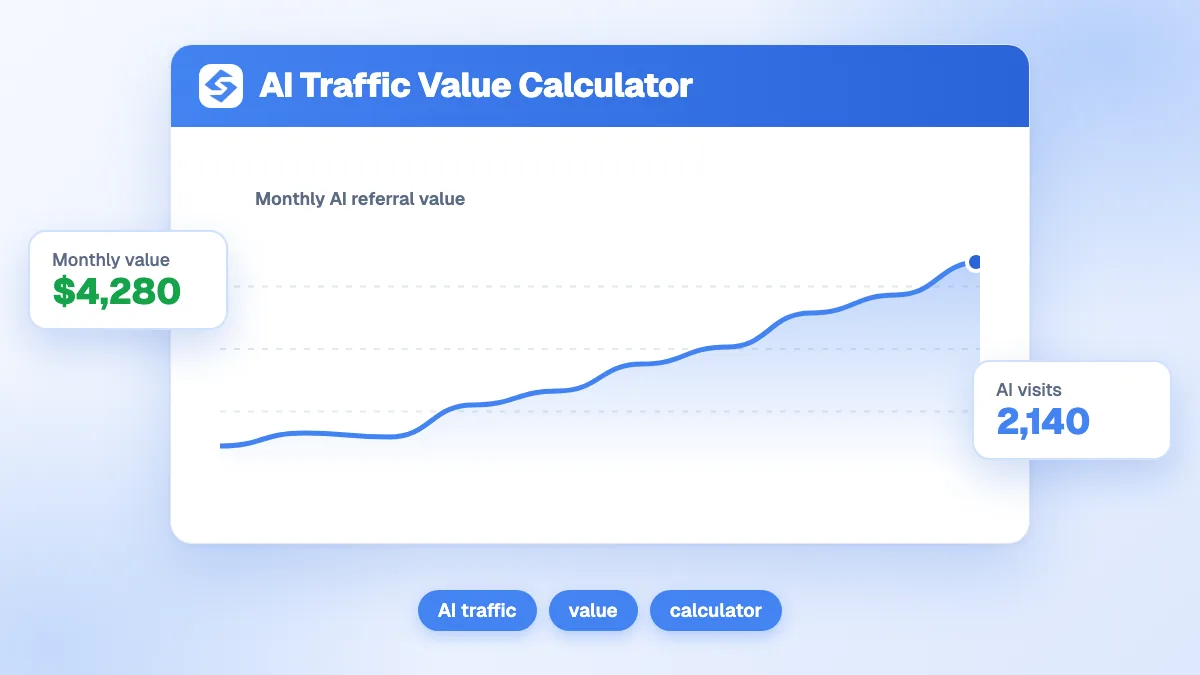
These systems retrieve content from the web and from search indexes, so classic SEO remains the entry ticket. What they add is a preference for clear, factual passages and for brands mentioned consistently across many independent sources. To estimate what this traffic is worth for your site, our free AI traffic value calculator converts AI referrals into an equivalent advertising value.
The AIs answer with brands and facts they can attribute confidently, so a clear entity and a consistent presence across the web increase the chance of being named. An entity is a thing a search system recognises as distinct (a company, product, person or concept), with known attributes and relationships.
| Signal | Why it matters in 2026 | What to do |
|---|---|---|
| Consistent brand description | Helps systems connect mentions to one entity | Use the same name, category and positioning everywhere |
| Third-party mentions | The AIs weigh what others say about you | Earn coverage in reviews, comparisons, press and partner sites |
| Structured data | Makes facts explicit for machines | Organization, Product, Article and FAQ markup where relevant |
| Citable facts | Sourced figures and definitions are easy to quote | Publish original data and cite sources by name |
E-E-A-T (experience, expertise, authoritativeness, trust) is the framework Google's quality raters use to judge content, and first-hand experience is now its most visible differentiator. Google added "experience" to its rater guidelines in December 2022, and its March 2024 core update folded the helpful content system into the core ranking systems.
Google has also said that it rewards quality content however it is produced, including with AI, while its scaled content abuse policy targets pages mass-produced mainly to manipulate rankings. The practical line is clear: automation is acceptable when every page is accurate, useful and checked; volume without value is a liability. Our page on E-E-A-T lists the signals that support each letter.
Search results and AI answers increasingly draw on discussions, videos and reviews, so your visibility now depends partly on content you do not host. Google signed a data agreement with Reddit in 2024, and forum and discussion results have become more prominent in many queries. YouTube videos appear widely in results and are cited by assistants.
Automation now covers most of the repetitive work (research, planning, drafting, internal linking, publishing, reporting), which moves human effort to strategy, expertise and verification. Teams that automate well publish consistently and keep their pages fresh; teams that automate badly publish thin pages at scale and risk the policies mentioned above.
Two related practices are emerging. The first is tracking AI visibility directly: checking every week which prompts your buyers ask and whether your brand appears. The second is the proposed llms.txt file, a convention to guide AI systems through a site; it is cheap to add, but adoption by the major AIs has not been confirmed, so treat it as optional.
Keep the technical and content fundamentals, then add citation, brand and AI measurement on top. A short priority list:
The SEO trends of 2026 converge on one idea: search engines and assistants now summarise the web, so the winners are the sources they trust enough to quote. Keep your pages crawlable and genuinely useful, write passages that stand on their own, build a recognisable brand across the web and measure where the AIs mention you. Sorank handles the publishing and the tracking in autopilot: daily articles built for Google and the AIs, plus weekly AI mention tracking, with a 3-day free trial.

Yes. Google still sends the largest share of referral traffic on the web, and the AIs build many of their answers from pages that already rank and are well structured. What changed is the payoff: fewer clicks on simple informational queries, more value in being the cited source, and more weight on brand, expertise and pages that answer buying questions.
The spread of AI-generated answers inside search results and in assistants. Google's AI Overviews and AI Mode, ChatGPT search, Perplexity and Gemini now answer many questions directly and cite a handful of sources. The goal therefore expands from ranking a page to being one of the sources those answers quote and recommend.
AI changes how SEO is done but does not remove the need for it. Assistants rely on content they can crawl, understand and trust, which is exactly what SEO produces: accessible pages, clear structure, credible sources and strong entity signals. The discipline extends into GEO (generative engine optimisation) rather than disappearing.
 AI Content Brief Generator
 FAQ Schema Generator
 AI Blog Post Ideas Generator
 Structured Data Validator
 Alt Text Checker
 Internal Link Analyzer
 Backlink Challenge
 AI Meta Description Generator
 AI Blog Title Generator
 Google Indexability Checker
 AI Blog Outline Generator
 UTM Link Builder
 Keyword Clustering Tool
 Canonical Tag Checker
 XML Sitemap Generator
 Broken Link Checker
 AI SEO Title Generator
 Headline Analyzer
 SERP Preview Tool
 Redirect Checker
 Hreflang Tag Generator
 Heading Structure Analyzer
 HTTP Headers Checker
 Favicon Extractor
 SERP CTR Calculator
 SEO vs Paid Search Savings Calculator
 SEO Share of Voice Calculator
 SEO ROI Calculator
 SEO Traffic and Revenue Forecast Calculator
 SEO Budget Calculator
 SEO Break-Even Calculator
 SaaS SEO ROI Calculator
 ROAS Calculator
 Reading Time Calculator
 Ranking Gain Simulator
 Organic Traffic Value Calculator
 Organic Traffic Estimator
 LTV to CAC Ratio Calculator
 Local SEO ROI Calculator
 Link Building Cost Calculator
 Keyword Value Calculator
 Keyword Opportunity Score Calculator
 Keyword Density Calculator
 GEO ROI Calculator
 GEO Content Investment Calculator
 Ecommerce SEO ROI Calculator
 Customer Lifetime Value Calculator
 Customer Acquisition Cost Calculator
 CTR Calculator
 Cost Per Article Calculator
 Conversion Rate Calculator
 Content Marketing ROI Calculator
 ChatGPT Referral Traffic Estimator
 Bounce Rate Calculator
 Backlink ROI Calculator
 AI Visibility Score Calculator
 AI Traffic Value Calculator
 AI Share of Voice Calculator
 Cost of AI Invisibility Calculator
 AI Citation Rate Calculator
 llms.txt Validator
 AI Overview Checker
 Robots.txt Checker
 AI SEO Audit
 LLM Readability Checker
 SearchGPT Readiness Checker
 Structured Data LLM Audit
 Website Crawlability AI Audit
 Why ChatGPT Is Not Recommending My Website
 Gemini Ranking Tool
 Perplexity Ranking Checker
 LLM Citation Checker
 Answer Engine Optimization Audit
 GEO Audit
 AI Search Visibility Test
 ChatGPT Visibility Checker
 llms.txt Generator
 URL Extractor
 Webpage to Markdown
 Sitemap Checker
 SERP Volatility Sensor
 Page Size Checker
 Word Counter
 Slug Generator
 Schema Generator
 Robots Generator
 OG Preview
 Meta Tags Generator
 Image Compressor
 Favicon Generator
 On-Page SEO Audit
 Backlink Analysis Tool
 Keyword Research Tool
 Domain Authority Checker
THEY TRIED SORANK BEFORE YOU
 “I tested Sorank on a real client site and it's insane. It does everything an agency would bill you $1500 a month for. It's going into production on that client now.”

 Guillaume Guersanguersanguillaume.com“We are an Ads agency and we wanted to get our SEO back on track once and for all. Sorank gave us a clear view of our site, helped us prioritize optimizations, and properly structure our content. The tool is easy to use, well designed for a team, and very practical for centralizing tracking without having to juggle multiple platforms. A very solid foundation to start fresh with our SEO.”
 Gaspard MadouiAds Agency
 “I just let the Sorank software do its thing, and now my DR is 25 and my page is ranking higher.”
 Lucas Flandrefoundertrace.fr“I specialized in GEO thanks to Sorank. The GEO Leaderboard allows me to show my clients their position vs competitors on ChatGPT. It’s a real commercial differentiator.”
 MélanieSEO Freelance“Great service, works well for our website and helps us understand how to improve it to rank better on Google and elsewhere. Congrats, keep going, I recommend it.”
 Hugo T.E-commerce merchant
























