
Preferences
Privacy is important to us, so you have the option of disabling certain types of storage that may not be necessary for the basic functioning of the website. Blocking categories may impact your experience on the website. More information
Privacy is important to us, so you have the option of disabling certain types of storage that may not be necessary for the basic functioning of the website. Blocking categories may impact your experience on the website. More information

Agentic search lets AI agents plan, run, and refine several queries to answer one goal. See how it works and how to get your pages cited.







Founder Sorank, 7+ years in SEO.
Summary
Agentic search is a method where an AI agent plans its own search steps, runs several queries, checks what it finds, and refines its next queries until it can give one sourced answer instead of a list of links.
Want to go further? Ask
Agentic search is the process of letting an AI agent drive the whole search, from the first question to the final answer. Instead of sending one query and reading a list of links, the agent splits a goal into smaller questions, searches for each one, compares the results, notices what is still missing, and searches again. The output is a synthesized answer with sources, built by the agent rather than by the user.
This matters because more research now happens inside AI assistants and AI agents instead of on a classic results page. When an agent does the searching, the question for a business changes from whether one page ranks for one keyword to whether the agent finds that page, trusts it, and cites it while it researches.
Agentic search is a search run by an AI agent, which is a system that keeps a goal in mind and chooses its own next steps. Anthropic's guide to building effective agents defines agents as systems where LLMs dynamically direct their own processes and tool usage. In search, the tools are the search engines, the pages the agent opens, and the notes it keeps about what it has already read.
A traditional search engine returns results for one query and stops. An agent keeps the goal in memory, decides which queries to run next, evaluates each result set, and continues until it has enough evidence to answer. This ability to take several steps, hold context, and use tools is what separates an agent from a simple chatbot reply.
Agentic search follows a loop of plan, search, evaluate, and refine. The agent plans by breaking a complex question into sub-questions. It searches with a targeted query, evaluates whether the results answer that sub-question, and refines the next query to close the gap. Each round of results shapes the next query, so the process adapts as it goes. The loop stops when the agent judges that coverage is good enough.
Anthropic describes this pattern in plain terms: agents are typically just LLMs using tools based on environmental feedback in a loop. In agentic search, the search results are that feedback. Google's documentation describes a similar technique for its own AI features. AI Overviews and AI Mode issue multiple related searches across subtopics and data sources to build one response, a technique it calls query fan-out.
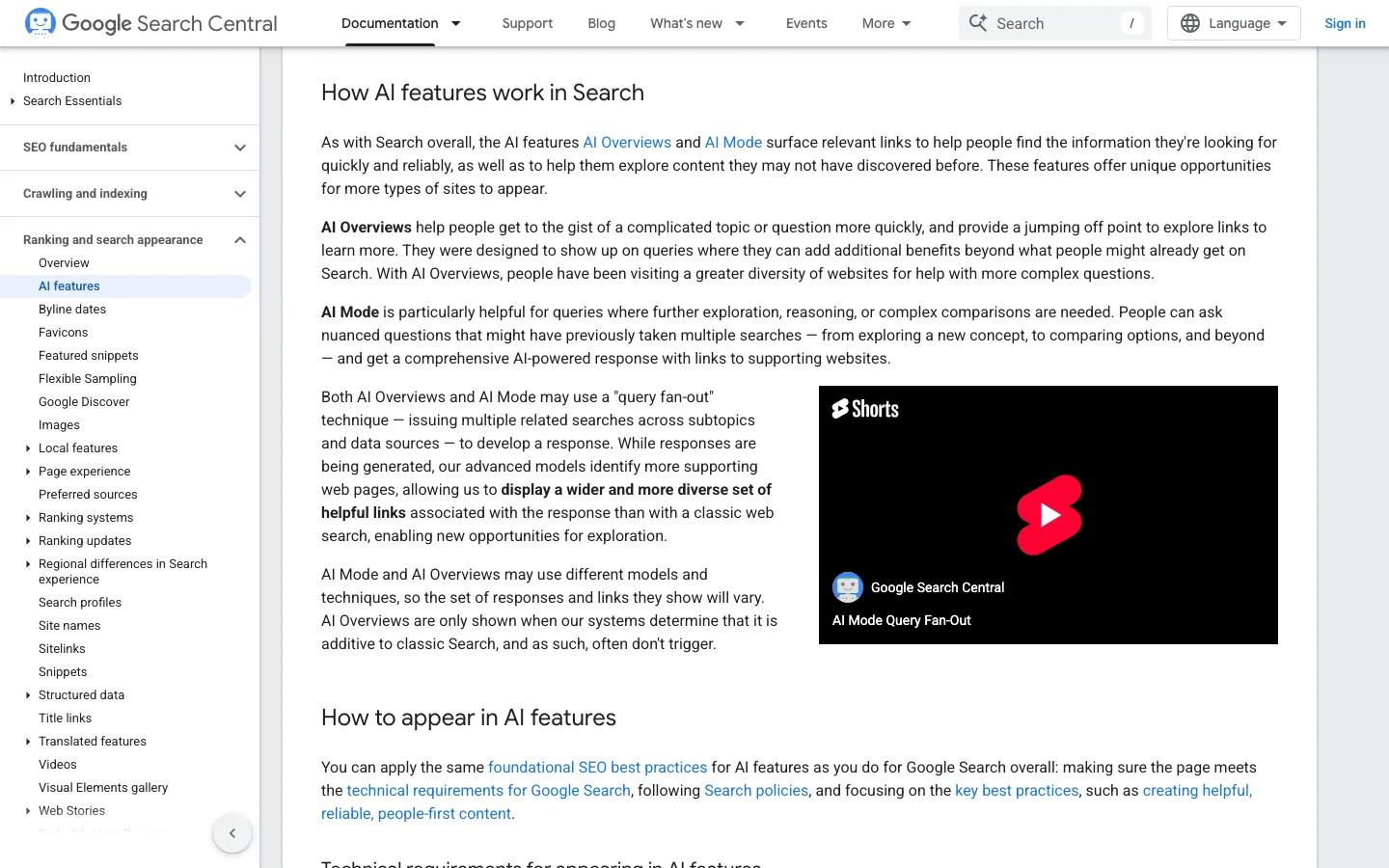
The loop is also why a single search ranking tells you less than it used to. An agent may run ten or twenty queries for one question, and each query can surface a different set of pages. A page that never ranks for the head term can still be opened, read, and cited when it answers one of the sub-questions. For more on how the sub-queries are generated, read about query fan-out.
A standard AI answer responds to one prompt in a single pass, summarizing what the model retrieved once. Agentic search runs several passes and changes its queries between them. Retrieval augmented generation, or RAG, sits in between. It pulls from a fixed store of documents that someone indexed in advance, which suits internal documentation well.
Agentic search is built for the open web, where the agent cannot know in advance which sources matter. It has to search, check what it found, and search again. A useful way to picture the difference: a chatbot that returns a few restaurant links is still just search. An agent that compares reviews across sites, asks clarifying questions, and then recommends a table is agentic.
An agent cites the pages that answer its sub-questions clearly and can be checked. Google says that content shown in its AI features must meet the same basic requirement as regular Search, which is that a page must be indexed and eligible to be shown in Google Search with a snippet, with no additional technical requirements. Google also says AI Mode gives a comprehensive AI-powered response with links to supporting websites, so being one of those links is the goal.
Agents favor pages that state a fact plainly, name its source, and stay consistent with the rest of the site. A page that contradicts itself or hides its answer under a long introduction gives the agent less to work with.
Start with direct answers. Put a clear, self-contained answer near the top of each page so an agent can extract it without guessing. Then cover the sub-questions an agent is likely to ask, including comparisons, definitions, and edge cases. Write each H2 as a real question and answer it in its first sentence.
Internal linking matters more than it used to. An agent that lands on one page should be able to move to the next related page without a dead end. Link each definition to the concepts it depends on, and link each guide to the tools that help the reader act. For a view of the questions people put to AI assistants, see Sorank's AI prompt research page. Those questions are closer to what an agent searches for than a single keyword is.
Structured data helps machines read your facts, and consistent facts across pages help an agent trust them. Keep prices, dates, and claims identical wherever they appear on your site.
You can measure it, but not with a single ranking report. Track the prompts where your brand appears, record which sources the assistants give, and compare your share with competitors. The LV3D case study reports 188 sessions from AI assistants between May 21 and November 7, 2026, which shows that these visits can be counted in analytics. Read the results by prompt rather than by total, because an agent can cite you for one sub-question and ignore you for the next.
The most common mistake is writing for a person who reads one page. An agent reads many pages, so a thin page that answers only the head term can lose to a source that covers the sub-questions. Three other mistakes come up often:
Agentic search moves visibility from one ranking to many citations. A page can rank well for a head term and still be ignored if agents find it weak on the sub-questions they ask. Brands that get cited will be the ones that answer each question directly, keep their facts consistent, and link related pages together. This is the core idea behind grounding queries, the searches an AI system runs to check its answer against the web. Pages that match those queries have a better chance of being used as evidence.
The gain adds up across the queries an agent runs. One well-structured page can answer several sub-questions in the same session, which is hard to achieve with a page written only for one keyword. For a deeper look at this shift, the guide on agentic SEO covers how agents change the way search work is done.
Agentic search turns retrieval into a loop. The agent plans, searches, evaluates, and refines until it can answer. For a business, the work is to be the source that answers each sub-question clearly, with direct answers, real depth, consistent facts, and links that help an agent move on. Related concepts such as agentic workflows show how these loops are built inside software.
The agentic web is the part of the internet where AI agents do more than read pages. They compare options, fill in forms, and complete tasks for a user. To stay usable there, your site has to be readable without its design, publish a clear guide for machines, and expose actions only where that is safe.
Agents reach a site in three main ways. Each one asks something different from you.
| Access route | What the agent does | What you control |
|---|---|---|
| Reading pages | Fetches the HTML and extracts facts and quotes | Rendering, clean text, structured data, robots.txt |
| Calling tools | Queries an API or an MCP server for data or an action | Which endpoints exist, authentication, rate limits |
| Operating the interface | Clicks, types, and scrolls through a browser | Button labels, form field labels, stable layouts |
Many agents read the text of a page, not how it looks. Prices, specifications, and opening hours that appear only after a script runs can be missed. Keep the key facts in the HTML itself. Give buttons and form fields clear labels, such as “Check availability” instead of “Go”, so a browsing agent can tell what each control does.
An llms.txt file at the root of your site lists your most useful pages in Markdown. Jeremy Howard proposed the format on September 3, 2024. It is still a proposal, not an agreed standard, so treat it as a low-cost extra. The file has one required H1 with your site name, an optional blockquote summary, H2 sections of links, and an “Optional” section for secondary pages. See llms.txt for the full format.
# Example Shop
> Handmade ceramics, shipped across the EU.

## Products
- [Catalog](https://www.example.com/products.md): every item with price and stock

## Optional
- [Blog](https://www.example.com/blog.md): care guides and news
Link only to pages that return a 200 status and hold the same facts as your HTML. A guide that points to missing or outdated pages sends agents to dead ends.
The Model Context Protocol (MCP) is an open standard for connecting AI applications to outside systems such as data sources and tools. An MCP server on your site could let an assistant search your catalog or check stock. Start with read-only tools. Anything that changes an order, a booking, or an account needs authentication, a clear confirmation step, and rate limits.
Tip
Check your server logs for AI bot visits before you write a guide file. The logs show which agents already arrive and which pages they request most. Use that list to choose the pages for your llms.txt. The AI crawler logs guide explains how to read them.
For a wider view of how agents are changing discovery, read agentic SEO.
Sources
A standard AI answer responds to one prompt in a single pass. Agentic search is a loop: the agent plans sub-questions, runs several searches, checks the results, and refines its queries until the answer is complete.
Visibility shifts from ranking one page for one keyword to being a source the agent trusts across many sub-queries. Clear answers near the top, consistent facts, and strong internal linking help an agent find and reuse your content.
Partly. You can track the prompts where your brand appears and the sources AI assistants give, then compare your share with competitors. Read the results prompt by prompt, because an agent can cite you for one sub-question and ignore you for the next.
 “I tested Sorank on a real client site and it's insane. It does everything an agency would bill you $1500 a month for. It's going into production on that client now.”

 Guillaume Guersanguersanguillaume.com“We are an Ads agency and we wanted to get our SEO back on track once and for all. Sorank gave us a clear view of our site, helped us prioritize optimizations, and properly structure our content. The tool is easy to use, well designed for a team, and very practical for centralizing tracking without having to juggle multiple platforms. A very solid foundation to start fresh with our SEO.”
 Gaspard MadouiAds Agency
 “I just let the Sorank software do its thing, and now my DR is 25 and my page is ranking higher.”
 Lucas Flandrefoundertrace.fr“I specialized in GEO thanks to Sorank. The GEO Leaderboard allows me to show my clients their position vs competitors on ChatGPT. It’s a real commercial differentiator.”
 MélanieSEO Freelance“Great service, works well for our website and helps us understand how to improve it to rank better on Google and elsewhere. Congrats, keep going, I recommend it.”
 Hugo T.E-commerce merchant



















