Preferences
Privacy is important to us, so you have the option of disabling certain types of storage that may not be necessary for the basic functioning of the website. Blocking categories may impact your experience on the website. More information
Privacy is important to us, so you have the option of disabling certain types of storage that may not be necessary for the basic functioning of the website. Blocking categories may impact your experience on the website. More information

Explain AI search to clients in plain words: one-minute script, six methods, a 30-minute meeting plan, answers to hard questions and what to report monthly.

In short
AI search is a way of searching where an AI model reads several web pages for you and writes one answer, often with a few cited sources. To explain it to clients, show them a live answer about their market, separate what changes from what stays, and promise effort and measurement, never a guaranteed mention.
Want to go further? Ask
Quick quiz
How should you get mentioned by ChatGPT and other AI assistants?
Sorank matches your answers


Test it for 3 days on your own site and see where you stand on Google, ChatGPT and the other AIs.
Start 3-day free trial3 days free, then stop whenever you want. 90-day results guarantee, conditions apply.
AI search is search that answers instead of listing. The person types a full question into ChatGPT, Gemini, Claude or Google AI Mode, and gets back a written answer that names a few brands and links to a few pages. Classic Google gives ten links and lets the person choose. AI search does the choosing and summarizing first.
That is the whole idea, and it is the sentence your client needs to remember. Everything else is detail you keep for the people who ask for it. If you want a longer reference to send after the meeting, our glossary entry on what AI search is and how generative answers work covers the definition in more depth.
Use this script almost word for word. It works because it uses no technical terms and ends on the business question.
A marketing manager will want to know where the answer comes from. Give them the mechanism in three steps:
The practical takeaway: a brand gets named when its own pages answer the question clearly and when other sites (reviews, directories, press, comparisons) say the same thing about it. Our guide on how AI models pick the sources they cite goes through the selection step by step.
The SEO on the client side wants facts, not analogies. Point them to Google's own documentation. In its page on AI features and your website, Google Search Central states that AI Overviews and AI Mode "may use a query fan-out technique", issuing "multiple related searches across subtopics and data sources", and that "there are no additional requirements to appear in AI Overviews or AI Mode": a page must simply be indexed and eligible to show with a snippet. Google also says this traffic is counted inside the normal "Web" search type in Search Console, so it does not appear as a separate line.
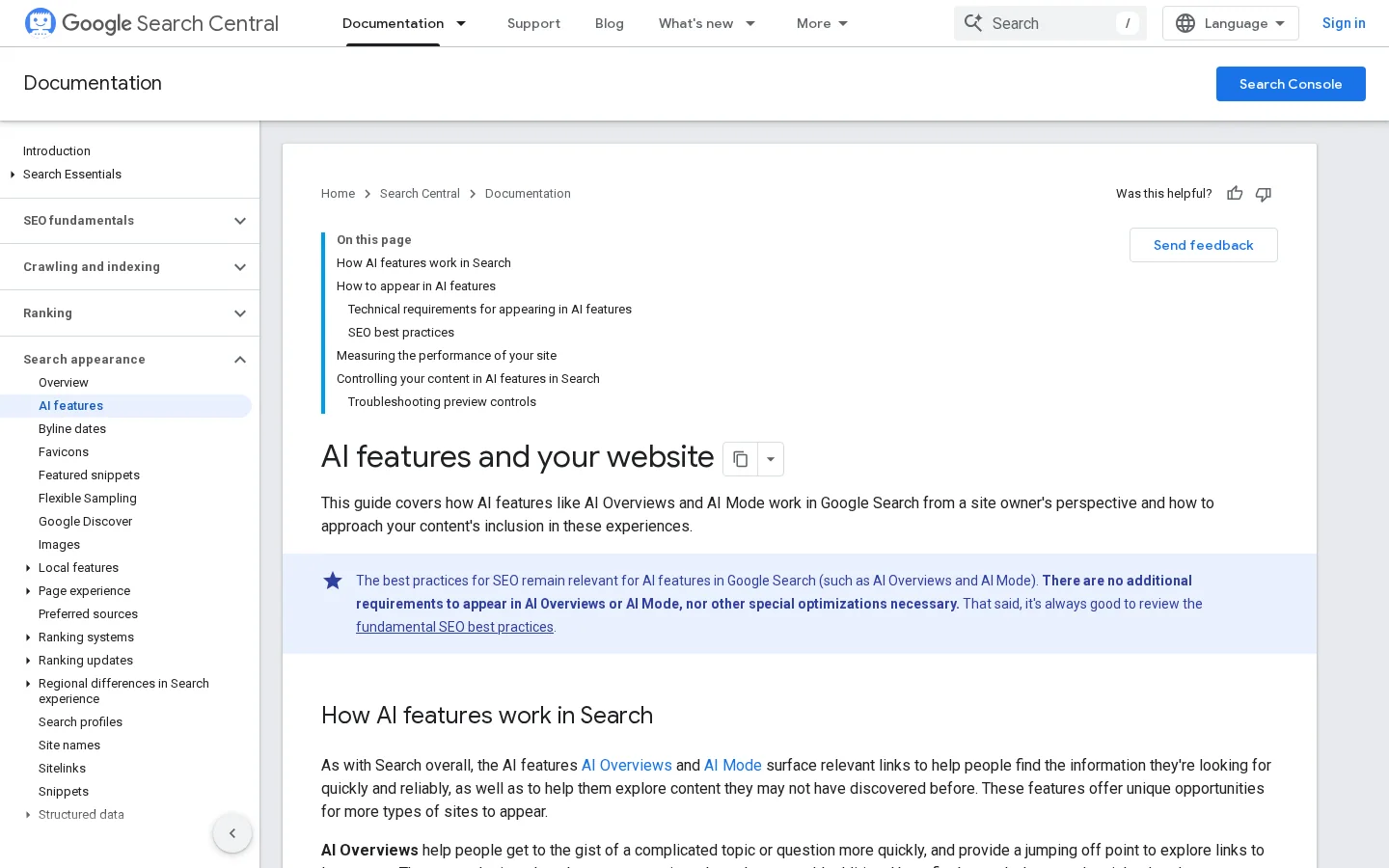
For a deeper read on the splitting step, send them our glossary page on query fan-out and how one question becomes many searches.
Classic search vs AI search, as the client sees it
Clients ask because the tools are now used by hundreds of millions of people every week, and because some of them already see fewer clicks. You do not need to scare them. You need two or three solid numbers, each with its source, and a clear link to their own business.
Stick to figures published by the companies themselves or by a serious outlet that reports them. TechCrunch reported on February 27, 2026 that ChatGPT reached 900 million weekly active users. On Alphabet's Q2 2026 earnings call, Sundar Pichai said in the CEO remarks published on Google's blog that AI Mode had passed 1 billion monthly active users since its global expansion, and that the Gemini app had 950 million monthly active users.
How many people already use AI search
Sources: TechCrunch, February 27, 2026; Alphabet Q2 2026 earnings remarks, Google blog
The most useful study for a client meeting is still the one from Pew Research Center. Athena Chapekis and Anna Lieb published it on July 22, 2025, based on the real browsing of 900 US adults in March 2025. In their analysis of Google searches with and without an AI summary, users clicked a classic result on 8% of visits when an AI summary appeared, against 15% when it did not. They clicked a link inside the summary itself on only 1% of visits. And 26% of visits with a summary ended the browsing session, against 16% without one.
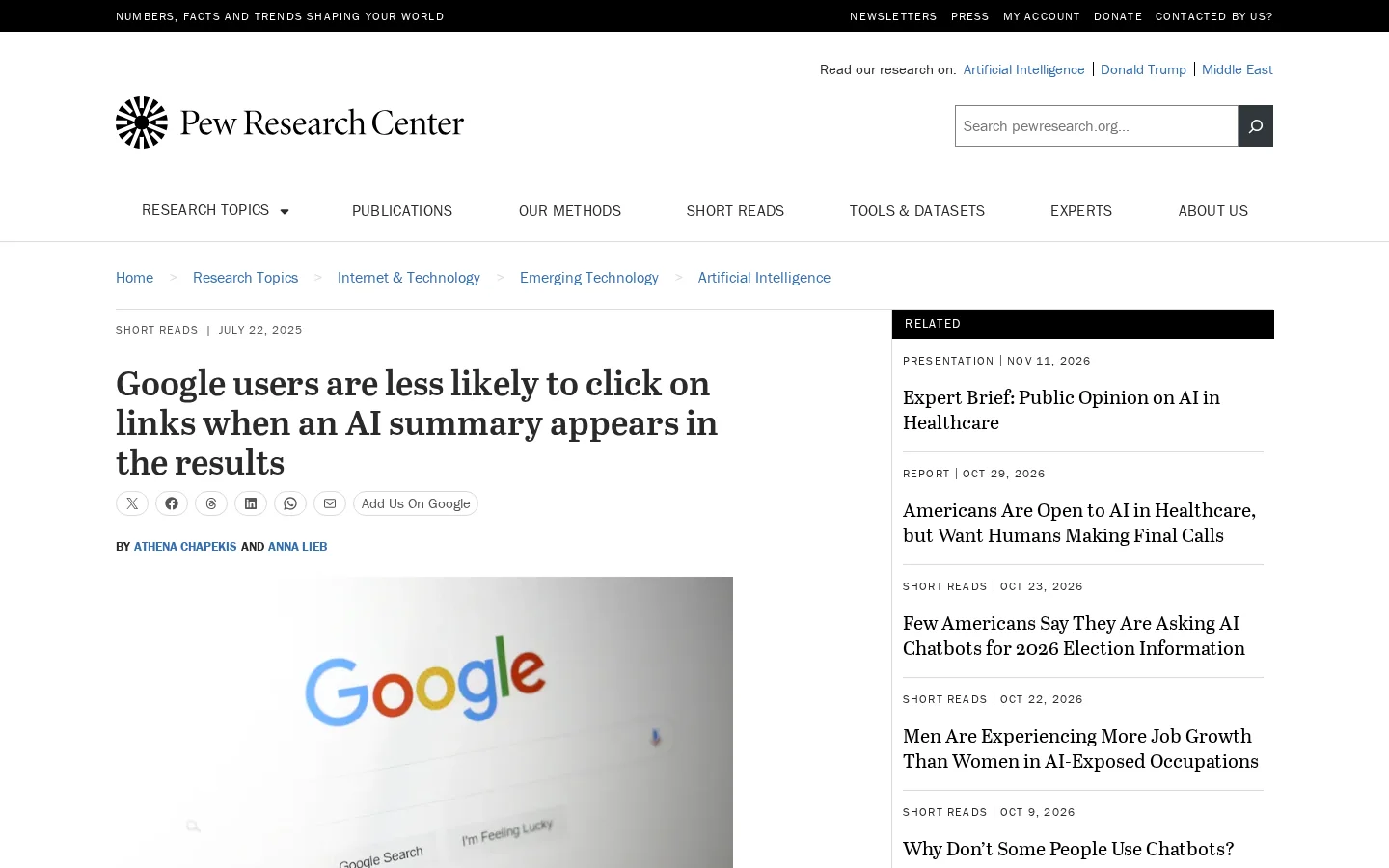
How to say it to a client: "When Google shows an AI summary, people click about half as often. That does not mean your business disappears. It means the summary itself becomes a place where you must appear." If they want the business case in more detail, our article on why AI search matters for a business and how to measure it builds it with numbers.
Note
Pew measured US adults on desktop and mobile in March 2025. Do not present it as "your traffic will halve". Present it as "this is the direction, now let us look at your own data".
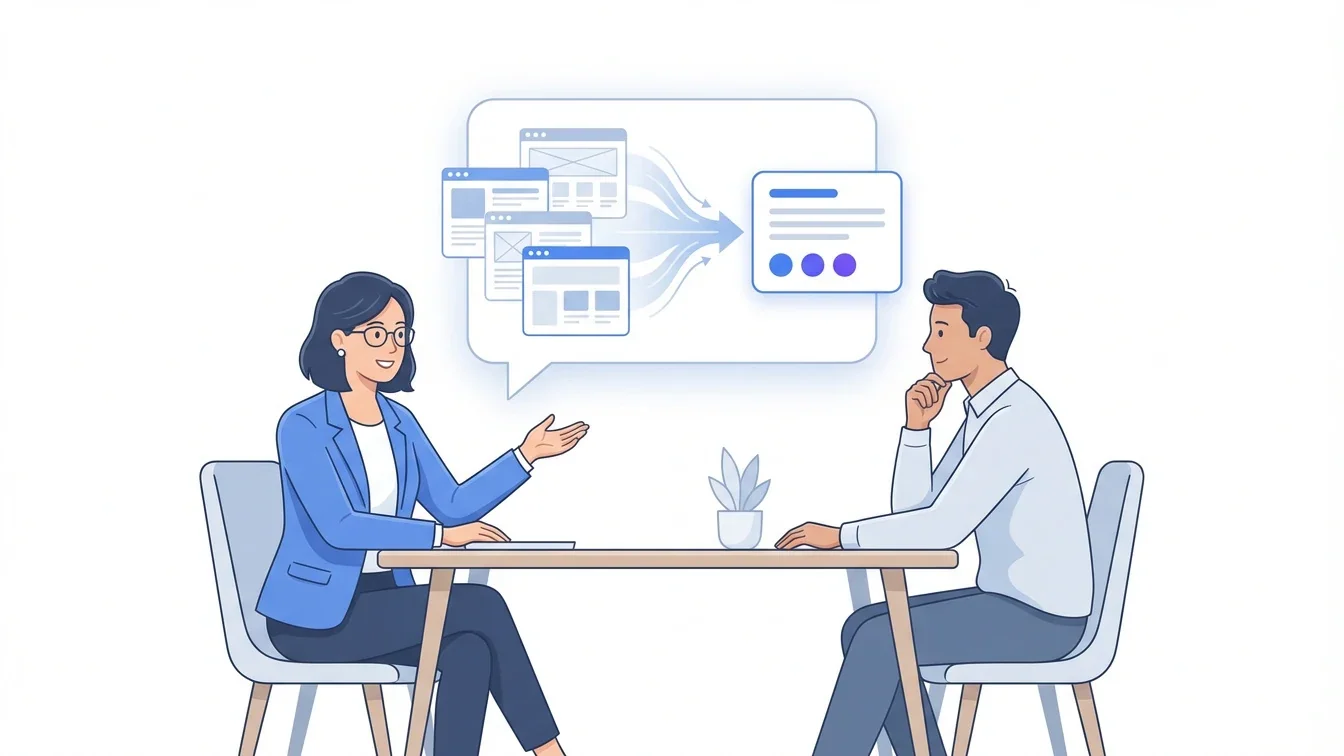
Most client fear comes from one wrong belief: that AI search replaces everything they paid for. It does not. The foundations stay, the scoreboard changes. Say this early in the meeting, because it lowers the tension and makes the rest of the talk easier.
How the client should read success, before and after AI search
| Client question | Classic SEO answer | AI search answer |
|---|---|---|
| Where do people find us? | Google results pages | Google results, AI Overviews, AI Mode, ChatGPT, Gemini, Claude |
| What do we measure? | Rankings, clicks, sessions | Mentions, citations, share of answers, accuracy, plus conversions |
| What do we work on? | Pages, technical health, links | The same, plus clear answers, third-party mentions and consistent facts |
| How fast does it move? | Weeks to months | Answers can change daily; trends show over months |
| Can it be guaranteed? | No | No, and even less so |
There is no single best explanation. The right one depends on who is in the room and what they fear. Here are the six methods that work in practice, with their limits. Prepare two of them before each meeting.
Principle: classic Google is a librarian who points to ten books. AI search is a research assistant who reads the books and hands over a one-page summary with a few names in it.
When to use it: first meeting, owner of a small business, anyone who has never used ChatGPT for work.
Advantages: instant, memorable, no jargon. Limits: it hides the fact that the assistant can be wrong and that answers vary. Example: "Your goal is to be in the summary, not only on the shelf."
Principle: AI models repeat what the web says about you, a bit like a well-connected friend who has read every review. If many trusted sites say you are the best option for X, the model tends to say it too.
When to use it: local businesses, service firms, any client who already cares about reviews and reputation.
Advantages: connects AI search to things they already do (reviews, press, partners). Limits: it can make them think reviews alone are enough. Example: "ChatGPT recommends the dentist everyone talks about, with the clearest site."
Principle: the buyer's shortlist is now built inside the AI answer. Being on Google's page 1 got you into the comparison. Being named in the answer puts you on the final list of three.
When to use it: B2B, software, high-value purchases, sales-driven companies.
Advantages: speaks the language of pipeline and sales. Limits: works less for impulse or very local purchases. Example: "When a buyer asks for the best payroll software for a 50-person company, which three names come back?"
Principle: do not describe, show. Ask ChatGPT, Gemini and Google AI Mode three real buying questions about the client's market, in front of them.
When to use it: every time you can. It is the strongest method by far.
Advantages: the client sees their competitors named, which creates urgency without any exaggeration. Limits: one answer is a snapshot; the next one may differ, so say it out loud. Example: "Let us ask Gemini where to buy a commercial espresso machine in Bordeaux."
Principle: a three-part story. What happened (the market change), so what (the impact on this client, with their data), now what (the three actions you propose).
When to use it: executive committees, quarterly reviews, any written report.
Advantages: tight, decision-oriented, easy to put on three slides. Limits: needs client data to be convincing. Example: "Informational traffic is down 18% on the guide pages (what), leads are stable because branded searches rose (so what), we will add comparison pages and track 40 buying questions (now what)."
Principle: translate visibility into lost or won revenue. If a competitor is named on the questions that bring customers, every month of absence has a cost.
When to use it: CFOs, owners who think in budget, renewals.
Advantages: justifies investment. Limits: any estimate is a model, not a fact; label it as such. Example: run the client's own numbers through our calculator for the cost of being absent from AI answers and show the assumptions.
| Method | Best audience | Strength | Main limit | Time needed |
|---|---|---|---|---|
| Librarian analogy | Owners, beginners | Instant understanding | Hides variability | 1 minute |
| Word of mouth at scale | Local and service businesses | Links to reviews and reputation | Oversimplifies the role of the site | 2 minutes |
| The shortlist | B2B, software, high-value | Speaks sales | Weak for impulse purchases | 2 minutes |
| Live demo | Everyone | Proof, urgency without hype | One answer is a snapshot | 10 minutes |
| What, So What, Now What | Executives, reports | Ends with a decision | Needs client data | 15 minutes of prep |
| Money framing | CFOs, renewals | Justifies budget | Estimates, not facts | 30 minutes of prep |
The best explanation is a short meeting with a fixed structure: one definition, one live demo, one look at the data, one plan. Here is the format we recommend, with what to prepare and what to say.
The 30-minute client meeting on AI search
Spend 30 minutes with the client's sales team or their support inbox. Collect the exact questions buyers ask. Mix four types: discovery ("what is the best X for Y"), comparison ("X vs Y"), trust ("is X reliable"), and local ("X near Lyon"). Ten questions are enough for the meeting. You will extend the list to 30 to 50 for monthly tracking. Our article on finding the prompts and fan-out queries of your market explains how to go further.
Prompt list template (copy into a spreadsheet)
id | type        | question                                                        | market | language
01 | discovery   | What is the best accounting firm for restaurants in Lyon?       | FR     | en
02 | comparison  | Firm A vs Firm B for a small restaurant: which is better?        | FR     | en
03 | trust       | Is Firm A a reliable accountant for hospitality businesses?      | FR     | en
04 | local       | Accountant near Part-Dieu who knows restaurant VAT rules        | FR     | en
05 | problem | How do I lower my restaurant's accounting costs? | FR | enRun each question in a private browser window, logged out where possible, so personal history does not bias the answer. Take a screenshot of each answer. Point to three things on screen: the brands named, the order they appear in, and the sources listed. Then say the honest sentence: "If I ask again tomorrow, this may change. That is why we track it every month instead of trusting one test."
Tip
No time to test by hand before a call? Our free AI search visibility test asks up to three AI models one customer question with web search on, then shows whether the brand is named, which sources were cited and which competitors came up.
Open Search Console with the client. Show impressions vs clicks over 16 months. A pattern where impressions hold or grow while clicks fall on informational pages is the typical sign of AI summaries. Then filter for branded queries: rising brand searches often mean people heard about the brand elsewhere, sometimes in an AI answer. If you need a method to confirm the cause, our guide to confirming an AI Overviews traffic drop walks through it.
In Google Analytics 4, show visits coming from AI tools. A simple regex on the session source does most of the work:
chatgpt\.com|chat\.openai\.com|gemini\.google\.com|claude\.ai|copilot\.microsoft\.comUse it in an exploration with "Session source" matches regex. Warn the client that this undercounts: many AI visits arrive without a referrer and land in "direct". That hidden share is often called AI dark traffic.
End on what the client can act on. Never end on the fear. Propose three actions maximum, each tied to a measured question. The recap email goes out the same day and fits on one screen.
Clients ask the same six questions, almost always in this order. Prepare a short, honest answer for each. Honesty here is what makes them trust you on everything else.
Short answer: "Some informational traffic will drop. Traffic that leads to a purchase holds better, and AI can send you buyers who are already convinced." Then show their split: informational pages vs service, product or pricing pages. If the commercial pages are stable, say so clearly.
No. Google itself writes that the same SEO best practices apply to its AI features, and that a page must be indexed to be eligible. A site that is slow, blocked or unclear is invisible in both places. SEO becomes the entry ticket, not the whole game.
No one can, and anyone who does is lying. Say: "We can make your site the clearest and most trusted source on your questions, and measure how often you are named. We cannot control what a model writes on a given day." Answers vary from one run to the next, a point explained in our article on why AI answers keep changing.
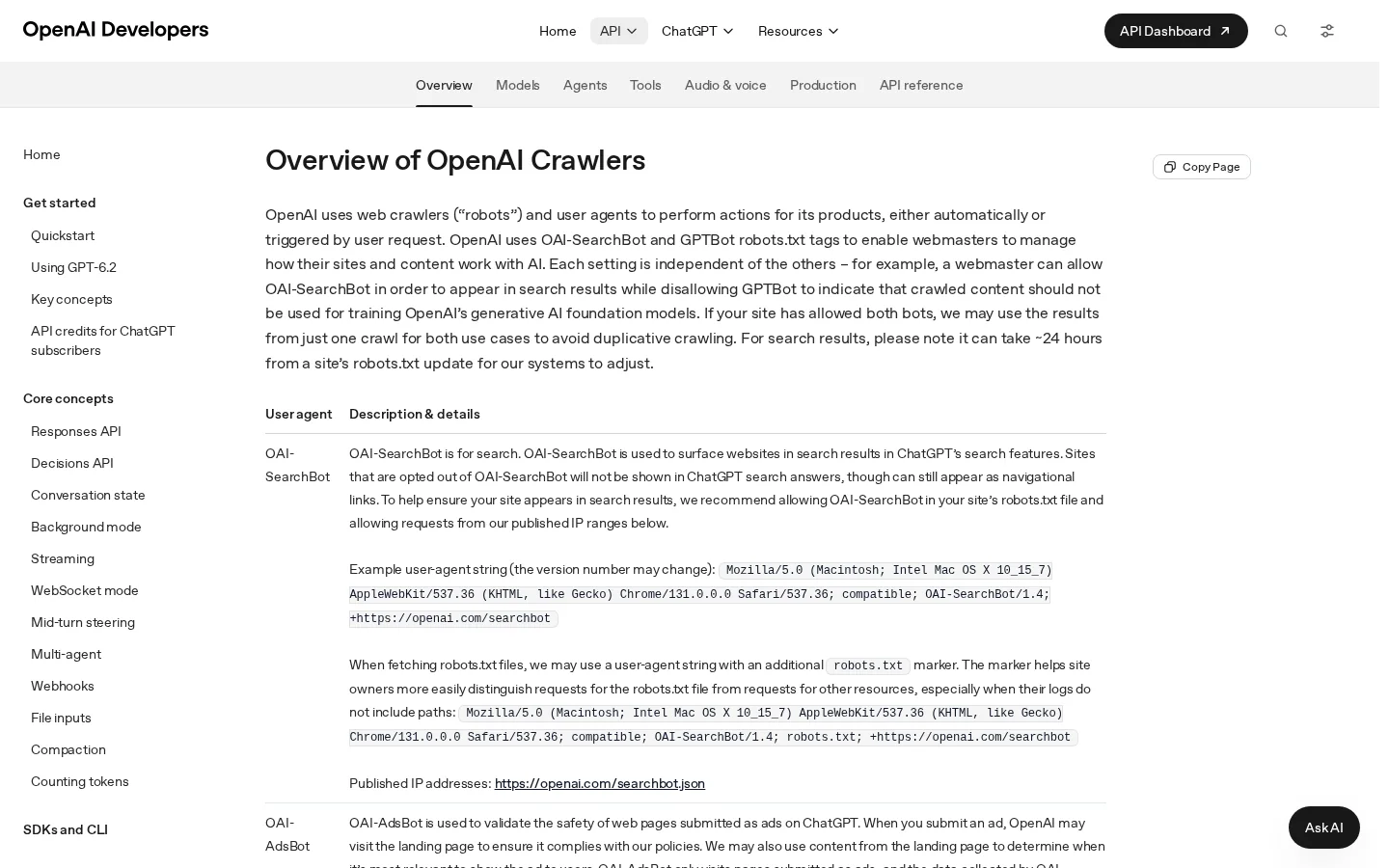
It depends on the bot, and this is where a precise answer builds trust. OpenAI's documentation of its crawlers separates them: OAI-SearchBot is "used to surface websites in search results in ChatGPT's search features", while GPTBot crawls content "that may be used in training" its models. A client who wants to appear in ChatGPT answers but refuses training can do this:
# robots.txt
# Allow ChatGPT search to read and cite the site
User-agent: OAI-SearchBot
Allow: /

# Refuse use of the content for model training
User-agent: GPTBot
Disallow: /
Blocking OAI-SearchBot, on the other hand, removes the site from ChatGPT's search answers (it can still appear as a plain navigational link, according to the same page). Our glossary entry on GPTBot, OAI-SearchBot and ChatGPT-User lists each bot and its role.
Tip
Before the meeting, run the client's domain through our free robots.txt checker for AI crawlers. Arriving with "your site currently blocks ChatGPT search" is a very concrete opening.
Be careful here. Google says no special file is needed for its AI features. An llms.txt file is a proposal, cheap to add, but it is not a lever that changes rankings or mentions on its own. Tell the client it is a nice-to-have, not a priority.
Models mix sources. An old price on a directory, a former address, a competitor's review page: all of it can end up in the answer. The fix is boring and effective: make the facts identical everywhere (site, Google Business Profile, directories, social profiles) and publish a clear page that states them.
A good AI search report answers one question: "Are we named more often, more accurately, on the questions that bring customers?" It sits next to the SEO report, not instead of it. Keep it short: one page of numbers, one page of examples.
| Metric | What it means for the client | Where it comes from | How often |
|---|---|---|---|
| Mention rate | Share of tracked questions where the brand is named | Prompt tracking tool or manual runs | Monthly |
| Citation rate | Share of answers that link to the client's site | Same | Monthly |
| Share of answers vs competitors | How often the client is named compared with the top rivals | Same, competitors listed | Monthly |
| Accuracy | Is what AI says correct (price, location, offer)? | Manual reading of answers | Monthly |
| Cited sources | Which third-party sites the models rely on | Prompt tracking tool | Quarterly |
| AI referral visits | Visits from ChatGPT, Gemini, Claude | GA4 with the regex above | Monthly |
| Branded search demand | People searching the brand name | Search Console | Monthly |
| Conversions | Leads, calls, sales | GA4, CRM | Monthly |
The share of answers is the clearest number for a client, because it compares them with competitors they know. The glossary explains how to compute this AI share of voice and its limits.
From a question asked to AI to a customer
Run the same question list every month, with the same models, in the same language and market. Changing the questions breaks the comparison. Show the trend over three months before drawing any conclusion. For a full template, see our guide to building a monthly AI visibility report.
Doing this by hand for 40 questions and three models is 120 answers a month to read. That is where a tool earns its place. Sorank's AI mention tracking keeps the tracked prompts for one market and one language, shows the visibility rate per prompt and per model, and lists the sources the models rely on. Its GEO leaderboard ranks every domain cited on those prompts, which gives the client their rank among the sites AI actually names.
Expectations decide whether a client renews. Set them in the first meeting, in writing. Promise actions and measurement. Never promise a position or a mention.
What the client can expect, and when
Explain why it takes months: new pages must be crawled and indexed, third-party mentions take time to earn, and a single run of answers is too noisy to judge. Saying this upfront protects you from the "nothing happened after two weeks" call.
| Avoid | Say instead | Why |
|---|---|---|
| "We will get you ranked #1 in ChatGPT" | "We will increase how often you are named on your key questions, and show it monthly" | There is no stable rank to promise |
| "GEO, AEO, LLMO, RAG" | "Being recommended by AI tools" | Acronyms lose the room in seconds |
| "SEO is dead" | "SEO is the entry ticket; AI adds a second scoreboard" | It is false and it undermines past work |
| "Your traffic will halve" | "Clicks fall on some questions; here is your own data" | Industry averages are not their reality |
| "It is all new, nobody knows" | "It changes fast, so we measure every month and adjust" | Uncertainty plus a method is reassuring |
If you write proposals, include a short AI search section with this wording and the measurement plan. Our guide on writing an SEO proposal that wins clients shows where it fits.
Most failed conversations come from the same handful of mistakes. Each one is easy to spot and easy to fix once you know it.
Mistakes to avoid in the client conversation
What it is: starting with GEO, AEO, LLM, RAG. How to spot it: the client stops asking questions after two minutes, or asks "so what do I need to do?" How to fix it: one plain sentence first, the live demo second, vocabulary only if they ask.
What it is: "you will be recommended by ChatGPT within 60 days". How to spot it: your proposal contains a guaranteed outcome tied to a model's answer. How to fix it: promise deliverables (pages, fixes, mentions earned) and a measured trend on a fixed question list.
What it is: the client tests once, sees a competitor, panics; or sees their brand once and thinks the job is done. How to spot it: emails with a single screenshot and "why are we not there?" How to fix it: explain variability from day one and answer with the monthly rate, not with another screenshot.
What it is: presenting a study's click drop as what will happen to their site. How to spot it: the client repeats the number to their boss as a forecast. How to fix it: always pair an external number with their own Search Console data, and say which one is the fact.
What it is: a new budget line, a new team, a new tool, with no link to SEO. How to spot it: the AI plan has no indexing, no technical checks and no content work in it. How to fix it: present one plan with two scoreboards. Most actions (clear pages, technical access, reputation) serve both.
What it is: a developer or legal team adds a blanket block in robots.txt or in the CDN. How to spot it: the brand is never cited with a link in ChatGPT, even on its own brand questions; the robots.txt lists OAI-SearchBot or a wildcard rule for AI agents. How to fix it: separate search bots from training bots, as in the robots.txt example above, and check the CDN's bot settings too.
What it is: a report full of mention rates and no business number. How to spot it: the client asks "and how much did it bring?" every month. How to fix it: put conversions and branded demand on the first page, AI visibility on the second, and link them in one sentence.
Send a short written version after every first conversation. Clients forward it to their boss, so it must stand on its own. Adapt this template, keep it under 200 words, and replace the bracketed parts with the client's real data.
Example
Subject: How AI search affects [Company], in one page. More and more buyers ask ChatGPT, Gemini or Google's AI a full question and read a written answer that names a few companies. Today, on 10 questions your customers ask, [Company] was named [X] times and [Competitor] [Y] times. Your Google clicks on guide pages fell while your sales pages stayed stable. What we will do: 1. make sure AI tools can read your site; 2. publish clear answers to your customers' top questions; 3. get your business facts consistent everywhere. What we will measure every month: how often you are named, by which AI, what it says, and the leads that follow. No one can guarantee an AI mention; we can make you the clearest, most trusted answer, and show you the trend.
For agencies handling this across many accounts, our page for agencies delivering SEO and GEO to every client shows how Sorank fits into a client portfolio.
You can start before your next client call. Pick one client and do these five things:
The clients who understand AI search are not the ones who heard the best theory. They are the ones who saw their own market in a live answer, got an honest promise, and received a clear number every month after that.
Say that AI search answers instead of listing: the person asks a full question to ChatGPT, Gemini or Google's AI and gets a written answer that names a few companies. Then show a live answer about their own market. The business question becomes: are we named, and what is said about us?
No. AI answers change from one run to the next and no one controls what a model writes on a given day. An agency can promise concrete work (clear answer pages, crawler access, consistent facts, third-party mentions) and a monthly measure of how often the brand is named on a fixed list of questions.
Conversions and branded search demand first, then the share of tracked questions where the brand is named, how often the site is cited, its share of answers against competitors and whether what AI says is accurate. Keep the same questions, models and market every month so the trend can be read.
We analyse your competitors, your website and your AI visibility to create a tailored content plan for free.
 Website Value Calculator
 Website Accessibility Checker
 Google Analytics Checker
 Duplicate Content Checker
 Mobile-Friendly Test
 Website Speed Test
 Subdomain Finder
 Domain Age Checker
 CMS Detector
 Googlebot Simulator
 Nofollow Link Checker
 Meta Tag Checker
 Keyword Cannibalization Checker
 Keyword Intent Checker
 Keyword Extractor
 Google Ads Cost Calculator
 CPC Calculator
 Local Citation Finder
 Reddit Threads Finder
 Disavow File Generator
 Redirect Generator
 Canonical Tag Generator
 Passive Voice Checker
 Google Location Changer
 Google Review Calculator
 Google Review Link Generator
 Keyword Combiner
 Podcast Show Notes Generator
 AI Content Rewriter
 AI Text Humanizer
 ChatGPT Prompt Generator
 Twitter Thread Generator
 Tweet Generator
 Landing Page Copy Generator
 Google Ads Copy Generator
 Pinterest Pin Description Generator
 Anchor Text Generator
 Social Media Post Generator
 LinkedIn Post Generator
 Free AI Writer
 Review Response Generator
 LSI Keyword Generator
 YouTube Video Ideas Generator
 YouTube Tag Generator
 YouTube Description Generator
 Product Description Generator
 CTA Generator
 Blog Introduction Generator
 Conclusion Generator
 Hook Generator
 AI Content Brief Generator
 FAQ Schema Generator
 AI Blog Post Ideas Generator
 Structured Data Validator (Schema Validator)
 Alt Text Checker
 Internal Link Analyzer
 Backlink Challenge
 AI Meta Description Generator
 AI Blog Title Generator
 Google Indexability Checker
 AI Blog Outline Generator
 UTM Link Builder
 Keyword Clustering Tool
 Canonical Tag Checker
 XML Sitemap Generator
 Broken Link Checker
 AI SEO Title Generator
 Headline Analyzer
 SERP Preview Tool
 Redirect Checker
 Hreflang Tag Generator
 Heading Structure Analyzer
 HTTP Headers Checker
 Favicon Extractor
 SERP CTR Calculator
 SEO vs Paid Search Savings Calculator
 SEO Share of Voice Calculator
 SEO ROI Calculator
 SEO Traffic and Revenue Forecast Calculator
 SEO Budget Calculator
 SEO Break-Even Calculator
 SaaS SEO ROI Calculator
 ROAS Calculator
 Reading Time Calculator
 Ranking Gain Simulator
 Organic Traffic Value Calculator
 Organic Traffic Estimator and Website Traffic Checker
 LTV to CAC Ratio Calculator
 Local SEO ROI Calculator
 Link Building Cost Calculator
 Keyword Value Calculator
 Keyword Opportunity Score Calculator
 Keyword Density Calculator
 GEO ROI Calculator
 GEO Content Investment Calculator
 Ecommerce SEO ROI Calculator
 Customer Lifetime Value Calculator
 Customer Acquisition Cost Calculator
 CTR Calculator
 Cost Per Article Calculator
 Conversion Rate Calculator
 Content Marketing ROI Calculator
 ChatGPT Referral Traffic Estimator
 Bounce Rate Calculator
 Backlink ROI Calculator
 AI Visibility Score Calculator
 AI Traffic Value Calculator
 AI Share of Voice Calculator
 Cost of AI Invisibility Calculator
 AI Citation Rate Calculator
 llms.txt Validator
 AI Overview Checker and AI Overviews Rank Checker
 Robots.txt Checker
 AI SEO Audit
 LLM Readability Checker
 SearchGPT Readiness Checker
 Structured Data LLM Audit
 Website Crawlability AI Audit
 Why ChatGPT Is Not Recommending My Website
 Gemini Ranking Tool
 Perplexity Ranking Checker
 LLM Citation Checker
 Answer Engine Optimization Audit
 GEO Audit
 AI Search Visibility Test
 ChatGPT Visibility Checker
 llms.txt Generator
 URL Extractor
 Webpage to Markdown
 Sitemap Checker
 SERP Volatility Sensor
 Page Size Checker
 Word Counter
 Slug Generator
 Schema Generator
 Robots Generator
 OG Preview
 Meta Tags Generator
 Image Compressor
 Favicon Generator
 On-Page SEO Audit: SEO Checker and SEO Analyzer
 Backlink Analysis Tool
 Keyword Research Tool
 Domain Authority Checker
 “I tested Sorank on a real client site and it's insane. It does everything an agency would bill you $1500 a month for. It's going into production on that client now.”

 Guillaume Guersanguersanguillaume.com“We are an Ads agency and we wanted to get our SEO back on track once and for all. Sorank gave us a clear view of our site, helped us prioritize optimizations, and properly structure our content. The tool is easy to use, well designed for a team, and very practical for centralizing tracking without having to juggle multiple platforms. A very solid foundation to start fresh with our SEO.”
 Gaspard MadouiAds Agency
 “I just let the Sorank software do its thing, and now my DR is 25 and my page is ranking higher.”
 Lucas Flandrefoundertrace.fr“I specialized in GEO thanks to Sorank. The GEO Leaderboard allows me to show my clients their position vs competitors on ChatGPT. It’s a real commercial differentiator.”
 MélanieSEO Freelance“Great service, works well for our website and helps us understand how to improve it to rank better on Google and elsewhere. Congrats, keep going, I recommend it.”
 Hugo T.E-commerce merchant