Preferences
Privacy is important to us, so you have the option of disabling certain types of storage that may not be necessary for the basic functioning of the website. Blocking categories may impact your experience on the website. More information
Privacy is important to us, so you have the option of disabling certain types of storage that may not be necessary for the basic functioning of the website. Blocking categories may impact your experience on the website. More information

See how AI models change the way consumers discover, compare and buy, with survey and traffic data, four ways to measure it and a step-by-step plan.

In short
AI consumer behavior is the way people now discover, compare and buy products by asking AI models such as ChatGPT, Gemini or Google AI Mode instead of browsing many websites. Shoppers get a short list in one conversation, check it on Google and review sites, then buy. Brands must be named in that list.
Want to go further? Ask
Quick quiz
How should you use AI in your marketing?
Sorank matches your answers


Test it for 3 days on your own site and see where you stand on Google, ChatGPT and the other AIs.
Start 3-day free trial3 days free, then stop whenever you want. 90-day results guarantee, conditions apply.
AI consumer behavior describes what changes when an AI model sits between a shopper and the web. The shopper no longer types three keywords, opens ten tabs and builds a comparison in their head. They describe their need in a full sentence, and the AI model returns a short list with reasons.
This is not a new channel next to search. It is a new layer on top of every channel. The same person still uses Google, Amazon, YouTube and reviews. But the first filter, the moment where 50 options become 3, now often happens inside an AI answer.
How a purchase journey changes with AI
Most of this influence is invisible in your analytics. A shopper who asked ChatGPT for "the best quiet dishwasher under 800 dollars" and then typed your brand name into Google shows up as branded organic or direct traffic. The AI model did the selling work; your reports credit something else. That is why many teams underestimate the shift until their non-brand traffic falls.
For a precise definition of the purchase side of this trend, see our glossary entry on AI shopping and how buyers purchase through AI. This guide goes wider: it covers the behavior behind it, the data, and how to measure it in your own market.
A large and fast-growing share of online shoppers already use AI models in their buying process, and the heaviest users do it every week. The figures below come from surveys and traffic panels, so read them as orders of magnitude, not exact market shares.
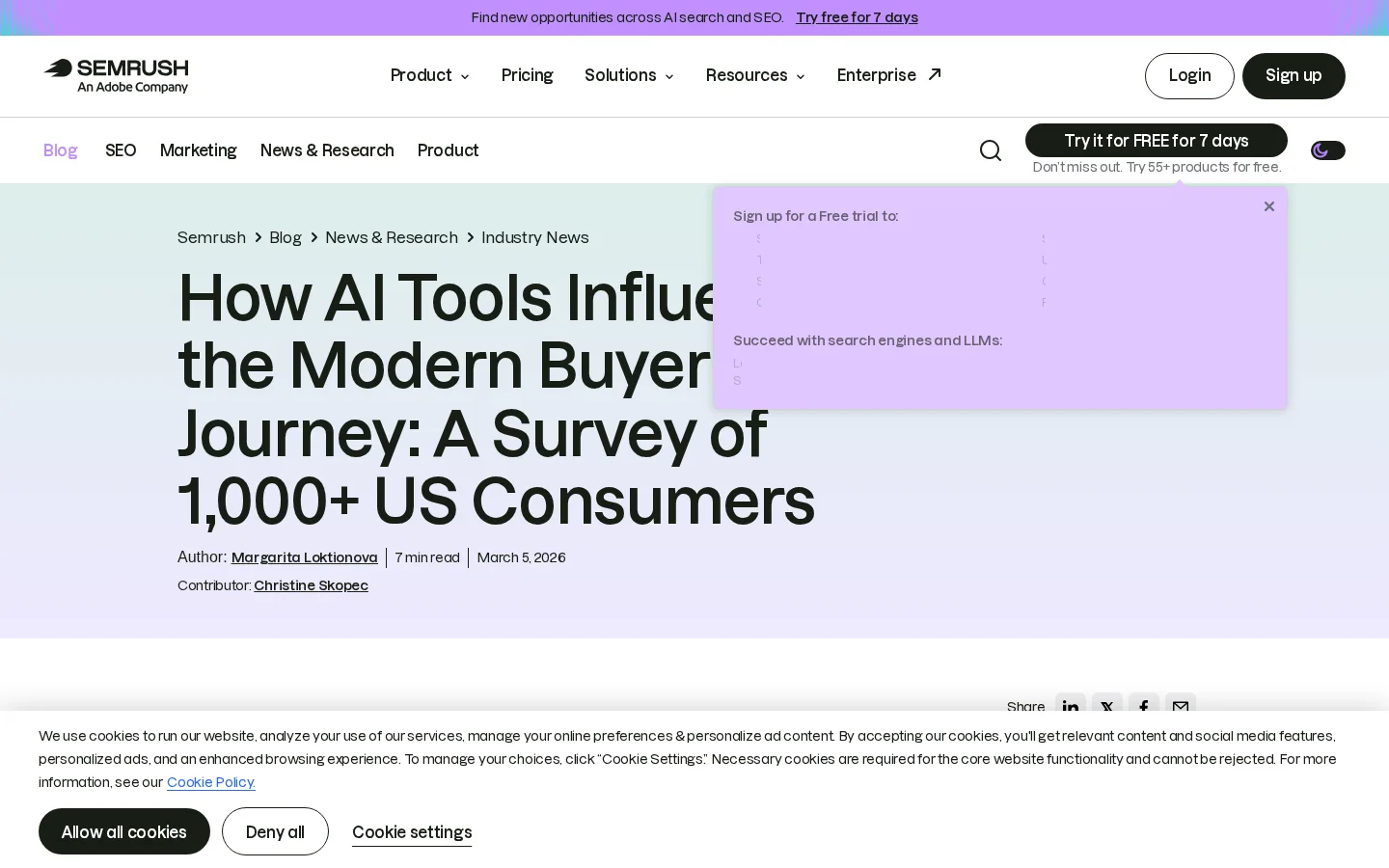
The most detailed recent survey is the Semrush buyer journey study published on March 5, 2026, run in December 2025 among 1030 US shoppers who had tried AI tools. Among them, 85% use AI at least weekly and 55% use it for product research at least weekly. Half (50%) made a purchase after using AI during research, and 22% completed a purchase directly inside an AI tool.
How US shoppers who tried AI tools use them
Source: Semrush survey of 1030 US shoppers, December 2025
An earlier wave of data shows how fast this moved. In a survey of more than 5000 US consumers, Adobe reported in March 2025 that 39% had already used generative AI for online shopping and 53% planned to do so that year.
ChatGPT leads, but it is far from alone. Google's own AI surfaces (Gemini, AI Mode and AI Overviews) add up to a large share of usage, which means a brand cannot optimize for one model only.
Three technical caveats matter before you put any of these figures in a board deck:

AI touches every stage, but its strongest effect is in the middle: narrowing and comparing. In the Semrush study, 57% of respondents use AI to narrow down choices, 53% to compare products they already consider, 51% for early discovery and 50% to make a final decision. Only 20% use AI across the entire process.
A classic query looks like "running shoes flat feet". An AI prompt looks like "I run 20 km a week on asphalt, I have flat feet and knee pain, my budget is 150 euros, what should I buy?". The AI model does not search that sentence as one string. It splits it into several sub-searches (cushioning, stability, price range, reviews), a mechanism Google calls query fan-out. Your page wins only if it answers one of those sub-questions clearly.
We break down this retrieval step in how AI models choose the sources they cite. The practical takeaway: write for specific situations (flat feet, small kitchen, first-time buyer), not just for the generic product category.
Comparison used to be the job of affiliate sites, review blogs and the shopper's own tabs. Now the AI model writes the comparison itself, with pros, cons and a recommendation per profile. It pulls the facts from pages that state them plainly: specifications, prices, compatibility, warranty, return policy. A product page that hides its dimensions in an image, or its price behind a "contact us" button, gives the AI model nothing to compare.
At the decision stage, AI answers concentrate attention. A Google results page shows ten organic results plus ads and shopping units; an AI answer usually names a handful of options. Being fourth on Google still brings some clicks. Being absent from the AI shortlist brings none from that conversation.
After the AI step, the journey splits in three. The Semrush data shows that 47% narrow options with AI then turn to Google for reviews or pricing, 40% research with AI but buy elsewhere, and 39% ask AI for recommendations then shop on marketplaces such as Amazon. After the purchase, people also ask AI models for setup help, troubleshooting and alternatives, which shapes repeat purchase and reviews.
| Stage | What the shopper did before | What the shopper does with AI | What the brand must provide |
|---|---|---|---|
| Discovery | Typed a short keyword, scanned results | Describes a situation in a full sentence | Pages that answer specific use cases |
| Comparison | Opened 5 to 10 tabs, read reviews | Reads a comparison written by the AI model | Plain, crawlable specs, prices and policies |
| Shortlist | Chose among top results and ads | Gets 2 to 5 named options | Mentions on third-party sites the AI model trusts |
| Verification | Rarely needed, the result was the source | Checks on Google, brand site, reviews | Consistent facts everywhere, strong reviews |
| Purchase | Bought on the site or marketplace | Buys on site, marketplace or inside the AI tool | Accurate product feed and stock data |
| After purchase | Read the manual, called support | Asks the AI model for help and alternatives | Public help pages and documentation |
If you want to map these stages for your own customers, our guide to customer journey mapping you can act on gives a template you can extend with an "AI step" column.
Consumers trust AI recommendations, but not blindly: most of them check the answer before they buy. This verification loop is where classic SEO, reviews and brand consistency still decide the sale.
In the same Semrush survey, 75% rate their trust in AI recommendations 3 or 4 out of 5, 20% trust AI completely, and only 7% report low trust. Yet 86% verify AI brand recommendations at least sometimes, and 20% always do.
Trust and verification of AI shopping advice
Source: Semrush survey of 1030 US shoppers, December 2025
Google is still the main verification tool. That is a key point for budget decisions: AI does not make search useless, it changes the queries. Instead of "best robot vacuum", the verification search is "Brand X model Y reviews" or "Brand X vs Brand Z".
Trust breaks when the AI answer and the real world disagree: a discontinued product, an old price, a wrong warranty length, a feature the product never had. The shopper blames both the AI model and the brand. Three technical causes are common:
Reviews carry a lot of weight in this loop. Our analysis of how review sites shape AI recommendations explains which platforms matter and why.
AI answers reduce clicks on informational searches, but the visits that do arrive from AI tools are growing fast and are more engaged. Both effects are real at the same time.
The cleanest behavioral data comes from Pew Research Center (Athena Chapekis and Anna Lieb, July 22, 2025), which tracked real browsing of about 900 US adults in March 2025. When a Google results page showed an AI summary, users clicked a traditional result in 8% of visits, against 15% without a summary. They clicked a link inside the summary in only 1% of visits. They also ended their browsing session more often: 26% of visits with a summary, against 16% without.
Google users' behavior with and without an AI summary
Source: Pew Research Center, July 2025
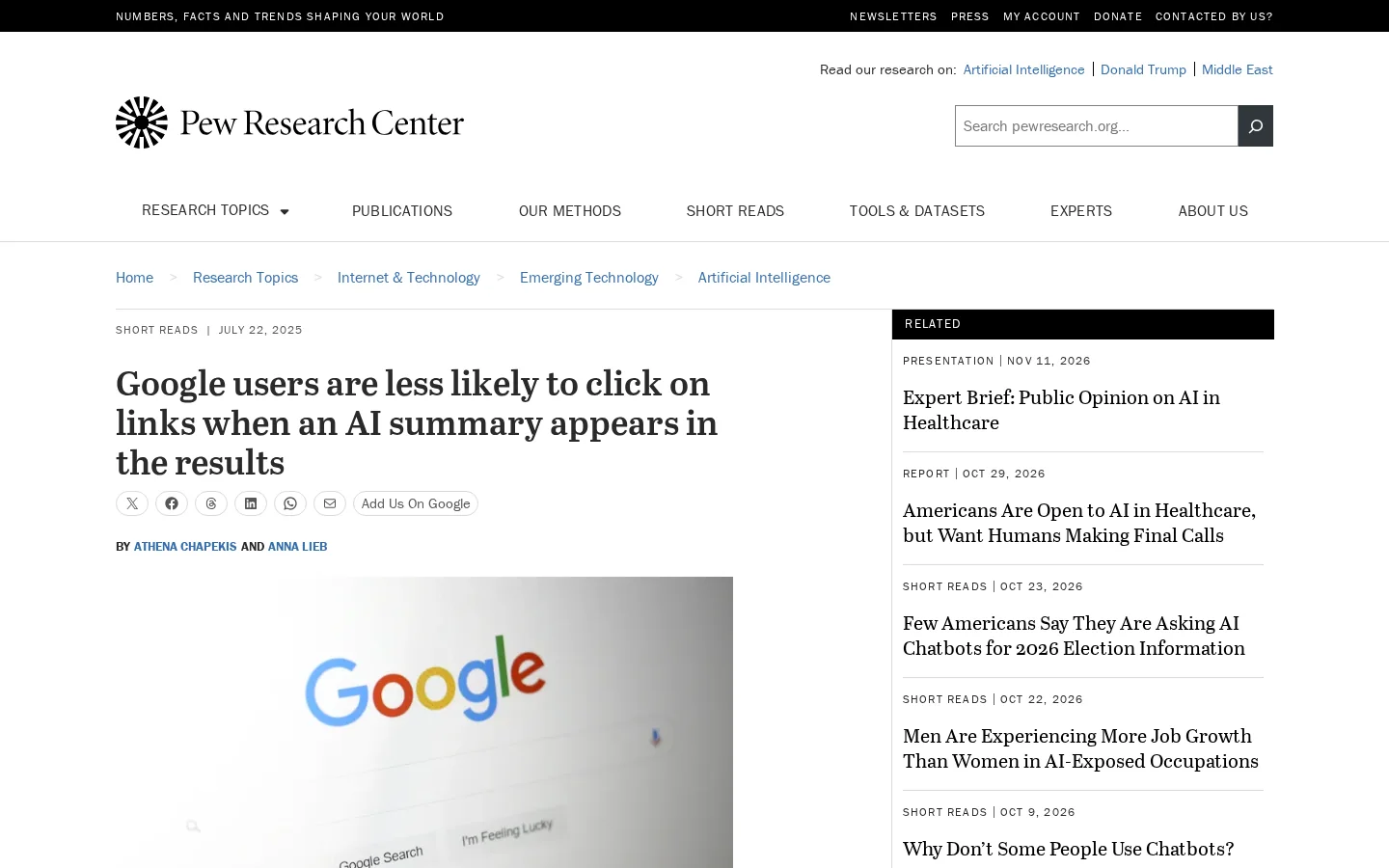
Pew also found that 18% of the searches in its panel produced an AI summary, and 60% of queries that started with a question word (who, what, when, why) did. Question-style queries are exactly the ones shoppers use at the research stage. This is the mechanism behind zero-click searches: the answer is consumed on the results page.
At the same time, clicks that come from AI tools to retail sites have exploded. Adobe's holiday report of January 7, 2026, based on more than 1 trillion visits to US retail sites, measured a 693.4% rise in traffic from generative AI tools during the 2025 holiday season (November 1 to December 31) compared with the year before, and a 670% rise on Cyber Monday. Adobe notes that the base of users is still modest. The previous season had already grown by 1300%.
Growth of generative AI traffic to US retail sites, holiday season vs prior year
Sources: Adobe Analytics, March 2025 and January 2026
Growth rates fall as the base gets bigger, which is normal. The quality of those visits matters more. In its March 2025 analysis, Adobe found that visitors coming from AI tools showed 8% higher engagement, 12% more pages per visit and a 23% lower bounce rate than other traffic. Their conversion gap closed fast: they were 43% less likely to convert in July 2024, and only 9% less likely in February 2025. The shopper arrives with the comparison already done.
Note
Clicks from AI tools are only the visible part. A shopper who reads your name in ChatGPT and later types it into Google appears as branded search. Track branded search volume and direct traffic next to AI referrals, or you will miss most of the effect.
For a deeper look at the traffic side, read our study of how much traffic really comes from AI search.
Consumers delegate research, comparison and simple repeat purchases to AI; they keep emotional, expensive and risky decisions for themselves. The line moves a little every year, but it moves category by category.
Adobe's March 2025 survey listed the shopping tasks consumers used generative AI for. Research came first, followed by recommendations and deal hunting.
Semrush asked which purchases AI had influenced. Everyday categories lead: food (29%) and wellness (29%), then electronics (27%) and travel (21%). Education (16%), home services (15%) and financial services (13%) come after. Adobe's holiday data points the same way for retail: AI tools were used most for video games, toys, appliances, electronics and personal care.
The next step is delegation of the purchase itself. In September 2025, OpenAI launched Instant Checkout so users can buy some products without leaving ChatGPT, and Google is adding similar checkout features to its AI surfaces. For now, delegation works best for low-risk, repeatable purchases: reorders, subscriptions, simple gifts. For a full view of the protocols and what stores must prepare, see our guide on agentic commerce and how e-commerce brands should prepare, and the hands-on page on getting your products recommended in ChatGPT Shopping.
What consumers delegate to AI vs what they keep
You cannot manage what you do not measure, and AI influence is mostly invisible in default analytics. Four complementary methods give you a reliable picture: a prompt panel, referral segmentation, a post-purchase survey and conversation mining. Use at least two, because each one sees a different part of the journey.
Principle. You write the 30 to 100 questions your buyers really ask AI models ("best X for Y under Z"), run them each week in ChatGPT, Gemini, Claude and Google AI Mode, and record which brands are named, in which order, with which arguments.
When to use it. Always. It is the only method that shows the shortlist itself, including when you are absent.
Advantages. Shows competitors, wording, sources cited and errors about your brand. Works before you have any AI traffic.
Limits. Answers vary between runs, accounts and locations. You need repeated runs and averages, not one screenshot. The prompts you choose bias the result.
Example. Take a fictional meal-kit brand that tracks 40 prompts such as "healthy meal kit for a family of four on a budget". The panel shows in which prompts it is named, which two competitors always come first, and that the AI models quote an outdated price taken from an old review.
Finding the right prompts is the hard part. Sorank's AI prompt research finds the questions your customers ask AI models, and its AI mention tracking shows when ChatGPT, Gemini or Claude names your brand.
Principle. You isolate visits that come from AI tools into their own channel, then compare their engagement, conversion rate and landing pages with other channels.
When to use it. As soon as you have a few hundred AI visits per month.
Advantages. Hard data on revenue. Shows which pages AI models send people to.
Limits. Misses every shopper who did not click, and some AI apps strip the referrer, so part of this traffic lands in "direct".
Example. In Google Analytics 4, create a custom channel group with a channel named "AI tools" placed above "Referral", with the condition "Source matches regex":
.*(chatgpt\.com|chat\.openai\.com|gemini\.google\.com|bard\.google\.com|claude\.ai|copilot\.microsoft\.com|grok\.com|meta\.ai).*Then add a comparison in the "Landing page" report. Check the regex every quarter: AI products change domains.
Principle. You ask buyers, right after checkout or at signup, how they first heard about you, with AI models as explicit answer options.
When to use it. When you have enough orders to get 100 answers a month or more.
Advantages. Captures the invisible influence (the shopper who read your name in ChatGPT and came back through Google).
Limits. Memory is imperfect and the answer order biases results. Rotate the order of options.
Example. A single question with these options works well:
How did you first hear about us?
[ ] Google search
[ ] An AI model (ChatGPT, Gemini, Claude, Google AI Mode...)
[ ] Instagram, TikTok or YouTube
[ ] A friend or family member
[ ] A review or comparison site
[ ] Other: ________Principle. You read what customers say in sales calls, chats, support tickets and reviews, and tag every mention of an AI model ("ChatGPT told me you were the only one with...").
When to use it. For services, B2B and high-ticket products, where volumes are low but each conversation is rich.
Advantages. Gives the exact arguments the AI model used, good and bad.
Limits. Qualitative, slow, and dependent on your team tagging conversations.
Example. Take a fictional kitchen fitter that adds a "found us via AI" tag in its customer database. After two months, it knows how many leads carry the tag, and it notices that most repeat the same argument the AI model gave them, such as "the only one with a 10-year guarantee in the city". That argument goes straight onto the homepage.
| Method | What it sees | Effort | Main blind spot | Best for |
|---|---|---|---|---|
| Prompt panel | The AI shortlist and its arguments | Medium, weekly | Answer variability | Every brand, from day one |
| Referral segmentation | Clicks and revenue from AI tools | Low, one setup | Shoppers who never click | E-commerce and lead generation sites |
| Post-purchase survey | Invisible influence before purchase | Low, ongoing | Memory bias | Stores with steady order volume |
| Conversation mining | Exact AI arguments heard by buyers | High, manual | Small samples | Services, B2B, high-ticket items |
Tip
Before setting up a full prompt panel, run our free AI search visibility test to see in a few minutes whether AI models already mention your brand.
Adapting means three things: being present in the sources AI models read, making your facts easy to extract, and measuring the result. Here is a plan you can start today and finish in about 30 days.
The 6-step plan to win AI-assisted shoppers
Start from real language: site search logs, Search Console queries of 6 words or more, support tickets, reviews. Turn them into prompts by profile. Then test each one in at least three AI models, three times, in a clean session without memory. Record presence, rank in the answer, the arguments used and the sources cited. That last column is your target list for step 5.
Google's Search Central documentation on AI features states that there are no additional requirements to appear in AI Overviews or AI Mode: a page must be indexed and eligible to show a snippet. The same page advises keeping important content in text form, keeping structured data consistent with visible text, and keeping Merchant Center and Business Profile information up to date. It also confirms that these features may use query fan-out across subtopics.
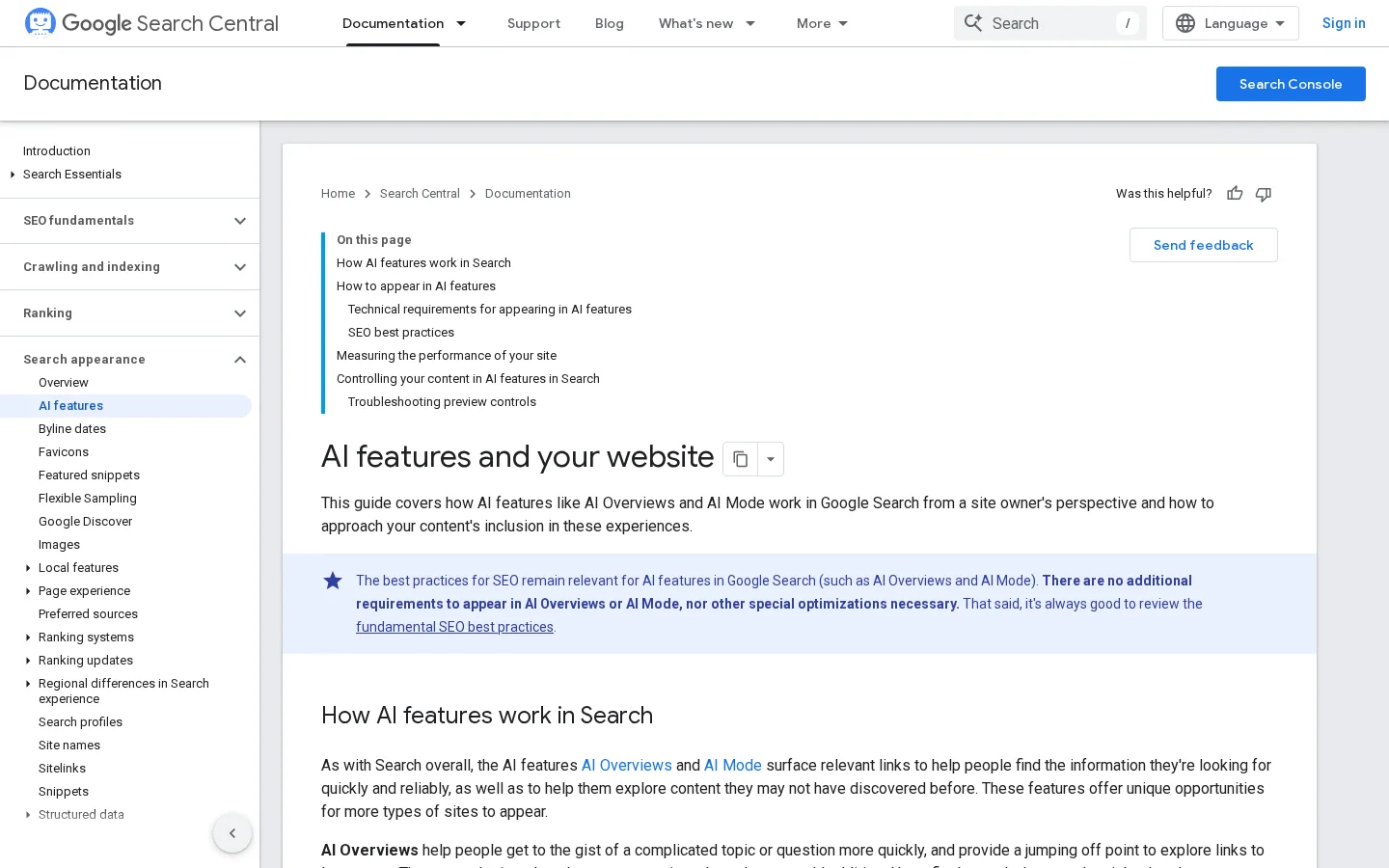
For a product page, a minimal Product markup in JSON-LD that matches the visible page looks like this:
<script type="application/ld+json">
{
  "@context": "https://schema.org",
  "@type": "Product",
  "name": "QuietClean 400 Dishwasher",
  "brand": {"@type": "Brand", "name": "QuietClean"},
  "description": "Built-in dishwasher, 42 dB, 14 place settings, 60 cm wide.",
  "sku": "QC400-60",
  "offers": {
    "@type": "Offer",
    "price": "749.00",
    "priceCurrency": "EUR",
    "availability": "https://schema.org/InStock"
  }
}
</script>
Our checklist of the 15 elements of a product page that AI models can pick goes through the rest: specs table, return policy, FAQ, reviews.
AI consumers ask about their situation. Build pages such as "best dishwasher for a small apartment", "X vs Y for families", "how to choose a Z if you have allergies". Each page answers in the first lines, gives a comparison table and states who the product is not for. That honesty is what makes an AI model quote you as a fair source.
Your own site is only one input. AI models also read review platforms, forums, comparison articles and niche blogs. Use the "sources cited" column from step 2: contact those publishers, offer data, samples or expert quotes, and get your products into their next update. Natural backlinks and brand mentions from your niche feed both Google and AI answers.
Set up the four methods described above and review them monthly. A useful single number is your AI share of voice: the share of tracked prompts where your brand is named, compared with your main competitors.
If you run an online store, our playbook on getting products recommended by ChatGPT, Gemini and AI Mode applies this plan to catalogs and feeds.
Most mistakes come from treating AI as a traffic source to chase instead of a buying behavior to understand. Here are the seven we see most often, with how to spot and fix each one.
Mistakes to avoid
What it is. Judging AI impact from the "chatgpt.com" line in analytics. How to spot it. Your report says AI is a tiny share of traffic, while sales teams hear "ChatGPT recommended you" every week. How to fix it. Add the post-purchase survey and track branded search volume next to referrals.
What it is. Taking a single screenshot as proof that you are, or are not, recommended. How to spot it. Two colleagues get different answers to the same question. How to fix it. Run each prompt several times, in several models, in clean sessions, and work with presence rates over weeks.
What it is. Focusing all efforts on one AI model. How to spot it. Your tracking covers one tool. How to fix it. Gemini, AI Mode and AI Overviews together reach a large share of shoppers, as the usage data above shows. Track at least ChatGPT, Gemini, Claude and Google's AI features.
What it is. "Contact us for pricing", specs in PDFs or images, policies behind a login. How to spot it. AI answers describe your product vaguely or with wrong numbers, while competitors get precise lines. How to fix it. Publish at least a price range, a specs table in HTML and your return and warranty terms on an open page.
What it is. Optimizing only your own site. How to spot it. In your baseline, the sources cited are review sites and blogs where you are absent. How to fix it. Make those sources your outreach list (step 5 of the plan).
What it is. Moving all budget from SEO to AI visibility. How to spot it. Branded and comparison queries lose rankings a few months later. How to fix it. Remember that 68% of shoppers verify AI advice on Google, and AI features themselves rely on indexed pages. SEO and GEO are one job.
What it is. Seeing a false claim about your brand in an AI answer and doing nothing. How to spot it. Customers ask about a feature you never had, or quote an old price. How to fix it. Find the source the AI model relies on, correct it at the root, and publish the right fact clearly on your site. Our guide on fixing wrong brand mentions in AI answers details the process.
The direction is clear: more research inside AI models, more purchases completed there, and more weight on a few trusted sources. The pace differs by country and category, so the brands that measure early will adapt before their traffic tells them to.
Key milestones in AI shopping behavior
To keep this work running without adding headcount, Sorank's GEO optimization software plans and publishes content for the prompts your buyers ask, earns natural backlinks from your niche, and tracks your presence in ChatGPT, Claude and Gemini every week. For the wider picture of retail uses, our guide to AI in ecommerce and how to appear in AI shopping is the next read.
Your action for today: write down ten questions your best customers would ask an AI model before buying from you, run them in two AI models, and note who gets named. That list is your new competitive map.
AI models let shoppers describe their need in one sentence and get a short list of products with reasons, instead of browsing many websites. Most people still check that list on Google, brand sites and review platforms before buying. Some now complete the purchase directly inside the AI tool.
Partly. In a Semrush survey of US shoppers who tried AI tools, 75% rated their trust 3 or 4 out of 5, but 86% verify AI brand recommendations at least sometimes. Google remains the main place where they check.
Combine four methods: a weekly prompt panel in ChatGPT, Gemini, Claude and Google AI Mode, a separate AI channel in your analytics, a post-purchase survey that lists AI models as an option, and tagging of AI mentions in sales and support conversations. Each method sees a different part of the journey.
We analyse your competitors, your website and your AI visibility to create a tailored content plan for free.
 Website Value Calculator
 Website Accessibility Checker
 Google Analytics Checker
 Duplicate Content Checker
 Mobile-Friendly Test
 Website Speed Test
 Subdomain Finder
 Domain Age Checker
 CMS Detector
 Googlebot Simulator
 Nofollow Link Checker
 Meta Tag Checker
 Keyword Cannibalization Checker
 Keyword Intent Checker
 Keyword Extractor
 Google Ads Cost Calculator
 CPC Calculator
 Local Citation Finder
 Reddit Threads Finder
 Disavow File Generator
 Redirect Generator
 Canonical Tag Generator
 Passive Voice Checker
 Google Location Changer
 Google Review Calculator
 Google Review Link Generator
 Keyword Combiner
 Podcast Show Notes Generator
 AI Content Rewriter
 AI Text Humanizer
 ChatGPT Prompt Generator
 Twitter Thread Generator
 Tweet Generator
 Landing Page Copy Generator
 Google Ads Copy Generator
 Pinterest Pin Description Generator
 Anchor Text Generator
 Social Media Post Generator
 LinkedIn Post Generator
 Free AI Writer
 Review Response Generator
 LSI Keyword Generator
 YouTube Video Ideas Generator
 YouTube Tag Generator
 YouTube Description Generator
 Product Description Generator
 CTA Generator
 Blog Introduction Generator
 Conclusion Generator
 Hook Generator
 AI Content Brief Generator
 FAQ Schema Generator
 AI Blog Post Ideas Generator
 Structured Data Validator (Schema Validator)
 Alt Text Checker
 Internal Link Analyzer
 Backlink Challenge
 AI Meta Description Generator
 AI Blog Title Generator
 Google Indexability Checker
 AI Blog Outline Generator
 UTM Link Builder
 Keyword Clustering Tool
 Canonical Tag Checker
 XML Sitemap Generator
 Broken Link Checker
 AI SEO Title Generator
 Headline Analyzer
 SERP Preview Tool
 Redirect Checker
 Hreflang Tag Generator
 Heading Structure Analyzer
 HTTP Headers Checker
 Favicon Extractor
 SERP CTR Calculator
 SEO vs Paid Search Savings Calculator
 SEO Share of Voice Calculator
 SEO ROI Calculator
 SEO Traffic and Revenue Forecast Calculator
 SEO Budget Calculator
 SEO Break-Even Calculator
 SaaS SEO ROI Calculator
 ROAS Calculator
 Reading Time Calculator
 Ranking Gain Simulator
 Organic Traffic Value Calculator
 Organic Traffic Estimator and Website Traffic Checker
 LTV to CAC Ratio Calculator
 Local SEO ROI Calculator
 Link Building Cost Calculator
 Keyword Value Calculator
 Keyword Opportunity Score Calculator
 Keyword Density Calculator
 GEO ROI Calculator
 GEO Content Investment Calculator
 Ecommerce SEO ROI Calculator
 Customer Lifetime Value Calculator
 Customer Acquisition Cost Calculator
 CTR Calculator
 Cost Per Article Calculator
 Conversion Rate Calculator
 Content Marketing ROI Calculator
 ChatGPT Referral Traffic Estimator
 Bounce Rate Calculator
 Backlink ROI Calculator
 AI Visibility Score Calculator
 AI Traffic Value Calculator
 AI Share of Voice Calculator
 Cost of AI Invisibility Calculator
 AI Citation Rate Calculator
 llms.txt Validator
 AI Overview Checker and AI Overviews Rank Checker
 Robots.txt Checker
 AI SEO Audit
 LLM Readability Checker
 SearchGPT Readiness Checker
 Structured Data LLM Audit
 Website Crawlability AI Audit
 Why ChatGPT Is Not Recommending My Website
 Gemini Ranking Tool
 Perplexity Ranking Checker
 LLM Citation Checker
 Answer Engine Optimization Audit
 GEO Audit
 AI Search Visibility Test
 ChatGPT Visibility Checker
 llms.txt Generator
 URL Extractor
 Webpage to Markdown
 Sitemap Checker
 SERP Volatility Sensor
 Page Size Checker
 Word Counter
 Slug Generator
 Schema Generator
 Robots Generator
 OG Preview
 Meta Tags Generator
 Image Compressor
 Favicon Generator
 On-Page SEO Audit: SEO Checker and SEO Analyzer
 Backlink Analysis Tool
 Keyword Research Tool
 Domain Authority Checker
 “I tested Sorank on a real client site and it's insane. It does everything an agency would bill you $1500 a month for. It's going into production on that client now.”

 Guillaume Guersanguersanguillaume.com“We are an Ads agency and we wanted to get our SEO back on track once and for all. Sorank gave us a clear view of our site, helped us prioritize optimizations, and properly structure our content. The tool is easy to use, well designed for a team, and very practical for centralizing tracking without having to juggle multiple platforms. A very solid foundation to start fresh with our SEO.”
 Gaspard MadouiAds Agency
 “I just let the Sorank software do its thing, and now my DR is 25 and my page is ranking higher.”
 Lucas Flandrefoundertrace.fr“I specialized in GEO thanks to Sorank. The GEO Leaderboard allows me to show my clients their position vs competitors on ChatGPT. It’s a real commercial differentiator.”
 MélanieSEO Freelance“Great service, works well for our website and helps us understand how to improve it to rank better on Google and elsewhere. Congrats, keep going, I recommend it.”
 Hugo T.E-commerce merchant