Preferences
Privacy is important to us, so you have the option of disabling certain types of storage that may not be necessary for the basic functioning of the website. Blocking categories may impact your experience on the website. More information
Privacy is important to us, so you have the option of disabling certain types of storage that may not be necessary for the basic functioning of the website. Blocking categories may impact your experience on the website. More information

AI search sends about 0.32% of website traffic in 2026 studies. See the sourced figures, how they were measured, and how to track your own AI share.
In short
In 2026 studies, AI search sends about 0.32% of all website traffic, while organic search sends about 42.75%. AI search adds to Google traffic and does not replace it yet, but the studies probably undercount it, because clicks from Google's AI Overviews and AI Mode are counted as normal Google search. Check your own numbers before you act.
Want to go further? Ask
Quick quiz
How should you get mentioned by ChatGPT and other AI assistants?
Sorank matches your answers


Test it for 3 days on your own site and see where you stand on Google, ChatGPT and the other AIs.
Start 3-day free trial3 days free, then stop whenever you want. 90-day results guarantee, conditions apply.
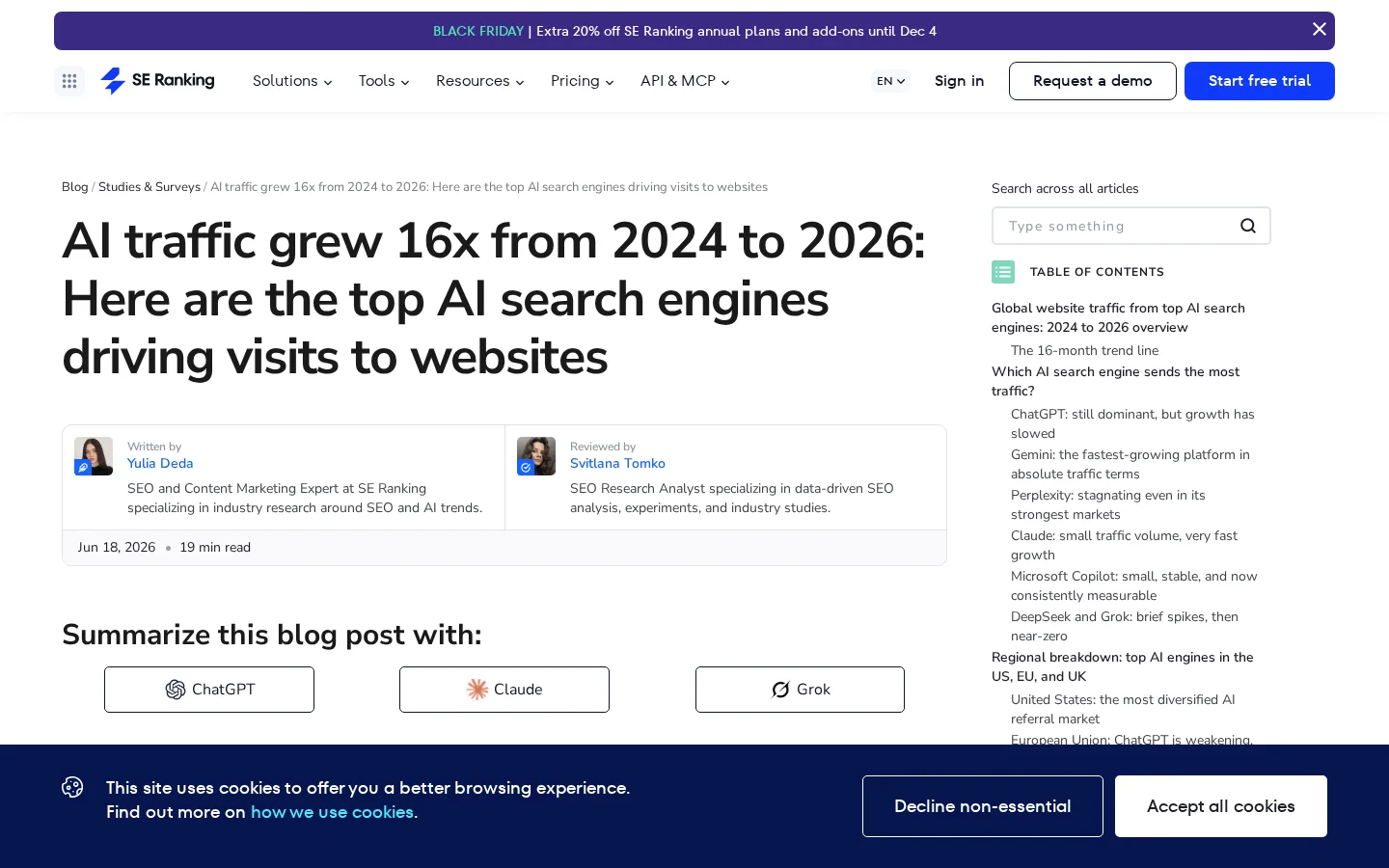
AI search engines send about 0.32% of all website traffic, according to the largest recent study we found. SE Ranking's study, published June 18, 2026, says AI traffic rose from 0.02% of total website traffic in 2024 to 0.32% in 2026. The study covers 101574 websites in 250 countries and territories, tracked from January 2025 through April 2026.
The growth is simple division. 0.32 divided by 0.02 gives 16, so the share grew 16 times in two years. The base is small, which is why a big multiple still means a small share. A site that moves from 1 visit in 5000 to 1 visit in 300 has seen the same kind of growth, and it still gets very little of its traffic from AI.
The same study puts organic search at 42.75% of all website traffic. Divide one by the other and you get about 134, which is the figure the study itself uses: Google's organic search sends about 134 times more visitors than AI platforms combined. The division checks out, but the number comes from one dataset, so read it as an order of magnitude, not an exact ratio.
AI search versus organic search, share of all website traffic
Source: SE Ranking, June 18, 2026
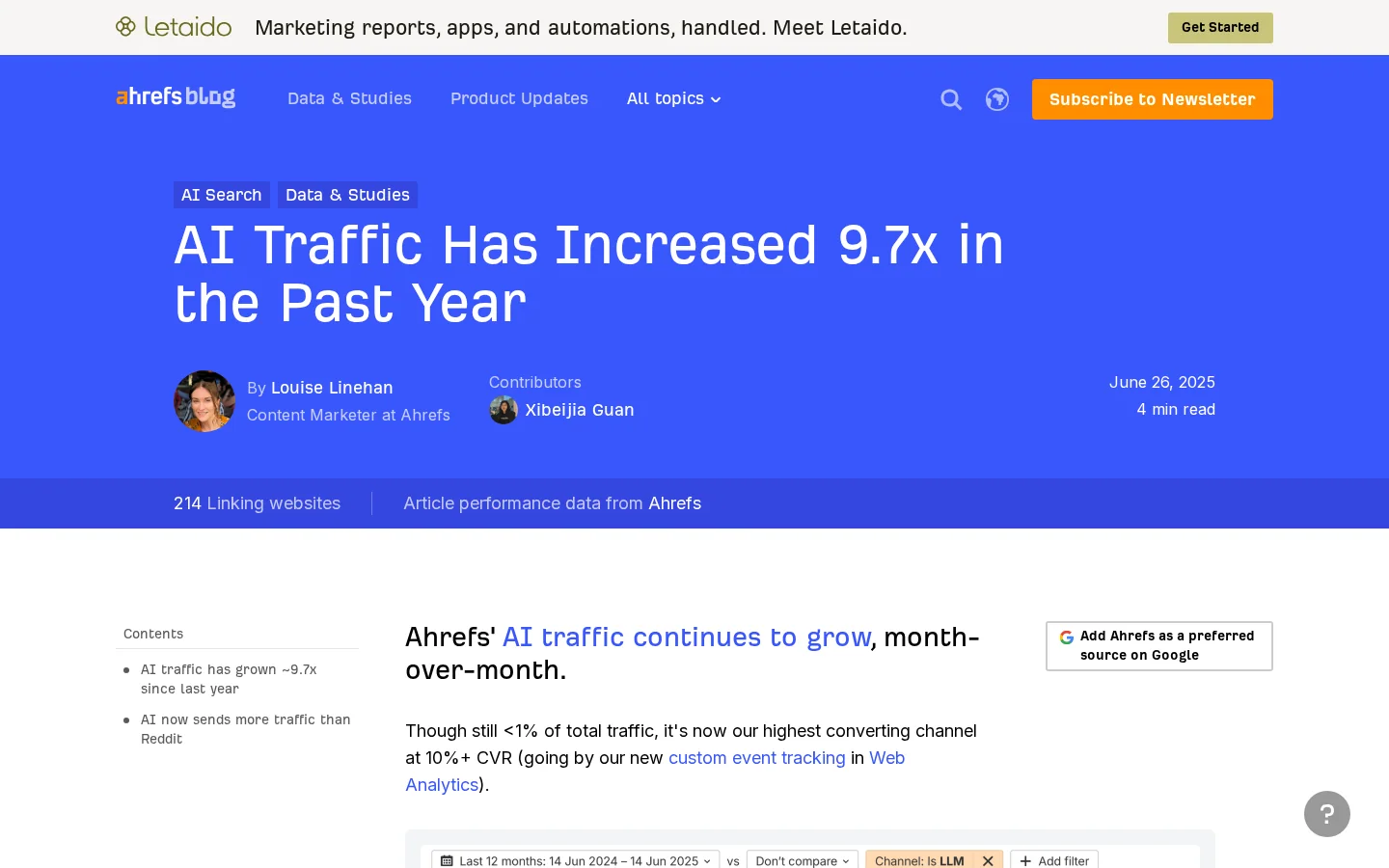
Ahrefs' study of June 26, 2025 measured the same question a year earlier. It covered 81947 sites and found that AI traffic grew about 9.7 times over the previous year. Even so, AI traffic reached only 0.25% of a site's traffic on average. The two studies do not give the same figure, because their samples and periods differ. Both show the same thing, though: AI traffic is under 1% of the total.
Each study also draws the line around "AI search" in its own way. SE Ranking counts nine named AI platforms and an "other" group. Ahrefs looks at a short list of the largest AI referrers. Semrush's scope goes further and includes Google's AI Overviews and AI Mode next to standalone chat tools. So a larger AI share in one study can come from a wider definition, not from more visits. Check the definition before you compare the numbers.
At 0.32%, about one visit in 300 comes from AI search. That is too small to drive a plan on its own today, but the growth rate is steep enough that you should watch it every month.
Take a site with 20000 visits a month. At 0.32%, AI search would send about 64 of them. You can check that number in your analytics this week. If it is far from 64, your site is not the market average, and that is a reason to look at why.
For now AI search adds to Google traffic, and no study we read shows it replacing Google at scale. The signals are mixed, though. Ahrefs reports that AI referrals grew about 9.7 times in a year, while average search traffic on its sample fell about 21% over the same year.
For a single site, adding means the AI visits are extra. The question that matters is then whether those extra visitors are worth the work, which is why the conversion section below matters.
Ahrefs does not say why search traffic fell. One possible cause is that AI Overviews answer a question without a click. The study cannot test that, because it records AI Overviews as ordinary search traffic. Treat the fall as a reason to check your own data, not as proof of cause.
| Traffic source | Share of all website traffic, 2026 | Change over time |
|---|---|---|
| Organic search | 42.75% | Not given in the SE Ranking study |
| AI search engines | 0.32% | Up 16 times since 2024 |
Semrush's study of July 21, 2025 models the future rather than measuring it. Its authors project that combined traffic will fall at first, then stabilize and grow slowly. They also say the projections are extrapolations of past data and user adoption rates. Read them as scenarios, not as a forecast you can plan a budget on.
ChatGPT sends most of it. In SE Ranking's 2026 data it accounts for 74.78% of AI referral traffic, down from 79.74% in 2025, even though its own traffic grew 27% year over year. Gemini is second at 11.56%, and the third AI referrer has 7.23%.
The sources disagree on the exact split, and the gap is wide. Ahrefs found that ChatGPT sent more than 80% of AI traffic in mid-2025. The same study reports that Copilot, back after a referral outage, now sent more AI traffic than Gemini. Both studies agree on the main point: one platform sends most of the AI traffic, and the split is moving.
Gemini's share covers visits from Gemini itself. Clicks from Google's AI features are counted as Google Search, as the next section explains. So the Gemini figure leaves out Google's own AI features, and it is a floor, like the total.
| Study | Published | Sample | ChatGPT share | Google compared with AI |
|---|---|---|---|---|
| Semrush | July 21, 2025 | Over 500 topics turned into search terms and prompts | Not reported | AI search visitors worth 4.4 times an average organic visit, by conversion rate |
| Ahrefs | June 26, 2025 | 81947 sites | Above 80% of AI traffic | About 210 times more traffic than the big three AI platforms combined |
| SE Ranking | June 18, 2026 | 101574 websites | 74.78% | About 134 times more visitors than AI platforms combined |
Read the last column with care. Semrush's figure compares value per visit, not volume. The other two compare volume. Put them side by side only after you check what each one counts.
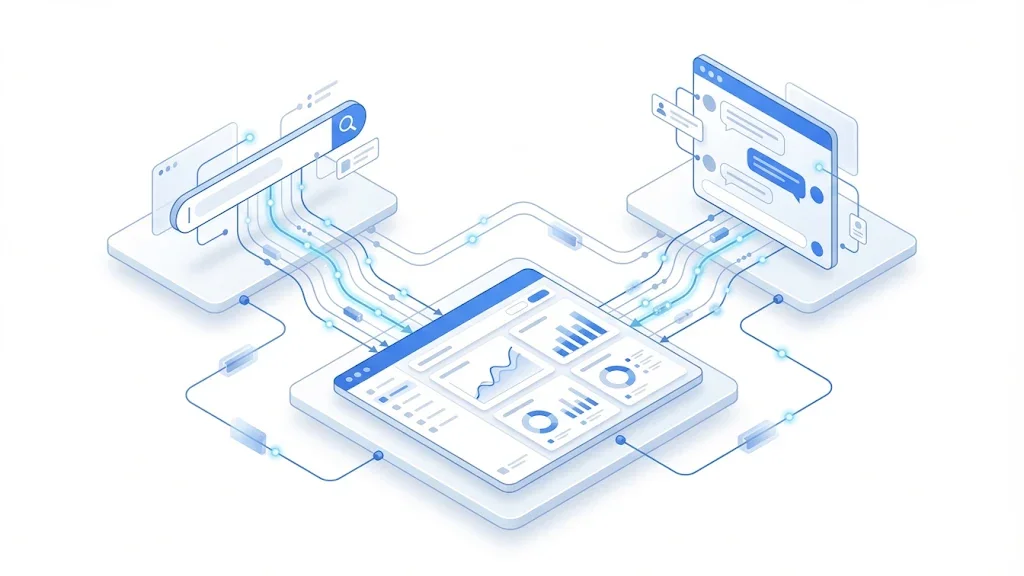
They count visits from AI domains in web analytics, so they only see visits that arrive with a referrer. A visit that loses its referrer lands in direct traffic, and the studies cannot tell it apart from someone who typed your address. This gap has a name, AI dark traffic, and it is the main reason to read these figures as floors.
Ahrefs says that AI referral traffic is probably underestimated, because some platforms strip referral data. SE Ranking takes its data from websites that use Google Analytics, and its page does not explain how the referrers were identified. Semrush says its projections model untracked traffic, such as clicks without referrer data, and people who buy later through branded search.
Before you trust a figure, check how much of the method the study publishes. Ahrefs names the kind of data it uses, site analytics, but not a single tool for the whole dataset. SE Ranking names the source of its sites, but not how it identified each referrer. Semrush describes its sample of topics, but not how AI referral traffic was counted. None of the three gives you enough to rebuild its number from scratch, so use them for direction and check the size against your own data.
SE Ranking's regional breakdowns cover only the United States, the United Kingdom and the European Union. Ahrefs changed its sample between two studies. It grew from about 35000 sites in March 2025 to 81947 in June, and Ahrefs says the two results are not like for like. A bigger sample only helps when it is the same sample at both dates.
Copilot, Claude and the other smaller platforms make up the rest of the AI referral traffic in these studies. Ahrefs' data shows how fast the order can change. Copilot went through a referral outage, came back, and by June 2025 sent more AI traffic than Gemini. The lesson for you is to keep your AI channel open to new sources, not to fix it to a list of three platforms.
Semrush's 500 topics were turned into search terms and prompts, and its study says so. That means its sample tests what AI models answer, not how many visits they send. Use it for the logic of the market, and use the Ahrefs and SE Ranking traffic data for the size.
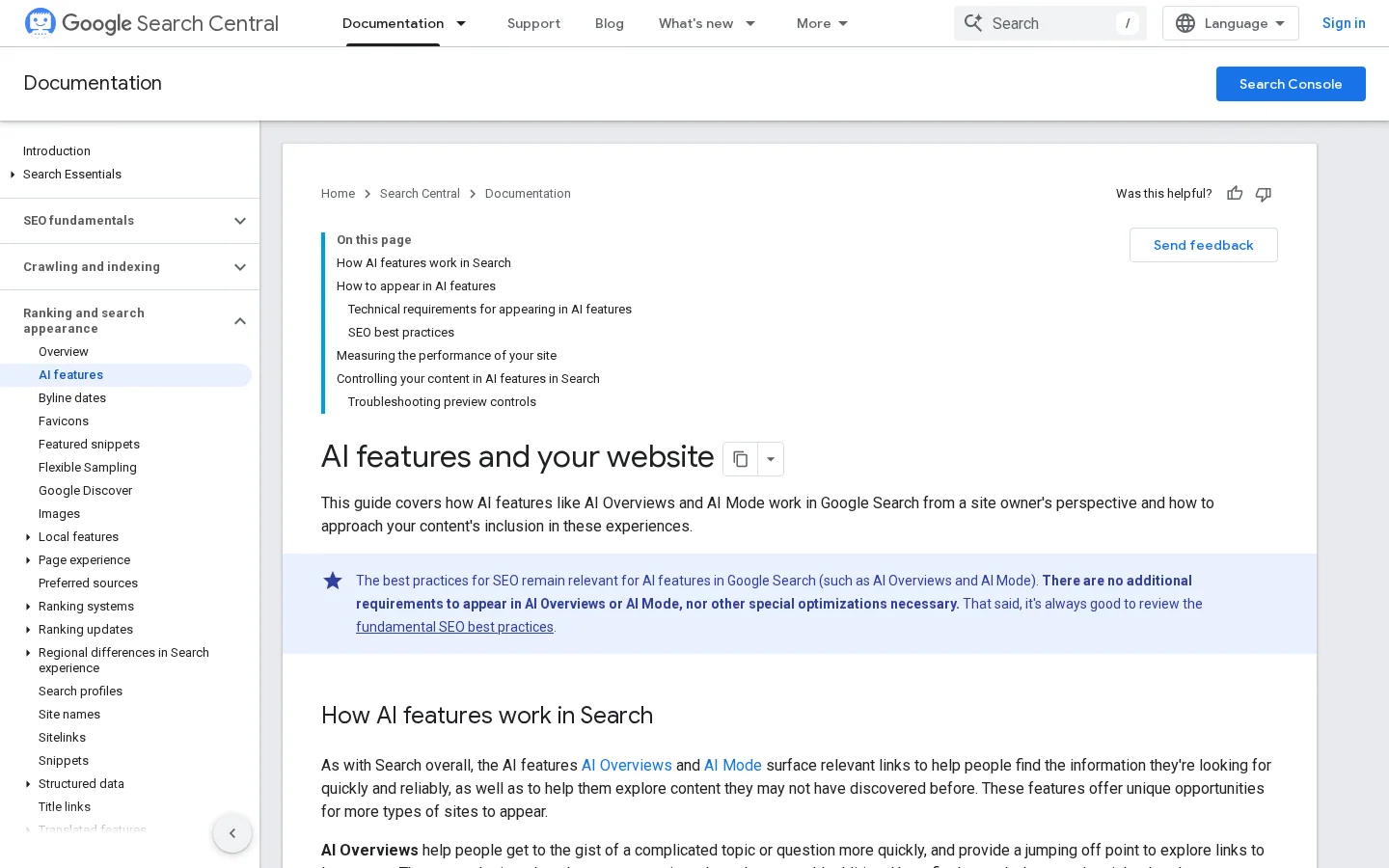
Clicks from AI Overviews and AI Mode are counted as Google Search, not as AI referrals, so studies that count AI referrals leave them out. Google's Search Central documentation says that traffic from these features is included in the overall search traffic in Search Console, under the Web search type. That is the total you already see, so the AI part is hidden inside the Google part.
Where a click from AI shows up in your reports
Source: Google Search Central documentation; Ahrefs, June 26, 2025
When Google changes its AI features, your Google organic line can move even if your rankings do not. Read clicks next to impressions and average position before you blame AI for a fall. Stable impressions with fewer clicks can mean that searchers get their answer without clicking. That is a hypothesis to test on your own pages, not a confirmed cause. A drop in both impressions and clicks points to lost visibility, which is a different problem with a different fix.
The practical result is that every AI share cited here is probably a floor. The true share of AI-influenced clicks is higher, but the sources we read do not split it out cleanly. To see how the two features differ, read our AI Overviews study and the comparison of AI Mode and AI Overviews.
Export your traffic by source for the last twelve months, group the AI domains into one channel, and divide that channel by all sessions. The method takes four steps. It gives the same kind of share as the studies, but for standalone AI platforms only, not for AI Overviews.
Measure your AI referral share in four steps
Use this formula for each month:
AI share (%) = AI referral sessions / all sessions × 100Example
A site has 20000 sessions in one month, and 60 of them come from AI platforms. The share is 60 / 20000 × 100, which gives 0.3%. That is close to the 0.32% in the SE Ranking study, so this site looks like the market.
Most analytics tools let you build a custom channel group, a set of rules that sort visits into named channels. Add a rule on the session source that matches your AI domains. Some tools accept a regular expression, which lets you match several domains in one rule. Check the list every quarter, because new AI products appear and old ones change their domain. A channel you set up once and never check quietly goes out of date.
Traffic has seasonal patterns, and one month can mislead. Ahrefs saw an April peak in its data, then a dip in May and June 2025. Compare each month with the same month a year earlier, and read the trend over at least three months before you decide anything. If the term is new to your team, start with AI referred traffic.
Tip
To estimate what your AI referral visits are worth, use the free AI traffic value calculator. It helps you compare that value with the cost of your SEO work.
If you use Sorank, the GEO / SEO Dashboard puts Google and AI traffic in one view, so you can run the check without building the export by hand.
The forecasts say AI search could match traditional search in economic value by the end of 2027, and could overtake it in traffic by early 2028. Treat both dates as scenarios. The Semrush authors describe them as extrapolations of historical data and adoption rates, and they say the timing could come sooner if Google makes AI Mode the default.
Semrush's timeline, as stated in its July 21, 2025 study
Source: Semrush, July 21, 2025
Take a site with a 0.3% AI share that doubles each year. It reaches 0.6% after one year and 1.2% after two. That is arithmetic, not a forecast. The studies above recorded faster growth than doubling, so doubling is a cautious case. Build your plan on a range of cases, and update it when your own monthly share moves.
Semrush says AI search visitors are worth more. The average one is 4.4 times as valuable as the average traditional organic visit, based on conversion rate. That is a figure from one study's model. Ahrefs reports a conversion rate above 10% for AI traffic, but that comes from its own site alone. Measure the conversion rate of your own AI visitors before you plan around any value figure.
The most common mistake is to compare two studies as if they measured the same thing. Four errors come up again and again, and each one is easy to spot once you know it.
This error means reading a change in a study's sample size as a change in traffic. Ahrefs grew its sample from about 35000 sites to 81947 between March and June 2025, and it says the results are not like for like. To spot it, check the sample size in each study before you compare two numbers. To fix it, compare inside one study, or say clearly that the sample changed.
This error means treating the average across many sites as the number that applies to yours. Ahrefs' 0.25% is an average, and an average can hide a wide spread, so a single site can sit far above or far below it. To spot it, look for the words "on average" or "on the whole sample". To fix it, put your own share next to the study figure, and look at how the share varies from page to page on your site before you decide what it means.
This error means quoting a share without saying what it is a share of. The 0.32% figure is a share of all website traffic. The 0.25% figure from Ahrefs is an average across sites, and the 9.7 times figure is a growth rate, not a share. To spot it, look at what comes after the word "of" in the sentence. To fix it, write the base in every number you publish, such as "of all website traffic".
This error puts AI Overviews visits in the AI channel, or assumes that a fall in Google clicks is a fall in visits from AI. To spot it, check whether your AI channel includes any google.com source. To fix it, keep AI Overviews in the Google line, and read the Google totals in Search Console to see the real effect.
This error reads a forecast as a measured fact. The Semrush dates for 2027 and 2028 are projections, and the authors call them extrapolations. To spot it, look for words such as "may", "could" or "project". To fix it, plan for a range, and update your plan when your own monthly share moves.
Before you quote an AI traffic study
Start by measuring your own AI share each month, then keep working on standard SEO. Google says there are no additional requirements to appear in AI Overviews or AI Mode. Its documentation says you do not need new machine-readable files, AI text files, markup or special structured data. Standard SEO fundamentals still apply.
| Step | What it tells you |
|---|---|
| Measure your AI share each month | Whether the AI channel is growing on your site |
| Check whether AI models cite your pages | Which pages AI models already send people to. See the AI visibility audit guide. |
| Compare conversion rates by source | Whether AI visitors are worth more to you than Google visitors, based on your own data |
| Read Google's totals in Search Console | The combined effect of AI Overviews and AI Mode, which the AI channel cannot show |
Give your team three numbers: your AI share, its trend over three months, and the Google total. Name the study behind each benchmark, and give its date. A benchmark without a date goes stale quickly, and a team that sees only the headline figure will plan against the wrong number.
Pick one day each month to review the AI share, and compare it with the same month last year. Write down what changed on your site that month, such as new articles or new links, so you can connect a change to its cause. A monthly note is enough, and it stops you from reacting to one good or bad week.
For the wider picture, why AI search matters for a business explains why it matters and how to measure it. How to confirm an AI Overviews traffic drop shows how to test a fall in your own data before you change anything.
The largest 2026 study found that AI platforms send about 0.32% of all website traffic, against about 42.75% from organic search. The AI share grew about 16 times between 2024 and 2026, but it is still small.
Not yet. The studies show AI traffic adding to Google traffic. Clicks from Google's AI Overviews and AI Mode are counted as Google Search, so the studies cannot fully measure their effect.
Export your traffic by source for the last 12 months, group the AI domains into one channel, and divide that channel by all sessions. Keep Google's AI features in the Google line, not in the AI line.
We analyse your competitors, your website and your AI visibility to create a tailored content plan for free.
 AI Content Brief Generator
 FAQ Schema Generator
 AI Blog Post Ideas Generator
 Structured Data Validator (Schema Validator)
 Alt Text Checker
 Internal Link Analyzer
 Backlink Challenge
 AI Meta Description Generator
 AI Blog Title Generator
 Google Indexability Checker
 AI Blog Outline Generator
 UTM Link Builder
 Keyword Clustering Tool
 Canonical Tag Checker
 XML Sitemap Generator
 Broken Link Checker
 AI SEO Title Generator
 Headline Analyzer
 SERP Preview Tool
 Redirect Checker
 Hreflang Tag Generator
 Heading Structure Analyzer
 HTTP Headers Checker
 Favicon Extractor
 SERP CTR Calculator
 SEO vs Paid Search Savings Calculator
 SEO Share of Voice Calculator
 SEO ROI Calculator
 SEO Traffic and Revenue Forecast Calculator
 SEO Budget Calculator
 SEO Break-Even Calculator
 SaaS SEO ROI Calculator
 ROAS Calculator
 Reading Time Calculator
 Ranking Gain Simulator
 Organic Traffic Value Calculator
 Organic Traffic Estimator and Website Traffic Checker
 LTV to CAC Ratio Calculator
 Local SEO ROI Calculator
 Link Building Cost Calculator
 Keyword Value Calculator
 Keyword Opportunity Score Calculator
 Keyword Density Calculator
 GEO ROI Calculator
 GEO Content Investment Calculator
 Ecommerce SEO ROI Calculator
 Customer Lifetime Value Calculator
 Customer Acquisition Cost Calculator
 CTR Calculator
 Cost Per Article Calculator
 Conversion Rate Calculator
 Content Marketing ROI Calculator
 ChatGPT Referral Traffic Estimator
 Bounce Rate Calculator
 Backlink ROI Calculator
 AI Visibility Score Calculator
 AI Traffic Value Calculator
 AI Share of Voice Calculator
 Cost of AI Invisibility Calculator
 AI Citation Rate Calculator
 llms.txt Validator
 AI Overview Checker and AI Overviews Rank Checker
 Robots.txt Checker
 AI SEO Audit
 LLM Readability Checker
 SearchGPT Readiness Checker
 Structured Data LLM Audit
 Website Crawlability AI Audit
 Why ChatGPT Is Not Recommending My Website
 Gemini Ranking Tool
 Perplexity Ranking Checker
 LLM Citation Checker
 Answer Engine Optimization Audit
 GEO Audit
 AI Search Visibility Test
 ChatGPT Visibility Checker
 llms.txt Generator
 URL Extractor
 Webpage to Markdown
 Sitemap Checker
 SERP Volatility Sensor
 Page Size Checker
 Word Counter
 Slug Generator
 Schema Generator
 Robots Generator
 OG Preview
 Meta Tags Generator
 Image Compressor
 Favicon Generator
 On-Page SEO Audit: SEO Checker and SEO Analyzer
 Backlink Analysis Tool
 Keyword Research Tool
 Domain Authority Checker
 “I tested Sorank on a real client site and it's insane. It does everything an agency would bill you $1500 a month for. It's going into production on that client now.”

 Guillaume Guersanguersanguillaume.com“We are an Ads agency and we wanted to get our SEO back on track once and for all. Sorank gave us a clear view of our site, helped us prioritize optimizations, and properly structure our content. The tool is easy to use, well designed for a team, and very practical for centralizing tracking without having to juggle multiple platforms. A very solid foundation to start fresh with our SEO.”
 Gaspard MadouiAds Agency
 “I just let the Sorank software do its thing, and now my DR is 25 and my page is ranking higher.”
 Lucas Flandrefoundertrace.fr“I specialized in GEO thanks to Sorank. The GEO Leaderboard allows me to show my clients their position vs competitors on ChatGPT. It’s a real commercial differentiator.”
 MélanieSEO Freelance“Great service, works well for our website and helps us understand how to improve it to rank better on Google and elsewhere. Congrats, keep going, I recommend it.”
 Hugo T.E-commerce merchant