Preferences
Privacy is important to us, so you have the option of disabling certain types of storage that may not be necessary for the basic functioning of the website. Blocking categories may impact your experience on the website. More information

Privacy is important to us, so you have the option of disabling certain types of storage that may not be necessary for the basic functioning of the website. Blocking categories may impact your experience on the website. More information

Google AI Mode vs AI Overviews: where each appears, how answers are built, how sources are cited and what changes for your SEO, with a comparison table.
Tools

In short
AI Overviews are short AI summaries that Google adds above the classic results for some queries. AI Mode is a separate tab where Gemini writes a full, conversational answer and runs many sub-queries behind the scenes. Both cite web pages, both follow the same eligibility rules and both report clicks in Search Console under Web. The practical difference for SEO: AI Overviews reward a clear answer to the main question, AI Mode rewards coverage of every sub-question around it.
Want to go further? Ask
Quick quiz
How should you use AI in your marketing?
Sorank matches your answers


Test it for 3 days on your own site and see where you stand on Google, ChatGPT and the other AIs.
Start 3-day free trial3 days free, then stop whenever you want. 90-day results-or-refund guarantee.
Google now has two AI surfaces in its search engine, and the AI Mode vs AI Overviews question comes up as soon as a site sees its traffic change. AI Overviews started rolling out to everyone in the United States on May 14, 2024; AI Mode followed on May 20, 2025. Both have since expanded to more countries and languages. This article compares them point by point and explains how to work on both.
AI Overviews are a block of a few paragraphs or a list, generated by Gemini, that appears at the top of the results page for some queries, usually informational ones. Links to the sources sit next to the text or in a side panel, and the classic results stay below. Google decides when to show one; the user does nothing special. See our glossary entry on Google AI Overviews for the definition.
AI Mode is a dedicated tab in Google Search and in the Google app. The user asks a question, often long and detailed, and receives a structured answer with links, then can ask follow-up questions in the same conversation. To build the answer, Google says AI Mode breaks the question into subtopics and issues many searches at once, the query fan-out. Our guide to SEO for Google AI Mode details how to get cited there.
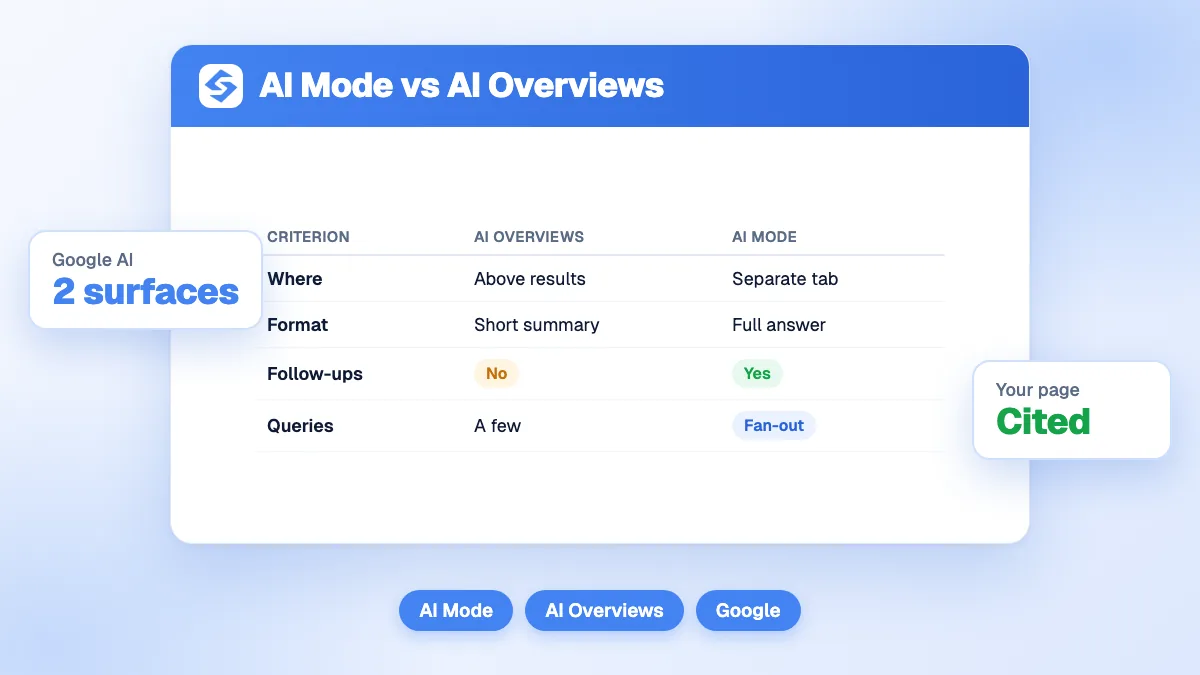
| Criterion | AI Overviews | AI Mode |
|---|---|---|
| Where it appears | At the top of the classic results page | In a separate tab, instead of the results list |
| Who triggers it | Google, for some queries | The user, by opening AI Mode |
| Length of the answer | Short summary | Full answer with sections, lists, sometimes tables |
| Follow-up questions | No (a new search starts over) | Yes, in a conversation |
| Searches behind the answer | A few | Many sub-queries (fan-out) |
| Classic links on the page | Yes, below the summary | Only the cited sources |
| Typical queries | Informational, how-to | Complex, comparative, multi-step |
| Launch (United States) | May 14, 2024 | May 20, 2025 |
| Reporting | Search Console, Web search type | Search Console, Web search type |
The key difference is the role of the classic results. With AI Overviews, a user who wants more can still scroll to the ten links, so a well-ranked page keeps a chance of being clicked. In AI Mode, the only links on screen are the sources the answer cites: being one of them is the whole game.
Note
Both surfaces follow the same rules in Google's documentation AI features and your website: no special markup or file is needed, a page must be indexed and eligible for a snippet, and traffic is counted in Search Console with your web results.
Both answer part of the question on Google's page, so some searches end without a click. In a study of the browsing of 900 US adults in March 2025, the Pew Research Center found that users clicked a traditional result on 8% of visits when an AI summary was shown, against 15% without one. Informational pages (definitions, simple how-tos) are the most exposed; pages that support a decision or an action (pricing, comparisons, tools, local services) keep more clicks.
Google, for its part, states that clicks from pages with AI Overviews tend to be of higher quality, with users more likely to spend time on the site. The practical reading: fewer but more qualified visits on many informational queries, and a new type of visibility, the citation, that you need to measure separately. See also our page on zero-click search.
Example
For "what is a 301 redirect", an AI Overview answers in three lines and a few users click. For "migrate a 2,000-page Shopify store to a new domain without losing traffic", AI Mode runs sub-queries on redirects, sitemaps and Search Console, and cites the most precise guides: a detailed page on each step has a better chance there than a short definition.
No separate strategy, but two emphases on the same base. The base is classic SEO: crawlable, indexed, fast pages with useful content and internal links. Then:
Tip
Take your ten most important queries, search them in normal Google and in AI Mode, and note for each whether an AI Overview appears and which sources AI Mode cites. In one hour you know where you stand on both surfaces.
Search Console gives the total clicks and impressions but does not separate AI surfaces from classic results. To know whether you are cited, you need to check the answers themselves. The free AI Overview checker tests a query, our comparison of AI Overviews tracking tools lists the options, and Sorank's AI Overview tracker follows your queries over time. For assistants outside Google, AI mention tracking does the same in ChatGPT, Claude and Gemini.
Gemini powers both surfaces, so our Gemini citation study is a good indicator of the kinds of sites Google's AI tends to cite.
AI Overviews summarize, AI Mode converses; the first sits on top of your rankings, the second replaces them with citations. A page that answers clearly and a site that covers every sub-question of its topic are the two levers that work on both. Sorank is SEO and GEO software that runs on autopilot: it finds your keywords and their sub-questions, then the article generator writes and publishes answer-first articles with sources and tables. See the Sorank plans, with a 3-day free trial.

Yes. The two surfaces use the same eligibility rules but build their answers differently. AI Overviews often cite pages that answer the main question directly, while AI Mode runs many sub-queries and can cite other pages that cover a specific part of the question better.
No. Both exist side by side: AI Overviews appear on the classic results page for some queries, and AI Mode is a separate tab the user chooses to open. Google has said it moves some AI Mode features into core Search over time, so the two keep evolving.
Clicks and impressions from AI Mode are included in the Performance report under the Web search type, together with the rest of your organic traffic. There is no dedicated filter, so pair Search Console with regular checks or a tracker that records which sources AI Mode cites for your key questions.
We analyse your competitors, your website and your AI visibility to create a tailored content plan for free.
 AI Content Brief Generator
 FAQ Schema Generator
 AI Blog Post Ideas Generator
 Structured Data Validator (Schema Validator)
 Alt Text Checker
 Internal Link Analyzer
 Backlink Challenge
 AI Meta Description Generator
 AI Blog Title Generator
 Google Indexability Checker
 AI Blog Outline Generator
 UTM Link Builder
 Keyword Clustering Tool
 Canonical Tag Checker
 XML Sitemap Generator
 Broken Link Checker
 AI SEO Title Generator
 Headline Analyzer
 SERP Preview Tool
 Redirect Checker
 Hreflang Tag Generator
 Heading Structure Analyzer
 HTTP Headers Checker
 Favicon Extractor
 SERP CTR Calculator
 SEO vs Paid Search Savings Calculator
 SEO Share of Voice Calculator
 SEO ROI Calculator
 SEO Traffic and Revenue Forecast Calculator
 SEO Budget Calculator
 SEO Break-Even Calculator
 SaaS SEO ROI Calculator
 ROAS Calculator
 Reading Time Calculator
 Ranking Gain Simulator
 Organic Traffic Value Calculator
 Organic Traffic Estimator and Website Traffic Checker
 LTV to CAC Ratio Calculator
 Local SEO ROI Calculator
 Link Building Cost Calculator
 Keyword Value Calculator
 Keyword Opportunity Score Calculator
 Keyword Density Calculator
 GEO ROI Calculator
 GEO Content Investment Calculator
 Ecommerce SEO ROI Calculator
 Customer Lifetime Value Calculator
 Customer Acquisition Cost Calculator
 CTR Calculator
 Cost Per Article Calculator
 Conversion Rate Calculator
 Content Marketing ROI Calculator
 ChatGPT Referral Traffic Estimator
 Bounce Rate Calculator
 Backlink ROI Calculator
 AI Visibility Score Calculator
 AI Traffic Value Calculator
 AI Share of Voice Calculator
 Cost of AI Invisibility Calculator
 AI Citation Rate Calculator
 llms.txt Validator
 AI Overview Checker and AI Overviews Rank Checker
 Robots.txt Checker
 AI SEO Audit
 LLM Readability Checker
 SearchGPT Readiness Checker
 Structured Data LLM Audit
 Website Crawlability AI Audit
 Why ChatGPT Is Not Recommending My Website
 Gemini Ranking Tool
 Perplexity Ranking Checker
 LLM Citation Checker
 Answer Engine Optimization Audit
 GEO Audit
 AI Search Visibility Test
 ChatGPT Visibility Checker
 llms.txt Generator
 URL Extractor
 Webpage to Markdown
 Sitemap Checker
 SERP Volatility Sensor
 Page Size Checker
 Word Counter
 Slug Generator
 Schema Generator
 Robots Generator
 OG Preview
 Meta Tags Generator
 Image Compressor
 Favicon Generator
 On-Page SEO Audit: SEO Checker and SEO Analyzer
 Backlink Analysis Tool
 Keyword Research Tool
 Domain Authority Checker
THEY TRIED SORANK BEFORE YOU
 “I tested Sorank on a real client site and it's insane. It does everything an agency would bill you $1500 a month for. It's going into production on that client now.”

 Guillaume Guersanguersanguillaume.com“We are an Ads agency and we wanted to get our SEO back on track once and for all. Sorank gave us a clear view of our site, helped us prioritize optimizations, and properly structure our content. The tool is easy to use, well designed for a team, and very practical for centralizing tracking without having to juggle multiple platforms. A very solid foundation to start fresh with our SEO.”
 Gaspard MadouiAds Agency
 “I just let the Sorank software do its thing, and now my DR is 25 and my page is ranking higher.”
 Lucas Flandrefoundertrace.fr“I specialized in GEO thanks to Sorank. The GEO Leaderboard allows me to show my clients their position vs competitors on ChatGPT. It’s a real commercial differentiator.”
 MélanieSEO Freelance“Great service, works well for our website and helps us understand how to improve it to rank better on Google and elsewhere. Congrats, keep going, I recommend it.”
 Hugo T.E-commerce merchant