Preferences
Privacy is important to us, so you have the option of disabling certain types of storage that may not be necessary for the basic functioning of the website. Blocking categories may impact your experience on the website. More information
Privacy is important to us, so you have the option of disabling certain types of storage that may not be necessary for the basic functioning of the website. Blocking categories may impact your experience on the website. More information

Our Localo review covers every feature, the real cost per profile, the geo-grid tracker, its limits, a 14-day test plan and the best alternatives.
In short
Localo is a local SEO tool that guides you, week by week, through the optimization of your Google Business Profile: small tasks, geo-grid rank tracking, review replies, posts and edit protection. It costs $39 per month on annual billing for one business. It suits owners and small agencies, less so large networks or teams that need deep data.
Want to go further? Ask
Quick quiz
How should you get more local customers from Google?
Sorank matches your answers


Test it for 3 days on your own site and see where you stand on Google, ChatGPT and the other AIs.
Start 3-day free trial3 days free, then stop whenever you want. 90-day results guarantee, conditions apply.
Localo is a software as a service that turns local SEO into a weekly to-do list for your Google Business Profile. You connect the profile, Localo analyzes it, then it tells you what to fix, tracks where you rank on the map and helps you answer reviews and publish posts.
The company is LOCALO SP. Z O.O., based in Wrocław, Poland. The product was first sold under the name Surfer Local, then renamed Localo, partly to stop the confusion with Surfer, a different content optimization tool. If you read old reviews or videos that mention Surfer Local, they talk about the same product and the same team.
The site and the app exist in six languages (English, Polish, German, French, Spanish and Brazilian Portuguese), and Localo says the tool works in every country. That matters if you manage clients outside the United States: many local SEO tools are built around US directories and US data.
Localo in four numbers
Source: Localo pricing page, November 2026
If you are new to the topic, start with what a Google Business Profile is and how it feeds the map results: everything Localo does revolves around that one listing. Localo is not a website SEO tool. It does not write your site pages, does not build links to your domain and does not audit your technical SEO. Keep that in mind for the whole review.
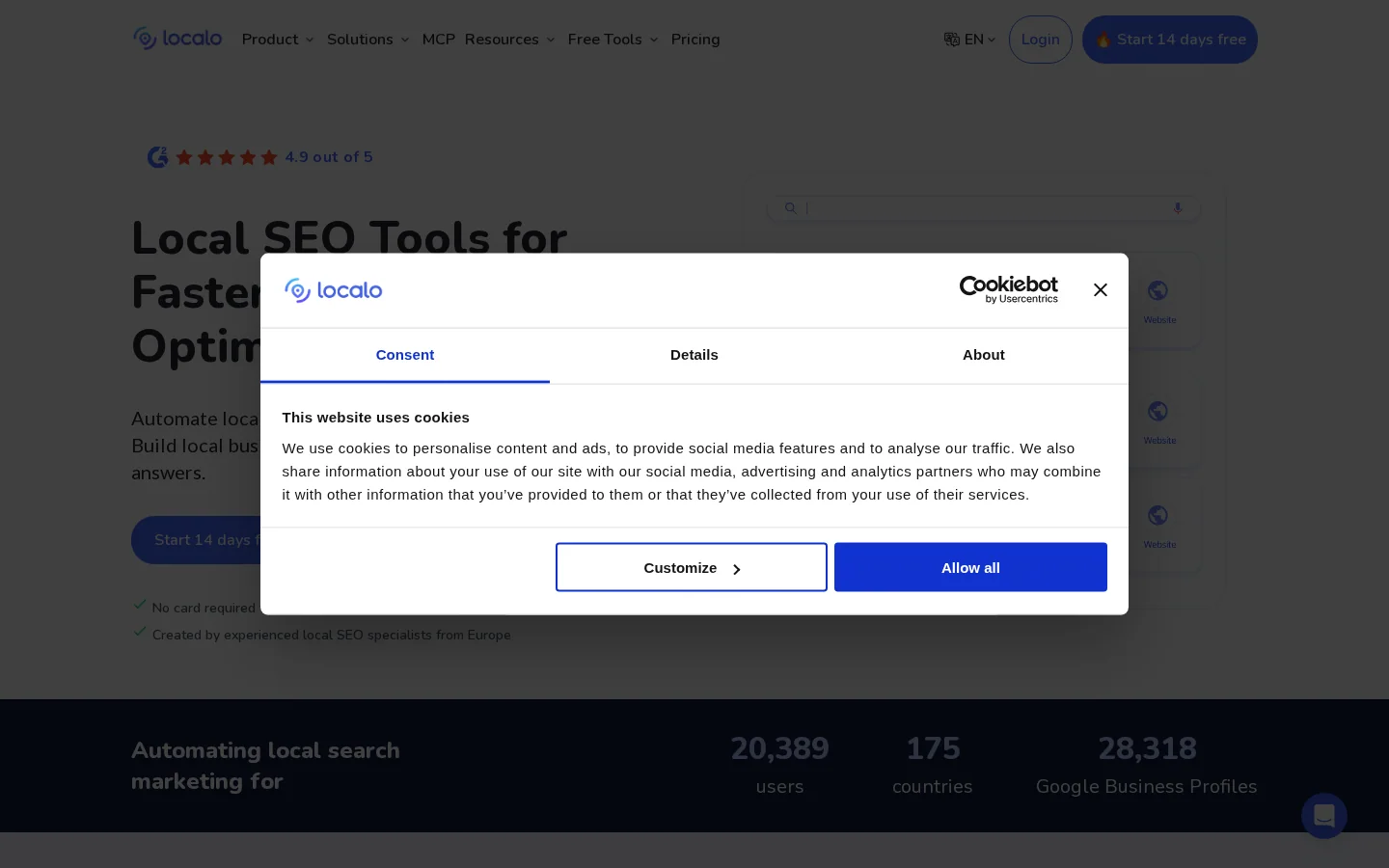
Localo bundles about a dozen modules around the Business Profile. The core is Smart Tasks and the rank tracker; the rest supports them. Here is what each module really does, based on Localo's own feature pages, and what stays manual.
| Module | What it does | Automated | Still manual |
|---|---|---|---|
| Smart Tasks | Weekly list of small fixes for each profile | Analysis, task list, reminders, carry-over | Every edit, marking tasks as done |
| Local Rank Tracker | Position map for up to 10 keywords per profile | Weekly scans, history, competitor view | Choosing keywords and grid settings |
| Protection | Reverses edits suggested by outsiders | Detection and reversal within 15 minutes | Nothing once enabled |
| Content Publisher | AI posts and offers, calendar, Facebook cross-posting | Drafting and scheduling | Topics and proofreading |
| Review Manager | Google reviews of all locations in one inbox | Four reply suggestions, publishing | Choosing and approving each reply |
| Citations Manager | Directory list based on your industry and competitors | List building, status tracking | Creating each listing |
| Reports | Weekly or monthly client reports, white label on Pro | Report generation | Review before sending |
| AI Agent and MCP | Ask questions about your data in a chat, or from ChatGPT and Claude | Reading the data | Acting on the answers |
Smart Tasks is a weekly batch of small optimization tasks for each connected profile: add photos, write a post, rework the description, update business information. Each task comes with instructions and a shortcut to the right place. Localo estimates the work at about 35 minutes per week and says the low volume is deliberate, to avoid triggering Google's spam detection with too many edits at once. Unfinished tasks roll over to the next week.
The technical point to understand: Localo chooses the tasks, but it does not make the changes for you. The value is the prioritization and the rhythm, not automation. For a business owner who never knows where to start, that is exactly the missing piece. For an experienced local SEO, the list can feel basic, because it covers the same categories as any local SEO audit done step by step.
The rank tracker shows, on a map, your position for a keyword at many points around the business. Localo's rank tracker page gives the limits: up to 10 keywords per profile, weekly updates, 25 or more spots in standard mode, and an advanced mode with grids of 9 to 49 control points over areas of 1 to 50 km. We detail how to read it in its own section below.
Anyone can click "Suggest an edit" on your listing and propose a new name, phone number, address, or even mark you as permanently closed. Google sometimes publishes those edits without asking you. Localo's Protection page says the system catches an unauthorized change within 15 minutes and reverses it, for name, phone, address and closed status. Changes made from your own connected Google account are left alone.
This is the feature that pays for the tool on its own in competitive trades (locksmiths, towing, plumbers, lawyers), where competitors and spammers really do hijack listings.
Content Publisher writes Google posts and offers from a topic, in a brand voice that Localo builds from your profile, site and social pages. You can queue a month of posts and send the same post to your Facebook Page through Meta Business Suite. Review Manager gathers the Google reviews of every location in one view and offers four AI reply suggestions per review. You still approve each reply: Localo notes that Google discourages fully automated review responses.
Review Manager covers Google only. If your customers also review you on Yelp, Facebook or industry sites, you will handle those elsewhere. For the replies themselves, the method matters more than the tool: see our guide on how to respond to Google reviews without sounding like a template.
Citations Manager builds a list of directories chosen from your industry, location and competitors, then tracks the status of each listing. It does not submit listings for you: you open each directory, create the citation and mark it as done. If you need a refresher on why these listings matter, read the definition of local citations and their role in local trust.
Reports produces weekly or monthly client reports, white label on the Pro plan. The AI Agent answers questions about your profile, industry and competitors in a chat. The MCP connector goes further: it lets you query your Localo data from ChatGPT or Claude. It is included in every plan, reads rankings, impressions, reviews and keywords, and can manage keywords, tasks and reports inside Localo. It never writes to the Business Profile itself, and Localo states that Gemini is not supported.

Localo has three plans: Single Business at $39 per month billed annually ($49 per month without the annual discount), Pro at $149 per month billed annually ($169 otherwise), and Enterprise on quote. All prices are before tax. The figures below come from Localo's pricing page, checked in November 2026.
| Plan | Monthly price | Annual billing (per month) | Active profiles | Optimization seats | Best for |
|---|---|---|---|---|---|
| Single Business | $49 | $39 | 1 | 1 | One owner, one location |
| Pro | $169 | $149 | 60 | Up to 30 | Freelancers and agencies |
| Enterprise | On quote | On quote | Custom | Custom | Networks and large agencies |
The Pro plan has two limits, and they are not the same thing. An active profile is a listing connected to Localo (tracking, reviews, reports). An optimization seat is a profile that also gets the weekly Smart Tasks. On Pro, you can connect up to 60 profiles but optimize up to 30. If your agency sells "full optimization" to 40 clients, you hit the seat limit before the profile limit.
Pro at $149 per month costs about $2.50 per profile per month if you fill all 60 slots, and about $5 per optimized profile if you use all 30 seats. With only 3 clients, the same plan costs about $50 per client per month, more than buying three Single Business plans. Do the math on your real portfolio, not on the plan ceiling.
cost per profile per month = plan price / profiles you actually connect
Pro, 60 profiles: 149 / 60 = 2.48 dollars
Pro, 30 profiles: 149 / 30 = 4.97 dollars
Pro, 3 profiles: 149 / 3 = 49.67 dollarsWhen we read the pricing page, three details did not match. First, the annual discount is shown as "2 months free" (about 17%), while the FAQ promises 20%; the real gap is 20% on Single Business ($39 vs $49) but about 12% on Pro ($149 vs $169). Second, the Pro plan says 60 active profiles in the table, while a bullet says it is "best for managing 2 to 10 profiles". Third, the FAQ still mentions "Pro 30" and "Pro 60" tiers that no longer appear in the plan list. None of this is a red flag, but ask support to confirm your limits in writing before you pay for a year.
Renewal and refunds
Localo's FAQ says subscriptions renew automatically on the billing date without additional notification, and that refunds are processed if you contact the team within 30 days of payment. Put the renewal date in your calendar the day you subscribe.
A geo-grid tracker simulates searches from many points around your business and records your position at each point. It answers the question a classic rank tracker cannot: "where on the map do I appear in the local pack, and where do I disappear?" Since distance is one of the three factors Google names for local ranking, your position changes from one street to the next.
In advanced mode, Localo lets you choose grids from 9 points (3 by 3) to 49 points (7 by 7), over an area from 1 to 50 km, with the center pin placed anywhere. The spacing between two points depends on the width of the area and the number of points per side:
spacing between points = area width / (points per side - 1)
7 x 7 grid over a 6 km wide area: 6 / (7 - 1) = 1 km between points
3 x 3 grid over the same area:    6 / (3 - 1) = 3 km between points
A 7 by 7 grid over a 6 km area gives one reading per kilometer, which is fine for a neighborhood business. Over 50 km, the same grid leaves more than 8 km between points: useful for a service area business, too coarse for a dentist in a dense city. Specialized trackers go much finer: Local Falcon offers grids up to 21 by 21, or 441 points per scan.
Points measured per scan, by grid size
Sources: Localo rank tracker page; Local Falcon pricing page, November 2026
Each marker on the map is colored by position range: 1 to 3, 4 to 10, 11 to 20, and beyond 20. The outline color shows difficulty: green for easy, orange for medium, red for the most competitive points. Localo then computes your average position across all points, compares it with the averages of competitors on the same keyword, and gives you a rank: "rank 3" means you are the third best performer on that map, not that you are third everywhere.
Example, 3 x 3 grid, keyword "emergency plumber"
positions:  1  2  4
            1  1  3
            6  9  20+
average position = sum of positions / number of points
The catch is the "20+" points. Localo's page does not say which value it uses when you are absent from the results, and every tracker handles it differently (some count 20, some 21, some exclude the point). Two tools can therefore show different averages for the same map. Compare a tool with itself over time, never with another tool.
Localo updates positions weekly and tracks up to 10 keywords per profile. A weekly scan is enough to follow a trend over months. It is not enough to measure the effect of a change made on Tuesday, or to catch a sudden drop after a Google update. History starts when tracking starts, and replacing a keyword restarts its history, so choose your 10 keywords carefully on day one. Our guide to local rank tracking in the map, the pack and AI answers explains how to pick them.
Localo's strength is guidance: it tells a non-expert what to do this week, and it protects the listing. Its limits are depth (data, integrations, review platforms) and scope (the Business Profile only). Here is the balance, item by item.
Where Localo shines and where it stops
Buy Localo if you run one to a few locations yourself, or if you are a freelancer or small agency who needs a repeatable weekly routine for 5 to 30 profiles. Look elsewhere if your job is deep rank analysis, if you manage more than 60 profiles, or if your main problem is your website rather than your listing.
| Your situation | Verdict | Why |
|---|---|---|
| Owner of one shop, clinic or trade business | Good fit (Single Business) | Tasks tell you what to do, Protection guards the listing |
| Freelancer with 5 to 30 clients | Good fit (Pro) | White label reports, client access, cost per client drops fast |
| Agency with 2 or 3 clients | Borderline | Pro costs about $50 per client per month at that size |
| Agency selling rank reports | Weak fit | Weekly scans and 49 points max are too coarse |
| Network of more than 60 locations | Enterprise only | Above the Pro ceiling, price on quote |
| Business whose website gets no traffic | Not enough alone | Localo does not work on site content or links |
Our overall verdict: Localo is one of the most approachable Business Profile tools for small businesses and small agencies, with a real differentiator in Protection. It is a coach and a guard for your listing, not an analytics suite.
There is no single "best" local SEO tool, because tools follow different approaches. Pick the approach first, then the tool. Our comparison of the best local SEO tools on verified features and prices goes wider; here are the five approaches that compete with Localo directly.
Principle: the tool decides what to do each week and you execute. When to use it: you lack time or expertise. Advantages: fast start, steady rhythm, protection. Limits: limited data depth. Example: a hair salon owner who spends 35 minutes on Monday morning on the week's tasks.
Principle: a broad toolbox of audits, rank tracking, citation building and reports, priced per location. When to use it: an agency that sells reporting and audits. Advantages: depth, many report formats. Limits: you must know what to do with the data. Example: BrightLocal's pricing page (November 2026) lists Track from $31 per month for one location on annual billing ($41 monthly), with a 14-day trial. Our BrightLocal review with its real costs details each plan.
Principle: pay per map point scanned, choose any grid from 3 by 3 to 21 by 21. When to use it: you need dense, on-demand maps. Advantages: precision, scan whenever you want. Limits: no task list, no review inbox. Example: Local Falcon's pricing page lists a Starter plan at $24.99 per month for 7500 credits, one credit per point: that is about 153 scans of 7 by 7, or 17 scans of 21 by 21. Our ranking of local rank trackers compared honestly covers the others.
Principle: tools and a done-for-you service focused on listing accuracy. When to use it: your name, address and phone are inconsistent across directories. Advantages: the submissions are done for you. Limits: a narrower scope. Example: Whitespark's pricing page (November 2026) lists its Local Rank Tracker from $14 to $200 per month, and listing packages from $20 to $999 as a one-time fee.
Principle: the Business Profile dashboard, its performance stats and a spreadsheet. When to use it: one location, a tight budget and some discipline. Advantages: free, direct. Limits: no grid view, no edit protection, no reminders. Example: a weekly 30-minute routine built from our guide to keeping business listings accurate.
| Approach | Example tool | Entry price checked | Best at | Weak at |
|---|---|---|---|---|
| Guided coach | Localo | $39 per month, annual | Weekly tasks, protection | Data depth |
| Reporting suite | BrightLocal | $31 per month, annual, 1 location | Audits and reports | Telling you what to do |
| Pure grid tracker | Local Falcon | $24.99 per month, 7500 credits | Dense maps on demand | Everything else |
| Citation specialist | Whitespark | $14 per month (rank tracker) | Listing accuracy | Profile management |
| Do it yourself | Google Business Profile | Free | Control, no cost | Time, no grid view |
The trial lasts 14 days, without a card. Since rankings update weekly, you will see only two or three readings: use the trial to test the workflow and the data quality, not to judge ranking gains. Here is the method we recommend.
The 14-day Localo test
For an agency, run the test on two real clients: one easy (few competitors) and one hard (dense city, competitive trade). The difference between the two maps tells you more about the tool than any demo. Before you choose the 10 keywords, our method for local keyword research helps you avoid wasting slots.
Keep a simple log during the test, so the decision on day 13 rests on facts:
date,task,minutes,found_alone(yes/no),words_rewritten,note
D2,add 5 photos,12,yes,0,
D3,rewrite description,8,no,40,AI draft too generic
D5,reply to 5 reviews,10,yes,25,
D8,scan 2 read,15,,,"plumber" avg 6.2 vs baseline 6.5
Checklist before you pay for Localo
Most disappointments with Localo come from a wrong expectation, not from the tool. Here are the seven we see most, with how to spot and fix each one.
What it is: canceling or buying because the map moved, or did not, during the trial. How to spot it: your decision rests on one ranking change. How to fix it: judge the trial on workflow and data quality; judge rankings after 8 to 12 weekly readings.
What it is: tracking your brand name, near duplicates ("plumber" and "plumbers") or terms nobody searches. How to spot it: you rank first everywhere on half your keywords. How to fix it: keep one keyword per service and intent. Remember that replacing a keyword restarts its history, so fix the list early.
What it is: centering every scan on your address when your customers are elsewhere. How to spot it: green maps but flat calls. How to fix it: move the center pin to the neighborhoods you want to win, and widen the area for a service area business. Our article on local ranking factors and their weight explains why distance shapes the map.
What it is: accepting the first suggestion every time. How to spot it: your replies start the same way, your posts sound like anyone's. How to fix it: add one concrete detail per reply (the service, the first name of the employee, the neighborhood) and one real fact per post (a price, a date, a photo of the work).
What it is: catching up on several weeks of tasks with a burst of edits. How to spot it: name, categories, hours and description all changed the same day. How to fix it: keep the weekly rhythm Localo proposes. Mass edits can send a profile to review or worse: our guide to Business Profile suspensions and how to prevent them lists the triggers.
What it is: paying a year, forgetting the tool, then being renewed without warning. How to spot it: an annual charge you did not expect. How to fix it: calendar reminders at day 25 after payment (refund window) and one month before renewal.
What it is: buying a listing tool to solve a website problem. How to spot it: your listing is complete, but your site has a few thin pages and no links. How to fix it: treat the site as a separate project, covered in the next section.
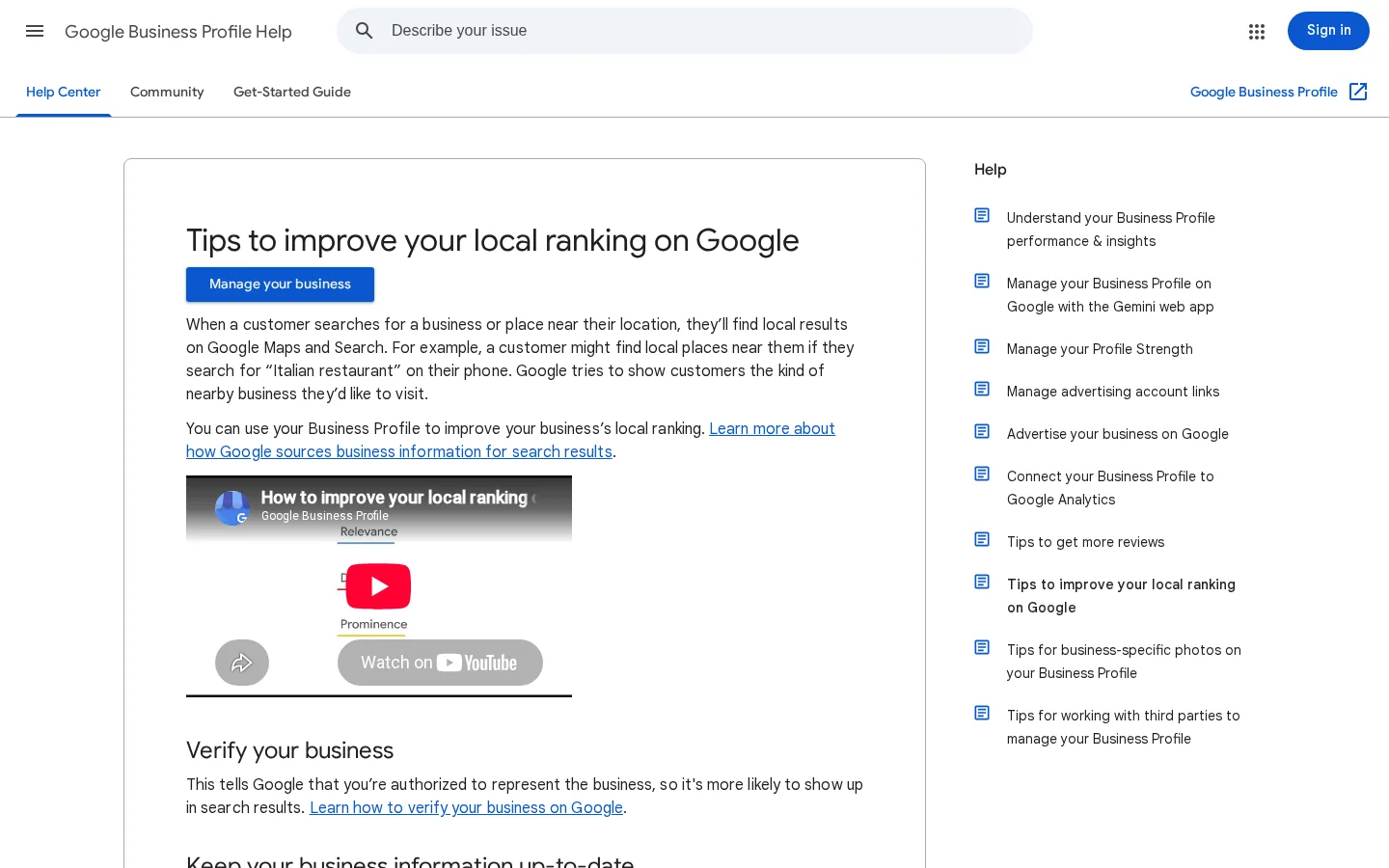
Google itself ties local prominence to your presence on the wider web. On its page "Tips to improve your local ranking on Google", Google names relevance, distance and prominence as the three factors, links prominence to links and reviews, and states that there is no way to request or pay for a better local ranking. Localo works on the listing side of relevance and prominence. Your website, its content and the links pointing to it are the other half.
That other half also decides whether ChatGPT, Claude and Gemini recommend you: AI models read your site, the pages that cite you and your reviews, not just your listing. Our guide to local GEO and getting recommended by AI models explains how they choose local businesses. One quick technical win is to add LocalBusiness markup to your site; our free schema markup generator builds the JSON-LD for you.
This is where Sorank complements a tool like Localo. Sorank works on autopilot on your website: it finds the keywords, writes and publishes the SEO articles for Google and AI search, gets you natural backlinks from sites in your niche through link exchanges between users, and tracks when ChatGPT and other AI models mention you. Localo keeps the listing in shape; Sorank grows the site behind it.
Tip
Before you add a monthly tool to your budget, estimate what local search is worth to you with our local SEO ROI calculator. If one extra customer per month covers the subscription, the decision becomes easy.
Localo is a solid choice for a business owner or a small agency that wants a clear weekly routine on Google Business Profiles, with automatic protection against hostile edits. Its weak points are data depth, Google-only reviews and manual citations. Test it for 14 days with your own baseline, check your real cost per profile, and pair it with work on your website if you want to grow beyond the map.
Localo's Single Business plan costs $49 per month, or $39 per month billed annually, for one Business Profile. The Pro plan costs $169 per month, or $149 per month billed annually, for up to 60 active profiles and 30 optimization seats. Enterprise is priced on quote, and all prices are before tax.
Yes, if you manage your Google Business Profile yourself and need someone to tell you what to do each week. Its Smart Tasks take about 35 minutes per week and its Protection module reverses hostile edits within 15 minutes. It will not improve your website, so pair it with work on your site content and links.
BrightLocal suits agencies that sell audits and reports, Local Falcon suits anyone who needs dense geo-grid maps on demand, and Whitespark suits businesses with inconsistent directory listings. For a single location on a tight budget, the free Google Business Profile dashboard and a weekly routine can be enough.
We analyse your competitors, your website and your AI visibility to create a tailored content plan for free.
 Website Value Calculator
 Website Accessibility Checker
 Google Analytics Checker
 Duplicate Content Checker
 Mobile-Friendly Test
 Website Speed Test
 Subdomain Finder
 Domain Age Checker
 CMS Detector
 Googlebot Simulator
 Nofollow Link Checker
 Meta Tag Checker
 Keyword Cannibalization Checker
 Keyword Intent Checker
 Keyword Extractor
 Google Ads Cost Calculator
 CPC Calculator
 Local Citation Finder
 Reddit Threads Finder
 Disavow File Generator
 Redirect Generator
 Canonical Tag Generator
 Passive Voice Checker
 Google Location Changer
 Google Review Calculator
 Google Review Link Generator
 Keyword Combiner
 Podcast Show Notes Generator
 AI Content Rewriter
 AI Text Humanizer
 ChatGPT Prompt Generator
 Twitter Thread Generator
 Tweet Generator
 Landing Page Copy Generator
 Google Ads Copy Generator
 Pinterest Pin Description Generator
 Anchor Text Generator
 Social Media Post Generator
 LinkedIn Post Generator
 Free AI Writer
 Review Response Generator
 LSI Keyword Generator
 YouTube Video Ideas Generator
 YouTube Tag Generator
 YouTube Description Generator
 Product Description Generator
 CTA Generator
 Blog Introduction Generator
 Conclusion Generator
 Hook Generator
 AI Content Brief Generator
 FAQ Schema Generator
 AI Blog Post Ideas Generator
 Structured Data Validator (Schema Validator)
 Alt Text Checker
 Internal Link Analyzer
 Backlink Challenge
 AI Meta Description Generator
 AI Blog Title Generator
 Google Indexability Checker
 AI Blog Outline Generator
 UTM Link Builder
 Keyword Clustering Tool
 Canonical Tag Checker
 XML Sitemap Generator
 Broken Link Checker
 AI SEO Title Generator
 Headline Analyzer
 SERP Preview Tool
 Redirect Checker
 Hreflang Tag Generator
 Heading Structure Analyzer
 HTTP Headers Checker
 Favicon Extractor
 SERP CTR Calculator
 SEO vs Paid Search Savings Calculator
 SEO Share of Voice Calculator
 SEO ROI Calculator
 SEO Traffic and Revenue Forecast Calculator
 SEO Budget Calculator
 SEO Break-Even Calculator
 SaaS SEO ROI Calculator
 ROAS Calculator
 Reading Time Calculator
 Ranking Gain Simulator
 Organic Traffic Value Calculator
 Organic Traffic Estimator and Website Traffic Checker
 LTV to CAC Ratio Calculator
 Local SEO ROI Calculator
 Link Building Cost Calculator
 Keyword Value Calculator
 Keyword Opportunity Score Calculator
 Keyword Density Calculator
 GEO ROI Calculator
 GEO Content Investment Calculator
 Ecommerce SEO ROI Calculator
 Customer Lifetime Value Calculator
 Customer Acquisition Cost Calculator
 CTR Calculator
 Cost Per Article Calculator
 Conversion Rate Calculator
 Content Marketing ROI Calculator
 ChatGPT Referral Traffic Estimator
 Bounce Rate Calculator
 Backlink ROI Calculator
 AI Visibility Score Calculator
 AI Traffic Value Calculator
 AI Share of Voice Calculator
 Cost of AI Invisibility Calculator
 AI Citation Rate Calculator
 llms.txt Validator
 AI Overview Checker and AI Overviews Rank Checker
 Robots.txt Checker
 AI SEO Audit
 LLM Readability Checker
 SearchGPT Readiness Checker
 Structured Data LLM Audit
 Website Crawlability AI Audit
 Why ChatGPT Is Not Recommending My Website
 Gemini Ranking Tool
 Perplexity Ranking Checker
 LLM Citation Checker
 Answer Engine Optimization Audit
 GEO Audit
 AI Search Visibility Test
 ChatGPT Visibility Checker
 llms.txt Generator
 URL Extractor
 Webpage to Markdown
 Sitemap Checker
 SERP Volatility Sensor
 Page Size Checker
 Word Counter
 Slug Generator
 Schema Generator
 Robots Generator
 OG Preview
 Meta Tags Generator
 Image Compressor
 Favicon Generator
 On-Page SEO Audit: SEO Checker and SEO Analyzer
 Backlink Analysis Tool
 Keyword Research Tool
 Domain Authority Checker
 “I tested Sorank on a real client site and it's insane. It does everything an agency would bill you $1500 a month for. It's going into production on that client now.”

 Guillaume Guersanguersanguillaume.com“We are an Ads agency and we wanted to get our SEO back on track once and for all. Sorank gave us a clear view of our site, helped us prioritize optimizations, and properly structure our content. The tool is easy to use, well designed for a team, and very practical for centralizing tracking without having to juggle multiple platforms. A very solid foundation to start fresh with our SEO.”
 Gaspard MadouiAds Agency
 “I just let the Sorank software do its thing, and now my DR is 25 and my page is ranking higher.”
 Lucas Flandrefoundertrace.fr“I specialized in GEO thanks to Sorank. The GEO Leaderboard allows me to show my clients their position vs competitors on ChatGPT. It’s a real commercial differentiator.”
 MélanieSEO Freelance“Great service, works well for our website and helps us understand how to improve it to rank better on Google and elsewhere. Congrats, keep going, I recommend it.”
 Hugo T.E-commerce merchant