Preferences
Privacy is important to us, so you have the option of disabling certain types of storage that may not be necessary for the basic functioning of the website. Blocking categories may impact your experience on the website. More information
Privacy is important to us, so you have the option of disabling certain types of storage that may not be necessary for the basic functioning of the website. Blocking categories may impact your experience on the website. More information

 Ahrefs Brand Radar Review: How It Measures AI Visibility, What It Costs, Where It Falls Short
Ahrefs Brand Radar review: how its 578M prompts are built, real pricing and check math, a 30-minute audit protocol, common mistakes and who should buy it.

In short
Ahrefs Brand Radar is a research index that runs hundreds of millions of search-derived prompts through ChatGPT, Perplexity, Gemini, Copilot, AI Overviews and AI Mode, then lets you search the answers for your brand and your competitors. It is the best tool on the market for benchmarking a category at scale, but it is not a tracker of your own prompts unless you pay for custom prompts, and its chatbot data refreshes only once a month. Buy it if you already live in Ahrefs and need market-level share of voice; pair it with a prompt tracker if you need to act every week.
Want to go further? Ask
Quick quiz
What should you work on first for your brand?
Sorank matches your answers


Test it for 3 days on your own site and see where you stand on Google, ChatGPT and the other AIs.
Start 3-day free trial3 days free, then stop whenever you want. 90-day results guarantee, conditions apply.
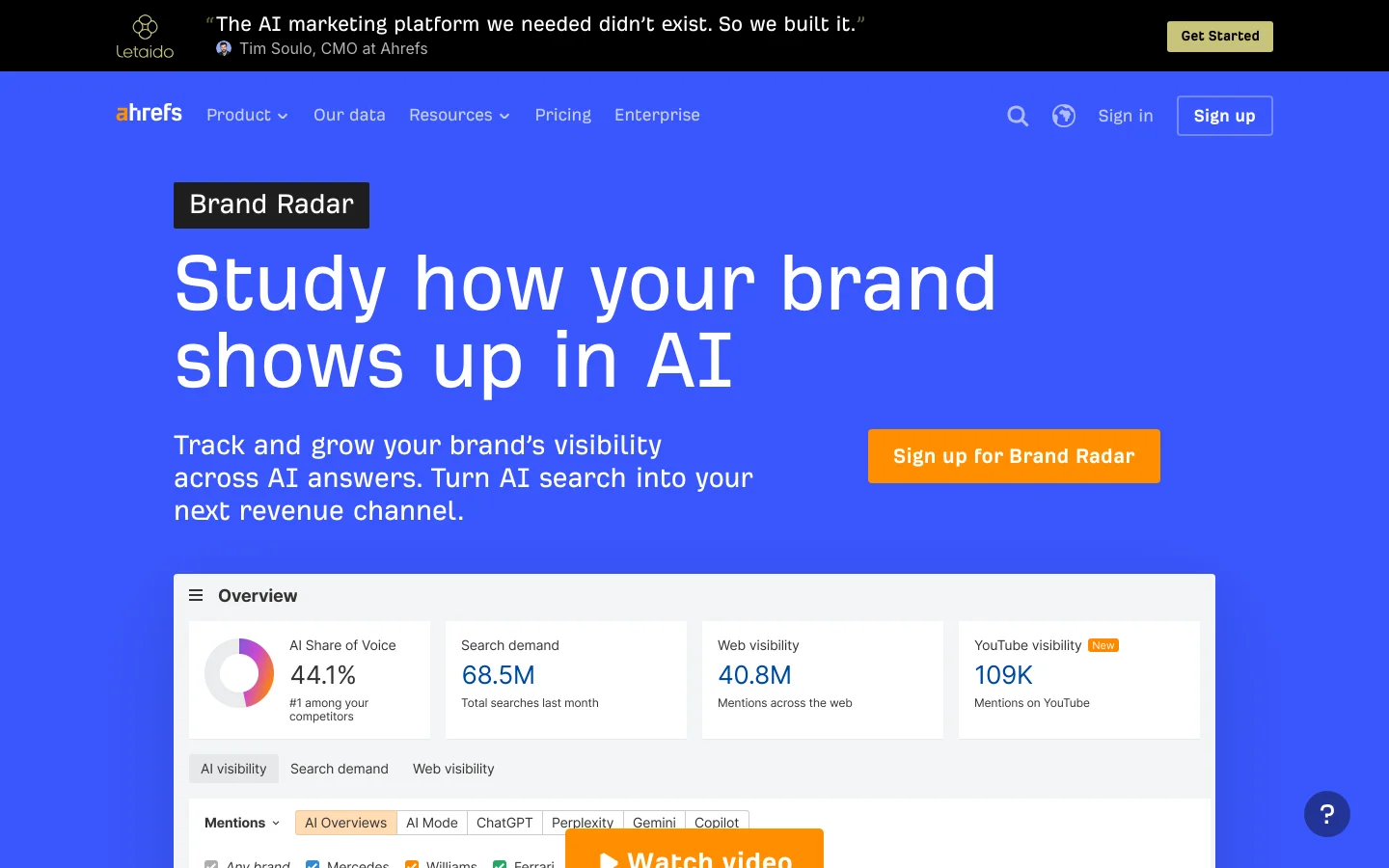
Brand Radar is the part of Ahrefs that measures how visible a brand is outside classic rankings: in AI answers, in search demand, on the web and on video platforms. You type a brand, a domain or any term, and Brand Radar shows how often it appears in its stored AI answers, which pages get cited, and how you compare with competitors.
The key idea to understand before you pay: Brand Radar is first a database you query, not a monitor you configure. Ahrefs runs its own prompts, stores the raw answers, and you search that corpus. That is the opposite of most AI visibility trackers, where you write 50 prompts and the tool checks them for you. Ahrefs added this second mode later, under the name custom prompts (or Prompt Tracking).
So when people ask "is Brand Radar good?", the honest answer depends on which question you ask it. "Who owns the conversation about CRM software in AI answers?" Brand Radar answers that better than anyone. "Did ChatGPT recommend us this week for best CRM for a 10-person agency?" Only the paid custom prompts answer that, and only for the prompts you add.
| Module | What it measures | Refresh (per Ahrefs help center) | Access |
|---|---|---|---|
| AI visibility (index) | Mentions and citations of a term in stored answers from AI Overviews, AI Mode, ChatGPT, Perplexity, Gemini, Copilot | Chatbots: once a month. AI Overviews: every few days | Brand Radar AI add-on |
| Custom prompts | Your own prompts, checked on the platforms you choose | Daily to monthly, your choice | Prompt packages (checks per month) |
| Search demand | Branded search volume and its trend | Every few days | Starter plan and above |
| Web visibility | Mentions of the brand on web pages | Every few minutes | Standard plan and above |
| Video and social (YouTube, TikTok, Reddit) | Mentions in videos and threads | Beta | Free on Lite and above during the beta |
This table comes from the Ahrefs help center article "What is Brand Radar and how do you use it", read on 18 November 2026. Note one detail that most reviews skip: Grok data collection is listed as temporarily paused, and Claude is only tracked through the API for custom prompts, at 8 checks per run.
A visibility number is only as good as the prompts behind it. Ahrefs published its method in "Ahrefs Brand Radar Methodology", written by Rebekah Bek and last updated on 26 February 2026. Here is what it says, in plain words.
Ahrefs does not use real chatbot logs. It starts from Google "People Also Ask" questions and from its keyword database (about 110 billion keywords, 28.7 billion with positive search volume). It then expands these seeds with two systems: PAA, which follows real follow-up behavior, and "Fanout", which follows semantic relationships between topics. The prompts are run through the free, public web interfaces of each assistant, with a locale mix that mirrors the country and language ratios of the keyword database.
Consequence: Brand Radar measures how AI assistants answer search-shaped questions. That is a solid proxy for demand, because these questions are asked on Google. But it is not the same as conversational prompts like "I run a 12-person agency in Lyon, we hate HubSpot's price, what should we use?". Long, contextual prompts are under-represented by design. The methodology says it openly: long-tail and niche prompts may be missing.
Add these up and AI Overviews weigh about three quarters of all prompts (282M out of roughly 376M). This matters when you read a global "AI share of voice": unless you filter by platform, the number is mostly a Google AI Overviews number. If your buyers use ChatGPT more than Google, always filter the report on ChatGPT before you draw conclusions.
Ahrefs stores the raw answers and applies two simple detections:
Read these metrics as directional signals. The methodology states that Brand Radar is not a substitute for audience measurement or traffic analytics. If you want the theory behind why an assistant cites one page and not another, our guide on how AI assistants choose their sources explains retrieval, query fan-out and citation criteria.
Brand Radar data history and refresh milestones
Two technical consequences. First, chatbot data is monthly and uses a 90-day reporting window, so a content change you ship today shows in the index weeks later, and is smoothed with older answers. Second, custom prompt data starts the day you add a prompt: there is no backfill. Add your important prompts early, even before you need the report.
The interface follows the usual Ahrefs logic: you enter a site, click Analyze, Brand Radar suggests your brand and competitors, you correct the list, then click Explore. You can group several names and domains into one entity (useful for a brand with a product name that differs from the company name).
The default view compares share of voice, mentions, citations and impressions for your brand and your competitors. It is the screen you show a manager. Its weakness is the one explained above: without a platform filter it blends AI Overviews and chatbots, so the headline number hides very different situations.
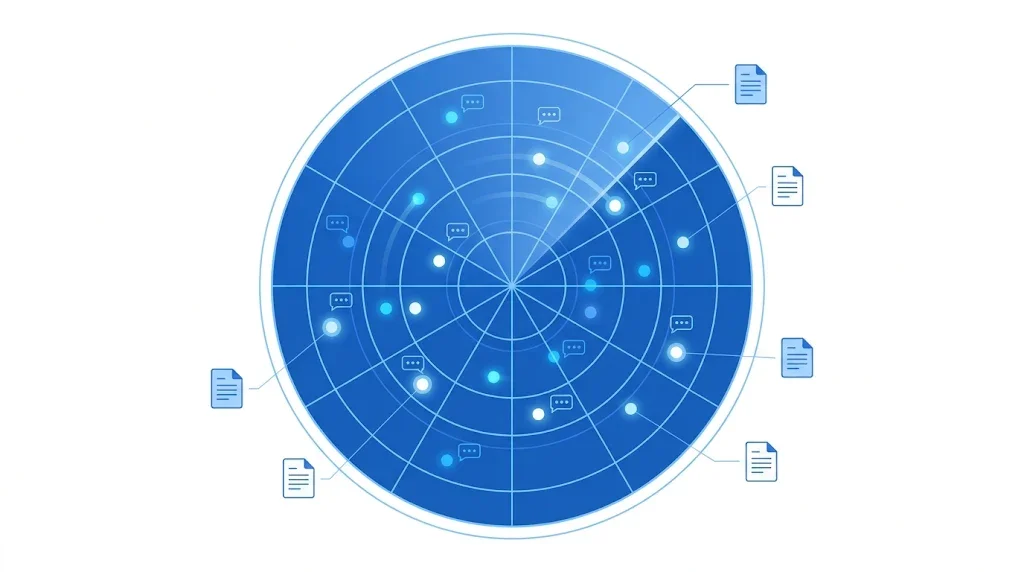
This is the core of the product. You see the list of stored prompts where your term appears, the answer text, the cited URLs, and you can sort by relevance or by search volume. Two uses are very strong here:
Here you add your own prompts, generate prompt ideas with AI, organize them with tags, choose the platforms and the frequency (daily, weekly, monthly), and see the fan-out queries behind each answer. This is what turns Brand Radar from a research database into a tracker. It is billed in checks, explained in the pricing section.
Search demand shows branded search volume over time, a good lagging indicator of AI visibility: if assistants recommend you more, more people search your name. Web visibility counts mentions on web pages, refreshed every few minutes. YouTube, TikTok and Reddit monitoring were free in beta on 18 November 2026, with Ahrefs announcing a future paid add-on.
You can save reports, build custom ones in the Report Builder, pull data through the Ahrefs API and connect Looker Studio. For an agency, the API and Looker Studio connector are what make monthly client reporting possible without screenshots.
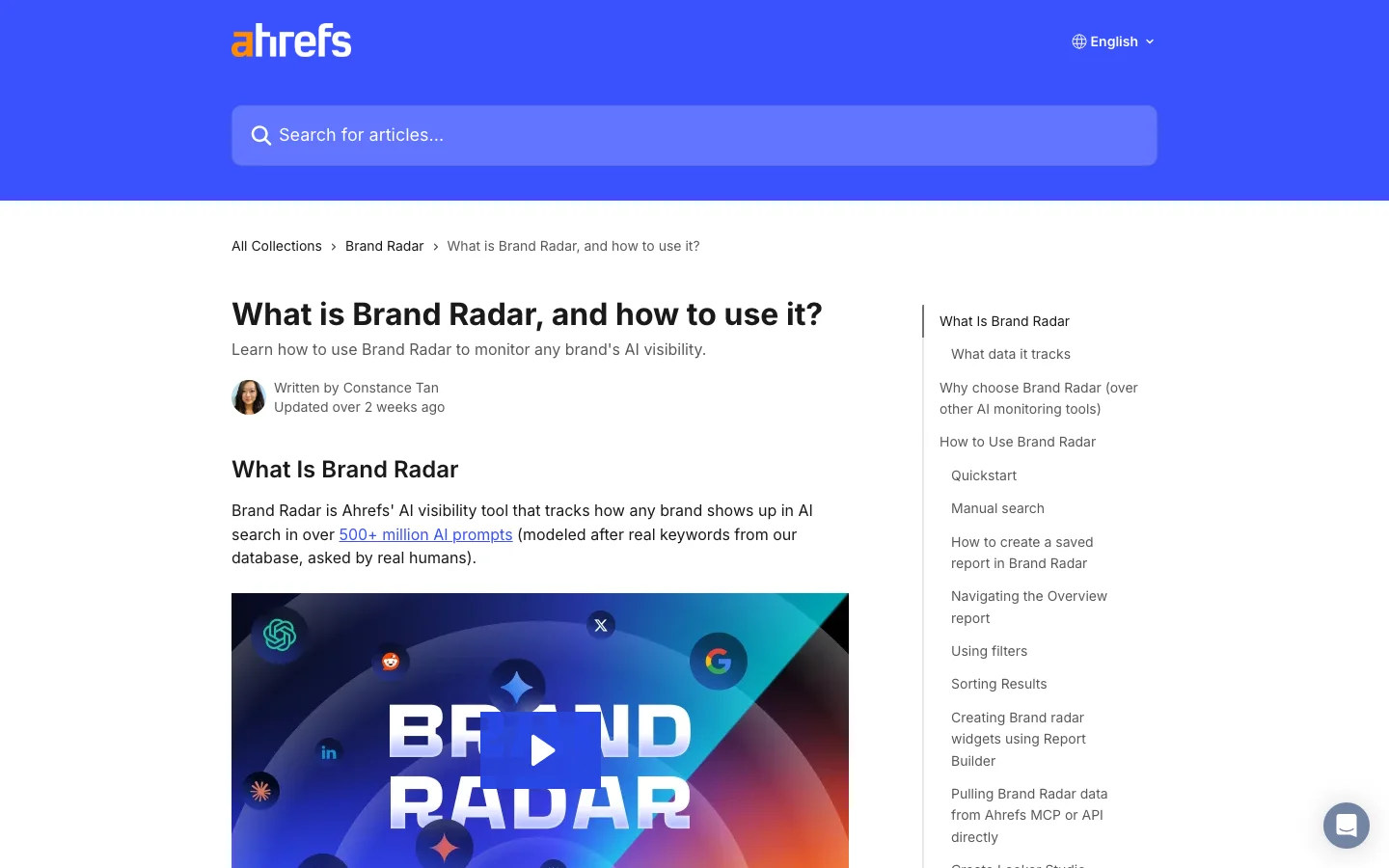
Ahrefs pricing for Brand Radar has changed several times since launch, and reviews published even a few months ago quote numbers that no longer exist. Here is what the Ahrefs pricing page and the Brand Radar product page showed on 18 November 2026, prices excluding tax.
Brand Radar in four numbers (18 November 2026)
Sources: ahrefs.com/pricing and ahrefs.com/brand-radar, read 18 November 2026
| Item | Price per month | What you get |
|---|---|---|
| Ahrefs Starter | $29 | Entry plan, gives access to Search demand |
| Ahrefs Lite | $129 | Core SEO suite |
| Ahrefs Standard | $249 | Adds Web visibility in Brand Radar |
| Ahrefs Advanced | $449 | Higher limits |
| Brand Radar AI add-on | From $199 | Research the 578M+ prompt database |
| Custom prompts Basic | $50 | 2500 checks |
| Custom prompts Growth | $100 | 7000 checks |
| Custom prompts Scale | $250 | 25000 checks |
Annual billing saves up to 17% according to the same page. The product page also states that overage on the AI Visibility Index is billed $0.020 per check.
One check is one prompt run once on one platform. Ahrefs gives the example: 5 prompts on 1 platform checked daily equals 150 checks per month. Claude is the exception, at 8 checks per update. Here is the formula to size your package before you buy:
checks_per_month = prompts × platforms × runs_per_month
                 (+ 7 extra checks per prompt per run if Claude is selected)

Example A: 40 prompts × 4 platforms × 30 daily runs   = 4800 checks  → Growth (7000)
Example B: 40 prompts × 4 platforms × 4 weekly runs   = 640 checks   → Basic (2500)
Example C: 40 prompts × (4 platforms + Claude) × 30   = 40 × (4 + 8) × 30 = 14400 → Scale (25000)
The lesson from example B: for most brands, weekly runs are enough. AI answers vary from one run to the next, so daily checks mostly add noise unless you are measuring the effect of a launch. Weekly frequency cuts the bill by more than 7 times.
Tip
Before paying for any tracker, run a quick free check of where you stand. Our ChatGPT visibility checker tests whether ChatGPT names your brand, and the AI share of voice calculator turns your counts into a share you can compare with competitors.
There are four methods to measure a brand in AI answers. Brand Radar sells two of them. Knowing all four stops you from paying for the wrong one.
Principle: a vendor runs millions of prompts built from search data and lets you query the answers. When to use it: category benchmarking, competitor research, finding cited third-party sources. Advantages: huge sample, history, no setup. Limits: prompts are search-shaped, refresh is monthly for chatbots, you cannot choose the prompts. Example: a project management SaaS checks its share of mentions against 5 rivals across all "best project management tool" style questions.
Principle: you write the prompts, the tool runs them on a schedule. When to use it: monitoring the 20 to 100 prompts that bring you customers, measuring the effect of content changes. Advantages: exact prompts, frequency control, fan-out queries visible. Limits: small sample, results depend on how well you wrote the prompts, cost grows with platforms. Example: an agency tracks "best SEO agency in Bordeaux" weekly on ChatGPT and Perplexity.
Principle: you ask the assistants yourself, several times, in a clean session, and log the results in a spreadsheet. When to use it: before buying a tool, or to audit a tool's numbers. Advantages: free, you see the real answer with personalization off. Limits: slow, not scalable, easy to bias. Our guide on how to track brand mentions in AI gives a full manual protocol.
Principle: measure visits that come from AI assistants (referrers such as chatgpt.com or perplexity.ai) in your analytics, plus AI crawler visits in your logs. When to use it: always, as the business truth. Advantages: real users, real conversions. Limits: many AI answers produce no click, so traffic underestimates visibility. Ahrefs sells this too, through Web Analytics and Bot Analytics.
| Method | Sample | Freshness | You choose the prompts | Best for |
|---|---|---|---|---|
| Search-derived index | Millions of prompts | Monthly (chatbots) | No | Market benchmark |
| Custom prompt tracking | Tens to hundreds | Daily to monthly | Yes | Weekly steering |
| Manual sampling | A few dozen | When you do it | Yes | Audit, first check |
| Traffic analytics | All real visits | Real time | Not applicable | Business impact |
Brand Radar index vs Brand Radar custom prompts
For steering, custom prompts win. For research, the index wins. Most teams that get value from Brand Radar use both: the index once a quarter to pick battles, custom prompts every week to track them.
Here is the protocol we recommend to get a usable answer from Brand Radar on day one, whether you are on a trial or deciding to renew.
The 6-step Brand Radar audit
Mentions are string matches. If your brand is written "Sorank", "SoRank" or "sorank.com", a single variant misses answers. List every variant, including common typos, before you analyze. If you export the raw answers to clean them yourself, a regex like this catches the usual variants without matching unrelated words:
(?i)\bso[\s\-]?rank(\.com)?\bAdapt it to your name, and test it on 20 exported answers before you trust a count. Short or generic brand names (a dictionary word, a first name) create false positives: in that case group the brand with its domain and read citations rather than mentions.
Export the gap prompts with their search volume, then cluster them by intent: comparison ("X vs Y"), best-of lists, how-to, pricing. Each cluster maps to one page type. Comparison prompts need an honest comparison page; best-of prompts need you to be listed on the third-party lists the assistants cite; how-to prompts need a guide that answers in the first paragraph. Our guide on AI visibility optimization details what each page type needs to get cited.
Search-shaped prompts ("best crm software") are already covered by the index. Your custom prompts should add what the index lacks: context. Add a company size, a constraint, a location, a competitor to avoid. "Which CRM should a 10-person agency use instead of HubSpot, budget under 50€ per user" tells you far more about your real pipeline than "best CRM".
What it is: taking the overview share of voice as "our AI visibility". How to spot it: your number barely moves when you publish great content, or it is far from what you see in ChatGPT. How to fix it: filter by platform. AI Overviews weigh about three quarters of the prompts, so the blended number is mostly a Google number.
What it is: checking the chatbot index every Monday after a content update. How to spot it: the report shows no change for weeks, then a jump. How to fix it: use custom prompts for weekly follow-up and read the index on a quarterly rhythm that matches the 90-day window.
What it is: one entity with one name. How to spot it: you find answers that mention you in manual checks but not in Brand Radar. How to fix it: group all name variants and the domain into one entity, and test variants with the regex above on exported answers.
What it is: counting every mention as a win. A string match also catches "avoid X, it is too expensive". How to spot it: mentions go up while branded search and AI referral traffic stay flat. How to fix it: read a sample of answers, check the sentiment view, and track citations and position in lists, not only raw mentions. Our glossary entry on AI share of voice explains how to weight these.
What it is: 100 prompts, 6 platforms, daily. That is 18000 checks per month before Claude. How to spot it: you jump to the Scale package and your charts are noisy. How to fix it: run weekly on the 2 or 3 platforms your buyers use, and switch to daily only for a launch window.
What it is: putting "estimated impressions" in a client report as audience. How to spot it: the number dwarfs your analytics. How to fix it: present it as a modeled index, as Ahrefs itself does, and pair it with real AI referral sessions from analytics.
What it is: monthly reports full of gaps and no publication plan. How to spot it: the same competitor owns the same prompts three reports in a row. How to fix it: each gap cluster gets an owner, a page to create or update, and a list of third-party sources to approach.
Brand Radar is not the only way to measure AI visibility, and it is often the wrong first purchase. Pick the alternative by the question you need answered. A category benchmark points to a search-derived index, weekly steering points to a custom prompt tracker, and a first baseline needs nothing more than a manual check. The index and a prompt tracker answer different questions, so teams often use both.
If you want to know who owns a topic in AI answers, you need a large sample of prompts. A search-derived index is built for that job, and its sample size is the main reason to pay for one. Other indexes and suites that report share of voice by topic can serve the same purpose. Check three things before you switch: how many prompts sit behind the number, which platforms are covered, and how often chatbot answers are refreshed.
If you need to know whether ChatGPT or Perplexity named you this week, a custom prompt tracker fits better. Write your buyer prompts with context, such as company size, budget or a competitor to avoid, then run the same list on a fixed schedule. A tracker is only as good as its prompts, so spend your effort on the wording before you look at the dashboard.
Before paying for any tool, run the check yourself. Open ChatGPT, Gemini and Perplexity in a private window, ask your ten most important buyer questions, and log who is recommended and which pages are cited. Repeat the run over several days, because answers change between sessions. The sample is small, but it shows whether you have a visibility problem at all, and it is the only way to audit the numbers a tracker gives you. Our guide to an AI visibility audit gives the full checklist.
Tip
Before you switch tools, run both on the same prompt list for two weeks. Our comparison of ChatGPT tracking tools is a useful shortlist to start from.
Buy it if you already pay for Ahrefs, you need to benchmark a whole category, you run competitive research for clients, or you need history to show a trend. The research index is unique and the link with Ahrefs SEO data saves hours.
Think twice if you are a small business with one site and no Ahrefs subscription. Paying a plan plus the add-on to answer "does ChatGPT recommend us for our 30 key prompts?" is expensive. A dedicated prompt tracker or manual sampling will do it for less.
Pair it with an action layer if you want results, not reports. Brand Radar finds the gaps; someone still has to write the pages, get listed on the cited sources and earn the links. This is where Sorank sits: its AI mention tracking follows your brand in ChatGPT, Gemini, Claude and Perplexity, the GEO leaderboard shows who the assistants recommend instead of you, and the content and backlink modules work on the gaps on autopilot.
For a side-by-side of the other trackers, read our comparison of the best AI visibility tools. If you are choosing between the two big SEO suites, our Semrush AI Visibility Toolkit review uses the same criteria as this one, so you can compare directly.
Brand Radar buying checklist
Your action for today: open ChatGPT and Perplexity in a private window, ask your 10 most important buyer questions, and note who gets recommended. That baseline, made in 20 minutes, tells you whether you need Brand Radar's scale, a smaller prompt tracker, or simply a content plan.
It is worth it if you already use Ahrefs and need to benchmark a whole category or research competitors in AI answers, because its prompt index has no equal in size. For weekly tracking of your own buyer prompts, you also need the paid custom prompts or a dedicated tracker, since chatbot data in the index refreshes only once a month.
On 18 November 2026, the Ahrefs pricing page listed the Brand Radar AI add-on from $199 per month, on top of an Ahrefs plan (Lite at $129 per month). Custom prompt packages cost $50, $100 or $250 per month for 2500, 7000 or 25000 checks, prices excluding tax.
Ahrefs builds its prompts from Google People Also Ask questions and its keyword database, expands them with related sub-questions, and runs them through the public interfaces of ChatGPT, Perplexity, Gemini, Copilot, AI Overviews and AI Mode. It stores the raw answers and detects mentions as text matches and citations as linked URLs, without personalization.
We analyse your competitors, your website and your AI visibility to create a tailored content plan for free.
 AI Content Brief Generator
 FAQ Schema Generator
 AI Blog Post Ideas Generator
 Structured Data Validator (Schema Validator)
 Alt Text Checker
 Internal Link Analyzer
 Backlink Challenge
 AI Meta Description Generator
 AI Blog Title Generator
 Google Indexability Checker
 AI Blog Outline Generator
 UTM Link Builder
 Keyword Clustering Tool
 Canonical Tag Checker
 XML Sitemap Generator
 Broken Link Checker
 AI SEO Title Generator
 Headline Analyzer
 SERP Preview Tool
 Redirect Checker
 Hreflang Tag Generator
 Heading Structure Analyzer
 HTTP Headers Checker
 Favicon Extractor
 SERP CTR Calculator
 SEO vs Paid Search Savings Calculator
 SEO Share of Voice Calculator
 SEO ROI Calculator
 SEO Traffic and Revenue Forecast Calculator
 SEO Budget Calculator
 SEO Break-Even Calculator
 SaaS SEO ROI Calculator
 ROAS Calculator
 Reading Time Calculator
 Ranking Gain Simulator
 Organic Traffic Value Calculator
 Organic Traffic Estimator and Website Traffic Checker
 LTV to CAC Ratio Calculator
 Local SEO ROI Calculator
 Link Building Cost Calculator
 Keyword Value Calculator
 Keyword Opportunity Score Calculator
 Keyword Density Calculator
 GEO ROI Calculator
 GEO Content Investment Calculator
 Ecommerce SEO ROI Calculator
 Customer Lifetime Value Calculator
 Customer Acquisition Cost Calculator
 CTR Calculator
 Cost Per Article Calculator
 Conversion Rate Calculator
 Content Marketing ROI Calculator
 ChatGPT Referral Traffic Estimator
 Bounce Rate Calculator
 Backlink ROI Calculator
 AI Visibility Score Calculator
 AI Traffic Value Calculator
 AI Share of Voice Calculator
 Cost of AI Invisibility Calculator
 AI Citation Rate Calculator
 llms.txt Validator
 AI Overview Checker and AI Overviews Rank Checker
 Robots.txt Checker
 AI SEO Audit
 LLM Readability Checker
 SearchGPT Readiness Checker
 Structured Data LLM Audit
 Website Crawlability AI Audit
 Why ChatGPT Is Not Recommending My Website
 Gemini Ranking Tool
 Perplexity Ranking Checker
 LLM Citation Checker
 Answer Engine Optimization Audit
 GEO Audit
 AI Search Visibility Test
 ChatGPT Visibility Checker
 llms.txt Generator
 URL Extractor
 Webpage to Markdown
 Sitemap Checker
 SERP Volatility Sensor
 Page Size Checker
 Word Counter
 Slug Generator
 Schema Generator
 Robots Generator
 OG Preview
 Meta Tags Generator
 Image Compressor
 Favicon Generator
 On-Page SEO Audit: SEO Checker and SEO Analyzer
 Backlink Analysis Tool
 Keyword Research Tool
 Domain Authority Checker
 “I tested Sorank on a real client site and it's insane. It does everything an agency would bill you $1500 a month for. It's going into production on that client now.”

 Guillaume Guersanguersanguillaume.com“We are an Ads agency and we wanted to get our SEO back on track once and for all. Sorank gave us a clear view of our site, helped us prioritize optimizations, and properly structure our content. The tool is easy to use, well designed for a team, and very practical for centralizing tracking without having to juggle multiple platforms. A very solid foundation to start fresh with our SEO.”
 Gaspard MadouiAds Agency
 “I just let the Sorank software do its thing, and now my DR is 25 and my page is ranking higher.”
 Lucas Flandrefoundertrace.fr“I specialized in GEO thanks to Sorank. The GEO Leaderboard allows me to show my clients their position vs competitors on ChatGPT. It’s a real commercial differentiator.”
 MélanieSEO Freelance“Great service, works well for our website and helps us understand how to improve it to rank better on Google and elsewhere. Congrats, keep going, I recommend it.”
 Hugo T.E-commerce merchant