Preferences
Privacy is important to us, so you have the option of disabling certain types of storage that may not be necessary for the basic functioning of the website. Blocking categories may impact your experience on the website. More information
Privacy is important to us, so you have the option of disabling certain types of storage that may not be necessary for the basic functioning of the website. Blocking categories may impact your experience on the website. More information

An honest BrightLocal review: the six modules, real prices by location, hidden citation costs, user ratings, alternatives and a 14-day test plan.
In short
BrightLocal is a local SEO platform for businesses and agencies that need to track Google Maps rankings, clean up business listings and manage reviews from one dashboard. Plans start at $41 per month for one location (or $31 per month billed yearly). It is strong for listings and reporting, weaker on website content and AI search coverage.
Want to go further? Ask
Quick quiz
Is SEO right for you, and how should you start?
Sorank matches your answers


Test it for 3 days on your own site and see where you stand on Google, ChatGPT and the other AIs.
Start 3-day free trial3 days free, then stop whenever you want. 90-day results guarantee, conditions apply.
BrightLocal is worth paying for if your growth depends on the map pack and you manage one or more physical locations. It is not the right tool if you need keyword research, content or technical SEO for your website. That is the whole verdict. The rest of this review shows you why, with the real prices, the hidden costs and a 14-day test plan.
BrightLocal does not try to be a full SEO suite. It focuses on the signals that move Google's local pack and map results: your Google Business Profile, your citations (mentions of your name, address and phone number on other sites), your reviews and your rankings from different points of a city. For those four jobs, it is one of the most complete tools you can buy at this price.
Where it falls short is everything that happens on your own website, and part of what happens in AI answers. Its AI tracker covers ChatGPT, Google AI Overviews and Google AI Mode, but not Gemini or Claude. If customers ask those models for "the best plumber near me", BrightLocal will not tell you whether you are named.
| Your profile | Fit | Why |
|---|---|---|
| Single-location business (dentist, plumber, restaurant) | Good | Track or Grow plan covers rankings, listings and reviews for one location at a low monthly price. |
| Local SEO agency | Very good | White-label reports, per-location pricing, client access and bulk citation credits. |
| Multi-location brand (10 to 100 sites) | Good | Pricing scales by location band; Active Sync protects data on Google, Apple Maps and Bing. |
| E-commerce or SaaS with no physical address | Poor | Almost every feature assumes a physical location or a service area. |
| Team that needs content, keyword research or technical audits | Poor | BrightLocal does not write, plan or audit website content beyond local pages. |
BrightLocal is built from six modules: a local rank tracker, a geo-grid tracker, a citation tracker and builder, a listings sync tool, a review manager and an AI visibility tracker. Each one solves a precise local SEO job. Here is what each module really does, and the details that matter before you buy.
The rank tracker checks where you appear for your keywords on Google Search, Google Maps and Bing, on mobile or desktop. Each report holds up to 100 keywords and up to four competitors shown side by side. Reports run weekly or monthly on a day you choose, and you can re-run them by hand. Yahoo is not tracked separately because it uses Bing's results.
The technical point most reviews miss: a local ranking depends on where the searcher stands. A classic rank tracker checks from one point (often the city center). That is fine for a city-wide keyword, but it hides the fact that you may rank first two streets from your shop and fifteenth three kilometers away. That is the job of the next module. For a deeper method, read our guide to measuring local rankings in the map, the pack and AI answers.
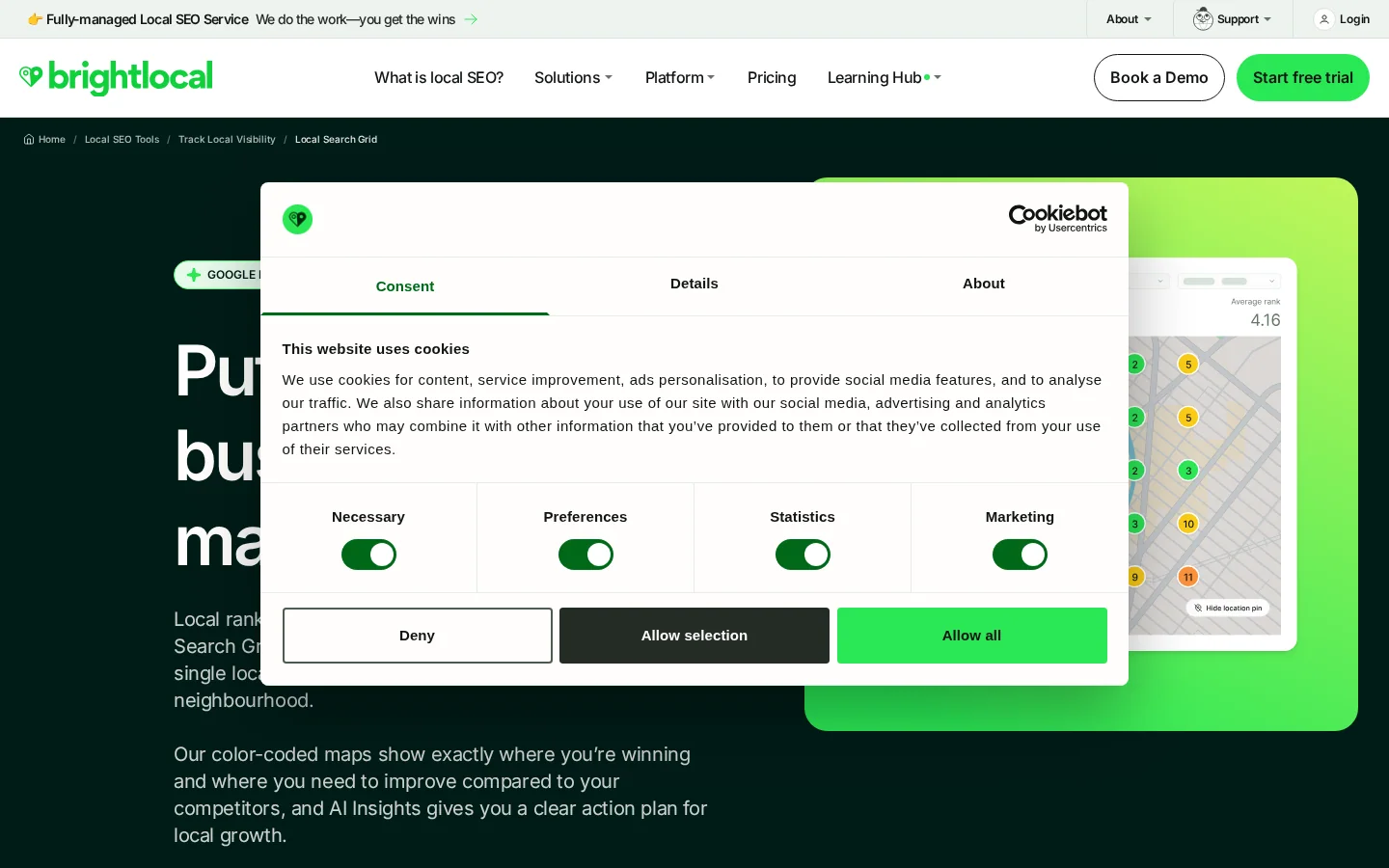
Local Search Grid places a grid of points over a map and simulates a search from each point. You get a color-coded heatmap of your rank across the area. Grid sizes are 3x3, 5x5, 7x7, 11x11 and 15x15. You set the distance between points, so a grid can cover a few blocks or a whole county. You can drag the grid to center it on a competitor and skip points that fall on water or empty land.
The Track plan includes geo-grid maps for up to five keywords. Choose the grid size with the math in mind: the number of points grows with the square of the side.
points = side x side
3x3   =   9 points
5x5   =  25 points  (BrightLocal's default advice)
7x7   =  49 points  (dense cities, large service areas)
11x11 = 121 points
15x15 = 225 points

area covered (km) = (side - 1) x spacing
example: 7x7 grid, 0.8 km spacing = 6 x 0.8 = 4.8 km wide
A practical rule: set the spacing so that the grid edge reaches the farthest place a customer would really travel from. A 15x15 grid with 3 km spacing around a hair salon measures places no customer comes from, and drags your average rank down for nothing.
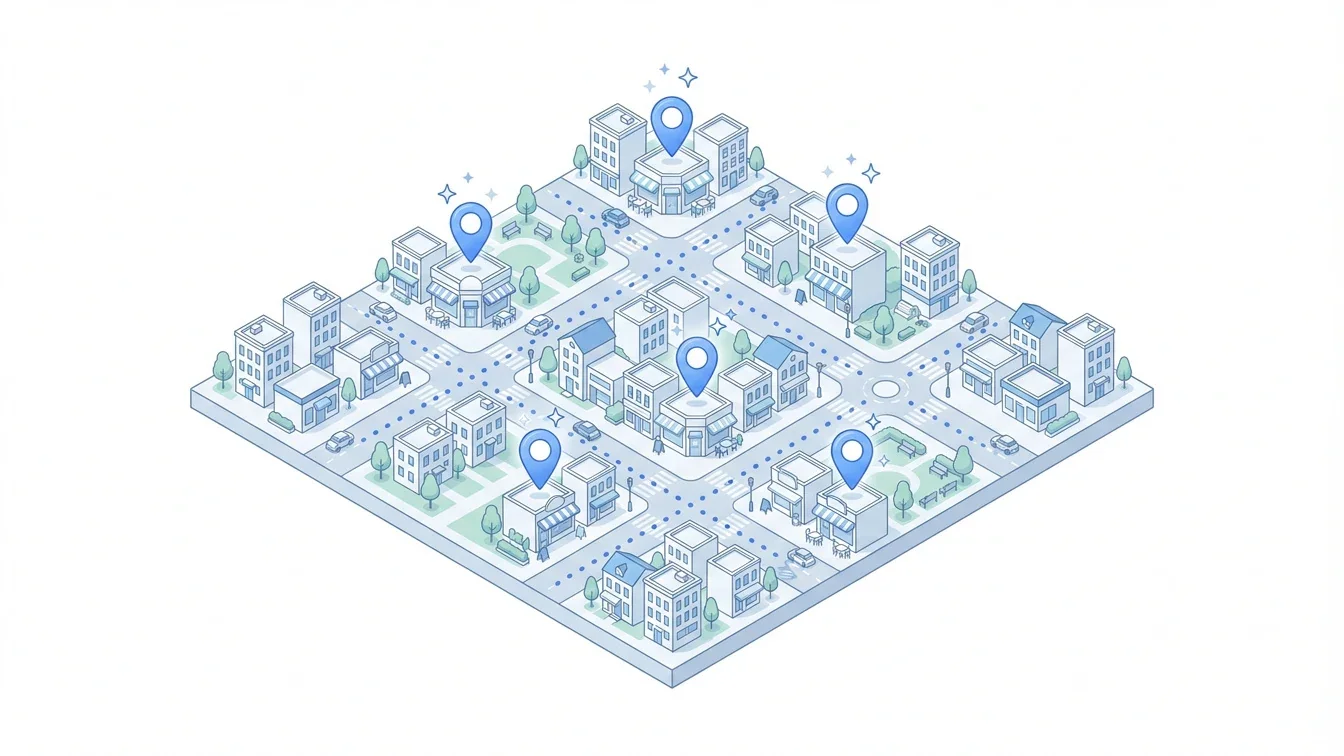
The Citation Tracker finds where your business is already listed, flags wrong names, addresses or phone numbers, and shows local citations your competitors have and you do not. The Citation Builder is a paid service where BrightLocal's team submits your listings by hand. It is sold per citation, outside the plans. We cover its costs in detail below because it is where most budgets go wrong.
Active Sync pushes your name, address, phone, hours and description through direct connections to Google (Search and Maps), Apple Maps, Bing Places, Facebook and Yelp (Yelp only in the USA and Canada). Updates usually go live within minutes, and the tool alerts you when a third party edits your data. It comes with the Manage and Grow plans, and can also be bought alone from a free account.
The review module monitors more than 80 review sites, including niche platforms for legal, medical, real estate and home services. You can reply to Google and Facebook reviews from inside BrightLocal, with AI help to draft replies. For other sites, you get a direct link to reply on the site itself. Review requests go out by branded email, SMS or QR code, with automated reminders. SMS uses credits: 1 credit per SMS in the USA and Canada, 2 in the UK, with 10 free credits to start.
The newest module, announced on BrightLocal's blog on September 10, 2026, tracks how a location appears in ChatGPT, Google AI Mode and Google AI Overviews. You get a score from 0 to 100 per location, a breakdown by platform and prompt, sentiment, share of voice against local competitors and a list of the domains the AI cites. Limits: up to 20 prompts per location, tracked twice a month, included in Track, Manage and Grow.
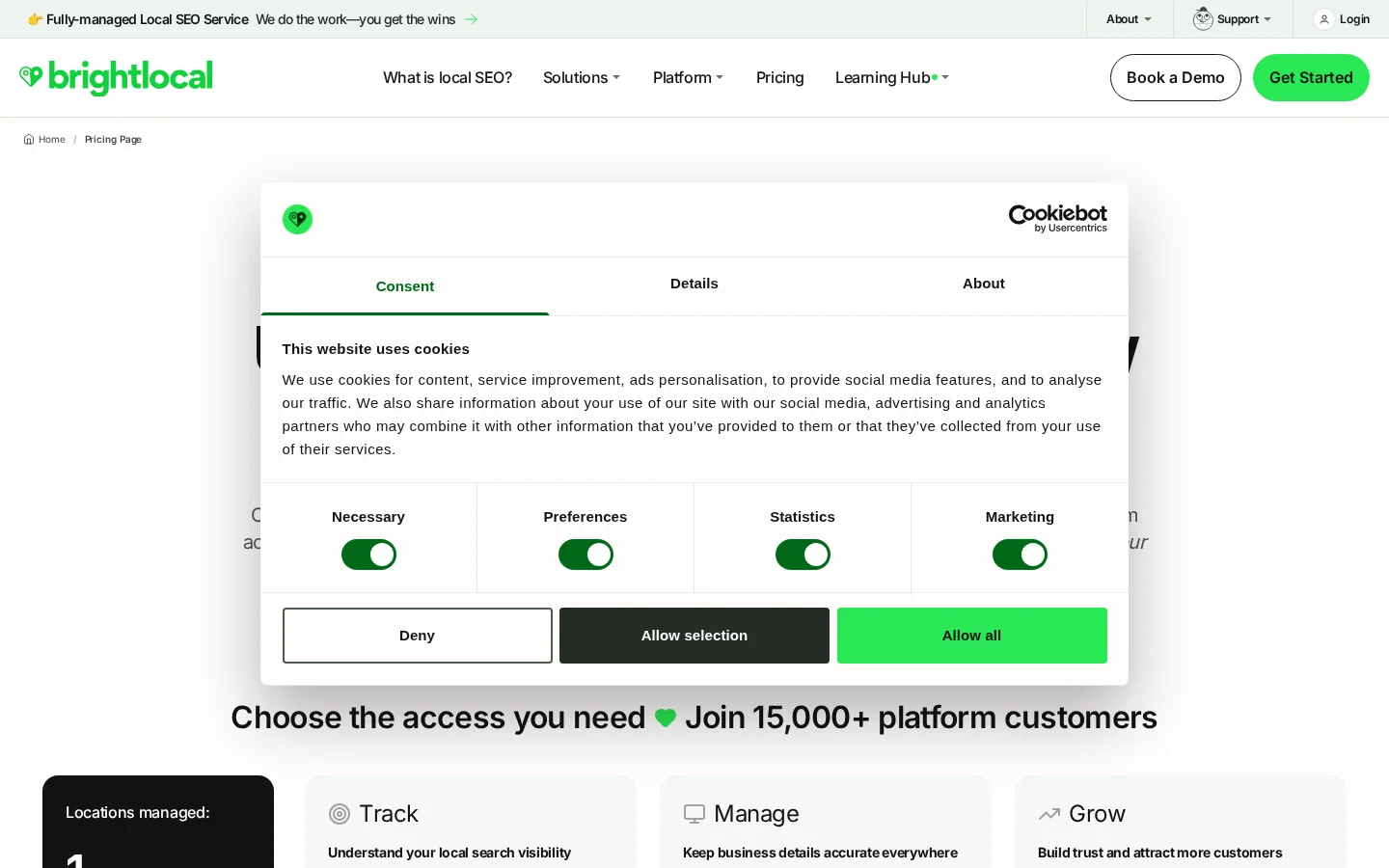
BrightLocal has three plans, Track, Manage and Grow, priced by the number of locations you manage. For one location, they cost $41, $54 and $65 per month billed monthly, or $31, $40 and $49 per month billed yearly. Prices below come from the official BrightLocal pricing page, checked in November 2026.
The price does not grow one location at a time. It moves by bands. That makes the per-location cost drop sharply when you fill a band, and rise when you pass into the next one.
| Locations | Track (monthly / yearly) | Manage (monthly / yearly) | Grow (monthly / yearly) |
|---|---|---|---|
| 1 | $41 / $369 | $54 / $485 | $65 / $584 |
| 2 to 5 | $62 / $558 | $76 / $683 | $87 / $782 |
| 6 to 10 | $83 / $747 | $109 / $980 | $131 / $1178 |
| 11 to 20 | $104 / $936 | $153 / $1376 | $197 / $1772 |
| 21 to 30 | $156 / $1408 | $230 / $2069 | $296 / $2663 |
| 41 to 50 | $261 / $2353 | $384 / $3455 | $494 / $4445 |
| 91 to 100 | $524 / $4716 | $769 / $6920 | $989 / $8900 |
| More than 100 | Price on request | ||
Example: an agency with 6 clients on Track pays $83 per month, about $13.80 per location. The same agency with 5 clients pays $62, or $12.40 per location. With 11 clients, it pays $104, or $9.45 per location. Inside a band, adding a client costs nothing; crossing into the next band makes the price jump.
The plan price is not the full bill. Citations and aggregator networks are sold apart. Here is a realistic first year for one location that wants everything:
Grow plan, yearly billing           $584
30 manual citations x $3.20         $96
5 aggregator networks x $30         $150
-------------------------------------------
First year total                    $830
Year two (plan + aggregator renewal $120)  $704
Before you commit, compare that cost with what a new customer is worth to you. Our free local SEO ROI calculator turns rankings and calls into a revenue estimate in two minutes.
Note
BrightLocal also sells a managed local SEO service from $499 per month and custom API plans. Standard plans do not let you buy one feature alone; custom plans exist for high-volume users who only need one or two report types.
Citation Builder is BrightLocal's pay-as-you-go listing service: its team submits your business to directories by hand, at $3.20 per citation, or $2 with bulk credits. You can use it without any subscription. According to the Citation Builder page, you can choose from more than 1000 sites in 20 countries, sorted by domain strength.
Citation Builder costs at a glance
Source: BrightLocal Citation Builder page, November 2026
A data aggregator is a company that sells business data to hundreds of smaller sites, apps and map providers. Submit once to an aggregator, and your data spreads downstream. BrightLocal resells five networks at $30 each:
| Network | Countries | Worth it if... |
|---|---|---|
| Data Axle | USA, Canada | You are in North America: it feeds many directories and in-car maps. |
| Neustar | USA | You are in the USA and want to cover the second big data supplier. |
| Foursquare | 20 countries | You are outside the USA: it is the only broad network for Europe. |
| GPS Network | 20 countries | Your customers come by car and use navigation devices. |
| YP Network | USA | You are a US trade business (plumber, roofer, locksmith). |
For a business in France, Germany or Spain, only two of the five networks apply. Buying all five is money lost.
Warning
Moving offices in the next 12 months? Wait before ordering citations. Building 40 listings and then paying to update all 40 doubles the bill. Set up Active Sync and the aggregators first, then build the manual citations at the new address.
BrightLocal's main strength is breadth at a low price: rank tracking, geo-grids, citations, listings sync, reviews and AI tracking in one account for under $70 per month for one location. Its main weaknesses are add-on costs, the limits of its AI coverage and the absence of tools for the website itself.
BrightLocal: what it does well and where it stops
One place for every local signal. Most local SEO work means switching between a rank tracker, a citation tool, a review tool and Google Business Profile itself. BrightLocal puts them in one account with one client list. For an agency handling 20 locations, the time saved on reporting alone often pays for the plan.
Geo-grid included in every plan. Several competitors sell geo-grid scans by credits. BrightLocal includes it, within the five-keyword limit of the Track plan.
Ownership of citations. Some listing services remove your listings when you stop paying. BrightLocal states the opposite: the listings you build are yours, with their logins.
The bill grows with add-ons. The plan is cheap; citations, aggregators and their renewals are not included. Plan the first-year cost, not the monthly price.
Partial AI coverage. Twenty prompts tracked twice a month on three Google and OpenAI surfaces is a good start for one location. It is thin if your customers use Gemini or Claude, or if you want to test 100 phrasings of the same question.
Nothing for the website. BrightLocal audits your listings and profile, not your pages. It will not tell you which local questions your site leaves unanswered, nor write the answer.
Users rate BrightLocal well overall: on Trustpilot, it holds a TrustScore of 4.0 out of 5 from 771 reviews, with 91% of 5-star reviews and 4% of 1-star reviews (checked November 2026). Praise centers on support and features; complaints center on technical support delays, report speed and billing.
BrightLocal reviews on Trustpilot
Source: Trustpilot, 771 reviews, November 2026
Trustpilot itself notes that BrightLocal has no recent history of inviting customers to leave reviews, and only 35 of the 771 reviews were posted in the last 12 months. Most of the rating reflects older versions of the product. Read the reviews from the last year first: they describe the tool you would actually buy today, including the new AI features.
There are four ways to cover local SEO: an all-in-one local suite like BrightLocal, a stack of specialist tools, an enterprise listings network, or a platform that works on your website and AI visibility. The right choice depends on your number of locations, your budget and where your customers search. You can see a wider list in our comparison of the best local SEO tools.
Principle: one account for rankings, listings, reviews and AI tracking. When to use it: you manage 1 to 100 locations and want one report per client. Advantages: low price per location, one dashboard. Limits: each module is good, rarely the best of its kind. Example: a dental group with 8 clinics on the Grow plan at $131 per month.
Principle: you pick the best tool for each job. Whitespark is known for citation research and listings work: its pricing page lists the Local Citation Finder from $33 to $149 per month, the Local Rank Tracker from $14 to $200 per month, and Reputation Builder at $79 per month per location. Local Falcon focuses on geo-grid scans and AI visibility, sold by credits (one credit per map point, so a 5x5 scan uses 25), with plans from $24.99 to $199.99 per month according to its pricing page. When to use it: you are an expert and want deeper data on one job. Limits: several bills, several logins, no shared report.
Principle: a yearly subscription pushes your data to a network of publishers and keeps it locked. When to use it: brands with dozens or hundreds of locations and a central marketing team. Limits: listings often depend on the subscription; less depth on rank tracking. Our guide to keeping business listings accurate and fixing duplicates explains the trade-offs.
Principle: work on the website, which answers the questions customers ask before they choose, and on how AI models describe the business. When to use it: your profile and listings are already clean, and you want to be found for questions and to be named by AI. Sorank does not manage Google Business Profiles. It finds the local questions for your services and town, publishes the answers on autopilot and tracks which businesses ChatGPT, Claude and Gemini recommend, with the sources they cite. See how it works for local businesses that want to be found down the street.
| Approach | Best for | Rankings | Listings | Reviews | Website content | AI tracking |
|---|---|---|---|---|---|---|
| All-in-one suite (BrightLocal) | 1 to 100 locations, agencies | Yes, plus geo-grid | Yes, paid citations | Yes (Grow) | No | ChatGPT, AI Overviews, AI Mode |
| Specialist stack (Whitespark, Local Falcon) | Experts, deep audits | Yes | Yes (Whitespark) | Yes (Whitespark) | No | Yes (Local Falcon) |
| Enterprise network (Yext, Moz Local) | Large brands | Limited | Yes, by subscription | Varies | No | Varies |
| Content and AI platform (Sorank) | Sites that need answers and AI mentions | Website rankings | No | No | Yes, on autopilot | ChatGPT, Claude, Gemini |
These approaches combine well. Many local businesses use a listings tool like BrightLocal for the profile and citations, and a content platform for the website. They solve different problems.
BrightLocal offers a 14-day trial with full access and no credit card. Fourteen days is enough to answer one question: does it find problems you would not have found alone? Follow this plan so the trial ends with a decision, not a half-explored dashboard.
A 14-day test plan for BrightLocal
Enter your business name exactly as it appears on your Google Business Profile, character for character. A missing "Ltd" or an "&" written "and" splits your citations into two groups and makes the tracker report false errors. If you are a service area business with a hidden address, BrightLocal supports it: follow its help guide to set the center of your area.
For keywords, mix three kinds: the service alone ("emergency plumber"), the service plus city ("emergency plumber Leeds") and a "near me" variant. Our method for local keyword research explains how to find the phrasings people really type.
Every tracker simulates searches. Check two or three points by hand. On a phone, open a private window, turn location on, stand at a place covered by the grid (or ask a colleague who lives there) and search your main keyword. If the grid says you rank third and you see yourself eighth, check the grid center and the keyword spelling before you blame the tool.
Tip
Before the trial ends, export your first citation audit and your first geo-grid. Even if you do not subscribe, they are a baseline you can compare with in six months. Our step-by-step local SEO audit shows what else to add to that baseline.
Most disappointment with BrightLocal comes from how it is used, not from the tool. Here are the mistakes we see most often, how to spot each one and how to fix it.
Mistakes to avoid with BrightLocal
What it is: paying $150 for all five networks when three of them only cover the USA. How to spot it: your business is outside the USA and Canada and your order includes Neustar, YP or Data Axle. How to fix it: outside North America, keep Foursquare and GPS Network only.
What it is: ordering 40 new listings while old ones still show your former phone number. How to spot it: the citation tracker flags inconsistent listings and you have not cleaned them. How to fix it: fix the source first (Google Business Profile, then aggregators, then the big directories), then order new citations. Otherwise the old data keeps spreading.
What it is: a grid much larger than the area your customers come from. How to spot it: the outer ring of points is all red, and the inner points are green. How to fix it: reduce the spacing so the grid edge matches your real service radius. Keep a second, wider grid only if you are trying to expand.
What it is: filling the 20 prompts with "is [brand] good?". The AI almost always mentions you when your name is in the question. How to spot it: your AI score is high but new customers never mention AI. How to fix it: keep 3 or 4 branded prompts and use the rest for unbranded questions ("best wedding photographer in Lyon for small budgets"). Our guide to getting a local business recommended by ChatGPT and Gemini lists the kinds of prompts that matter.
What it is: taking Track instead of Grow to save $24 per month, then running review requests by hand. How to spot it: you export review lists to another tool every month. How to fix it: compare the plan gap with the hours you spend on the missing module. For review needs alone, also look at dedicated review management software.
What it is: clean listings and good map rankings, but a website with five pages that answer nothing. How to spot it: your profile gets views, but your site gets no organic traffic beyond your brand name. How to fix it: add a content plan for the questions customers ask before they call: prices, delays, comparisons, "do I need".
BrightLocal tracks local AI visibility on ChatGPT, Google AI Overviews and Google AI Mode, for up to 20 prompts per location, twice a month. That covers the main Google surfaces and the most used chatbot. It does not cover Gemini or Claude, and it measures your presence without changing it.
| Question | BrightLocal Local AI Visibility |
|---|---|
| AI platforms tracked | ChatGPT, Google AI Overviews, Google AI Mode |
| Gemini and Claude | Not tracked (more platforms announced, no date) |
| Prompts | Up to 20 per location, editable |
| Frequency | Twice a month per location |
| Score | 0 to 100; above 75 strong, 50 to 74 competitive, below 50 weak |
| Sources cited by AI | Yes, a leaderboard of cited domains |
| Plans | Included in Track, Manage and Grow |
A score tells you where you stand. The list of cited domains tells you what to do. When an AI model recommends a local business, it often leans on directories, review sites and local media more than on the business website. If the leaderboard shows the same three directories again and again, those are the listings to complete first. Our analysis of what to fix first on your Google Business Profile for AI search goes deeper on that point.
If your customers use Gemini or Claude, or if you want to know which searches the AI runs before it answers, you need a second tool. Sorank's AI mention tracking follows your brand each month in ChatGPT, Claude and Gemini, per prompt and per model, with the sources each model cites. Used next to BrightLocal, it covers the AI surfaces BrightLocal does not.
Buy BrightLocal if you manage physical locations, your customers find you on Google Maps, and you want rankings, listings and reviews in one place at a fair price. Skip it if you have no physical location or if your real gap is website content. In both cases, use the 14-day trial before paying.
Whatever you choose, do one thing today: search your top service keyword on your phone from two places in your area and write down where you appear. That is your baseline, with or without a tool. Then read our comparison of six local rank trackers before you pay for anything.
For one location, BrightLocal costs $41, $54 or $65 per month on the Track, Manage and Grow plans, or $31, $40 and $49 per month billed yearly. Prices rise by bands of locations. Citations ($3.20 each, or $2 with bulk credits) and aggregator networks ($30 each) are billed on top.
Yes, if your customers find you on Google Maps and you want rankings, listings and reviews in one place. A single location can start on Track for $31 per month billed yearly. If you have no physical location or mainly need website content, it is not the right tool.
Yes. Its Local AI Visibility module tracks ChatGPT, Google AI Overviews and Google AI Mode, for up to 20 prompts per location, twice a month, on all plans. It does not track Gemini or Claude.
We analyse your competitors, your website and your AI visibility to create a tailored content plan for free.
 AI Content Brief Generator
 FAQ Schema Generator
 AI Blog Post Ideas Generator
 Structured Data Validator (Schema Validator)
 Alt Text Checker
 Internal Link Analyzer
 Backlink Challenge
 AI Meta Description Generator
 AI Blog Title Generator
 Google Indexability Checker
 AI Blog Outline Generator
 UTM Link Builder
 Keyword Clustering Tool
 Canonical Tag Checker
 XML Sitemap Generator
 Broken Link Checker
 AI SEO Title Generator
 Headline Analyzer
 SERP Preview Tool
 Redirect Checker
 Hreflang Tag Generator
 Heading Structure Analyzer
 HTTP Headers Checker
 Favicon Extractor
 SERP CTR Calculator
 SEO vs Paid Search Savings Calculator
 SEO Share of Voice Calculator
 SEO ROI Calculator
 SEO Traffic and Revenue Forecast Calculator
 SEO Budget Calculator
 SEO Break-Even Calculator
 SaaS SEO ROI Calculator
 ROAS Calculator
 Reading Time Calculator
 Ranking Gain Simulator
 Organic Traffic Value Calculator
 Organic Traffic Estimator and Website Traffic Checker
 LTV to CAC Ratio Calculator
 Local SEO ROI Calculator
 Link Building Cost Calculator
 Keyword Value Calculator
 Keyword Opportunity Score Calculator
 Keyword Density Calculator
 GEO ROI Calculator
 GEO Content Investment Calculator
 Ecommerce SEO ROI Calculator
 Customer Lifetime Value Calculator
 Customer Acquisition Cost Calculator
 CTR Calculator
 Cost Per Article Calculator
 Conversion Rate Calculator
 Content Marketing ROI Calculator
 ChatGPT Referral Traffic Estimator
 Bounce Rate Calculator
 Backlink ROI Calculator
 AI Visibility Score Calculator
 AI Traffic Value Calculator
 AI Share of Voice Calculator
 Cost of AI Invisibility Calculator
 AI Citation Rate Calculator
 llms.txt Validator
 AI Overview Checker and AI Overviews Rank Checker
 Robots.txt Checker
 AI SEO Audit
 LLM Readability Checker
 SearchGPT Readiness Checker
 Structured Data LLM Audit
 Website Crawlability AI Audit
 Why ChatGPT Is Not Recommending My Website
 Gemini Ranking Tool
 Perplexity Ranking Checker
 LLM Citation Checker
 Answer Engine Optimization Audit
 GEO Audit
 AI Search Visibility Test
 ChatGPT Visibility Checker
 llms.txt Generator
 URL Extractor
 Webpage to Markdown
 Sitemap Checker
 SERP Volatility Sensor
 Page Size Checker
 Word Counter
 Slug Generator
 Schema Generator
 Robots Generator
 OG Preview
 Meta Tags Generator
 Image Compressor
 Favicon Generator
 On-Page SEO Audit: SEO Checker and SEO Analyzer
 Backlink Analysis Tool
 Keyword Research Tool
 Domain Authority Checker
 “I tested Sorank on a real client site and it's insane. It does everything an agency would bill you $1500 a month for. It's going into production on that client now.”

 Guillaume Guersanguersanguillaume.com“We are an Ads agency and we wanted to get our SEO back on track once and for all. Sorank gave us a clear view of our site, helped us prioritize optimizations, and properly structure our content. The tool is easy to use, well designed for a team, and very practical for centralizing tracking without having to juggle multiple platforms. A very solid foundation to start fresh with our SEO.”
 Gaspard MadouiAds Agency
 “I just let the Sorank software do its thing, and now my DR is 25 and my page is ranking higher.”
 Lucas Flandrefoundertrace.fr“I specialized in GEO thanks to Sorank. The GEO Leaderboard allows me to show my clients their position vs competitors on ChatGPT. It’s a real commercial differentiator.”
 MélanieSEO Freelance“Great service, works well for our website and helps us understand how to improve it to rank better on Google and elsewhere. Congrats, keep going, I recommend it.”
 Hugo T.E-commerce merchant