Preferences
Privacy is important to us, so you have the option of disabling certain types of storage that may not be necessary for the basic functioning of the website. Blocking categories may impact your experience on the website. More information
Privacy is important to us, so you have the option of disabling certain types of storage that may not be necessary for the basic functioning of the website. Blocking categories may impact your experience on the website. More information

 WordPress SEO Plugin Fits Your Site
Compare All in One SEO and Yoast on price, features, setup and mistakes. Get a clear pick for your WordPress site, plus the settings to check first.
In short
All in One SEO (AIOSEO) and Yoast SEO are the two best-known SEO plugins for WordPress. Both set page titles, meta tags, XML sitemaps and schema markup. Yoast is easier to start with because it coaches you while you write. AIOSEO bundles more tools into each plan and lists its prices in US dollars.
Want to go further? Ask
Quick quiz
Is SEO right for you, and how should you start?
Sorank matches your answers


Test it for 3 days on your own site and see where you stand on Google, ChatGPT and the other AIs.
Start 3-day free trial3 days free, then stop whenever you want. 90-day results guarantee, conditions apply.
Both plugins control how your WordPress pages appear to search engines and AI systems. They write the title tag, the meta description, the canonical URL, the robots directives and the structured data. The real difference is what each plugin adds around that core, and how much it expects you to decide yourself. If you only need the basics, either one will work. Our Yoast SEO guide covers Yoast on its own, and our roundup of the best WordPress SEO plugins compares many tools at once. This article compares only these two, on the questions that decide the choice: price, renewals, what the output looks like, and how to switch safely.
Open any page on your site, view the page source, and look at the head section. An SEO plugin fills in the tags there. This is what the output looks like for one page:
<title>All in One SEO vs Yoast: Which Plugin Fits Your Site</title>
<meta name="description" content="Compare price, features and setup of two WordPress SEO plugins.">
<link rel="canonical" href="https://sorank.com/blog-geo-seo/all-in-one-seo-vs-yoast/">
The title element is the most visible of the three, because search engines often show it as the clickable headline. The canonical link tells search engines which URL is the main version of a page. If you want the full background on that tag, read our glossary entry on canonical URLs. Both plugins generate these tags, and both can override them per page, which is where most problems start.
The clearest way to see the difference is to read how each plugin describes itself on its WordPress.org listing. The All in One SEO listing on WordPress.org calls itself "a complete AI SEO plugin and marketing toolkit" and says it "brings AI into every step of your SEO workflow". Its feature list includes keyword rank tracking, local SEO, redirect management, SEO audits and internal linking suggestions. The Yoast listing leads with "Real-time SEO guidance, schema, and AI built in" and mentions traffic-light guidance while you write.
In practice, that means Yoast spends more of its interface on checking the page you are writing. AIOSEO spends more of its interface on the wider toolkit. Neither approach is wrong. They suit different working habits, and the table below puts the two side by side.
What each plugin puts first
Source: plugin listings on WordPress.org, checked 21 November 2026
AIOSEO lists four paid plans on its pricing page, in US dollars, billed once a year. Each plan covers a set number of sites: 1, 3, 10 and 100. Yoast bills its Premium plan annually too, but its pricing page shows prices without VAT and changes the amount by currency, and it does not give one clear US dollar figure. So for Yoast, compare the checkout total in your own currency, not the number on the marketing page.
The easiest way to compare AIOSEO's plans is to divide the yearly price by the number of sites. That gives you the cost per site, which is the number that matters once you run more than one WordPress install.
cost per site per year = yearly plan price / number of sites covered

Basic   $49.50 / 1    = $49.50
Plus    $99.50 / 3    = $33.17
Pro     $199.50 / 10  = $19.95
Elite $299.50 / 100 = $3.00 (rounded)| AIOSEO plan | Price per year (USD) | Sites covered | Cost per site per year |
|---|---|---|---|
| Basic | $49.50 | 1 | $49.50 |
| Plus | $99.50 | 3 | $33.17 |
| Pro | $199.50 | 10 | $19.95 |
| Elite | $299.50 | 100 | $3.00 (rounded) |
The table uses the current prices on AIOSEO's own pricing page, checked on 21 November 2026. The cost per site is our calculation from those prices. For one site, the Basic plan is the only line that matters, and it is the cheapest entry point. For an agency or a network of sites, the Elite line becomes very cheap per site, but only if you really use all 100 sites.
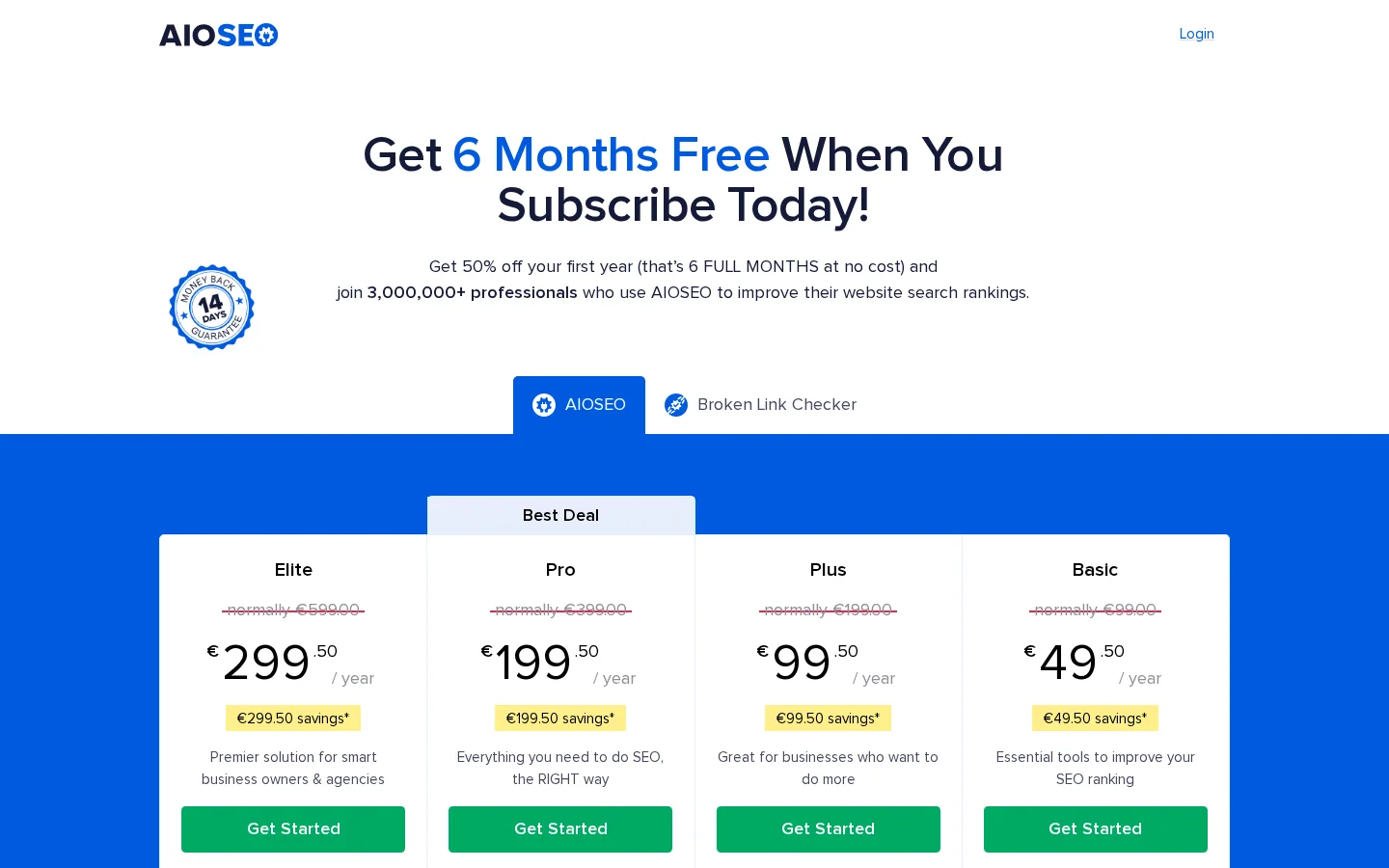
The list price is only the first bill. AIOSEO's FAQ says renewals run at roughly double the first-year rate, and its Basic plan is described as renewing at $99 per year against a $49.50 regular price. The same page also shows Basic with a $99.00 struck-through price on its plan card, so the numbers are not fully consistent. Before you buy, open the checkout, find the renewal amount in writing, and put the renewal date in your calendar.
The numbers to check before you buy
Source: AIOSEO pricing page and FAQ, aioseo.com, checked 21 November 2026
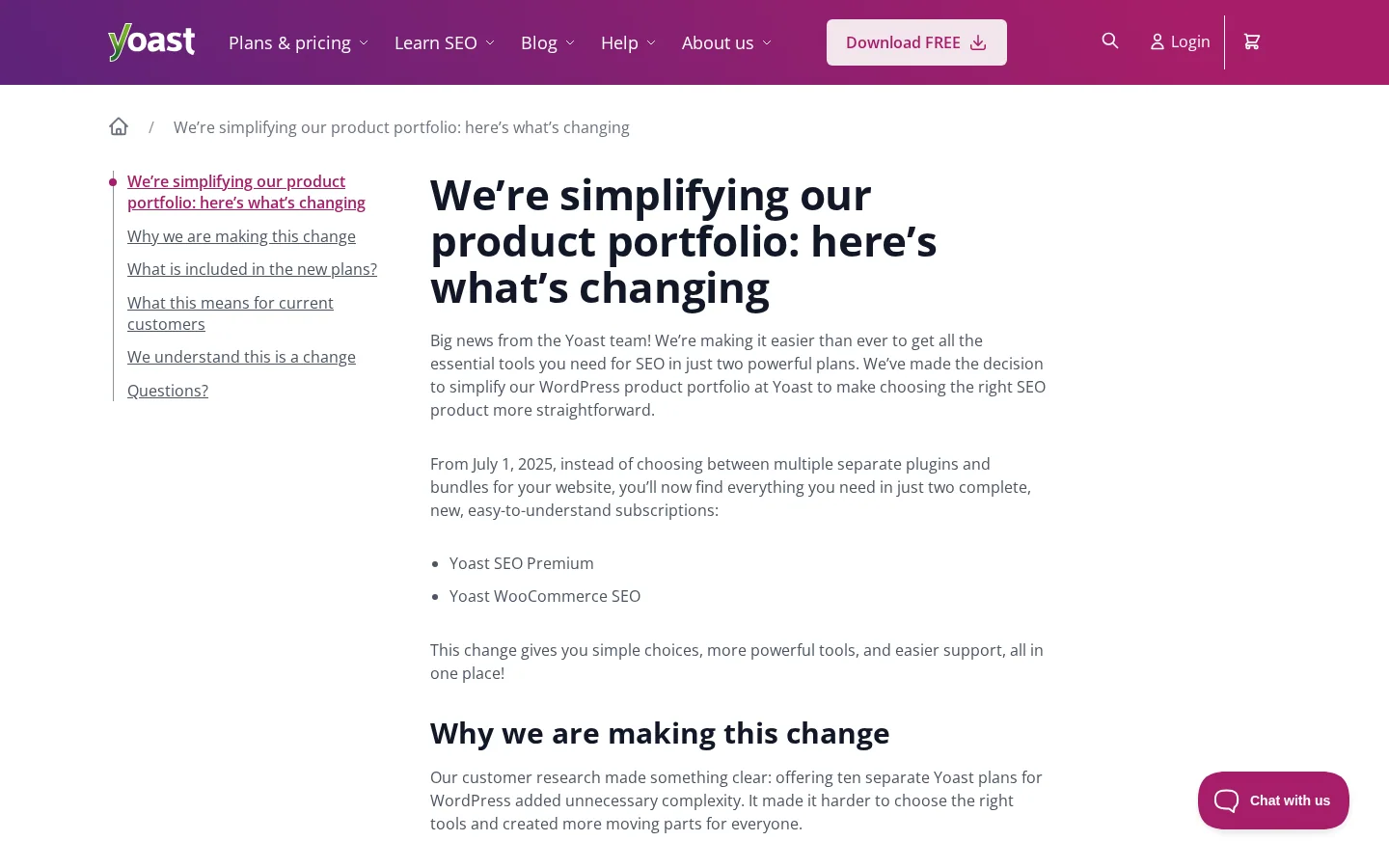
For Yoast, the same rule applies, with one extra step. Yoast bills annually and shows prices without VAT, so the amount you pay depends on your country and currency. Open the Yoast pricing page, choose your currency, and read the total at checkout. Do not compare a US dollar figure from one vendor with a euro figure from the other.
Here is the Yoast pricing page as it looked when we checked it. Compare the billing period and the VAT note with the AIOSEO page above.
Two more costs are easy to forget. The first is add-ons. Some features that come bundled in one plugin are sold separately in the other, so compare the features you need, not the plan names. The second is site count. If you manage three client sites, a plan that covers one site means three purchases, and that changes the maths quickly.

For most small WordPress sites, the features that matter are the same: a clean title and meta tag per page, an XML sitemap that lists the pages you want indexed, redirects when URLs change, structured data that matches the page, and robots rules for crawlers. Both plugins cover this core. The difference shows up in the extras, and in how easy those extras are to test.
Both plugins can output JSON-LD structured data. Turning it on is not the same as getting it right. A typical failure is an article that declares the wrong type, such as a generic WebPage on a blog post, or an author field that points to nothing. The fix is to copy the live URL into a validator and check that the type and the required fields match the page. Our guide to schema markup explains which fields matter for each type, and the free schema markup generator builds a clean block you can compare against your plugin output.
When a URL changes, you need a redirect, and the status code matters. A permanent move should return a 301. A temporary move should return a 302. Most SEO plugins include a redirect manager, so check three things before you rely on it: whether it can create 301 rules without editing your server, whether it logs 404 errors, and whether it can export its rules. If you want the difference between the two codes in detail, read our guide on 301 vs 302 redirects.
For sitemaps, the question is whether the plugin excludes the pages you do not want indexed, such as thin tag archives or internal search results. A sitemap that lists every page is a common cause of noise in Search Console. Our free XML sitemap generator produces a clean file, which is a useful standard to check your plugin output against.
AIOSEO lists an llms.txt file among its features, and Yoast's WordPress.org listing also mentions llms.txt management. The file is a plain text summary of your site for AI systems. Treat it as a cheap addition, not a ranking tool, and check your server logs before you expect it to change anything. Crawler access is the part that deserves attention. Our guide on robots.txt for AI crawlers covers what to allow and what to block.
Features to test before you commit
Both plugins score your text while you write. Yoast uses traffic-light checks, and AIOSEO includes an AI content generator and SEO audits. These checks are useful as a last pass, but they measure things like keyword presence and sentence length. They do not measure whether your page answers the question a searcher asked. A page can turn green and still lose to a clearer page on the same topic.
The focus keyword is the first place this shows up. Yoast asks you to pick one, and AIOSEO has a similar setup. Pick the phrase a reader would type, put it in the title and the first paragraph, and then stop optimising for the checker. Our focus keyword guide shows how to choose one and where to place it.
Google Search Central's title link guidance gives the rules that both plugins need to follow. Google says every page should have a title in the title element. It asks you to avoid keyword stuffing, to avoid repeated or boilerplate text in titles, and to avoid unnecessarily long or verbose text. Google does not set a fixed length limit for the title element, so the goal is clarity, not a character count.
In a plugin, boilerplate titles usually come from templates. A category archive, a tag page and an author page can all end up with the same pattern, such as "Blog | Site name". That is the case Google warns about. The fix is to set a distinct template for each content type and to write a real title for every important page. The next section shows how to find these problems.
Google's snippet documentation says Google sometimes uses the meta description when it gives users a more accurate description. There is no limit on how long a meta description can be, but Google truncates it in search results as needed. The same page does not say whether meta descriptions affect rankings, so treat them as a tool for clicks and for accurate previews. Our guide to meta tags covers the other tags you may see in the head section.
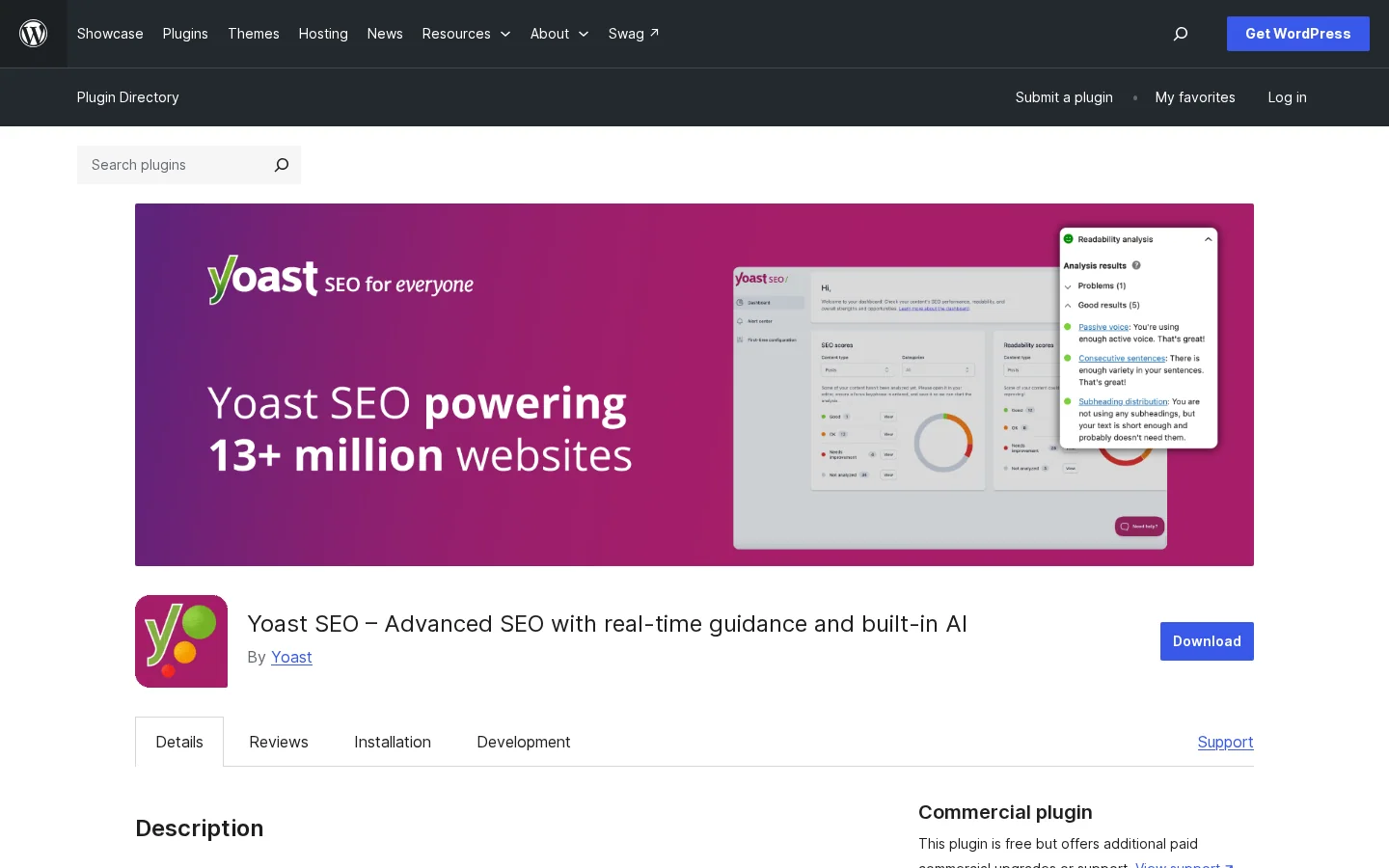
Yoast describes its own features on its WordPress.org listing, and the screenshot below shows that page. Read it as the vendor's own description of what the plugin does.
You have three realistic options. You can use an SEO plugin such as AIOSEO or Yoast, you can hand-code the tags in your theme, or you can use an SEO platform that audits and edits content outside WordPress. For most sites, a plugin is the right default. Hand-coding gives you the most control and costs developer time for every change. A platform makes sense when you publish at volume and need audits, rewrites and tracking in one place.
Principle: the plugin writes the tags from per-page fields and global templates. When to use it: most WordPress sites, including small businesses and blogs with a few dozen posts. Advantages: setup takes an afternoon, the editor shows the fields next to the content, and updates ship automatically. Limits: you depend on the plugin's template logic, a major update can change output, and two plugins can conflict. Example: you set a title template of "%title% | %sitename%" for posts and a different one for category archives.
Principle: a developer writes the title and meta output directly in the theme template. When to use it: a custom theme, a site with strict performance needs, or a team that already maintains its own code. Advantages: no extra plugin, full control, and nothing hidden in a settings screen. Limits: every change needs a developer, mistakes spread to every page at once, and you lose the reporting features. Example: a PHP function in the theme that builds the title from the post's custom field.
Principle: the platform audits your pages, suggests changes and can publish content, while WordPress keeps serving the pages. When to use it: you publish often, you want the same workflow across several sites, or the content work is the bottleneck. Advantages: audits, rewrites and tracking live in one place, and you are not limited to one CMS. Limits: you still need a plugin or theme code for the tags on the page, and every platform change needs a review step before it goes live. Example: a platform flags a thin category page, drafts a better intro, and you approve it before it is published.
| Method | Setup effort | Control | Ongoing cost | Main risk |
|---|---|---|---|---|
| SEO plugin (AIOSEO or Yoast) | Low, a setup wizard and a few settings | Medium, per-page fields and global templates | Yearly plan fee and renewals | Plugin conflicts and template output changing after an update |
| Hand-coded tags in the theme | High, needs a developer | Full | Developer time for each change | A single mistake repeats across every page |
| SEO platform outside WordPress | Low to medium, connection and review rules | Medium, audits and drafts before publishing | Subscription fee | Edits made outside WordPress that nobody reviews |
To switch from one SEO plugin to the other, keep every URL the same and move the settings, not the pages. The process takes an afternoon on a small site. The steps below are the order we recommend, and the last two steps are the ones people skip.
The switch in seven steps
Step 6 is the one that catches most problems. You can check the head section of a live page from a terminal, without opening a browser. The command below prints the title, the meta description and the canonical tag for one URL.
curl -s https://example.com/your-page/ | grep -i -E "<title|<meta name=\"description\"|<link rel=\"canonical\""If the output shows two title lines or two canonical lines, one plugin is still writing tags, and you need to find which one. Do not delete the second line by hand in the theme. Turn off the plugin that writes it, then run the command again.
Keep the URLs, the redirects and the titles that already rank. If a plugin's default template would change a title that brings traffic, write the same title in the new plugin. Check the redirect rules as well, because some plugins store redirects in their own tables. If the old plugin is removed without its redirects being moved, those rules disappear.
Most SEO problems on WordPress come from three habits: running two SEO plugins at the same time, leaving templates on their default setting, and trusting a green score more than the page itself. The table lists each error with a way to spot it and a fix. The sections after the table go into each one in more detail.
| Error | How to spot it | How to fix it |
|---|---|---|
| Two SEO plugins active at once | View the source and find two title or canonical lines | Deactivate one plugin and recheck the page source |
| Boilerplate titles from templates | Sort a crawl by title and look for repeated values | Set a distinct template for each content type and write real titles for key pages |
| Writing for the green light | The focus keyword appears in every heading and sentences read stiffly | Write for the reader, then use the checks as a final pass |
| Missing the renewal | The bill rises after the first year and nobody noticed | Read the renewal price at checkout and set a reminder before it renews |
What it is: two plugins both generate a title, a meta description, a canonical tag and often a sitemap. How to spot it: view the source of a post and count the title and canonical lines. Two of either means a conflict. How to fix it: pick one plugin, turn off the SEO features of the other, and check the output again. If you have migrated, confirm the old plugin is deactivated, not just hidden.
Warning
Two SEO plugins can output conflicting canonical tags. A canonical tag that points to another URL tells search engines which version to prefer, so a wrong one can send them to the wrong page. Check the source after every plugin change.
What it is: category, tag and author archives reuse the same title pattern, so many pages share one title. How to spot it: run a site crawler and sort the results by title. Repeated values show the problem. How to fix it: write distinct titles for each archive type, keep the template short, and rewrite the titles of your most important categories by hand. Google's title guidance warns against repeated and boilerplate text for this reason.
What it is: the writer repeats the focus keyword in headings, alt text and captions to turn the check green. How to spot it: read the post out loud. If a heading sounds like a keyword list, it is over-optimised. How to fix it: rewrite the headings as questions or statements a reader would ask, keep the keyword in the title and the opening, and remove the repeats. Google's title guidance names keyword stuffing as something to avoid.
What it is: the first year is cheap, and the renewal costs much more. How to spot it: check the invoice history and the renewal amount on the checkout page. How to fix it: read the renewal figure before you buy, count the sites you actually need, and set a reminder two weeks before renewal so you can compare the alternatives.
Pick Yoast if you write the posts yourself, you want guidance in the editor, and you run one site. Pick AIOSEO if you want more tools in one plugin, you manage several sites, or you need the schema, rank tracking and link suggestions in the same place. Both work on a small blog. The bigger the site, the more the price per site and the number of tools matter.
Pick by situation
Based on the feature listings and pricing pages cited above
Whichever you pick, set a calendar reminder for the renewal, run the output check from the switching section once, and review the plugin's settings each quarter. A plugin is a setting layer, not a strategy. The strategy is the content and the links, and that is where most of the gains come from.
Sorank is not an SEO plugin, and it does not replace the tags your plugin writes. It covers the content side of SEO and GEO: keyword research, writing and publishing articles, rewriting old pages, and tracking how AI assistants mention your brand. If you run WordPress, you can keep your plugin for the tags and use Sorank for the content work. Our page on WordPress SEO and GEO explains how the two fit together, and the content optimization feature shows how old pages get reviewed and rewritten.
| Job | Handled by |
|---|---|
| Titles, meta tags, canonical tags, XML sitemap | Your SEO plugin or theme |
| Redirects and schema markup on the page | Your SEO plugin or theme |
| Keyword research and content planning | Sorank |
| Writing and rewriting articles | Sorank |
| Tracking mentions in AI assistants | Sorank |
Tip
Before you change plugins, run your key pages through the free schema markup generator, then compare the block it produces with the schema your current plugin outputs. Any missing field is worth fixing before the switch.
The short version is this. Use the plugin that fits how you work, keep one plugin active, read the renewal price in writing, and check the output on real pages. The plugin is the easy part. Keeping the content current is the part that decides whether your pages rank.
Neither is better for every site. Yoast is easier to start with because it guides you while you write. All in One SEO bundles more tools, such as rank tracking, local SEO and schema, into one plugin, which helps if you run several sites or want those tools in one place.
Yes, the core plugin is free on WordPress.org. The paid plans are billed once a year, and AIOSEO lists them in US dollars, starting at $49.50 for one site. Check the renewal price before you buy, because AIOSEO's FAQ says renewals run at roughly double the first-year rate.
You should not. Both plugins write title tags, meta tags and sitemaps, so they can output duplicate or conflicting tags. Pick one, deactivate the other, then view the page source to confirm that only one title and one canonical tag remain.
We analyse your competitors, your website and your AI visibility to create a tailored content plan for free.
 Duplicate Content Checker
 Mobile-Friendly Test
 Website Speed Test
 Subdomain Finder
 Domain Age Checker
 CMS Detector
 Googlebot Simulator
 Nofollow Link Checker
 Meta Tag Checker
 Keyword Cannibalization Checker
 Keyword Intent Checker
 Keyword Extractor
 Google Ads Cost Calculator
 CPC Calculator
 Local Citation Finder
 Reddit Threads Finder
 Disavow File Generator
 Redirect Generator
 Canonical Tag Generator
 Passive Voice Checker
 Google Location Changer
 Google Review Calculator
 Google Review Link Generator
 Keyword Combiner
 Podcast Show Notes Generator
 AI Content Rewriter
 AI Text Humanizer
 ChatGPT Prompt Generator
 Twitter Thread Generator
 Tweet Generator
 Landing Page Copy Generator
 Google Ads Copy Generator
 Pinterest Pin Description Generator
 Anchor Text Generator
 Social Media Post Generator
 LinkedIn Post Generator
 Free AI Writer
 Review Response Generator
 LSI Keyword Generator
 YouTube Video Ideas Generator
 YouTube Tag Generator
 YouTube Description Generator
 Product Description Generator
 CTA Generator
 Blog Introduction Generator
 Conclusion Generator
 Hook Generator
 AI Content Brief Generator
 FAQ Schema Generator
 AI Blog Post Ideas Generator
 Structured Data Validator (Schema Validator)
 Alt Text Checker
 Internal Link Analyzer
 Backlink Challenge
 AI Meta Description Generator
 AI Blog Title Generator
 Google Indexability Checker
 AI Blog Outline Generator
 UTM Link Builder
 Keyword Clustering Tool
 Canonical Tag Checker
 XML Sitemap Generator
 Broken Link Checker
 AI SEO Title Generator
 Headline Analyzer
 SERP Preview Tool
 Redirect Checker
 Hreflang Tag Generator
 Heading Structure Analyzer
 HTTP Headers Checker
 Favicon Extractor
 SERP CTR Calculator
 SEO vs Paid Search Savings Calculator
 SEO Share of Voice Calculator
 SEO ROI Calculator
 SEO Traffic and Revenue Forecast Calculator
 SEO Budget Calculator
 SEO Break-Even Calculator
 SaaS SEO ROI Calculator
 ROAS Calculator
 Reading Time Calculator
 Ranking Gain Simulator
 Organic Traffic Value Calculator
 Organic Traffic Estimator and Website Traffic Checker
 LTV to CAC Ratio Calculator
 Local SEO ROI Calculator
 Link Building Cost Calculator
 Keyword Value Calculator
 Keyword Opportunity Score Calculator
 Keyword Density Calculator
 GEO ROI Calculator
 GEO Content Investment Calculator
 Ecommerce SEO ROI Calculator
 Customer Lifetime Value Calculator
 Customer Acquisition Cost Calculator
 CTR Calculator
 Cost Per Article Calculator
 Conversion Rate Calculator
 Content Marketing ROI Calculator
 ChatGPT Referral Traffic Estimator
 Bounce Rate Calculator
 Backlink ROI Calculator
 AI Visibility Score Calculator
 AI Traffic Value Calculator
 AI Share of Voice Calculator
 Cost of AI Invisibility Calculator
 AI Citation Rate Calculator
 llms.txt Validator
 AI Overview Checker and AI Overviews Rank Checker
 Robots.txt Checker
 AI SEO Audit
 LLM Readability Checker
 SearchGPT Readiness Checker
 Structured Data LLM Audit
 Website Crawlability AI Audit
 Why ChatGPT Is Not Recommending My Website
 Gemini Ranking Tool
 Perplexity Ranking Checker
 LLM Citation Checker
 Answer Engine Optimization Audit
 GEO Audit
 AI Search Visibility Test
 ChatGPT Visibility Checker
 llms.txt Generator
 URL Extractor
 Webpage to Markdown
 Sitemap Checker
 SERP Volatility Sensor
 Page Size Checker
 Word Counter
 Slug Generator
 Schema Generator
 Robots Generator
 OG Preview
 Meta Tags Generator
 Image Compressor
 Favicon Generator
 On-Page SEO Audit: SEO Checker and SEO Analyzer
 Backlink Analysis Tool
 Keyword Research Tool
 Domain Authority Checker
 “I tested Sorank on a real client site and it's insane. It does everything an agency would bill you $1500 a month for. It's going into production on that client now.”

 Guillaume Guersanguersanguillaume.com“We are an Ads agency and we wanted to get our SEO back on track once and for all. Sorank gave us a clear view of our site, helped us prioritize optimizations, and properly structure our content. The tool is easy to use, well designed for a team, and very practical for centralizing tracking without having to juggle multiple platforms. A very solid foundation to start fresh with our SEO.”
 Gaspard MadouiAds Agency
 “I just let the Sorank software do its thing, and now my DR is 25 and my page is ranking higher.”
 Lucas Flandrefoundertrace.fr“I specialized in GEO thanks to Sorank. The GEO Leaderboard allows me to show my clients their position vs competitors on ChatGPT. It’s a real commercial differentiator.”
 MélanieSEO Freelance“Great service, works well for our website and helps us understand how to improve it to rank better on Google and elsewhere. Congrats, keep going, I recommend it.”
 Hugo T.E-commerce merchant