Preferences
Privacy is important to us, so you have the option of disabling certain types of storage that may not be necessary for the basic functioning of the website. Blocking categories may impact your experience on the website. More information

Privacy is important to us, so you have the option of disabling certain types of storage that may not be necessary for the basic functioning of the website. Blocking categories may impact your experience on the website. More information

A focus keyword is the main search term a page targets. Learn how to choose one, where to place it, and how Yoast and Rank Math score it, without stuffing.

Tools

In short
a focus keyword is the main search term you want one page to rank for. Choose it from real search demand and the intent behind it, give each page its own, then place it naturally in the title tag, URL, H1, first paragraph, a subheading or two and the meta description. Plugins such as Yoast SEO and Rank Math check these placements, but Google ranks pages on relevance and usefulness, not on a green score.
Want to go further? Ask
Quick quiz
How should you find the right keywords?
Sorank matches your answers


Test it for 3 days on your own site and see where you stand on Google, ChatGPT and the other AIs.
Start 3-day free trial3 days free, then stop whenever you want. 90-day money-back guarantee, conditions apply.
The focus keyword (Yoast calls it the focus keyphrase) is the term a page is built around. It decides the angle of the content, the wording of the title and the page you link to when you write about that topic elsewhere on the site. Google's SEO Starter Guide asks site owners to "think about the words that a user might search for to find a piece of your content", and adds that its language matching systems "can understand how your page relates to many queries". The focus keyword is how you make that first step deliberate, page by page.
A focus keyword is the single search query a page is designed to answer best. It is usually a phrase of two to five words ("running shoes for flat feet", "how to verify a Google Business Profile") rather than one broad word. Other names for the same idea: primary keyword, main keyword, target keyword, focus keyphrase.
Three points avoid frequent confusions:
The term became popular through WordPress plugins. You type the phrase in a field under the editor and the plugin scores the page against it. Yoast lists its checks on its SEO analysis page ("Keyphrase in introduction", "Keyphrase in slug", "Previously used keyphrase" and others). Rank Math documents its own tests in its guide to scoring 100/100, with a keyword density target of 1% to 1.5% and a warning above 2.5%.
| Point | Yoast SEO | Rank Math |
|---|---|---|
| Name of the field | Focus keyphrase | Focus keyword |
| Keywords per page | 1 in the free version; up to 4 related keyphrases added in Premium | Up to 5 in the free version; unlimited in PRO (the first one is the primary keyword) |
| Title | Keyphrase in title | In the SEO title, ideally in its first half |
| URL | Keyphrase in slug | Focus keyword in URL |
| Opening | Keyphrase in the first paragraph | Keyword in the first 10% of the content |
| Subheadings and images | Keyphrase in subheadings and image alt attributes | Keyword in subheadings and in at least one image alt text |
| Repetition | Keyphrase density check (no fixed figure published) | Density target 1% - 1.5%, warning above 2.5% |
| Uniqueness | Previously used keyphrase | Focus keyword not used in another post |
Limits and test names checked in October 2026 on the Yoast and Rank Math sites. Our comparison of WordPress SEO plugins covers the other differences.
Note
A plugin score measures where a string of words appears. It does not measure whether the page answers the query better than the pages already ranking. Treat a green light as a finished checklist and judge the page against the current top results.
The choice matters more than the placement. A well-placed keyword that nobody searches, or that a page cannot realistically rank for, brings no traffic.
List the queries a visitor would type to land on this page, then check their search intent. "Running shoes" is a shopping query that leads to category pages; "how to choose running shoes" calls for a guide. If the intent of the query does not match the page type, pick another query or another page.
Compare the monthly search volume of the candidates with their keyword difficulty. A young site usually wins faster on a precise phrase with modest volume than on a head term dominated by large brands.
A long-tail keyword describes the need more precisely, faces fewer competitors and converts better. "Accounting software for freelancers" says far more than "accounting software".
Search the phrase yourself. The top results show the expected format (list, guide, product page, tool), the depth needed and the gaps you can fill. If they all answer a different need from yours, the phrase is wrong for your page.
Two pages on the same focus keyword compete with each other, a problem known as keyword cannibalization. Check your keyword map, or search site:yourdomain.com "phrase", before you commit.
Tip
Choose the focus keyword before you write the outline, not after the article is finished. A keyword picked at the end usually ends up pasted into a text that was written for something else.
Placement tells readers and search engines at a glance what the page covers. The important spots are few, and each has a natural form.
| Location | How to use it | Example for "running shoes for flat feet" |
|---|---|---|
| Title tag | Once, close to the start, inside a readable title | Running Shoes for Flat Feet: How to Choose the Right Pair |
| H1 | Once; can match or extend the title | Running Shoes for Flat Feet: Support, Fit and Our Picks |
| URL slug | Short, words separated by hyphens, no dates | /running-shoes-flat-feet |
| First paragraph | In the first two or three sentences, as part of the answer | "Running shoes for flat feet need firm arch support and a stable heel..." |
| Subheadings | In one or two H2s, with variants elsewhere | How to test running shoes for flat feet in store |
| Meta description | Once, inside a sentence that promises an answer | Which running shoes suit flat feet, what to check and which to avoid |
| Image alt text | Only where it describes the image accurately | Side view of a stability running shoe for flat feet |
| Internal links | As anchor text from related pages of the site | "our guide to running shoes for flat feet" |
Our guide to keyword optimization details each element, and the free on-page SEO audit checks title, headings, meta description and alt text on any URL.
Two placements carry less weight than plugins suggest. Google writes that keywords in the domain name or URL path "alone have hardly any effect" beyond appearing in breadcrumbs, so a clear slug is enough. And exact repetition is not required: the same Starter Guide notes that varying your wording gives you "more chances to show up in Search".
There is no official density. Google's spam policies list keyword stuffing, including "repeating the same words or phrases so often that it sounds unnatural", as a violation. Rank Math's 1% - 1.5% target is a plugin convention, not a Google rule.
A practical approach: use the exact phrase in the key spots listed above, then write the body for the reader, with synonyms, plural forms and related terms. Read the page out loud; if a sentence sounds forced, rewrite it. The keyword density calculator helps spot an overused phrase, and our article on keyword stuffing shows what crosses the line.
Yes for the focus keyword, no for the keywords the page ranks for. One page, one focus keyword keeps the topic clear and prevents two URLs from competing. But a good page usually ranks for dozens or hundreds of related queries: variants, questions and synonyms that the same answer satisfies.
Rank Math's multiple keywords and Yoast's related keyphrases are useful for tracking those close variants in the analysis. If two candidate keywords need different answers ("best running shoes" and "how to clean running shoes"), they need two pages. Our article on how many keywords per page covers the grouping rules in detail.
They matter, but the unit changes. When someone asks ChatGPT, Gemini or Google's AI Mode a question, the system breaks it into several sub-queries. Google describes this in its documentation on AI features: AI Overviews and AI Mode "may use a 'query fan-out' technique", and there are "no additional requirements" to appear in them beyond normal SEO fundamentals.
So the focus keyword still sets the topic and the page that should be cited, while the sub-questions around it decide whether the page gets quoted. Cover them in clear H2 sections that each answer one question in a self-contained passage. The AI query fan-out tool shows which searches an AI runs behind a question, which helps you choose the subheadings around your focus keyword.
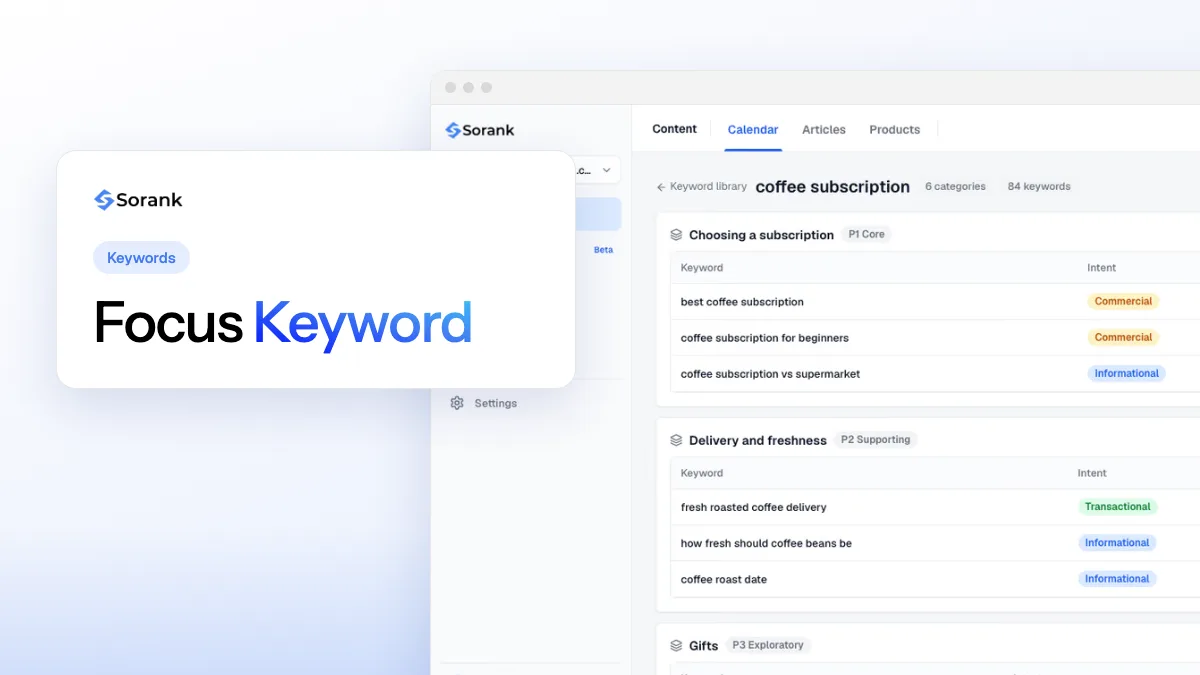
On a site with hundreds of pages, assigning one focus keyword per page by hand becomes a project in itself. Sorank's automated keyword research analyzes your site, groups keywords into topic clusters with their intent, volume and difficulty, and assigns one main keyword per page to avoid cannibalization.
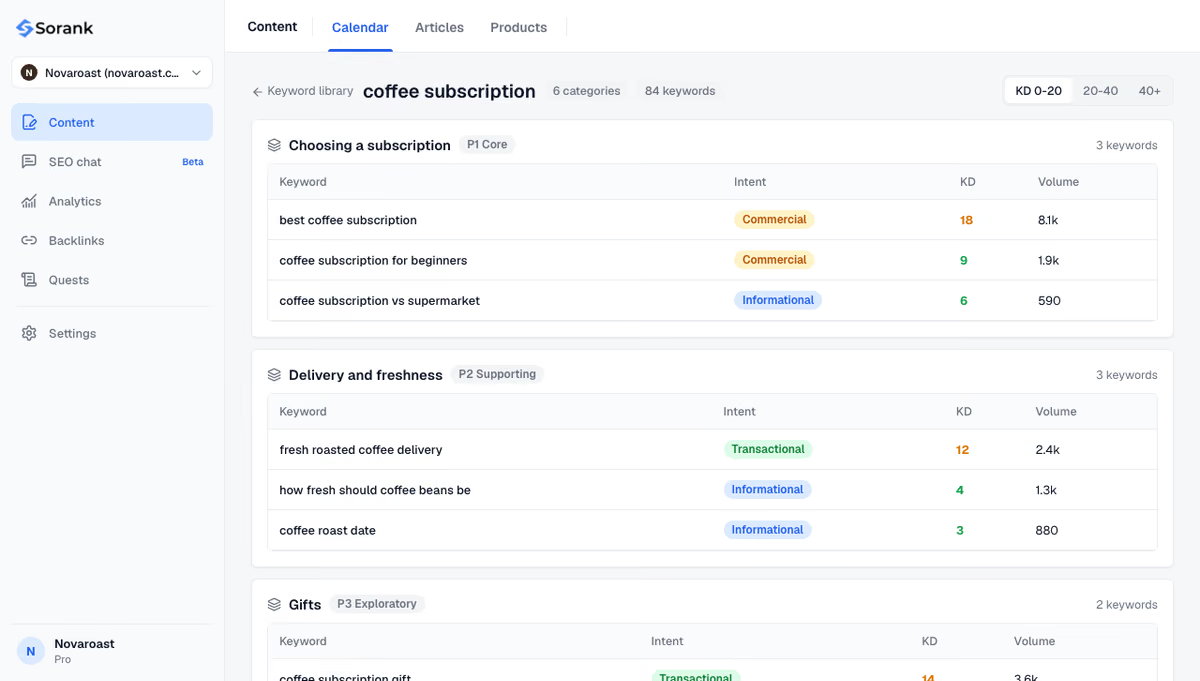
The article generator then writes and publishes each article around its focus keyword and the related questions, for Google and for AI assistants.
Pick one search query per page from real demand and matching intent, check that no other page targets it, and place it once in the title, URL, H1, opening, a subheading and the meta description. Then write for the reader and cover the questions around the topic. A focus keyword chooses the target; the quality of the answer decides the ranking. To find and assign focus keywords across a whole site in autopilot, see the Sorank plans, with a 3-day free trial.

A keyword is any search term a page can rank for. The focus keyword is the one term you choose as the main target of a specific page, the one that shapes its title, URL and angle. A page has one focus keyword but often ranks for many related keywords.
No. The focus keyword field is only read by the plugin to score your page, and it is never sent to Google. Google reads the visible content, title, headings and links to understand what the page is about.
Yes, if Search Console shows the page earns impressions on a different query or the original choice had no demand. Update the title, H1, opening and subheadings to match the new target, keep the URL unless it is misleading, and use a 301 redirect if you do change it.
We analyse your competitors, your website and your AI visibility to create a tailored content plan for free.
 AI Content Brief Generator
 FAQ Schema Generator
 AI Blog Post Ideas Generator
 Structured Data Validator (Schema Validator)
 Alt Text Checker
 Internal Link Analyzer
 Backlink Challenge
 AI Meta Description Generator
 AI Blog Title Generator
 Google Indexability Checker
 AI Blog Outline Generator
 UTM Link Builder
 Keyword Clustering Tool
 Canonical Tag Checker
 XML Sitemap Generator
 Broken Link Checker
 AI SEO Title Generator
 Headline Analyzer
 SERP Preview Tool
 Redirect Checker
 Hreflang Tag Generator
 Heading Structure Analyzer
 HTTP Headers Checker
 Favicon Extractor
 SERP CTR Calculator
 SEO vs Paid Search Savings Calculator
 SEO Share of Voice Calculator
 SEO ROI Calculator
 SEO Traffic and Revenue Forecast Calculator
 SEO Budget Calculator
 SEO Break-Even Calculator
 SaaS SEO ROI Calculator
 ROAS Calculator
 Reading Time Calculator
 Ranking Gain Simulator
 Organic Traffic Value Calculator
 Organic Traffic Estimator and Website Traffic Checker
 LTV to CAC Ratio Calculator
 Local SEO ROI Calculator
 Link Building Cost Calculator
 Keyword Value Calculator
 Keyword Opportunity Score Calculator
 Keyword Density Calculator
 GEO ROI Calculator
 GEO Content Investment Calculator
 Ecommerce SEO ROI Calculator
 Customer Lifetime Value Calculator
 Customer Acquisition Cost Calculator
 CTR Calculator
 Cost Per Article Calculator
 Conversion Rate Calculator
 Content Marketing ROI Calculator
 ChatGPT Referral Traffic Estimator
 Bounce Rate Calculator
 Backlink ROI Calculator
 AI Visibility Score Calculator
 AI Traffic Value Calculator
 AI Share of Voice Calculator
 Cost of AI Invisibility Calculator
 AI Citation Rate Calculator
 llms.txt Validator
 AI Overview Checker and AI Overviews Rank Checker
 Robots.txt Checker
 AI SEO Audit
 LLM Readability Checker
 SearchGPT Readiness Checker
 Structured Data LLM Audit
 Website Crawlability AI Audit
 Why ChatGPT Is Not Recommending My Website
 Gemini Ranking Tool
 Perplexity Ranking Checker
 LLM Citation Checker
 Answer Engine Optimization Audit
 GEO Audit
 AI Search Visibility Test
 ChatGPT Visibility Checker
 llms.txt Generator
 URL Extractor
 Webpage to Markdown
 Sitemap Checker
 SERP Volatility Sensor
 Page Size Checker
 Word Counter
 Slug Generator
 Schema Generator
 Robots Generator
 OG Preview
 Meta Tags Generator
 Image Compressor
 Favicon Generator
 On-Page SEO Audit: SEO Checker and SEO Analyzer
 Backlink Analysis Tool
 Keyword Research Tool
 Domain Authority Checker
THEY TRIED SORANK BEFORE YOU
 “I tested Sorank on a real client site and it's insane. It does everything an agency would bill you $1500 a month for. It's going into production on that client now.”

 Guillaume Guersanguersanguillaume.com“We are an Ads agency and we wanted to get our SEO back on track once and for all. Sorank gave us a clear view of our site, helped us prioritize optimizations, and properly structure our content. The tool is easy to use, well designed for a team, and very practical for centralizing tracking without having to juggle multiple platforms. A very solid foundation to start fresh with our SEO.”
 Gaspard MadouiAds Agency
 “I just let the Sorank software do its thing, and now my DR is 25 and my page is ranking higher.”
 Lucas Flandrefoundertrace.fr“I specialized in GEO thanks to Sorank. The GEO Leaderboard allows me to show my clients their position vs competitors on ChatGPT. It’s a real commercial differentiator.”
 MélanieSEO Freelance“Great service, works well for our website and helps us understand how to improve it to rank better on Google and elsewhere. Congrats, keep going, I recommend it.”
 Hugo T.E-commerce merchant