
Preferences
Privacy is important to us, so you have the option of disabling certain types of storage that may not be necessary for the basic functioning of the website. Blocking categories may impact your experience on the website. More information

Privacy is important to us, so you have the option of disabling certain types of storage that may not be necessary for the basic functioning of the website. Blocking categories may impact your experience on the website. More information

How to do a SERP analysis: read search intent, dominant formats, SERP features and AI Overviews, measure competitor depth, then choose your angle and page type.
Tools


In short
A SERP analysis means reading the results Google shows for a query before you write or optimize a page, to understand what the search engine already considers a good answer. You identify the dominant intent, the page formats that rank, the SERP features (AI Overview, featured snippet, People also ask, videos), the depth and authority of the top competitors, and the gaps they leave. The outcome is a decision: which page type, which angle, which sections, and whether the query is worth targeting at all.
Want to go further? Ask
A SERP analysis is the cheapest insurance in SEO. Ten minutes on the results page prevents the most common failure: publishing a well-written guide for a query where Google only shows product pages, or a product page where it only shows tutorials. This guide explains how to do a SERP analysis step by step, from intent to the final brief.
It is a structured reading of the search engine results page for a target query, done before creating or updating content. The SERP is a direct statement of what Google thinks satisfies the query, in that language and that market, today.
A complete analysis answers five questions:
Look at what dominates the top 10: the type of page Google ranks most is the intent it has detected. The keyword alone is often ambiguous; the results remove the ambiguity.
| What dominates the results | Detected intent | Page to create |
|---|---|---|
| Guides, definitions, how-to articles | Informational | Blog article, guide, glossary entry |
| Rankings, comparisons, reviews | Commercial investigation | "Best X" list, comparison, review |
| Product, category or pricing pages | Transactional | Product, category or service page |
| One brand's homepage and subpages | Navigational | Usually not worth targeting |
| Map and local businesses | Local | Location page and Google Business Profile |
When the results are mixed (half guides, half product pages), the intent is split. You can target it, but expect a less stable position, and choose the format that matches your offer. Our glossary entry on search intent details the categories and their nuances.
Every block that is not a classic blue link: they decide how much visibility and how many clicks are left for organic pages. Note their presence and their position on the page.
Our free AI Overview checker shows whether a query triggers an AI Overview, and the glossary page on SERP features describes each block.
Open the top 3 to 5 results and compare them on the same grid: depth, structure, freshness, authority and angle. This shows the level you have to reach and where you can do better.
| Criterion | What to check | What it tells you |
|---|---|---|
| Depth | Word count, number of sections, subtopics covered | The coverage expected for the query |
| Structure | H2 headings, tables, lists, FAQ | The format readers and Google reward |
| Freshness | Publication and update dates, year in the title | Whether recency matters |
| Authority | Domain type, known brand, backlinks | How hard it will be to outrank them |
| Angle | Beginner, expert, list, opinion, data | The angle Google favors, and the one still free |
Take the median length of the top pages rather than the longest one, and list the subtopics that appear on most of them: they are the minimum coverage. Then list what only one page covers, or none: that is your differentiation.
Match the dominant format, cover the shared subtopics, then add what the top results lack. Copying the top result gives you no reason to outrank it.
Sometimes the right decision is not to target the query: if the top 10 is made only of very strong domains, or if the AI Overview answers the question completely, a more specific long-tail variant is often a better investment.
You now analyze two layers: the classic ranking and the sources cited by the generated answers. They overlap less than you might think: in a March 2026 study of about 863,000 keyword SERPs, Ahrefs found that only 38% of the pages cited in AI Overviews also ranked in the top 10.
This dual reading also feeds a keyword gap analysis: the queries where competitors are cited and you are not become priorities.
A SERP analysis turns a keyword into a precise brief: intent, format, required sections, features to target and the angle that is still available. Do it before every new page and every major update, and include the AI Overview and the answers of the AIs in your reading.
Sorank applies this logic in autopilot: it analyzes your site and your competitors, finds the keywords worth targeting, publishes one optimized article per day with FAQ and structured data, and tracks each week whether the AIs cite your brand. You can try it with a 3-day free trial.

SERP analysis is the study of the results Google shows for a query before you create or optimize a page. You look at the intent behind the results, the types of pages that rank, the special blocks displayed and the strength of the competitors, to decide what kind of page can realistically rank and how it should be built.
The top 10 organic results are enough for most queries, with closer attention to the top 3 to 5, which set the standard. Add the SERP features above and between them (AI Overview, featured snippet, People also ask, videos, local pack), because they change how many clicks the organic results actually receive.
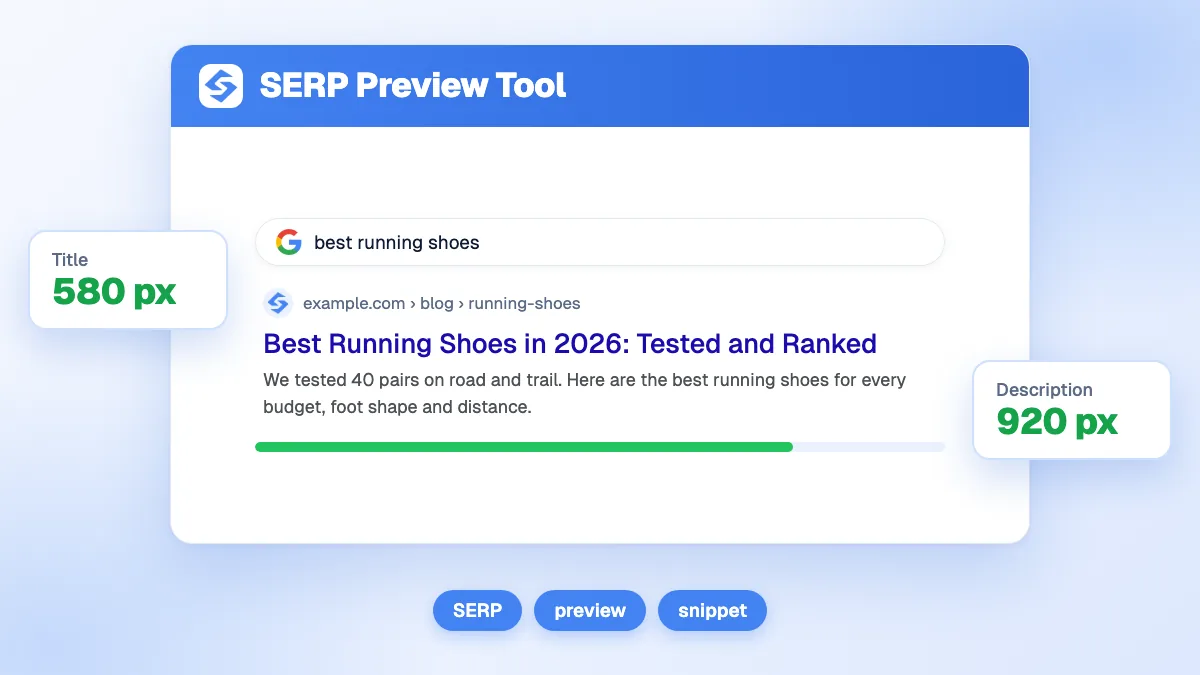
Yes. A private browser window set to the right country and language shows you the results, the features and the competitor pages. Free tools add the rest: a browser SEO extension for each page's headings and metadata, Google Search Console for your own positions, and a SERP preview tool to test how your title and description will look.
 AI Content Brief Generator
 FAQ Schema GeneratorAI Blog Post Ideas GeneratorStructured Data Validator
 Alt Text Checker
 Internal Link AnalyzerBacklink ChallengeAI Meta Description GeneratorAI Blog Title Generator
 Google Indexability CheckerAI Blog Outline GeneratorUTM Link BuilderKeyword Clustering ToolCanonical Tag Checker
 XML Sitemap GeneratorBroken Link CheckerAI SEO Title GeneratorHeadline AnalyzerSERP Preview ToolRedirect Checker
 Hreflang Tag GeneratorHeading Structure AnalyzerHTTP Headers CheckerFavicon Extractor
 SERP CTR Calculator
 SEO vs Paid Search Savings Calculator
 SEO Share of Voice Calculator
 SEO ROI Calculator
 SEO Traffic and Revenue Forecast Calculator
 SEO Budget Calculator
 SEO Break-Even Calculator
 SaaS SEO ROI Calculator
 ROAS Calculator
 Reading Time Calculator
 Ranking Gain Simulator
 Organic Traffic Value Calculator
 Organic Traffic Estimator
 LTV to CAC Ratio Calculator
 Local SEO ROI Calculator
 Link Building Cost Calculator
 Keyword Value Calculator
 Keyword Opportunity Score Calculator
 Keyword Density Calculator
 GEO ROI Calculator
 GEO Content Investment Calculator
 Ecommerce SEO ROI Calculator
 Customer Lifetime Value Calculator
 Customer Acquisition Cost Calculator
 CTR Calculator
 Cost Per Article Calculator
 Conversion Rate Calculator
 Content Marketing ROI Calculator
 ChatGPT Referral Traffic Estimator
 Bounce Rate Calculator
 Backlink ROI Calculator
 AI Visibility Score Calculator
 AI Traffic Value Calculator
 AI Share of Voice Calculator
 Cost of AI Invisibility Calculator
 AI Citation Rate Calculatorllms.txt ValidatorAI Overview CheckerRobots.txt CheckerAI SEO AuditLLM Readability CheckerSearchGPT Readiness Checker
 Structured Data LLM AuditWebsite Crawlability AI AuditWhy ChatGPT Is Not Recommending My Website
 Gemini Ranking ToolPerplexity Ranking CheckerLLM Citation CheckerAnswer Engine Optimization AuditGEO AuditAI Search Visibility TestChatGPT Visibility Checkerllms.txt Generator
 URL ExtractorWebpage to MarkdownSitemap CheckerSERP Volatility SensorPage Size Checker
 Word Counter
 Slug GeneratorSchema GeneratorRobots Generator
 OG PreviewMeta Tags Generator
 Image CompressorFavicon Generator
 On-Page SEO Audit
 Backlink Analysis Tool
 Keyword Research Tool
 Domain Authority Checker
THEY TRIED SORANK BEFORE YOU
 “I tested Sorank on a real client site and it's insane. It does everything an agency would bill you $1500 a month for. It's going into production on that client now.”

 Guillaume Guersanguersanguillaume.com“We are an Ads agency and we wanted to get our SEO back on track once and for all. Sorank gave us a clear view of our site, helped us prioritize optimizations, and properly structure our content. The tool is easy to use, well designed for a team, and very practical for centralizing tracking without having to juggle multiple platforms. A very solid foundation to start fresh with our SEO.”
 Gaspard MadouiAds Agency
 “I just let the Sorank software do its thing, and now my DR is 25 and my page is ranking higher.”
 Lucas Flandrefoundertrace.fr“I specialized in GEO thanks to Sorank. The GEO Leaderboard allows me to show my clients their position vs competitors on ChatGPT. It’s a real commercial differentiator.”
 MélanieSEO Freelance“Great service, works well for our website and helps us understand how to improve it to rank better on Google and elsewhere. Congrats, keep going, I recommend it.”
 Hugo T.E-commerce merchant























