Preferences
Privacy is important to us, so you have the option of disabling certain types of storage that may not be necessary for the basic functioning of the website. Blocking categories may impact your experience on the website. More information

Privacy is important to us, so you have the option of disabling certain types of storage that may not be necessary for the basic functioning of the website. Blocking categories may impact your experience on the website. More information

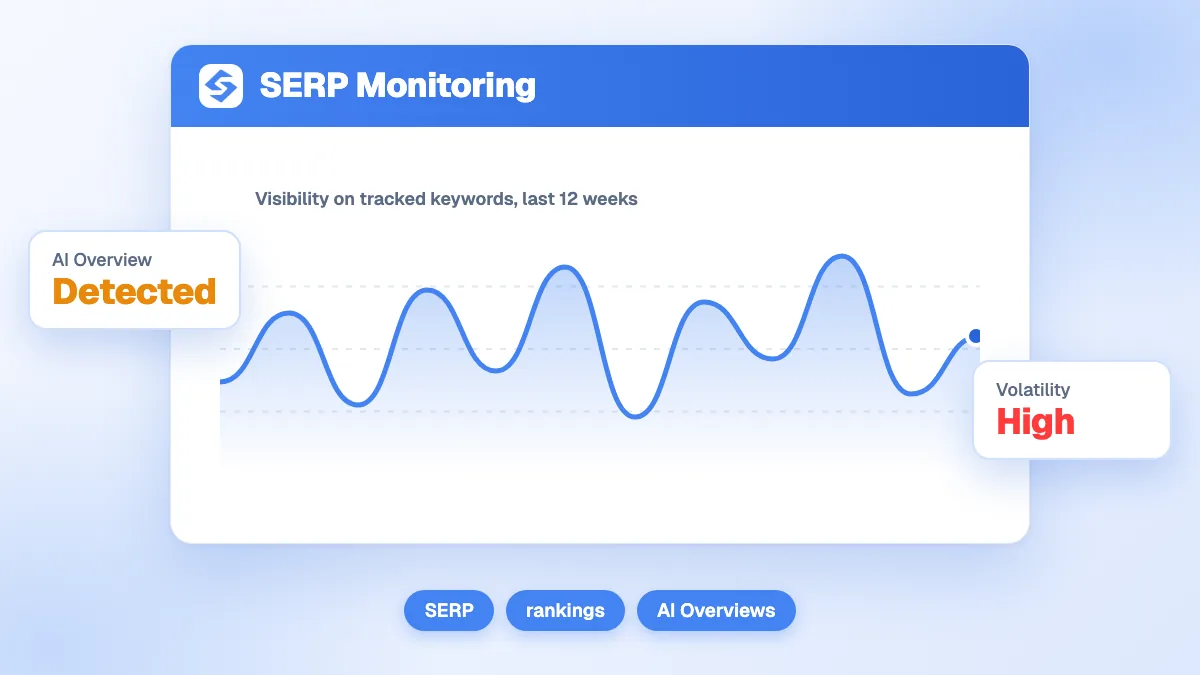
SERP monitoring tracks your positions, the results page features and AI Overviews over time: what to watch, how often, which tools and how to react.

Tools

In short
SERP monitoring means checking the search results pages for your important queries on a regular schedule: your positions, the competitors around you, the features Google shows (featured snippets, People Also Ask, local pack, AI Overviews) and how all of it changes. It lets you spot drops early, tell a site problem from a Google update, and see when an AI answer starts taking clicks above your result. Weekly checks on 50 to 300 key queries, plus Search Console for traffic, cover most businesses.
Want to go further? Ask
Quick quiz
How should you follow your positions on Google?
Sorank matches your answers


Test it for 3 days on your own site and see where you stand on Google, ChatGPT and the other AIs.
Start 3-day free trial3 days free, then stop whenever you want. 90-day results-or-refund guarantee.
SERP monitoring (also called SERP tracking) goes further than rank tracking. A position alone says little if the page around it changed: a first position under an AI Overview, four ads and a local pack does not get the clicks it got two years ago. This guide explains what to monitor, how often, with which tools, and how to react. For the vocabulary, see our glossary entries on the SERP and SERP features.
A SERP (search engine results page) is what Google shows for a query. SERP monitoring records, for a list of queries, the full composition of that page at regular intervals: organic results and their order, ads, rich results and AI elements. Comparing snapshots over time shows who gains, who loses and what new element changed the page.
| What you monitor | Why it matters |
|---|---|
| Your position on each query | Core visibility metric |
| Competitors in the top 10 | Who is gaining, new entrants |
| SERP features present | Featured snippet, People Also Ask, images, videos, local pack, shopping |
| AI Overviews | Whether an AI summary appears and which sources it cites |
| Ads above organic results | How far down the first organic result sits |
| Volatility | How much the whole page moved, a sign of a Google update |
Because clicks depend on the whole page. Google lists dozens of possible elements in its visual elements gallery, and each one changes where users look. Three situations show the difference:
Example
A software vendor sees clicks on "how to write a project brief" drop by a third while its position stays at 1. SERP monitoring shows an AI Overview appeared that week, citing two other sites. The fix is to make its own page the clearest source for that summary: a direct definition at the top and a template table.
Weekly is the right rhythm for most sites: frequent enough to catch a drop within days, calm enough to ignore daily noise. Switch to daily during a migration, a launch or a confirmed Google update. Google announces major ranking updates on its ranking updates page and on the Search Status Dashboard; check them before concluding that a drop is your fault. The free SERP volatility sensor shows how much results are moving across the market.
Tip
Tag each query with the page that should rank for it. When two of your pages alternate on the same query week after week, you have a cannibalization problem to fix by merging or differentiating them.
AI Overviews are part of the SERP, so a good monitoring setup records when one appears and which sources it cites. Beyond Google, buyers ask ChatGPT, Gemini and Perplexity, which do not have a results page in the classic sense: you monitor them by running a fixed list of questions and recording the brands and sources named. Sorank's AI Overview tracker follows Google's AI answers on your queries, and AI mention tracking does the same in the assistants. Our comparison of AI Mode vs AI Overviews explains the two Google surfaces.
| What you see | Likely cause | Action |
|---|---|---|
| Many queries drop at once, competitors too | Google update | Wait one to two weeks, then compare winners and losers |
| One page drops, others stable | Page issue or stronger competitor page | Check indexing, content freshness and the new top results |
| Position stable, clicks down | New SERP feature or AI Overview | Target the feature: direct answer, table, FAQ |
| New competitor in the top 3 | Fresh, better content or links | Analyze their page and close the gap |
| Lost featured snippet | Another page answers more directly | Rewrite the answer in 40 to 60 words under a question heading |
Our guides to the Google algorithm and keyword ranking reports help put movements in context.
Watch out
Do not rewrite a page after two days of decline. Rankings often fluctuate after updates and come back. Act on trends over one to two weeks, unless the cause is clear (noindex, broken page, lost redirect).
SERP monitoring tells you not only where you rank but what the page around you looks like, and in 2026 that includes AI answers. Monitor weekly, compare with Search Console clicks, and react to trends rather than single days. Sorank, SEO and GEO software that runs on autopilot, publishes the content that wins these pages and tracks your brand in AI answers; see the Sorank plans, with a 3-day free trial. For a quick look at how your page appears in results, try the free SERP preview.

Rank tracking records your position on each query. SERP monitoring records the whole results page: your position, competitors, ads, featured snippets, People Also Ask, local pack and AI Overviews. It explains why clicks change when your position does not.
Partly. Search Console gives your average positions, clicks and impressions for free, and you can check results by hand in a private window. Monitoring many queries, competitors and SERP features over time requires a rank tracker or a SERP API, which are paid beyond small volumes.
Check Google's ranking updates page and Search Status Dashboard, then look at whether competitors on the same queries moved at the same time. A broad, simultaneous movement points to an update; a drop limited to your site or one page points to a site issue.
We analyse your competitors, your website and your AI visibility to create a tailored content plan for free.
 AI Content Brief Generator
 FAQ Schema Generator
 AI Blog Post Ideas Generator
 Structured Data Validator (Schema Validator)
 Alt Text Checker
 Internal Link Analyzer
 Backlink Challenge
 AI Meta Description Generator
 AI Blog Title Generator
 Google Indexability Checker
 AI Blog Outline Generator
 UTM Link Builder
 Keyword Clustering Tool
 Canonical Tag Checker
 XML Sitemap Generator
 Broken Link Checker
 AI SEO Title Generator
 Headline Analyzer
 SERP Preview Tool
 Redirect Checker
 Hreflang Tag Generator
 Heading Structure Analyzer
 HTTP Headers Checker
 Favicon Extractor
 SERP CTR Calculator
 SEO vs Paid Search Savings Calculator
 SEO Share of Voice Calculator
 SEO ROI Calculator
 SEO Traffic and Revenue Forecast Calculator
 SEO Budget Calculator
 SEO Break-Even Calculator
 SaaS SEO ROI Calculator
 ROAS Calculator
 Reading Time Calculator
 Ranking Gain Simulator
 Organic Traffic Value Calculator
 Organic Traffic Estimator and Website Traffic Checker
 LTV to CAC Ratio Calculator
 Local SEO ROI Calculator
 Link Building Cost Calculator
 Keyword Value Calculator
 Keyword Opportunity Score Calculator
 Keyword Density Calculator
 GEO ROI Calculator
 GEO Content Investment Calculator
 Ecommerce SEO ROI Calculator
 Customer Lifetime Value Calculator
 Customer Acquisition Cost Calculator
 CTR Calculator
 Cost Per Article Calculator
 Conversion Rate Calculator
 Content Marketing ROI Calculator
 ChatGPT Referral Traffic Estimator
 Bounce Rate Calculator
 Backlink ROI Calculator
 AI Visibility Score Calculator
 AI Traffic Value Calculator
 AI Share of Voice Calculator
 Cost of AI Invisibility Calculator
 AI Citation Rate Calculator
 llms.txt Validator
 AI Overview Checker and AI Overviews Rank Checker
 Robots.txt Checker
 AI SEO Audit
 LLM Readability Checker
 SearchGPT Readiness Checker
 Structured Data LLM Audit
 Website Crawlability AI Audit
 Why ChatGPT Is Not Recommending My Website
 Gemini Ranking Tool
 Perplexity Ranking Checker
 LLM Citation Checker
 Answer Engine Optimization Audit
 GEO Audit
 AI Search Visibility Test
 ChatGPT Visibility Checker
 llms.txt Generator
 URL Extractor
 Webpage to Markdown
 Sitemap Checker
 SERP Volatility Sensor
 Page Size Checker
 Word Counter
 Slug Generator
 Schema Generator
 Robots Generator
 OG Preview
 Meta Tags Generator
 Image Compressor
 Favicon Generator
 On-Page SEO Audit: SEO Checker and SEO Analyzer
 Backlink Analysis Tool
 Keyword Research Tool
 Domain Authority Checker
THEY TRIED SORANK BEFORE YOU
 “I tested Sorank on a real client site and it's insane. It does everything an agency would bill you $1500 a month for. It's going into production on that client now.”

 Guillaume Guersanguersanguillaume.com“We are an Ads agency and we wanted to get our SEO back on track once and for all. Sorank gave us a clear view of our site, helped us prioritize optimizations, and properly structure our content. The tool is easy to use, well designed for a team, and very practical for centralizing tracking without having to juggle multiple platforms. A very solid foundation to start fresh with our SEO.”
 Gaspard MadouiAds Agency
 “I just let the Sorank software do its thing, and now my DR is 25 and my page is ranking higher.”
 Lucas Flandrefoundertrace.fr“I specialized in GEO thanks to Sorank. The GEO Leaderboard allows me to show my clients their position vs competitors on ChatGPT. It’s a real commercial differentiator.”
 MélanieSEO Freelance“Great service, works well for our website and helps us understand how to improve it to rank better on Google and elsewhere. Congrats, keep going, I recommend it.”
 Hugo T.E-commerce merchant