Preferences
Privacy is important to us, so you have the option of disabling certain types of storage that may not be necessary for the basic functioning of the website. Blocking categories may impact your experience on the website. More information
Privacy is important to us, so you have the option of disabling certain types of storage that may not be necessary for the basic functioning of the website. Blocking categories may impact your experience on the website. More information

Who John Mueller is at Google, his career since 2007, where he speaks and what he said on links, AI and GEO, plus a method to turn his advice into action.
In short
John Mueller is the Google employee who leads Search Relations, the team that explains Google Search to people who build websites. He joined Google in Zurich in 2007 as a Webmaster Trends Analyst. Today he answers SEO questions on the Search Central blog, in Office Hours, on a podcast and on social networks.
Want to go further? Ask
Quick quiz
Is SEO right for you, and how should you start?
Sorank matches your answers


Test it for 3 days on your own site and see where you stand on Google, ChatGPT and the other AIs.
Start 3-day free trial3 days free, then stop whenever you want. 90-day results guarantee, conditions apply.
John Mueller is the public voice of Google Search for site owners. His job is not to build the ranking systems. His job is to explain them, collect feedback from the web and pass it back to the engineers.
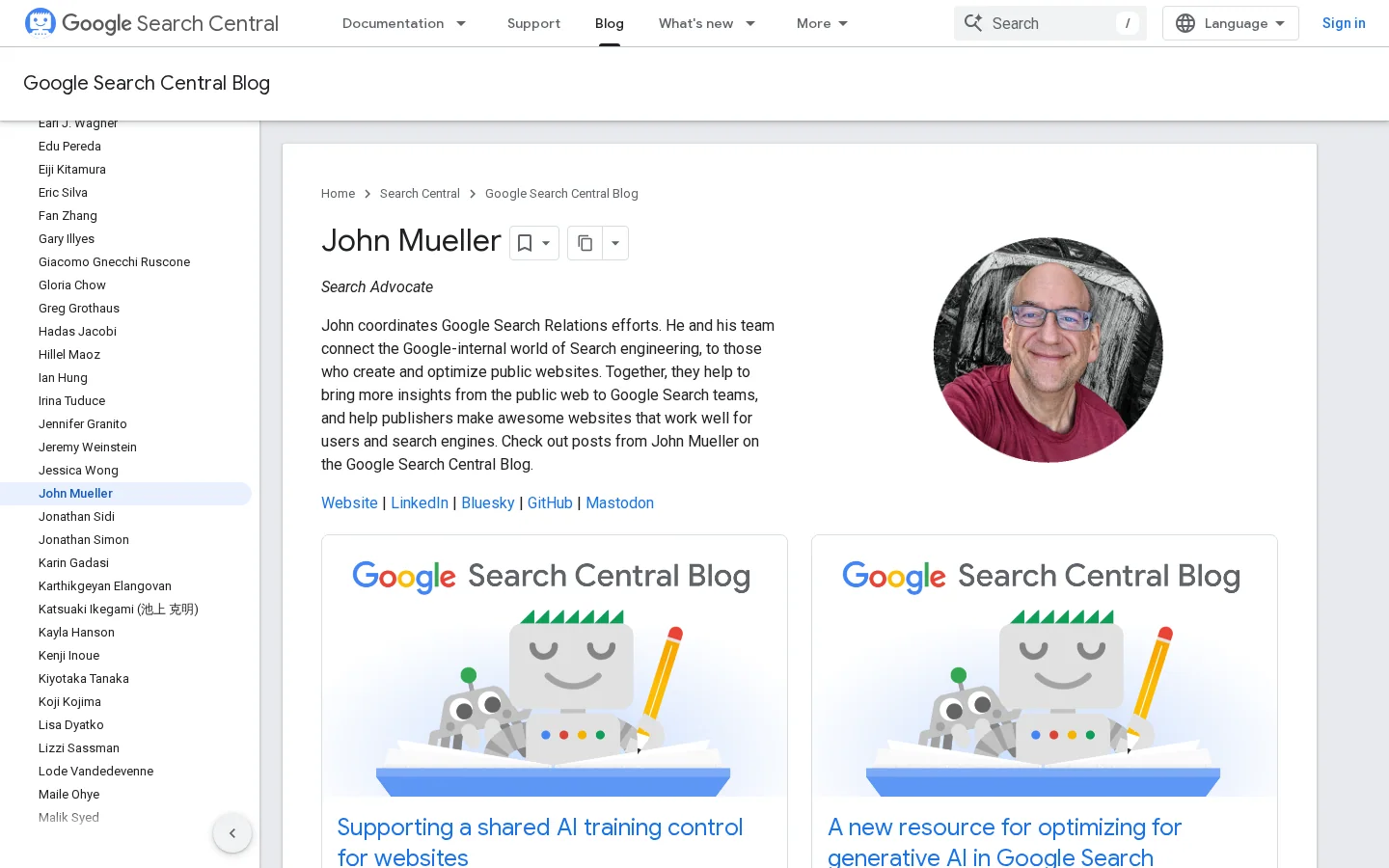
His official author page on Google Search Central sums it up in three sentences. It says that John "coordinates Google Search Relations efforts" and that his team connects "the Google-internal world of Search engineering, to those who create and optimize public websites". The same page lists where he is active: his personal site johnmu.com, LinkedIn, Bluesky, Mastodon and GitHub.
His title has changed several times, which explains why articles call him different things:
The titles change, the role stays the same: he is the bridge between Google Search and the people who make websites. If you read "Google's John Mu" or "JohnMu" in an SEO newsletter, it is him. JohnMu is his long-standing handle, and johnmu.com is his domain.
This point matters more than it seems. John Mueller does not review your site, does not lift penalties, does not decide rankings and cannot see a private file on why one page beats another. When he answers, he explains how Google's systems are meant to work in general. He rarely comments on a single site, and when he does, he looks at it from the outside like anyone else.
The expert detail: Google separates three kinds of public roles in Search. Search Relations (Mueller's team) speaks to site owners and developers. Google's Search Liaison, Danny Sullivan, speaks to the public and the press about Search launches. The people who handle manual actions work inside the Search Quality teams and answer through the reconsideration requests in Google Search Console, not on social networks. Knowing who speaks for what saves you from asking the wrong person the wrong question.
What John Mueller does and does not do
John Mueller came to Google from the webmaster community itself. He was not hired out of a marketing department. He was the person who already answered webmasters' questions every day, for free.
When Search Engine Roundtable announced his hiring on 27 August 2007, in a post by Barry Schwartz, it described him as a regular in Google's webmaster help groups, where he answered questions daily, and an active member of SEO forums such as Cre8asite. He had also built dozens of free tools for SEOs and webmasters on his site oyoy.eu. The post said he would start "come September" as a Webmaster Trends Analyst, based in Zürich, Switzerland.
That background explains his style. He still writes like a forum regular: short replies, plain words, a dry joke now and then, and a strong dislike for magic recipes.
For most of his career, his work has followed the way Google talks to site owners. The key dates are below.
John Mueller at Google: key dates
The 2020 rename is worth a closer look. In the post "Goodbye Google Webmasters, hello Google Search Central" (Lizzi Sassman, 11 November 2020), Google explained that a user study showed few web professionals call themselves webmasters. The blog and its 13 localized versions moved to developers.google.com/search/blog, and the help forum became the Google Search Central Community. Mueller's titles followed the same path: "Webmaster Trends Analyst" became "Search Advocate".
John Mueller's work in three figures
Sources: Search Engine Roundtable (2007 and 2022), Google Search Central blog (2020)

Search Relations is Google's translation desk between engineers and the web. It turns internal changes into documentation, answers, talks and podcasts, and it brings back what site owners struggle with.
In practice, the team's work shows up in four places:
Mueller rarely works alone in public. The Search Off the Record page lists four voices: Gary Illyes (Search Advocate, often on crawling and Googlebot), Martin Splitt (Developer Advocate, often on JavaScript and rendering), Lizzi Sassman (Tech Writer, who shapes much of the documentation) and John Mueller (Search Relations Lead). When you research a topic, check whether one of the others has gone deeper on it. On a JavaScript rendering question, for example, Splitt's videos usually give more detail than a short Mueller reply.
The part most SEOs miss is the return trip. Search Relations does not only push information out. Repeated questions, confused site owners and broken reports are signals the team reports back. That is why Mueller often asks for examples ("send me the URL") when many people report the same bug: a clean example helps engineers reproduce it. If you want Google to fix a reporting issue, a precise and reproducible case on a public channel has far more weight than an angry thread.
Mueller speaks on many channels, and each one has a different weight. Official channels carry Google's voice. Personal channels carry his own, usually close to Google's but more casual.
| Channel | Format | Official or personal | Best for |
|---|---|---|---|
| Google Search Central blog | Articles | Official | Announcements and changes you must act on |
| Google SEO Office Hours | Recorded Q&A with transcripts | Official | Clear answers to common site owner questions |
| Search Off the Record podcast | Audio and video discussion | Official | Background, reasoning and history behind Search topics |
| Search Central YouTube channel | Videos | Official | Short explanations and conference talks |
| Bluesky (johnmu.com) | Short posts and replies | Personal | Fast reactions to SEO debates |
| Mastodon (@johnmu) | Short posts | Personal | Same as Bluesky, smaller audience |
| LinkedIn (johnmu) | Posts and comments | Personal | Longer opinions, often on AI and SEO advice |
| Reddit (r/SEO, r/TechSEO) | Thread replies | Personal | Very direct answers to real cases |
| johnmu.com | Personal blog | Personal | Side projects, code and occasional SEO scripts |
For years, the Office Hours were the best place to ask Mueller anything live. That changed in 2022. According to Search Engine Roundtable (Barry Schwartz, 21 June 2022), he used to hold about four sessions per month, two in English and two in German, every other week. He moved to pre-submitted questions, answered in about 30 minutes, and aimed for "about 1/month", explaining that the sessions were "quite time-intensive". Later sessions became a panel, with Gary Illyes, Martin Splitt or Lizzi Sassman answering next to him.
SEO Office Hours before and after 2022
Source: Search Engine Roundtable, June 2022
The transcripts are a goldmine because they are written down and dated. In the July 2024 session, for example, a site owner asked about growing a product catalog tenfold. Mueller's answer: "It's basically a new website after all." To someone whose brand name is also a common word, he said: "There's no shortcut available." On how to fill XML sitemaps: "If you're generating them automatically, I'd just fill them up." Three short answers, three decisions you can apply.
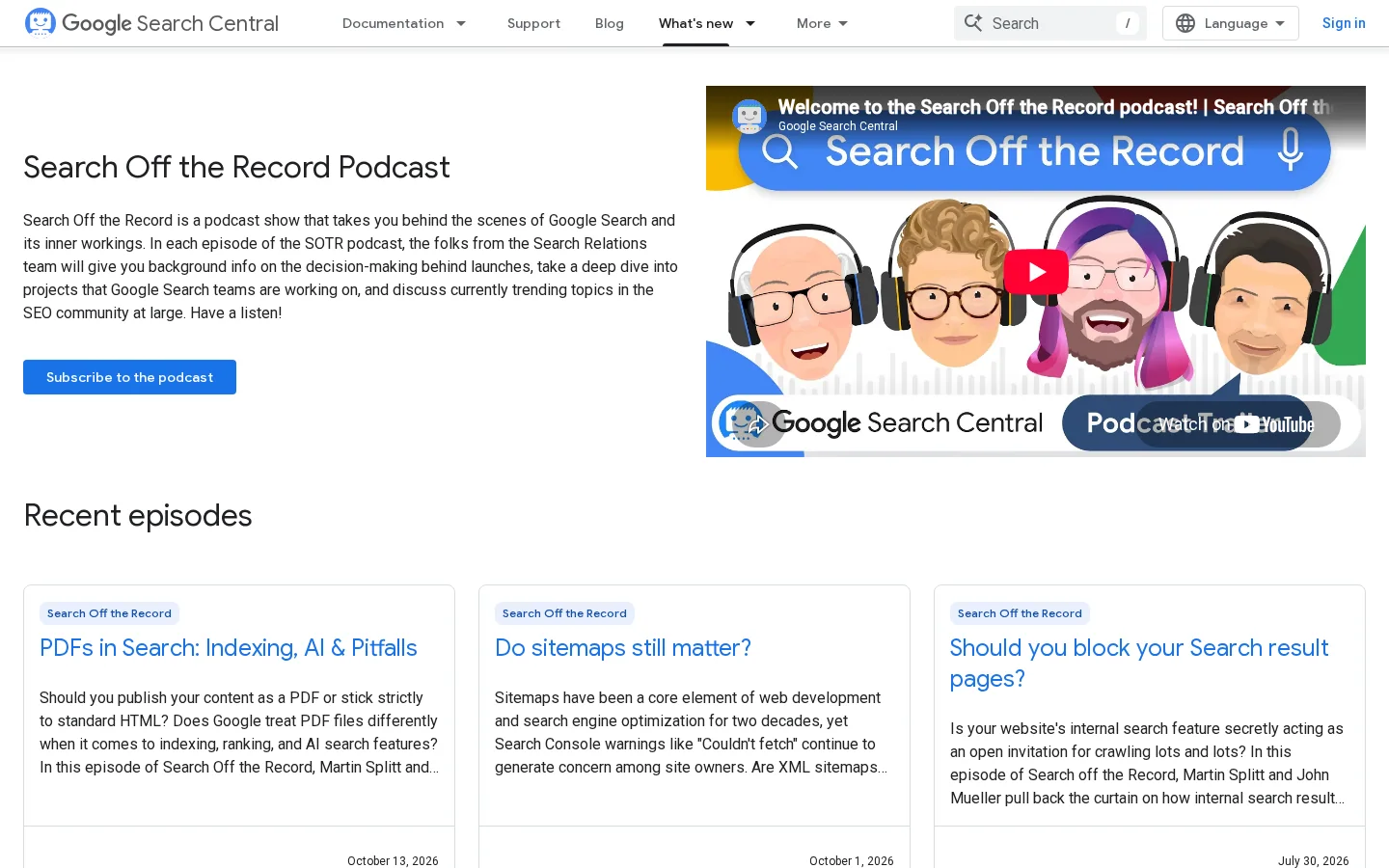
Search Off the Record is the team's podcast. Google's page describes it as a look behind the scenes of Google Search: the reasoning behind launches, deep dives into Search projects and trending SEO topics. It is the best channel to understand why Google does something, not only what it does. Episodes on crawling, the Page Indexing report or AI in Search often give context that no documentation page contains.
Mueller was known for years as @JohnMu on Twitter. His official Google profile now points to LinkedIn, Bluesky, Mastodon and GitHub rather than X, so Bluesky is where most of his quick SEO replies appear today. His personal site, johnmu.com, mixes SEO scripts (for example, automating IndexNow submissions or checking lost URLs after a CMS migration) with electronics projects. Its footer states: "The views expressed here are mine and not those of my employer." Keep that sentence in mind when you quote him from a personal channel.
Set up your John Mueller watch in 15 minutes
Mueller's positions are consistent over the years: make sites for people, keep the technical basics clean, ignore tricks. Below are the statements that come up most often, with their date and source, so you can use them correctly.
This is his most quoted topic. On Reddit, in a thread reported by Search Engine Roundtable on 27 May 2024, he wrote: "The concept of toxic links is made up by SEO tools so that you pay them regularly." He later added: "Nothing has really changed here, you can continue to save yourself the effort."
Two years later, he gave the nuance that many people forget. On Bluesky, on 6 March 2026 (also reported by Search Engine Roundtable), he wrote that "the disavow file is a tool, not a religion" and that "most sites don't need it, but that's not all sites". He added that if you are conflicted, "it's totally fine to set up & use disavow files", and that you can disavow a whole top-level domain if most problems come from it.
What it means for you: random spammy links pointing to your site are usually ignored by Google. A disavow file is for links that you, or a former agency, actually bought or built in a way that breaks Google's rules, especially after a manual action. Our guide on when disavowing backlinks is actually needed goes through each case.
# Disavow file: only links you or a former provider built against Google's rules
# One URL or one domain per line, UTF-8 text file
domain:paid-links-network.example
domain:spun-articles.example
https://old-directory.example/page-with-our-paid-link.htmlOn content, his line has not changed in 15 years: no secret formula, no word count to hit, no keyword percentage. He repeats that Google has no problem with several H1 headings on a page, that word count is not a ranking factor, and that adding more pages is not a strategy by itself. These positions match Google's guidance on people-first helpful content. When a site loses traffic after an update, he usually says to compare it with what is ranking now, not with its own past version. Many of these answers are the basis of our list of SEO myths that Google has debunked.
He often defends technical SEO against people who say it is dead. His usual points: a clean site structure matters, HTML sitemaps are not needed if navigation is clear, during a domain move you use the change of address tool once the new site is live, and good Core Web Vitals help users but will not lift a page that does not answer the query. In short: fix what blocks crawling and indexing first, then stop polishing.
Since 2025, a large share of his replies are about AI. Three positions stand out:
Note the limit: when he speaks about AI, he speaks about Google Search and its AI features (AI Overviews, AI Mode). He does not speak for ChatGPT, Claude or Gemini outside Search. Being cited by those AI models depends on their own sources and crawlers, which is why tracking them separately matters. Our guide to getting your pages cited in Google AI Mode covers the Google side.
| Topic | What Mueller said | Date and place | What to do |
|---|---|---|---|
| Toxic links | "The concept of toxic links is made up by SEO tools" | May 2024, Reddit | Stop paying for "toxic score" cleanups |
| Disavow | "A tool, not a religion"; most sites don't need it | March 2026, Bluesky | Disavow only links you built against the rules |
| llms.txt | "Comparable to the keywords meta tag" | April 2025, Reddit | Do not expect a ranking or citation boost from it |
| GEO | "What you call it doesn't matter, but 'AI' is not going away" | January 2026, Reddit | Measure your AI traffic and visibility, then prioritize |
| Catalog growth | "It's basically a new website after all" | July 2024, Office Hours | Treat a tenfold expansion like a launch |
| Sitemaps | "If you're generating them automatically, I'd just fill them up" | July 2024, Office Hours | Do not split sitemaps without a reason |
Mueller is one source among several. To make good decisions, you need to know what each kind of Google information is worth. There are five main methods, from the most official to the most personal.
Principle: read the Search Central guides and policies directly. When to use it: before any decision that could cost traffic (migration, structured data, spam risk). Advantages: it is the reference, updated by Google, and it is what Mueller himself links to. Limits: it stays general and rarely covers edge cases. Example: before rewriting 500 pages with AI, read the spam policies summarized in our guide to Google's Search Essentials and spam policies.
Principle: read what he answers on Bluesky, Reddit or LinkedIn. When to use it: for a specific case the documentation does not cover. Advantages: fast, concrete, often about real sites. Limits: short, personal channel, context easy to lose. Example: his March 2026 nuance on disavowing a whole top-level domain, which no help page documents.
Principle: follow the team's recorded sessions and podcast. When to use it: to understand the reasoning behind a rule. Advantages: official, dated, with transcripts. Limits: less frequent since 2022, questions are filtered. Example: the July 2024 answer that a tenfold catalog is "basically a new website".
Principle: read news sites that collect Google statements every day. When to use it: to stay informed without following every channel. Advantages: nothing is missed, with links to the original. Limits: headlines simplify; always open the original post. Example: a headline saying "Google: disavow is useless" when the post says "most sites don't need it".
Principle: check what actually happens on your site in Search Console, your analytics and your tests. When to use it: always, as the final judge. Advantages: it is about your site, not sites in general. Limits: needs time and clean tracking. Example: after a Google core update, comparing pages that lost clicks with the pages now ranking above them.
| Method | Authority | Speed | Detail on edge cases | Main risk |
|---|---|---|---|---|
| Official documentation | Highest | Slow | Low | Too general for your case |
| Mueller's public replies | Medium | Very fast | High | Quote taken out of context |
| Office Hours and podcast | High | Monthly | Medium | Your question is never picked |
| Industry recaps | Depends on the original | Fast | Medium | Simplified headline |
| Your own data | Highest for your site | Slow | Highest | Wrong conclusion from noisy data |
A quote is only useful if it leads to a decision on your site. Here is the method we use, in five steps.
From a Mueller quote to a decision on your site
Search for the exact words with a search operator, then open the original post. On Bluesky, the search bar accepts a "from:" filter followed by the account name.
"Mueller" "disavow" site:seroundtable.com
from:johnmu.com disavow
site:developers.google.com/search/help/office-hours sitemapWrite down three things: the exact question, the type of site concerned (a news site, a store, a site with a manual action...) and the date. A 2014 hangout answer about a feature that no longer exists is not advice for 2027.
If the reply contradicts the documentation, the documentation wins until Google updates it. If the reply adds a detail the documentation does not mention, treat it as a useful hint, not as a rule.
Open the Performance report in Search Console. Filter the pages concerned with a regular expression and compare 28 days before and after the change you are investigating. Example to isolate product and category pages:
^https://www\.yoursite\.com/(products|category)/If a drop matches a Google update date, check whether the whole market moved too before you change anything.
Tip
Before you blame your site for a drop, check whether Google's results are moving for everyone. Our free SERP volatility sensor shows in real time whether an update is shaking the rankings.
Write a line in a change log: date, page or section, change made, source of the decision (with the link to the original Mueller post or doc page), metric to watch. Review it after 4 to 8 weeks. This turns "Mueller said" into a decision you can defend in front of a client or a manager.
Most problems do not come from what Mueller says, but from how it is quoted. Here are the seven mistakes we see most often.
What it is: repeating a news headline as if it were his exact words. How to spot it: you cannot give the link to the original post or video. How to fix it: always open the source and copy the full sentence, with the date.
What it is: applying an answer from 2015 to a 2027 site. Google has changed many systems since then (mobile-first indexing, AI Overviews, spam policies). How to spot it: the quote has no date, or mentions tools that no longer exist. How to fix it: search for a more recent statement on the same topic and check the current documentation.
What it is: deciding that something does not matter because Mueller said it is not a direct ranking factor. How to spot it: you are about to remove something users need (a clear title, a fast page, a helpful FAQ). How to fix it: ask whether it helps users or conversions. Many things are not ranking factors and still matter for business.
What it is: applying to every site an answer given for one situation. "Most sites don't need a disavow file" does not mean "no site does". How to spot it: the original reply includes "usually", "most", "in your case". How to fix it: compare your situation with the one in the question. A site with a manual action for unnatural links is not "most sites"; read our guide on how to tell a manual action from an algorithmic drop.
What it is: presenting a Bluesky joke or a LinkedIn opinion as a Google rule. How to spot it: the source is a personal account, not developers.google.com. How to fix it: label it clearly ("Mueller said on Bluesky") and look for the official page.
What it is: sharing a cropped screenshot or a quote invented to sell a service. How to spot it: no link, no date, a promise that sounds too good ("Google confirms this trick"). How to fix it: find the post on his verified profiles, which are listed on his Google author page.
Warning
Mueller never sells SEO services, link packages or "Google-approved" audits. Any message using his name to sell you something is not from him.
What it is: assuming that what is true for Google Search is true for ChatGPT, Claude or Gemini. How to spot it: you plan your AI visibility using only Google statements. How to fix it: measure each AI model separately, with prompts your customers really ask.
His message, repeated for nearly 20 years, is simple: build pages that answer real people well, keep the technical basics clean and do not pay for tricks. That message has not changed with AI. What has changed is where people search: on Google, but also in AI answers.
His January 2026 advice is the useful part here: look at actual usage metrics before you decide how much effort to put into AI search. You cannot do that without measuring. With Sorank, tracking when ChatGPT, Claude and Gemini mention your brand shows whether AI models already cite you, on which questions, and which competitors they recommend instead. From there, GEO optimization for AI answers follows the same principle as Mueller's SEO advice: useful content, published regularly, on the questions your customers ask.
The expert detail: Google's quality framework, explained in the Search Quality Rater Guidelines, puts experience and trust at the center. AI models that cite sources use similar clues: clear authorship, precise facts, pages that answer one question well. Following Mueller's advice for Google is also a good base for AI answers.
John Mueller is the most useful public source on how Google Search works, as long as you read him in context. Three actions for today:
Then measure. Mueller himself says it: look at your actual data, understand your audience and prioritize accordingly.
John Mueller leads Google's Search Relations team, which explains Google Search to people who build and optimize websites. He joined Google in Zurich in 2007 as a Webmaster Trends Analyst and is known in the SEO world as JohnMu.
Yes. His Google Search Central author page says he coordinates Google Search Relations efforts, and Google's Search Off the Record podcast lists him as Search Relations Lead. He still answers SEO questions on Bluesky, LinkedIn, Reddit and in Google's recorded sessions.
You can submit a question for Google's SEO Office Hours, which are recorded and published with transcripts, or ask in public on Bluesky or in SEO threads on Reddit, where he often replies. He does not audit sites privately, so give a clear, public and reproducible example.
We analyse your competitors, your website and your AI visibility to create a tailored content plan for free.
 Website Value Calculator
 Website Accessibility Checker
 Google Analytics Checker
 Duplicate Content Checker
 Mobile-Friendly Test
 Website Speed Test
 Subdomain Finder
 Domain Age Checker
 CMS Detector
 Googlebot Simulator
 Nofollow Link Checker
 Meta Tag Checker
 Keyword Cannibalization Checker
 Keyword Intent Checker
 Keyword Extractor
 Google Ads Cost Calculator
 CPC Calculator
 Local Citation Finder
 Reddit Threads Finder
 Disavow File Generator
 Redirect Generator
 Canonical Tag Generator
 Passive Voice Checker
 Google Location Changer
 Google Review Calculator
 Google Review Link Generator
 Keyword Combiner
 Podcast Show Notes Generator
 AI Content Rewriter
 AI Text Humanizer
 ChatGPT Prompt Generator
 Twitter Thread Generator
 Tweet Generator
 Landing Page Copy Generator
 Google Ads Copy Generator
 Pinterest Pin Description Generator
 Anchor Text Generator
 Social Media Post Generator
 LinkedIn Post Generator
 Free AI Writer
 Review Response Generator
 LSI Keyword Generator
 YouTube Video Ideas Generator
 YouTube Tag Generator
 YouTube Description Generator
 Product Description Generator
 CTA Generator
 Blog Introduction Generator
 Conclusion Generator
 Hook Generator
 AI Content Brief Generator
 FAQ Schema Generator
 AI Blog Post Ideas Generator
 Structured Data Validator (Schema Validator)
 Alt Text Checker
 Internal Link Analyzer
 Backlink Challenge
 AI Meta Description Generator
 AI Blog Title Generator
 Google Indexability Checker
 AI Blog Outline Generator
 UTM Link Builder
 Keyword Clustering Tool
 Canonical Tag Checker
 XML Sitemap Generator
 Broken Link Checker
 AI SEO Title Generator
 Headline Analyzer
 SERP Preview Tool
 Redirect Checker
 Hreflang Tag Generator
 Heading Structure Analyzer
 HTTP Headers Checker
 Favicon Extractor
 SERP CTR Calculator
 SEO vs Paid Search Savings Calculator
 SEO Share of Voice Calculator
 SEO ROI Calculator
 SEO Traffic and Revenue Forecast Calculator
 SEO Budget Calculator
 SEO Break-Even Calculator
 SaaS SEO ROI Calculator
 ROAS Calculator
 Reading Time Calculator
 Ranking Gain Simulator
 Organic Traffic Value Calculator
 Organic Traffic Estimator and Website Traffic Checker
 LTV to CAC Ratio Calculator
 Local SEO ROI Calculator
 Link Building Cost Calculator
 Keyword Value Calculator
 Keyword Opportunity Score Calculator
 Keyword Density Calculator
 GEO ROI Calculator
 GEO Content Investment Calculator
 Ecommerce SEO ROI Calculator
 Customer Lifetime Value Calculator
 Customer Acquisition Cost Calculator
 CTR Calculator
 Cost Per Article Calculator
 Conversion Rate Calculator
 Content Marketing ROI Calculator
 ChatGPT Referral Traffic Estimator
 Bounce Rate Calculator
 Backlink ROI Calculator
 AI Visibility Score Calculator
 AI Traffic Value Calculator
 AI Share of Voice Calculator
 Cost of AI Invisibility Calculator
 AI Citation Rate Calculator
 llms.txt Validator
 AI Overview Checker and AI Overviews Rank Checker
 Robots.txt Checker
 AI SEO Audit
 LLM Readability Checker
 SearchGPT Readiness Checker
 Structured Data LLM Audit
 Website Crawlability AI Audit
 Why ChatGPT Is Not Recommending My Website
 Gemini Ranking Tool
 Perplexity Ranking Checker
 LLM Citation Checker
 Answer Engine Optimization Audit
 GEO Audit
 AI Search Visibility Test
 ChatGPT Visibility Checker
 llms.txt Generator
 URL Extractor
 Webpage to Markdown
 Sitemap Checker
 SERP Volatility Sensor
 Page Size Checker
 Word Counter
 Slug Generator
 Schema Generator
 Robots Generator
 OG Preview
 Meta Tags Generator
 Image Compressor
 Favicon Generator
 On-Page SEO Audit: SEO Checker and SEO Analyzer
 Backlink Analysis Tool
 Keyword Research Tool
 Domain Authority Checker
 “I tested Sorank on a real client site and it's insane. It does everything an agency would bill you $1500 a month for. It's going into production on that client now.”

 Guillaume Guersanguersanguillaume.com“We are an Ads agency and we wanted to get our SEO back on track once and for all. Sorank gave us a clear view of our site, helped us prioritize optimizations, and properly structure our content. The tool is easy to use, well designed for a team, and very practical for centralizing tracking without having to juggle multiple platforms. A very solid foundation to start fresh with our SEO.”
 Gaspard MadouiAds Agency
 “I just let the Sorank software do its thing, and now my DR is 25 and my page is ranking higher.”
 Lucas Flandrefoundertrace.fr“I specialized in GEO thanks to Sorank. The GEO Leaderboard allows me to show my clients their position vs competitors on ChatGPT. It’s a real commercial differentiator.”
 MélanieSEO Freelance“Great service, works well for our website and helps us understand how to improve it to rank better on Google and elsewhere. Congrats, keep going, I recommend it.”
 Hugo T.E-commerce merchant