Preferences
Privacy is important to us, so you have the option of disabling certain types of storage that may not be necessary for the basic functioning of the website. Blocking categories may impact your experience on the website. More information

Privacy is important to us, so you have the option of disabling certain types of storage that may not be necessary for the basic functioning of the website. Blocking categories may impact your experience on the website. More information

Google's SEO guidelines explained: the 3 technical requirements, the spam policies that get sites demoted, the key best practices and the rules for AI content.

Tools

In short
Google's guidelines for SEO are called Google Search Essentials (formerly the Webmaster Guidelines). They have three parts: technical requirements (Googlebot is not blocked, the page returns HTTP 200, the content is indexable), spam policies (cloaking, link spam, scaled content abuse and other tactics that can get a page or a whole site demoted or removed) and key best practices (helpful, people-first content, the words people search for, crawlable links). AI-generated content is allowed if it is useful and accurate, and AI Overviews and AI Mode add no extra requirements.
Want to go further? Ask
Quick quiz
Is SEO right for you, and how should you start?
Sorank matches your answers


Test it for 3 days on your own site and see where you stand on Google, ChatGPT and the other AIs.
Start 3-day free trial3 days free, then stop whenever you want. 90-day results-or-refund guarantee.
Every site that wants traffic from Google plays by the same rulebook. Google's guidelines for SEO are published as Google Search Essentials, a short set of pages that tells you what Google needs to show a page, what gets a site penalized and what helps it appear better. This guide explains each part in plain language, adds Google's guidance on helpful content and AI, and ends with a checklist you can run on your own site.
Google Search Essentials replaced the Webmaster Guidelines in 2022. The content is largely the same, rewritten and organized in three parts:
| Part | Google's definition | What it means for you |
|---|---|---|
| Technical requirements | "What Google needs from a web page to show it in Google Search" | The minimum to be indexed at all |
| Spam policies | "The behaviors and tactics that can lead to lower ranking or being completely omitted from Google Search results" | What not to do, ever |
| Key best practices | "The main things that can help improve how your site appears in Google Search results" | What actually moves rankings |
Google adds an important caveat: meeting all of them "doesn't mean that Google will crawl, index, or serve its content." The guidelines define eligibility, not a ranking guarantee. To understand where they fit in the full process, see our explainer on how search engines work.
There are only three, and most sites meet them by default:
You can check all three for any URL with the URL Inspection tool in Google Search Console. For new pages, a clean sitemap helps Google find them: our guide shows how to submit a sitemap to Google.
The spam policies list the tactics that "can lead to a page or an entire site being ranked lower or completely omitted from Google Search." Google detects violations with automated systems and, when needed, human review; a confirmed human finding becomes a manual action, visible in the Manual actions report of Search Console.
| Policy | What it covers, in plain words |
|---|---|
| Cloaking | Showing Google different content from what users see |
| Doorway abuse | Many near-identical pages built to rank for variations of a query and funnel users elsewhere |
| Expired domain abuse | Buying an expired domain to exploit its reputation with unrelated, low-value content |
| Hacked content | Content placed on a site without permission through a security flaw |
| Hidden text and link abuse | Text or links visible to Google but not to readers |
| Keyword stuffing | Repeating keywords unnaturally to manipulate rankings |
| Link spam | Links created mainly to manipulate rankings, including buying or selling links that pass ranking credit |
| Machine-generated traffic | Automated queries sent to Google |
| Malicious practices | Malware and unwanted software |
| Misleading functionality | Fake tools or services that trick users |
| Scaled content abuse | "Many pages are generated for the primary purpose of manipulating search rankings", by AI, humans or both |
| Scraping | Republishing other sites' content without adding value |
| Site reputation abuse | Third-party pages published on a host site mainly to exploit the host's ranking signals |
| Sneaky redirects | Sending users to a different URL than the one Google saw |
| Thin affiliation | Affiliate pages copied from the merchant with no original value |
| User-generated spam | Spam left by users in comments, forums or profiles |
Watch out
The two policies that catch the most well-meaning sites today are link spam and scaled content abuse. Paid links must carry rel="sponsored" or rel="nofollow", and publishing hundreds of pages with no real value is a violation whether a person or an AI wrote them. See our pages on AI spam and toxic backlinks.
This is the short list Google itself puts forward, and it is where most ranking gains come from:
For what Google has confirmed about ranking signals beyond this list, see our guide to Google ranking factors, which separates confirmed factors from myths.
Google's guide to creating helpful, reliable, people-first content gives a self-assessment rather than a formula. Among its questions: does the content provide "original information, reporting, research, or analysis"? Is it something readers would "bookmark, share with a friend, or recommend"? It also proposes a Who, How and Why test: who created the content, how it was made (including any use of automation or AI) and why, the last one being "perhaps the most important question."
Two clarifications matter. First, E-E-A-T (experience, expertise, authoritativeness, trustworthiness) "isn't a specific ranking factor"; it describes what Google's systems try to reward, and trust weighs the most. Second, Google flags content made mainly to attract search visits, or that "mainly summariz[es] what others have to say without adding much value", as a warning sign. Our glossary entry on helpful content summarizes the history of these updates.
Google does not ban it. Its guidance on generative AI content says AI "can be particularly useful when researching a topic, and to add structure to original content", as long as the result meets Search Essentials and the spam policies. The limits:
Our guide to AI content for SEO covers how to use AI within these rules.
No. Google's page on AI features and your website states: "There are no additional requirements to appear in AI Overviews or AI Mode, nor other special optimizations necessary." To be shown as a supporting link, a page must be "indexed and eligible to be shown in Google Search with a snippet." In other words, the same Search Essentials that get you into the classic results get you into Google AI Overviews.
Other assistants (ChatGPT, Perplexity, Claude) have their own crawlers and do not follow Google's spam policies, but they reward the same things in practice: accessible pages, clear answers, original information and sources. A site that follows Search Essentials is in a good position for both.
| Check | Where | Red flag |
|---|---|---|
| Important pages indexed | Page indexing report | Key URLs under "Why pages aren't indexed" |
| No manual action | Security and Manual actions section | Any active manual action |
| No security issue | Security issues report | Hacked content or malware flagged |
| Clean link profile | Links report, backlink tool | Paid links without sponsored or nofollow, sitewide footer links |
| Content quality | Manual review of thin and old pages | Pages with no unique information, mass-produced templates |
| Search intent match | Performance report (queries vs pages) | Pages ranking for queries they do not answer |
If you are unsure where a practice sits, our comparison of white hat and black hat SEO gives concrete examples on both sides.
Search Essentials describe the floor: be accessible, do not manipulate, publish content that deserves to rank. The growth comes from doing the best practices consistently, publishing useful pages on the topics your buyers search and ask AI assistants about, and measuring what happens.
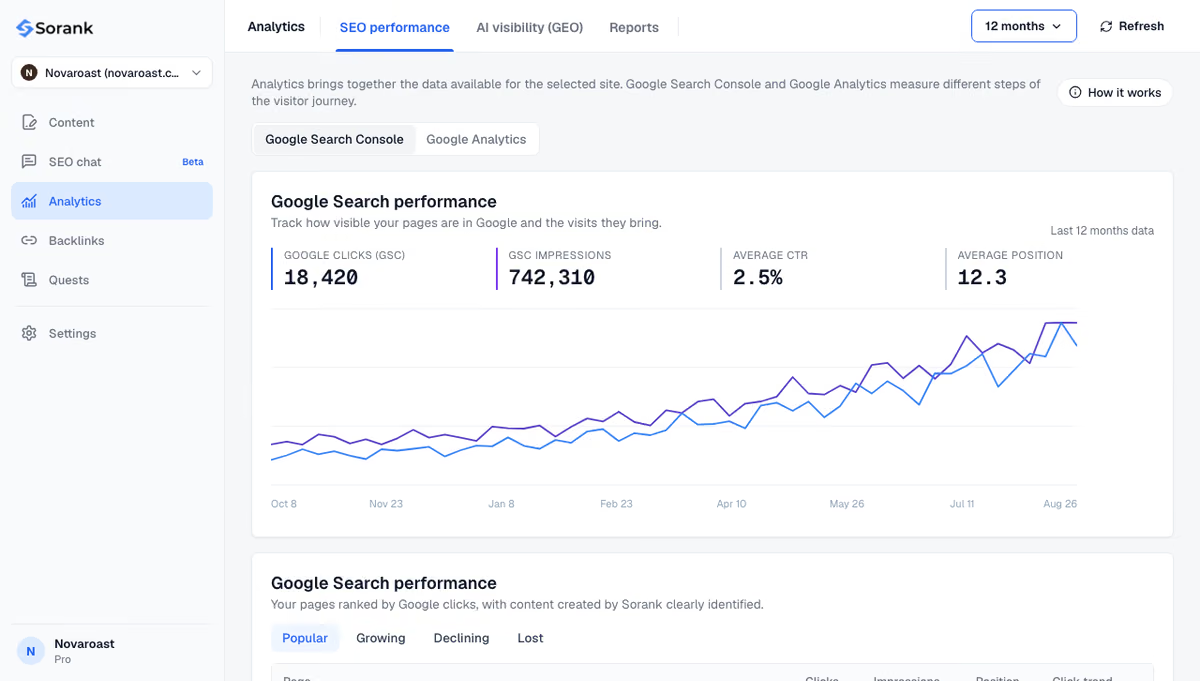
Sorank is our product: an autopilot SEO and GEO software. Its blog article generator writes articles with sources and internal links, published automatically or as drafts for your review, and the GEO and SEO dashboard tracks clicks, impressions and positions from Search Console so you can see which pages Google rewards.
The short version: meet the three technical requirements, stay clear of the spam policies and put your effort into helpful, people-first content; the same rules apply to AI Overviews. To publish that content every week without adding hours to your schedule, see Sorank's plans, from $49 per month with a 3-day free trial.

Yes, Search Essentials is the new name and structure of the former Google Webmaster Guidelines, introduced in 2022. Most topics carried over from the old quality guidelines, rewritten and grouped into technical requirements, spam policies and key best practices.
Pages or the whole site can rank lower or disappear from Google Search. Violations are detected by automated systems, and when a human reviewer confirms one, Google applies a manual action and notifies the owner in Search Console. After fixing the issue, the owner can file a reconsideration request from the Manual actions report.
No, not because it was written with AI. Google judges the content, not the tool: AI-assisted pages that are accurate, original and useful can rank. What Google penalizes is scaled content abuse, meaning many pages produced mainly to manipulate rankings without adding value, whoever or whatever wrote them.
We analyse your competitors, your website and your AI visibility to create a tailored content plan for free.
 AI Content Brief Generator
 FAQ Schema Generator
 AI Blog Post Ideas Generator
 Structured Data Validator (Schema Validator)
 Alt Text Checker
 Internal Link Analyzer
 Backlink Challenge
 AI Meta Description Generator
 AI Blog Title Generator
 Google Indexability Checker
 AI Blog Outline Generator
 UTM Link Builder
 Keyword Clustering Tool
 Canonical Tag Checker
 XML Sitemap Generator
 Broken Link Checker
 AI SEO Title Generator
 Headline Analyzer
 SERP Preview Tool
 Redirect Checker
 Hreflang Tag Generator
 Heading Structure Analyzer
 HTTP Headers Checker
 Favicon Extractor
 SERP CTR Calculator
 SEO vs Paid Search Savings Calculator
 SEO Share of Voice Calculator
 SEO ROI Calculator
 SEO Traffic and Revenue Forecast Calculator
 SEO Budget Calculator
 SEO Break-Even Calculator
 SaaS SEO ROI Calculator
 ROAS Calculator
 Reading Time Calculator
 Ranking Gain Simulator
 Organic Traffic Value Calculator
 Organic Traffic Estimator and Website Traffic Checker
 LTV to CAC Ratio Calculator
 Local SEO ROI Calculator
 Link Building Cost Calculator
 Keyword Value Calculator
 Keyword Opportunity Score Calculator
 Keyword Density Calculator
 GEO ROI Calculator
 GEO Content Investment Calculator
 Ecommerce SEO ROI Calculator
 Customer Lifetime Value Calculator
 Customer Acquisition Cost Calculator
 CTR Calculator
 Cost Per Article Calculator
 Conversion Rate Calculator
 Content Marketing ROI Calculator
 ChatGPT Referral Traffic Estimator
 Bounce Rate Calculator
 Backlink ROI Calculator
 AI Visibility Score Calculator
 AI Traffic Value Calculator
 AI Share of Voice Calculator
 Cost of AI Invisibility Calculator
 AI Citation Rate Calculator
 llms.txt Validator
 AI Overview Checker and AI Overviews Rank Checker
 Robots.txt Checker
 AI SEO Audit
 LLM Readability Checker
 SearchGPT Readiness Checker
 Structured Data LLM Audit
 Website Crawlability AI Audit
 Why ChatGPT Is Not Recommending My Website
 Gemini Ranking Tool
 Perplexity Ranking Checker
 LLM Citation Checker
 Answer Engine Optimization Audit
 GEO Audit
 AI Search Visibility Test
 ChatGPT Visibility Checker
 llms.txt Generator
 URL Extractor
 Webpage to Markdown
 Sitemap Checker
 SERP Volatility Sensor
 Page Size Checker
 Word Counter
 Slug Generator
 Schema Generator
 Robots Generator
 OG Preview
 Meta Tags Generator
 Image Compressor
 Favicon Generator
 On-Page SEO Audit: SEO Checker and SEO Analyzer
 Backlink Analysis Tool
 Keyword Research Tool
 Domain Authority Checker
THEY TRIED SORANK BEFORE YOU
 “I tested Sorank on a real client site and it's insane. It does everything an agency would bill you $1500 a month for. It's going into production on that client now.”

 Guillaume Guersanguersanguillaume.com“We are an Ads agency and we wanted to get our SEO back on track once and for all. Sorank gave us a clear view of our site, helped us prioritize optimizations, and properly structure our content. The tool is easy to use, well designed for a team, and very practical for centralizing tracking without having to juggle multiple platforms. A very solid foundation to start fresh with our SEO.”
 Gaspard MadouiAds Agency
 “I just let the Sorank software do its thing, and now my DR is 25 and my page is ranking higher.”
 Lucas Flandrefoundertrace.fr“I specialized in GEO thanks to Sorank. The GEO Leaderboard allows me to show my clients their position vs competitors on ChatGPT. It’s a real commercial differentiator.”
 MélanieSEO Freelance“Great service, works well for our website and helps us understand how to improve it to rank better on Google and elsewhere. Congrats, keep going, I recommend it.”
 Hugo T.E-commerce merchant