Preferences
Privacy is important to us, so you have the option of disabling certain types of storage that may not be necessary for the basic functioning of the website. Blocking categories may impact your experience on the website. More information
Privacy is important to us, so you have the option of disabling certain types of storage that may not be necessary for the basic functioning of the website. Blocking categories may impact your experience on the website. More information

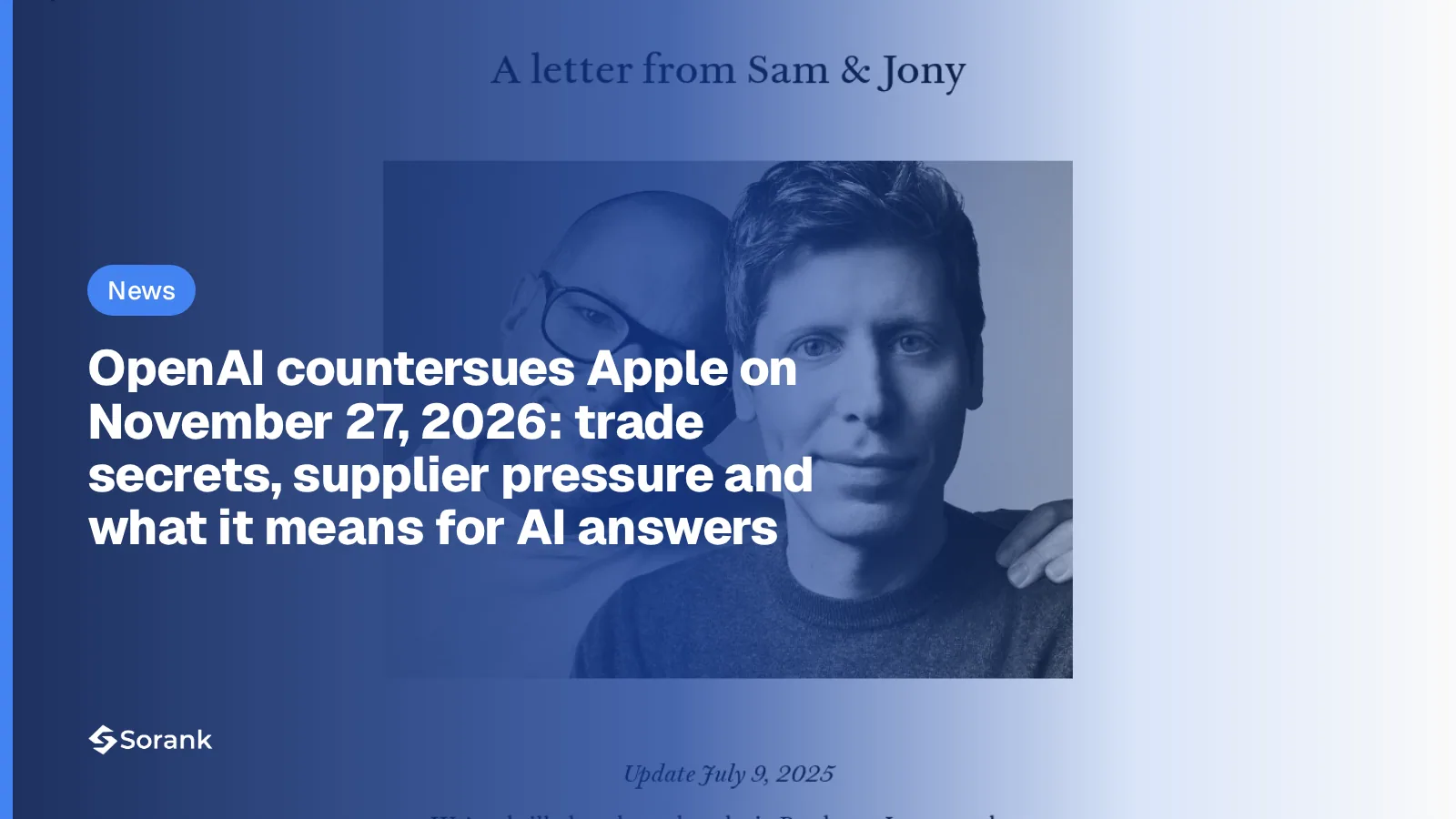
On November 27, 2026, OpenAI filed counterclaims against Apple over trade secrets and supplier pressure. What it alleges, Apple's reply and what to do now.
In short
On November 27, 2026, OpenAI filed counterclaims against Apple in federal court in San Jose, California. OpenAI accuses Apple of using its trade secrets and of pressuring the hardware suppliers both companies share. The fight is about the AI devices OpenAI is building with Jony Ive, and it tells you a lot about where ChatGPT, Siri and AI answers are heading.
Want to go further? Ask
The case is Apple Inc. v. Liu et al., No. 5:26-cv-07078, before the U.S. District Court for the Northern District of California. Apple started it on July 10, 2026, when it sued OpenAI, its device company io Products and two former Apple employees, Chang Liu and Tang Tan. You can read Apple's original complaint in full.
On November 27, 2026, the defendants answered and struck back. According to 9to5Mac, which cites the Financial Times, OpenAI says Apple is "coercing and threatening" suppliers that work with OpenAI. The German site Apfelpatient, which read the filing (docket entry 217), counts 12 counterclaims. Other reports count 11.
The same day, the defendants withdrew their motion to dismiss Apple's lawsuit (docket entry 216). The case now moves on to the facts themselves. OpenAI has not published a statement or a blog post on its own site: everything below comes from the court filings and from reports that read them.
The case in numbers
Sources: Apple complaint (July 10, 2026), 9to5Mac, Apfelpatient
The counterclaims cover three areas.
OpenAI and io Products bring 4 of the claims: theft of trade secrets under federal law, interference with supply contracts and two counts of unfair competition. The other claims belong to Chang Liu and Tang Tan personally.
Apple rejects the counterclaims. Quoted by 9to5Mac, Apple says: "This case is about OpenAI employees deliberately stealing, accessing, and using Apple's secret and confidential information". It calls the counterclaims "a transparent attempt to distract from the substance of Apple's lawsuit".
In its own complaint, Apple says former employees took engineering and supply chain information to help OpenAI build devices. Apple also says OpenAI had a trusted Apple partner use Apple's own multi-step metal-finishing technique. In October 2026, Apple said its internal investigation had found no OpenAI confidential information, and OpenAI agreed not to use the files Apple says were taken while the case goes on.
None of these claims has been tested by a judge yet. Both sides deny the other's version.
| Topic | OpenAI says (counterclaims, Nov 27, 2026) | Apple says (complaint and statement) |
|---|---|---|
| Trade secrets | A returning employee sent confidential OpenAI files to private accounts | Former Apple employees took engineering and supply chain information |
| Suppliers | Apple pressures shared suppliers to report their OpenAI projects | OpenAI had a trusted Apple partner use Apple's metal-finishing technique |
| Employee contracts | Apple's agreements are too broad and should be declared invalid | Not addressed in the public statement |
| The counterclaims | 12 counterclaims (11 in some reports) | "A transparent attempt to distract" from its lawsuit |
Apple vs OpenAI: the key dates
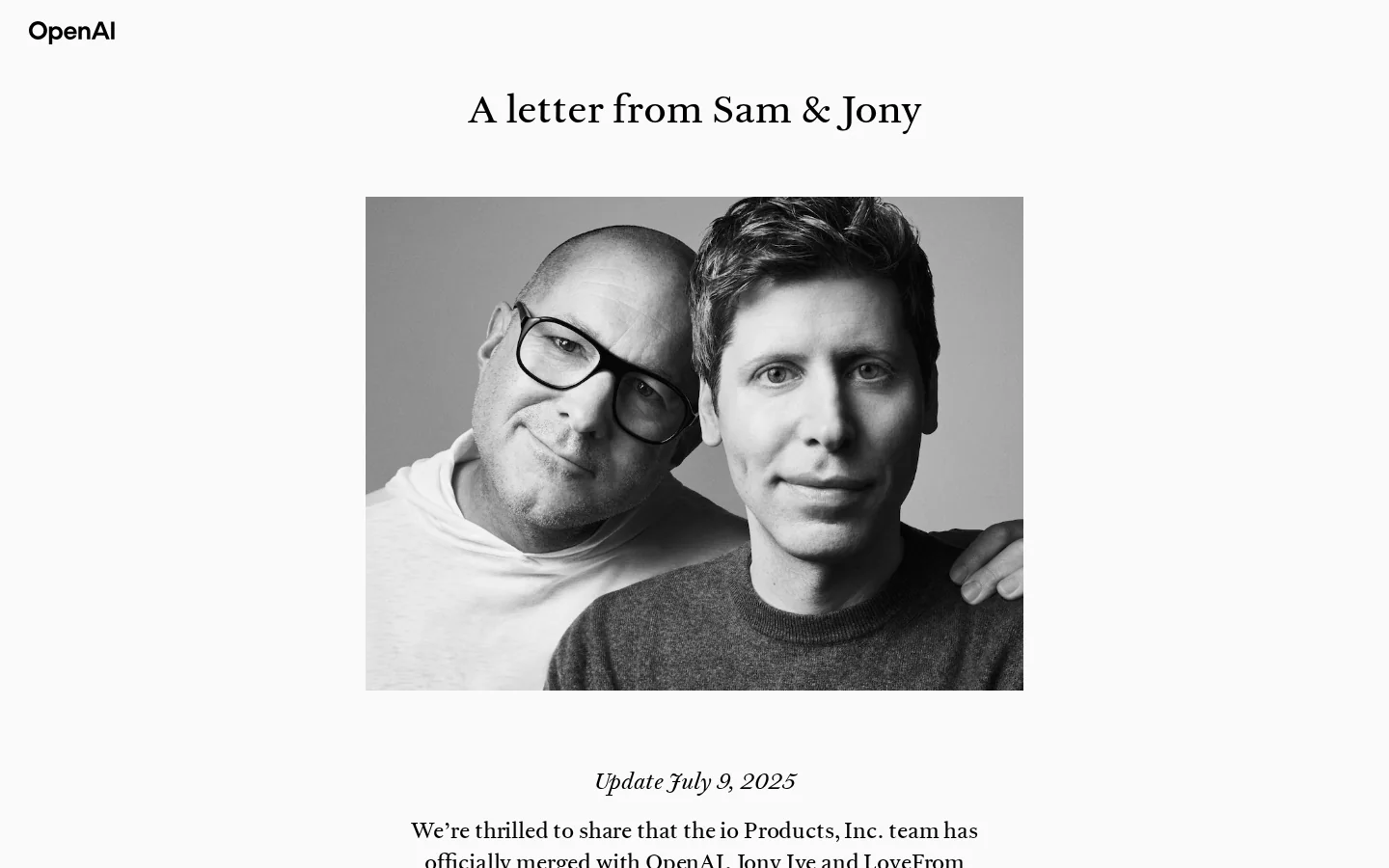
This is not a fight about a patent. It is about who controls the next device you will use to ask an AI model a question. OpenAI wants to sell its own hardware, designed with Jony Ive. The Next Web reports the first one is a doughnut-shaped speaker. Apple sells the iPhone, where Siri is the built-in assistant.
The two companies once worked together to bring ChatGPT into Siri. The Next Web describes that partnership as soured, even if Apple says it is not part of this case. For a business, the message is simple: the way people reach AI answers is splitting between rival devices and rival assistants. A customer may ask ChatGPT on an OpenAI device, Siri on an iPhone or Gemini on Android. Each one picks its own sources.
This article only reports the news. It is not legal advice: if your business faces a question about suppliers, contracts or former employees, ask your own lawyer.
You cannot influence the trial. You can make sure your brand is visible whichever device wins. Here are the concrete steps.
5 steps to stay visible whichever AI device wins
For step 3, here is the kind of block that keeps OpenAI's crawlers allowed (see our guide to OpenAI crawlers for the full list):
User-agent: OAI-SearchBot
Allow: /

User-agent: ChatGPT-User
Allow: /
To do step 1 without testing prompts by hand every week, you can use a tool. Sorank's AI mention tracking shows when ChatGPT, Claude and Gemini name your brand. Our guide on how to track brand mentions in AI explains the manual method too. And if you have not yet claimed your listing, read how Businesses in ChatGPT works.
Your checklist this week
We will update this article when the court rules on the next steps.
On November 27, 2026, OpenAI filed counterclaims in Apple's trade secrets case. It accuses Apple of using OpenAI's confidential device information through a former employee who returned to Apple, and of pressuring suppliers shared by both companies.
A jury trial is scheduled to start on July 19, 2027, in the U.S. District Court for the Northern District of California, unless the parties settle before then.
Not directly. The case is about devices, suppliers and employees. But it shows that AI answers will reach people through rival devices and assistants, so brands should track their visibility in ChatGPT, Gemini and Claude at the same time.
We analyse your competitors, your website and your AI visibility to create a tailored content plan for free.
 Website Value Calculator
 Website Accessibility Checker
 Google Analytics Checker
 Duplicate Content Checker
 Mobile-Friendly Test
 Website Speed Test
 Subdomain Finder
 Domain Age Checker
 CMS Detector
 Googlebot Simulator
 Nofollow Link Checker
 Meta Tag Checker
 Keyword Cannibalization Checker
 Keyword Intent Checker
 Keyword Extractor
 Google Ads Cost Calculator
 CPC Calculator
 Local Citation Finder
 Reddit Threads Finder
 Disavow File Generator
 Redirect Generator
 Canonical Tag Generator
 Passive Voice Checker
 Google Location Changer
 Google Review Calculator
 Google Review Link Generator
 Keyword Combiner
 Podcast Show Notes Generator
 AI Content Rewriter
 AI Text Humanizer
 ChatGPT Prompt Generator
 Twitter Thread Generator
 Tweet Generator
 Landing Page Copy Generator
 Google Ads Copy Generator
 Pinterest Pin Description Generator
 Anchor Text Generator
 Social Media Post Generator
 LinkedIn Post Generator
 Free AI Writer
 Review Response Generator
 LSI Keyword Generator
 YouTube Video Ideas Generator
 YouTube Tag Generator
 YouTube Description Generator
 Product Description Generator
 CTA Generator
 Blog Introduction Generator
 Conclusion Generator
 Hook Generator
 AI Content Brief Generator
 FAQ Schema Generator
 AI Blog Post Ideas Generator
 Structured Data Validator (Schema Validator)
 Alt Text Checker
 Internal Link Analyzer
 Backlink Challenge
 AI Meta Description Generator
 AI Blog Title Generator
 Google Indexability Checker
 AI Blog Outline Generator
 UTM Link Builder
 Keyword Clustering Tool
 Canonical Tag Checker
 XML Sitemap Generator
 Broken Link Checker
 AI SEO Title Generator
 Headline Analyzer
 SERP Preview Tool
 Redirect Checker
 Hreflang Tag Generator
 Heading Structure Analyzer
 HTTP Headers Checker
 Favicon Extractor
 SERP CTR Calculator
 SEO vs Paid Search Savings Calculator
 SEO Share of Voice Calculator
 SEO ROI Calculator
 SEO Traffic and Revenue Forecast Calculator
 SEO Budget Calculator
 SEO Break-Even Calculator
 SaaS SEO ROI Calculator
 ROAS Calculator
 Reading Time Calculator
 Ranking Gain Simulator
 Organic Traffic Value Calculator
 Organic Traffic Estimator and Website Traffic Checker
 LTV to CAC Ratio Calculator
 Local SEO ROI Calculator
 Link Building Cost Calculator
 Keyword Value Calculator
 Keyword Opportunity Score Calculator
 Keyword Density Calculator
 GEO ROI Calculator
 GEO Content Investment Calculator
 Ecommerce SEO ROI Calculator
 Customer Lifetime Value Calculator
 Customer Acquisition Cost Calculator
 CTR Calculator
 Cost Per Article Calculator
 Conversion Rate Calculator
 Content Marketing ROI Calculator
 ChatGPT Referral Traffic Estimator
 Bounce Rate Calculator
 Backlink ROI Calculator
 AI Visibility Score Calculator
 AI Traffic Value Calculator
 AI Share of Voice Calculator
 Cost of AI Invisibility Calculator
 AI Citation Rate Calculator
 llms.txt Validator
 AI Overview Checker and AI Overviews Rank Checker
 Robots.txt Checker
 AI SEO Audit
 LLM Readability Checker
 SearchGPT Readiness Checker
 Structured Data LLM Audit
 Website Crawlability AI Audit
 Why ChatGPT Is Not Recommending My Website
 Gemini Ranking Tool
 Perplexity Ranking Checker
 LLM Citation Checker
 Answer Engine Optimization Audit
 GEO Audit
 AI Search Visibility Test
 ChatGPT Visibility Checker
 llms.txt Generator
 URL Extractor
 Webpage to Markdown
 Sitemap Checker
 SERP Volatility Sensor
 Page Size Checker
 Word Counter
 Slug Generator
 Schema Generator
 Robots Generator
 OG Preview
 Meta Tags Generator
 Image Compressor
 Favicon Generator
 On-Page SEO Audit: SEO Checker and SEO Analyzer
 Backlink Analysis Tool
 Keyword Research Tool
 Domain Authority Checker
 “I tested Sorank on a real client site and it's insane. It does everything an agency would bill you $1500 a month for. It's going into production on that client now.”

 Guillaume Guersanguersanguillaume.com
 “I just let the Sorank software do its thing, and now my DR is 25 and my page is ranking higher.”
 Lucas Flandrefoundertrace.fr“We are an Ads agency and we wanted to get our SEO back on track once and for all. Sorank gave us a clear view of our site, helped us prioritize optimizations, and properly structure our content. The tool is easy to use, well designed for a team, and very practical for centralizing tracking without having to juggle multiple platforms. A very solid foundation to start fresh with our SEO.”
 Gaspard MadouiAds Agency“I specialized in GEO thanks to Sorank. The GEO Leaderboard allows me to show my clients their position vs competitors on ChatGPT. It’s a real commercial differentiator.”
 MélanieSEO Freelance