Preferences
Privacy is important to us, so you have the option of disabling certain types of storage that may not be necessary for the basic functioning of the website. Blocking categories may impact your experience on the website. More information
Privacy is important to us, so you have the option of disabling certain types of storage that may not be necessary for the basic functioning of the website. Blocking categories may impact your experience on the website. More information

 ChatGPT: What It Does and How to Claim Your Business
OpenAI launched Businesses in ChatGPT on 10 November 2026: claim your profile, manage your info and read your mentions and clicks. Here is what to do.

Tools

In short
On 10 November 2026, OpenAI launched Businesses in ChatGPT in beta. It gives businesses a Business Hub where they can claim their profile, manage the information ChatGPT uses about them, and see aggregated insights on mentions, website clicks and the topics around them. If you run a business website, check whether you can claim your profile and what your numbers say before you change anything.
Want to go further? Ask
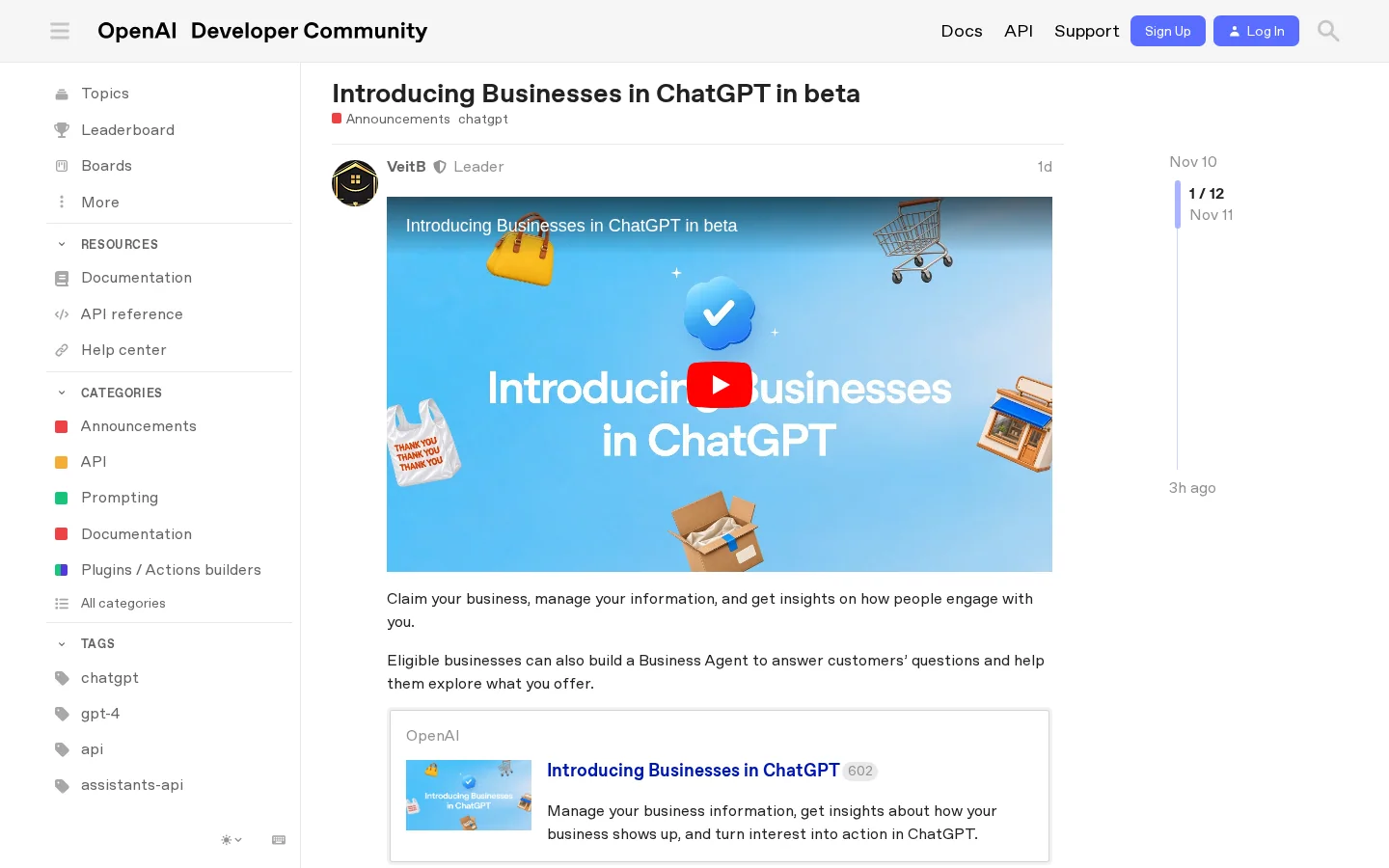
OpenAI published "Introducing Businesses in ChatGPT" on 10 November 2026. The launch is labelled a beta. In its own words, the announcement is "an early step" that starts with "accurate business information, useful insights, and conversations that help people make informed decisions". It rests on three parts:
| Part | What it does | Who it is for | Status at launch |
|---|---|---|---|
| Business Hub | Claim your business and manage the information ChatGPT uses about it | Eligible businesses where ChatGPT is available | Beta, free for now |
| Insights | Aggregated figures on mentions, website clicks and common conversation topics | Businesses that claim their profile | Beta |
| Business Agents | Answers customer questions in a separately labelled conversation | Eligible ecommerce and online service businesses | Limited to the United States |
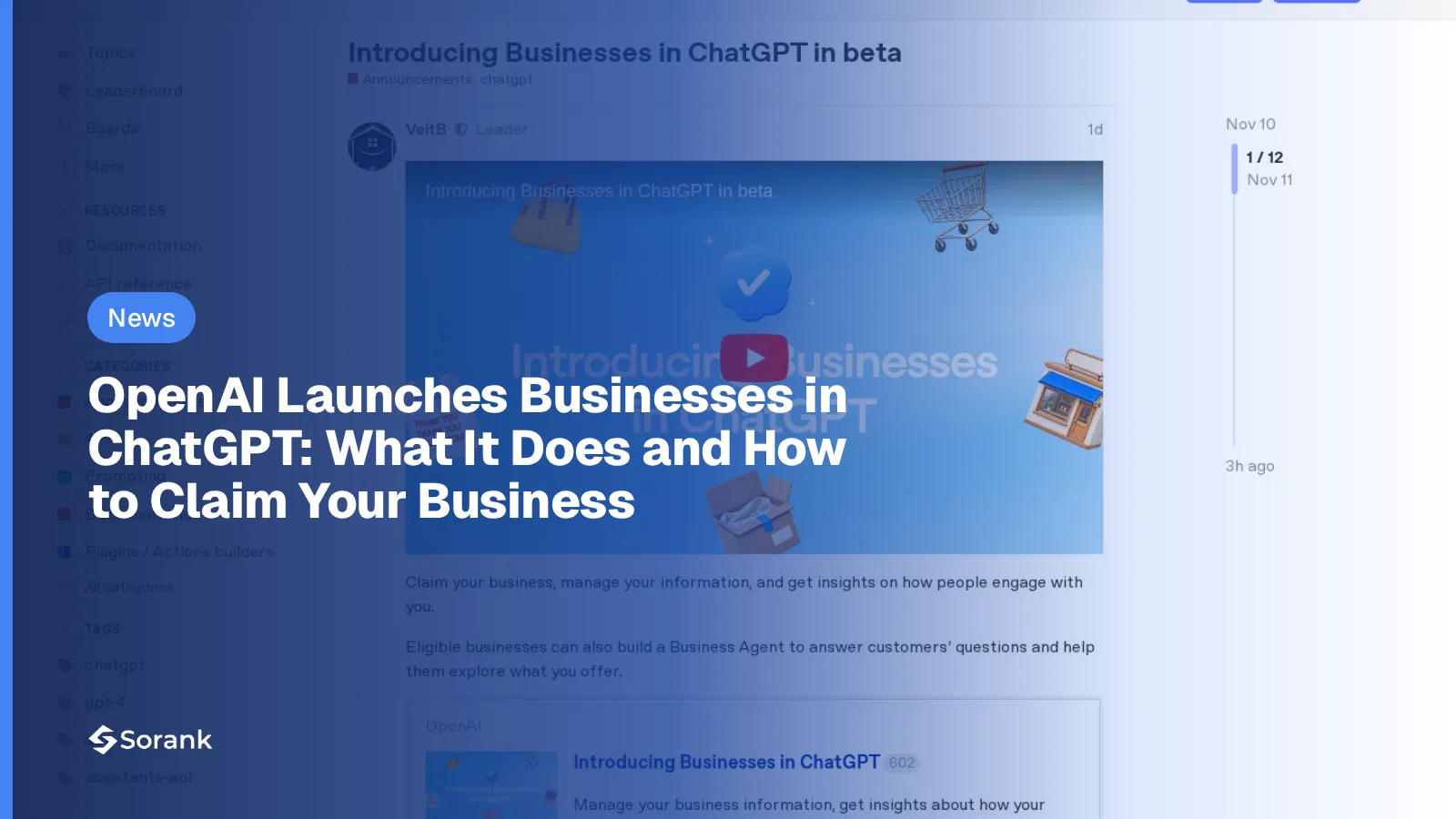
The official post sums up the first two parts in one line: "Claim your business, manage your information, and get insights on how people engage with you." You can read the full post in OpenAI's announcement, and the community thread where it was reposted is a useful second reference: Introducing Businesses in ChatGPT in beta.
Insights are the part you will check most often, so read the definitions before you draw conclusions from a chart. According to launch coverage, an OpenAI spokesperson explained how a mention is counted. The rule depends on the type of business:
How a mention is counted
Source: OpenAI spokesperson, as quoted by Digiday and reported by Relevant Audience
Website clicks are recorded link clicks. The Business Hub help text says they do not confirm website visits or conversions, so do not report them as sales. The discovery topics are themes drawn from conversations where your website is cited. They are not the exact prompts people typed.
Two privacy limits also apply. OpenAI says it does not share people's conversations or Business Agent chats with businesses. And the figures are aggregated: coverage reports that low-volume counts can be withheld until they pass minimum thresholds, so a small site may see little or no data at first.
Claiming is open to eligible businesses in the places where ChatGPT is available. Coverage describes the sequence like this:
How to start with Business Hub
Source: Relevant Audience, 11 November 2026, reporting on OpenAI's announcement
Verification is the bottleneck. Forum users report delays and identity checks. Shopify merchants can connect their store from Business Hub or the Shopify admin, but a Shopify store is not required. Existing Enterprise customers and advertisers work with their OpenAI representative instead.
At launch, Business Agents are limited to eligible ecommerce and online service businesses in the United States. You cannot bring your own agent. It is built from the instructions and the product feed you supply, and it must follow OpenAI's Business Agents Policy, which covers disclosure, accurate offers and prices, and approval based on business category and intended use.
An eligible business can also sponsor its agent and use it as the destination for ChatGPT Ads. Coverage says OpenAI has not described how that placement is priced. Business Hub and agents are free for now, but the OpenAI executive quoted in the coverage did not rule out a paid model later. Plan for that possibility before you build a budget around it.
Claiming a profile does not, on the coverage's account, make ChatGPT mention you more often. OpenAI's stated position, as reported, is that it should not change how often you are mentioned or ranked. Coverage also reports that OpenAI declined to say how long mentions are tracked. One advertising executive with dashboard access described a chart covering the past 7 or 28 days, but that is not an official figure. Treat the dashboard as a measurement tool, not a ranking lever.
You do not need to wait for the rules to be complete. Four actions pay off whatever OpenAI changes next, and one thing is worth avoiding:
Checklist for this launch
Your website is what ChatGPT cites for online businesses, so the content of your pages matters as much as the profile. Our guide on how to rank in ChatGPT covers the page-level work, and the AI visibility audit shows how to check your brand across assistants. For a local business, the local GEO guide covers the location side. Verifying your listing is a useful parallel too: read how to verify your Google Business Profile to see why the same name, address and phone number must match everywhere.
To follow mentions over time, Sorank's AI Mention Tracking shows when AI assistants cite your site, prompt by prompt, across ChatGPT, Gemini, Claude and Perplexity. OpenAI's dashboard only covers ChatGPT, so keep a second record of your results.
Several points are not confirmed in the launch material or the coverage. These include whether Business Agents will reach countries outside the United States, and when. They also include the full list of eligible countries and business types for claiming, how long mention data is kept, whether there is an export or an API, how a sponsored agent is priced, and how competing claims to the same business are settled. Those are the points to watch in the next updates from OpenAI.
It is a beta from OpenAI with a Business Hub, where eligible businesses claim their profile, manage their information and see aggregated insights on mentions, website clicks and conversation topics.
Eligible businesses where ChatGPT is available, after a verification step. At launch, Business Agents are limited to eligible ecommerce and online service businesses in the United States.
Coverage reports that OpenAI does not say a claimed profile will be mentioned more often. Use the insights to measure your results, and keep improving your content and your business data.
We analyse your competitors, your website and your AI visibility to create a tailored content plan for free.
 AI Content Brief Generator
 FAQ Schema Generator
 AI Blog Post Ideas Generator
 Structured Data Validator (Schema Validator)
 Alt Text Checker
 Internal Link Analyzer
 Backlink Challenge
 AI Meta Description Generator
 AI Blog Title Generator
 Google Indexability Checker
 AI Blog Outline Generator
 UTM Link Builder
 Keyword Clustering Tool
 Canonical Tag Checker
 XML Sitemap Generator
 Broken Link Checker
 AI SEO Title Generator
 Headline Analyzer
 SERP Preview Tool
 Redirect Checker
 Hreflang Tag Generator
 Heading Structure Analyzer
 HTTP Headers Checker
 Favicon Extractor
 SERP CTR Calculator
 SEO vs Paid Search Savings Calculator
 SEO Share of Voice Calculator
 SEO ROI Calculator
 SEO Traffic and Revenue Forecast Calculator
 SEO Budget Calculator
 SEO Break-Even Calculator
 SaaS SEO ROI Calculator
 ROAS Calculator
 Reading Time Calculator
 Ranking Gain Simulator
 Organic Traffic Value Calculator
 Organic Traffic Estimator and Website Traffic Checker
 LTV to CAC Ratio Calculator
 Local SEO ROI Calculator
 Link Building Cost Calculator
 Keyword Value Calculator
 Keyword Opportunity Score Calculator
 Keyword Density Calculator
 GEO ROI Calculator
 GEO Content Investment Calculator
 Ecommerce SEO ROI Calculator
 Customer Lifetime Value Calculator
 Customer Acquisition Cost Calculator
 CTR Calculator
 Cost Per Article Calculator
 Conversion Rate Calculator
 Content Marketing ROI Calculator
 ChatGPT Referral Traffic Estimator
 Bounce Rate Calculator
 Backlink ROI Calculator
 AI Visibility Score Calculator
 AI Traffic Value Calculator
 AI Share of Voice Calculator
 Cost of AI Invisibility Calculator
 AI Citation Rate Calculator
 llms.txt Validator
 AI Overview Checker and AI Overviews Rank Checker
 Robots.txt Checker
 AI SEO Audit
 LLM Readability Checker
 SearchGPT Readiness Checker
 Structured Data LLM Audit
 Website Crawlability AI Audit
 Why ChatGPT Is Not Recommending My Website
 Gemini Ranking Tool
 Perplexity Ranking Checker
 LLM Citation Checker
 Answer Engine Optimization Audit
 GEO Audit
 AI Search Visibility Test
 ChatGPT Visibility Checker
 llms.txt Generator
 URL Extractor
 Webpage to Markdown
 Sitemap Checker
 SERP Volatility Sensor
 Page Size Checker
 Word Counter
 Slug Generator
 Schema Generator
 Robots Generator
 OG Preview
 Meta Tags Generator
 Image Compressor
 Favicon Generator
 On-Page SEO Audit: SEO Checker and SEO Analyzer
 Backlink Analysis Tool
 Keyword Research Tool
 Domain Authority Checker
5/5 from 5 reviews
 “I tested Sorank on a real client site and it's insane. It does everything an agency would bill you $1500 a month for. It's going into production on that client now.”

 Guillaume Guersanguersanguillaume.com“We are an Ads agency and we wanted to get our SEO back on track once and for all. Sorank gave us a clear view of our site, helped us prioritize optimizations, and properly structure our content. The tool is easy to use, well designed for a team, and very practical for centralizing tracking without having to juggle multiple platforms. A very solid foundation to start fresh with our SEO.”
 Gaspard MadouiAds Agency
 “I just let the Sorank software do its thing, and now my DR is 25 and my page is ranking higher.”
 Lucas Flandrefoundertrace.fr“I specialized in GEO thanks to Sorank. The GEO Leaderboard allows me to show my clients their position vs competitors on ChatGPT. It’s a real commercial differentiator.”
 MélanieSEO Freelance“Great service, works well for our website and helps us understand how to improve it to rank better on Google and elsewhere. Congrats, keep going, I recommend it.”
 Hugo T.E-commerce merchant