Preferences
Privacy is important to us, so you have the option of disabling certain types of storage that may not be necessary for the basic functioning of the website. Blocking categories may impact your experience on the website. More information
Privacy is important to us, so you have the option of disabling certain types of storage that may not be necessary for the basic functioning of the website. Blocking categories may impact your experience on the website. More information

A go-to-market strategy checklist in 7 phases: ICP, positioning, pricing, GTM motion, launch assets, AI visibility and the 90-day review, with a template.

In short
A go-to-market strategy checklist is the list of decisions and tasks you must close before and after you launch a product: target customer, value proposition, pricing, channels, launch assets, launch day and measurement. Each item gets an owner, a deadline and a "done" test, so nothing important is skipped.
Want to go further? Ask
Quick quiz
Is SEO right for you, and how should you start?
Sorank matches your answers


Test it for 3 days on your own site and see where you stand on Google, ChatGPT and the other AIs.
Start 3-day free trial3 days free, then stop whenever you want. 90-day results guarantee, conditions apply.
A go-to-market (GTM) strategy checklist turns your launch strategy into a sequence of verifiable items. It answers four questions in order: who will buy, why they will buy from you, how much they will pay, and how they will find you. Everything else (ads, emails, sales scripts) comes after these four answers.
The checklist is not a marketing plan and not a launch plan. People mix the three up, and that is the first reason checklists fail: a team writes social posts before anyone has decided the price.
| Document | Question it answers | Time horizon | Typical owner |
|---|---|---|---|
| Go-to-market strategy | Which market, which customer, which offer, which channels | One product or one market entry | Founder, product marketing |
| Marketing plan | Which campaigns, budgets and calendar for the year | 12 months, all products | Head of marketing |
| Launch plan | Who does what in the weeks around launch day | About 90 days before and after | Launch lead |
| GTM checklist | Have we closed every decision and task, with proof? | From first idea to 90 days after launch | One accountable person |
If you need the yearly view, our guide to writing a marketing plan step by step covers it. This article stays on the launch of one product, one new market or one new segment.
You need a GTM checklist each time something changes for the buyer: a new product, a new country, a new segment (moving from small businesses to enterprise, for example), a new pricing model or a relaunch after a failed start. A feature update for existing users usually needs a lighter release checklist instead.
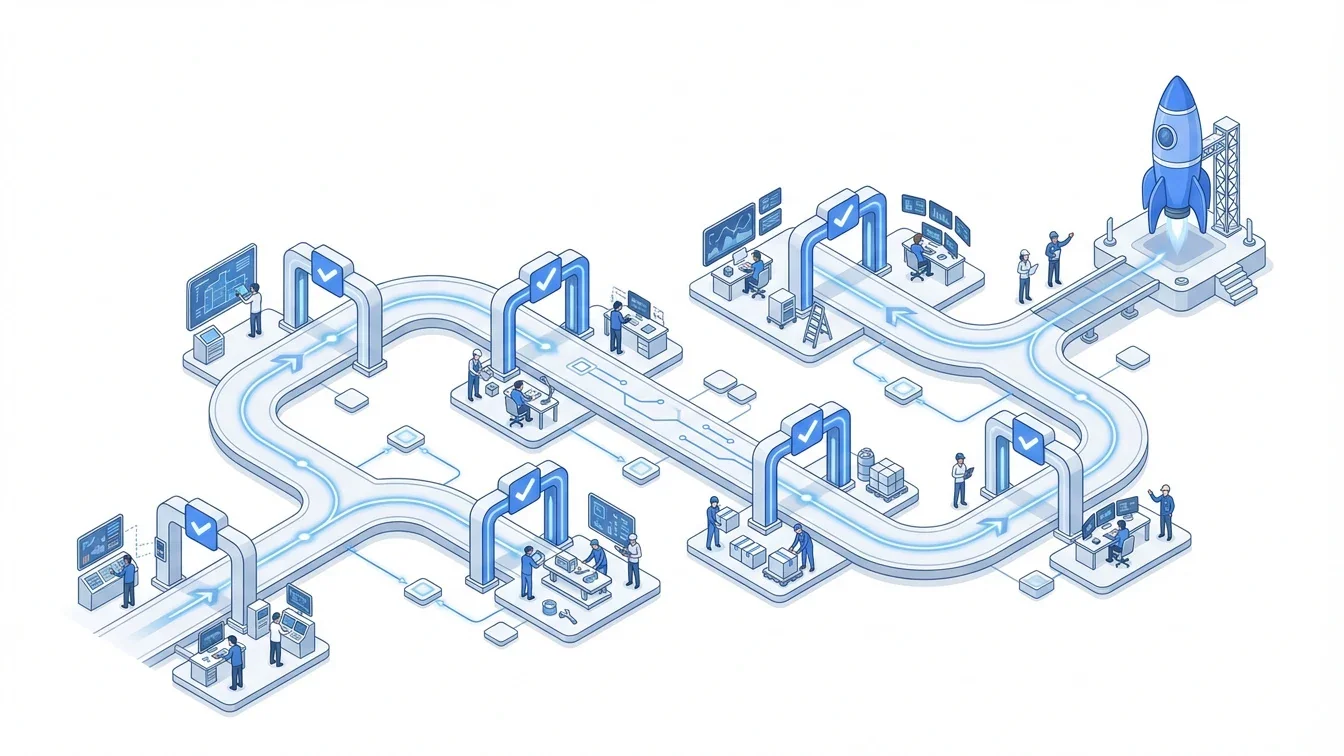
The best checklists are built around gates. A gate is a point where you stop and check proof before spending more money. "Write the landing page" is a task. "Ten target customers have read the value proposition and seven could repeat it back in their own words" is a gate. Tasks tell people what to do; gates tell you whether to keep going.
A complete checklist has seven phases, from readiness to the first 90 days after launch. Each phase ends with a gate, and you only move to the next phase when the gate is passed.
The 7 phases of a go-to-market strategy checklist
The phases overlap in practice. You can test messages (phase 3) while you size the market (phase 2). But the gates stay in order: never sign off pricing before you know who the customer is.
Phase 1 is done when you have one written launch goal, a budget, a date and one person accountable for the whole checklist. Without these, every later decision turns into a debate.
Write the goal in a single line that anyone can check in 90 days. Avoid "raise awareness". Use a number, a segment and a date.
Goal format:
[metric] from [baseline] to [target] in [segment] by [date]

Example:
Paying customers from 0 to 40 among independent dental clinics in France by 31 March
Add one or two guardrail metrics that must not get worse, such as gross margin or churn of existing customers. A launch that hits its target by giving away 60% discounts did not succeed.
List what you cannot change: cash available, people available, legal limits in the target market, technical limits of the product. Readiness is not about being perfect. It is about knowing the limits before you promise anything to customers.
Phase 1 gate: readiness
For each phase, write who is Responsible, Accountable, Consulted and Informed. The rule that matters: exactly one "A" per line. When two people are accountable for pricing, nobody is.
Phase 2 is done when you can name your ideal customer precisely, estimate how many of them exist and show evidence that they already look for a solution.
Top-down sizing ("the global software market is huge, we only need 1%") is useless for decisions. Size bottom-up: count real accounts you can reach and multiply by what they would pay.
TAM = number of accounts that have the problem x annual price
SAM = accounts you can serve today (language, country, product fit) x annual price
SOM = SAM x share you can realistically win in 12 to 24 months

Example (dental clinics, France):
SAM accounts = 4000 independent clinics reachable in French
Annual price = 1200
SAM = 4000 x 1200 = 4800000 per year
SOM (2% in 18 months) = 80 clinics = 96000 per year
The numbers in this example are illustrative. Your own count should come from public registers, trade associations or a list you can actually export. The definition and calculation of market share helps you set a realistic SOM.
The ideal customer profile (ICP) describes the company or person that gets the most value fastest: size, sector, tools already used, trigger events. Personas describe the people inside: who uses, who pays, who can block the deal. Our guides on building an ideal customer profile you can prove and on buyer personas for search and AI go deep on both.
A good ICP has a disqualifier list too. Write down who you will not sell to at launch, even if they ask. Each wrong customer costs support time and gives you misleading feedback.
Demand exists when people already spend time or money on the problem. Three quick checks:
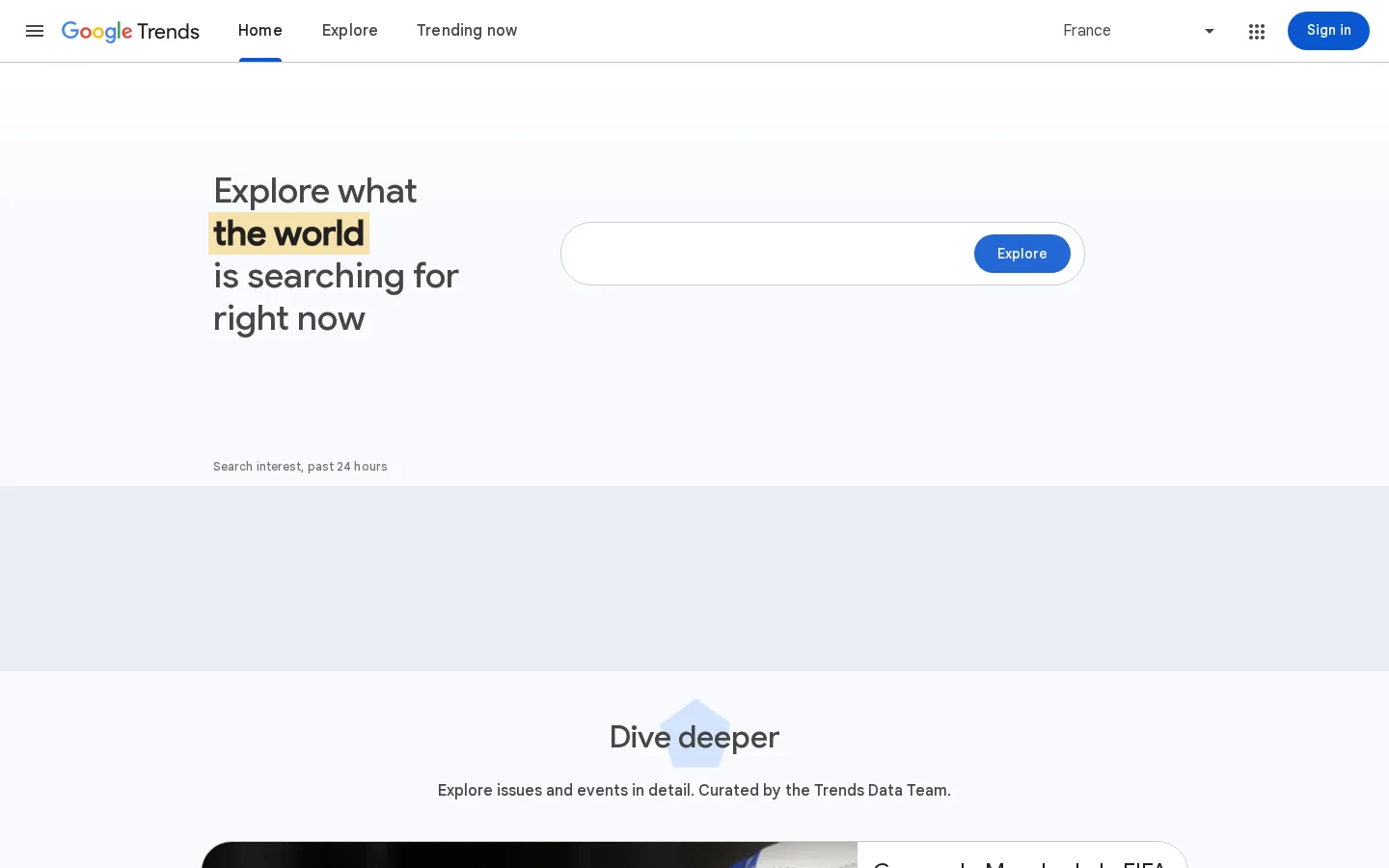
Google Trends is free and enough for a first read of seasonality: compare your main query across the countries you plan to enter and note the peak months. A product for tax preparation launched after the peak waits a full year for its next window.
Tip
To list the questions your buyers ask AI models, AI prompt research in Sorank finds the prompts around your topic and shows which brands come up. For classic search demand, the free keyword research tool gives you related queries in a few seconds.
Your real competitor is often a spreadsheet, an agency or doing nothing. List three types of alternatives: direct competitors, indirect solutions, and the status quo. For each, write what the buyer likes about it, since that is what you must beat. For the search side of this work, follow our 7-step SEO competitor analysis.
Phase 2 gate: market and customer
Phase 3 is done when you have one positioning statement, a short message hierarchy and proof for each claim, all tested on real buyers.
Positioning says which category you are in, for whom, and what makes you the better choice against a named alternative. Use a fixed template so the team argues about content, not format.
For [ideal customer]
who [problem or trigger event],
[product] is a [category]
that [main benefit, measurable if possible].
Unlike [main alternative],
we [key difference, with proof].
Our article on how to define and write your positioning goes through each line with examples. The category line matters more than most teams think: it decides which comparison the buyer makes and which queries you must rank for.
Under the statement, write three levels: one headline promise, three supporting benefits, and two or three proofs per benefit (a number, a customer quote, a demo, a guarantee). Every page, ad and sales deck later picks from this hierarchy. Nobody invents a new claim on the fly.
Weak message vs tested message
Show the headline and three benefits to five to ten ICP buyers for five seconds, then ask what the product does and for whom. If fewer than most of them can say it back, rewrite. You can also run two versions of a landing page with a small ad budget; our guide to A/B tests that give real answers explains how many visitors you need before you trust a result.
Phase 4 is done when you have a price model, the plans, and numbers showing that a customer brings back more than it costs to win and serve.
| Model | How it works | Fits when | Watch out for |
|---|---|---|---|
| Flat subscription | One price per month or year | Value is similar for every customer | Large customers pay too little |
| Tiered plans | Good, better, best plans by features or limits | Segments have clearly different needs | Too many plans slow the decision |
| Per seat | Price per user | Value grows with the number of users | Customers share logins to save money |
| Usage-based | Price per unit used | Usage tracks value closely | Bills are hard to predict for the buyer |
| One-time plus service | Purchase price, then maintenance | Physical products, installations | Revenue drops after the first sale |
Pricing is one of the four Ps of the marketing mix (4Ps and 7Ps), and it sends a positioning signal. A price far below the alternatives tells buyers you are the cheap option, whatever your message says.
Three formulas decide whether the launch can scale. Write them in the checklist with your real assumptions.
CAC (customer acquisition cost) = sales and marketing spend / new customers won
LTV (lifetime value) = average monthly revenue per customer x gross margin % / monthly churn rate
CAC payback (months) = CAC / (average monthly revenue per customer x gross margin %)

Example:
Monthly revenue 100, gross margin 80%, churn 3% per month, CAC 600
LTV = 100 x 0.8 / 0.03 = 2667
LTV / CAC = 2667 / 600 = 4.4
Payback = 600 / (100 x 0.8) = 7.5 months
Many SaaS teams use an LTV to CAC ratio of about 3 and a payback under 12 months as rules of thumb. These are habits of the industry, not laws: a company with a lot of cash can accept a longer payback. What matters is that you write the numbers down before launch and compare them after.
Tip
Run your own numbers with the free customer acquisition cost calculator and the LTV to CAC ratio calculator, then paste the results into the phase 4 gate.
Decide what is in each plan, what the trial or demo looks like, and what guarantee you offer. A free trial suits a product people can understand alone in a few minutes. A demo suits a product that needs setup or several decision makers. Write the refund and cancellation terms now, not after the first angry email.
A GTM motion is the main way customers discover, try and buy your product. There are five classic motions. Most companies pick one main motion at launch and add a second one later. Choosing two or three at once usually splits a small team too thin.
Principle: the product sells itself through a free plan or trial; users sign up alone and upgrade when they hit a limit. When to use it: simple setup, value visible in minutes, low price. Strengths: low cost per customer, fast feedback, scales without a big sales team. Limits: needs excellent onboarding, many free users never pay, hard for complex products. Example: a design tool where a user creates a first file in two minutes and invites colleagues.
Principle: sales reps find, qualify and close accounts. When to use it: high price, several decision makers, custom setup. Strengths: large contracts, deep feedback from each deal. Limits: expensive, slow to scale, depends on hiring. Example: enterprise security software sold after a pilot and a procurement process.
Principle: content, search and ads bring qualified visitors who convert on the website or book a call. When to use it: buyers research online before buying, mid-range price. Strengths: content keeps working after you publish it, and search and AI visibility build up over time. Limits: SEO takes months to pay off; paid ads stop the day the budget stops. Example: accounting software that ranks for "how to send an invoice" and offers a free trial on each article.
Principle: resellers, agencies, integrators or marketplaces sell for you. When to use it: buyers already trust an intermediary, or you enter a market where you have no brand. Strengths: instant reach and trust. Limits: lower margin, less control over the message and the customer relationship. Example: a payment terminal sold through accounting firms to their clients.
Principle: a community of users (forum, events, open source, creators) spreads the product and helps new users. When to use it: passionate users, technical audience, strong shared identity. Strengths: high trust, low acquisition cost once it works. Limits: slow to build, hard to measure, needs a dedicated person. Example: a developer tool with an open source core and an active forum.
| Motion | Typical price level | Speed to first revenue | Cost per customer | Main team skill | Main risk |
|---|---|---|---|---|---|
| Product-led | Low to mid | Fast | Low | Product, onboarding | Many free users, few paying |
| Sales-led | High | Medium | High | Sales, account management | Cost grows with every hire |
| Marketing-led | Low to high | Slow for SEO, fast for ads | Medium, falls over time with SEO | Content, search, ads | Giving up before content pays off |
| Partner-led | Mid to high | Medium | Medium (shared margin) | Partnerships | Loss of control over the message |
| Community-led | Any | Slow | Low once built | Community, developer relations | Hard to measure |
Even sales-led companies must let buyers do most of the research alone. In a Gartner survey of 646 B2B buyers run in August and September 2025, reported by Mark Brohan in Digital Commerce 360 (March 2026), 67% said they prefer a buying experience without a sales rep, and 45% said they used AI tools during a recent purchase.
How buyers research before they talk to you
Source: Gartner survey of 646 B2B buyers (August to September 2025), reported by Digital Commerce 360, March 2026
The practical consequence for your checklist: whatever the motion, the website, the pricing page and your presence in AI answers must be ready on launch day, because that is where buyers form their shortlist.
Phase 6 is done when every asset a buyer will meet exists, is tracked, and has been checked by someone other than its author: website, search and AI presence, sales and support material, and legal points.
The minimum set: a home page that states the positioning in one sentence, a pricing page, one landing page per segment or main use case, a comparison page against the main alternative, and an FAQ. Each page carries one call to action that matches the motion (start a trial, book a demo, find a partner). Our landing page anatomy and checklist lists the blocks that convert.
A new site does not rank on launch day. Start SEO work at least a few months before launch: technical setup, the pages above, and articles that answer the questions found in phase 2. Our guide to SEO for new websites before launch and in the first 90 days gives the full sequence.
AI answers change the stakes. In a study published in July 2025 by Athena Chapekis and Anna Lieb at Pew Research Center, based on the browsing of 900 US adults, users clicked a traditional result in 8% of visits when Google showed an AI summary, against 15% without one. They clicked a link inside the summary in only 1% of visits.
What happens when Google shows an AI summary
Source: Pew Research Center, Chapekis and Lieb, July 2025 (March 2025 browsing data, 900 US adults)
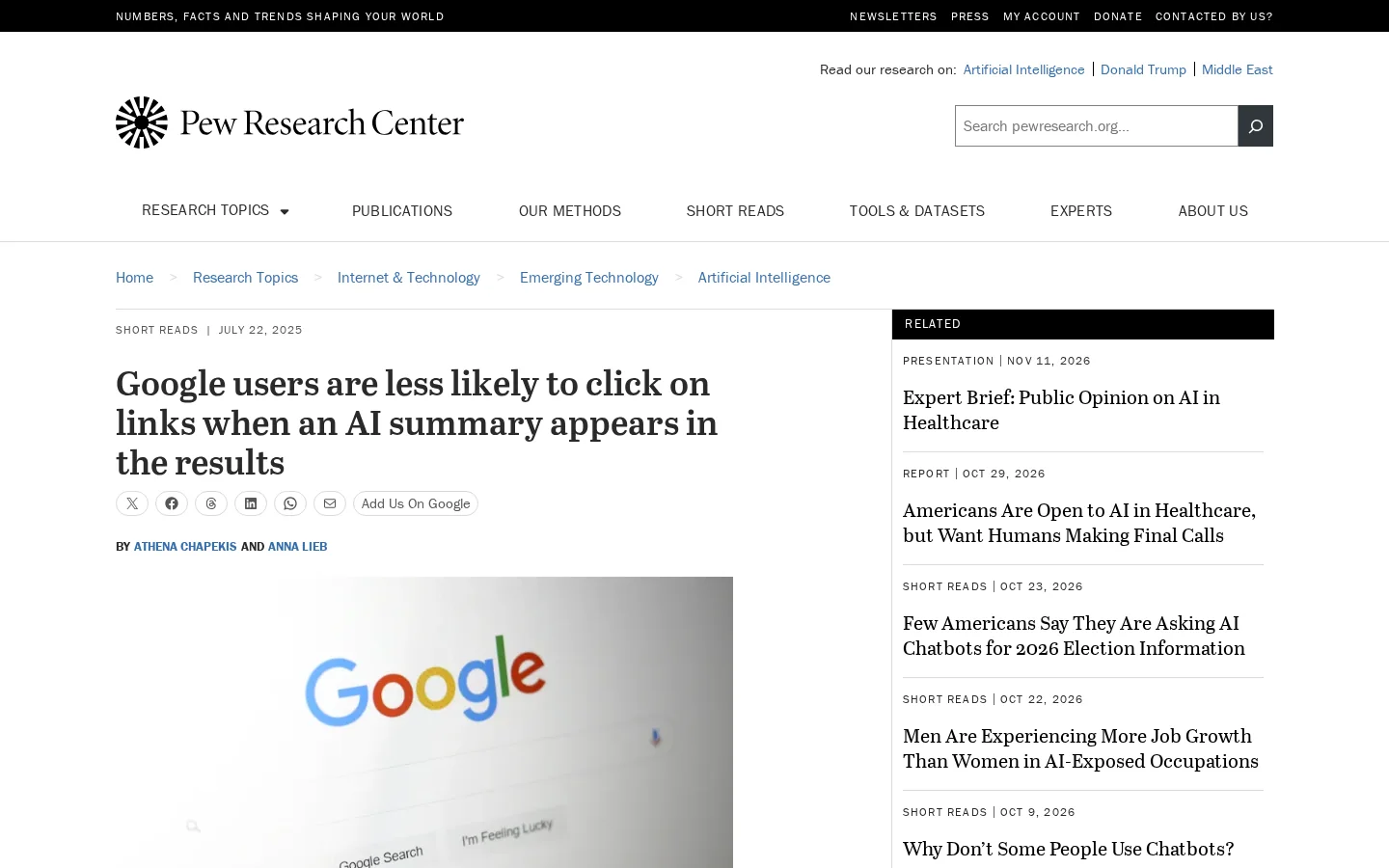
When the answer is given on the results page, being named inside it is what counts. Add these items to phase 6: check whether ChatGPT, Claude and Gemini already mention your brand for your main prompts, publish clear pages that answer those prompts, and get cited on the sites AI models read. The share of model metric measures how often AI answers name you against competitors.
Sorank handles this layer on autopilot if you do not have an SEO team: it plans and publishes the articles, earns links from sites in your niche, and its AI mention tracking shows when ChatGPT, Claude and Gemini cite your brand. You can also run a free first check with the ChatGPT visibility checker.
Add structured data to the product page so search engines and AI models read the basics without guessing. A minimal example for software:
<script type="application/ld+json">
{
  "@context": "https://schema.org",
  "@type": "SoftwareApplication",
  "name": "Your Product",
  "applicationCategory": "BusinessApplication",
  "operatingSystem": "Web",
  "offers": {
    "@type": "Offer",
    "price": "49",
    "priceCurrency": "EUR"
  }
}
</script>Decide your naming rules for campaigns before launch, or your reports will be unreadable after a week. Tag every link you control with UTM parameters, using lowercase and one fixed vocabulary.
https://example.com/pricing?utm_source=newsletter&utm_medium=email&utm_campaign=launch-dental-fr&utm_content=hero-buttonThe free UTM link builder keeps the format consistent across the team. Check that the conversion events (trial start, demo booked, payment) fire correctly in your analytics tool with a test purchase.
Sales needs a one-page battlecard per competitor, a demo script that follows the message hierarchy, the answers to the ten most likely objections and the pricing rules (who can give a discount, how much). Support needs an FAQ, the known limits of the product, the refund process and an escalation path to the product team for launch week.
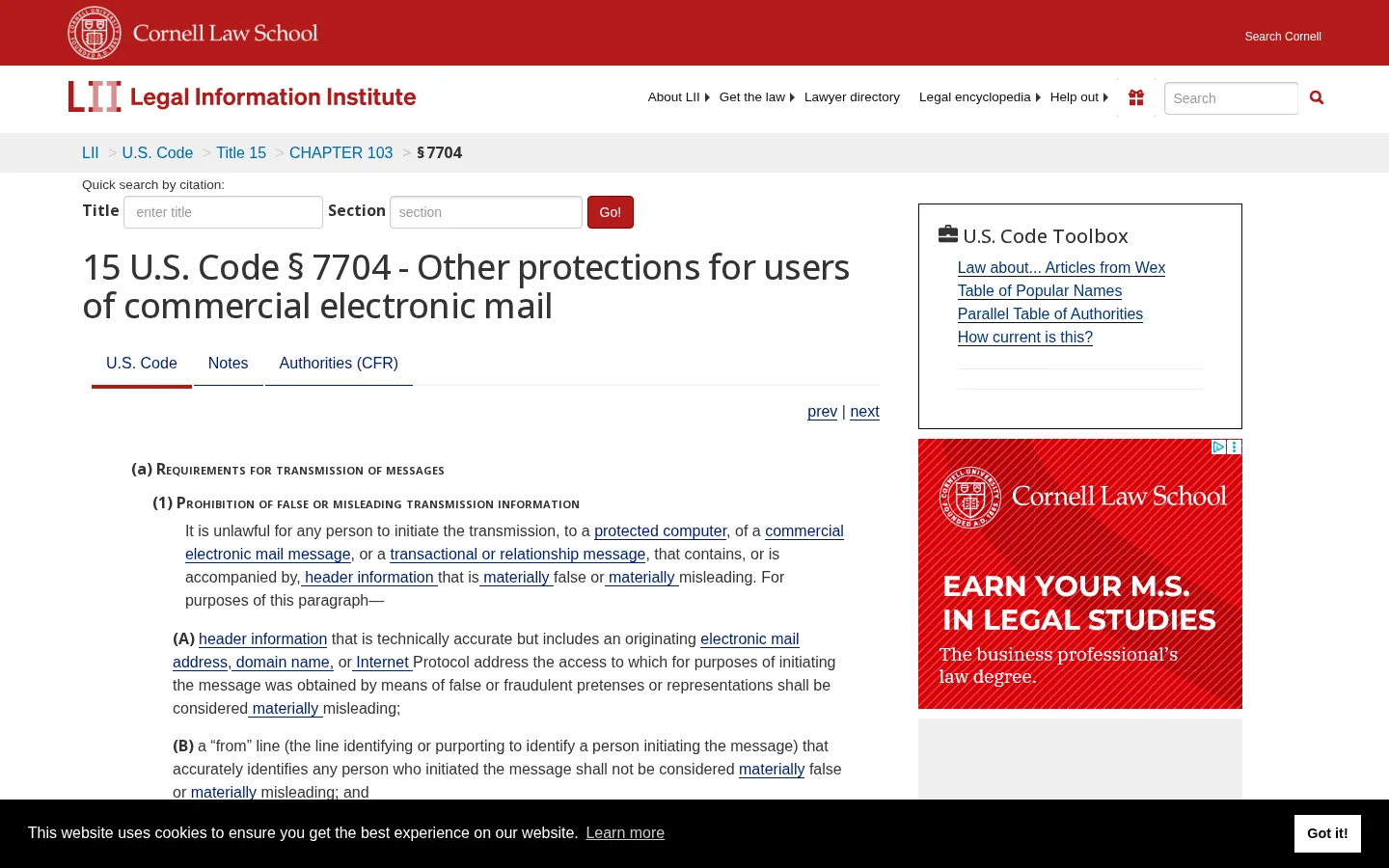
The rules depend on the country. Two examples for the United States: commercial emails must follow the CAN-SPAM Act. The text of 15 U.S.C. § 7704 on Cornell's Legal Information Institute requires a non-misleading subject line, a working opt-out, a valid physical postal address, and that opt-outs be honored within 10 business days.
If creators, affiliates or customers promote your launch, the Guides Concerning Use of Endorsements and Testimonials in Advertising (16 CFR Part 255, revised July 2023) require that material connections, such as payment or free products, be disclosed. In Europe, add consent rules for data collection and email, and translate your terms of use into the language of each market you enter.
Warning
This section is a checklist, not legal advice. Have a lawyer of the target country review your terms, privacy policy and email practices before you send the first campaign.
Phase 6 gate: launch readiness
Phase 7 is done when the 90-day review has taken place and the team has decided, with numbers, to scale, fix or stop.
Three launch types exist: a closed beta with a small group, a soft launch to one segment or one country, and a full public launch. The first two reduce risk; the third gives you one big moment of attention.
Soft launch vs full public launch
For a first product, a soft launch followed by a public launch four to eight weeks later is usually the safer path. You get real data, fix what breaks, and then launch publicly with customer quotes.
Go-to-market timeline from 90 days before to 90 days after launch
Track the same funnel every week. The point is not to report big numbers but to find the stage where most people drop.
The launch funnel to review every week
| Stage | Metric | Where to read it | Typical fix if weak |
|---|---|---|---|
| Reach | Visits by source, brand mentions in AI answers | Analytics, Search Console, AI visibility tracking | More content on buyer questions, partners, ads |
| Interest | Visit to signup or demo rate | Analytics conversion events | Rewrite the headline, clarify the price, add proof |
| Activation | Share of signups who reach the first value | Product analytics | Shorter onboarding, guided setup, welcome emails |
| Revenue | Trial to paid or demo to won rate, CAC | Billing tool, CRM | Packaging, objections, follow-up sequence |
| Retention | Monthly churn, usage at day 30 and 90 | Billing tool, product analytics | Fix the ICP, improve the product, customer success |
To see Google and AI traffic side by side during launch weeks, the GEO and SEO dashboard puts both in one view.
Book the review on the day you set the goal. Compare results with the goal and guardrails, then decide one of three things: scale (the goal is met and unit economics hold), fix (one stage is clearly broken and you know why) or stop (no stage works, or the market is smaller than expected). Write the decision and the reasons in the checklist itself, so the next launch starts from what you learned.
You can build a working GTM checklist in a spreadsheet in one afternoon. Here is the method.
Build your go-to-market checklist in 6 steps
Use these columns. The "done test" column is the one most templates forget, and the one that makes the checklist useful.
phase,item,owner,deadline,status,done_test,proof_link,blocker
2,Write the ICP,Head of product,D-80,todo,"ICP doc approved by founder and sales lead",,
3,Positioning statement,Product marketing,D-60,todo,"7 of 10 interviewed buyers repeat it correctly",,
6,Conversion events tracked,Marketing ops,D-30,todo,"Test purchase visible in analytics",,
7,90-day review,Founder,D+90,todo,"Decision written: scale, fix or stop",,
Keep status values to four words (todo, doing, blocked, done) so you can filter quickly. Count deadlines from launch day (D-60, D+30) instead of fixed dates: if the launch moves, the whole plan moves with it. If you want an outside view on your plan, our selection of go-to-market experts in France lists specialists by type of launch.
Most failed launches break on a handful of repeated mistakes. Each one below comes with the signal that shows it and the fix.
What it is: no clear ICP, so the message is vague and channels are chosen at random. How to spot it: the team cannot name ten target companies or people; ads get clicks but few signups. How to fix it: go back to phase 2, write the ICP and the disqualifier list, and relaunch to one segment.
What it is: the message uses internal words and feature names. How to spot it: visitors cannot say what the product does after reading the home page; sales calls start with "so what exactly is it?". How to fix it: reuse the exact words from interviews and test with the five-second method.
What it is: the price is copied from a competitor a week before launch. How to spot it: LTV to CAC below 1, or a payback longer than the average customer life. How to fix it: do the unit economics of phase 4 before any spending, and test two price levels if you can.
What it is: ads, SEO, events, partners and outbound all started in the same month by a small team. How to spot it: every channel has a little traffic and none has enough data to learn from. How to fix it: pick one main motion and one test channel; stop the rest until one works.
What it is: the website goes live the day of the announcement, with no content. How to spot it: branded searches show other sites; AI models do not know the brand or describe it wrongly. How to fix it: start content and links months before launch, and track brand mentions in AI answers from the first week.
What it is: conversions are not recorded, or every channel uses its own campaign names. How to spot it: a large share of signups shows as "direct" or "unassigned"; reports disagree. How to fix it: set UTM rules, test every conversion event with a real purchase, and freeze naming before launch.
What it is: the launch brings leads, but nobody can answer their questions. How to spot it: slow first replies, the same question asked many times, refunds in the first week. How to fix it: battlecards, FAQ and escalation path in phase 6, and a launch-week rota.
What it is: the launch "kind of works" and the team drifts for months. How to spot it: nobody can say whether the goal was met. How to fix it: hold the 90-day review, compare with the written goal, and decide to scale, fix or stop.
Mistakes to avoid on your launch
A go-to-market checklist works when it is short enough to review each week and strict enough to stop you when the proof is missing. Today, write the launch goal in one line, name the owner, and book the 90-day review. Then work through the seven gates in order: market and customer, positioning, pricing, motion, assets, launch and decision.
For the bigger picture around the launch, our article on marketing strategy components and examples shows how a single launch fits into the company's overall plan, and the guide to product marketing and its deliverables details the role that usually owns this checklist.
It should cover seven phases: readiness and goal, market and ideal customer, positioning, pricing, the GTM motion, launch assets (website, search and AI visibility, sales, support, legal) and the first 90 days after launch. Each item needs an owner, a deadline and a test that proves it is done.
Start about 90 days before launch for a typical product, and earlier for search work, since a new website rarely ranks in its first weeks. The checklist then runs until a written review 90 days after launch.
A go-to-market strategy decides the market, customer, offer and channels for one product or one market entry. A marketing plan sets the campaigns, budgets and calendar for all products over a year. The GTM strategy comes first and feeds the plan.
We analyse your competitors, your website and your AI visibility to create a tailored content plan for free.
 Website Value Calculator
 Website Accessibility Checker
 Google Analytics Checker
 Duplicate Content Checker
 Mobile-Friendly Test
 Website Speed Test
 Subdomain Finder
 Domain Age Checker
 CMS Detector
 Googlebot Simulator
 Nofollow Link Checker
 Meta Tag Checker
 Keyword Cannibalization Checker
 Keyword Intent Checker
 Keyword Extractor
 Google Ads Cost Calculator
 CPC Calculator
 Local Citation Finder
 Reddit Threads Finder
 Disavow File Generator
 Redirect Generator
 Canonical Tag Generator
 Passive Voice Checker
 Google Location Changer
 Google Review Calculator
 Google Review Link Generator
 Keyword Combiner
 Podcast Show Notes Generator
 AI Content Rewriter
 AI Text Humanizer
 ChatGPT Prompt Generator
 Twitter Thread Generator
 Tweet Generator
 Landing Page Copy Generator
 Google Ads Copy Generator
 Pinterest Pin Description Generator
 Anchor Text Generator
 Social Media Post Generator
 LinkedIn Post Generator
 Free AI Writer
 Review Response Generator
 LSI Keyword Generator
 YouTube Video Ideas Generator
 YouTube Tag Generator
 YouTube Description Generator
 Product Description Generator
 CTA Generator
 Blog Introduction Generator
 Conclusion Generator
 Hook Generator
 AI Content Brief Generator
 FAQ Schema Generator
 AI Blog Post Ideas Generator
 Structured Data Validator (Schema Validator)
 Alt Text Checker
 Internal Link Analyzer
 Backlink Challenge
 AI Meta Description Generator
 AI Blog Title Generator
 Google Indexability Checker
 AI Blog Outline Generator
 UTM Link Builder
 Keyword Clustering Tool
 Canonical Tag Checker
 XML Sitemap Generator
 Broken Link Checker
 AI SEO Title Generator
 Headline Analyzer
 SERP Preview Tool
 Redirect Checker
 Hreflang Tag Generator
 Heading Structure Analyzer
 HTTP Headers Checker
 Favicon Extractor
 SERP CTR Calculator
 SEO vs Paid Search Savings Calculator
 SEO Share of Voice Calculator
 SEO ROI Calculator
 SEO Traffic and Revenue Forecast Calculator
 SEO Budget Calculator
 SEO Break-Even Calculator
 SaaS SEO ROI Calculator
 ROAS Calculator
 Reading Time Calculator
 Ranking Gain Simulator
 Organic Traffic Value Calculator
 Organic Traffic Estimator and Website Traffic Checker
 LTV to CAC Ratio Calculator
 Local SEO ROI Calculator
 Link Building Cost Calculator
 Keyword Value Calculator
 Keyword Opportunity Score Calculator
 Keyword Density Calculator
 GEO ROI Calculator
 GEO Content Investment Calculator
 Ecommerce SEO ROI Calculator
 Customer Lifetime Value Calculator
 Customer Acquisition Cost Calculator
 CTR Calculator
 Cost Per Article Calculator
 Conversion Rate Calculator
 Content Marketing ROI Calculator
 ChatGPT Referral Traffic Estimator
 Bounce Rate Calculator
 Backlink ROI Calculator
 AI Visibility Score Calculator
 AI Traffic Value Calculator
 AI Share of Voice Calculator
 Cost of AI Invisibility Calculator
 AI Citation Rate Calculator
 llms.txt Validator
 AI Overview Checker and AI Overviews Rank Checker
 Robots.txt Checker
 AI SEO Audit
 LLM Readability Checker
 SearchGPT Readiness Checker
 Structured Data LLM Audit
 Website Crawlability AI Audit
 Why ChatGPT Is Not Recommending My Website
 Gemini Ranking Tool
 Perplexity Ranking Checker
 LLM Citation Checker
 Answer Engine Optimization Audit
 GEO Audit
 AI Search Visibility Test
 ChatGPT Visibility Checker
 llms.txt Generator
 URL Extractor
 Webpage to Markdown
 Sitemap Checker
 SERP Volatility Sensor
 Page Size Checker
 Word Counter
 Slug Generator
 Schema Generator
 Robots Generator
 OG Preview
 Meta Tags Generator
 Image Compressor
 Favicon Generator
 On-Page SEO Audit: SEO Checker and SEO Analyzer
 Backlink Analysis Tool
 Keyword Research Tool
 Domain Authority Checker
 “I tested Sorank on a real client site and it's insane. It does everything an agency would bill you $1500 a month for. It's going into production on that client now.”

 Guillaume Guersanguersanguillaume.com“We are an Ads agency and we wanted to get our SEO back on track once and for all. Sorank gave us a clear view of our site, helped us prioritize optimizations, and properly structure our content. The tool is easy to use, well designed for a team, and very practical for centralizing tracking without having to juggle multiple platforms. A very solid foundation to start fresh with our SEO.”
 Gaspard MadouiAds Agency
 “I just let the Sorank software do its thing, and now my DR is 25 and my page is ranking higher.”
 Lucas Flandrefoundertrace.fr“I specialized in GEO thanks to Sorank. The GEO Leaderboard allows me to show my clients their position vs competitors on ChatGPT. It’s a real commercial differentiator.”
 MélanieSEO Freelance“Great service, works well for our website and helps us understand how to improve it to rank better on Google and elsewhere. Congrats, keep going, I recommend it.”
 Hugo T.E-commerce merchant