
Preferences
Privacy is important to us, so you have the option of disabling certain types of storage that may not be necessary for the basic functioning of the website. Blocking categories may impact your experience on the website. More information
Privacy is important to us, so you have the option of disabling certain types of storage that may not be necessary for the basic functioning of the website. Blocking categories may impact your experience on the website. More information

Market share is the percentage of a market that one company controls. Learn the formula, a worked example and why this metric matters for SEO and GEO.








Founder Sorank, 7+ years in SEO.
Summary
Market share is the part of a total market that one company holds, measured as its sales divided by all sales in that market, then multiplied by 100 to show a percentage. It tells you how big your business is compared with its rivals.
Want to go further? Ask
Market share is the slice of a market that belongs to one company, brand or product. If you sell part of everything bought in your market, that part is your market share. It shows whether a business grows faster or slower than the others in its market. The idea works for shops, software, cars and search engines alike.
Market share is your sales divided by the total sales of the market, then multiplied by 100. Both numbers must cover the same period.
Market share (%) = company sales / total market sales × 100Take a simple case from the Corporate Finance Institute: consumers buy 100 tubes of toothpaste in total, and one maker sells 60 of them. Its market share is 60 divided by 100, times 100, which gives 60%.
Follow these steps each time you measure, so that every number is comparable with the last one.
The total market is every sale made by every seller of the same product, in the same place, over the same period. Pick the market before you count. A shoe store in one city and a shoe brand sold across a whole country have very different totals, so their shares cannot be compared directly.
Match the periods too. If your sales cover January to March, the market total must cover January to March as well. A monthly figure divided by a yearly total gives a share that looks far too small.
Units and money both work. You can divide the units you sold by the units sold in the market, or your revenue by the market revenue. Pick one measure and keep it for every period, so the trend stays honest. Your rivals define the edge of the market, so a good market map starts with a clear view of who competes with you. See our competitor analysis entry for how to list them.
The total is usually the hardest number to get. Industry reports, trade associations and market research firms publish market totals. Public companies publish their own sales in annual reports, which gives you a figure for the biggest players. For a niche market, no clean total may exist. Then you build an estimate from several sources and label it as an estimate.
Online, the same logic works with searches or traffic instead of sales. StatCounter publishes an estimate of the search engine market share worldwide. Its page for October 2026 gives Google 91.05%. The page does not explain its method, so treat the figure as an estimate from one tracker, not an exact count.
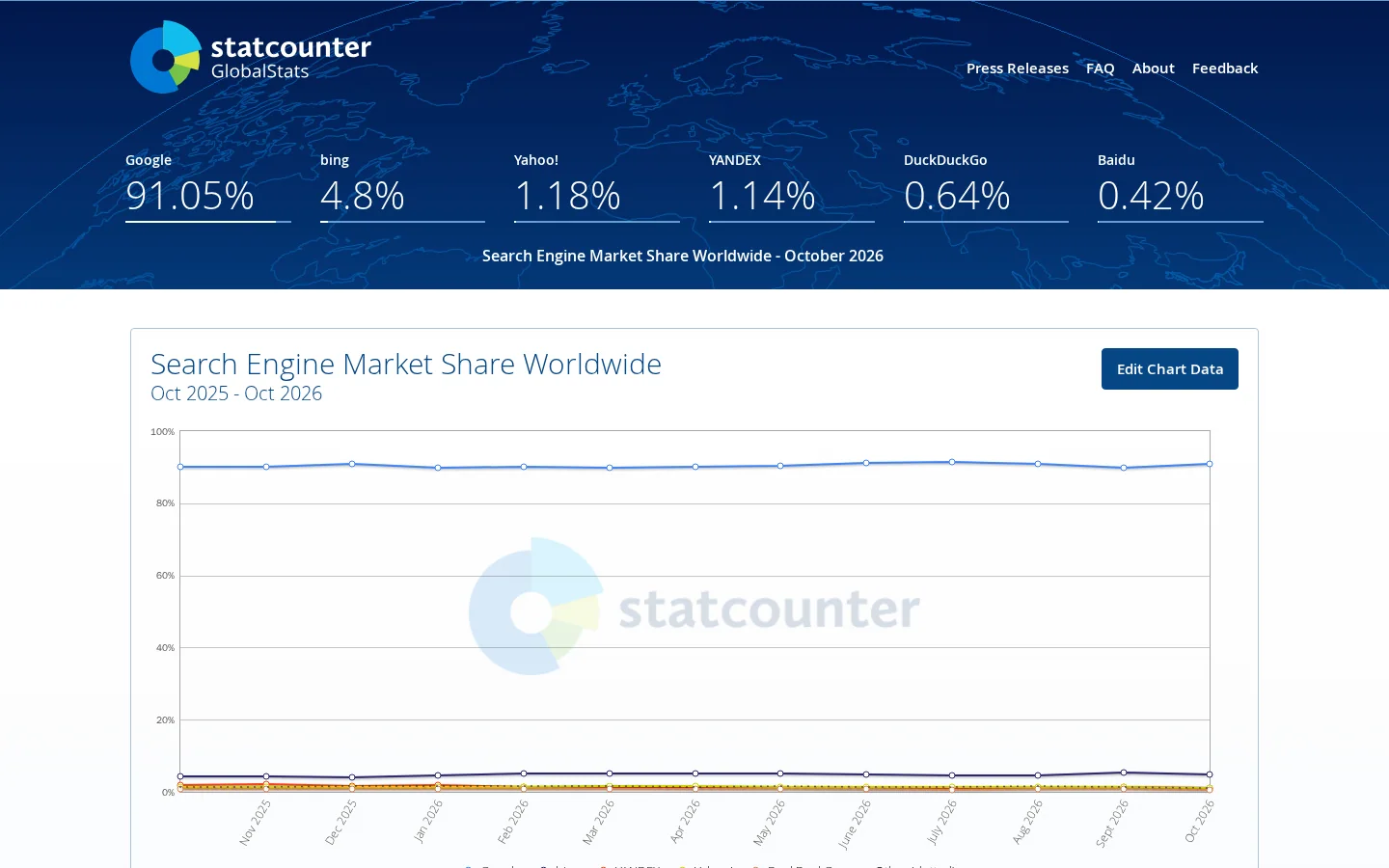
For a full look at each engine over time, read our search engine market share article. That article covers the engines themselves. This glossary entry only explains the measure.
No. Market share counts sales or revenue. Share of voice counts how often a brand is seen or mentioned compared with rivals, in ads, search results or AI answers. A brand can have a large share of voice and still hold a small market share, because attention does not always turn into sales.
| Measure | What it counts | Question it answers |
|---|---|---|
| Market share | Your sales or revenue against all sales in the market | How much of the money in this market is yours? |
| Share of voice | How often your brand is seen or mentioned against rivals | How often do people hear about you compared with rivals? |
| Search engine market share | Share of search use per engine, estimated by a tracker | Which search engine do people use most? |
Read the full definitions in our share of voice entry and our AI share of voice entry. Both measure visibility, not the money a company earns.
There is no single good number. A small share can be strong in a crowded market, and a large share can be weak in a market that is shrinking. Compare your share with your own figures from earlier periods, and with the main rivals in the same market, not with a number from another sector.
Market share is only as good as its total. If the market is estimated, the share is an estimate too. A market defined too wide hides a small player in a niche. A market defined too narrow makes a weak company look strong.
Market share also says nothing about profit. A company can take share by selling at a loss, so read share next to margin and growth.
A share can also rise only because the market shrank. Check the total for each period, not just your own number.
AI answers do not publish sales, so you cannot measure market share inside them. You can measure the closest proxy: how often AI names your brand compared with rivals for the same questions. Sorank has a free SEO Share of Voice Calculator that measures your search visibility against competitors. Its GEO Leaderboard shows which brands AI recommends instead of yours.
Three errors appear in most market share work. Check for each one before you share a number.
This is when your sales cover one period and the market total covers another. You spot it when the share jumps with no clear reason. Fix it by pulling both numbers for the same months, quarters or years.
This is when the market includes products you do not sell, or leaves out your direct rivals. You spot it when your share looks unrealistic for your sector. Fix it by defining the market from the products your customers compare. Check that list against the questions your customers actually ask, and against the results a search engine shows for them.
This is when a rough total is shown as an exact share with no source. You spot it when no report or dated figure backs the number. Fix it by naming the source and the date, and writing "estimated" next to any share built on a guess.
In search, the market is the set of queries your topic gets. Your share of those clicks shows whether your pages win against rival pages. In AI answers, the market is the set of answers on your topic, and your share is how often your brand is named in them. Tracking that share over time shows whether your content and your links gain ground. Without it, you only see your own traffic, not the market around it.
Market share is your sales divided by the total market sales, times 100. Use the same period for both numbers, name your source, and read the result next to growth and profit. For the AI side, track how often your brand appears compared with rivals.
Sources
Divide your sales by the total sales of the market over the same period, then multiply the result by 100. Both numbers must cover the same months or years, or the share will be wrong.
There is no single good number. A small share can be strong in a crowded market, and a large share can be weak in a market that is shrinking. Compare your share with your own past figures and with your main rivals.
Market share counts sales or revenue. Share of voice counts how often a brand is seen or mentioned compared with rivals. A brand can have a large share of voice and still hold a small market share.
 “I tested Sorank on a real client site and it's insane. It does everything an agency would bill you $1500 a month for. It's going into production on that client now.”

 Guillaume Guersanguersanguillaume.com“We are an Ads agency and we wanted to get our SEO back on track once and for all. Sorank gave us a clear view of our site, helped us prioritize optimizations, and properly structure our content. The tool is easy to use, well designed for a team, and very practical for centralizing tracking without having to juggle multiple platforms. A very solid foundation to start fresh with our SEO.”
 Gaspard MadouiAds Agency
 “I just let the Sorank software do its thing, and now my DR is 25 and my page is ranking higher.”
 Lucas Flandrefoundertrace.fr“I specialized in GEO thanks to Sorank. The GEO Leaderboard allows me to show my clients their position vs competitors on ChatGPT. It’s a real commercial differentiator.”
 MélanieSEO Freelance“Great service, works well for our website and helps us understand how to improve it to rank better on Google and elsewhere. Congrats, keep going, I recommend it.”
 Hugo T.E-commerce merchant



















