Preferences
Privacy is important to us, so you have the option of disabling certain types of storage that may not be necessary for the basic functioning of the website. Blocking categories may impact your experience on the website. More information
Privacy is important to us, so you have the option of disabling certain types of storage that may not be necessary for the basic functioning of the website. Blocking categories may impact your experience on the website. More information

Distribb review: what it costs, how its backlink exchange works, what Google's spam policies say, and a four-step test to run before you join any link exchange.
In short
Distribb is an AI SEO subscription that writes articles, publishes them to your site and runs a backlink exchange between members. The subscription is simple to understand, but the exchange needs a test before you pay. Google's spam policies list "link to me and I'll link to you" as link spam, so judge the links you would place and receive before you judge the price.
Want to go further? Ask
Quick quiz
Is SEO right for you, and how should you start?
Sorank matches your answers


Test it for 3 days on your own site and see where you stand on Google, ChatGPT and the other AIs.
Start 3-day free trial3 days free, then stop whenever you want. 90-day results guarantee, conditions apply.
Distribb sells one monthly subscription that bundles three jobs. It researches keywords and writes long articles, it publishes them to your content management system (CMS), and it adds a backlink exchange plus link outreach. Of the three, the exchange deserves the closest reading, because it changes which other sites link to you and how.
The price is the easiest part to check. On its pricing page, which we checked on 22 November 2026, Distribb lists two monthly plans: Pro at $97 per month and Accelerator at $495 per month. The page offers yearly billing with "2 months free", which lowers the effective monthly cost, but the yearly amounts are not printed in the text we could read. Compare the yearly figure on the live page before you decide.
Pro is the plan where the exchange and outreach are included, according to the product pages. Accelerator adds a bigger article quota, done-for-you videos and social posts, and outreach that Distribb sends in your name. If you only want the exchange, Pro is the plan to test, and the test is the same whichever plan you pick.
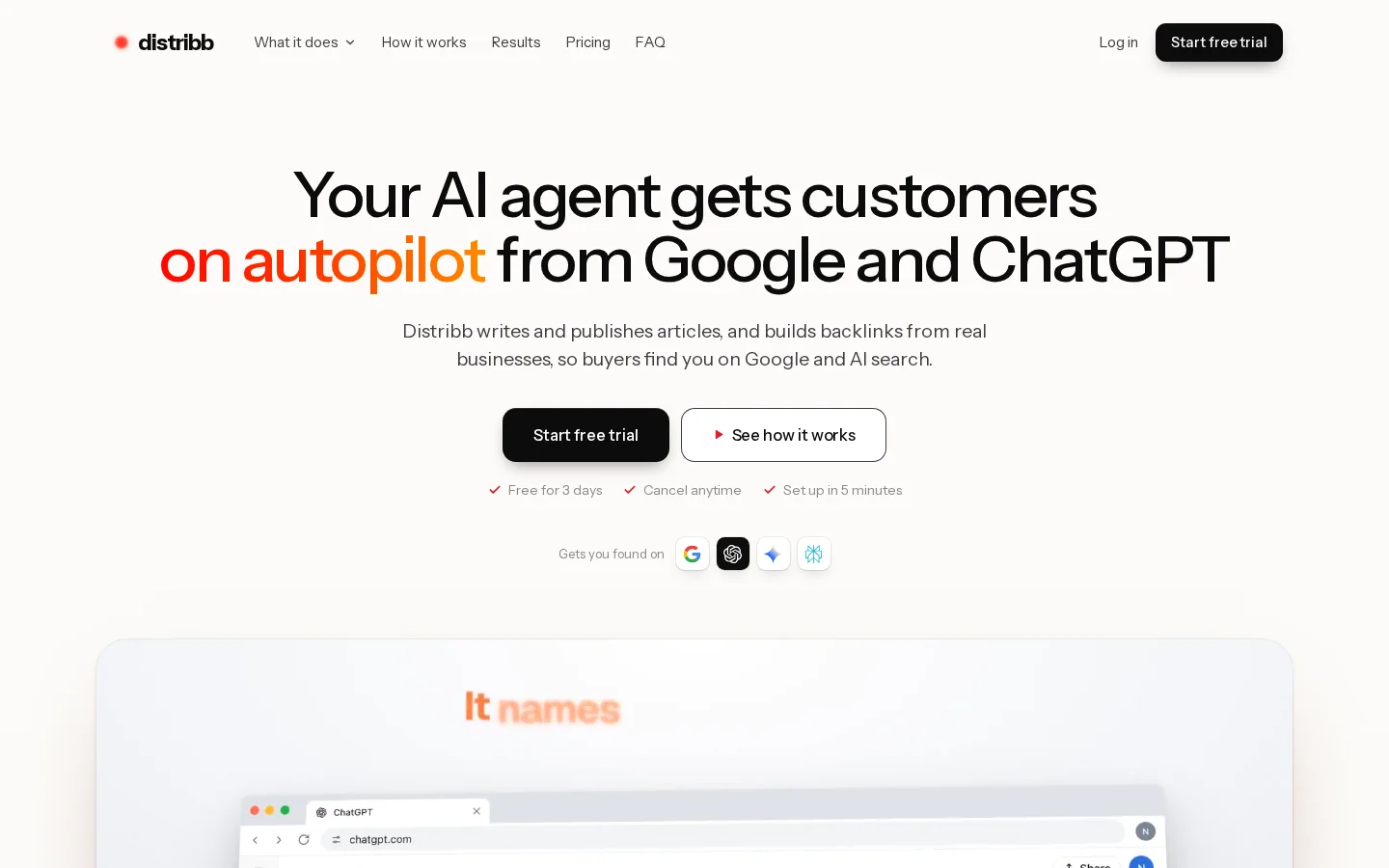
The homepage describes the product in plain terms: keyword research, long articles with internal links and sourced tables, publishing to the usual CMS platforms, Search Console data, an AI visibility tracker and the backlink exchange. The sections below go through each part that matters to a buyer. They spend the most time on the exchange, because that is where the risk sits and where the marketing says the least.
The exchange is a network of businesses. You switch it on from the dashboard, your site joins the network, and the system places contextual links from members into articles on your site while placing yours into theirs. The company describes it as a few links a month, placed on autopilot, and says the links appear only where they are relevant to readers. Those are the company's own claims, and they are exactly what you should test before you rely on them. For the general concept, see backlink exchange: what it is and why Google calls it a link scheme. This review takes a narrower angle: one product's offer, and what to check in it.
An exchange is a balance. Members host links in their own articles and receive links in return. A competing review of Distribb, which is a third-party article and not a Distribb page, describes up to five outbound links a month in exchange for three to five inbound ones, with a routing rule meant to avoid a direct A to B and back link pattern. We could not confirm that routing rule on Distribb's own pages, so treat it as an unverified description. Ask for the routing rule in writing before you join, and keep the answer.
The network's composition is not public in the pages we read. Distribb does not show the domain ratings of its members, the topics of the member sites, or how many links from the network are still live after a few months. Without those numbers you can only judge the exchange by the first links it places on your site. That is why the test in the fifth section asks you to inspect the actual pages that will link to you instead of the marketing around them.
One more thing matters here. An exchange is only as good as the pages that host your links. A link from a relevant article on a live, indexed site with real readers is a useful signal. A link from a thin page that nobody visits adds risk and very little value, however high the domain score looks.

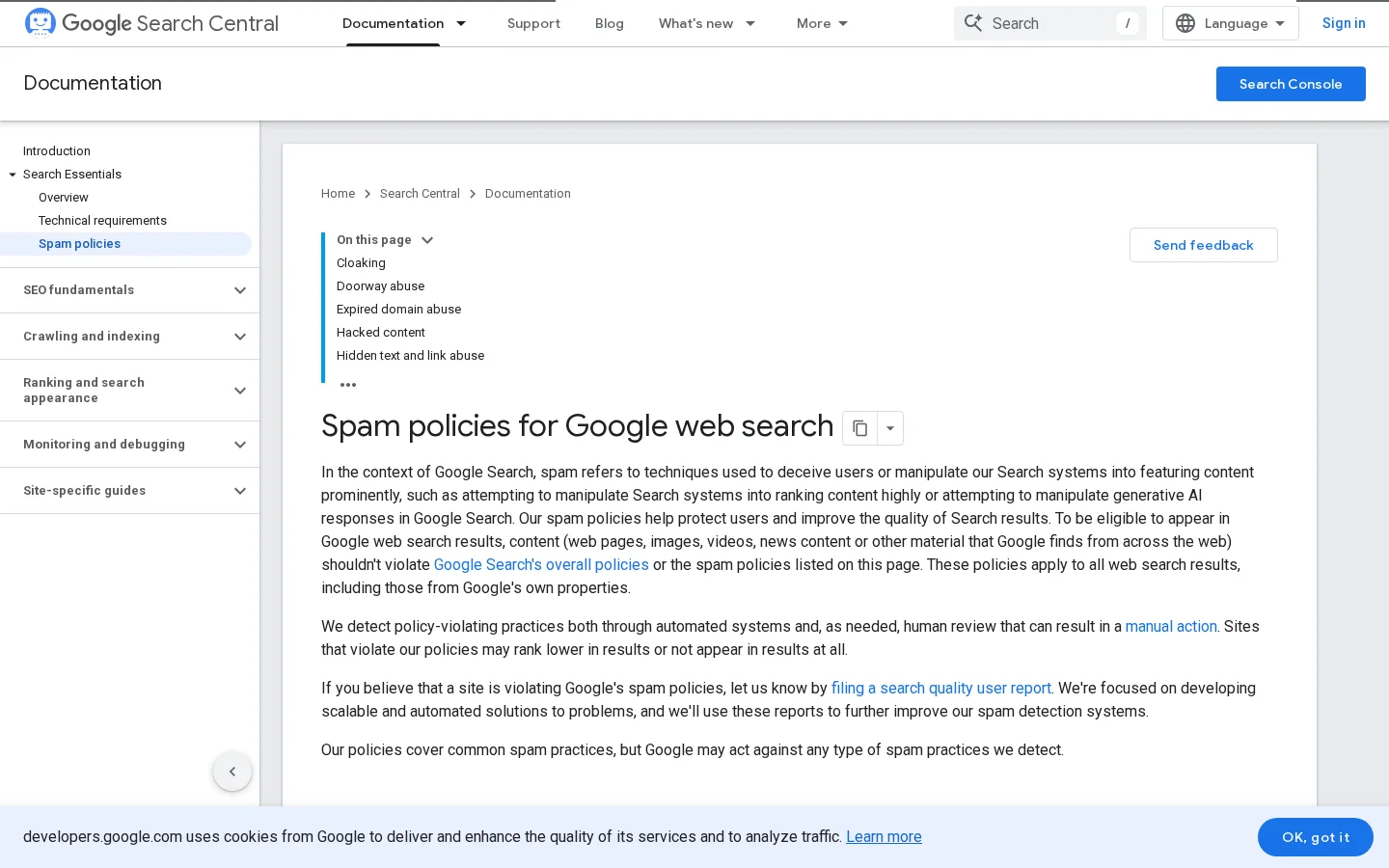
Google's spam policies name excessive link exchanges as link spam. The example in the policy is a reciprocal deal, "link to me and I'll link to you". The policy does not depend on the mechanism. It defines link spam as linking "primarily for the purpose of manipulating search rankings", so an exchange is judged by what it is built to do, not by what its marketing calls it.
Reciprocal swap vs one-way link
The spam policies page of Google's Search Central documentation, which we read on 22 November 2026, defines link spam in one sentence: "Link spam is the practice of creating links to or from a site primarily for the purpose of manipulating search rankings." Under that definition the page gives three examples that matter for any exchange: "link to me and I'll link to you" deals, partner pages created only for cross-linking, and the use of "automated programs or services to create links to your site". An exchange network that places links for its members at a steady pace is close to that third example, whatever the feature is called in the product.
Some exchange programs say that a three-way route, where A links to B, B links to C and C links back to A, avoids the reciprocal pattern. Google's spam policies page does not mention three-way arrangements, and it does not approve them either. The question it asks is the same for every arrangement: were the links placed mainly to move rankings? A loop designed to hide a swap is still a swap in purpose. The pattern is also easy to spot when the same sites keep appearing together month after month, and that is the kind of pattern a spam system is built to notice.
The honest conclusion is that no published rule makes a three-way network safe. The policy judges purpose and pattern, and you cannot read either off a marketing page. That is a reason to keep exchange links few, relevant and clearly placed for readers, and to avoid any setup that promises links at volume.
If you pay for a link, or get paid for one, mark it. Google's guidance on qualifying outbound links, which we read on the same day, says that links which are advertisements or paid placements should use the rel value "sponsored", and that Google prefers it over "nofollow" for those links. You can combine values in one list, for example "ugc nofollow", and the guidance says marked links will generally not be followed. A link you place in an exchange is not a paid link in Google's sense, but if you pay a network to place links, treat the placement as paid and mark it.
| Link model | How it works | Google's stated position | Main risk |
|---|---|---|---|
| Reciprocal swap | You link to them, they link to you | Listed as link spam in the spam policies | Manual action, links ignored |
| Exchange network | Members place links for each other, sometimes routed through the network | Judged by purpose. The policy does not mention three-way routes | An automated pattern across many sites |
| Paid placement | You pay for a link or a sponsored article | Must be marked "sponsored" or "nofollow" | Undisclosed paid links |
| Earned editorial link | A site links because your page helps its readers | Not one of the spam examples listed | Slow, and hard to scale |
The terms of service let you ask for a refund of your first subscription payment within 14 days of that payment. Renewal payments are non-refundable, except where applicable law requires a refund, and you can cancel at any time so that no further charges are made. The pricing page promises cancellation at any time, but the terms are the document that decides a refund dispute, so read them rather than the short marketing line. You can read them in full in Distribb's terms of service.
Section 4, on payment terms, holds the refund rule. Section 8, on termination, says you can cancel from your account settings or by emailing support, and that cancelling does not cancel amounts that were already due. Section 3 adds a trap for trial users: if you do not cancel before the trial ends, the first subscription payment is charged when the trial ends. Put the trial end date in your calendar on the day you start, not on the day you remember to check.
Two things are worth noting. The refund window runs from your first payment, not from the day you join the exchange. And a renewal you forget to cancel is the most likely source of a dispute, because the terms do not promise money back on it.
Public reviews of Distribb are mixed. Positive Trustpilot reviews mention content automation and the link arrangements, and some reviewers report first clients within a few weeks. Negative reviews complain about generic articles that were not about their store, spelling mistakes, and refund requests that went unanswered. Distribb replies to negative reviews and has disputed at least one of them. Because the company answers its own reviews, read the complaints for their pattern, which here is article quality, refunds and support, rather than for the company's replies. Ratings on review sites also move from week to week, so check the live page before you rely on any figure.
Warning
Set two reminders on the day you subscribe: one for the end of any trial, and one 14 days after your first charge. After that window, the terms do not promise a refund of the first payment.
You can test an exchange offer without trusting its marketing. List the links you already have, check the partner pages the network would place you next to, count the balance you would run, and write the rules you will enforce. The four steps take an afternoon, and they tell you more than any feature list.
Testing an exchange offer before you join
Start with a complete list of the links that already point at your site. Note which referring domains are on your topic, which anchors they use and which of your pages receive them. This list is your baseline. Without it, you cannot tell whether an exchange has changed your profile, and you cannot tell which of your pages the new links point to. The process is the same as in backlink audit: how to review your links step by step, so use that method if you are starting from nothing.
Tip
Run your domain through the free backlink checker to get a first list of referring domains. Keep it as your baseline before you compare it with the partners an exchange proposes.
Ask the network for three example pages where your link would sit, then check each one. Look at four things: the topic of the article, whether the page is indexed and visible in search, whether the page has real readers, and whether the link sits in the body text or in a footer. A plumber's article about boiler servicing that links to a project management app is a red flag, even if the domain looks strong. A page that exists only to host links is another, and so is a site with no contact details, no author and no date on its articles.
Do not accept a sample because the network picked it. Ask for a random sample, or check a few pages you find yourself through a search for the topic. If the network refuses to show you where your link would go, you have learned something about the offer.
Count what you would receive and what you would place. The simplest test is a monthly balance. A negative number means you place more links than you get, and a positive number means the reverse. The number matters less than its pattern. A balance that matches to the link every month looks mechanical, because real editorial links never arrive in a perfectly matched pattern.
net_balance = links_received_per_month - links_placed_per_month
# Hypothetical month, not a Distribb figure: 4 received, 5 placed
# net_balance = 4 - 5 = -1, so you place more links than you get
Write the formula in your own sheet and fill it in from your export every month. If the balance is flat at zero for several months in a row, stop and look at the pages again before you add any new partner.
Write four rules and share them with whoever manages the account. First, a topic filter: a link is accepted only when the hosting article is on the same subject as the page it points to. Second, an anchor policy: no exact-match phrase on most links, which is covered in the anchor text guide. Third, a monthly cap on outgoing links, lower than the network would allow. Fourth, a review date, 30 days after you start, when you check the export against the rules and decide whether to continue.
Before you join any link exchange
Most of the damage from an exchange comes from five repeatable mistakes. Each one is easy to spot once you know the sign to look for, and each has a fix you can apply the same week. The mistakes below are the ones that appear in the profiles of sites that lost ground, and they are the ones to check in your own export.
The mistake is to take any link on any topic because it is free. The sign is a link sitting in an article on a subject far from yours, or on a site whose readers would never buy what you sell. A single unrelated link is not a disaster, but a profile full of them tells search engines that your links are not chosen for their readers. The fix is to refuse the link, set a topic filter on the network if it has one, and ask the partner to remove any off-topic link you already host. For the wider question of what makes a link useful, read what a quality backlink is, with nine criteria and a scoring grid.
The mistake is letting the same keyword phrase become the anchor of most of your links. The sign is visible in an export: sort the anchors by frequency and look at the top three. If one money phrase sits on most of your links, the profile looks engineered. The fix is to vary the anchors across four types: brand names, partial matches, descriptive phrases and bare URLs. Your exchange rules should say which type a partner can use. The vocabulary is defined in the anchor text glossary entry, which is worth reading before you write the rule.
The mistake is to judge a link by the domain rating of the site that hosts it. The sign is a high score on a site with thin pages, no visits and no real author. A domain score summarizes the site's link profile. It says little about the page that carries your link. The fix is to judge the page: is it indexed, does it get organic visits, is it a real article written for readers, and is the link in the body? For the reasons domains matter as a group, read the guide on referring domains and why they count more than raw link totals.
The mistake is to accept whatever links the network sends each month, so that your outgoing links arrive on a fixed rhythm with the same number of partners. The sign is a flat line in your monthly export, with new links arriving on the same day and in the same quantity. The fix is to cap outgoing links well below what the network allows, pause when the pattern looks mechanical, and balance the profile with links you earned without any exchange. The broader set of errors that waste link budgets is covered in link building mistakes that waste your budget, and how to fix each one.
The mistake is to join without a way out. The sign is that you cannot say which of your articles host which partner link, or you have no monthly export and no record of when you started. The fix is to keep a monthly export and a list of the articles that host partner links, so that you can remove a link within a week if a partner turns out to be a problem. If a link you host was paid for, mark it with the right rel value rather than leaving it as a plain link, and read the nofollow glossary entry to choose the value. Keep the record in the backlink monitoring routine, so the export is not a one-off.
Your link profile, before and after the filter
There are more ways to earn a link than an exchange, and most of them are slower. Exchange networks, reciprocal swaps and paid placements carry the most policy risk, because Google's spam policies name them directly or apply to them through the purpose test. Guest posts, broken link building and original data depend on the quality of what you publish and the care of your outreach. The sections below present each method with its principle, when to use it, its advantages, its limits and an example, and the table at the end compares them side by side.
The principle is that members place links for each other, often through a network that matches sites. Use it only when you can verify the topic of each partner page and you accept that you have little control over timing. The advantage is that it runs without you. The limits are the policy risk, the lack of control over the network's composition and the fact that you cannot see every partner until the link is live. An example is a landscaping company whose network partners include a project management app, placed in an article about garden planning. That is the kind of mismatch the test in the fifth section is designed to catch.
The principle is that you link to a site on the condition that it links back. Almost no situation justifies it at scale, because it is the pattern the spam policy names. When the reason is real, for example two accountants who each mention the other in an article that helps readers, keep it to one relevant mention and do not build it into a routine. The advantage is speed. The limits are the policy and the fact that the two links look like a deal to anyone who checks.
The principle is that you pay for a link in a sponsored article or a placement on a site, and the link is marked as paid. Use it when the placement brings readers who are likely to become customers, and when the publisher discloses the sponsorship. The advantage is control over topic and timing. The limits are the cost, the need to mark the link with the right rel value, and the risk of paying for links that do not help readers. An example is a sponsored guide on a niche newsletter, with a single link marked "sponsored" and the disclosure visible on the page.
The principle is that you write an article for another site, with its editor's approval, and receive a link in the article or the author box. Use it when you have a real expertise to share and the site's readers would benefit from the article. The advantage is that you reach a new audience as well as earning a link. The limits are that it is slow, editors refuse most pitches, and a guest post written only to carry a link is weak on both counts. The method is explained in the guest posting guide, and the list of places to pitch in free guest posting sites, with how to vet each one.
The principle is to find a page that links to a dead address, and to offer a working replacement that covers the same subject. Use it when you have a page that closely matches the broken link's topic. The advantage is that the webmaster has a reason to say yes: the page gets fixed. The limit is that you must find dead links at a reasonable pace, and that the replacement must be better than the dead target. An example is a university resource list with a broken link to an old guide on local SEO. You offer your updated guide, and the editor replaces the dead link. The full method, with email templates, is in broken link building, step by step.
The principle is to publish a study, a dataset or a tool that other writers want to cite. Use it when you have data nobody else has, such as a survey of your own customers or a measurement from your product. The advantage is that the links are editorial and often come from high-quality sites. The limit is cost: it takes time and research before the first link arrives. An example is a short survey of 200 customers about how they found you, published with the methodology and the raw figures, which journalists cite when they write about the subject.
The principle is to recover links you already earned that are now broken, redirected or pointing at the wrong page. Use it before you buy or swap anything new, because the links are already yours. The advantage is that it is low risk and quick. The limit is that it helps only if you have lost links in the first place. An example is a page that moved to a new address without a redirect. The fix is a 301 redirect, and the links that pointed at the old page start working again. The process is in link reclamation: how to recover lost and broken backlinks.
| Method | Effort | Cost | Policy risk | Best use |
|---|---|---|---|---|
| Exchange network | Low | Subscription | High at scale | Verified topics, capped volume |
| Reciprocal swap | Low | None | High | One real, relevant mention |
| Paid placement | Low to medium | Per placement | Low if marked | Disclosed sponsored content |
| Guest post | High | Time | Low when earned | Real expertise for a new audience |
| Broken link building | Medium | Time | Low | A better replacement page |
| Original data and PR | High | Research time | Low | Data others want to cite |
| Link reclamation | Low | None | Low | Links you already earned |
Sorank also places links between member sites, and it is fair to say so before you compare anything. Its feature page describes one-way links between sites, paid for with credits: you earn credits when one of your published articles hosts a partner link, you spend credits to receive a link, a daily cap keeps spending gradual, and you can refuse any link you host. The page says a site that links to you is never a site you link out to. That is a claim about the network's design, so it needs the same test as Distribb's exchange, and we are not a neutral reviewer of our own feature.
The feature is described on the natural backlink acquisition page, and the concept of a backlink in general is covered in the backlink glossary entry. Whatever network you use, ask the same four questions: which topics it matches, how it routes links, what it shows you about the pages that host your links, and how you remove a link in a week. If a network cannot answer them clearly, pick a different method from the table above.
Start with the money and the paper. Read the terms, set the reminders for any trial end and for the 14-day refund window, and ask the vendor how links are routed, in writing. Then export your current links and check the topics, because that list is the baseline any offer must beat. If you decide to test an exchange, cap the outgoing links from the first week, and set the review date for 30 days later.
After that, decide how you will earn the rest of your links. An exchange is one method among several, and it is the one that needs the most supervision. The nine methods for getting backlinks give you a list of options that do not depend on a partner network. Whatever you choose, the discipline is the same: relevant pages, varied anchors, a cap you can defend and a record you can export.
Distribb runs a backlink exchange between member sites, and Google's spam policies list excessive link exchanges as link spam. Whether a given exchange breaks the policy depends on its purpose and its pattern, so test the links it would place on your site before you rely on them.
On its pricing page, checked on 22 November 2026, Distribb lists Pro at $97 per month and Accelerator at $495 per month. Yearly billing is offered with two months free, but the yearly amounts are not printed on the page, so check the live page before you buy.
The terms of service allow a refund of your first subscription payment if you ask within 14 days of that payment. Renewal payments are non-refundable except where the law requires otherwise, so cancel before each renewal date if you do not want to pay again.
We analyse your competitors, your website and your AI visibility to create a tailored content plan for free.
 Website Value Calculator
 Website Accessibility Checker
 Google Analytics Checker
 Duplicate Content Checker
 Mobile-Friendly Test
 Website Speed Test
 Subdomain Finder
 Domain Age Checker
 CMS Detector
 Googlebot Simulator
 Nofollow Link Checker
 Meta Tag Checker
 Keyword Cannibalization Checker
 Keyword Intent Checker
 Keyword Extractor
 Google Ads Cost Calculator
 CPC Calculator
 Local Citation Finder
 Reddit Threads Finder
 Disavow File Generator
 Redirect Generator
 Canonical Tag Generator
 Passive Voice Checker
 Google Location Changer
 Google Review Calculator
 Google Review Link Generator
 Keyword Combiner
 Podcast Show Notes Generator
 AI Content Rewriter
 AI Text Humanizer
 ChatGPT Prompt Generator
 Twitter Thread Generator
 Tweet Generator
 Landing Page Copy Generator
 Google Ads Copy Generator
 Pinterest Pin Description Generator
 Anchor Text Generator
 Social Media Post Generator
 LinkedIn Post Generator
 Free AI Writer
 Review Response Generator
 LSI Keyword Generator
 YouTube Video Ideas Generator
 YouTube Tag Generator
 YouTube Description Generator
 Product Description Generator
 CTA Generator
 Blog Introduction Generator
 Conclusion Generator
 Hook Generator
 AI Content Brief Generator
 FAQ Schema Generator
 AI Blog Post Ideas Generator
 Structured Data Validator (Schema Validator)
 Alt Text Checker
 Internal Link Analyzer
 Backlink Challenge
 AI Meta Description Generator
 AI Blog Title Generator
 Google Indexability Checker
 AI Blog Outline Generator
 UTM Link Builder
 Keyword Clustering Tool
 Canonical Tag Checker
 XML Sitemap Generator
 Broken Link Checker
 AI SEO Title Generator
 Headline Analyzer
 SERP Preview Tool
 Redirect Checker
 Hreflang Tag Generator
 Heading Structure Analyzer
 HTTP Headers Checker
 Favicon Extractor
 SERP CTR Calculator
 SEO vs Paid Search Savings Calculator
 SEO Share of Voice Calculator
 SEO ROI Calculator
 SEO Traffic and Revenue Forecast Calculator
 SEO Budget Calculator
 SEO Break-Even Calculator
 SaaS SEO ROI Calculator
 ROAS Calculator
 Reading Time Calculator
 Ranking Gain Simulator
 Organic Traffic Value Calculator
 Organic Traffic Estimator and Website Traffic Checker
 LTV to CAC Ratio Calculator
 Local SEO ROI Calculator
 Link Building Cost Calculator
 Keyword Value Calculator
 Keyword Opportunity Score Calculator
 Keyword Density Calculator
 GEO ROI Calculator
 GEO Content Investment Calculator
 Ecommerce SEO ROI Calculator
 Customer Lifetime Value Calculator
 Customer Acquisition Cost Calculator
 CTR Calculator
 Cost Per Article Calculator
 Conversion Rate Calculator
 Content Marketing ROI Calculator
 ChatGPT Referral Traffic Estimator
 Bounce Rate Calculator
 Backlink ROI Calculator
 AI Visibility Score Calculator
 AI Traffic Value Calculator
 AI Share of Voice Calculator
 Cost of AI Invisibility Calculator
 AI Citation Rate Calculator
 llms.txt Validator
 AI Overview Checker and AI Overviews Rank Checker
 Robots.txt Checker
 AI SEO Audit
 LLM Readability Checker
 SearchGPT Readiness Checker
 Structured Data LLM Audit
 Website Crawlability AI Audit
 Why ChatGPT Is Not Recommending My Website
 Gemini Ranking Tool
 Perplexity Ranking Checker
 LLM Citation Checker
 Answer Engine Optimization Audit
 GEO Audit
 AI Search Visibility Test
 ChatGPT Visibility Checker
 llms.txt Generator
 URL Extractor
 Webpage to Markdown
 Sitemap Checker
 SERP Volatility Sensor
 Page Size Checker
 Word Counter
 Slug Generator
 Schema Generator
 Robots Generator
 OG Preview
 Meta Tags Generator
 Image Compressor
 Favicon Generator
 On-Page SEO Audit: SEO Checker and SEO Analyzer
 Backlink Analysis Tool
 Keyword Research Tool
 Domain Authority Checker
 “I tested Sorank on a real client site and it's insane. It does everything an agency would bill you $1500 a month for. It's going into production on that client now.”

 Guillaume Guersanguersanguillaume.com“We are an Ads agency and we wanted to get our SEO back on track once and for all. Sorank gave us a clear view of our site, helped us prioritize optimizations, and properly structure our content. The tool is easy to use, well designed for a team, and very practical for centralizing tracking without having to juggle multiple platforms. A very solid foundation to start fresh with our SEO.”
 Gaspard MadouiAds Agency
 “I just let the Sorank software do its thing, and now my DR is 25 and my page is ranking higher.”
 Lucas Flandrefoundertrace.fr“I specialized in GEO thanks to Sorank. The GEO Leaderboard allows me to show my clients their position vs competitors on ChatGPT. It’s a real commercial differentiator.”
 MélanieSEO Freelance“Great service, works well for our website and helps us understand how to improve it to rank better on Google and elsewhere. Congrats, keep going, I recommend it.”
 Hugo T.E-commerce merchant