Preferences
Privacy is important to us, so you have the option of disabling certain types of storage that may not be necessary for the basic functioning of the website. Blocking categories may impact your experience on the website. More information
Privacy is important to us, so you have the option of disabling certain types of storage that may not be necessary for the basic functioning of the website. Blocking categories may impact your experience on the website. More information

 ChatGPT vs
 Perplexity: How They Differ in Search, Sources and Accuracy
ChatGPT and Perplexity answer questions differently. Compare how they search, cite sources and match Google, then test both for your brand weekly.
In short
ChatGPT is a general AI assistant that can search the web, and Perplexity is an answer engine built around search. ChatGPT searches when a question needs current information. Perplexity's cited pages overlap more with Google's top results: in one Ahrefs study, about 28.6% of its cited URLs ranked in Google's top 10 for the same prompt.
Want to go further? Ask
Quick quiz
How should you get mentioned by ChatGPT and other AI assistants?
Sorank matches your answers


Test it for 3 days on your own site and see where you stand on Google, ChatGPT and the other AIs.
Start 3-day free trial3 days free, then stop whenever you want. 90-day results guarantee, conditions apply.
The two products start from different places, and that shapes everything else in this comparison. ChatGPT is a general assistant. You can ask it to write, code, plan or explain, and it can also search the web. Perplexity is an answer engine: each question is handled as a search, and the answer is written from the pages it finds. If the terms are new to you, read the glossary entry on Perplexity and the ChatGPT glossary entry first.
Both tools answer with links, so both look like research tools at first glance. The difference is what each one does first. OpenAI's help article on ChatGPT search describes it as a way to "search the web to answer questions with current information and links to relevant sources." ChatGPT answers from what it already knows when it can, and goes to the web when the question calls for it. Perplexity puts the search at the center of every answer.
| Question | ChatGPT | Perplexity |
|---|---|---|
| Basic design | General AI assistant with web search | Answer engine built around search |
| When it searches | Automatically, when the question would benefit from current information | Search is the first step of every answer |
| How sources appear | Citations when web search is used, plus a view of the cited sources | Source links next to the answer |
| Share of cited URLs in Google's top 10 (Ahrefs, August 2025) | About 12%, for ChatGPT, Gemini and Copilot combined | 28.6% |
| What to check first | Whether the citation supports the sentence it sits next to | Whether the cited page is current and on topic |
The last row is a reminder, not a verdict. The 12% figure covers three tools together, so it can't tell you how ChatGPT alone compares. If you want the model-level view, Sorank has a page for each assistant: the ChatGPT model page and the Perplexity model page explain how to get a business named in each one.
ChatGPT searches on its own when a question needs current information. Before it searches, it usually rewrites your question into one or more search queries. That second step is the one most site owners miss. The page that ranks for the words a user typed is not always the page that answers the rewritten query.
OpenAI's help article on ChatGPT search says that "ChatGPT may search the web automatically when your question would benefit from current information." A question about a price, a release date or last month's news is likely to trigger a search. A question about how a concept works may not. The simplest way to learn which of your questions trigger a search is to ask each one and see whether links appear.
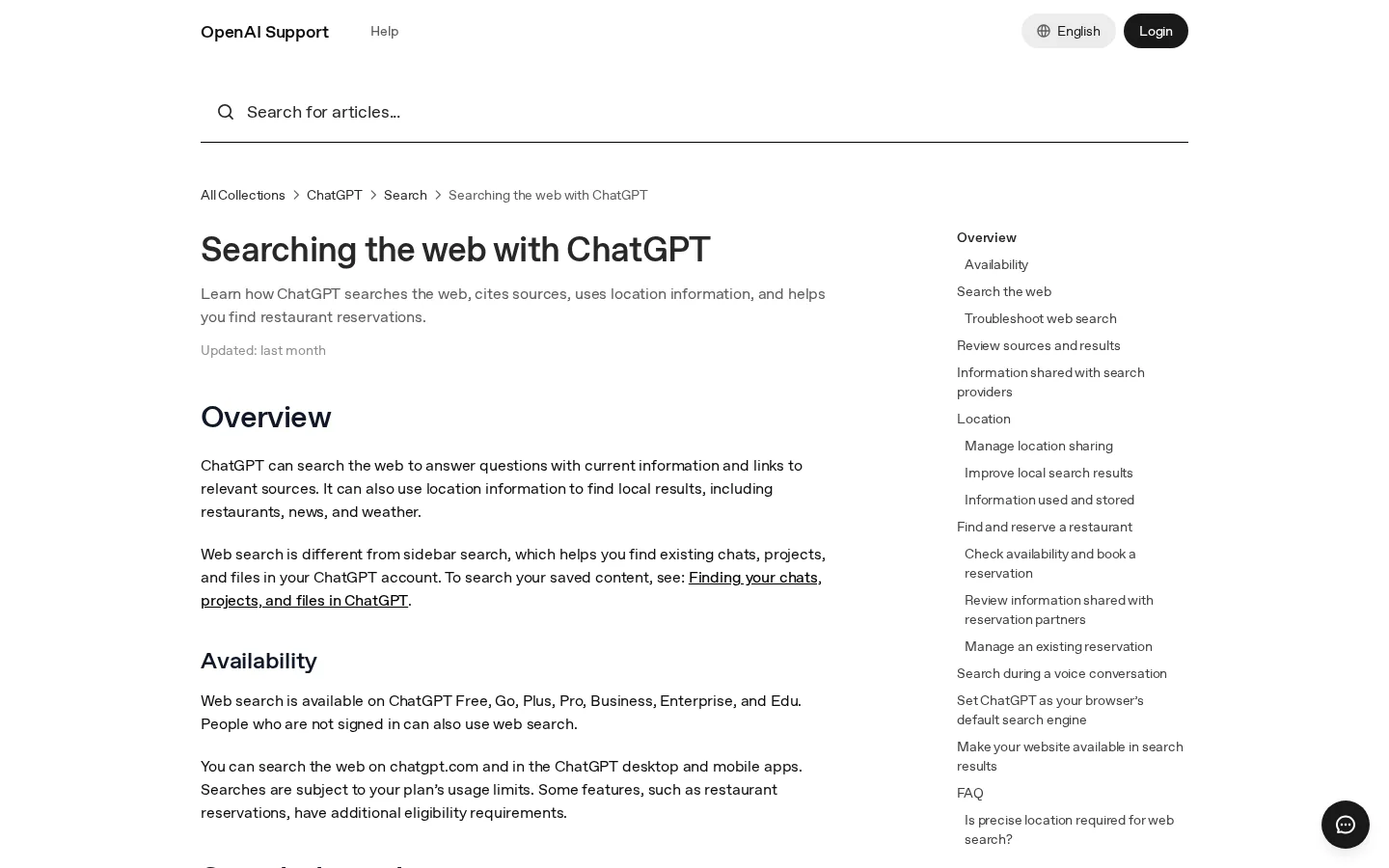
The same help article says that ChatGPT "typically rewrites your query into one or more targeted queries." A question such as "which CRM should a 10-person agency use" may be searched as something narrower, such as "CRM for small agencies pricing". That example illustrates the pattern, it is not a measured log. Your page competes on the narrower query, not on the exact words your buyer typed.
Here is the sequence as OpenAI's help article describes it. The article gives the outline, not every internal detail, so treat the steps as the visible order of events.
How a ChatGPT answer with web search is built
Source: OpenAI Help Center, ChatGPT search article
Three things follow. First, the page has to answer the narrower query, so name the exact product, price or use case in the first lines. Second, the page has to be easy to cite: one claim per paragraph, with the number, its source and its date next to it. Third, you can't see the rewritten query in the chat, so you learn it by testing your own questions and reading the sources each answer lists.

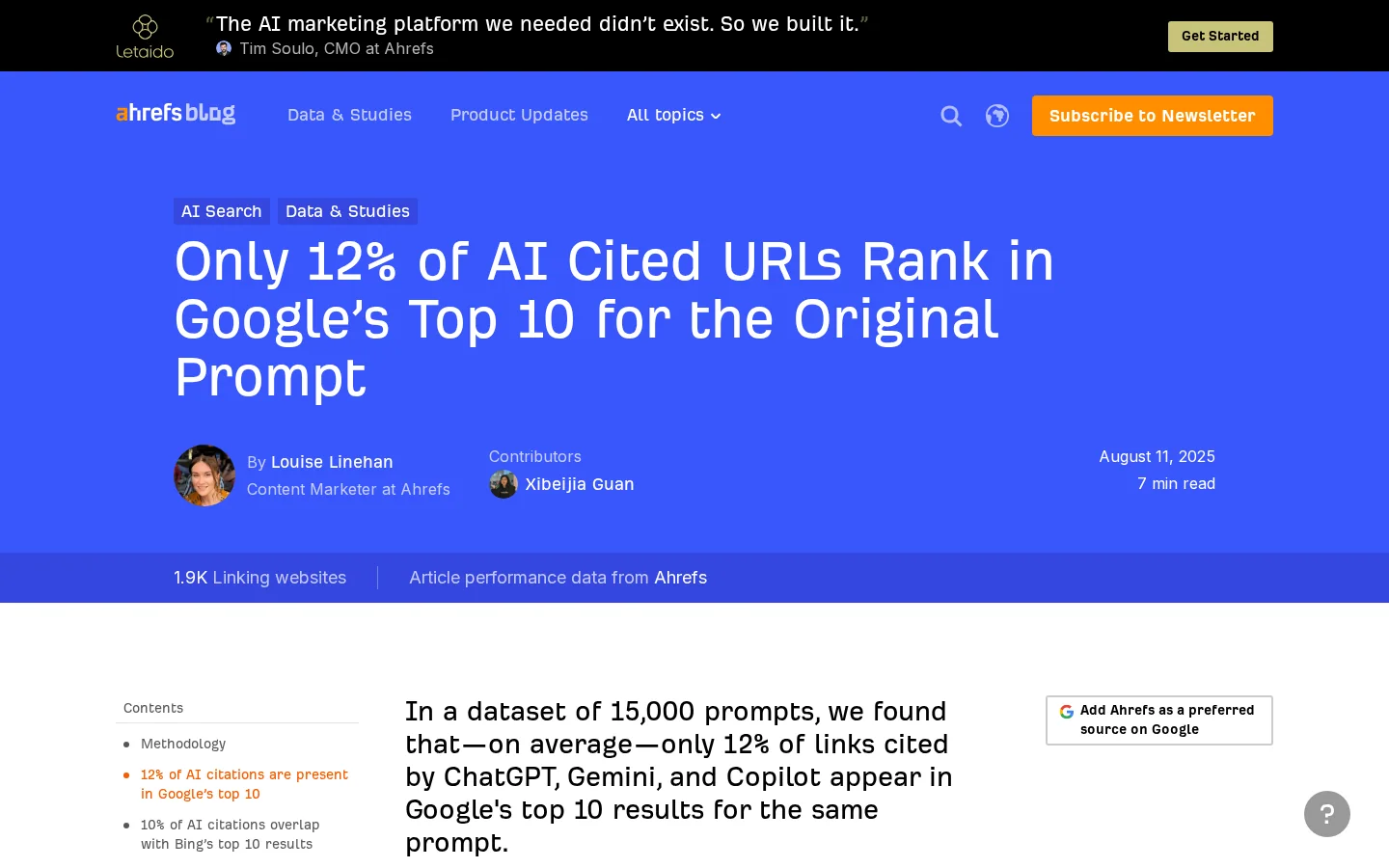
In a study of 15000 prompts, Ahrefs (August 11, 2025) found that about 28.6% of Perplexity's cited URLs ranked in Google's top 10 for the same prompt. Only 12% of the links cited by ChatGPT, Gemini and Copilot did the same. Ahrefs put it this way: "Perplexity is the outlier: nearly 1 in 3 of its citations point to pages that rank in the top 10 for the target query."
The Ahrefs overlap study in three numbers
Source: Ahrefs, AI search overlap study, August 11, 2025
The study compares the URLs each tool cited with Google's top 10 for the same prompt. It does not say which tool gives better answers, and it does not measure whether the cited pages were correct. Its data is one year old at the time of writing, and answer engines change often. Later studies use different methods and query sets, so their percentages do not line up with this one. Read any single figure as a snapshot, and use the study to decide what to test, not what to believe.
If you want to see how the same question plays out across Sorank's own citation data, the AI citation comparison page lays out which platform gets cited more, with its method. Use it for the method and the questions it asks, and check the current numbers on the page itself.
You don't need to rely on a study's figure. Take the prompts from your log, check where your pages rank on Google for each prompt, and compare that list with the URLs each tool cited in the same run. Count how many cited URLs also appear in Google's top 10 for that prompt, and divide by the total number of cited URLs. The result is your overlap figure, for your market and your questions. It will be noisy with a small list, so the first run is a baseline, not a conclusion. Repeat it across weeks, and note any prompt where a cited page ranks outside the top 10, because those are the pages that show the tools reach beyond Google.
If Perplexity's citations sit close to Google's top 10, a page that already ranks well has a better chance of being cited there. The other side of the data matters more for most sites. About 88% of the links that ChatGPT, Gemini and Copilot cited were outside the top 10 for the same prompt. Those tools cite pages you may not expect, so a page at position 15 can still be cited. A good ranking is useful, but it is not a visibility plan on its own. You need to test the answers.
No tool is reliably more accurate on every question, and OpenAI says the same about its own search: "Search results and citations can be incomplete, outdated, or incorrect." Many comparison articles quote accuracy percentages with no source behind them. Do not use those figures in a decision. Treat both tools as a fast way to find sources, not as a source in their own right. A citation is only useful when the linked page says what the answer says it says.
Bad citations usually come from one of three patterns, and you can check each one. The page is outdated for the question. The page mentions the topic but does not support the specific claim. Or the answer blends several sources into one sentence that no single source says. The third pattern is the hardest to spot, because the sentence looks well supported.
Run this check on any claim you plan to publish, quote or pay for:
Warning
A number that appears in an AI answer but not on the cited page is an error, not a finding. Do not copy it into your article or deck.
Before you publish an AI-sourced claim
Use Perplexity when you want to read the sources behind an answer quickly. Use ChatGPT when the job is to draft, plan or work through a problem in a longer conversation. The split is a starting point, not a rule. Run your own questions through both tools and keep whatever helps.
| Job | Start with | Why | Still check |
|---|---|---|---|
| Checking a statistic before you publish | Either tool, then the source page | Both can cite something outdated or misread | The original study, its date and its sample |
| Finding sources on a niche topic | Perplexity | Its answers are built around the sources it lists | Whether each source is recent and on topic |
| Drafting an outline or a plan | ChatGPT | It works as a general assistant across longer tasks | Every fact, which still needs a source |
| Following your brand in AI answers | A tracking tool | A single chat leaves no record and varies from run to run | The prompts used, the dates and the sources cited |
Where each tool fits in your work
Write a fixed list of 20 to 30 questions your buyers ask, run each one in both tools on the same day, and log whether your brand is named and which URLs are cited. Repeat the same list every week. A single test only shows what happened once.
Mix three kinds of question: category questions ("best ... for ..."), problem questions ("how do I ..."), and comparison questions ("X vs Y"). Keep each wording exactly the same every time. Then a change in the answer means a change in the engine, not a change in your question.
Example
"What is the best accounting software for a freelance designer?" and "How do I track invoices without an accountant?" are the kinds of questions a buyer types. Put each one in the list exactly as written.
Open a new chat for each prompt, so earlier messages don't shape the answer. Keep the account, the country setting and the model the same for every run, and note the date. If you run the tests from a logged-in workspace or a browser extension, record that too, since it can change the results.
Use one row per prompt and per tool. Paste this header into a spreadsheet, then fill one row for each run:
date,engine,prompt,brand_named,position_in_list,cited_urls
YYYY-MM-DD,ChatGPT,"your exact prompt",yes or no,position or blank,cited URLs separated by spaces
YYYY-MM-DD,Perplexity,"your exact prompt",yes or no,position or blank,cited URLs separated by spaces
Keep brand_named and cited_urls in separate columns. A brand name in the answer and a link to your site are two different results.
Run the same list each week for at least four weeks before you call something a trend. AI answers change, and a single week can be noise. Read the piece on AI search volatility before you decide that a change is real.
Tip
For a first reading, run one prompt through the free ChatGPT visibility checker and the Perplexity ranking checker, then build the full list. For a monthly record, Sorank's AI mention tracking runs your prompts in ChatGPT, Claude and Gemini and keeps the sources each answer cites. It does not track Perplexity, so keep that column in your own log.
Sort your findings into three groups. Prompts where you are named and cited are working, so protect those pages from unplanned edits. Prompts where you are named but no page of yours is cited point to a page that needs a clearer, sourced answer. Prompts where you are not named at all point to a gap in coverage, which usually means a missing page for that question rather than a problem with an existing one. Change one group at a time, then check the same prompts a few weeks later so you can see what the change did.
The testing loop
Put a direct answer near the top of every page that targets a question. State each claim with its number, its source and its date. Make sure the page ranks for the query a buyer would send to Google, because Perplexity's citations overlap more with Google's results. ChatGPT also needs the page to answer the narrower query it actually searches, so both engines reward clear, specific answers.
The Ahrefs data shows Perplexity's citations sitting closer to Google's top 10, so a page that already ranks for the question is your first lever. Work on the query, the title and the body the way you would for Google, then check which pages Perplexity cites. The step-by-step for that engine is in how to rank in Perplexity.
ChatGPT searches for narrower versions of the question, so a page needs a clear answer for one use case, not a general overview. Name the product, the audience and the constraint in the first paragraph. A broad page that covers ten topics is often harder to match to a rewritten query than a page that answers one. The wider approach is in AI visibility optimization.
Give each section the answer first, then the detail. Use a question as the heading when that is what buyers type. Use a table when you compare, and a short list when you give steps. Sorank's GEO optimization page covers this work for ChatGPT, Claude and Gemini.
A page section, before and after
The most common mistakes are testing once, reading a citation as a ranking, and assuming that one engine's answer predicts the other's. Each one produces a confident-looking result that does not hold up when you check it.
| Mistake | How to spot it | How to fix it |
|---|---|---|
| Testing one prompt once | Your conclusion rests on a single screenshot with no repeat | Use 20 to 30 prompts, repeated every week |
| Treating a citation as a ranking | You report "cited by ChatGPT" as if it meant "ranks first" | Log mentions, citations and position separately |
| Assuming the engines agree | A Perplexity result is used to predict ChatGPT | Log each engine in its own column |
| Using old study numbers as current | The percentage has no date beside it | Quote the date, and re-check the source before you decide |
| Counting a brand name as a citation | Your name appears in the answer, but no link to your site does | Keep brand_named and cited_urls as two fields |
This is a conclusion drawn from one run. You spot it when you have a single screenshot and no date, or when your report says "ChatGPT doesn't mention us" after one question. Fix it with a fixed list run over several weeks. Answers vary between runs and over time, so one run tells you what happened that day, nothing more.
A citation means the answer used your page. It does not mean your page ranks first, and it does not mean the answer recommended you. The Ahrefs data shows that most of the links these tools cite sit outside Google's top 10 for the same prompt. That is one more reason to log citations and rankings in separate columns.
This is the belief that a page ranking on Google will be cited by ChatGPT. You spot it when your visibility report has one column for "AI" and no engine split. Fix it by logging each engine separately, and check the ChatGPT column even when your Google position is good. In the Ahrefs data, the overlap with Google is higher for Perplexity than for ChatGPT, Gemini and Copilot taken together, so one column cannot describe both.
You quote a percentage from a study without its date, or with no sample size next to it. Fix it by putting the date beside every number, and re-measuring before you make a decision. The Ahrefs study used here is dated August 11, 2025, and answer engines change, so treat it as a starting point for your own test.
These are the three questions that come up most, with short answers. The list at the end is what to do this week.
Neither tool is reliably more accurate in every case, and OpenAI warns that ChatGPT search results and citations can be incomplete, outdated, or incorrect. Open the cited source before you rely on any answer.
More often than ChatGPT does, according to the Ahrefs study. About 28.6% of Perplexity's cited URLs ranked in Google's top 10 for the same prompt, against 12% for ChatGPT, Gemini and Copilot combined.
Write 20 to 30 questions your buyers ask, run each one in both tools, and record whether your brand is named and which URLs are cited. Repeat the same prompts every week, because answers change.
This week
For a broader audit across ChatGPT, Gemini and Perplexity, the AI visibility audit guide walks through the full process.
Neither tool is reliably more accurate in every case, and OpenAI warns that ChatGPT search results and citations can be incomplete, outdated, or incorrect. Open the cited source before you rely on any answer.
More often than ChatGPT does, according to the Ahrefs study. About 28.6% of Perplexity's cited URLs ranked in Google's top 10 for the same prompt, against 12% for ChatGPT, Gemini and Copilot combined.
Write 20 to 30 questions your buyers ask, run each one in both tools, and record whether your brand is named and which URLs are cited. Repeat the same prompts every week, because answers change.
We analyse your competitors, your website and your AI visibility to create a tailored content plan for free.
 Website Value Calculator
 Website Accessibility Checker
 Google Analytics Checker
 Duplicate Content Checker
 Mobile-Friendly Test
 Website Speed Test
 Subdomain Finder
 Domain Age Checker
 CMS Detector
 Googlebot Simulator
 Nofollow Link Checker
 Meta Tag Checker
 Keyword Cannibalization Checker
 Keyword Intent Checker
 Keyword Extractor
 Google Ads Cost Calculator
 CPC Calculator
 Local Citation Finder
 Reddit Threads Finder
 Disavow File Generator
 Redirect Generator
 Canonical Tag Generator
 Passive Voice Checker
 Google Location Changer
 Google Review Calculator
 Google Review Link Generator
 Keyword Combiner
 Podcast Show Notes Generator
 AI Content Rewriter
 AI Text Humanizer
 ChatGPT Prompt Generator
 Twitter Thread Generator
 Tweet Generator
 Landing Page Copy Generator
 Google Ads Copy Generator
 Pinterest Pin Description Generator
 Anchor Text Generator
 Social Media Post Generator
 LinkedIn Post Generator
 Free AI Writer
 Review Response Generator
 LSI Keyword Generator
 YouTube Video Ideas Generator
 YouTube Tag Generator
 YouTube Description Generator
 Product Description Generator
 CTA Generator
 Blog Introduction Generator
 Conclusion Generator
 Hook Generator
 AI Content Brief Generator
 FAQ Schema Generator
 AI Blog Post Ideas Generator
 Structured Data Validator (Schema Validator)
 Alt Text Checker
 Internal Link Analyzer
 Backlink Challenge
 AI Meta Description Generator
 AI Blog Title Generator
 Google Indexability Checker
 AI Blog Outline Generator
 UTM Link Builder
 Keyword Clustering Tool
 Canonical Tag Checker
 XML Sitemap Generator
 Broken Link Checker
 AI SEO Title Generator
 Headline Analyzer
 SERP Preview Tool
 Redirect Checker
 Hreflang Tag Generator
 Heading Structure Analyzer
 HTTP Headers Checker
 Favicon Extractor
 SERP CTR Calculator
 SEO vs Paid Search Savings Calculator
 SEO Share of Voice Calculator
 SEO ROI Calculator
 SEO Traffic and Revenue Forecast Calculator
 SEO Budget Calculator
 SEO Break-Even Calculator
 SaaS SEO ROI Calculator
 ROAS Calculator
 Reading Time Calculator
 Ranking Gain Simulator
 Organic Traffic Value Calculator
 Organic Traffic Estimator and Website Traffic Checker
 LTV to CAC Ratio Calculator
 Local SEO ROI Calculator
 Link Building Cost Calculator
 Keyword Value Calculator
 Keyword Opportunity Score Calculator
 Keyword Density Calculator
 GEO ROI Calculator
 GEO Content Investment Calculator
 Ecommerce SEO ROI Calculator
 Customer Lifetime Value Calculator
 Customer Acquisition Cost Calculator
 CTR Calculator
 Cost Per Article Calculator
 Conversion Rate Calculator
 Content Marketing ROI Calculator
 ChatGPT Referral Traffic Estimator
 Bounce Rate Calculator
 Backlink ROI Calculator
 AI Visibility Score Calculator
 AI Traffic Value Calculator
 AI Share of Voice Calculator
 Cost of AI Invisibility Calculator
 AI Citation Rate Calculator
 llms.txt Validator
 AI Overview Checker and AI Overviews Rank Checker
 Robots.txt Checker
 AI SEO Audit
 LLM Readability Checker
 SearchGPT Readiness Checker
 Structured Data LLM Audit
 Website Crawlability AI Audit
 Why ChatGPT Is Not Recommending My Website
 Gemini Ranking Tool
 Perplexity Ranking Checker
 LLM Citation Checker
 Answer Engine Optimization Audit
 GEO Audit
 AI Search Visibility Test
 ChatGPT Visibility Checker
 llms.txt Generator
 URL Extractor
 Webpage to Markdown
 Sitemap Checker
 SERP Volatility Sensor
 Page Size Checker
 Word Counter
 Slug Generator
 Schema Generator
 Robots Generator
 OG Preview
 Meta Tags Generator
 Image Compressor
 Favicon Generator
 On-Page SEO Audit: SEO Checker and SEO Analyzer
 Backlink Analysis Tool
 Keyword Research Tool
 Domain Authority Checker
 “I tested Sorank on a real client site and it's insane. It does everything an agency would bill you $1500 a month for. It's going into production on that client now.”

 Guillaume Guersanguersanguillaume.com“We are an Ads agency and we wanted to get our SEO back on track once and for all. Sorank gave us a clear view of our site, helped us prioritize optimizations, and properly structure our content. The tool is easy to use, well designed for a team, and very practical for centralizing tracking without having to juggle multiple platforms. A very solid foundation to start fresh with our SEO.”
 Gaspard MadouiAds Agency
 “I just let the Sorank software do its thing, and now my DR is 25 and my page is ranking higher.”
 Lucas Flandrefoundertrace.fr“I specialized in GEO thanks to Sorank. The GEO Leaderboard allows me to show my clients their position vs competitors on ChatGPT. It’s a real commercial differentiator.”
 MélanieSEO Freelance“Great service, works well for our website and helps us understand how to improve it to rank better on Google and elsewhere. Congrats, keep going, I recommend it.”
 Hugo T.E-commerce merchant