Preferences
Privacy is important to us, so you have the option of disabling certain types of storage that may not be necessary for the basic functioning of the website. Blocking categories may impact your experience on the website. More information
Privacy is important to us, so you have the option of disabling certain types of storage that may not be necessary for the basic functioning of the website. Blocking categories may impact your experience on the website. More information

Learn the signs of AI writing: overused words, sentence patterns, structure and content gaps, plus a 7-step review method and why AI detectors often fail.
In short
Signs of AI writing are patterns that language models produce more often than people: inflated words like "pivotal" or "showcasing", "not X, but Y" contrasts, tidy groups of three, vague claims without names or dates, and an even, polished tone. No single sign proves anything, and AI detectors make frequent mistakes, so judge clusters of signs and check the facts.
Want to go further? Ask
Quick quiz
How should you use AI in your marketing?
Sorank matches your answers


Test it for 3 days on your own site and see where you stand on Google, ChatGPT and the other AIs.
Start 3-day free trial3 days free, then stop whenever you want. 90-day results guarantee, conditions apply.
Signs of AI writing are habits of vocabulary, sentence shape, structure and content that show up far more often in text from a language model than in text from a person writing in the same genre. They are probabilities, not fingerprints. A human can write "this pivotal moment underscores", and a model can be prompted to write like a tired reporter on deadline.
The habits come from how the models are built. A large language model (an LLM, the engine behind ChatGPT, Claude and Gemini) writes one token at a time and favors likely continuations. That pulls the text toward safe, average phrasing. Then the model is tuned with human feedback to sound helpful, balanced and complete. That second step is where the polish comes from: the summaries, the hedges, the upbeat "importance" language and the neat lists.
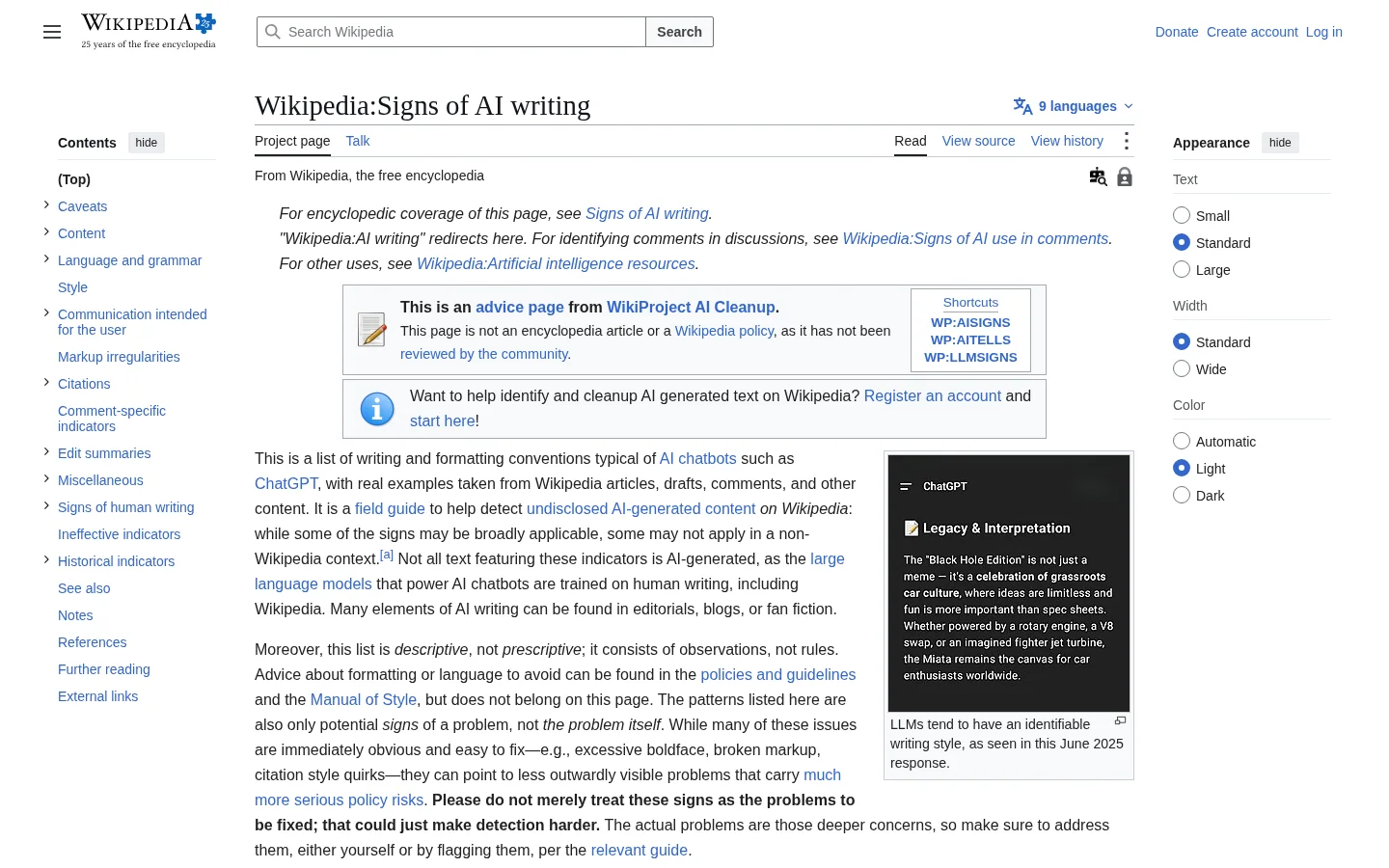
The best public catalogue of these habits is the "Signs of AI writing" guide kept by Wikipedia editors, who clean up machine-written edits every day. The Wikipedia guide (version read in November 2026) sorts the signs into content, language, style, communication with the user, markup and citations, and it opens with a warning: the signs describe typical output, they do not prove authorship, and fixing the surface signs does not fix unsupported or wrong content.
Keep three facts in mind before you go hunting:
The fastest sign to spot is a cluster of words that models overuse. One of them alone is normal English. Four of them in one paragraph is a strong hint.
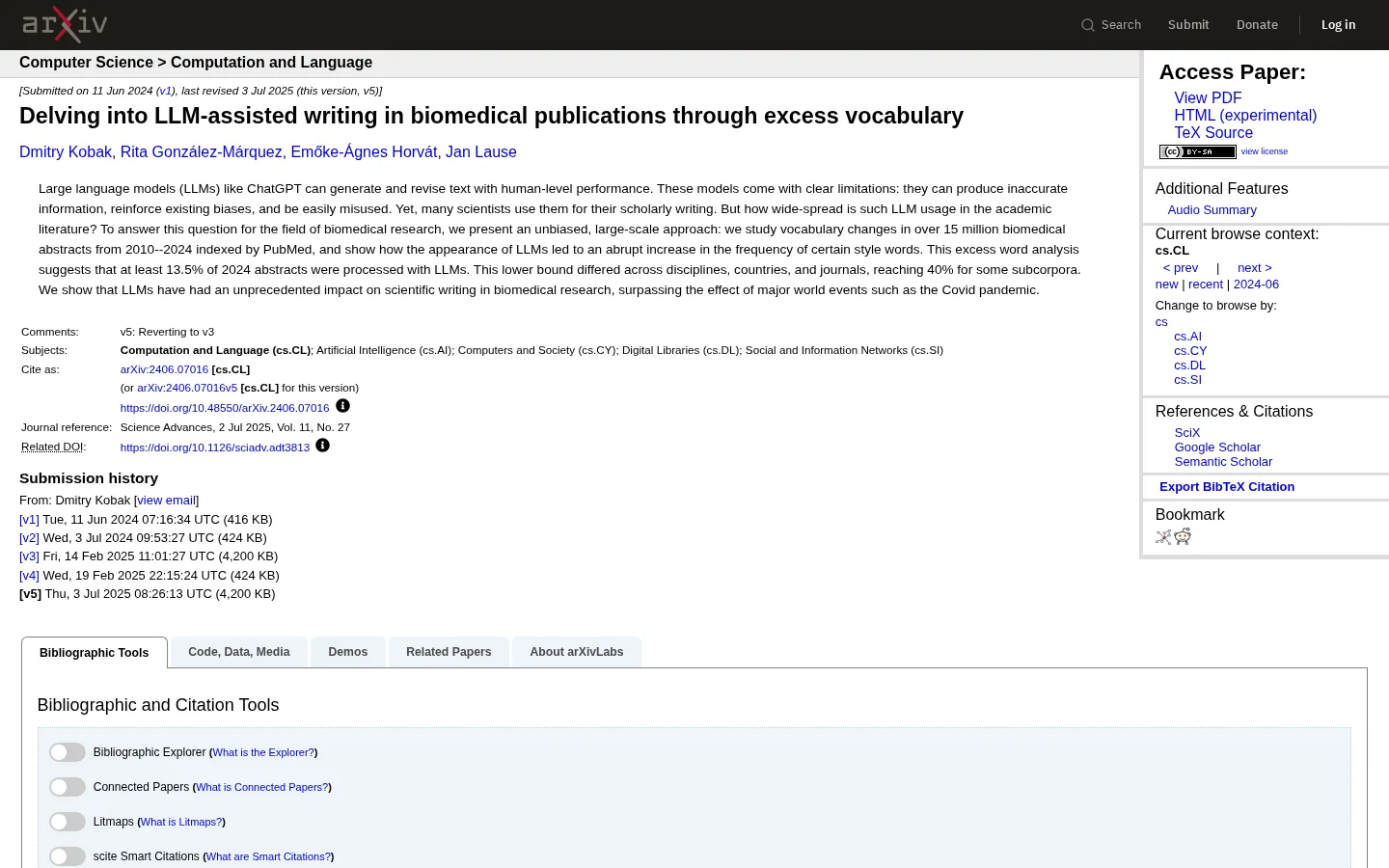
This is not just an impression. In a study published in Science Advances on 2 July 2025, Dmitry Kobak and colleagues analysed more than 15 million PubMed abstracts from 2010 to 2024 and measured which words suddenly became more frequent after ChatGPT came out. They found 379 "style words" with excess use in 2024, 66% of them verbs and 14% adjectives, and estimated that at least 13.5% of 2024 abstracts were processed with an LLM. The jump for some words was huge.
Group the words by the job they do. It makes them easier to see when you read.
Each generation has its own tics. The Wikipedia guide tracks them by period, and the drift is why old checklists age fast. "Delve" was the joke of 2023. By mid-2026 the guide lists words such as "challenge", "leverage", "multifaceted", "prioritize", "quietly" and "universally", plus more full stops, more commas and shorter sentences.
How the AI vocabulary has shifted
You do not need a paid tool to count them. Save the text as a plain file and run this on Mac or Linux. It lists every match with its count, so you see clusters at a glance.
grep -oiE "\b(delv(e|es|ing)|tapestry|testament|pivotal|crucial|underscor(e|es|ing)|showcas(e|es|ing)|foster(ing)?|intricate|meticulous(ly)?|vibrant|garner(ed)?|align(s)? with|landscape|multifaceted|leverag(e|es|ing)|serves as|stands as|nestled|robust|seamless(ly)?)\b" draft.txt | tr 'A-Z' 'a-z' | sort | uniq -c | sort -rnRead the result as a density, not a verdict. Ten hits in a 3000-word technical guide may be normal. Ten hits in a 300-word product description is a lot. Compare with a few pages you know a person wrote on the same subject.
Beyond single words, models repeat a handful of sentence shapes. These are often more reliable than vocabulary, because writers who edit AI text usually swap the words but keep the shapes.
The model corrects a misconception nobody had. "It's not just a tool, it's a partner." "This isn't about speed. It's about trust." "No fluff, no jargon, just results." One of these is a rhetorical choice. One per paragraph is a pattern.
Lists of three adjectives or three nouns, used for rhythm rather than meaning: "fast, reliable and scalable", "clarity, consistency and confidence". Check whether each of the three items says something the others do not. Often the third is filler.
A sentence states a fact, then adds a comma and a participle that tells you what the fact means: "The company opened a second office in Lyon, highlighting its commitment to growth." The tail adds an interpretation with no evidence. The Wikipedia guide calls this "superficial analysis".
People write "the museum is in Lyon" and "the app has a dark mode". Models prefer "the museum stands as a cultural landmark nestled in Lyon" and "the app boasts a dark mode". Replacing plain verbs with "serves as", "stands as", "represents", "features" or "boasts" is a classic tell.
"While X has many benefits, it also comes with challenges." "It's important to note that results may vary." Every claim gets a cushion. A person with real experience usually commits: "This works for stores under 500 products. Above that, use a feed."
For three years the em dash was the most quoted sign of AI writing. That advice is now out of date. According to the Wikipedia guide, the newest models have been tuned to avoid the em dash almost entirely since around September 2026, and the side effect is a new sign: text made only of commas and full stops, with fewer colons, parentheses or semicolons than a person would use. The same guide reports a July 2026 study in which, among recent models, only Claude used em dashes more than professional writers, while ChatGPT used them less. Curly quotes in a text where the rest of the site uses straight quotes can also betray a paste from a chat window.
The same paragraph, model style and human style
The rewrite is not better because it avoids certain words. It is better because it contains facts only someone who went there could know. That is the deeper sign, covered below.
Structure signs show up when you look at the whole page rather than one sentence. They are the easiest to see from a distance, and the easiest to fake, so treat them as supporting evidence.
Sentences of similar length, paragraphs of similar length, sections of similar length. Human writing is bumpy: a long sentence with three clauses, then a short one. Researchers call this variation "burstiness". You can measure it roughly with a few lines of Python, which give the average sentence length and how much it varies.
import re, statistics

text = open("draft.txt", encoding="utf-8").read()
sentences = [s for s in re.split(r"(?<=[.!?])\s+", text) if s.strip()]
lengths = [len(s.split()) for s in sentences]
mean = statistics.mean(lengths)
sd = statistics.pstdev(lengths)
print(f"{len(sentences)} sentences, mean {mean:.1f} words, sd {sd:.1f}, variation {sd / mean:.2f}")
There is no universal threshold. Run the script on the suspect text and on two or three texts of the same genre you know a person wrote. A much lower variation in the suspect text is one more clue, nothing more.
Tip
No terminal at hand? Paste the text into the free word counter for SEO writers to see word, sentence and paragraph counts, then compare the averages with a page you wrote yourself.
A definition first, then "Key benefits", "Challenges", "Best practices", "Future outlook" and a "Conclusion" that restates everything. The Wikipedia guide notes that "Challenges and future prospects" sections and "Awards and recognition" headings are almost standard in machine-written biographies and company pages.
| Sign | Example | Strength on its own | What to check next |
|---|---|---|---|
| Chatbot leftovers | "I hope this helps", "as of my last knowledge update", "oaicite" | Strong | Was the text pasted from a chat window without review? |
| Fake or broken citations | DOI that leads to an unrelated paper, link that returns 404 | Strong | Open every source and read the cited passage |
| Vocabulary cluster | "pivotal", "testament", "showcasing" in one paragraph | Medium | Density compared with human pages on the same topic |
| Negative parallelism | "It's not X, it's Y" repeated | Medium | How many times per page? |
| Template outline | Benefits, Challenges, Future outlook, Conclusion | Weak to medium | Does each section say something specific? |
| Uniform rhythm | Every sentence 15 to 20 words | Weak | Sentence length variation versus a human baseline |
| Perfect grammar | No typo in 3000 words | Very weak | Ignore it: many people write cleanly |
The strongest signs are not in the style. They are in the content: what is missing, what is vague and what is made up. These are also the signs that matter most to a reader, a client or Google.
No names, no dates, no prices, no numbers from a real project, no place you could visit. "Many businesses have seen great results" instead of "a 12-person plumbing firm in Leeds doubled its calls in four months". Generic advice that would fit any company in any country is the clearest sign that nobody with experience was involved.
"Experts argue", "industry reports suggest", "studies show", "observers have noted". If the text cites authority without naming it, ask which expert and which report. Models produce these phrases because they sound sourced.
Citations that look correct but point nowhere: a DOI that resolves to an unrelated article, a book without page numbers, a link to a search results page, or a link carrying "utm_source=chatgpt.com" that shows where it was copied from. Our guide on how to fact-check AI content before you publish it walks through checking each claim.
Enthusiastic, balanced and polite in every paragraph. No irritation, no joke that lands badly, no strong opinion, no admission of "we tried this and it failed". Real experts have favorites and grudges.
The most embarrassing sign and the only near-certain one: "Certainly! Here is a blog post about...", "I hope this helps", "Would you like me to...", "as an AI language model", placeholder text like "[insert date]", or exposed markup such as "contentReference[oaicite:1]". These mean the text was pasted without being read.
Content red flags to check in any text
Several popular "tells" do more harm than good. The Wikipedia guide lists them as ineffective indicators, because they lead to false accusations.
On the other side, some traits point toward a human. Text published before 30 November 2022, the launch date of ChatGPT, can be ruled out. Plain verbs ("wrote" rather than "authored"), definite statements ("was the first"), small wordy habits ("in order to") and a writer who can explain why they chose each sentence are all good signs of a person at the keyboard.
Weak signals vs stronger signals
There are five broad methods to judge whether a text came from a model. Each answers a slightly different question, and none is enough alone.
Principle: a trained reader looks for the clusters described above. When to use it: always, as the first pass. Advantages: free, explains its reasons, works on any language you read well. Limits: slow, depends on the reader. Example: an editor flags a guest post with four "-ing" tails, two "not X but Y" lines and no named example.
Trained readers can be very good. In a study accepted at ACL 2025, Jenna Russell, Marzena Karpinska and Mohit Iyyer asked annotators to label 300 non-fiction articles. A majority vote of five people who often use LLMs for writing misclassified only 1 of the 300, and did better than most commercial and open-source detectors they tested, even on paraphrased or "humanized" text. Readers who rarely use these tools did much worse.
Principle: measure how predictable each word is for a language model (its log-probability) and how much sentence length varies. Text that is very predictable and very even scores as "AI". When to use it: research, large batches. Advantages: fast, no training data needed. Limits: famous human texts with a formal, predictable style score as AI, and so do writers with a limited vocabulary. Example: a scoring script flags a legal notice that a lawyer wrote by hand.
Principle: a model trained on labeled human and AI text outputs a probability. Commercial detectors work this way. When to use it: as a second opinion on long texts. Advantages: instant, sentence-level highlighting. Limits: unreliable on short texts, beaten by paraphrasing, blind to models they were not trained on, biased against non-native writers (see the next section). Example: a 200-word product description gets 80% "AI" one day and 30% the next after small edits.
Principle: the model provider hides a statistical pattern in the words it chooses, which its own tool can later detect. Google does this with SynthID for its Gemini models. When to use it: when you know which provider might have produced the text and it offers a checker. Advantages: much more precise than guessing from style. Limits: only works for that provider's output, and heavy rewriting weakens the pattern. Example: a platform checks uploads for one provider's watermark and finds nothing, which says nothing about other models.
Principle: look at how the text was made rather than at the text: version history in Google Docs, drafts, notes, the time spent, and a conversation with the author. When to use it: any decision with consequences (a grade, a contract, a firing). Advantages: the fairest method, and the only one that can clear someone. Limits: needs access and time. Example: a writer shows a document history with 40 sessions of edits over two weeks.
| Method | Best for | Speed | Main weakness | Can it prove AI use? |
|---|---|---|---|---|
| Reading for signs | Editors, clients, teachers | Minutes per text | Depends on the reader's experience | No, it builds a case |
| Statistical scoring | Research, large batches | Seconds | Flags formal and non-native writing | No |
| Trained classifiers | Second opinion on long texts | Seconds | False positives, easy to evade, weak on short texts | No |
| Watermarking | Output from one known provider | Seconds | Covers one provider only | Close to it, for that provider |
| Process evidence | Any decision with consequences | Hours | Needs access to drafts and the author | It is the best evidence either way |
AI detectors give a probability, not proof, and their errors are large enough to hurt real people. Three facts make the case.
First, the maker of ChatGPT gave up on its own detector. OpenAI withdrew its AI classifier on 20 July 2023, "due to its low rate of accuracy". On OpenAI's own challenge set, it caught 26% of AI-written text and wrongly labeled 9% of human text as AI. OpenAI also wrote that it was "very unreliable" on texts under 1000 characters.
What the tests show
Sources: OpenAI, AI classifier update, July 2023; Russell, Karpinska and Iyyer, ACL 2025
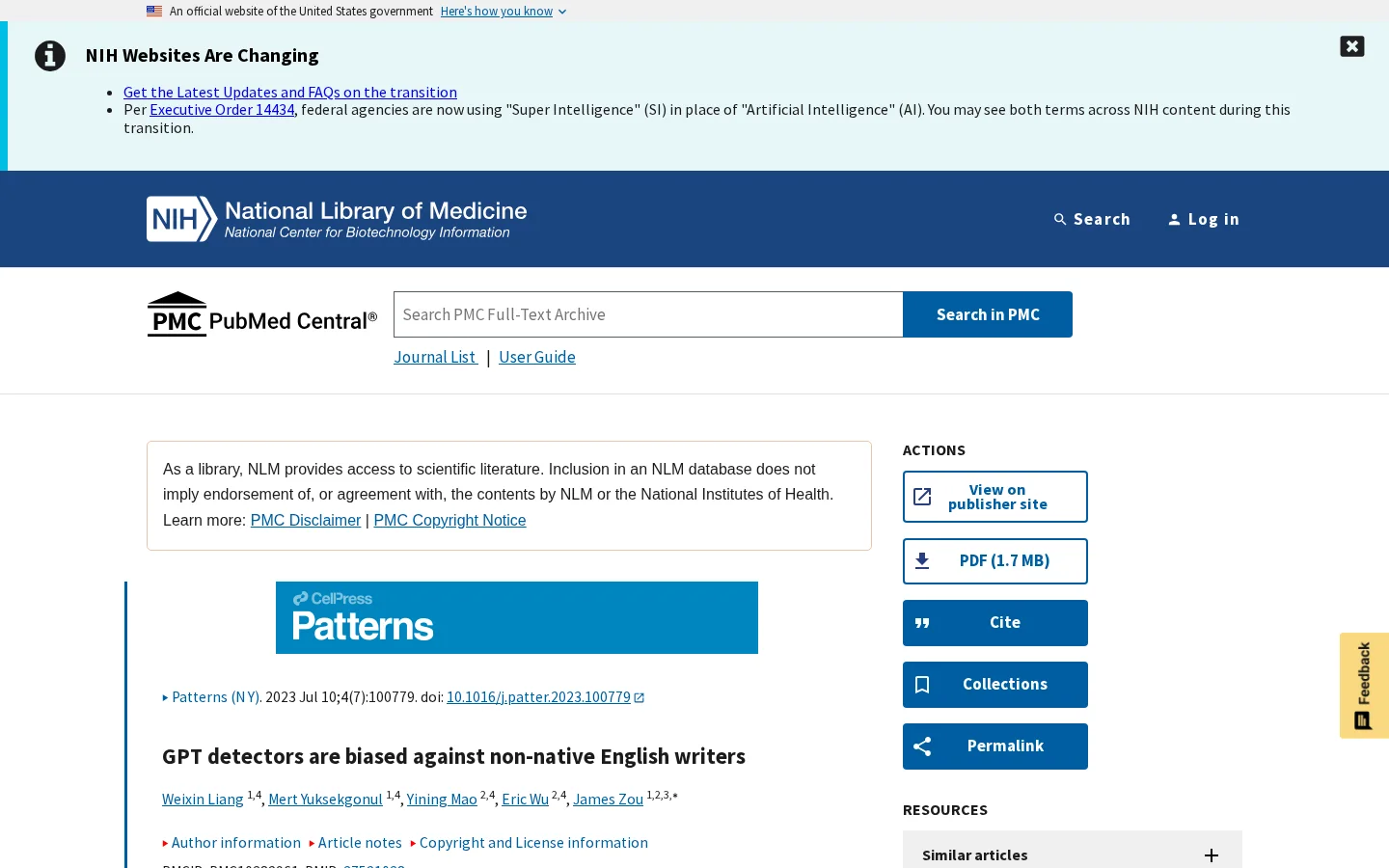
Second, detectors punish people who write in a second language. In a study published in Patterns on 10 July 2023, Weixin Liang, James Zou and colleagues at Stanford ran seven popular detectors on 91 TOEFL essays written by humans. The detectors were near perfect on essays by US eighth graders, but labeled the TOEFL essays as AI 61.3% of the time on average. The reason: writers with a smaller vocabulary produce more predictable text, which is exactly what the detectors look for.
Human TOEFL essays flagged as AI by seven detectors
Source: Liang et al., Patterns, July 2023
Third, detectors are easy to fool in the other direction. The same Stanford team showed that asking a model to use more varied language helped AI text slip past the detectors. Paraphrasing tools and light manual edits do the same. The result is the worst of both worlds: careful human writers get flagged and careless AI users who run a "humanizer" pass.
So use a detector, if at all, as one weak signal among others, on long texts only, and never as the sole basis for a decision about a person. Our glossary entry on how AI content detection works explains the scoring methods in more depth.
This is the method we recommend for an editor, a client reviewing a supplier, or a manager reading a guest post. It takes 10 to 20 minutes for a 1500-word article and gives you reasons you can explain, not a score.
The 7-step review method
This command finds the phrases that only appear when someone pasted a chat answer without reading it. Any match is worth a look.
grep -niE "as an ai language model|as of my last (knowledge|training) update|i hope this helps|certainly!|would you like me to|let me know if|\[insert|oaicite|contentreference|utm_source=chatgpt" draft.txtTake one section and list every concrete detail: a proper name, a date, a price, a measurement, a quote, a place, a result from a real project. Divide by the number of paragraphs. You will quickly see the difference between a page written from experience and a page written from the average of the web. This is also how Google frames quality: its E-E-A-T framework for experience, expertise, authoritativeness and trust rewards first-hand detail, whoever typed the words.
Ask open questions: "Where did this number come from?", "Why did you pick this example?", "What would you cut if the piece had to be half as long?". A person who wrote the text, or who seriously edited an AI draft, can answer. This step protects you from the false positives described above.
Most mistakes come from treating a probability as proof. Here are the ones we see most, with how to spot and fix each.
What it is: calling a text AI because it contains "delve" or one em dash. How to spot it: you can name only one reason for your suspicion. How to fix it: list at least three signs from different families (vocabulary, sentence shape, content) before you form an opinion.
What it is: treating "87% AI" as a fact. How to spot it: the decision rests on a screenshot of a detector. How to fix it: run two detectors and see them disagree, then go back to reading and process evidence. Never act on a score for a text under 1000 characters.
What it is: hunting for em dashes and "delve" in 2026 text. How to spot it: your list of signs was written before the latest models. How to fix it: check the dated sections of the Wikipedia guide every few months and update your word scan.
What it is: flagging plain, careful or repetitive English from someone writing in a second language, or from a lawyer or scientist who writes formally. How to spot it: your suspicion rests on "predictable" or "flat" style rather than on missing specifics or fake sources. How to fix it: weigh content signs and process evidence above style signs for these writers.
What it is: running a "humanizer" or swapping "pivotal" for "important", while the text still says nothing specific. How to spot it: the page passes a detector but you cannot find one fact you did not know. How to fix it: add real data, examples and opinions. The Wikipedia guide makes the same point: removing surface signs does not fix the underlying problem.
What it is: reading the citations as decoration. How to spot it: you have not clicked a single link. How to fix it: open every source. Invented citations are among the strongest signs, and a wrong fact hurts you whoever wrote it.
| Mistake | Risk | Quick fix |
|---|---|---|
| Single-sign judgment | False accusation | Three signs from three families |
| Trusting a detector | Unfair decision, missed AI text | Use it as one weak signal, long texts only |
| Old checklist | Looking for signs that faded | Review the list every few months |
| Bias against non-native writers | Punishing the wrong people | Favor content and process evidence |
| Cosmetic fixes | Empty content that still fails readers | Add facts, examples and opinions |
| Unchecked sources | Publishing invented facts | Click and read every citation |
Google does not rank text down for being written by AI. It ranks down text that is unhelpful or made to manipulate rankings. In its guidelines on Search Essentials, spam policies and AI content, Google says it rewards quality "rather than how content is produced", and treats mass-produced content made mainly to rank as spam. Our analysis of whether Google penalizes AI-generated content covers the ranking data in detail.
The signs still matter, for two reasons. Readers notice them and trust the page less. And the signs usually come with the real problem Google cares about: generic content without experience. A page full of "pivotal" and "seamless" rarely contains the specifics that make helpful, people-first content and that AI models such as ChatGPT and Gemini like to quote.
The fix is upstream, not a cosmetic pass at the end:
This is the approach behind Sorank. Its brand voice feature writes AI articles in your tone and with your words, and its content optimization rewrites and updates your older pages on autopilot. If you edit by hand, our guide on how to humanize AI text gives rewrite techniques sentence by sentence, and the comparison of AI content and human content shows where each one wins.
Before you publish an AI-assisted page
Start today with one page: run the two commands from this guide on your last published article, mark the sentence shapes, and count the specifics per section. You will know in 15 minutes whether it reads like you or like the average of the web, and exactly what to change.
The most common signs are clusters of inflated words (pivotal, testament, showcasing), "not X, but Y" contrasts, groups of three, trailing "-ing" clauses and an even, polished tone. The strongest signs are in the content: no names, dates or numbers, vague "experts say" claims, invented sources and leftover chatbot phrases.
Not enough to prove anything. OpenAI withdrew its own classifier in July 2023 because it caught only 26% of AI text and flagged 9% of human text, and a Stanford study found detectors labeled human essays by non-native writers as AI 61.3% of the time on average. Use them, at most, as one weak signal on long texts.
Google does not penalize text for being written by AI; it targets unhelpful content and content mass-produced to manipulate rankings. Pages full of AI tics often lack first-hand detail, though, and that is what costs them rankings and reader trust.
We analyse your competitors, your website and your AI visibility to create a tailored content plan for free.
 Website Value Calculator
 Website Accessibility Checker
 Google Analytics Checker
 Duplicate Content Checker
 Mobile-Friendly Test
 Website Speed Test
 Subdomain Finder
 Domain Age Checker
 CMS Detector
 Googlebot Simulator
 Nofollow Link Checker
 Meta Tag Checker
 Keyword Cannibalization Checker
 Keyword Intent Checker
 Keyword Extractor
 Google Ads Cost Calculator
 CPC Calculator
 Local Citation Finder
 Reddit Threads Finder
 Disavow File Generator
 Redirect Generator
 Canonical Tag Generator
 Passive Voice Checker
 Google Location Changer
 Google Review Calculator
 Google Review Link Generator
 Keyword Combiner
 Podcast Show Notes Generator
 AI Content Rewriter
 AI Text Humanizer
 ChatGPT Prompt Generator
 Twitter Thread Generator
 Tweet Generator
 Landing Page Copy Generator
 Google Ads Copy Generator
 Pinterest Pin Description Generator
 Anchor Text Generator
 Social Media Post Generator
 LinkedIn Post Generator
 Free AI Writer
 Review Response Generator
 LSI Keyword Generator
 YouTube Video Ideas Generator
 YouTube Tag Generator
 YouTube Description Generator
 Product Description Generator
 CTA Generator
 Blog Introduction Generator
 Conclusion Generator
 Hook Generator
 AI Content Brief Generator
 FAQ Schema Generator
 AI Blog Post Ideas Generator
 Structured Data Validator (Schema Validator)
 Alt Text Checker
 Internal Link Analyzer
 Backlink Challenge
 AI Meta Description Generator
 AI Blog Title Generator
 Google Indexability Checker
 AI Blog Outline Generator
 UTM Link Builder
 Keyword Clustering Tool
 Canonical Tag Checker
 XML Sitemap Generator
 Broken Link Checker
 AI SEO Title Generator
 Headline Analyzer
 SERP Preview Tool
 Redirect Checker
 Hreflang Tag Generator
 Heading Structure Analyzer
 HTTP Headers Checker
 Favicon Extractor
 SERP CTR Calculator
 SEO vs Paid Search Savings Calculator
 SEO Share of Voice Calculator
 SEO ROI Calculator
 SEO Traffic and Revenue Forecast Calculator
 SEO Budget Calculator
 SEO Break-Even Calculator
 SaaS SEO ROI Calculator
 ROAS Calculator
 Reading Time Calculator
 Ranking Gain Simulator
 Organic Traffic Value Calculator
 Organic Traffic Estimator and Website Traffic Checker
 LTV to CAC Ratio Calculator
 Local SEO ROI Calculator
 Link Building Cost Calculator
 Keyword Value Calculator
 Keyword Opportunity Score Calculator
 Keyword Density Calculator
 GEO ROI Calculator
 GEO Content Investment Calculator
 Ecommerce SEO ROI Calculator
 Customer Lifetime Value Calculator
 Customer Acquisition Cost Calculator
 CTR Calculator
 Cost Per Article Calculator
 Conversion Rate Calculator
 Content Marketing ROI Calculator
 ChatGPT Referral Traffic Estimator
 Bounce Rate Calculator
 Backlink ROI Calculator
 AI Visibility Score Calculator
 AI Traffic Value Calculator
 AI Share of Voice Calculator
 Cost of AI Invisibility Calculator
 AI Citation Rate Calculator
 llms.txt Validator
 AI Overview Checker and AI Overviews Rank Checker
 Robots.txt Checker
 AI SEO Audit
 LLM Readability Checker
 SearchGPT Readiness Checker
 Structured Data LLM Audit
 Website Crawlability AI Audit
 Why ChatGPT Is Not Recommending My Website
 Gemini Ranking Tool
 Perplexity Ranking Checker
 LLM Citation Checker
 Answer Engine Optimization Audit
 GEO Audit
 AI Search Visibility Test
 ChatGPT Visibility Checker
 llms.txt Generator
 URL Extractor
 Webpage to Markdown
 Sitemap Checker
 SERP Volatility Sensor
 Page Size Checker
 Word Counter
 Slug Generator
 Schema Generator
 Robots Generator
 OG Preview
 Meta Tags Generator
 Image Compressor
 Favicon Generator
 On-Page SEO Audit: SEO Checker and SEO Analyzer
 Backlink Analysis Tool
 Keyword Research Tool
 Domain Authority Checker
 “I tested Sorank on a real client site and it's insane. It does everything an agency would bill you $1500 a month for. It's going into production on that client now.”

 Guillaume Guersanguersanguillaume.com“We are an Ads agency and we wanted to get our SEO back on track once and for all. Sorank gave us a clear view of our site, helped us prioritize optimizations, and properly structure our content. The tool is easy to use, well designed for a team, and very practical for centralizing tracking without having to juggle multiple platforms. A very solid foundation to start fresh with our SEO.”
 Gaspard MadouiAds Agency
 “I just let the Sorank software do its thing, and now my DR is 25 and my page is ranking higher.”
 Lucas Flandrefoundertrace.fr“I specialized in GEO thanks to Sorank. The GEO Leaderboard allows me to show my clients their position vs competitors on ChatGPT. It’s a real commercial differentiator.”
 MélanieSEO Freelance“Great service, works well for our website and helps us understand how to improve it to rank better on Google and elsewhere. Congrats, keep going, I recommend it.”
 Hugo T.E-commerce merchant