Preferences
Privacy is important to us, so you have the option of disabling certain types of storage that may not be necessary for the basic functioning of the website. Blocking categories may impact your experience on the website. More information
Privacy is important to us, so you have the option of disabling certain types of storage that may not be necessary for the basic functioning of the website. Blocking categories may impact your experience on the website. More information

 Screaming Frog vs
 Semrush: Which SEO Tool Fits Your Work?
Screaming Frog or Semrush? Compare free limits, plan page caps, crawl depth and keyword data, then pick the tool or two-tool setup that fits your site.
In short
Screaming Frog SEO Spider is a desktop crawler that reads every URL on your site and flags technical problems like broken links, redirects, missing titles and duplicate content. Semrush is a cloud platform for keyword research, competitor analysis, rank tracking and site audits. Pick Screaming Frog for page-by-page control of a crawl, Semrush for market data and tracking.
Want to go further? Ask
Quick quiz
Which kind of SEO tool is right for you?
Sorank matches your answers


Test it for 3 days on your own site and see where you stand on Google, ChatGPT and the other AIs.
Start 3-day free trial3 days free, then stop whenever you want. 90-day results guarantee, conditions apply.
Screaming Frog is a crawler you run yourself. It starts from a URL, requests the pages it finds one by one, and stores what it sees: status codes, titles, meta descriptions, headings, canonical tags, redirects, internal and external links, and more. You get one row per URL, and you can export any column to a spreadsheet.
Semrush is a suite built around the questions that come before and after a crawl. Its site audit runs in the cloud and checks many of the same issues, but the platform is mainly about which keywords to target, which competitors take the traffic you want, and whether your positions move over time.
That difference decides most of the choice. If your question is "what is wrong with my pages right now", Screaming Frog answers it in detail. If your question is "what should I write next, and where does this competitor beat me", Semrush answers it with data that a crawler never collects. Neither tool does the other's job well, so the useful comparison is by job, not by a winner.
Screaming Frog runs on your own computer, so the crawl speed, the memory use and the storage are yours to tune. Its user guide lists integrations with Google Search Console and PageSpeed Insights, which add data to each crawled URL. That is useful when you want to see which broken page also lost clicks. It is still not a keyword tool. Search volume, keyword difficulty and the list of queries a competitor ranks for come from somewhere else.
Semrush keeps its audit inside a web app with reports, schedules and project dashboards. That makes it easier to share with a client or a manager who will never open a crawler. The trade-off is that the audit is bound to your plan's page limits, which we cover below, and you see the results it chooses to show you. For a deeper look at what the platform does and where it falls short, read our Semrush review.
Which tool does which job
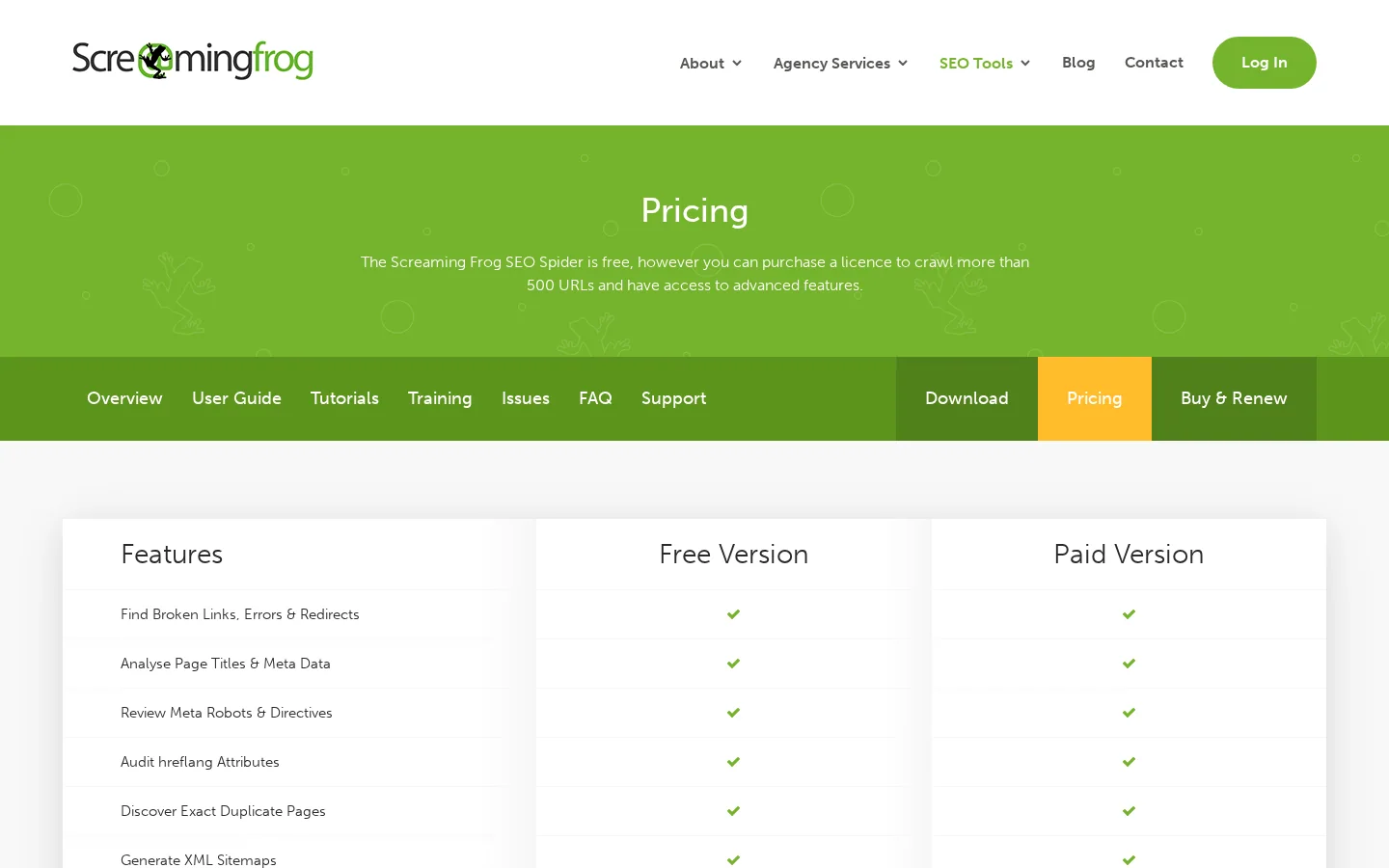
Screaming Frog's free version crawls up to 500 URLs per crawl. Its pricing page, checked on 22 November 2026, lists a paid licence at €245 per user per year, and says licences are per user, last one year and must be renewed. Two things follow. The price is in euros, so a table that lists dollars is either quoting another currency or an old price. And a team that shares one installation needs to read the licence terms before it buys.
The 500 URL cap is the one that surprises people. The free version does not warn you that a large site is partly invisible to it. The crawl just stops at 500 URLs, which is why it suits a small site, a single section, or a first look at a new client. Once the site has more pages than that, the licence is the only way to crawl all of it in one go. The Screaming Frog user guide, configuration section, states that the free version has a 500 URL crawl limit and that a licensed version replaces it with 5 million URLs.
Semrush does not publish one flat price for its tools anymore. The Semrush pricing page, checked on 22 November 2026, lists SEO, Starter, Pro+ and Advanced plans, plus a free plan at $0 that gives 10 reports per day and one demo project. Many guides still quote Pro, Guru and Business prices. Those names and numbers are out of date, and a comparison built on them will be wrong before you read it. Semrush's help centre maps the new names to the older toolkit tiers: Starter includes the Pro SEO Toolkit, Pro+ includes the Guru SEO Toolkit and Advanced includes the Business SEO Toolkit. Read the tier on your own account before you compare numbers.
The free limits and the paid entry point
Sources: Screaming Frog pricing page and Semrush pricing and help centre, all checked on 22 November 2026

Screaming Frog limits the crawl per run, and the cap is set by your licence. Semrush limits the crawl twice: per audit and per month. The two numbers work differently, so compare them in the same unit before you decide. A crawler that reads 5 million URLs in one run and a platform that reads 100000 pages in a month are not measuring the same thing.
Screaming Frog's default is 5 simultaneous requests, which the user guide calls threads, and it has no speed limit per second by default. Those 5 threads keep the load on the server low, and the crawl slows down when the host responds slowly or stops answering. If you crawl a production site during a busy period, lower the thread count in the speed settings before you start. The licence cap of 5 million URLs is a ceiling. In practice, your computer's memory and storage set the real limit, so a very large crawl needs enough RAM.
Semrush's help centre article on how many pages you can crawl in an audit, checked on 22 November 2026, gives the limits below. The article does not carry a publication date, so check your own Site Audit settings before you plan a large project.
| Plan (SEO Toolkit tier) | Pages per audit | Pages per month |
|---|---|---|
| Without SEO Toolkit (free) | 100 | 100 |
| Pro SEO Toolkit (Semrush One Starter) | 20000 | 100000 |
| Guru SEO Toolkit (Semrush One Pro+) | 20000 | 300000 |
| Business SEO Toolkit (Semrush One Advanced) | 100000 | 1000000 |
Unused pages do not carry over, and the monthly budget resets on the first day of each month. Put that into a real example. A 3000 page site fits in one full Pro audit, and the 100000 monthly budget covers about 33 full audits. The same site on the free Semrush plan would need 30 months of monthly budget to crawl once, which is why the free plan is for a quick check, not an audit.
The budget matters because a crawl is only as good as its coverage. Before you run anything, you need to know what the crawler is going to visit, and that is the core idea of crawling: a bot follows links from a starting point and records what it reaches. A crawl that stops early, or spends its budget on duplicate URLs, gives you a clean report about the wrong part of the site.
This section is about the audit logic. For installation and the first run, read our Screaming Frog SEO Spider setup guide. Here we focus on the settings that decide whether the result is worth reading. The steps assume a licence, but the first four also work on the free version when your site has fewer than 500 URLs.
Most bad crawls come from URLs that should not be crawled at all. Faceted navigation and tracking parameters can turn a site of a few hundred pages into a crawl of many thousands of URLs. In Screaming Frog, open Configuration, then Exclude, and enter a regular expression. The expression is matched against the full URL, so anchor it to the part you want to skip. This example skips sort, filter and page parameters:
.*\?(sort|filter|page)=.*Then add a custom extraction when you need data the default fields do not show. This XPath returns every JSON-LD block on a page, which tells you whether your structured data is present in the HTML before any JavaScript runs:
//script[@type="application/ld+json"]Export Response Codes filtered to Client Errors (4xx) and Server Errors (5xx), and open the inlinks for each one. For example, a 404 with 40 internal links pointing at it costs more than a 404 with one link, because the internal links are the paths both users and crawlers follow. Then look at redirects. A redirect chain, where one URL goes to a second URL that goes to a third, slows the crawl and dilutes signals. Shorten each chain so the original URL points straight to the final page. For the full repair method, see our guide on how to fix broken links from crawl to prevention.
The page title and H1 are the first things a reader and a search engine see, so check them in bulk. Filter the Page Titles tab for missing, duplicate and over-long values, then do the same for meta descriptions and H1 tags. Duplicates matter more than length. Two URLs with the same title compete with each other, and the crawl makes that visible in one sort. If a page has no H1, read the template it uses before you edit pages one by one, because the fix is usually in the template.
Tip
To check one page's on-page tags without installing anything, run the free On-Page SEO Audit tool on that URL first, then start the full crawl for the rest of the site.
Screaming Frog reads the raw HTML by default, and it only renders JavaScript when you switch it on in the Rendering tab. If your links or content are added by a script, the raw crawl will show empty titles or missing links. Turn rendering on for the sections that need it, and compare the two crawls. Our JavaScript SEO guide explains which pages usually need it.
Checklist for one crawl
Screaming Frog tells you about the pages you have. Semrush tells you about the searches you could win and the competitors who already win them. Its keyword research tools show volume and related queries, its position tracking follows your rankings for the keywords you choose, and its competitor reports show the terms another domain ranks for that you do not. Those three jobs are outside a crawler's scope.
Use a simple test to pick the starting tool. If you can answer the question from a crawl of your own site, start with Screaming Frog. If the answer depends on search demand or on a competitor's pages, start with Semrush. Most questions that come from a client sit on the second side: "why are we losing to them?" is a competitor question, and a crawl of your own site will not show you their keywords.
The table below sorts the common jobs. It is a guide to fit, not a score, and the details depend on your plan.
| Job | Screaming Frog | Semrush |
|---|---|---|
| Crawl every URL and read its status code | Yes, on your computer, within the licence limit | Yes, in the cloud, within pages per audit and per month |
| Find keyword ideas and search volume | No | Yes |
| Follow rankings over time | No, it only adds Search Console data to each crawled URL | Yes, through position tracking |
| See the keywords a competitor ranks for | No | Yes |
| Run the crawl with your own rules and extraction | Yes, with regex, XPath and custom settings | Set in the Site Audit settings of the app |
Our Semrush and SpyFu comparison covers the competitor side in more depth, so read it if your question is about rival keywords rather than your own pages.
Most wrong decisions about these tools come from a small set of mistakes. Each one is easy to spot once you know what to look for. For each mistake, the fix is a change in the way you read or set up the work, not a different tool.
What it is: a comparison that uses a plan name or price that the vendor no longer shows, or puts euros and dollars in one column.
How to spot it: the plan names do not match the pricing page, the currency changes from row to row, or the article has no date.
How to fix it: open the pricing page yourself, copy the plan name and the currency, and write the date you checked next to the number. Then the figure can be checked by anyone who reads it later.
Fixing a price comparison
What it is: treating the output of a 500 URL free crawl, or a licence crawl that stopped early, as a full picture of the site.
How to spot it: the URL count stops at a round number, the crawl ends before you expect, or the number of URLs does not match your sitemap or your analytics landing pages.
How to fix it: compare the crawl count with the number of URLs in your XML sitemap. If they differ, crawl section by section, add the missing sections with a start URL, or move to a licence if the site is large. Do not draw a conclusion about a site from a partial crawl.
What it is: letting the crawler follow sort, filter, pagination and tracking parameters, which can add thousands of near-duplicate URLs.
How to spot it: the same title appears on hundreds of URLs that differ only by a query string, and the crawl takes far longer than the site size would suggest.
How to fix it: add an exclude rule before the crawl, not after it. The regex example earlier in this guide is a starting point. Then confirm that the excluded pages are not the only path to a page you need, because an excluded path can hide real content.
What it is: running a full site audit every week when only one section changed, and running out of pages before the month ends.
How to spot it: the monthly page budget is used up in the first half of the month, and the audit report repeats issues you already fixed.
How to fix it: set a per audit limit that matches the section you are working on, and run the full site only once a month. Remember that unused pages do not carry over, so a quiet month is a chance to plan a bigger audit for the next one, not a reason to spend the whole budget at once.
What it is: a raw crawl with rendering off, which reports pages as empty or links as missing when the content is loaded by a script.
How to spot it: pages that look fine in a browser show no H1, no description or no internal links in the crawl, and the same pages appear with content when rendering is on.
How to fix it: turn on JavaScript rendering for those sections only, because rendering is slower and uses more memory. Compare the raw and rendered crawls, and document which templates need it.
What it is: fixing the largest group of issues first, even when it sits on pages with no traffic or links.
How to spot it: the team spends a week on low-value pages while the important landing pages still have a 4xx or a redirect chain.
How to fix it: sort the issues by the number of internal links pointing to the URL, then by the traffic the page gets from Search Console. Start with the pages that link and earn clicks. For the logic behind this ordering, see our guide to log file analysis, which shows which URLs search engines actually request.
Pick the tool that answers the question you have most often. Many people try to answer the question they have once a year, and buy the tool for that. Choose for the work you do every week, and add the second tool later if the need appears.
| Role | Start with | Why |
|---|---|---|
| Technical SEO or developer | Screaming Frog | Raw crawl data, custom rules and extraction on your own machine |
| Content lead or SEO writer | Semrush | Keyword research and competitor gaps for the next articles |
| Owner of a small site under 500 URLs | Screaming Frog free version | Enough for a first audit without a budget decision |
| Agency with many clients | Both | Screaming Frog for audits, Semrush for research and client reports |
| Marketing director | Semrush | Research, tracking and reports in one place, once you have checked the plan tier |
A small team with one developer and one writer usually needs both, but not both at full volume. The developer runs the crawl, and the writer uses the keyword research. That split costs less than two full licences for the same person.
When you use both tools, the best order is research first, then crawl, then fix. Research tells you which pages should matter, and the crawl tells you whether those pages are healthy. Run the loop in the same order every week, so each tool feeds the next.
Start in Semrush. Pull the keyword gaps against two competitors, save the list, and map each keyword to an existing page or a planned page. Then open Screaming Frog, crawl only the sections you changed, and export the errors that touch those pages. Fix the top errors on the pages that already get clicks, and re-crawl the same section the next week to check that the counts fell.
A weekly loop with both tools
Once a month, run a full crawl in Screaming Frog on a schedule, and use the Semrush monthly budget for a site audit of the same domain. Compare the two reports only on the issues they both report, such as broken links and missing titles. Where the two disagree, trust the crawl for the URL data and the platform for the trend. Keep the notes with the dates, because a comparison without dates cannot show whether a fix worked.
Sorank is an SEO and GEO tool that runs keyword research, content and AI visibility tracking on autopilot. If your work is mostly finding keywords and publishing pages on a schedule, start with automated keyword research for Google and AI. It does not change the logic of this article: a crawl of your own pages still needs the crawl settings and checks described above.
| Your main need | Best starting point |
|---|---|
| Check every URL and its status code | Screaming Frog, or the free On-Page SEO Audit tool for single pages |
| Find keywords and competitor gaps | Semrush, or automated keyword research for a steady flow of ideas |
| Track rankings and visibility over time | Semrush position tracking, or a dashboard that combines search and AI traffic |
Choose Screaming Frog when your work is a crawl: every URL, its response code, its tags and its links, under settings you control. Choose Semrush when your work is the market: keywords, competitors and rankings, in a platform your whole team can read. The two tools answer different questions, and the cost of picking the wrong one is a month of data that does not match the decision. Check the plan tier and the crawl limit before you buy, and write down the date of every price you use. If you are also weighing a cloud crawler, read our Deepcrawl and Screaming Frog comparison before you commit.
For a detailed crawl of your own site, Screaming Frog is usually the stronger tool, because it reads every URL and lets you set crawl rules yourself. Semrush's site audit is easier to read and runs in the cloud, but it is capped by the pages per audit and per month of your plan.
Yes, for up to 500 URLs per crawl. Above that you need a paid licence, which the pricing page checked on 22 November 2026 lists at €245 per user per year. Read the licence terms before you buy for a team.
For keyword research and rank tracking, Semrush covers what Screaming Frog does not. For a full crawl of a large site, the monthly page budget may be too small, so many SEOs keep a desktop crawler for deep audits and use Semrush for research.
We analyse your competitors, your website and your AI visibility to create a tailored content plan for free.
 Duplicate Content Checker
 Mobile-Friendly Test
 Website Speed Test
 Subdomain Finder
 Domain Age Checker
 CMS Detector
 Googlebot Simulator
 Nofollow Link Checker
 Meta Tag Checker
 Keyword Cannibalization Checker
 Keyword Intent Checker
 Keyword Extractor
 Google Ads Cost Calculator
 CPC Calculator
 Local Citation Finder
 Reddit Threads Finder
 Disavow File Generator
 Redirect Generator
 Canonical Tag Generator
 Passive Voice Checker
 Google Location Changer
 Google Review Calculator
 Google Review Link Generator
 Keyword Combiner
 Podcast Show Notes Generator
 AI Content Rewriter
 AI Text Humanizer
 ChatGPT Prompt Generator
 Twitter Thread Generator
 Tweet Generator
 Landing Page Copy Generator
 Google Ads Copy Generator
 Pinterest Pin Description Generator
 Anchor Text Generator
 Social Media Post Generator
 LinkedIn Post Generator
 Free AI Writer
 Review Response Generator
 LSI Keyword Generator
 YouTube Video Ideas Generator
 YouTube Tag Generator
 YouTube Description Generator
 Product Description Generator
 CTA Generator
 Blog Introduction Generator
 Conclusion Generator
 Hook Generator
 AI Content Brief Generator
 FAQ Schema Generator
 AI Blog Post Ideas Generator
 Structured Data Validator (Schema Validator)
 Alt Text Checker
 Internal Link Analyzer
 Backlink Challenge
 AI Meta Description Generator
 AI Blog Title Generator
 Google Indexability Checker
 AI Blog Outline Generator
 UTM Link Builder
 Keyword Clustering Tool
 Canonical Tag Checker
 XML Sitemap Generator
 Broken Link Checker
 AI SEO Title Generator
 Headline Analyzer
 SERP Preview Tool
 Redirect Checker
 Hreflang Tag Generator
 Heading Structure Analyzer
 HTTP Headers Checker
 Favicon Extractor
 SERP CTR Calculator
 SEO vs Paid Search Savings Calculator
 SEO Share of Voice Calculator
 SEO ROI Calculator
 SEO Traffic and Revenue Forecast Calculator
 SEO Budget Calculator
 SEO Break-Even Calculator
 SaaS SEO ROI Calculator
 ROAS Calculator
 Reading Time Calculator
 Ranking Gain Simulator
 Organic Traffic Value Calculator
 Organic Traffic Estimator and Website Traffic Checker
 LTV to CAC Ratio Calculator
 Local SEO ROI Calculator
 Link Building Cost Calculator
 Keyword Value Calculator
 Keyword Opportunity Score Calculator
 Keyword Density Calculator
 GEO ROI Calculator
 GEO Content Investment Calculator
 Ecommerce SEO ROI Calculator
 Customer Lifetime Value Calculator
 Customer Acquisition Cost Calculator
 CTR Calculator
 Cost Per Article Calculator
 Conversion Rate Calculator
 Content Marketing ROI Calculator
 ChatGPT Referral Traffic Estimator
 Bounce Rate Calculator
 Backlink ROI Calculator
 AI Visibility Score Calculator
 AI Traffic Value Calculator
 AI Share of Voice Calculator
 Cost of AI Invisibility Calculator
 AI Citation Rate Calculator
 llms.txt Validator
 AI Overview Checker and AI Overviews Rank Checker
 Robots.txt Checker
 AI SEO Audit
 LLM Readability Checker
 SearchGPT Readiness Checker
 Structured Data LLM Audit
 Website Crawlability AI Audit
 Why ChatGPT Is Not Recommending My Website
 Gemini Ranking Tool
 Perplexity Ranking Checker
 LLM Citation Checker
 Answer Engine Optimization Audit
 GEO Audit
 AI Search Visibility Test
 ChatGPT Visibility Checker
 llms.txt Generator
 URL Extractor
 Webpage to Markdown
 Sitemap Checker
 SERP Volatility Sensor
 Page Size Checker
 Word Counter
 Slug Generator
 Schema Generator
 Robots Generator
 OG Preview
 Meta Tags Generator
 Image Compressor
 Favicon Generator
 On-Page SEO Audit: SEO Checker and SEO Analyzer
 Backlink Analysis Tool
 Keyword Research Tool
 Domain Authority Checker
 “I tested Sorank on a real client site and it's insane. It does everything an agency would bill you $1500 a month for. It's going into production on that client now.”

 Guillaume Guersanguersanguillaume.com“We are an Ads agency and we wanted to get our SEO back on track once and for all. Sorank gave us a clear view of our site, helped us prioritize optimizations, and properly structure our content. The tool is easy to use, well designed for a team, and very practical for centralizing tracking without having to juggle multiple platforms. A very solid foundation to start fresh with our SEO.”
 Gaspard MadouiAds Agency
 “I just let the Sorank software do its thing, and now my DR is 25 and my page is ranking higher.”
 Lucas Flandrefoundertrace.fr“I specialized in GEO thanks to Sorank. The GEO Leaderboard allows me to show my clients their position vs competitors on ChatGPT. It’s a real commercial differentiator.”
 MélanieSEO Freelance“Great service, works well for our website and helps us understand how to improve it to rank better on Google and elsewhere. Congrats, keep going, I recommend it.”
 Hugo T.E-commerce merchant