Preferences
Privacy is important to us, so you have the option of disabling certain types of storage that may not be necessary for the basic functioning of the website. Blocking categories may impact your experience on the website. More information
Privacy is important to us, so you have the option of disabling certain types of storage that may not be necessary for the basic functioning of the website. Blocking categories may impact your experience on the website. More information

Jasper AI vs Frase compared on 2026 prices, plan limits, SEO add-ons and Google's AI content rules, with a one-week test to pick the right tool.
In short
Jasper AI is a general AI writer for marketing copy, and its SEO features come from an add-on. Frase is built around SEO research, content briefs and articles, and its plans are sized by article count and AI generations. Pick Frase if your job is publishing articles that must rank. Pick Jasper if you mostly write ads, emails and brand copy for a team.
Want to go further? Ask
Quick quiz
How should you use AI in your marketing?
Sorank matches your answers


Test it for 3 days on your own site and see where you stand on Google, ChatGPT and the other AIs.
Start 3-day free trial3 days free, then stop whenever you want. 90-day results guarantee, conditions apply.
Jasper and Frase both write with AI, but they are sold for different jobs. Jasper sells a general writing workspace with brand voice and knowledge controls. Frase sells SEO research and content production, and it counts your output in articles, audit pages and AI generations. The table below sets them side by side on the points that change the decision.
| Question | Jasper AI | Frase |
|---|---|---|
| Main job | General AI writer for copy, long-form content and brand voice | SEO research, content briefs and articles |
| Entry paid plan | Pro, $59 per seat per month billed yearly, or $69 billed monthly | Starter, $39 per month billed yearly, with 1 seat and 1 site |
| What the plan counts | Seats, brand voices, knowledge assets and audiences | Articles, audit pages, AI generations, seats and sites |
| Word limit on the pricing page | None shown | None shown, but a set number of articles per month |
| SEO features | Surfer SEO and Copyscape, sold as add-ons | Audit pages included in every paid plan |
| Who it suits | Marketing teams writing many formats | Solo SEO writers and content teams publishing articles |
The biggest difference is the unit of measure. Jasper's pricing page counts seats and brand controls. Frase's counts articles and audits. A lower price on one page can cost more per published article on the other, so this guide compares cost per unit of work, not list price.
If you are new to the category, start with our guide to AI content generation. For the wider field, our list of the 10 best SEO writing tools, ranked by use case shows where both tools fit.
Also see our Writesonic vs Jasper comparison if you want to see how Jasper compares with another AI writer from the same market.
Frase's yearly entry plan costs less per month than Jasper Pro, but the two plans count different things. Jasper Pro is priced per seat and includes one seat. Frase Starter includes one seat and ten articles a month. Look at the unit before you look at the price.
Jasper's pricing page, checked on 22 November 2026, lists Pro at $69 per seat per month, or $59 per seat per month billed yearly. Pro includes one seat, two brand voices, five knowledge assets and three audiences. The monthly plan has no commitment, while the yearly plan is a 12-month commitment. Business has custom pricing, with unlimited brand voices, knowledge and audiences, and credits for its GEO Hub and agents. The page does not show how many credits you get.
Frase's pricing page, also checked on 22 November 2026, shows yearly billing prices only. Starter is $39 per month billed yearly, or $468 per year, with 10 articles, 50 audit pages, 25 AI generations, one seat and one site. Professional is $103 per month billed yearly, or $1236 per year, with 40 articles, 250 audit pages, 100 AI generations, three seats and five sites. Scale is $239 per month billed yearly, or $2868 per year, with 100 articles, 1000 audit pages, 350 AI generations, five seats and up to 10 domains.
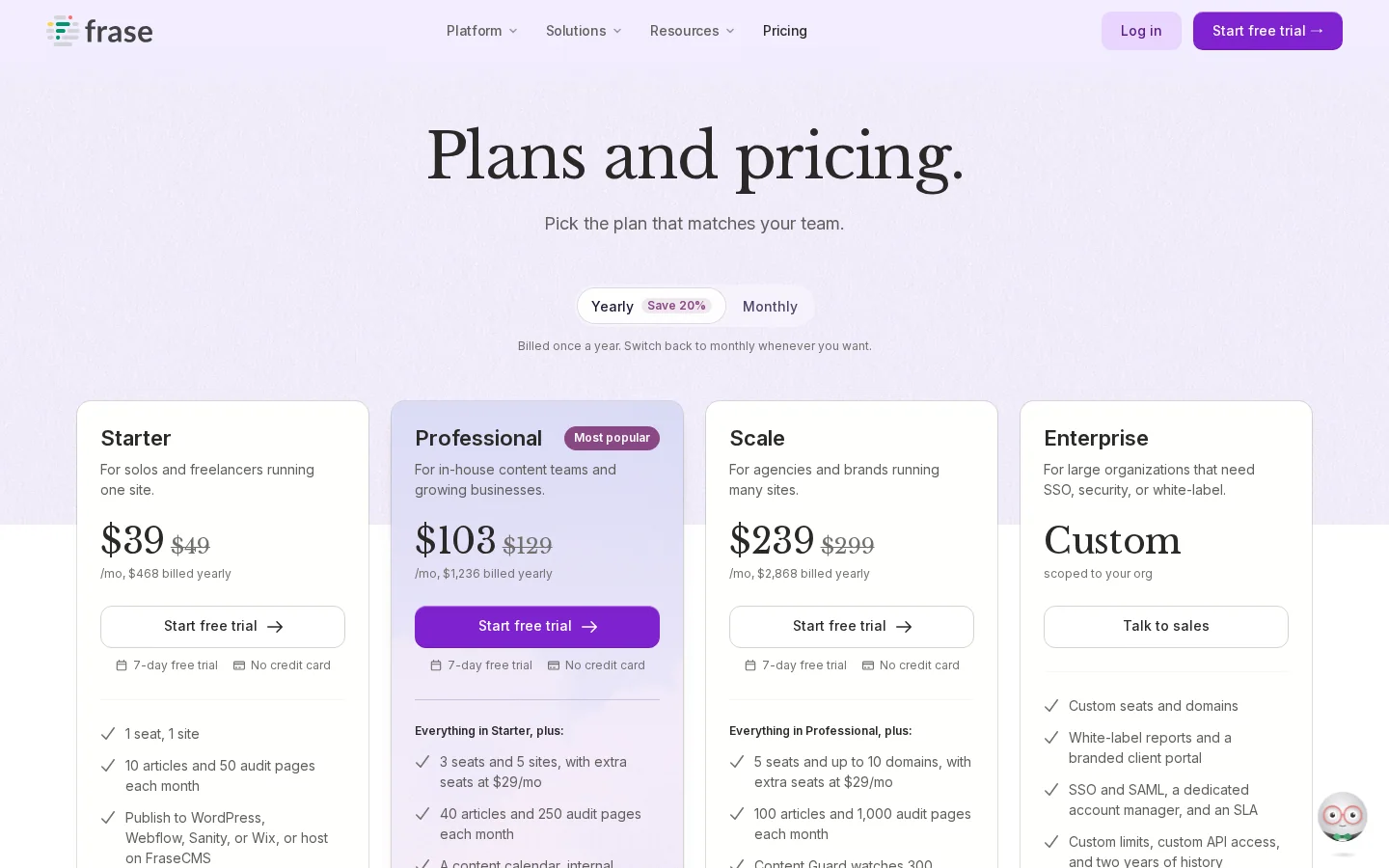
Frase's overage is optional and off by default. On Professional, each extra article costs $5, each audit page $0.50 and each AI prompt $0.25. Extra seats cost $29 per month on Professional and Scale. The pricing page lists no monthly-billed price, so budget on the yearly figure.
What Frase Professional includes each month
Source: Frase pricing page, checked 22 November 2026
The bars compare the yearly price per month of the plans you would actually buy. Jasper's only public price is Pro, so it is the only Jasper bar. Business is not on the chart because its price is set by sales.
Warning
Jasper's pricing page is not consistent on seats. Its structured data says Pro includes up to five users, while its FAQ says more than one Pro user requires contacting sales. Get the seat count in writing before you buy for a team.
To compare plans fairly, divide the plan price by the output you will publish. The formula below uses the yearly price, so the two plans are on the same footing.
Cost per article = plan price per year / articles published per year

Frase Professional, all 40 articles used every month:
1236 / (40 x 12) = 2.58 USD per article

Frase Starter, all 10 articles used every month:
468 / (10 x 12) = 3.90 USD per article
Jasper's public page gives no article count, so you cannot compute its cost per article from the page alone. Ask sales how many long articles one Pro seat produces, and what the credits cost on Business. The formula also leaves out your editing time, which is usually the largest cost. For a fuller budget, use our cost per article calculator.
If you also weigh content optimization tools, our Frase vs Clearscope prices guide puts Frase's plans next to a tool built around scoring.

Jasper is built for writing many formats with one brand voice. Frase is built for turning research into a brief, then into an article. Either tool can be pushed into the other's job, but you pay for that in time and in add-ons.
Jasper's own SEO page says it can generate keyword-optimized article outlines and first drafts at scale. It also says content can be analyzed for rankability, but through add-ons: the SurferSEO add-on for SERP analysis and the Copyscape add-on for plagiarism checks. That setup suits a team that already pays for Surfer and wants the writer in the same place. It suits less well a team that wants one tool for research, writing and checking.
Jasper's strength is breadth. Its pricing page stresses brand voices and knowledge assets, which keep product facts and tone consistent across ads, emails and blog posts. If your team writes many formats, that consistency matters more than a deep SEO panel. For a closer look at a rival, read our Copy AI vs Jasper comparison.
Frase's pricing is built around articles, audit pages and AI generations. That tells you its unit of work is the SEO article, not the ad or the email. The pricing page does not show ad or email formats, so check those before you commit if they are part of your job. Frase's plans suit a writer or a team that publishes articles on a schedule and wants a page audit for each one.
The trade-off is volume. The plan sets a ceiling on your monthly output, and each extra article beyond it costs money if overage is on. If you publish 12 articles a month, Starter is too small. If you publish 40, Professional fits. Work out your number before you choose.
Both tools can produce a first draft from a keyword. Both suggest the draft will help you rank. Neither can promise that, because ranking depends on your site, your links and the competition. The comparison we read on a rival tool's blog is dated 17 August 2022, and its Frase plans no longer match Frase's current pricing page. Treat any comparison as a snapshot and check the vendor's page on the day you buy.
Which tool fits which SEO job
Use the table at the top to shortlist. Then test both, as described later in this guide, rather than trusting either side's marketing.
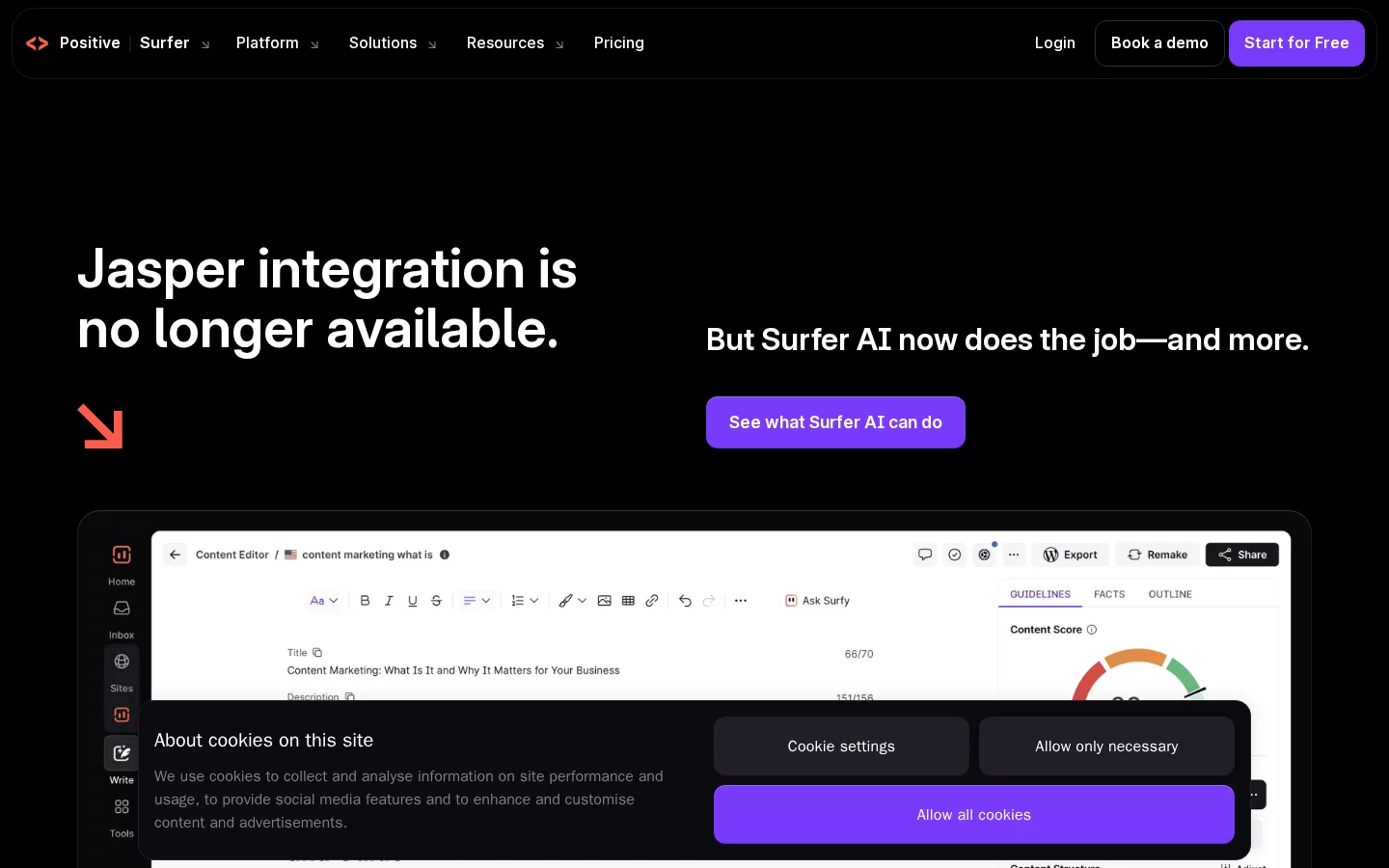
Jasper's SEO mode depends on an add-on from Surfer SEO, and Surfer's own page now says that the Jasper integration is no longer available. Jasper's SEO page still lists Surfer SEO as an add-on. Before you buy Jasper for SEO work, get the current setup in writing from both companies.
Jasper's SEO use-case page, checked on 22 November 2026, says SEO Mode can "analyze your content against SERP competitors and optimize accordingly with our SurferSEO add-on." The same page says content can be checked for rankability using the SurferSEO and Copyscape add-ons. Those are costs on top of the Jasper plan, so add their prices to the total.
Surfer's page on its Jasper integration, checked on 22 November 2026, says the Jasper integration is no longer available. It points readers to Surfer AI, which it presents as the replacement. The notice has no date, so we cannot say when it changed. That gap is exactly why you should ask before you pay.
Warning
Do not buy a Jasper plan for its SEO features until both companies confirm in writing that the Surfer add-on works on the plan you will buy. The two pages disagree, and neither one shows a date.
Frase's SEO work sits inside its plans. Every paid tier lists audit pages per month, so you can budget the SEO side along with the article count. For a team that wants one bill and one set of limits, that is simpler than stacking an add-on that may change. If you want the optimization side in depth, our Frase vs Surfer SEO guide compares the two tools as optimization products, a different angle from this one.
Neither tool decides whether your article ranks. Google's guidance focuses on accuracy, quality and relevance. It also says that using generative AI to create many pages without adding value for users may violate its spam policy on scaled content abuse, as stated in Google's documentation on generative AI content (undated page, checked 22 November 2026). The rule is about value, not about which tool wrote the page.
A raw draft from either tool usually has the same faults: a generic introduction, claims with no source, and the keyword repeated in every heading. The fix is an edit pass with a fixed checklist. The before and after below shows what that pass changes.
A raw AI draft against an edited article
Check every number, date and product claim before you publish. Our guide to fact-checking AI content before you publish gives a method, and the AI hallucination entry explains why a fluent draft can still be wrong. For the wider question of whether AI articles rank, read AI content for SEO.
Teams use Jasper and Frase in three ways: they draft from scratch, they build a brief first, or they optimize a page that already exists. Each way suits a different workload, and each has a failure you can predict. Choose the way before you choose the tool.
Principle. You give the tool a topic, a voice and a length, and it writes the first full draft. You then edit that draft into the final article.
When to use it. Use it for short, frequent pieces where the facts are simple: product descriptions, ad variants, email sequences and short news posts. Jasper suits this model best, because its pricing and features are built for many formats.
Advantages. The first draft arrives fast, and a team can keep one brand voice across formats. You spend your time on the edit instead of on a blank page.
Limits. Without research, the draft repeats what the model already knows. It may miss the competitors on your keyword, and it may include claims you cannot source.
Example. You ask for a 900 word post on a recent pricing change. The draft reads well, but the price it quotes is last year's. Your edit pass catches that only if you check the vendor's page.
Principle. You build an outline from the search results and the questions readers ask: the headings, the terms to cover and the target length. The draft follows the brief, so the structure is set before the writing starts.
When to use it. Use it for articles that must rank for a keyword with real competition. Frase's plans are built around this model, with article counts and audit pages per month.
Advantages. The brief forces a structure that matches what ranks, and the reader sees the questions the search results answer. Editing gets faster because the outline is already right.
Limits. A brief is only as good as the sources behind it. If you copy the headings of the top three results, you produce a me-too article. A brief also cannot supply the expertise that only you have.
Example. For the keyword "jasper ai vs frase", a brief lists the pricing units, the Surfer question and the team sizes as headings. The writer then adds the results of their own trial, which no brief can supply.
To build a brief for free, use our free AI content brief generator, or read the content brief guide for a template.
Principle. You take a page that already exists, score it against the top results, and rewrite the gaps. The URL, the inbound links and the history stay the same.
When to use it. Use it when a page used to rank and has slipped, or when it ranks for the right keyword but is thin. Optimization tools are built for this job, and Jasper's SEO mode, through its Surfer add-on, targets the same job.
Advantages. You keep the links and history of the page. Small changes, such as a better first answer or a missing section, can move a page more than a brand new article would.
Limits. A score is a proxy. Pushing a page to a higher score can make it worse for a reader. Rewriting a page that works is also a risk, so measure the traffic before and after.
Example. A two-year-old comparison page loses clicks. You add a current price table, a dated source and a real test result. You keep the URL and check the ranking four weeks later.
Sorank's content optimization page covers rewriting old pages on the same model, and the content freshness entry explains why dates in the text matter.
| Method | Best for | Main risk | What to check |
|---|---|---|---|
| Draft from scratch | Short, frequent copy in many formats | Unsourced claims | Every fact and price |
| Brief first | Competitive keywords that need long articles | A me-too structure | Your own examples and sources |
| Optimize an existing page | Old pages that slipped or are thin | Over-optimizing a page that already worked | Traffic before and after the change |
Run the same three briefs through both tools, score the drafts on one checklist, and divide the plan price by the output you can really publish. A one-week test with your own keywords tells you more than any comparison page, including this one.
Start by choosing the briefs. Pick three pieces: one short post, one long guide and one page you already have. The mix matters, because a tool that wins on short copy can lose on long articles.
Five steps to test both tools in one week
Give both tools the same keyword, audience, length and source list. Write down the time from brief to finished draft, and the time spent on the edit. Then score each draft on three counts: unsourced claims, factual errors and sections you had to rewrite. A draft with five unsourced claims and one wrong price is not ready, whatever the tool says about itself.
Use the formula from the pricing section. Add the cost of extra seats, any overage and any add-on you need for SEO. The result is your cost per publishable article, and it is the only number that compares the two tools fairly.
Ask both vendors, in writing, whether the CMS integration you need works on the plan you will buy. If you publish to WordPress, Webflow or Shopify, confirm the publishing path, not only the import. This is the step where the Surfer question would have shown up before you paid.
Tip
Before the test, generate a brief with our free AI content brief generator, then build the outline with the free blog outline generator. Give the same brief to both tools so the test measures the tools, not the input.
The most expensive mistakes are comparing list prices without units, trusting a comparison with no date, assuming an add-on still works, and publishing a draft with no fact check. Each one is easy to catch before you pay, once you know what to look for.
What it is. You put Jasper's $59 next to Frase's $39 and pick the lower number. Jasper's figure is per seat, while Frase's Starter includes ten articles a month, so the two numbers measure different things.
How to spot it. Your comparison has no article count, no seat count and no cost per article on either side.
How to fix it. Rebuild the comparison as cost per publishable article, using the formula above, and add extra seats and overage to both sides.
What it is. You rely on a comparison that quotes old plans. The comparison we read is dated 17 August 2022, and its Frase plans no longer match Frase's current pricing page.
How to spot it. Look for a publication date, plan names that do not match the vendor's page, and prices with no "as of" note.
How to fix it. Check each price on the vendor's page on the day you buy, and write the date next to it in your notes.
What it is. You buy a plan for an SEO feature, and the add-on has been discontinued or changed. Surfer's page says its Jasper integration is no longer available, while Jasper's SEO page still lists Surfer SEO as an add-on.
How to spot it. Check the integration page of each vendor, and look for a "no longer available" notice on the partner's side too.
How to fix it. Ask for the current setup in writing, with the plan name and the price of the add-on, before you pay.
What it is. You buy one Pro seat for a team of three. Jasper's FAQ says more than one Pro user requires contacting sales, and its structured data gives a different user count.
How to spot it. Count the people who will log in, then check whether the plan includes them.
How to fix it. Ask sales for the price of each extra seat in writing. For Frase, extra seats cost $29 per month on Professional and Scale, and Starter includes one seat only.
What it is. You publish the draft as it came out, with an unchecked price, date or claim. This is the mistake that hurts most, because a wrong figure in a comparison damages trust with readers and with the AI systems that quote you.
How to spot it. Count the numbers and claims in the article that have no source link next to them.
How to fix it. Put a source on every number and every price, and write the check date beside it. Run the edit pass described above before the article goes live.
Before you pay: a checklist
Choose Frase if SEO articles that rank are your main output and you publish a set number each month. Choose Jasper if you need many formats with one brand voice, and you accept paying for SEO features as add-ons. Choose neither if you need the whole path from keyword to published article, which is a different kind of tool.
| Your situation | Pick | Why |
|---|---|---|
| Solo writer publishing 10 articles a month | Frase Starter, after a test | The plan is sized to 10 articles and one seat |
| Team writing ads, email and articles | Jasper, after a seat check | Brand voice and knowledge assets across formats |
| Agency running SEO for several sites | Frase Scale, after an overage check | Articles, audit pages and up to 10 domains on one plan |
| Site with old pages that have slipped | An optimization workflow, not a writer | The job is rewriting existing pages, not drafting new ones |
We build Sorank, so weigh this part with that in mind. If you want the whole path from keyword to published article, our AI blog article generator analyzes the competing articles, writes a sourced article with internal links and images, scores it out of 100, and sends it to WordPress, Shopify, Webflow or Wix as a draft or as a live post. Like any tool on this list, it still needs your fact check before you publish.
Run the one-week test before you decide. It will tell you more than this article or any vendor page can.
For SEO articles built on research and briefs, Frase usually fits better, because its plans are sized by articles, audit pages and AI generations. Jasper is stronger for broad copy such as ads, emails and brand messaging, and its SEO features are add-ons.
It depends on the unit. Frase's cheapest yearly plan is $39 per month for 10 articles, while Jasper Pro is $59 per seat per month billed yearly, and its pricing page shows no article count. Divide each price by the output you will really publish to compare them fairly.
Google's guidance focuses on accuracy, quality and relevance, not on which tool wrote the page. It warns that many pages made without adding value for users may violate its spam policy on scaled content abuse.
We analyse your competitors, your website and your AI visibility to create a tailored content plan for free.
 Duplicate Content Checker
 Mobile-Friendly Test
 Website Speed Test
 Subdomain Finder
 Domain Age Checker
 CMS Detector
 Googlebot Simulator
 Nofollow Link Checker
 Meta Tag Checker
 Keyword Cannibalization Checker
 Keyword Intent Checker
 Keyword Extractor
 Google Ads Cost Calculator
 CPC Calculator
 Local Citation Finder
 Reddit Threads Finder
 Disavow File Generator
 Redirect Generator
 Canonical Tag Generator
 Passive Voice Checker
 Google Location Changer
 Google Review Calculator
 Google Review Link Generator
 Keyword Combiner
 Podcast Show Notes Generator
 AI Content Rewriter
 AI Text Humanizer
 ChatGPT Prompt Generator
 Twitter Thread Generator
 Tweet Generator
 Landing Page Copy Generator
 Google Ads Copy Generator
 Pinterest Pin Description Generator
 Anchor Text Generator
 Social Media Post Generator
 LinkedIn Post Generator
 Free AI Writer
 Review Response Generator
 LSI Keyword Generator
 YouTube Video Ideas Generator
 YouTube Tag Generator
 YouTube Description Generator
 Product Description Generator
 CTA Generator
 Blog Introduction Generator
 Conclusion Generator
 Hook Generator
 AI Content Brief Generator
 FAQ Schema Generator
 AI Blog Post Ideas Generator
 Structured Data Validator (Schema Validator)
 Alt Text Checker
 Internal Link Analyzer
 Backlink Challenge
 AI Meta Description Generator
 AI Blog Title Generator
 Google Indexability Checker
 AI Blog Outline Generator
 UTM Link Builder
 Keyword Clustering Tool
 Canonical Tag Checker
 XML Sitemap Generator
 Broken Link Checker
 AI SEO Title Generator
 Headline Analyzer
 SERP Preview Tool
 Redirect Checker
 Hreflang Tag Generator
 Heading Structure Analyzer
 HTTP Headers Checker
 Favicon Extractor
 SERP CTR Calculator
 SEO vs Paid Search Savings Calculator
 SEO Share of Voice Calculator
 SEO ROI Calculator
 SEO Traffic and Revenue Forecast Calculator
 SEO Budget Calculator
 SEO Break-Even Calculator
 SaaS SEO ROI Calculator
 ROAS Calculator
 Reading Time Calculator
 Ranking Gain Simulator
 Organic Traffic Value Calculator
 Organic Traffic Estimator and Website Traffic Checker
 LTV to CAC Ratio Calculator
 Local SEO ROI Calculator
 Link Building Cost Calculator
 Keyword Value Calculator
 Keyword Opportunity Score Calculator
 Keyword Density Calculator
 GEO ROI Calculator
 GEO Content Investment Calculator
 Ecommerce SEO ROI Calculator
 Customer Lifetime Value Calculator
 Customer Acquisition Cost Calculator
 CTR Calculator
 Cost Per Article Calculator
 Conversion Rate Calculator
 Content Marketing ROI Calculator
 ChatGPT Referral Traffic Estimator
 Bounce Rate Calculator
 Backlink ROI Calculator
 AI Visibility Score Calculator
 AI Traffic Value Calculator
 AI Share of Voice Calculator
 Cost of AI Invisibility Calculator
 AI Citation Rate Calculator
 llms.txt Validator
 AI Overview Checker and AI Overviews Rank Checker
 Robots.txt Checker
 AI SEO Audit
 LLM Readability Checker
 SearchGPT Readiness Checker
 Structured Data LLM Audit
 Website Crawlability AI Audit
 Why ChatGPT Is Not Recommending My Website
 Gemini Ranking Tool
 Perplexity Ranking Checker
 LLM Citation Checker
 Answer Engine Optimization Audit
 GEO Audit
 AI Search Visibility Test
 ChatGPT Visibility Checker
 llms.txt Generator
 URL Extractor
 Webpage to Markdown
 Sitemap Checker
 SERP Volatility Sensor
 Page Size Checker
 Word Counter
 Slug Generator
 Schema Generator
 Robots Generator
 OG Preview
 Meta Tags Generator
 Image Compressor
 Favicon Generator
 On-Page SEO Audit: SEO Checker and SEO Analyzer
 Backlink Analysis Tool
 Keyword Research Tool
 Domain Authority Checker
 “I tested Sorank on a real client site and it's insane. It does everything an agency would bill you $1500 a month for. It's going into production on that client now.”

 Guillaume Guersanguersanguillaume.com“We are an Ads agency and we wanted to get our SEO back on track once and for all. Sorank gave us a clear view of our site, helped us prioritize optimizations, and properly structure our content. The tool is easy to use, well designed for a team, and very practical for centralizing tracking without having to juggle multiple platforms. A very solid foundation to start fresh with our SEO.”
 Gaspard MadouiAds Agency
 “I just let the Sorank software do its thing, and now my DR is 25 and my page is ranking higher.”
 Lucas Flandrefoundertrace.fr“I specialized in GEO thanks to Sorank. The GEO Leaderboard allows me to show my clients their position vs competitors on ChatGPT. It’s a real commercial differentiator.”
 MélanieSEO Freelance“Great service, works well for our website and helps us understand how to improve it to rank better on Google and elsewhere. Congrats, keep going, I recommend it.”
 Hugo T.E-commerce merchant