Preferences
Privacy is important to us, so you have the option of disabling certain types of storage that may not be necessary for the basic functioning of the website. Blocking categories may impact your experience on the website. More information
Privacy is important to us, so you have the option of disabling certain types of storage that may not be necessary for the basic functioning of the website. Blocking categories may impact your experience on the website. More information

Writesonic vs Jasper compared on templates, brand voice, SEO, pricing and trials, plus a one-week test to pick the right AI writer for you before you pay.
In short
Writesonic and Jasper are both AI writing platforms for marketing copy and blog posts. Writesonic leans toward fast, template-driven drafts with SEO tools included. Jasper leans toward brand voice control, long-form editing and team workflows, with its SEO work running through Surfer. Plan prices change often, so compare the current pricing pages and test both tools on your own briefs.
Want to go further? Ask
Quick quiz
Which way of writing with AI is right for you?
Sorank matches your answers


Test it for 3 days on your own site and see where you stand on Google, ChatGPT and the other AIs.
Start 3-day free trial3 days free, then stop whenever you want. 90-day results guarantee, conditions apply.
Writesonic is the template-first tool. You pick a format, enter a topic and a few keywords, and you get a draft in minutes. Jasper is the control-first tool. You set a brand voice, work in a chat-style editor and build longer pieces step by step. Both can write a blog post. They differ in how much structure you give the AI before it writes, and how much editing you should expect afterward.
The table below covers the differences that matter most when you choose. Read the pricing row as a starting point, not a quote. The pricing section further down shows how to check the current numbers yourself.
| Criterion | Writesonic | Jasper |
|---|---|---|
| Starting point | Pick a template, add a topic and keywords | Set a brand voice, then prompt in a chat-style editor |
| Interface | Template-first dashboard, busy but easy to start | Cleaner sidebar with projects and folders |
| Brand voice | Tone and style options inside each template | Brand Voice assets, with limits by plan |
| SEO inputs | Keyword research and content gap tools built in | Surfer SEO integration for keyword and SERP guidelines |
| Long-form work | Works, but drafts can feel formulaic | Stronger for long pieces that need many passes |
| Free option | Current pricing page lists no free plan | No free plan, 7-day free trial on Pro |
| Best for | Solo creators and small teams publishing many articles | Marketing teams that need consistency across writers |
If you only need one sentence to decide, use this one. If your bottleneck is getting drafts out the door, start with Writesonic. If your bottleneck is making every piece sound like your company and survive a senior editor, start with Jasper. The rest of this guide shows how to confirm that for your own situation, because a comparison written by a vendor or a reviewer rarely matches your workflow exactly.
One thing to know before you read other comparisons. Many of them are published by vendors who sell their own AI writer, and some quote plan names and prices that no longer appear on the official pages. Treat every claim in this guide, ours included, as something to verify against the product you will actually use.
Most of the real difference between the two tools is not a feature list. It is the order in which you give information to the AI. That order decides how much work you do before the first draft and how much you do after it. Understanding it saves you from choosing a tool that fights the way your team writes.
Writesonic organizes its product around templates. There are templates for blog posts, ads, emails, landing pages, video scripts and short social copy. Each one asks for a few inputs, such as a topic, keywords, a tone and a length, and returns a draft. The SEO-oriented templates, such as an article writer or an article idea generator, take the keyword and some live search data into account.
The advantage is speed and predictability. A new team member can produce a usable first draft in their first hour, because the template has already decided the structure. The cost is that the structure is decided for you. When every post starts from the same template, the drafts often share the same rhythm, the same introduction pattern and the same closing paragraph. You will need an editor who notices and rewrites those patterns.
Jasper puts more weight on the setup before writing. You define a brand voice, add knowledge about your product or audience, and then prompt the tool in a chat-style editor. Its templates still exist, but the core workflow is conversational. You can ask for a section, change the tone of one paragraph, or ask the tool to expand one point without rewriting the whole piece.
The advantage is control. Once the brand voice is set, the output tends to be more consistent across writers, and long pieces can be built in stages. The cost is more work up front. A team that writes one generic prompt per article gets generic output from Jasper too, and the tool's extra features are wasted.
Ask yourself who writes the brief. If the answer is a single person who knows the topic and the tone, Writesonic's template path will feel fast and natural. If the answer is five writers with different habits, you will spend less time correcting drafts when everyone starts from the same brand voice and the same knowledge base, which is the model Jasper is built around.
A comparison we read describes Jasper's dashboard as a clean sidebar with strong folder organization and describes Writesonic's as busier and more template-led. That matches the design logic above. Because the author of that comparison sells an AI writer of their own, treat the description as a hypothesis to check in your first session with each tool, not as a verdict.
Quality is the question everyone asks first, and it is also the hardest to answer from a feature page. Output depends on the model underneath, the template or prompt you use, the length you ask for and the number of editing passes you make. Two tools can produce very different drafts from the same topic and still be equally good if you give them different inputs.
The fair way to judge quality is to measure what you do after the draft arrives. Count the sentences you rewrite, the claims you have to verify, and the sections you have to add. Those three numbers tell you more about a tool than a sample paragraph does.
Long articles, usually above 2000 words, expose the weaknesses of any AI writer. The middle sections start to repeat the introduction. Lists get longer than they should. Examples become vague. Jasper's conversational editing lets you fix these problems one section at a time, which is why it is often recommended for long-form work. Writesonic can produce long drafts too, but the usual approach is to generate the whole piece and then edit it, which means more of the work happens at the end.
For a long article, a practical method works with either tool. Generate an outline first, then one section at a time, then one edit pass that checks the claims against sources. The Free AI Blog Outline Generator on our site can produce the H2 and H3 plan before you open either tool, so the structure is set before any prose is written.
Consistency is where brand voice settings pay off. The next example shows the difference in the input, not the tool.
The same request, before and after a brief
Illustrative example written for this guide, not measured data
Whichever tool you choose, write the brief once and store it. Jasper lets you keep that brief inside a brand voice and knowledge set. In Writesonic, you paste the same brief into the fields of each template. The discipline is the same. The storage is different.
Sorank applies the same idea to its own articles through brand voice setup in Sorank, where tone and terms are set once and reused. If you run the same process across many posts, that saves more time than any single prompt trick.
SEO is where people expect the biggest gap between the two tools, and the gap is smaller and more specific than most reviews suggest. Both tools can help you write for a keyword. The question is how much of the research, the on-page checks and the optimization happens inside the same product.
Writesonic builds SEO into its templates. You enter a keyword in an instruction field, and the keyword is woven into the draft. Its SEO-focused tools include keyword research and a content gap analyzer, which helps you find topics your site does not yet cover. These features are useful for planning, but they are not a substitute for checking the search results yourself.
Jasper's SEO story is built around an integration. Its Surfer SEO connection brings real-time keyword data, SERP analysis and content guidelines into the editor, so you can check your draft against what top results cover. Reviews we read describe Surfer as a separate paid subscription, so add that cost to the Jasper line in your budget. Confirm the current terms on Jasper's pricing page before you assume it is included.
Both tools connect to outside software. Writesonic is commonly connected through Zapier and WordPress, and it works with some SEO data providers through its integrations. Jasper offers a Chrome extension, Grammarly and Copyscape checks, and on higher plans API access for teams with custom workflows. Check each integration against the stack you already use, because a native connection saves more time than a feature that needs a workaround.
SEO features compared
Summary of vendor pages and third-party comparisons read in November 2026
The short version: if you already pay for an SEO platform, Writesonic's built-in research may be enough for a first pass. If you want the content editor to score your draft against the top results, Jasper's Surfer workflow is the more direct route. Either way, the SEO value comes from the keyword choice and the search intent check, not from the tool's logo.
Search intent is the step most teams skip. Before you generate anything, open the first page of results for your keyword and note the format that ranks, whether it is a guide, a list, a comparison or a product page. A comparison keyword like this one needs a comparison format, and no tool will choose that for you unless you ask for it in the brief. Our guide to AI content for SEO covers how to check intent before you commit to a draft.
Jasper has no free plan, and its Pro plan has a 7-day free trial. Writesonic's plan names and prices have changed several times, so the only safe answer is the one on the vendor's page the day you buy. Plan names, seat limits and trial lengths move often, and third-party pages keep old figures for months, so the method below works even when the numbers move. Use it rather than trusting any table, including the one in this guide.
When we checked Jasper's pricing page on 21 November 2026, it listed a Pro plan with a 7-day free trial and no free plan. Pro included one seat, two Brand Voices, five Knowledge assets and three Audiences. Business was sold with custom pricing on a 12-month commitment, and added API access, unlimited Brand Voices and dedicated account management. The page showed Pro at $69 per seat per month billed monthly, or $59 per seat per month billed yearly.
What Jasper's pricing page says
Source: Jasper pricing page, checked 21 November 2026
Jasper's own page carries a warning you should heed. Its structured data gives a validity date of 31 December 2025 for its Pro offer, which is already in the past. That does not mean the price is wrong, but it does mean you must confirm the current figure on the page before you budget for it.
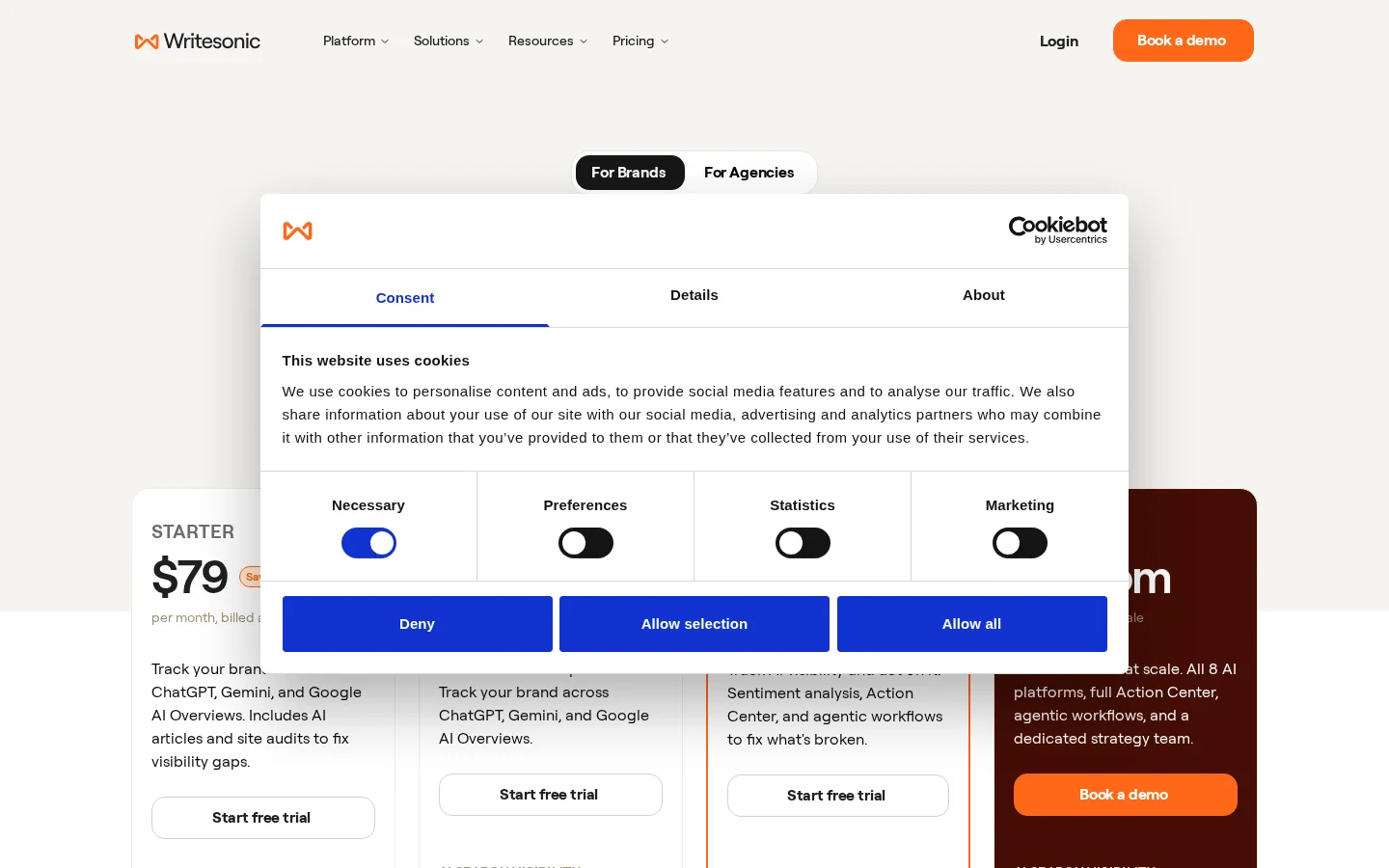
Writesonic's situation is less clear. The pricing page we checked on the same day lists Starter, Basic and Growth plans, priced around AI articles per month, site audits and tracked AI prompts. It states a 7-day trial on paid tiers and no free plan. Reviews and comparison sites still quote older Lite, Standard, Professional and Advanced tiers with different prices. A reader who compares a current Writesonic price against an older Jasper price will get the wrong answer, so always compare the same year and the same product line.
Note
Pricing pages can change in a week. Before you buy, screenshot the plan you want, note the date, and check the same page again at the moment of purchase. Compare the monthly price per seat, not the headline number on the first screen.
The number that matters is not the subscription price. It is what each usable article costs you once editing is included. A cheap plan that produces drafts you rewrite for two hours can cost more than a premium plan that needs twenty minutes. Use this formula with your own numbers.
cost per usable article = (plan price per month + editing hours × hourly rate) ÷ usable articles per monthA usable article is one you publish after a fact check, without a full rewrite. Track it for two weeks with each tool. The tool with the lower number wins, even if its plan costs more on paper.
Reviews are useful for shortlisting, but they cannot tell you how a tool handles your topics, your tone and your editors. A small test answers those questions in a week, and it costs nothing beyond the trial. Run it with the same brief in both tools, and keep the rules identical so the comparison means something.
The five-step test
Use the same brief text for both tools, word for word. Do not improve one brief after you see the first output. If you want to test a feature such as brand voice, set it up in the tool that has it, and note that the other tool was tested without it. Otherwise the comparison measures your setup, not the product.
Choose topics that represent your real work. A test that uses only easy, popular topics will flatter any AI writer. Include one topic you know well, where errors are easy to spot, and one you know less well, where the risk of a confident mistake is higher. The second one tells you more about the tool.
Style is what most people judge first, because it is the most visible. Accuracy matters more. Check every statistic, date, product name and claim about a competitor against a primary source. Note how often the tool invents a detail, cites a source that does not exist, or mixes up two products with similar names. Those errors cost more time later than a clumsy sentence does.
There is no universal winner. The right tool depends on who writes, who approves and how many articles you publish each month. The checklist below turns that into a decision you can make in a meeting.
Before you buy, check these
Writesonic tends to suit a solo creator or a small team that wants fast drafts for many formats, with SEO features included and minimal setup. Jasper tends to suit a marketing team that writes for several people, needs consistent brand voice and expects long pieces that go through several editing rounds. Neither answer is a recommendation to buy. Both are reasons to run the test first.
Most bad purchases come from the same few mistakes. Each one is easy to avoid once you know what it looks like. Here are the four we see most often, with how to spot each one and how to fix it.
What it is. Judging a tool by one impressive sample, usually the one on its homepage or in a review. Demo prompts are written to show the tool at its best, and they rarely match your topics.
How to spot it. The sample is short, generic and on a topic no one on your team would write about. The review shows no failed drafts.
How to fix it. Use the five-step test above with three of your own briefs. Include at least one brief that is hard for you to fact check, so you can see how each tool handles uncertainty.
What it is. Using a plan name and price from a page that was written months ago. Many comparison pages are updated once and then left alone, and their tables keep old tiers and trial lengths.
How to spot it. The page does not show a date, uses plan names the official site no longer uses, or gives a price that does not match the pricing page when you open it.
How to fix it. Open the vendor's pricing page on the day you decide. Note the plan, the billing period and the seat count. Compare like with like. If the two pages do not match, believe the vendor's current page and treat the comparison as out of date.
What it is. Choosing a tool because it produces the most words for the money. Word count is easy to measure and easy to misread, because a long draft that needs a full rewrite is not a saving.
How to spot it. Your team reports fast drafts, but the publishing calendar is not moving. Editors are spending their evenings on rewrites.
How to fix it. Measure usable articles, not words. Use the cost formula from the pricing section and track the editing minutes for each draft. The metric you optimize should be the one that ends in a published post.
What it is. Treating the AI draft as finished because it reads well. Fluent text can still include a wrong date, a made-up statistic or a product feature that does not exist.
How to spot it. The draft has no sources, or the sources it lists do not open. A sentence contains a precise number without a named origin.
How to fix it. Add a fact check step before every publish, and treat it as part of the cost in your formula. Our guide on how to fact-check AI content before you publish it lists the checks one by one.
Choosing a tool is only half the job. The other half is what you publish. Google does not ban AI-written pages as a category. Its guidance focuses on the quality and purpose of the page, whatever tool produced it. Google's Search Central documentation on generative AI content says that "It is critical to manually factcheck and review all AI-generated content for accuracy and trustworthiness before publishing." That is the standard to design your process around, whichever writer you choose.
Google's spam policies add a second rule. They define scaled content abuse as "when many pages are generated for the primary purpose of manipulating search rankings and not helping users." The risk is not that a tool wrote the page. The risk is publishing large numbers of pages that add nothing for the reader. A high-volume workflow is safe when each page answers a real question and has been checked. It is risky when the output is a batch of thin pages sent out without review.
Warning
A fast tool makes it easy to publish dozens of pages a week. Set a rule before you start: no page goes live without a human checking the claims, the sources and whether the page answers the query better than what already ranks.
Use this checklist before any AI-written article goes live. It applies to Writesonic, Jasper or any other writer.
For the wider question of how search engines and AI systems judge AI-assisted content, read our guide to whether Google penalizes AI-generated content. For the term itself and how the process is usually described, our glossary entry on AI content generation gives a short definition.
Sorank is an SEO and GEO platform that runs on autopilot. It is not a general-purpose writing app like Writesonic or Jasper, and it is not the right choice if you want to write every sentence yourself. It is closer to a publishing workflow. You add the keywords you want to target, and it researches the topic, analyzes the competing articles, writes a draft from your site brief and tone, and adds sources, internal links, image alt text and metadata before you review it.
The part that matters most for this comparison is the brand voice and the review step. Tone and terms are set once for the site. Each article gets a quality score based on structure, sources, links, alt text and schema, so you can see what needs work before you publish. You can publish to WordPress, Shopify, Webflow or Wix, or send the article to any system through a webhook. The AI blog article generator page describes the full flow, and the brand voice page covers how the tone settings work.
If you are still choosing between writing tools, you do not need Sorank to run the test in this guide. You do need a review step, whatever you use.
Tip
Before you write, build the outline. The Free AI Blog Outline Generator returns a full H2 and H3 plan for your topic, which you can paste into either tool as the structure of your brief.
Neither is better for every team. Writesonic suits people who want fast, template-driven drafts with SEO tools included. Jasper suits teams that need brand voice control and longer, more carefully edited pieces. Test both on the same brief before you decide.
When we checked on 21 November 2026, Jasper's pricing page listed no free plan. It offered a 7-day free trial on its Pro plan, and its Business plan was sold through sales contact. Confirm this on the page before you sign up, because trial terms change.
It depends on the plan, the billing period and the number of seats. Writesonic's current pricing page is built around AI articles and tracked prompts, and older reviews quote different tiers. Compare the plan you would actually buy, per seat and per month, on each vendor's current page, then run the cost-per-usable-article formula.
Writesonic and Jasper solve the same problem in different ways. Writesonic is faster to start and gives you SEO features in one place. Jasper gives you more control over voice and long-form work, and its SEO workflow runs through Surfer. Choose by who writes, how consistent the output must be and what each usable article costs you. Then run the one-week test with your own briefs, check the current pricing on the day you buy, and keep a fact check in every publishing process.
Neither is better for every team. Writesonic suits people who want fast, template-driven drafts with SEO tools included. Jasper suits teams that need brand voice control and longer, more carefully edited pieces. Test both on the same brief before you decide.
When we checked on 21 November 2026, Jasper's pricing page listed no free plan. It offered a 7-day free trial on its Pro plan, and its Business plan was sold through sales contact. Confirm this on the page before you sign up, because trial terms change.
It depends on the plan, the billing period and the number of seats. Writesonic's current pricing page is built around AI articles and tracked prompts, and older reviews quote different tiers. Compare the plan you would actually buy, per seat and per month, then run the cost-per-usable-article formula.
We analyse your competitors, your website and your AI visibility to create a tailored content plan for free.
 AI Content Brief Generator
 FAQ Schema Generator
 AI Blog Post Ideas Generator
 Structured Data Validator (Schema Validator)
 Alt Text Checker
 Internal Link Analyzer
 Backlink Challenge
 AI Meta Description Generator
 AI Blog Title Generator
 Google Indexability Checker
 AI Blog Outline Generator
 UTM Link Builder
 Keyword Clustering Tool
 Canonical Tag Checker
 XML Sitemap Generator
 Broken Link Checker
 AI SEO Title Generator
 Headline Analyzer
 SERP Preview Tool
 Redirect Checker
 Hreflang Tag Generator
 Heading Structure Analyzer
 HTTP Headers Checker
 Favicon Extractor
 SERP CTR Calculator
 SEO vs Paid Search Savings Calculator
 SEO Share of Voice Calculator
 SEO ROI Calculator
 SEO Traffic and Revenue Forecast Calculator
 SEO Budget Calculator
 SEO Break-Even Calculator
 SaaS SEO ROI Calculator
 ROAS Calculator
 Reading Time Calculator
 Ranking Gain Simulator
 Organic Traffic Value Calculator
 Organic Traffic Estimator and Website Traffic Checker
 LTV to CAC Ratio Calculator
 Local SEO ROI Calculator
 Link Building Cost Calculator
 Keyword Value Calculator
 Keyword Opportunity Score Calculator
 Keyword Density Calculator
 GEO ROI Calculator
 GEO Content Investment Calculator
 Ecommerce SEO ROI Calculator
 Customer Lifetime Value Calculator
 Customer Acquisition Cost Calculator
 CTR Calculator
 Cost Per Article Calculator
 Conversion Rate Calculator
 Content Marketing ROI Calculator
 ChatGPT Referral Traffic Estimator
 Bounce Rate Calculator
 Backlink ROI Calculator
 AI Visibility Score Calculator
 AI Traffic Value Calculator
 AI Share of Voice Calculator
 Cost of AI Invisibility Calculator
 AI Citation Rate Calculator
 llms.txt Validator
 AI Overview Checker and AI Overviews Rank Checker
 Robots.txt Checker
 AI SEO Audit
 LLM Readability Checker
 SearchGPT Readiness Checker
 Structured Data LLM Audit
 Website Crawlability AI Audit
 Why ChatGPT Is Not Recommending My Website
 Gemini Ranking Tool
 Perplexity Ranking Checker
 LLM Citation Checker
 Answer Engine Optimization Audit
 GEO Audit
 AI Search Visibility Test
 ChatGPT Visibility Checker
 llms.txt Generator
 URL Extractor
 Webpage to Markdown
 Sitemap Checker
 SERP Volatility Sensor
 Page Size Checker
 Word Counter
 Slug Generator
 Schema Generator
 Robots Generator
 OG Preview
 Meta Tags Generator
 Image Compressor
 Favicon Generator
 On-Page SEO Audit: SEO Checker and SEO Analyzer
 Backlink Analysis Tool
 Keyword Research Tool
 Domain Authority Checker
 “I tested Sorank on a real client site and it's insane. It does everything an agency would bill you $1500 a month for. It's going into production on that client now.”

 Guillaume Guersanguersanguillaume.com“We are an Ads agency and we wanted to get our SEO back on track once and for all. Sorank gave us a clear view of our site, helped us prioritize optimizations, and properly structure our content. The tool is easy to use, well designed for a team, and very practical for centralizing tracking without having to juggle multiple platforms. A very solid foundation to start fresh with our SEO.”
 Gaspard MadouiAds Agency
 “I just let the Sorank software do its thing, and now my DR is 25 and my page is ranking higher.”
 Lucas Flandrefoundertrace.fr“I specialized in GEO thanks to Sorank. The GEO Leaderboard allows me to show my clients their position vs competitors on ChatGPT. It’s a real commercial differentiator.”
 MélanieSEO Freelance“Great service, works well for our website and helps us understand how to improve it to rank better on Google and elsewhere. Congrats, keep going, I recommend it.”
 Hugo T.E-commerce merchant