Preferences
Privacy is important to us, so you have the option of disabling certain types of storage that may not be necessary for the basic functioning of the website. Blocking categories may impact your experience on the website. More information
Privacy is important to us, so you have the option of disabling certain types of storage that may not be necessary for the basic functioning of the website. Blocking categories may impact your experience on the website. More information

Frase vs Clearscope compared on 2026 prices, features and AI tracking, with a two-week test to see which tool fits your team before you pay for either.
In short
Frase is an AI content tool for research, briefs, drafting and scoring, and Clearscope is a content grader that now also tracks how AI assistants mention a brand. On 21 November 2026, Frase's cheapest plan was $39 per month billed yearly, and Clearscope's cheapest listed plan was $129 per month. Choose by the job you need done first, then compare seats and output units on the plan you would actually buy.
Want to go further? Ask
Quick quiz
Which way of writing with AI is right for you?
Sorank matches your answers


Test it for 3 days on your own site and see where you stand on Google, ChatGPT and the other AIs.
Start 3-day free trial3 days free, then stop whenever you want. 90-day results guarantee, conditions apply.
Frase is a research-to-draft tool, and Clearscope is a content grader that now also tracks AI answers. The two overlap more than they did when most comparisons were written, which is why people put them side by side.
Frase starts from the keyword and ends at a published page. You research the questions people ask, generate a brief from the top results, draft with AI, then check the draft with SEO and GEO scores. Its pricing page lists publishing to WordPress, Webflow, Sanity, Wix and FraseCMS, so the draft can leave the tool without copy and paste.
Clearscope starts from the draft. Its homepage leads with the line "Write what Google ranks and AI mentions", and its four product steps are called Discover, Track, Write and Monitor. The write step grades your draft before publication, and the track step shows which brands AI engines name instead of yours. Clearscope also sells drafts, with 20 per month on its entry plan, but grading and monitoring are what the homepage leads with.
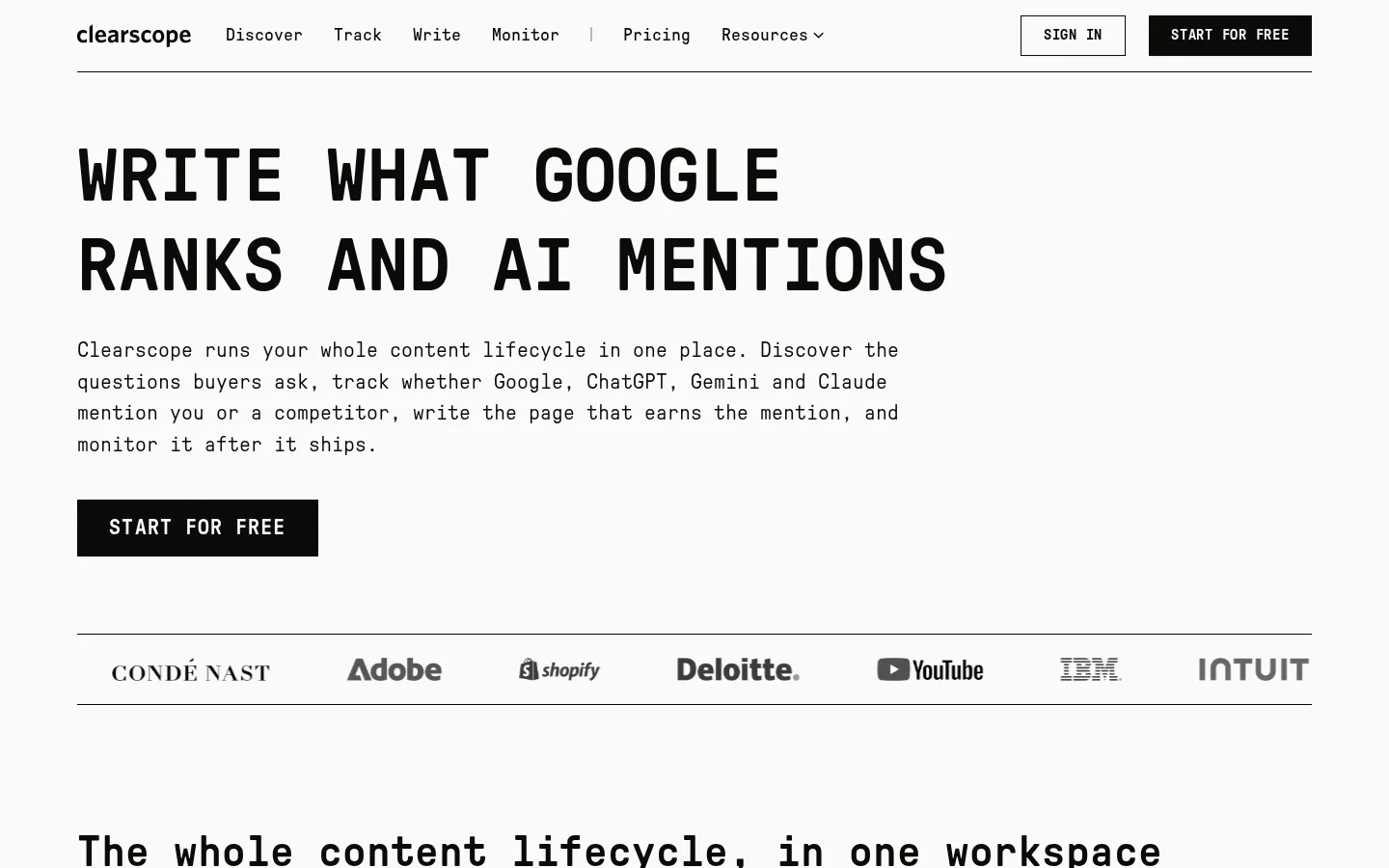
The overlap is real, and so is the difference in where each tool starts. If your team already has a writer and a CMS, you may need only one half of the workflow. Frase covers more of the production chain. Clearscope puts more weight on checking the page against the market and on watching what AI says about the brand.
A grader is useful, but it has limits. It compares your draft with the pages that already rank, so it can tell you which terms, entities and sections are missing. The idea behind term checks is older than the tools, and it is the same family as LSI keywords, a label many SEO writers still use for an idea that is more useful as a checklist than as a ranking rule. It cannot tell you whether a claim is true, whether your example is convincing, or whether your page answers the question the reader actually has. A high score on a page that repeats the top results will not make it the best page on the topic. That judgement stays with the editor.
Both tools also raise a question that comes before any purchase: do you need a tool that writes, or a tool that tells you whether a page you wrote is competitive? Most teams need both answers at different points in the year, which is why the plan you choose should match the bottleneck you have today.
Frase and Clearscope, built around different first steps
Sources: frase.io/pricing and clearscope.io/pricing, checked 21 November 2026
On 21 November 2026, Frase's cheapest plan was $39 per month billed yearly, and Clearscope's cheapest listed plan was $129 per month. The top self-serve plans were $239 per month billed yearly for Frase Scale and $399 per month for Clearscope Business. Check both numbers on the Frase pricing page and the Clearscope pricing page on the day you buy, because both vendors change their plans.
An older comparison, published in September 2022 by a competitor, still gives Frase at about $45 per month and Clearscope Essentials at $170 per month, with Business at $1200 per month. Those figures no longer match the vendor pages, and the article does not say when or where its numbers were taken. Any price you read in a review without a date should be treated as unverified.
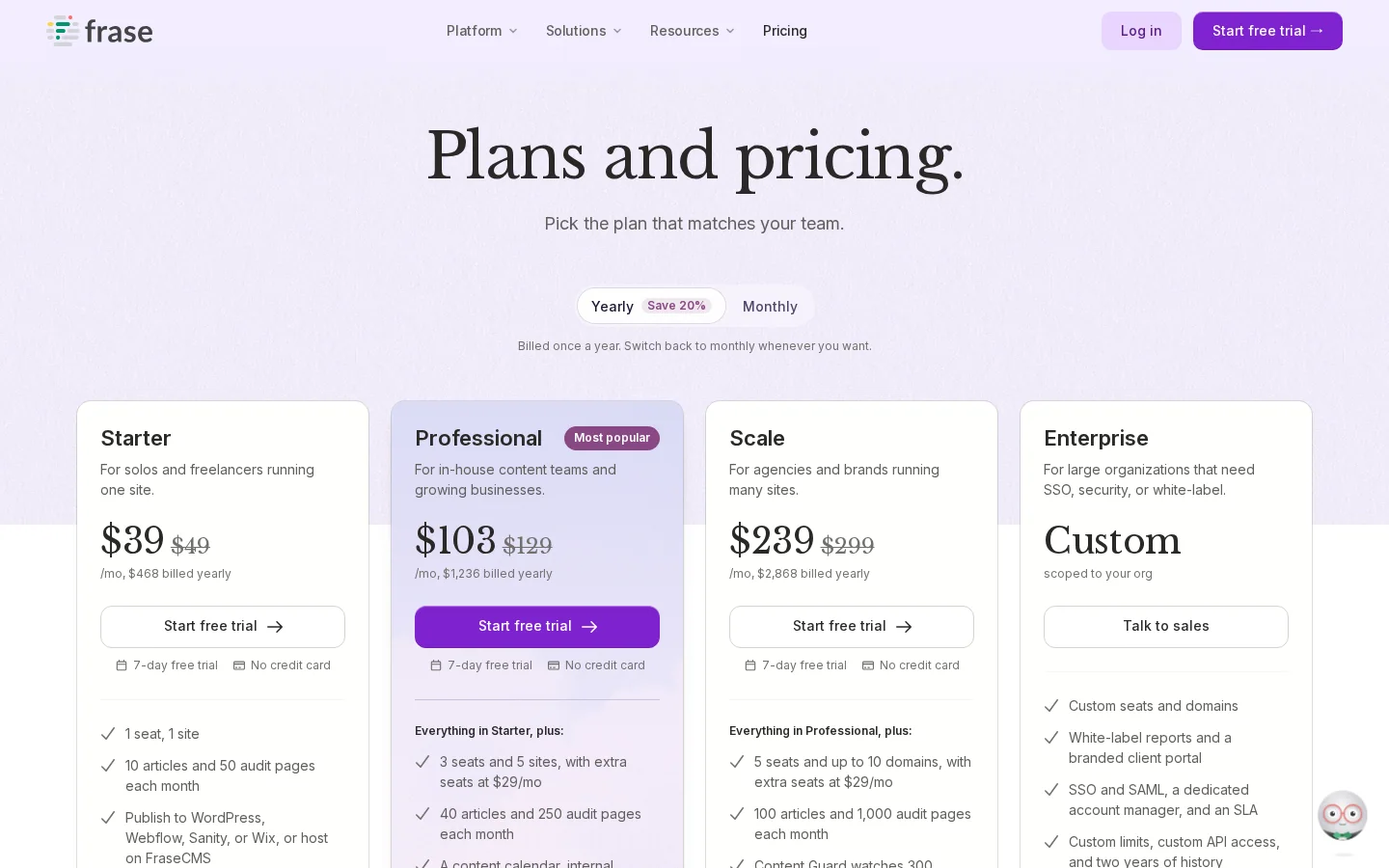
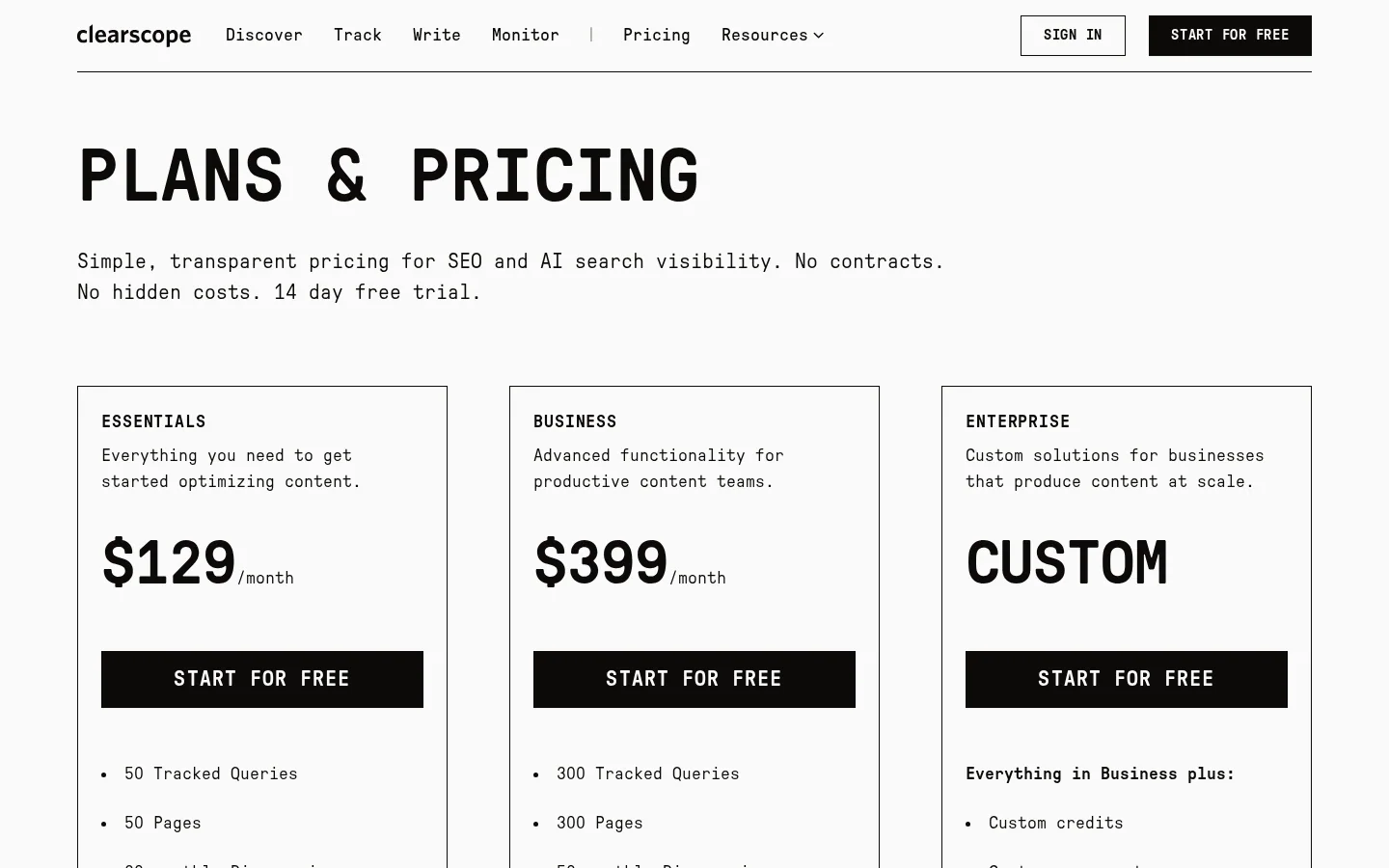
Billing period changes the bill more than most readers expect. Frase's Starter plan works out to $468 per year when billed yearly, which is $39 for each of 12 months. A Clearscope plan billed month to month at $129 costs $1548 over the same 12 months, and the pricing page we checked did not list an annual Clearscope price. Ask for the annual figure before you compare totals.
The two bars compare price levels only. They do not compare equal products. A Frase Scale plan covers 5 seats and up to 10 domains, while Clearscope Business lists unlimited seats and 300 tracked queries on its Business tier. A lower price with fewer seats can cost more per person, so read the plan limits before you read the price.
A price per plan is not a price per output. Divide the monthly price by the units the plan includes, and you get a number you can compare. The units are not identical, though. Frase counts articles, audit pages and AI generations, while Clearscope counts drafts, discoveries and tracked queries. Use the result as a rough guide, and check what each unit covers before you act on it.
cost per unit = monthly price / units included per month

Frase Starter:           39 / 10 articles = 3.90 per article
Clearscope Essentials:  129 / 20 drafts   = 6.45 per draft
Warning
Vendor prices change, and add-ons can change the real bill. Frase lists extra seats at $29 per month on its Professional and Scale plans, and Clearscope lists extra tracked queries and pages as add-ons. Read the add-on section of each pricing page before you commit to annual billing.

The two entry plans differ mostly in what they count. Frase counts articles, audit pages and AI generations, and it adds scores. Clearscope counts drafts, discoveries and tracked queries. Those counts decide how much work fits in a month, so compare them with the volume your team actually publishes.
The table compares the entry plans, because that is where most small teams start. "Not stated" means the pricing page we checked did not say, not that the feature is missing. Ask the vendor before you assume either way.
| Question | Frase Starter | Clearscope Essentials |
|---|---|---|
| Price, USD per month | 39, billed yearly | 129 |
| Seats and sites | 1 seat, 1 site | Unlimited seats, unlimited projects |
| Monthly content units | 10 articles, 50 audit pages, 25 AI generations | 20 drafts, 20 discoveries |
| AI answer tracking | ChatGPT and Google AI, 20 prompts | Query tracking on ChatGPT and Gemini, 50 tracked queries |
| Scoring | SEO and GEO scores | Draft grading before publication, as stated on the homepage |
| Publishing | WordPress, Webflow, Sanity, Wix, FraseCMS | Google Docs, Word and WordPress add-ons |
| Languages | 70+ languages | 5 (English, French, German, Italian, Spanish) |
Two rows need a closer look. Frase's SEO and GEO scores appear on the Starter plan, so you can test the scoring before you move to a higher tier. Clearscope includes query tracking on every plan, which makes it easy to watch the same prompts across ChatGPT and Gemini, but its drafts and discoveries are capped at 20 per month on the entry plan.
Frase's Starter plan includes AI Visibility on ChatGPT and Google AI, with 20 prompts. The Professional plan adds Perplexity tracking with 50 prompts, and the Scale plan adds Claude and Gemini tracking with 75 prompts. If you plan to track more than a handful of prompts, those counts matter more than the feature names.
Tracking is only useful if you measure the same thing every time. Pick 20 prompts that your buyers actually type, run them on the same schedule, and log three things for each answer: whether your brand is named, where it appears in the answer, and which URL is cited. Keep the prompt set fixed for at least a month, or the changes you see will reflect the prompts, not your content. Both tools can store results, but the log that matters is the one you keep yourself.
A two-week test on one keyword tells you more than any feature list, because it measures the time and the edits your team actually spends. Start from the same content brief for both tools, so the difference you see comes from the tools and not from the input.
The two-week test
Write the numbers down as you go, in one shared sheet with a row for each step. Record the minutes for the brief, the minutes for each edit pass, the number of terms missing from each draft, and any claim that a reviewer had to remove or correct. Those four numbers tell you more about a tool's real cost than any pricing table, because they measure the work that comes after the tool has finished.
Keep notes on the step that takes the longest. For most teams it is the edit after the draft, not the draft itself. If a plan offers monthly billing, use it for the test, so you are not locked into a year while you learn which tool fits.
The rankings take longer than two weeks to move, so judge the brief and the editing in the test, then judge the rankings in a second review. Six weeks is a reasonable first checkpoint for a page that has been live the whole time, though some pages need longer, especially in competitive categories.
Pick the tool that removes your current bottleneck. If your writers lose time between the keyword and the brief, Frase's research-to-draft flow matches that problem. If your editor loses time checking drafts against the terms that top pages use, and your marketing team needs to watch AI mentions across many prompts, Clearscope's grading and tracking fits better. Count seats and sites first, because the seat limit can decide the plan before the features do.
One writer rarely needs more than one seat, so the seat limit matters less than the monthly units. Count how many articles you publish in a typical month, then check whether the entry plan covers that number with room to spare. A single seat is enough for the test, but a plan that covers your publishing volume is what keeps the cost per article low. If you only publish a few pages a month, the cheapest plan that includes publishing may be the right answer even if its scoring is simpler.
A team of several writers and one or two editors needs seats more than units. Clearscope lists unlimited seats on the plans we checked, which makes it easy to give every writer access to the grader without arguing about licenses. Frase's seat count rises with the plan, with 3 seats on Professional and 5 on Scale, plus extra seats at $29 per month. Count the people who will open the tool each week, not the people who will write one article a year.
An agency manages several sites, so the number of domains and the number of client reports matter as much as the score. Frase's Scale plan lists up to 10 domains and exportable client-ready reports, which fits agencies that run several sites at once. Check whether the reporting covers the same measures your clients already see in Search Console, and whether the tool's AI tracking can be shared with the client without extra work.
Before you pay for either tool
Tip
Use our free content brief generator to produce a baseline brief for one keyword. Then compare it with the brief each tool gives you. The gap shows how much editing each tool will need before a writer can use it.
Most bad choices come from five repeated errors: old prices, unequal plans, unchecked AI drafts, generic anchor text and ignoring search intent. Each one below says what it is, how to spot it, and how to fix it.
What it is: you use a comparison from 2022, or a screenshot from an old review, as if it were current. How to spot it: the price has no date, or it names a plan that no longer appears on the vendor page. How to fix it: open each pricing page on the day you decide, write down the plan, the units and the billing period, and save a dated screenshot with your notes.
What it is: you set Frase Scale against Clearscope Essentials because the prices look close. How to spot it: the seats, sites or content units differ by a factor of two or more. Frase Scale includes 5 seats and up to 10 domains, while Clearscope Essentials lists unlimited seats but 20 drafts per month. How to fix it: compare the plans that cover your real volume, then run the cost per unit calculation from the price section.
What it is: the tool drafts a page, and the page goes live without an editor who checks facts and adds first-hand detail. How to spot it: pages with no named author, no example from your own work, or claims you cannot trace to a source. How to fix it: Google's guidance says that "using generative AI tools or other similar tools to generate many pages without adding value for users may violate" its spam policy on scaled content abuse. The same page says it is "critical to manually factcheck and review all AI-generated content for accuracy and trustworthiness before publishing" (Google Search Central, "Using generative AI content", no date shown on the page). Add a review step before any draft goes live, and read our guide on whether Google penalizes AI content.
What it is: links that say "read more" or "this article" where the anchor should describe the target page. How to spot it: an audit of your anchors shows the same few phrases across many pages. How to fix it: Google's documentation says that anchor text "tells people and Google something about the page you're linking to" (Google Search Central, documentation on crawlable links). Write each anchor as a short description of the target, and vary the wording so it does not repeat across the site. For the reasoning behind clusters of related pages, see topical authority.
What it is: you add the right terms to a page but choose the wrong format. A list might be what searchers want when your draft is an essay. How to spot it: most of the top ten results are tables, and your draft is prose, or the reverse. How to fix it: open the top ten results and copy their format before you grade any draft with either tool. A grader can tell you which terms are missing, but it cannot tell you the format the reader expects.
The table below summarizes the five errors, so you can check your current process against them.
| Mistake | Sign you are making it | Fix |
|---|---|---|
| Old prices | No date next to the price | Check the pricing page on the day you decide |
| Unequal plans | Seats or units differ by a factor of two | Compare plans by cost per unit at your real volume |
| Unchecked AI drafts | No named editor on the page | Add a fact and experience review before publishing |
| Generic anchors | "Read more" repeated across pages | Describe the target page in each anchor |
| Wrong format | Your format differs from the top results | Match the format of the top ten results first |
Choose Frase for a brief-to-draft workflow, Clearscope for grading and AI tracking across a team with many seats, and Sorank if you want the whole content loop on autopilot. Both Frase and Clearscope still need an editor who checks the result. Frase includes publishing on its plans, and Clearscope includes drafts, but neither removes the review step that Google's guidance asks for.
If you want the work done on autopilot, including rewriting older pages, look at Sorank's content optimization, then run the same two-week test before you commit to it or to a competitor. The test works the same way for every tool: one keyword, one brief, two drafts, and a dated record of the time and the results.
| Your main bottleneck | Start by testing | Why |
|---|---|---|
| Briefs and drafts take too long | Frase | Research, brief and drafting sit in one workspace |
| Drafts need grading and AI mentions need watching | Clearscope | Grading and tracking are the first things its homepage shows |
| Old pages and the content plan must run without you | Sorank | Its content optimization feature rewrites existing pages on autopilot |
Prices and plan limits in this article reflect the vendor pages on 21 November 2026. Check them again before you buy, because they are the first thing that changes.
Neither is better for every team. Frase fits teams that want research, brief and drafting in one workspace, while Clearscope fits teams that grade drafts and track AI mentions with unlimited seats. Test both on the same keyword before you pay.
On 21 November 2026, Clearscope's Essentials plan was listed at $129 per month and its Business plan at $399 per month, with Enterprise priced on request. Check the pricing page on the day you buy, since vendors change their plans.
The cheapest Frase plan, Starter, was listed at $39 per month billed yearly on the same date, which is a lower entry price than Clearscope's $129 per month. Compare the seats and content units each plan includes, because the cheapest plan is not always the lowest cost per output.
We analyse your competitors, your website and your AI visibility to create a tailored content plan for free.
 Duplicate Content Checker
 Mobile-Friendly Test
 Website Speed Test
 Subdomain Finder
 Domain Age Checker
 CMS Detector
 Googlebot Simulator
 Nofollow Link Checker
 Meta Tag Checker
 Keyword Cannibalization Checker
 Keyword Intent Checker
 Keyword Extractor
 Google Ads Cost Calculator
 CPC Calculator
 Local Citation Finder
 Reddit Threads Finder
 Disavow File Generator
 Redirect Generator
 Canonical Tag Generator
 Passive Voice Checker
 Google Location Changer
 Google Review Calculator
 Google Review Link Generator
 Keyword Combiner
 Podcast Show Notes Generator
 AI Content Rewriter
 AI Text Humanizer
 ChatGPT Prompt Generator
 Twitter Thread Generator
 Tweet Generator
 Landing Page Copy Generator
 Google Ads Copy Generator
 Pinterest Pin Description Generator
 Anchor Text Generator
 Social Media Post Generator
 LinkedIn Post Generator
 Free AI Writer
 Review Response Generator
 LSI Keyword Generator
 YouTube Video Ideas Generator
 YouTube Tag Generator
 YouTube Description Generator
 Product Description Generator
 CTA Generator
 Blog Introduction Generator
 Conclusion Generator
 Hook Generator
 AI Content Brief Generator
 FAQ Schema Generator
 AI Blog Post Ideas Generator
 Structured Data Validator (Schema Validator)
 Alt Text Checker
 Internal Link Analyzer
 Backlink Challenge
 AI Meta Description Generator
 AI Blog Title Generator
 Google Indexability Checker
 AI Blog Outline Generator
 UTM Link Builder
 Keyword Clustering Tool
 Canonical Tag Checker
 XML Sitemap Generator
 Broken Link Checker
 AI SEO Title Generator
 Headline Analyzer
 SERP Preview Tool
 Redirect Checker
 Hreflang Tag Generator
 Heading Structure Analyzer
 HTTP Headers Checker
 Favicon Extractor
 SERP CTR Calculator
 SEO vs Paid Search Savings Calculator
 SEO Share of Voice Calculator
 SEO ROI Calculator
 SEO Traffic and Revenue Forecast Calculator
 SEO Budget Calculator
 SEO Break-Even Calculator
 SaaS SEO ROI Calculator
 ROAS Calculator
 Reading Time Calculator
 Ranking Gain Simulator
 Organic Traffic Value Calculator
 Organic Traffic Estimator and Website Traffic Checker
 LTV to CAC Ratio Calculator
 Local SEO ROI Calculator
 Link Building Cost Calculator
 Keyword Value Calculator
 Keyword Opportunity Score Calculator
 Keyword Density Calculator
 GEO ROI Calculator
 GEO Content Investment Calculator
 Ecommerce SEO ROI Calculator
 Customer Lifetime Value Calculator
 Customer Acquisition Cost Calculator
 CTR Calculator
 Cost Per Article Calculator
 Conversion Rate Calculator
 Content Marketing ROI Calculator
 ChatGPT Referral Traffic Estimator
 Bounce Rate Calculator
 Backlink ROI Calculator
 AI Visibility Score Calculator
 AI Traffic Value Calculator
 AI Share of Voice Calculator
 Cost of AI Invisibility Calculator
 AI Citation Rate Calculator
 llms.txt Validator
 AI Overview Checker and AI Overviews Rank Checker
 Robots.txt Checker
 AI SEO Audit
 LLM Readability Checker
 SearchGPT Readiness Checker
 Structured Data LLM Audit
 Website Crawlability AI Audit
 Why ChatGPT Is Not Recommending My Website
 Gemini Ranking Tool
 Perplexity Ranking Checker
 LLM Citation Checker
 Answer Engine Optimization Audit
 GEO Audit
 AI Search Visibility Test
 ChatGPT Visibility Checker
 llms.txt Generator
 URL Extractor
 Webpage to Markdown
 Sitemap Checker
 SERP Volatility Sensor
 Page Size Checker
 Word Counter
 Slug Generator
 Schema Generator
 Robots Generator
 OG Preview
 Meta Tags Generator
 Image Compressor
 Favicon Generator
 On-Page SEO Audit: SEO Checker and SEO Analyzer
 Backlink Analysis Tool
 Keyword Research Tool
 Domain Authority Checker
 “I tested Sorank on a real client site and it's insane. It does everything an agency would bill you $1500 a month for. It's going into production on that client now.”

 Guillaume Guersanguersanguillaume.com“We are an Ads agency and we wanted to get our SEO back on track once and for all. Sorank gave us a clear view of our site, helped us prioritize optimizations, and properly structure our content. The tool is easy to use, well designed for a team, and very practical for centralizing tracking without having to juggle multiple platforms. A very solid foundation to start fresh with our SEO.”
 Gaspard MadouiAds Agency
 “I just let the Sorank software do its thing, and now my DR is 25 and my page is ranking higher.”
 Lucas Flandrefoundertrace.fr“I specialized in GEO thanks to Sorank. The GEO Leaderboard allows me to show my clients their position vs competitors on ChatGPT. It’s a real commercial differentiator.”
 MélanieSEO Freelance“Great service, works well for our website and helps us understand how to improve it to rank better on Google and elsewhere. Congrats, keep going, I recommend it.”
 Hugo T.E-commerce merchant