Preferences
Privacy is important to us, so you have the option of disabling certain types of storage that may not be necessary for the basic functioning of the website. Blocking categories may impact your experience on the website. More information
Privacy is important to us, so you have the option of disabling certain types of storage that may not be necessary for the basic functioning of the website. Blocking categories may impact your experience on the website. More information

Surfer SEO or Clearscope? Compare prices, scoring, briefs and workflows, then pick the content optimizer that fits your team, budget and writing process.
In short
Surfer SEO and Clearscope are content optimization tools. They compare your draft with the pages that already rank for a keyword and show which terms, headings and length to add or cut. Surfer offers a wider toolkit. Clearscope is simpler and built around one content grade. Pick the one that matches who writes your pages.
Want to go further? Ask
Quick quiz
Is SEO right for you, and how should you start?
Sorank matches your answers


Test it for 3 days on your own site and see where you stand on Google, ChatGPT and the other AIs.
Start 3-day free trial3 days free, then stop whenever you want. 90-day results guarantee, conditions apply.
Surfer SEO and Clearscope both turn a keyword into a checklist. You enter the keyword, the tool collects the pages that rank for it, and it compares your draft with those pages. Every suggestion comes from that comparison. Neither vendor has access to Google's ranking formula, so treat the output as a picture of what the current top results have in common, not as a list of ranking factors.
The process runs in the same order in both tools, which is useful to know before you read their reports.
How a content optimizer works
Both tools look at the same kinds of signals. The first is the set of terms that appear across the top pages, often called entities or NLP terms. Our NLP SEO guide explains where these terms come from and why they are not a keyword count. The second is the structure: how many headings the pages use, how those headings are worded, and what order the subtopics follow. The third is the typical length and the number of images.
The tools report these signals as ranges, not exact targets. A range such as "5 to 12 uses" for a term tells you what the top pages do on average. It does not tell you that Google rewards that number. Keep that difference in mind every time a report gives you a figure.
Suppose the top five pages for a keyword all open with a comparison table and run close to 3000 words. The tool will tell you to add a table and reach about 3000 words. That is useful, but it also means you are copying the pages that are already winning. If you add the same table and the same length with no new information, you give the reader nothing the others did not give them. The better question is what the top five pages leave out. Section 4 shows how to use the output to answer that question.
Surfer SEO is the wider toolkit. Its paid plans add SERP analysis, AI drafts and brand workspaces. Clearscope is the narrower tool: one content grade, a list of what to change, and a 14-day free trial you can start before you pay. For most readers, the choice comes down to how much analysis you want to do yourself and who will open the tool each week.
The table below compares the two on what their own pricing and product pages state. Where a page does not say something, the table says so. This article compares only these two products. For the wider market, see our guide to the best content optimization tools.
| Criterion | Surfer SEO | Clearscope |
|---|---|---|
| Main approach | Content Editor with scoring, SERP analysis, AI drafts | One content grade based on relevance and readability |
| Prices shown | From €49 per month, billed yearly (in euros) | $129 and $399 per month (in dollars) |
| AI drafts | Included, allowance varies by plan | 20 drafts per month on Essentials |
| Free trial | Not stated on the pricing page I read | 14 days |
| Who it suits (our view) | Teams running SEO across several sites | Writers who want one clear grade |
Surfer lists its prices in euros, and Clearscope lists them in dollars. Do not compare the numbers directly. Convert them with the exchange rate on the day you buy, and compare the same billing period on both sides.

Clearscope's pricing page, read on November 21, 2026, lists the Essentials plan at $129 per month and the Business plan at $399 per month. Surfer's pricing page, read the same day, lists its plans in euros with yearly billing only. The cheapest is Discovery at €49 per month, and Standard is €99 per month. The page I read shows no monthly-billing rates, so the euro figures are the yearly rate.
Plan prices as shown on the pricing pages
Source: Clearscope and Surfer pricing pages, read November 21, 2026
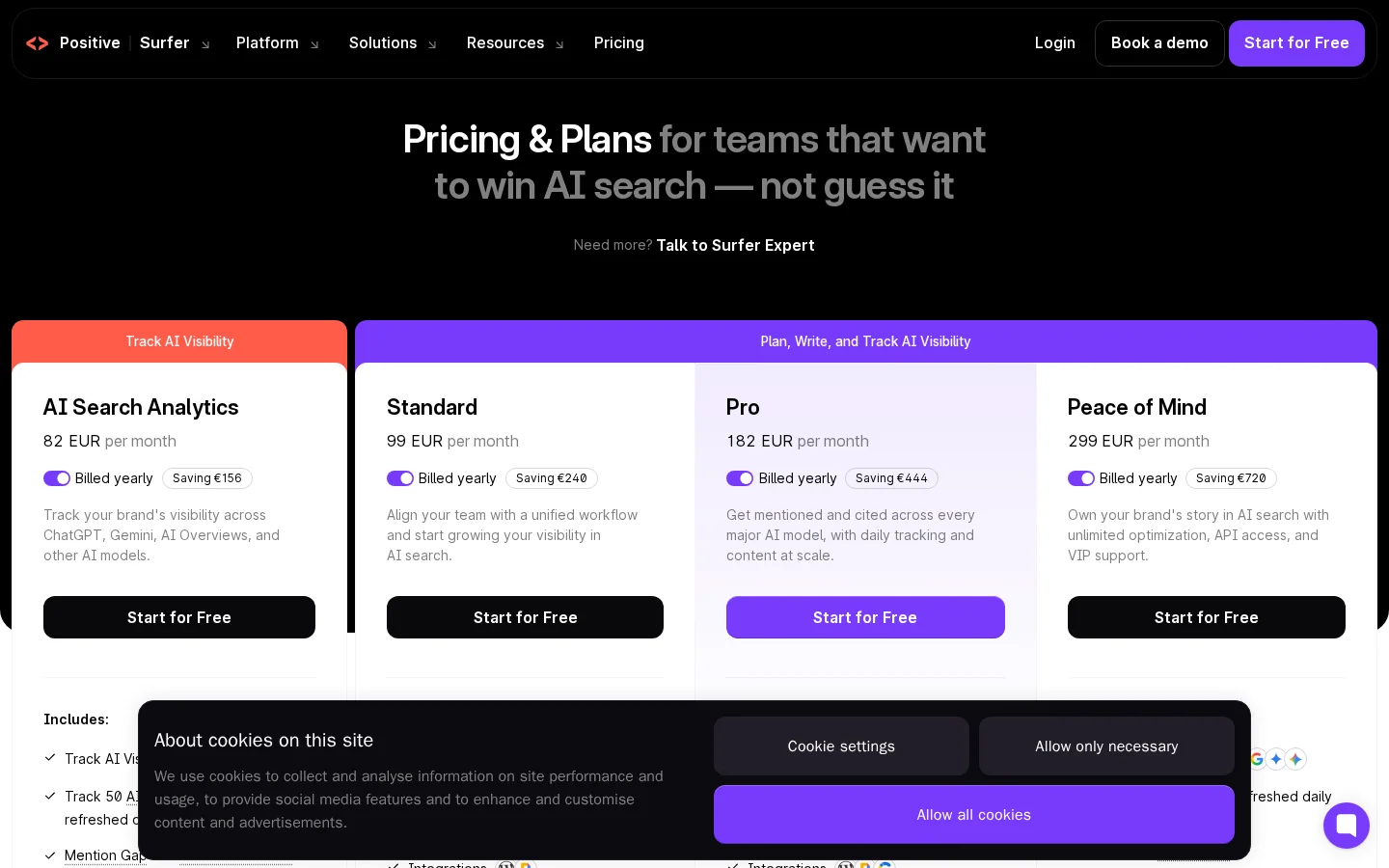
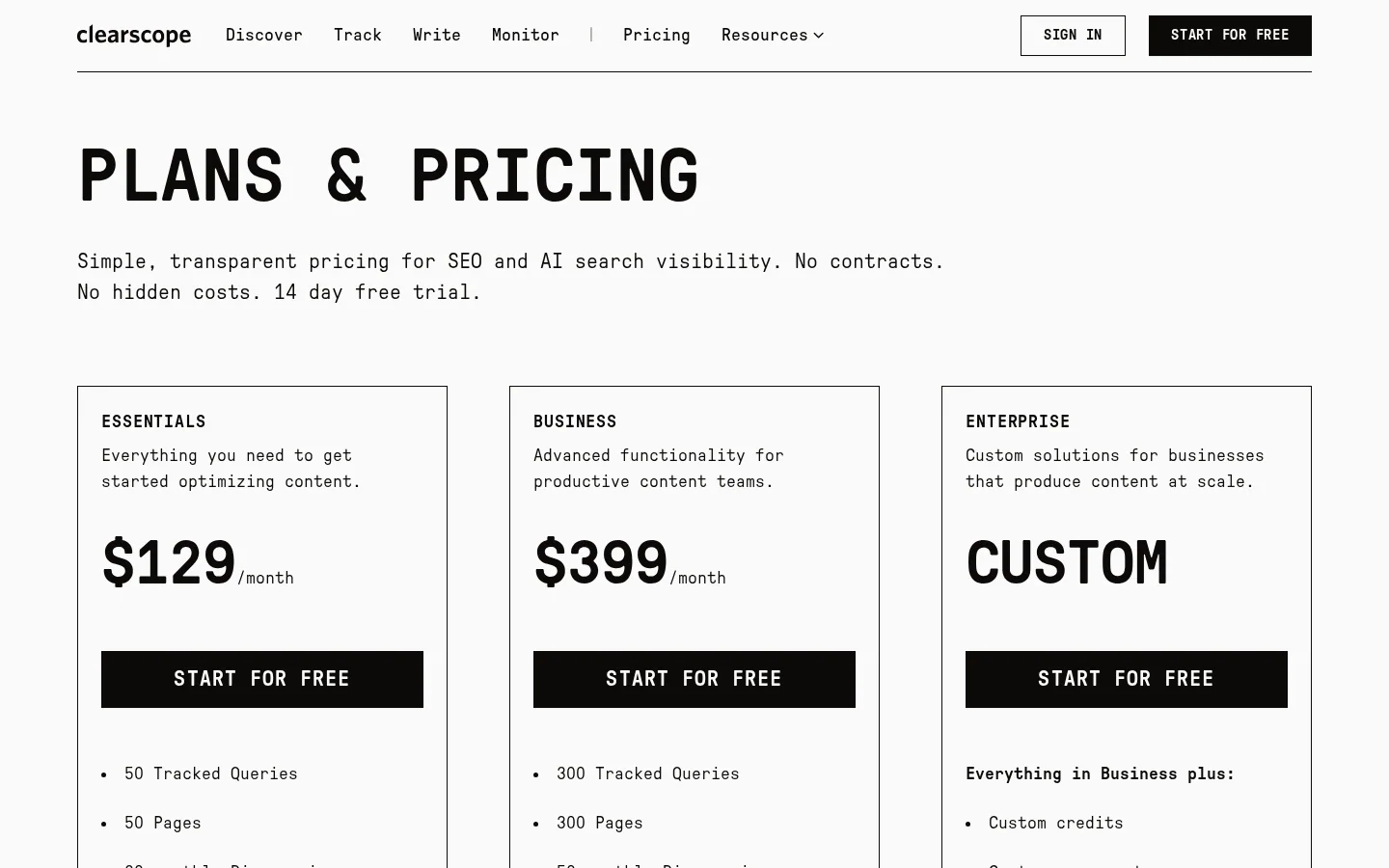
Read the limits next to each price. Clearscope's Essentials plan includes 50 pages, 20 keyword discoveries and 20 drafts per month. Business raises the page count to 300 and the discoveries to 50, and keeps 20 drafts. Surfer's plans count different things, such as tracked pages, AI documents and team seats, so match those units to your workload instead of comparing the headline price alone.
A monthly price is easy to compare. What matters more is the cost of each piece of output. Divide the monthly price by the number of drafts you will actually use:
cost per draft = monthly plan price / drafts used per monthOn Clearscope's Essentials plan, using all 20 drafts gives $129 / 20 = $6.45 per draft. If you use only 10 drafts, the same plan costs $129 / 10 = $12.90 per draft. The plan that looks cheapest per month can be the most expensive per draft if you leave its allowance unused. Run the same calculation for each plan you consider, with the drafts you expect to use in a normal month.
Clearscope offers a 14-day free trial, so you can run it on one of your own pages before you pay. The Surfer pricing page I read has "start for free" buttons on each plan but does not state a trial length, so ask Surfer or check the signup flow before you plan around one. Whichever tool you test, use a page you already know well. You will notice a wrong suggestion faster on a page you have read many times.
There are three common ways to use these tools, and most teams mix them up without noticing. Score chasing means you edit until the number goes up. Gap reading means you use the tool as a list of what the top pages cover, then decide what your page needs. Brief first means the tool produces a brief, a writer drafts from it, and the tool checks the finished draft. Each method has a place, and each has a failure mode.
Principle: the score is the target. You rewrite until the page reaches the level the tool recommends.
Use it when: you are refreshing an old page that has lost ground, and you need a clear, measurable goal for an editor who has little time.
Advantage: it is fast and easy to explain to a writer. Nobody argues about whether the page is finished.
Limit: the score measures closeness to competitors, not usefulness to a reader. Pages that chase it tend to sound alike.
Example (hypothetical): a page scores 62, and the tool asks for more coverage of "pricing" and "free trial". The writer adds three paragraphs that repeat the pricing page almost word for word. The score rises to 80, and the page now says less than it did before.
Principle: the tool shows you what the top pages cover. You decide which of those topics your page needs, and which it can skip because your angle is different.
Use it when: you are writing a new page and you have a point of view worth defending.
Advantage: you keep your angle, and you still see the subtopics that readers expect.
Limit: it takes longer, and it needs an editor who can judge the output. A junior writer may copy every gap the tool shows.
Example (hypothetical): the tool flags "free trial" as a missing topic. You check the top five pages and see that only two mention it. You decide to answer the question in one paragraph, since the trial length is the only fact a buyer needs from that section.
Principle: the tool builds the plan before anyone writes. The brief lists headings, subtopics and terms. The writer drafts from it, and the tool checks the finished text against the same list.
Use it when: several writers work on the same site, or the topic is large enough that structure matters more than wording. Our guide to content briefs shows what a good brief contains.
Advantage: the structure stays consistent across writers, and the final check catches gaps.
Limit: a brief that is too strict makes every article read the same. Keep the brief to outcomes, meaning what the reader should learn, and leave the wording to the writer.
Example (hypothetical): the brief asks for a comparison table, a pricing section and a step-by-step method. The writer decides the order and the examples, and the tool confirms that the table and the steps are there.
| Method | Core idea | Best when | Main advantage | Main risk |
|---|---|---|---|---|
| Score chasing | Reach the target score | Fast refresh of an old page | A clear finish line | Pages sound alike |
| Gap reading | Choose from the gaps | A new page with its own angle | Keeps your point of view | Slower, needs judgement |
| Brief first | Plan before drafting | Several writers, one standard | Consistent structure | The brief becomes a script |
Score chasing or gap reading?
Note
A content score summarizes the pages you compared against. It is not a ranking formula, and a high score does not promise a higher position.
To optimize one page, check the search intent first, then use the tool's data to find gaps, then edit by reading the page. Keep that order. If you start with the score, you will optimize for the tool and not for the person who reads the page.
Search your keyword in a private browser window and note what the top five results are. Are they guides, comparisons, product pages or lists of tools? If most of them are comparisons and your page is a tutorial, the tool will push you toward the wrong structure. Write down the page type before you open the tool.
Both tools choose the competitor pages for you, and the choice is not always right. Remove forum threads, dictionary entries, outdated posts and sites that do not serve the same reader. Keep the pages that would satisfy the same question. Five good pages give better targets than ten mixed ones, and the rerun after cleaning will show different terms.
Use the range the tool shows, not its average. If the top pages run from 1800 to 3600 words, the average of 2700 hides the reason some pages are long. Check which sections the long pages add. If they add a pricing table and a setup guide, and your page has no need for either, you can stay near the short end of the range and still cover the question fully.
Write your H2s from the reader's questions, then compare them with the competitor headings. Keep the competitor headings that match the questions you want to answer, and drop the rest. An outline that copies the tool's list heading for heading usually reads like everyone else's.
Write the full draft without looking at the term list. Then check the list. For each missing term, ask whether a reader would benefit from it in that section. If yes, add one sentence. If no, skip it. Never add a term to a sentence only to satisfy the tool.
Tip
Before you open any optimizer, write a brief. Our free AI content brief generator builds a complete SEO brief from a keyword in seconds, and you can use it as the starting point for the outline above.
Read the page out loud, or ask someone else to read it to you. Mark any paragraph that repeats a point, any sentence that only fills space and any term that appears in a list with no context. Cut them. A shorter page that answers the question usually beats a long page padded with terms.
Rerun the tool after you publish, and again a month later. The top results change, so the target moves with them. Compare rankings and clicks for the page over the same period in Google Search Console. If the page does not move after two or three months, the cause is more often the search intent or the internal links than the term list.
Before you publish
Choose Surfer SEO if one person runs SEO across several sites and wants analysis, drafting and tracking in one place. Choose Clearscope if writers need one grade to work toward and the team wants a shorter learning curve. Neither choice is wrong. The costly mistake is buying for features you might use one day and paying for them every month.
| Team | Lean toward | Why |
|---|---|---|
| Solo creator, a few articles a month | Clearscope | One grade, and a 14-day trial to test on your own page first |
| SEO team or agency, many sites | Surfer SEO | SERP analysis and team features across sites |
| Writers working from an SEO lead's brief | Either | Choose the tool your editor already uses, so the scores mean the same thing to everyone |
A solo creator publishing a few articles a month usually needs one clear list of what to add. Clearscope's grade and its free trial make it easy to test on a page you already have. Check the drafts and pages allowance against how many pages you will really optimize each month, not how many you hope to.
If you manage many sites or many keywords, the SERP analysis and team features of Surfer are more useful. Compare the plans by the units you use, such as tracked pages or AI documents, and by the seats you need. Do not assume the cheapest plan covers your workload, because the cheapest plan is often the one with the smallest limits.
If a writer receives a brief from an SEO lead, the tool's main job is to check the finished draft against that brief. Either tool can do that. Choose the one your editor already uses, so that a score means the same thing to the writer and the reviewer.
Example
A two-person team publishes four articles a month and has one editor. For that workload, Clearscope's 20 drafts per month and its single grade may cover the need. A team that runs SEO for five client sites and needs SERP analysis for each keyword should compare plans for that scope before choosing.
Most mistakes come from one habit: treating the tool's output as the goal. The fixes below all bring the reader back to the centre of the work, which is where the tool's suggestions should be judged.
What it is: you keep editing until the score is high, even when the text gets worse.
How to spot it: the page reads like the competitors, and one or two sentences repeat the same idea with different terms.
How to fix it: read the page with the tool closed. Ask what a reader learns in each section. Remove any paragraph that exists only to hit a term.
What it is: the tool asks for a term, and you add it several times, often in a list or in a sentence where it does not fit. Google's spam policies describe keyword stuffing as filling a page with keywords or numbers, often in a list or group, unnaturally or out of context. The same page gives no density threshold, so a percentage is not the test.
How to spot it: the same term appears in the title, the first paragraph, several H2s and a bulleted list within one section.
How to fix it: keep each term where a reader would use it, usually once per section. Replace repeats with a pronoun, a synonym or a concrete example.
What it is: the tool includes pages that are off topic, outdated or thin, so its targets pull you toward weak content.
How to spot it: the suggested headings include odd subtopics, or the length target sits far above what the best pages in your niche do.
How to fix it: remove the outliers, rerun the analysis and compare the result with a manual read of the top five pages.
What it is: you write a guide for a keyword people search to buy, or a product page for a question people ask to learn.
How to spot it: the top results are a different type of page from yours, and the tool's headings do not match what you sell.
How to fix it: change the page type before you change any term. A comparison and a guide need different structures, even when they share a keyword.
What it is: the page exists to satisfy a checker, not to help a reader. Google's guidance on creating helpful content asks for content "created primarily for people, and not to manipulate search engine rankings".
How to spot it: you cannot name one thing a reader learns from your page that they could not learn from the top result.
How to fix it: add one piece of information the other pages lack, such as a real test, a price check you ran yourself or a worked example.
What it is: you analyze the SERP once, write to that snapshot and never check again.
How to spot it: the page was written months ago, and the top results have since changed.
How to fix it: rerun the analysis before any refresh, and treat each result as a snapshot of one day, not a permanent target.
Stuffed heading vs natural heading
Surfer SEO and Clearscope are tools you run yourself: you pick the keyword, read the output and do the editing. Sorank works differently. It writes, publishes and refreshes articles on your site, and for older pages its content optimization feature rewrites them on autopilot. If you want a tool that does the editing as well as the analysis, compare it with the two tools above. If you prefer to edit yourself, the methods in this guide work with any optimizer.
If the idea behind these tools is new to you, read the semantic SEO definition first. It explains why the tools look for meaning and related subtopics, not only for the exact keyword.
| If you need | Look at |
|---|---|
| Analysis across several sites, with drafting in the same tool | Surfer SEO |
| One clear grade for writers, and a 14-day trial first | Clearscope |
| Older pages rewritten and refreshed with less manual work | Sorank content optimization |
Prices and trial terms change. Check both pricing pages on the day you buy, and compare the same billing period before you decide.
Neither is better for every team. Surfer SEO is the wider toolkit, with SERP analysis, AI drafts and team workspaces. Clearscope is narrower, with one content grade and a 14-day free trial.
Clearscope's pricing page lists its Essentials plan at $129 per month and its Business plan at $399 per month. Surfer's pricing page lists euro prices billed yearly, starting at €49 per month for its Discovery plan.
No. They show what the pages ranking now have in common, which reduces guesswork but does not guarantee a position. Google says content should be created primarily for people, not to manipulate rankings.
We analyse your competitors, your website and your AI visibility to create a tailored content plan for free.
 Duplicate Content Checker
 Mobile-Friendly Test
 Website Speed Test
 Subdomain Finder
 Domain Age Checker
 CMS Detector
 Googlebot Simulator
 Nofollow Link Checker
 Meta Tag Checker
 Keyword Cannibalization Checker
 Keyword Intent Checker
 Keyword Extractor
 Google Ads Cost Calculator
 CPC Calculator
 Local Citation Finder
 Reddit Threads Finder
 Disavow File Generator
 Redirect Generator
 Canonical Tag Generator
 Passive Voice Checker
 Google Location Changer
 Google Review Calculator
 Google Review Link Generator
 Keyword Combiner
 Podcast Show Notes Generator
 AI Content Rewriter
 AI Text Humanizer
 ChatGPT Prompt Generator
 Twitter Thread Generator
 Tweet Generator
 Landing Page Copy Generator
 Google Ads Copy Generator
 Pinterest Pin Description Generator
 Anchor Text Generator
 Social Media Post Generator
 LinkedIn Post Generator
 Free AI Writer
 Review Response Generator
 LSI Keyword Generator
 YouTube Video Ideas Generator
 YouTube Tag Generator
 YouTube Description Generator
 Product Description Generator
 CTA Generator
 Blog Introduction Generator
 Conclusion Generator
 Hook Generator
 AI Content Brief Generator
 FAQ Schema Generator
 AI Blog Post Ideas Generator
 Structured Data Validator (Schema Validator)
 Alt Text Checker
 Internal Link Analyzer
 Backlink Challenge
 AI Meta Description Generator
 AI Blog Title Generator
 Google Indexability Checker
 AI Blog Outline Generator
 UTM Link Builder
 Keyword Clustering Tool
 Canonical Tag Checker
 XML Sitemap Generator
 Broken Link Checker
 AI SEO Title Generator
 Headline Analyzer
 SERP Preview Tool
 Redirect Checker
 Hreflang Tag Generator
 Heading Structure Analyzer
 HTTP Headers Checker
 Favicon Extractor
 SERP CTR Calculator
 SEO vs Paid Search Savings Calculator
 SEO Share of Voice Calculator
 SEO ROI Calculator
 SEO Traffic and Revenue Forecast Calculator
 SEO Budget Calculator
 SEO Break-Even Calculator
 SaaS SEO ROI Calculator
 ROAS Calculator
 Reading Time Calculator
 Ranking Gain Simulator
 Organic Traffic Value Calculator
 Organic Traffic Estimator and Website Traffic Checker
 LTV to CAC Ratio Calculator
 Local SEO ROI Calculator
 Link Building Cost Calculator
 Keyword Value Calculator
 Keyword Opportunity Score Calculator
 Keyword Density Calculator
 GEO ROI Calculator
 GEO Content Investment Calculator
 Ecommerce SEO ROI Calculator
 Customer Lifetime Value Calculator
 Customer Acquisition Cost Calculator
 CTR Calculator
 Cost Per Article Calculator
 Conversion Rate Calculator
 Content Marketing ROI Calculator
 ChatGPT Referral Traffic Estimator
 Bounce Rate Calculator
 Backlink ROI Calculator
 AI Visibility Score Calculator
 AI Traffic Value Calculator
 AI Share of Voice Calculator
 Cost of AI Invisibility Calculator
 AI Citation Rate Calculator
 llms.txt Validator
 AI Overview Checker and AI Overviews Rank Checker
 Robots.txt Checker
 AI SEO Audit
 LLM Readability Checker
 SearchGPT Readiness Checker
 Structured Data LLM Audit
 Website Crawlability AI Audit
 Why ChatGPT Is Not Recommending My Website
 Gemini Ranking Tool
 Perplexity Ranking Checker
 LLM Citation Checker
 Answer Engine Optimization Audit
 GEO Audit
 AI Search Visibility Test
 ChatGPT Visibility Checker
 llms.txt Generator
 URL Extractor
 Webpage to Markdown
 Sitemap Checker
 SERP Volatility Sensor
 Page Size Checker
 Word Counter
 Slug Generator
 Schema Generator
 Robots Generator
 OG Preview
 Meta Tags Generator
 Image Compressor
 Favicon Generator
 On-Page SEO Audit: SEO Checker and SEO Analyzer
 Backlink Analysis Tool
 Keyword Research Tool
 Domain Authority Checker
 “I tested Sorank on a real client site and it's insane. It does everything an agency would bill you $1500 a month for. It's going into production on that client now.”

 Guillaume Guersanguersanguillaume.com“We are an Ads agency and we wanted to get our SEO back on track once and for all. Sorank gave us a clear view of our site, helped us prioritize optimizations, and properly structure our content. The tool is easy to use, well designed for a team, and very practical for centralizing tracking without having to juggle multiple platforms. A very solid foundation to start fresh with our SEO.”
 Gaspard MadouiAds Agency
 “I just let the Sorank software do its thing, and now my DR is 25 and my page is ranking higher.”
 Lucas Flandrefoundertrace.fr“I specialized in GEO thanks to Sorank. The GEO Leaderboard allows me to show my clients their position vs competitors on ChatGPT. It’s a real commercial differentiator.”
 MélanieSEO Freelance“Great service, works well for our website and helps us understand how to improve it to rank better on Google and elsewhere. Congrats, keep going, I recommend it.”
 Hugo T.E-commerce merchant