Preferences
Privacy is important to us, so you have the option of disabling certain types of storage that may not be necessary for the basic functioning of the website. Blocking categories may impact your experience on the website. More information
Privacy is important to us, so you have the option of disabling certain types of storage that may not be necessary for the basic functioning of the website. Blocking categories may impact your experience on the website. More information

Compare MarketMuse and Clearscope on scores, topic coverage, 2026 pricing and workflow, then choose the right tool and test it on one page you own.
In short
MarketMuse and Clearscope are content optimization tools that show which terms or topics a page lacks compared with pages that already rank. Clearscope grades a page against the top results for one keyword. MarketMuse builds a topic model of roughly 50 related topics and gives a 0 to 100 Content Score. Test both on one page you own before buying.
Want to go further? Ask
Quick quiz
Which way of writing with AI is right for you?
Sorank matches your answers


Test it for 3 days on your own site and see where you stand on Google, ChatGPT and the other AIs.
Start 3-day free trial3 days free, then stop whenever you want. 90-day results guarantee, conditions apply.
Both tools answer one question: which topics or terms do the pages that rank use, and does your page use them too? They do not measure your rankings directly. They read a set of reference pages, extract what those pages contain, and show what your page leaves out. The two products differ in what they extract and in how they turn it into a score.
You enter a target keyword, and Clearscope analyzes the pages that rank for it. It collects the terms and entities that recur across them and weights each one by how often it appears. Its Terms list gives each term an importance from 10 (must include) to 1 (least important). When you use a term in your draft, the editor highlights it, ticks it off and updates the grade in real time. The grade reflects how comprehensive and relevant your writing is against the top-ranking pages, as Clearscope's support article on grades (undated) explains.
MarketMuse starts from a focus topic rather than from a list of terms. It builds a model of about 50 related topics, then checks how many times and how well your page covers each one. Because the model is a map of the subject, you can read it before you write a word. That makes it useful for planning a brief, not only for scoring a finished draft. The output is only as good as the reference data behind it, so check the model's topics against the search results yourself.
Neither tool tells you whether a paragraph reads well, whether the page matches the search intent, or whether anyone will link to it. The scoring counts topic mentions and does not judge whether the surrounding writing is coherent. A page can cover every topic on the list and still fail its reader. Use these tools as a coverage check, after you know the question the reader is asking. The concept behind both is content gap analysis: find what the pages ranking above you cover and yours does not.
For a wider view of the market, our guide to eight content optimization tools compares many products. This article takes two of them and goes into how their scores are calculated.
| Question | Clearscope | MarketMuse |
|---|---|---|
| Reference set | Pages that rank for one keyword | A focus topic and its related topic model |
| Unit of guidance | Terms and entities, each weighted | Topics, with mentions counted |
| Main output | A grade and a Terms list | A Content Score from 0 to 100 |
| Best first use | Improving one draft | Planning several pages on one subject |
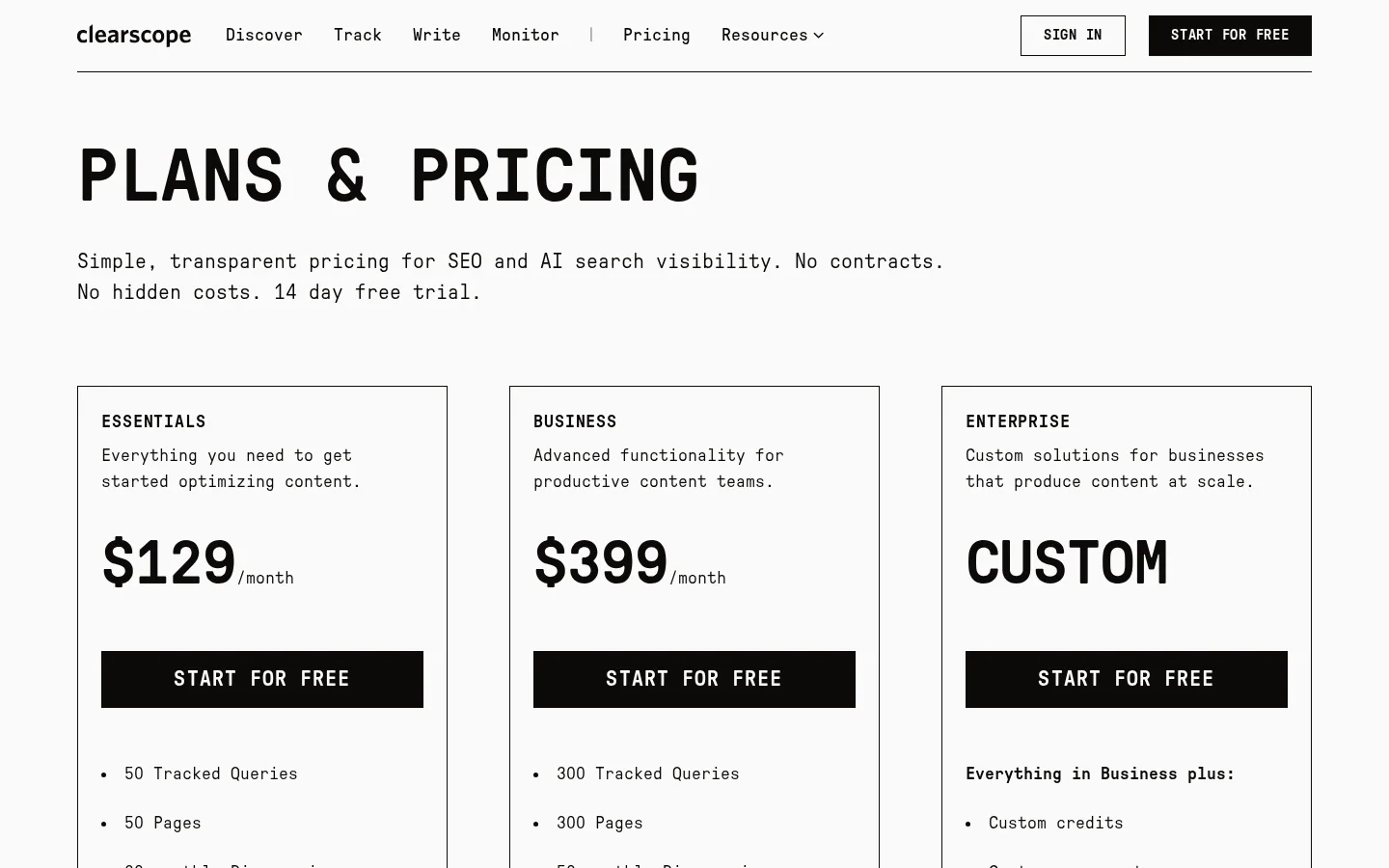
Clearscope publishes its prices, and MarketMuse does not. The Clearscope pricing page, checked on 21 November 2026, lists Essentials at $129 a month and Business at $399 a month, with a 14 day free trial. Enterprise is priced on request.
Warning
Prices change, and the Clearscope page has no effective date. Treat $129 and $399 as the figures of 21 November 2026, and confirm them on the pricing page before you buy. Aggregator sites often show older numbers.
Clearscope at a glance, as listed on its pricing page
Source: Clearscope pricing page, checked 21 November 2026
The plans also set monthly limits. Essentials includes 20 discoveries and 20 drafts a month, with 50 tracked queries and 50 pages. Business raises these to 50 discoveries, 20 drafts, 300 tracked queries and 300 pages. The page lists users as unlimited on all three plans, so check the add-on table before you assume that holds for your team.
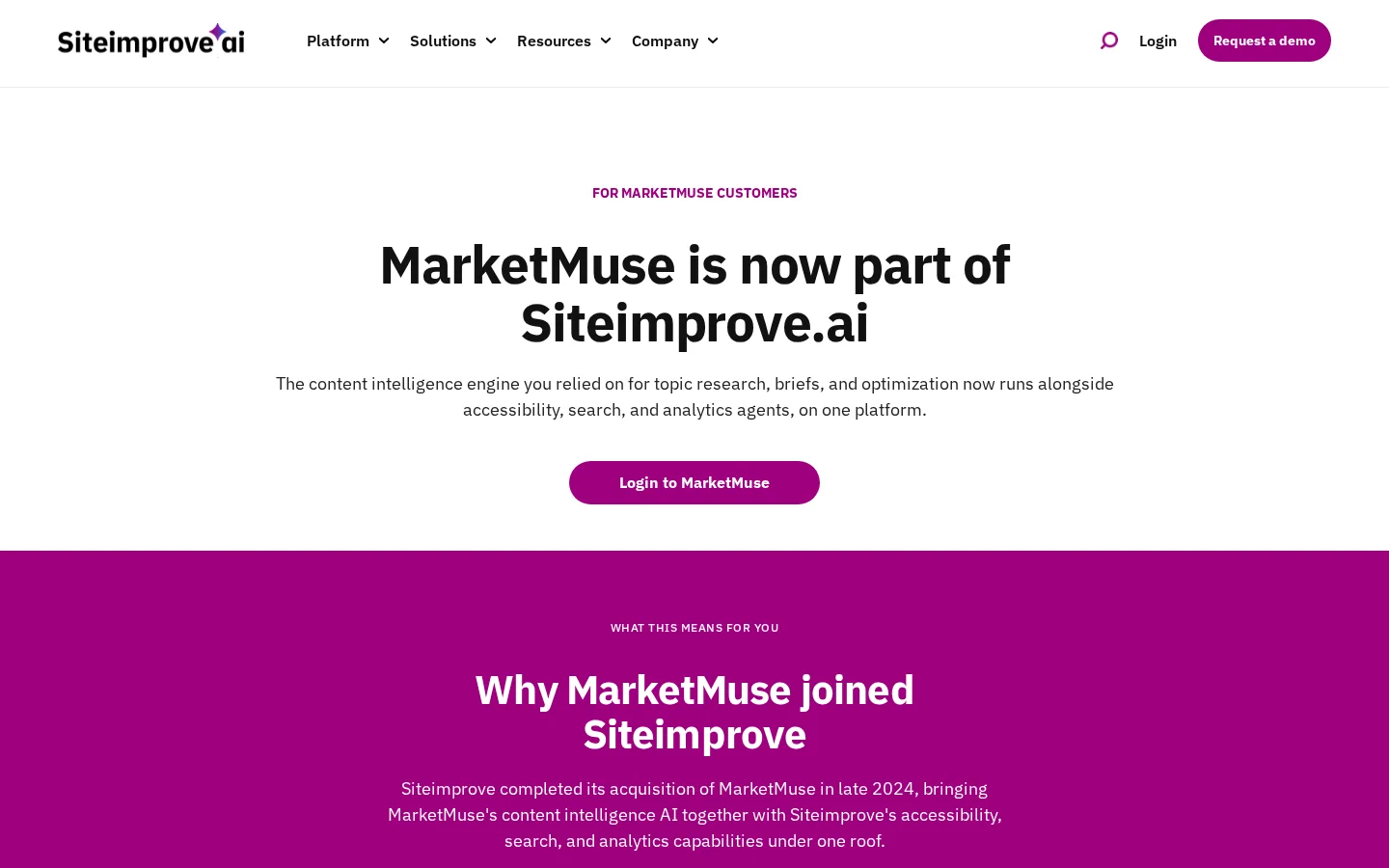
MarketMuse is harder to price. Its old pricing address now redirects to a Siteimprove page. Siteimprove says it completed its acquisition of MarketMuse in late 2024, and the page presents MarketMuse as part of its content strategy agents without listing plan prices. Third-party listings still show tiers called Optimize, Research and Strategy, but their figures disagree with each other, so this article does not quote them.
List price is the wrong number to compare. Divide the monthly price by the volume you will really use. On Clearscope Essentials, 50 pages at $129 a month works out to about $2.58 per page per month, if you use every page slot. Your real figure depends on how many pages you refresh and how many drafts you generate, so write those two numbers down before you request a quote or start a trial.

Clearscope gives you a grade that rises as you add the recommended terms. MarketMuse gives you a number from 0 to 100 that counts topic mentions. The two outputs are not comparable. If a manager asks why one tool says a B and the other says 72, the honest answer is that they measure different things.
The grade measures relevance and comprehensiveness against the top results. Clearscope's support article says that including more of the suggested terms raises the grade. It does not describe a letter scale or a weighting formula, so you cannot reproduce a grade by hand. What you can control is which suggested terms you skip, and why. Write that reason in your brief, so the next editor knows it was a choice and not an oversight.
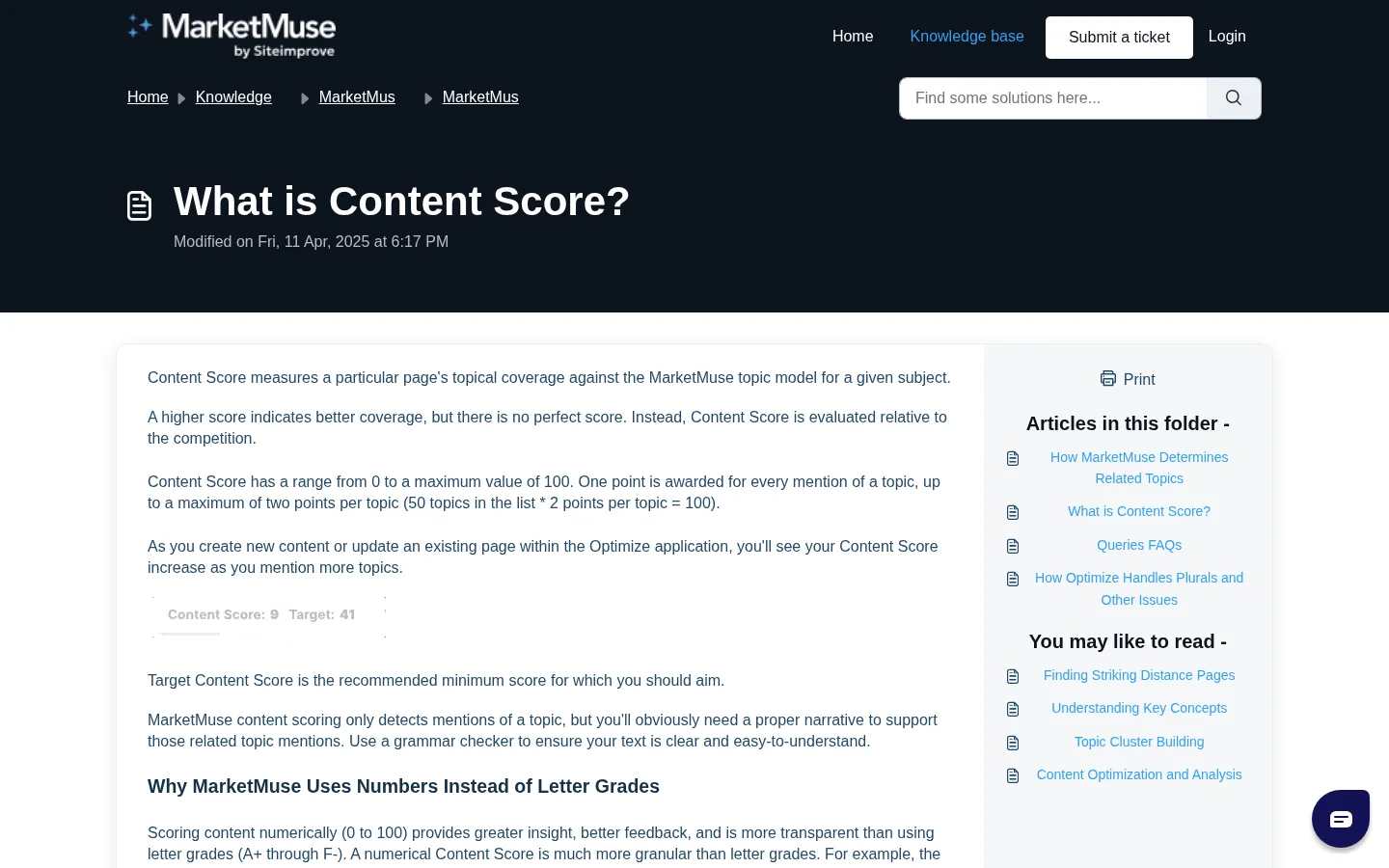
MarketMuse publishes its arithmetic. Its help article on Content Score, last modified on 11 April 2025, says each topic earns one point per mention, up to a maximum of two points per topic. With 50 topics in the list, the ceiling is 100.
content score = sum over the 50 topics of min(mentions, 2)
maximum       = 50 topics x 2 points = 100
The formula is more useful than the total. A page that mentions 30 of the 50 topics twice each scores 60, and the 20 topics it skips are where the remaining points are. Sort those missing topics by search intent, not by how easy they are to add. One topic that answers the reader's real question is worth more than three that only lift the number.
Note
Because each topic stops counting after two mentions, repeating a term does not push the score past its ceiling. The score measures coverage, not how well a topic is explained.
A content score measures coverage against a reference set, and that reference set is made of the same pages you compete with. In its study of content scores, written by Si Quan Ong and last updated on 21 May 2025, Ahrefs tested 20 random keywords across five content tools, including Clearscope, and found "weak correlations everywhere" between the scores and Google rankings. A score works as a checklist, not as a promise. For the wider picture of checking a whole article, see our semantic SEO audit.
The dates behind the facts in this article
Sources: Siteimprove, MarketMuse help center, Ahrefs, Clearscope pricing page
There are three practical ways to find what your page is missing. You can read the top results yourself, use a term list like Clearscope's, or use a topic model like MarketMuse's. Each one shows a different kind of gap, so pick the method by the question you need answered, not by the tool you already pay for.
The principle is simple. Open the top five to ten results, list the subtopics each one covers, and write down the questions in the "People also ask" box. Use this method when the keyword is new to you, when you do not yet know the search intent, or when you have no budget for a tool. Its advantage is that you see the intent directly, including the format of the pages that rank, such as a comparison table or a step list. Its limit is consistency: two people reading the same results will not list the same subtopics. The pages we read for this article compare features, cost and ease of use, which gives you a structure before any tool runs.
The principle is to collect the terms that recur across the top pages and check which ones your draft uses. Clearscope does this inside its editor, with a weight for each term and a live grade. Use this method when you write one page and want a checklist while you type. Its advantage is speed: you see missing terms as you write, not after. Its limit is that it pulls every page toward the same vocabulary, so the draft risks sounding like its competitors. To understand how search engines and AI systems read that text, our NLP SEO guide is the next read. For this keyword, a term list would likely surface words such as "topic model", "content score" and "brief", which your article needs anyway. It will not tell you how to explain them.
The principle is to build a model of the related topics for one focus topic, then count how often your page covers each one. MarketMuse works this way, with a model of about 50 topics and a score from 0 to 100. Use it when you plan several pages around one subject, because the model shows related topics you had not thought of and helps you split them across pages. Its limits are that it counts mentions without judging quality, and that its current pricing is not public. For example, if your focus topic is "content optimization" and the model has 50 topics, a page that covers 36 of them leaves 14 gaps. Two of those gaps may match what your readers ask, so they go into the draft. The other twelve can wait for a later article or a different page.
| Method | What it reads | Best for | Main limit |
|---|---|---|---|
| Manual reading | The top 5 to 10 pages and their questions | New keywords and unclear intent | Slow, and two readers disagree |
| Term list | Recurring terms in the top pages, weighted | Checking one draft while you write | Pulls every page toward the same vocabulary |
| Topic model | Related topics for one focus topic | Planning several pages on one subject | Counts mentions, not quality |
The two tools overlap more than their positioning suggests. Both score a draft against a reference set, and both offer some form of brief or draft generation. The differences show up in what each one feeds into those features, and in how open each one is about its plans.
| Feature | Clearscope | MarketMuse |
|---|---|---|
| Term or topic guidance | Terms list, weighted from top results | Topic model of about 50 topics |
| Score | A grade that rises as you add terms | Content Score from 0 to 100 |
| Drafts | Drafts tool, 20 a month on Essentials | Brief-to-draft workflow, per the Siteimprove page |
| Public pricing | Yes, with a 14 day free trial | No plan prices on the page we checked |
| Page limits | 50 pages on Essentials, 300 on Business | Not stated on the page we checked |
Tip
Before you run either tool, get a baseline. The free content brief generator lists the sections and questions a page needs, so you can score your draft against that list as well as against the tool's list.
Choose Clearscope if you write one page at a time, want a term list while you type, and need prices you can read before you talk to anyone. It offers a 14 day free trial, so you can test it on your own page first. Choose MarketMuse if you plan a cluster of pages on one subject and want the related topics before anyone writes a word, and if a conversation with sales is acceptable for pricing.
Three questions decide most cases. How many pages will you optimize each month? Do you plan around a subject or around single keywords? Do you need the price on a page before you talk to sales? If your answers are "many, a subject, and yes", the choice is simple. If they are mixed, run the test in the next section on the same page with both tools.
Pick by situation
Take one page you already rank with, or want to rank with, and run both tools on it. Compare what each one asks you to add. The test takes an afternoon, and it costs nothing if you use the free trial. The steps below keep the comparison fair.
The 5-step test
Step 2 is the one most people skip. A score without a date cannot show progress. Step 3 is the editing rule: a missing term earns its place only when it answers a question. Step 4 is where you cut. If a paragraph exists only to contain a term, delete it.
To count how often your draft mentions a term, export the page as plain text and run the loop below in a terminal. It mirrors the mention count behind a topic score in a crude way. It misses synonyms, and it cannot tell a useful mention from a filler one.
for term in "content brief" "search intent" "topic model"; do
  printf "%s: " "$term"
  grep -oi "$term" draft.txt | wc -l
done
If you do not have a brief for the page yet, write one first. Our content brief guide gives a template you can fill in before you open either tool.
Most mistakes come from treating a score as the goal. The six below waste the most time, and each one has a check you can run in ten minutes.
What it is. You add every missing term until the grade or the score stops moving, even when a term makes a sentence awkward. How to spot it. Sentences that list two or three terms in a row, or an introduction that reads like a glossary. How to fix it. Write the section from the reader's question first, then check which listed terms it already covers. Add only the ones that answer something.
What it is. The reference set includes pages that do not match your intent, such as forums, product pages or a brand homepage, and their vocabulary pulls your page off course. How to spot it. A term list that mixes unrelated subjects, or a score that jumps when you remove one result. How to fix it. Check the intent of each top result. Where the tool lets you exclude a page, exclude the outliers and rebuild the list from the rest.
What it is. Your headings follow the order and phrasing of the top pages, so the article becomes a copy with extra words. How to spot it. Your H2s match a competitor's H2s almost word for word. How to fix it. Write the outline from your own angle, then use the list to check coverage under each heading, not to choose the headings.
What it is. Putting a Clearscope grade next to a MarketMuse score and deciding which one is better. How to spot it. A report that shows two tools' numbers for one page with no shared baseline. How to fix it. Compare each tool against its own history for the same page, and compare the gaps, not the totals.
What it is. The top results change after core updates, and a term list built a year ago points you to pages that no longer rank. How to spot it. The list includes terms from pages that have dropped out of the top results, or topics that barely appear in search anymore. How to fix it. Run the analysis again after a major Google update and after any sharp change in the rankings for your keyword. Checking the topics and intents of the page at the same time, as in a topic and intent check, catches a stale list faster.
What it is. You optimize two of your own pages for the same keyword, and each one loses ground to the other. How to spot it. Both pages appear for the same queries in Search Console, their scores climb, and their clicks fall. How to fix it. Pick one page to own the keyword, merge the other into it or redirect it, and link any remaining page to the one you keep. Do this before you optimize either page further.
Before you trust a score
Sorank does not describe a term grade like Clearscope's or a topic model like MarketMuse's on its public feature pages, so do not expect it to replace either one for editing a single draft. What it does is work on the pages a site already has. Its Content Optimization module checks every page, lists its errors, and chooses a targeted fix or a full rewrite at the same URL based on the Google traffic of each page. The module is in beta.
| Job | Where Sorank's Content Optimization stands |
|---|---|
| Checks titles, descriptions, links, images and structured data on every page | Yes, errors listed page by page |
| Chooses targeted fixes or a full rewrite from Google traffic | Yes, at the same address |
| Merges pages that compete for the same topic | Yes, into one more complete page |
| Finds missing terms or topics in one draft | Not described on the public page, use a term list or topic model for this |
Tip
If you plan a cluster of pages around one subject, the topical cluster generator maps the pages for that subject and builds in protection against pages that compete with each other.
MarketMuse and Clearscope both answer the same question: what does your page leave out? Clearscope answers it page by page with a grade and a term list, and it publishes its prices. MarketMuse answers it for a whole subject with a topic model and a 0 to 100 score, and its pricing now goes through sales.
Use the score to find gaps, then use your reader to decide which gaps matter. If you want the bigger picture before you choose, start with the guide to the topic clusters that both tools are built around, then run the one-page test on a real page.
Neither is better for every team. Clearscope grades one page at a time against the top results and publishes its prices. MarketMuse builds a topic model for a whole subject, which suits planning clusters, and its current plans are not listed on the public pricing page.
The Clearscope pricing page, checked on 21 November 2026, lists Essentials at $129 a month and Business at $399 a month, with a 14 day free trial. Enterprise is priced on request. Confirm the figures on the page before you buy, since prices change.
Not reliably. A content score measures how much of a reference set your page covers. Ahrefs tested five content tools and found weak correlations between their scores and Google rankings, so treat a score as a checklist of gaps.
We analyse your competitors, your website and your AI visibility to create a tailored content plan for free.
 Duplicate Content Checker
 Mobile-Friendly Test
 Website Speed Test
 Subdomain Finder
 Domain Age Checker
 CMS Detector
 Googlebot Simulator
 Nofollow Link Checker
 Meta Tag Checker
 Keyword Cannibalization Checker
 Keyword Intent Checker
 Keyword Extractor
 Google Ads Cost Calculator
 CPC Calculator
 Local Citation Finder
 Reddit Threads Finder
 Disavow File Generator
 Redirect Generator
 Canonical Tag Generator
 Passive Voice Checker
 Google Location Changer
 Google Review Calculator
 Google Review Link Generator
 Keyword Combiner
 Podcast Show Notes Generator
 AI Content Rewriter
 AI Text Humanizer
 ChatGPT Prompt Generator
 Twitter Thread Generator
 Tweet Generator
 Landing Page Copy Generator
 Google Ads Copy Generator
 Pinterest Pin Description Generator
 Anchor Text Generator
 Social Media Post Generator
 LinkedIn Post Generator
 Free AI Writer
 Review Response Generator
 LSI Keyword Generator
 YouTube Video Ideas Generator
 YouTube Tag Generator
 YouTube Description Generator
 Product Description Generator
 CTA Generator
 Blog Introduction Generator
 Conclusion Generator
 Hook Generator
 AI Content Brief Generator
 FAQ Schema Generator
 AI Blog Post Ideas Generator
 Structured Data Validator (Schema Validator)
 Alt Text Checker
 Internal Link Analyzer
 Backlink Challenge
 AI Meta Description Generator
 AI Blog Title Generator
 Google Indexability Checker
 AI Blog Outline Generator
 UTM Link Builder
 Keyword Clustering Tool
 Canonical Tag Checker
 XML Sitemap Generator
 Broken Link Checker
 AI SEO Title Generator
 Headline Analyzer
 SERP Preview Tool
 Redirect Checker
 Hreflang Tag Generator
 Heading Structure Analyzer
 HTTP Headers Checker
 Favicon Extractor
 SERP CTR Calculator
 SEO vs Paid Search Savings Calculator
 SEO Share of Voice Calculator
 SEO ROI Calculator
 SEO Traffic and Revenue Forecast Calculator
 SEO Budget Calculator
 SEO Break-Even Calculator
 SaaS SEO ROI Calculator
 ROAS Calculator
 Reading Time Calculator
 Ranking Gain Simulator
 Organic Traffic Value Calculator
 Organic Traffic Estimator and Website Traffic Checker
 LTV to CAC Ratio Calculator
 Local SEO ROI Calculator
 Link Building Cost Calculator
 Keyword Value Calculator
 Keyword Opportunity Score Calculator
 Keyword Density Calculator
 GEO ROI Calculator
 GEO Content Investment Calculator
 Ecommerce SEO ROI Calculator
 Customer Lifetime Value Calculator
 Customer Acquisition Cost Calculator
 CTR Calculator
 Cost Per Article Calculator
 Conversion Rate Calculator
 Content Marketing ROI Calculator
 ChatGPT Referral Traffic Estimator
 Bounce Rate Calculator
 Backlink ROI Calculator
 AI Visibility Score Calculator
 AI Traffic Value Calculator
 AI Share of Voice Calculator
 Cost of AI Invisibility Calculator
 AI Citation Rate Calculator
 llms.txt Validator
 AI Overview Checker and AI Overviews Rank Checker
 Robots.txt Checker
 AI SEO Audit
 LLM Readability Checker
 SearchGPT Readiness Checker
 Structured Data LLM Audit
 Website Crawlability AI Audit
 Why ChatGPT Is Not Recommending My Website
 Gemini Ranking Tool
 Perplexity Ranking Checker
 LLM Citation Checker
 Answer Engine Optimization Audit
 GEO Audit
 AI Search Visibility Test
 ChatGPT Visibility Checker
 llms.txt Generator
 URL Extractor
 Webpage to Markdown
 Sitemap Checker
 SERP Volatility Sensor
 Page Size Checker
 Word Counter
 Slug Generator
 Schema Generator
 Robots Generator
 OG Preview
 Meta Tags Generator
 Image Compressor
 Favicon Generator
 On-Page SEO Audit: SEO Checker and SEO Analyzer
 Backlink Analysis Tool
 Keyword Research Tool
 Domain Authority Checker
 “I tested Sorank on a real client site and it's insane. It does everything an agency would bill you $1500 a month for. It's going into production on that client now.”

 Guillaume Guersanguersanguillaume.com“We are an Ads agency and we wanted to get our SEO back on track once and for all. Sorank gave us a clear view of our site, helped us prioritize optimizations, and properly structure our content. The tool is easy to use, well designed for a team, and very practical for centralizing tracking without having to juggle multiple platforms. A very solid foundation to start fresh with our SEO.”
 Gaspard MadouiAds Agency
 “I just let the Sorank software do its thing, and now my DR is 25 and my page is ranking higher.”
 Lucas Flandrefoundertrace.fr“I specialized in GEO thanks to Sorank. The GEO Leaderboard allows me to show my clients their position vs competitors on ChatGPT. It’s a real commercial differentiator.”
 MélanieSEO Freelance“Great service, works well for our website and helps us understand how to improve it to rank better on Google and elsewhere. Congrats, keep going, I recommend it.”
 Hugo T.E-commerce merchant