Preferences
Privacy is important to us, so you have the option of disabling certain types of storage that may not be necessary for the basic functioning of the website. Blocking categories may impact your experience on the website. More information
Privacy is important to us, so you have the option of disabling certain types of storage that may not be necessary for the basic functioning of the website. Blocking categories may impact your experience on the website. More information

Learn how HARO works today and how to write a HARO pitch that gets quoted: structure, template, 5 strategies, real examples and the mistakes to avoid.
In short
A HARO pitch is a short email reply to a journalist's request on Help a Reporter Out, the free service that matches reporters with expert sources. To get picked, answer the exact question within the first hour, lead with your credential, give one quotable insight with proof, and stay under 200 words.
Want to go further? Ask
Quick quiz
Is SEO right for you, and how should you start?
Sorank matches your answers


Test it for 3 days on your own site and see where you stand on Google, ChatGPT and the other AIs.
Start 3-day free trial3 days free, then stop whenever you want. 90-day results guarantee, conditions apply.
A HARO pitch is your answer to a "query", a request a journalist posts when they need an expert quote, a data point or a real example for a story. You do not pitch your own story idea. You answer their question, in their format, before their deadline. If they use your answer, you get a quote in the article, often with your name, title, company and sometimes a link to your site.
The mechanics are simple. Journalists submit a query with a topic, a short description, the requirements (credentials, location, word count) and a deadline. HARO groups these queries by category and sends them to sources by email. You read the digest, pick the queries you can answer with real expertise, and reply to the anonymous address attached to each one. The journalist receives dozens of replies, keeps a few, and publishes the ones that fit the story.
According to the HARO page for sources, you can "sign up to receive three daily HARO emails featuring journalist requests across a variety of topics and industries", and when a request matches your expertise you "submit a short, insightful response that helps the journalist with their story". Signing up as a source is free. The service is financed by advertising inside the newsletter, not by pitch credits.
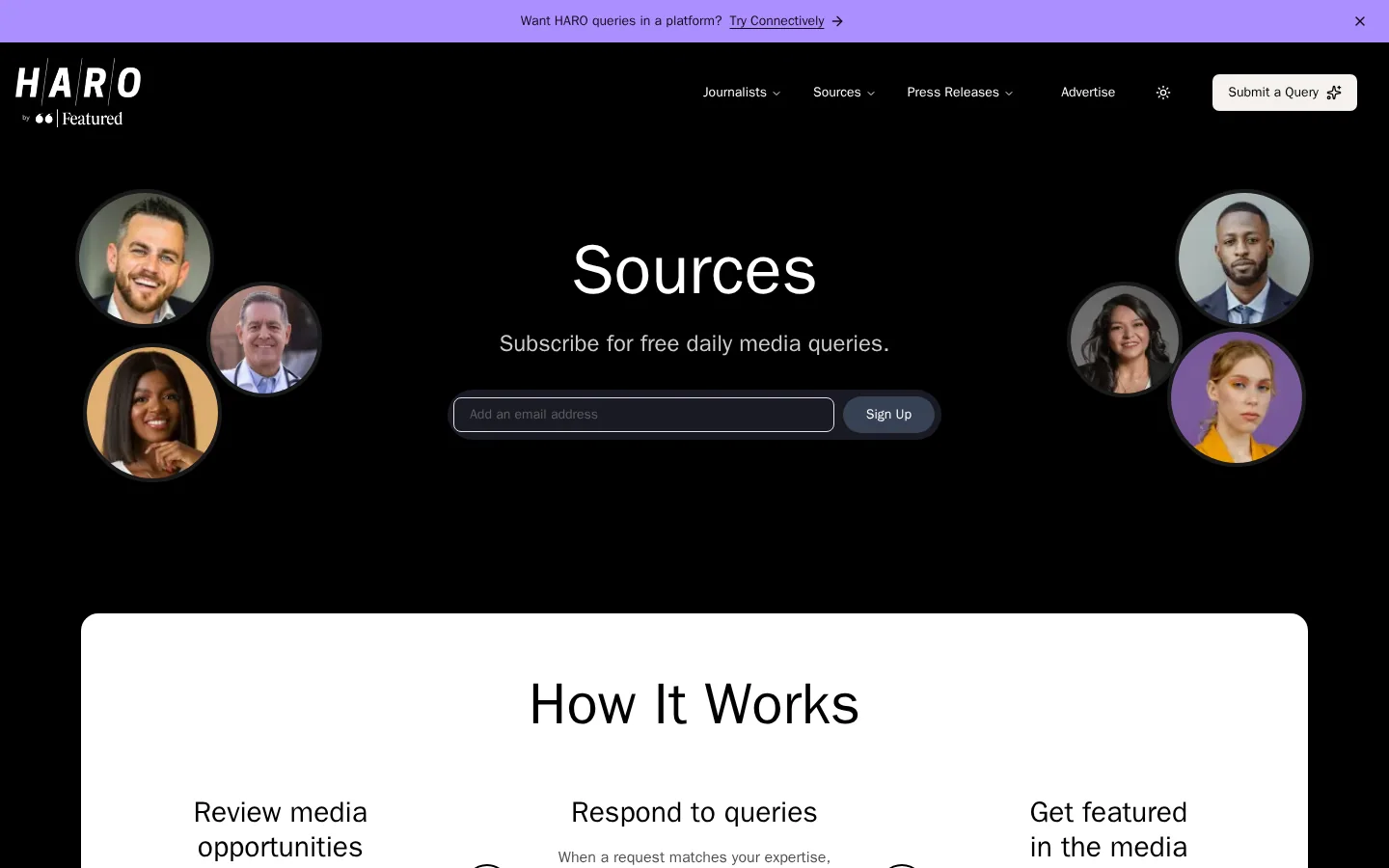
Most guides you will find on "HARO pitch" are out of date. They describe Connectively, the paid platform with pitch limits that Cision ran in 2024, and which no longer exists under that model. Here is the real timeline. Featured.com bought HARO from Cision and announced it on April 16, 2025 in a press release from Featured.com, stating that HARO "will stay free for journalists and sources" and would be supported by newsletter advertising.
HARO from 2008 to today
Why does this matter for your pitch? Because the rules changed twice. Under Connectively, each pitch cost a credit, so people pitched less and more carefully. With a free HARO again, volume is back, and journalists filter harder. Your pitch competes with more replies than in 2024, so the bar for relevance and speed is higher.
A HARO pitch is worth it because one accepted answer gives you three things at once: a mention in a real publication, often a link, and a signal of expertise that Google and AI models can read. It costs nothing but your time, and a good pitch takes 10 to 15 minutes once you have a system.
A link from a journalist's article is an editorial link: someone with no commercial interest chose to cite you. That is the kind of link Google's systems value the most, and the kind you cannot get by paying. For a definition of how these links fit into your wider strategy, see our glossary entry on what link building is and how quality links are earned.
ChatGPT, Claude and Gemini build their answers from pages they trust. A quote in a news article or a trade publication puts your name next to a topic on a site that these models already read. Even an unlinked mention counts here: it ties your brand to an expertise. We explain the mechanics in our guide on how industry press coverage earns AI citations.
Every published quote is a piece of proof you can reuse: an "As seen in" line on your home page, a link on your author page, a mention in your sales deck. This supports the experience and expertise signals that Google describes in its quality guidelines, covered in our entry on E-E-A-T and how Google judges trust.
The network behind HARO's owner
Source: Featured.com press release, April 16, 2025

Journalists want a relevant, short, non-promotional answer they can quote as is. That is not an opinion: it is what they say in every large survey, and it should shape every line you write.
In its 2026 State of the Media report, Cision surveyed more than 1800 journalists. 82% say relevance is a must-have before they consider covering a story, and 72% find fewer than a quarter of the pitches they receive relevant. On HARO, relevance has a very precise meaning: you answer the question that was asked, not the one you wish had been asked.
Source: Cision, 2026 State of the Media report
Muck Rack's survey data, shared in its State of Journalism 2025 webinar FAQ (July 2025), shows that 69% of journalists prefer pitches under 200 words. A HARO reply is not a press release: it is a quote the reporter should be able to paste into the draft.
The same Cision report found that 53% of journalists oppose receiving AI-generated work. HARO's relaunch was framed around exactly this point: reporters need credible human sources. You can use an AI model to check grammar or shorten a draft, but the insight, the example and the number must come from you.
Three numbers to keep in mind before you hit send
Sources: Cision 2026 State of the Media; Muck Rack State of Journalism 2025
A winning HARO pitch has six parts, in this order: a subject line that mirrors the query, one line of credential, the answer, one piece of proof, a short bio, and your links. Each part has one job. If a part does not help the journalist decide or quote, cut it.
| Part | Its job | Length | Example |
|---|---|---|---|
| Subject line | Show the reporter it answers their query | 5 to 10 words | Re: Query "Why SaaS churn spikes in month 3" |
| Credential line | Say why you are qualified to answer | 1 sentence | I run retention at a 40-person B2B software company. |
| The answer | Give the quotable insight, directly | 60 to 120 words | Churn spikes in month 3 because... |
| Proof | Make it credible: a number, a case, a test | 1 to 2 sentences | When we added a day-60 check-in call, month-3 cancellations fell. |
| Bio | Give the attribution line, ready to paste | 1 to 2 sentences | Jane Doe, Head of Customer Success at Example Co. |
| Links | Let the reporter verify you | 2 to 3 links | Website, LinkedIn, headshot |
Reporters often receive many replies for one query, and they scan subject lines to match replies with the right story. Reuse the query title, word for word. Do not try to be clever. "Re: Query: Best budgeting tips for freelancers" beats "A fresh take you won't find anywhere else".
Skip "I hope this email finds you well". The reporter's first question is "why should I trust this person on this topic?". Answer it in one sentence, with the most specific credential you have: a role, a number of years, a number of clients, a certification, a result. Specific beats impressive. "I've filed 600 small business tax returns since 2018" beats "I'm a leading tax expert".
Write the answer as if it will be pasted into the article without any edit, because often it will be. That means full sentences, no "as mentioned above", no jargon the reader would not know, and one clear idea per paragraph. If the query asks three questions, number your answers 1, 2, 3 in the same order.
Generic advice is the reason most pitches are ignored. Add one element only you can provide: a number from your own work, a short case, a mistake you saw, a test you ran. This is also what makes the quote valuable for the reporter, because it cannot be found in a search.
End with the exact line you want printed: name, title, company. Then a link to your site, your LinkedIn profile, and a headshot URL if the query asks for one. Never attach files: many inboxes strip attachments, and a link is enough.
Here is a template you can copy and adapt. Keep it as a saved reply in your email tool, and fill it in for every query.
Subject: Re: Query "[exact query title]"

Hi [first name if given, otherwise "Hi there"],

[One sentence: who you are and why you can answer this query.]

[Answer to question 1, 2 to 4 sentences, quotable as is.]

[Answer to question 2, if the query has several.]

[One proof: a number, a short case or a test from your own work.]

Attribution: [Full name], [Title] at [Company]
Website: [URL]
LinkedIn: [URL]
Headshot: [URL]

Happy to answer a follow-up today if useful.
[First name]
Tip
Paste your draft into our free word counter for writers before you send it. If the body is over 200 words, cut the context first, never the proof.
The method that works is a short daily routine: filter the queries, decide in two minutes, write in ten, send fast, and log the result. Speed matters because reporters on deadline often keep the first good answers they read and stop there.
The daily HARO routine
Create a dedicated address or label for HARO, so digests do not drown in your main inbox. Write a bio bank: three versions of your bio (one line, two lines, five lines), each with the exact attribution you want. Host a clear headshot on your site and keep its URL ready. List your areas of real expertise: 3 to 5 topics, not 20.
Then set a filter that flags only the queries on your topics. In Gmail, a filter in the "Has the words" field can catch several keywords at once with curly braces, which mean "any of these":
{"customer retention" "churn" "SaaS pricing" "onboarding" "B2B marketing"}Apply a label such as "HARO / match" and a star. You now read only what you can answer.
For each query, ask three questions. Do I have first-hand experience on this exact question? Do I meet every stated requirement? Can I send before the deadline, ideally within the hour? If one answer is no, skip it. Answering only a few queries well beats answering many queries badly: your reputation with reporters is built one reply at a time.
Queries often state who they want: "CPAs only", "US-based", "founders of companies with 10+ employees", "please include your city". They also state the format: "2 to 3 sentences", "a list of 3 tips". Any reply that ignores a requirement is usually deleted without being read. Copy the requirements into the top of your draft and check them off before you send.
Open your saved template. Write the credential line for this specific query (it changes with the topic). Write the answer first, then the proof, then trim. Read it out loud once: if a sentence sounds like a brochure, rewrite it as you would say it to a client.
Reply to the anonymous address attached to the query, not to the HARO digest. One email per query, never several answers in one message. Send from a professional address on your own domain: it makes you easier to verify and it reaches inboxes better. If you send many replies, follow the deliverability rules from our guide on email outreach and sending rules.
Most reporters will not tell you when they publish. Keep a simple sheet with one row per pitch: date, query title, outlet (if named), topic, status. Then search your name and company every week. A simple formula gives your acceptance rate, with pitches in column A and the status "Published" in column E:
=COUNTIF(E2:E500,"Published")/COUNTA(A2:A500)Track this rate by topic. After a few weeks, you will see which topics turn into quotes and which waste your time.
There is no single pitch style. The best one depends on the query: a reporter asking for "tips" needs a different reply than one asking for "a story of a time when". Here are the five strategies that work, with their limits.
Principle: answer the question in the first sentence, then explain why. Use it for factual or "how to" queries ("What's the best way to..."). Advantage: fastest to read and to quote. Limit: if your answer is the same as everyone's, it is lost. Example: "Raise prices in the renewal email, not at checkout. Customers who already use your product accept a change better than new visitors."
Principle: lead with a number from your own business, survey or tool. Use it for trend stories ("Are more people..."). Advantage: reporters love original numbers, and these get cited again by other sites. Limit: the number must be real and you must be able to explain how you got it. Example: "Across the 1200 support tickets we handled last quarter, the most common complaint was..."
Principle: tell one short, real example with a beginning, a turning point and a result. Use it when the query asks for experiences ("Tell me about a time when..."). Advantage: human stories make articles, so they get picked. Limit: it must be short (5 sentences) and true. Example: "In 2023 we lost our biggest client overnight. Here is what we changed in the next 30 days..."
Principle: disagree with the common advice, with a reason. Use it for opinion or "myths" stories. Advantage: it gives the reporter tension, which stories need. Limit: only if you really believe it and can back it up; contrarian for its own sake reads as noise. Example: "Most guides say post every day on LinkedIn. For a B2B company with 5 clients a year, two deep posts a week work better, because..."
Principle: give 3 numbered, distinct tips, each in 1 to 2 sentences. Use it for listicle queries ("Top tips for..."). Advantage: easy to split and quote one item. Limit: weak if the tips are generic; each item needs a specific detail. Example: "1. Set the deadline before the budget..."
| Strategy | Best for | Strength | Limit | Effort |
|---|---|---|---|---|
| Direct answer | Factual and "how to" queries | Fastest to quote | Easily lost if generic | Low |
| Data pitch | Trend and "are more people" stories | Original, cited again by others | Needs real, explainable data | High |
| Story pitch | "Tell me about a time" queries | Human, makes the article | Must stay short and true | Medium |
| Contrarian pitch | Opinion and myth stories | Gives the story tension | Needs solid backing | Medium |
| List pitch | "Top tips" listicles | Easy to split and quote | Generic tips get ignored | Low |
The difference between a pitch that gets deleted and one that gets printed is rarely the writing. It is the order of the information and the presence of one concrete fact. Take a real-looking query: "Looking for small business owners: how do you handle late-paying clients? 2 to 3 sentences. Deadline today 5pm."
The weak version: "Hi! I hope you're having a great day. I'm the founder of an award-winning design agency and I'd love to contribute to your article. Late payments are a big problem for small businesses. It's important to have clear terms and to follow up. Let me know if you'd like to set up a call! Check out our website for more."
The strong version: "Subject: Re: Query: How do you handle late-paying clients? / I run a 6-person design studio and invoice about 40 clients a year. We moved every new client to 50% upfront and the rest on delivery, before files are sent. Since then, we have not had a single invoice more than 30 days late. / Attribution: Sam Lee, founder of Example Studio, Lyon."
What changed between the two pitches
Notice what the strong version does not contain: no link pushed in the body, no request for a link, no adjectives about the company. The reporter gets a usable quote in 15 seconds. That is the whole game.
Most failed pitches fail for the same few reasons. Each one is easy to spot in your own drafts and easy to fix.
What it is: replying to a "CPAs only" query as a bookkeeper, or to a health query without medical credentials. How to spot it: you need to stretch your bio to fit. How to fix it: skip it. Query services remove sources who send off-topic replies (Source of Sources states it removes them with no appeal), and the reporter will remember your name for the wrong reason.
What it is: replying the next day to a query sent in the morning. How to spot it: your log shows pitches sent more than a few hours after the digest, with no results. How to fix it: block 20 minutes right after each digest you care about, and use filters so you only open relevant queries.
What it is: product names, discount codes, "our solution", links in the body. How to spot it: count the times your company name appears; more than once in the body is too many. How to fix it: name your company only in the attribution line. Cision's data shows that being too promotional is the top reason journalists reject a pitch.
What it is: "please link to our homepage" or "we'd appreciate a dofollow link". How to spot it: the words "link" or "backlink" in your pitch body. How to fix it: never ask. Give your URL in the signature. Reporters and editors decide; asking makes you look like a link builder, not an expert.
What it is: a polished but generic text, with long sentences, lists of "key factors" and no lived detail. How to spot it: nothing in the pitch could only come from you. How to fix it: write the core yourself (the example, the number, the opinion), then use AI only to correct and shorten. Reporters read hundreds of replies and spot generated text quickly, and Cision's survey shows most of them do not want it.
What it is: 400 words for a "2 to 3 sentences" request, or a paragraph when a list was requested. How to spot it: compare your draft with the requirements you pasted at the top. How to fix it: match the format exactly, and add "Happy to expand if useful" at the end.
What it is: a PDF bio, an attached photo, or a reply with no name, title or city. How to spot it: the paperclip icon, or an attribution line you would need to complete. How to fix it: links instead of files, and a full attribution line every time.
What it is: pitching for months without knowing what was published. How to spot it: you cannot say how many quotes you got last quarter. How to fix it: the log from Step 6, a weekly search on your name, and an alert on your brand name.
Pre-send checklist for every HARO pitch
A HARO pitch pays off in three measurable ways: published mentions, links, and visibility in AI answers. Track all three, because a quote without a link can still be worth a lot.
Search your exact name in quotes plus your company name, on Google and Google News, every week. Add an alert on both. When you find an article, log the outlet, the date, the URL and whether it contains a link to you.
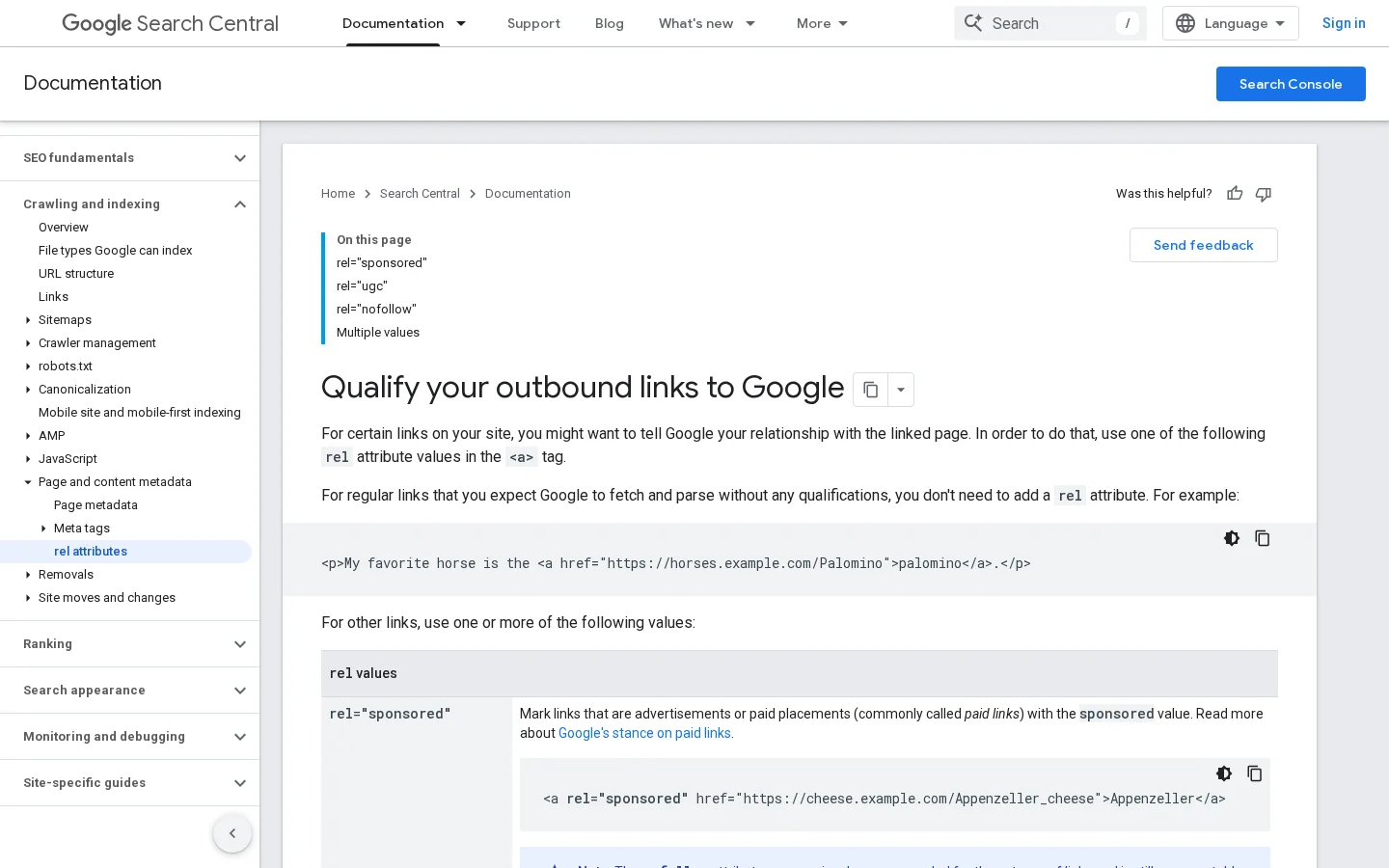
Many publishers add attributes to outbound links. Google's documentation on qualifying outbound links explains that "sponsored", "ugc" and "nofollow" are treated as hints: such links are generally not followed, but the pages can still be found by other means. To check a link, right-click it, choose "Inspect", and read the rel value:
<a href="https://example.com" rel="nofollow">Example Co</a>
<a href="https://example.com">Example Co</a>
The first link carries a hint not to follow it; the second is a standard link. Both bring you referral visitors, brand recognition and a mention that AI models can read. Our entry on nofollow links and when they are used explains the difference in detail.
Tip
Run your domain through our free backlink checker once a month. New referring domains from news sites are the first sign that your HARO pitches are turning into links.
Press quotes also change what AI models say about you. Ask ChatGPT, Claude and Gemini the questions your clients ask on your topic, and note whether your brand appears. Doing this by hand gets slow fast; Sorank's AI mention tracking follows these answers for you and shows when a model starts citing your brand.
HARO is the best-known service, but not the only one. Reporters post requests in several places, and a source who watches two or three of them sees more queries on their topic.
| Service | How it works | Best for |
|---|---|---|
| HARO | Three daily emails of journalist requests, free for sources | Broad coverage across business, tech, finance, lifestyle and health |
| Source of Sources | Free email of journalist queries, run by HARO's original founder Peter Shankman | Sources who liked the original HARO format |
| Qwoted | Platform where experts answer "expert needed" requests and build a profile | Experts who want a profile reporters can browse |
| #journorequest on X | Journalists post requests publicly with the hashtag | Fast, informal requests, often from UK media |
| Trade publications | Editors of niche magazines and sites ask their readers for input | Specialists in a narrow industry |
Reactive pitching vs proactive digital PR
Both approaches work together. HARO pitches give you a steady flow of quotes with little effort; a proactive campaign, built on your own data, gives you bigger peaks. Our complete guide to digital PR covers the proactive side: studies, newsjacking and pitching your own stories.
HARO pitching is one channel in a link plan, not the whole plan. It gives you high-trust mentions, but you cannot control the volume, the topics or the timing. For most sites, it works best on top of a steady base of relevant links from sites in your niche.
That base is the part you can automate. Sorank's natural backlink acquisition earns contextual links from other sites in your niche, in their articles, while you spend your own time on what only you can do: answering reporters with real expertise. To see how both fit with other methods by effort, cost and risk, read our comparison of backlink strategies.
What to do today: sign up as a source on HARO, write your three bios, set one filter with your 3 to 5 topics, and save the template from this guide. Tomorrow morning, answer one query, only one, and make it the best answer the reporter receives.
Yes. Cision shut down Connectively, the paid version of HARO, in December 2024, then sold HARO to Featured.com, which relaunched it in April 2025. Sources can sign up for free and receive three emails of journalist requests per day.
Aim for under 200 words, unless the query asks for a specific length. Muck Rack's data shows that 69% of journalists prefer pitches under 200 words. Put your credential first, then the answer, one proof and your attribution line.
Often, but not always. The publisher decides whether to add a link and which attribute to use, such as nofollow. Even without a link, a quote in a real publication builds trust and ties your brand to a topic that AI models read.
We analyse your competitors, your website and your AI visibility to create a tailored content plan for free.
 Website Value Calculator
 Website Accessibility Checker
 Google Analytics Checker
 Duplicate Content Checker
 Mobile-Friendly Test
 Website Speed Test
 Subdomain Finder
 Domain Age Checker
 CMS Detector
 Googlebot Simulator
 Nofollow Link Checker
 Meta Tag Checker
 Keyword Cannibalization Checker
 Keyword Intent Checker
 Keyword Extractor
 Google Ads Cost Calculator
 CPC Calculator
 Local Citation Finder
 Reddit Threads Finder
 Disavow File Generator
 Redirect Generator
 Canonical Tag Generator
 Passive Voice Checker
 Google Location Changer
 Google Review Calculator
 Google Review Link Generator
 Keyword Combiner
 Podcast Show Notes Generator
 AI Content Rewriter
 AI Text Humanizer
 ChatGPT Prompt Generator
 Twitter Thread Generator
 Tweet Generator
 Landing Page Copy Generator
 Google Ads Copy Generator
 Pinterest Pin Description Generator
 Anchor Text Generator
 Social Media Post Generator
 LinkedIn Post Generator
 Free AI Writer
 Review Response Generator
 LSI Keyword Generator
 YouTube Video Ideas Generator
 YouTube Tag Generator
 YouTube Description Generator
 Product Description Generator
 CTA Generator
 Blog Introduction Generator
 Conclusion Generator
 Hook Generator
 AI Content Brief Generator
 FAQ Schema Generator
 AI Blog Post Ideas Generator
 Structured Data Validator (Schema Validator)
 Alt Text Checker
 Internal Link Analyzer
 Backlink Challenge
 AI Meta Description Generator
 AI Blog Title Generator
 Google Indexability Checker
 AI Blog Outline Generator
 UTM Link Builder
 Keyword Clustering Tool
 Canonical Tag Checker
 XML Sitemap Generator
 Broken Link Checker
 AI SEO Title Generator
 Headline Analyzer
 SERP Preview Tool
 Redirect Checker
 Hreflang Tag Generator
 Heading Structure Analyzer
 HTTP Headers Checker
 Favicon Extractor
 SERP CTR Calculator
 SEO vs Paid Search Savings Calculator
 SEO Share of Voice Calculator
 SEO ROI Calculator
 SEO Traffic and Revenue Forecast Calculator
 SEO Budget Calculator
 SEO Break-Even Calculator
 SaaS SEO ROI Calculator
 ROAS Calculator
 Reading Time Calculator
 Ranking Gain Simulator
 Organic Traffic Value Calculator
 Organic Traffic Estimator and Website Traffic Checker
 LTV to CAC Ratio Calculator
 Local SEO ROI Calculator
 Link Building Cost Calculator
 Keyword Value Calculator
 Keyword Opportunity Score Calculator
 Keyword Density Calculator
 GEO ROI Calculator
 GEO Content Investment Calculator
 Ecommerce SEO ROI Calculator
 Customer Lifetime Value Calculator
 Customer Acquisition Cost Calculator
 CTR Calculator
 Cost Per Article Calculator
 Conversion Rate Calculator
 Content Marketing ROI Calculator
 ChatGPT Referral Traffic Estimator
 Bounce Rate Calculator
 Backlink ROI Calculator
 AI Visibility Score Calculator
 AI Traffic Value Calculator
 AI Share of Voice Calculator
 Cost of AI Invisibility Calculator
 AI Citation Rate Calculator
 llms.txt Validator
 AI Overview Checker and AI Overviews Rank Checker
 Robots.txt Checker
 AI SEO Audit
 LLM Readability Checker
 SearchGPT Readiness Checker
 Structured Data LLM Audit
 Website Crawlability AI Audit
 Why ChatGPT Is Not Recommending My Website
 Gemini Ranking Tool
 Perplexity Ranking Checker
 LLM Citation Checker
 Answer Engine Optimization Audit
 GEO Audit
 AI Search Visibility Test
 ChatGPT Visibility Checker
 llms.txt Generator
 URL Extractor
 Webpage to Markdown
 Sitemap Checker
 SERP Volatility Sensor
 Page Size Checker
 Word Counter
 Slug Generator
 Schema Generator
 Robots Generator
 OG Preview
 Meta Tags Generator
 Image Compressor
 Favicon Generator
 On-Page SEO Audit: SEO Checker and SEO Analyzer
 Backlink Analysis Tool
 Keyword Research Tool
 Domain Authority Checker
 “I tested Sorank on a real client site and it's insane. It does everything an agency would bill you $1500 a month for. It's going into production on that client now.”

 Guillaume Guersanguersanguillaume.com“We are an Ads agency and we wanted to get our SEO back on track once and for all. Sorank gave us a clear view of our site, helped us prioritize optimizations, and properly structure our content. The tool is easy to use, well designed for a team, and very practical for centralizing tracking without having to juggle multiple platforms. A very solid foundation to start fresh with our SEO.”
 Gaspard MadouiAds Agency
 “I just let the Sorank software do its thing, and now my DR is 25 and my page is ranking higher.”
 Lucas Flandrefoundertrace.fr“I specialized in GEO thanks to Sorank. The GEO Leaderboard allows me to show my clients their position vs competitors on ChatGPT. It’s a real commercial differentiator.”
 MélanieSEO Freelance“Great service, works well for our website and helps us understand how to improve it to rank better on Google and elsewhere. Congrats, keep going, I recommend it.”
 Hugo T.E-commerce merchant