Preferences
Privacy is important to us, so you have the option of disabling certain types of storage that may not be necessary for the basic functioning of the website. Blocking categories may impact your experience on the website. More information
Privacy is important to us, so you have the option of disabling certain types of storage that may not be necessary for the basic functioning of the website. Blocking categories may impact your experience on the website. More information

Earned trade press is a large share of AI citations. Learn which outlets AI cites, how to pitch them safely and how to measure whether coverage gets cited.
In short
Industry press coverage is an article in a trade or niche publication that names your company, data or experts. AI assistants cite it because it is indexed, dated, signed by a named author and focused on one topic. Earned media is a large share of AI citations, from about 40% to 84% depending on the study, so measure your own queries before you plan.
Want to go further? Ask
Quick quiz
How should you get mentioned by ChatGPT and other AI assistants?
Sorank matches your answers


Test it for 3 days on your own site and see where you stand on Google, ChatGPT and the other AIs.
Start 3-day free trial3 days free, then stop whenever you want. 90-day results guarantee, conditions apply.
Industry press is the set of trade magazines, niche newsletters and sector websites that cover one field, such as dental clinics, freight forwarding, B2B software or outdoor gear. Coverage means an editor or journalist chose to write about you, quoted someone from your company or used your data. A sponsored post, a paid listing or a press release copied across ten sites is something else, and we treat those separately later in this guide.
Assistants cite this kind of page for a simple reason: they need to show where a claim came from. A trade article is indexed, dated, signed by a named author and focused on one topic, so it is easy to attribute and easy to match to a question. A page you wrote about yourself can hold the same facts, but its author has an obvious interest in the answer. That is our reading of how the two pages differ, not a rule any AI company has published.
How much this matters depends on the assistant you care about. Meltwater's analysis for April 2026, which covered about 5.35 million citations across eight models, found that earned and news sources made up 39.5% of citations. The share changed a lot from one platform to the next, as the chart shows.
Muck Rack, a PR software company, reports that earned media is about 84% of AI citations, across more than 25 million links cited by ChatGPT, Claude and Gemini in 17 industries. In the same analysis, journalism is 27% of sources. The two figures do not conflict. Muck Rack's earned category is broad: it includes journalism, academic research, government and NGO pages, encyclopedias, social platforms and third-party corporate content. A trade article belongs to the journalism slice, and that is the slice you can target with a pitch.
The Meltwater figure uses a narrower earned and news category, which is why it comes out lower. Neither source publishes every classification rule in full, so treat both as direction, not as exact measurements. When you plan, use the narrowest number that matches what you want to change. If you want a trade editor to cite you, plan around the journalism and trade share, not the 84% headline.
Three figures, three definitions
Sources: Muck Rack, AI citations analysis (page updated November 3, 2026); Meltwater, April 2026
Note
Muck Rack sells PR software, and 5W, cited below, is a PR agency. Both have a commercial reason to promote earned media. Use their studies to decide where to look, not to forecast a budget.
The agency 5W ran a trade press study between October 30 and 31, 2026. It asked 24 questions, each three times, on ChatGPT, Claude, Gemini and Perplexity, and kept 282 answers that used web sources. Wikipedia was cited in 112 of those answers, or 39.7%, so encyclopedias compete directly with trade press. Among the 59 trade and news titles that 5W tracked, the most cited were Axios, Becker's Hospital Review and Forbes.
| Publication | Grounded answers citing it (of 282) | Share of grounded answers |
|---|---|---|
| Axios | 14 | 5.0% |
| Becker's Hospital Review | 14 | 5.0% |
| Forbes | 13 | 4.6% |
| Glossy | 11 | 3.9% |
| Nation's Restaurant News | 10 | 3.5% |
| Cosmetics Business | 9 | 3.2% |
| Fierce Biotech | 9 | 3.2% |
| The Hill | 9 | 3.2% |
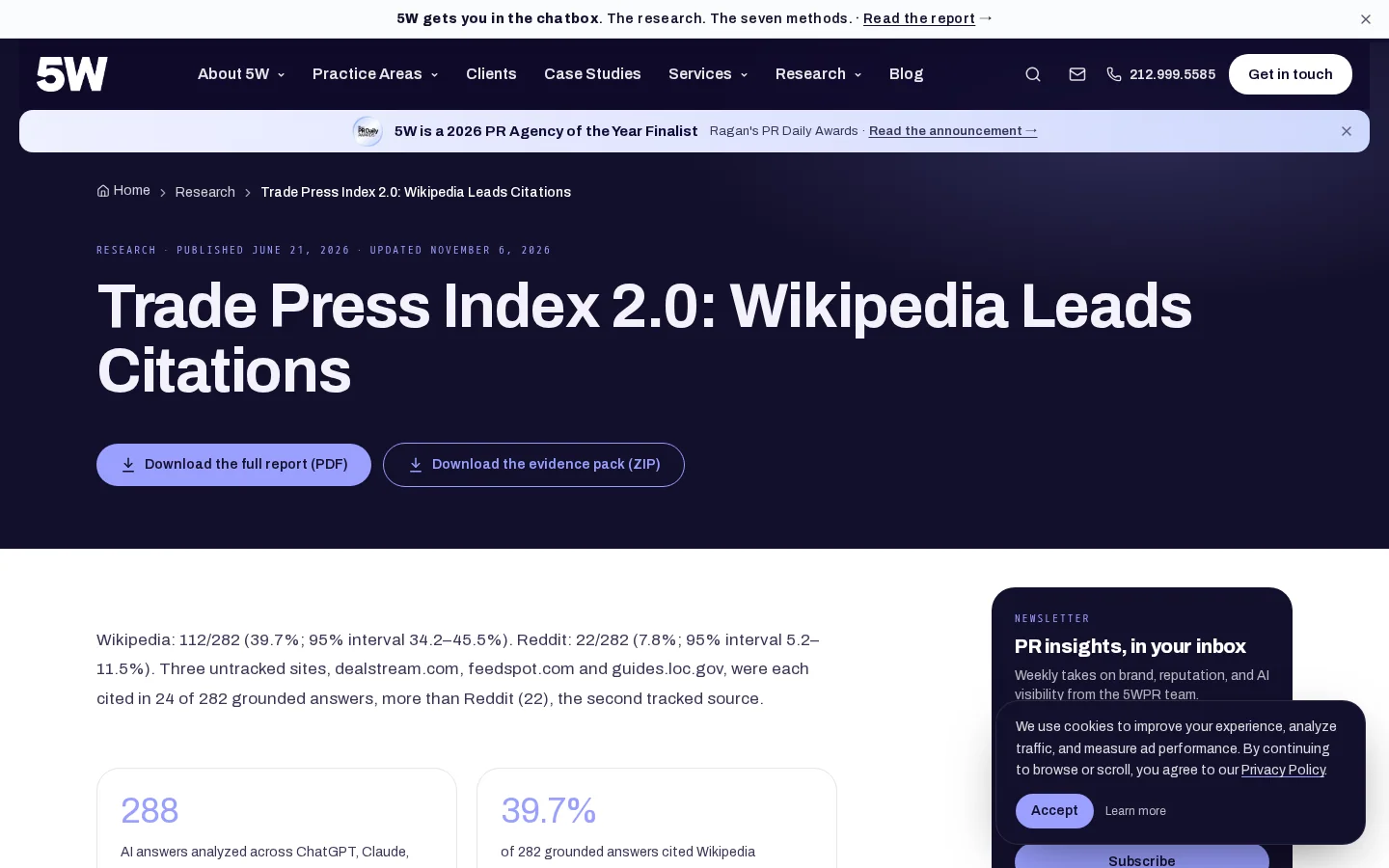
Two lessons come out of this. First, the list changes with the topic. Most of 5W's titles are sector titles, such as hospital, restaurant, cosmetics and biotech outlets, which only come up for questions in those sectors. Second, the sample is small. With 282 grounded answers, one publication at 5% is 14 answers, and a single run can flip the order. Read the table as an example of the method, not as the list for your market.
Pick 20 to 30 questions your buyers ask before they choose a supplier. Include category questions such as "best freight software for small carriers" and comparison questions such as "X or Y for a 10-person team". Ask each one in ChatGPT, Claude, Gemini and Perplexity with web search turned on. Repeat each question at least three times, because answers change from one run to the next.
For every answer, log each cited URL in a sheet with the question, the engine, the run number, the URL, the outlet and the outlet type: trade, national, reference, vendor, forum or your own site. Then count the outlets. In Google Sheets, this formula pulls the domain from a URL in column C, and the second line counts how many rows cite one outlet in column D:
=REGEXEXTRACT(C2, "^https?://(?:www\.)?([^/]+)")
=COUNTIF(D:D, "axios.com")
Sort the result by count. An outlet that appears in at least three of your questions is a target. An outlet that cites your competitors and never cites you is a gap. Our citation gap guide explains how to close those gaps once you have the list.
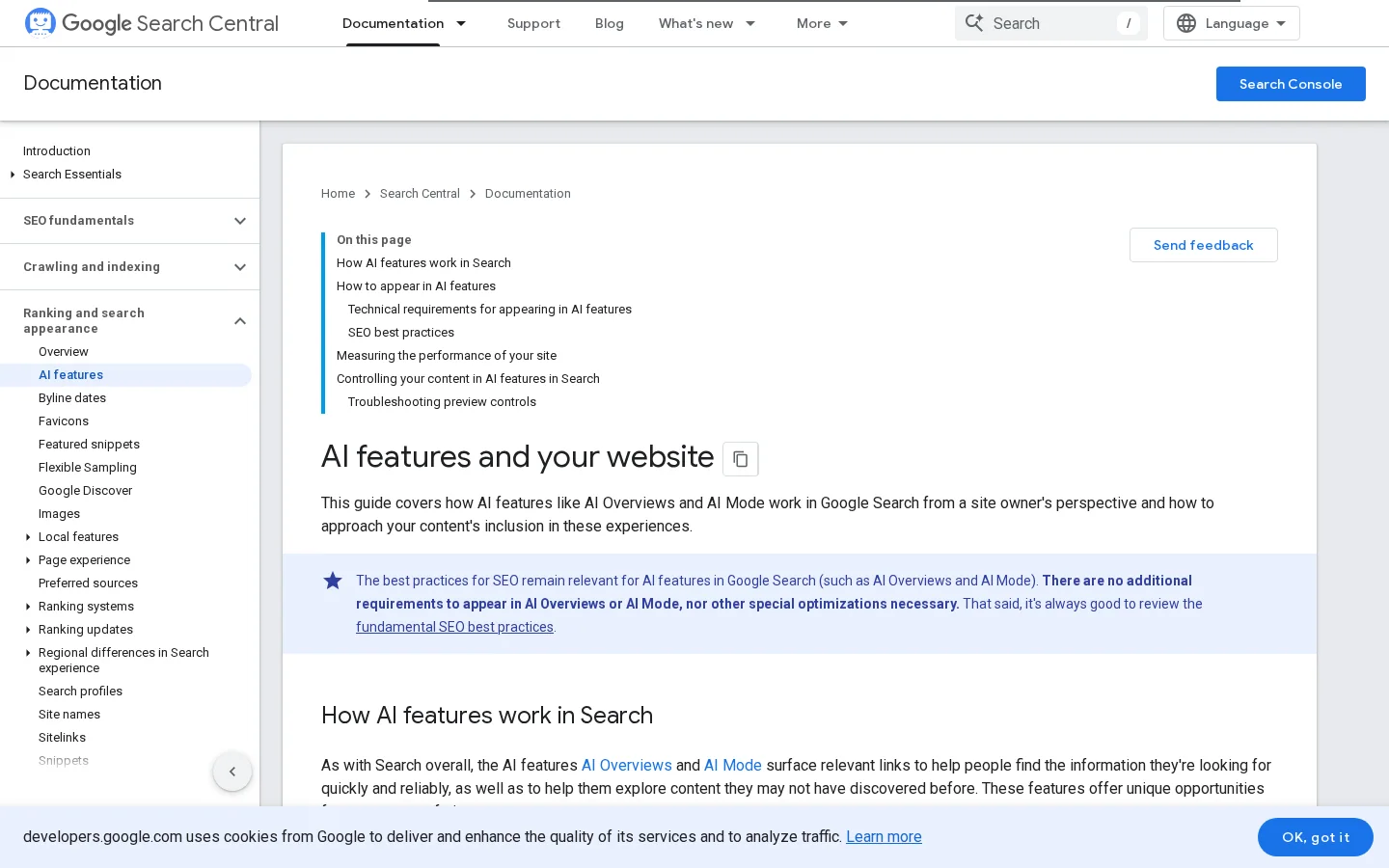
Google's guidance on AI features says there are no additional requirements to appear in AI Overviews or AI Mode, and no special markup, AI text file or optimization is needed. A page has to be indexed and eligible to show in Google Search with a snippet, and then it can appear as a supporting link. Indexing is not guaranteed, so the first check is whether the article is in the index at all, which you can confirm with the URL Inspection tool in Search Console.
Beyond indexing, three properties make a passage easy to quote. The source is named, with a role. The number has a date and a method. The sentence answers a question someone would type. For how assistants choose their sources in general, read how AI assistants choose their sources, and for the attribution mechanics, see the glossary entry on source citation.
Compare two sentences. "Industry experts agree that AI search rewards third-party proof" gives an assistant nothing to attribute. "[Name], [role] at [company], says trade editors now ask about AI answers in every interview request" gives it a person, a role and a claim it can quote. Keep the placeholders in your own draft and fill them with real names. A quote sourced like that is also one an editor can check before publishing.
What makes a trade article citable
The broader case for why a brand becomes the one assistants name is in brand authority. Press coverage feeds that picture because a third party put your name in print.
Digital PR is the wider discipline, and our digital PR guide covers its general method. This section stays on the five routes that most often produce trade coverage. Each one gets a principle, a best use, an upside, a limit and an example, so you can match a route to your stage.
Principle: journalists post requests for sources on query services, and you reply with a short, specific answer that includes your name and role.
When to use it: you have a real view or a real number on a topic a journalist is already writing about, and you can reply within hours.
Upside: the cost is low, the requests are frequent, and you can test quickly which topics get a response.
Limit: most replies never run. A quote with no company name, no number or a vague claim is the first thing an editor cuts.
Example: a reply to a request about ecommerce returns, from a named operations lead, with one sourced figure and a link to the method page on your site.
Principle: you analyze data you own, such as anonymized product usage or support records, and pitch the finding to editors who cover your field.
When to use it: you hold data that nobody else in your sector has, and you can explain how it was collected.
Upside: trade editors need original numbers. A good dataset can earn several articles, and the page that holds it stays citable for a long time.
Limit: it takes weeks. A weak sample or an unclear method gets ignored, and a dataset that reads like a sales pitch gets rejected.
Example: a 12-month analysis of anonymized support tickets, with the method on the first screen of the page. Publish the method next to the data and make the dataset a linkable asset that others can cite. Sending the study through a wire service is not the same as coverage. Our guide on what a press release can and cannot do for rankings explains where releases fit.
Principle: you write an article under a named expert's byline for a trade site, with no sales copy, and the editor edits it to fit the publication.
When to use it: you have a specific point of view on a process your readers handle every day, and the outlet accepts outside contributors.
Upside: the result is a full page with the expert's name on it, on a domain your buyers already read. It gives assistants an attributable source written by someone other than you.
Limit: it is hard to land. Editors reject pitches that read like marketing, and accepted drafts usually come back with edits.
Example: a 1000-word article on one diagnostic step in your field, signed by the clinical lead of the company, with the steps explained and no product section.
Principle: when a regulation, a platform change or a competitor's launch hits your field, you give a fast, specific reaction that an editor can quote in the same story.
When to use it: you follow your sector news every day and someone on the team can answer the same day.
Upside: it is fast and cheap. Timely pieces answer the questions people type after a change, which are often the questions where assistants search the web for fresh sources.
Limit: the window is short, and the coverage ages within days. You need a named expert available at short notice.
Example: a same-day quote on a platform's new reporting feature that explains what changes for a site owner and what does not change.
Principle: you pay for a placement on a trade site, and the outlet labels it as sponsored.
When to use it: you need reach for a launch, and the outlet labels paid content clearly.
Upside: you control the timing and the message.
Limit: it is not editorial coverage, so an editor did not choose to write about you, and the article is less likely to count as independent evidence. Links from paid placements must carry a sponsored or nofollow attribute, as the warning in the mistakes section explains.
Example: a brief in a trade newsletter marked "Sponsored", with a link that carries the sponsored attribute.
| Method | Effort | Time to first placement | Weight for AI citations (our judgment) | Main risk |
|---|---|---|---|---|
| Expert quotes for requests | Low | Days | Medium, when the quote names you | The quote is cut |
| Data stories | High | Weeks | High | A weak method gets ignored |
| Bylined expert articles | Medium | Weeks | High | Rejection or heavy edits |
| Reactive commentary | Low | Same day to days | Medium | A short window |
| Sponsored placements | Medium, plus budget | Days | Low, labeled as paid | Spam rules and reader trust |
Earned quote or sponsored placement
The steps below work for expert quotes, data stories and bylined articles. The goal is a short message that an editor can act on without a call.
Five steps from list to pitch
Step one takes the longest and gets skipped most often. An editor who writes 500-word news items will not run a 3000-word analysis from a stranger, and you can see the format in their last five pieces. Step two is the angle. Use a sentence with a placeholder number, such as "Support tickets about [topic] fell [X]% after we changed [process], measured over [period]." If the sentence has no number and no method, it is an opinion, and opinions are cheaper to find than data.
Step three is the note itself. Name the expert and their role. Offer one interview slot. Attach the data only if the editor asks for it. A template helps you keep the note short:
Example
Subject: Data on [topic] for [publication]
Hi [first name], your piece on [recent article] made me think of a finding we have not seen covered. [One sentence with the number, the date and the method.] [Name], [role], can answer questions this week. Would a short look at the data be useful?
A press program usually stalls for one of two reasons. A paid or traded arrangement makes a link look like ranking manipulation, or the coverage says nothing an assistant could use. Five mistakes come up most often. For each one, the description covers what it is, how to spot it and how to fix it.
Warning
Google's spam policies treat links that are bought, sold or traded to influence rankings as link spam. Paid links can stay if they carry a sponsored or nofollow attribute. A free product sent in exchange for a review that includes a link falls in the same group, and so does an advertorial with keyword-rich anchor text.
What it is: a sponsored article on a trade site where the link text is your target keyword, and the link carries no sponsored or nofollow attribute.
How to spot it: open the article, check the link text and inspect the link to see its attributes. The link looks like this when it is marked correctly:
<a href="https://www.example-brand.com/" rel="sponsored">Acme Freight</a>If the anchor is a keyword and the attribute is missing, the placement is a problem.
How to fix it: ask the outlet to mark the placement as sponsored, use your brand name as the anchor text, or ask for the link to be removed and keep the mention.
What it is: you send a free product, and the reviewer writes about it with a link back to you.
How to spot it: the article says the product was sent by the brand, the review links to your site, and there is no disclosure of the arrangement.
How to fix it: put no condition on the review, do not ask for a link, and let the outlet decide how to disclose the gift. Editorial independence is what makes the review worth citing in the first place.
What it is: buying a batch of guest posts on sites that accept any article for a fee, usually with the same text on several domains.
How to spot it: no editor is named, no one in your field reads the site, there is a price list for links, and the same article appears on many domains.
How to fix it: remove those sites from your plan. Replace them with three to five publications your buyers read, and check that each one has an editor and a real audience before you pitch.
What it is: a pitch or a published article says "experts say" or "our data shows" with no named person, no date and no method.
How to spot it: read the draft as an editor would. If you cannot say who spoke, when the data was collected or how it was counted, an assistant will not be able to attribute it either.
How to fix it: name the person and their role, add the date, describe the method in one sentence and link the method page on your site.
What it is: the monthly report counts placements and reach, but never checks whether AI answers now use those pages.
How to spot it: your report has no column for AI answers, and nobody has re-asked the buyer questions since the last placement.
How to fix it: add the audit from the section on trade titles to the report, and count the answers that cite each placement URL.
A placement helps AI citations only if an assistant later uses it, and there is a lag. You have to ask again after the article is indexed. The five steps below give you a measurement loop you can repeat each month.
Measure coverage in five steps
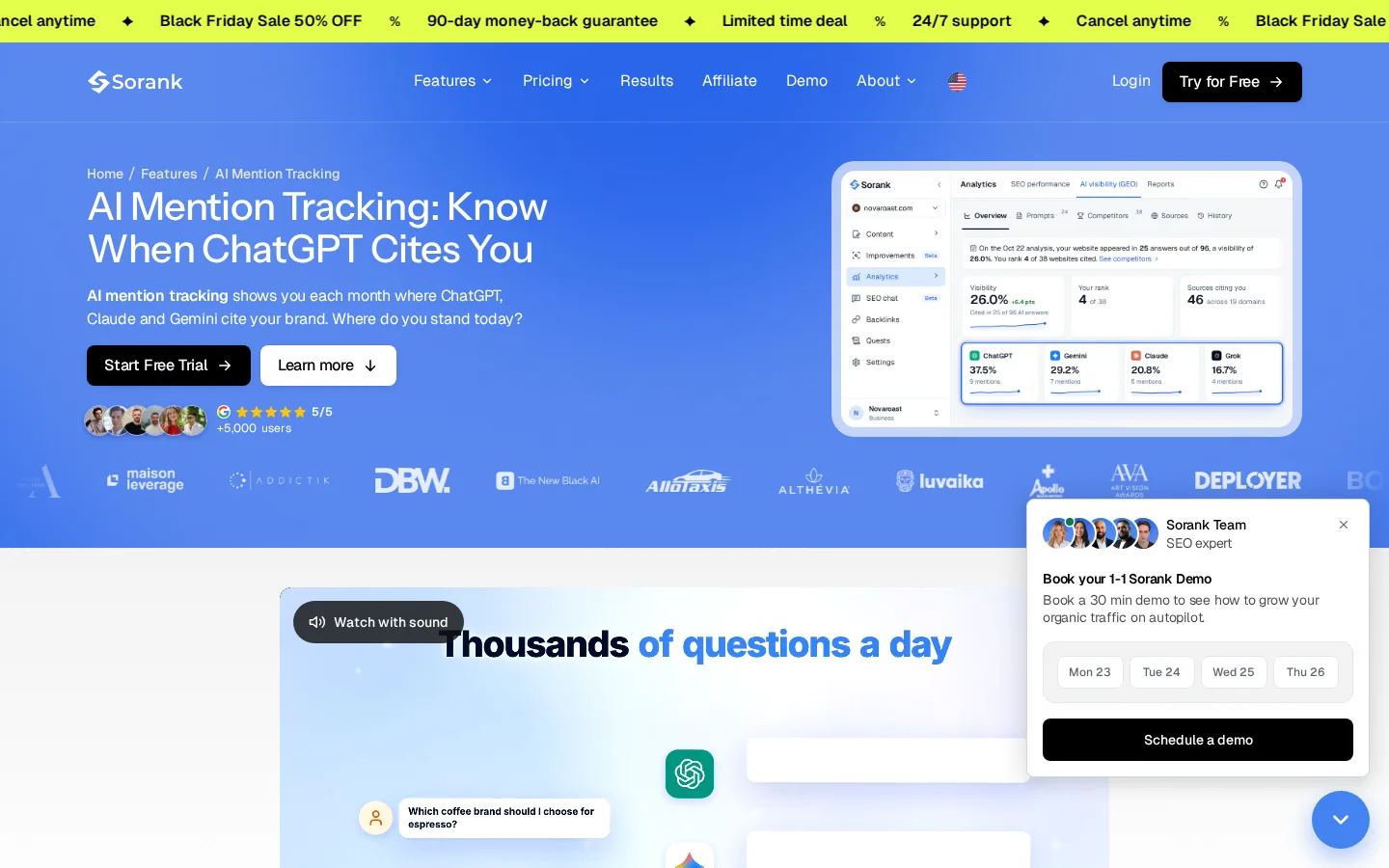
Sorank's AI mention tracking runs your prompts each month on ChatGPT, Claude and Gemini, counts the answers that mention your site and lists the AI reference sources with their share of citations. The page defines the visibility rate as the share of expected AI answers that mention your site. Grok is included from the Pro plan. If you prefer to do the manual version first, the steps and prompts are in how to track your brand mentions in AI assistants.
Tip
To check one question by hand, the LLM citation checker asks ChatGPT, Perplexity, Gemini or Claude with web search on, then scores whether your domain is cited, whether your brand is named and where it ranks in the answer. The page calls it free and allows three analyses per verified email address per day.
Start with the audit, because it tells you which trade titles assistants already use for your questions. Then pick one data story or one expert and pitch two editors, not twenty. Keep the claims in every piece specific and dated. Leave paid placements for later, once you know which outlets matter for your buyers.
Your first week
Trade press is slower than a blog post and harder to win than a directory listing. It is also one of the few pages an assistant can cite that was written by someone other than you. Earn it the way an editor would want: one good story at a time.
Industry press coverage is an editorial article about you in a trade or niche publication, written because an editor or journalist chose to cover you. Sponsored posts, paid listings and press releases copied across sites do not count as editorial coverage, even when they carry a link.
Yes, but a small set of titles receives most of the trade citations, and the list changes with the topic. In a 2026 study by 5W, Axios and Becker's Hospital Review were each cited in 14 of 282 grounded answers, while Wikipedia appeared in 112. Run your own audit with 20 to 30 buyer questions to find the outlets that matter for your market.
Paid placements can reach readers, but Google treats links bought for rankings as link spam unless they carry a sponsored or nofollow attribute. A sponsored article is also not editorial coverage, so an editor did not choose to write about you and it is less likely to count as independent evidence.
We analyse your competitors, your website and your AI visibility to create a tailored content plan for free.
 AI Content Brief Generator
 FAQ Schema Generator
 AI Blog Post Ideas Generator
 Structured Data Validator (Schema Validator)
 Alt Text Checker
 Internal Link Analyzer
 Backlink Challenge
 AI Meta Description Generator
 AI Blog Title Generator
 Google Indexability Checker
 AI Blog Outline Generator
 UTM Link Builder
 Keyword Clustering Tool
 Canonical Tag Checker
 XML Sitemap Generator
 Broken Link Checker
 AI SEO Title Generator
 Headline Analyzer
 SERP Preview Tool
 Redirect Checker
 Hreflang Tag Generator
 Heading Structure Analyzer
 HTTP Headers Checker
 Favicon Extractor
 SERP CTR Calculator
 SEO vs Paid Search Savings Calculator
 SEO Share of Voice Calculator
 SEO ROI Calculator
 SEO Traffic and Revenue Forecast Calculator
 SEO Budget Calculator
 SEO Break-Even Calculator
 SaaS SEO ROI Calculator
 ROAS Calculator
 Reading Time Calculator
 Ranking Gain Simulator
 Organic Traffic Value Calculator
 Organic Traffic Estimator and Website Traffic Checker
 LTV to CAC Ratio Calculator
 Local SEO ROI Calculator
 Link Building Cost Calculator
 Keyword Value Calculator
 Keyword Opportunity Score Calculator
 Keyword Density Calculator
 GEO ROI Calculator
 GEO Content Investment Calculator
 Ecommerce SEO ROI Calculator
 Customer Lifetime Value Calculator
 Customer Acquisition Cost Calculator
 CTR Calculator
 Cost Per Article Calculator
 Conversion Rate Calculator
 Content Marketing ROI Calculator
 ChatGPT Referral Traffic Estimator
 Bounce Rate Calculator
 Backlink ROI Calculator
 AI Visibility Score Calculator
 AI Traffic Value Calculator
 AI Share of Voice Calculator
 Cost of AI Invisibility Calculator
 AI Citation Rate Calculator
 llms.txt Validator
 AI Overview Checker and AI Overviews Rank Checker
 Robots.txt Checker
 AI SEO Audit
 LLM Readability Checker
 SearchGPT Readiness Checker
 Structured Data LLM Audit
 Website Crawlability AI Audit
 Why ChatGPT Is Not Recommending My Website
 Gemini Ranking Tool
 Perplexity Ranking Checker
 LLM Citation Checker
 Answer Engine Optimization Audit
 GEO Audit
 AI Search Visibility Test
 ChatGPT Visibility Checker
 llms.txt Generator
 URL Extractor
 Webpage to Markdown
 Sitemap Checker
 SERP Volatility Sensor
 Page Size Checker
 Word Counter
 Slug Generator
 Schema Generator
 Robots Generator
 OG Preview
 Meta Tags Generator
 Image Compressor
 Favicon Generator
 On-Page SEO Audit: SEO Checker and SEO Analyzer
 Backlink Analysis Tool
 Keyword Research Tool
 Domain Authority Checker
 “I tested Sorank on a real client site and it's insane. It does everything an agency would bill you $1500 a month for. It's going into production on that client now.”

 Guillaume Guersanguersanguillaume.com“We are an Ads agency and we wanted to get our SEO back on track once and for all. Sorank gave us a clear view of our site, helped us prioritize optimizations, and properly structure our content. The tool is easy to use, well designed for a team, and very practical for centralizing tracking without having to juggle multiple platforms. A very solid foundation to start fresh with our SEO.”
 Gaspard MadouiAds Agency
 “I just let the Sorank software do its thing, and now my DR is 25 and my page is ranking higher.”
 Lucas Flandrefoundertrace.fr“I specialized in GEO thanks to Sorank. The GEO Leaderboard allows me to show my clients their position vs competitors on ChatGPT. It’s a real commercial differentiator.”
 MélanieSEO Freelance“Great service, works well for our website and helps us understand how to improve it to rank better on Google and elsewhere. Congrats, keep going, I recommend it.”
 Hugo T.E-commerce merchant