Preferences
Privacy is important to us, so you have the option of disabling certain types of storage that may not be necessary for the basic functioning of the website. Blocking categories may impact your experience on the website. More information
Privacy is important to us, so you have the option of disabling certain types of storage that may not be necessary for the basic functioning of the website. Blocking categories may impact your experience on the website. More information

AI citations and backlinks are two different signals. Learn how each is earned and measured, then follow a step-by-step plan to earn both on your site.
In short
AI citations are mentions of your brand or page inside an answer from an AI assistant, with or without a clickable link. Backlinks are hyperlinks from other sites to yours, and Google uses them to judge authority for its rankings. They are two different signals, and you need both to be seen in search and in AI answers.
Want to go further? Ask
Quick quiz
How should you get mentioned by ChatGPT and other AI assistants?
Sorank matches your answers


Test it for 3 days on your own site and see where you stand on Google, ChatGPT and the other AIs.
Start 3-day free trial3 days free, then stop whenever you want. 90-day results guarantee, conditions apply.
A backlink is a hyperlink on one website that points to a page on another. For search engines, it is a vote that cost the linking site something, since someone chose to send readers to you. Backlinks have been a ranking signal for many years, and they still shape how Google judges how much authority a page deserves.
A backlink is more than a yes or no. Five parts decide how much it is worth, and you can read all of them in any backlink report. The table below lists them with what to check on each one.
| Part of the link | What it is | What to check |
|---|---|---|
| Source page | The page that contains the link | Is it on a topic close to yours, and is it indexed? |
| Target URL | The page on your site that receives the link | Does it point to the page that answers the query, or only to the homepage? |
| Anchor text | The words the link is written on | Is it natural and descriptive, or the same money keyword repeated? |
| Link attribute | Followed by default, or marked nofollow or sponsored | A nofollow or sponsored link is allowed for paid placements, but it is not a plain editorial vote. |
| Surrounding text | The sentence and paragraph around the link | Is the link inside editorial text, or in a footer, a sidebar or a list? |
You can check these parts with the free backlink checker, and read the full definition in our glossary entry on backlinks. The rest of this article uses the same vocabulary.
An AI citation happens when an AI assistant names your brand, product or page while it answers a question, and sometimes lists it as a source. The mention can come with a link, a numbered footnote or a source card, or with no link at all. The name is the signal, not the click. Our definition of AI citations covers the vocabulary.
You will see citations on several surfaces, and each one shows its sources differently. Check the surfaces your customers actually use before you decide where to measure.
Where AI answers name a source
The last case matters most. A brand can be recommended in an answer, and the reader never visits the site. That is why a backlink report alone cannot tell you how often AI assistants name you.
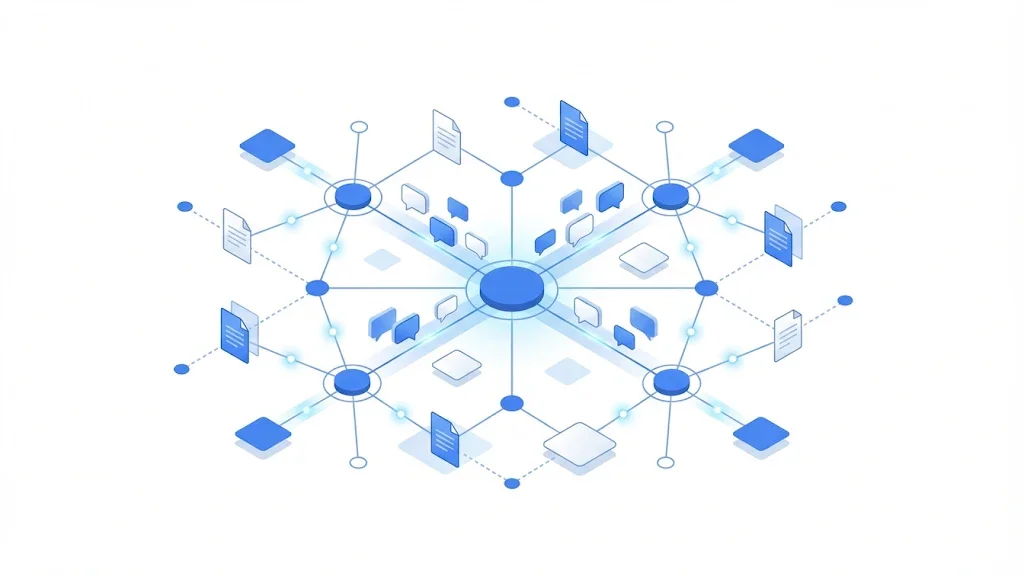
The two signals behave differently because the systems that read them work differently. A ranking system scores a page by the links that point to it, across the whole web. An AI assistant reads the question, runs its own web searches, reads a handful of pages and writes one answer, so what it names depends on the wording of each question as much as on your authority.
Backlinks vs AI citations
Google's own documentation on AI features says that "there are no additional requirements to appear in AI Overviews or AI Mode, nor other special optimizations necessary", and that the usual SEO best practices still apply. The foundations of classic search are also the base for AI answers. What changes is the layer on top: a page that answers a question in a quotable way has a better chance of being used in the answer.
Our guide on backlinks for AI search explains how to build those links. This article focuses on how to compare the two signals and how to measure both.
The most detailed public test of this question comes from Ahrefs. In its study of AI Overview brand visibility factors, published on May 26, 2025, the company looked at 75000 brands and measured how several off-site signals correlate with how often each brand appears in Google AI Overviews. About 26 percent of the brands had zero AI Overview mentions, so the analysis used the other 74 percent. The method is a Spearman correlation, where values near 1 mean a strong relationship and values near 0 mean almost none.
Branded web mentions, meaning pages that name your brand, scored 0.664. Brand anchors, which are links written with your brand name, scored 0.527. Backlinks scored 0.218, the lowest of the six signals. The bars use the same 0 to 1 scale as the values, so the gap is easy to read. Ahrefs also says plainly that correlation is not causation, so the chart does not prove that a mention makes an AI cite you.
The study in three numbers
Source: Ahrefs, May 26, 2025
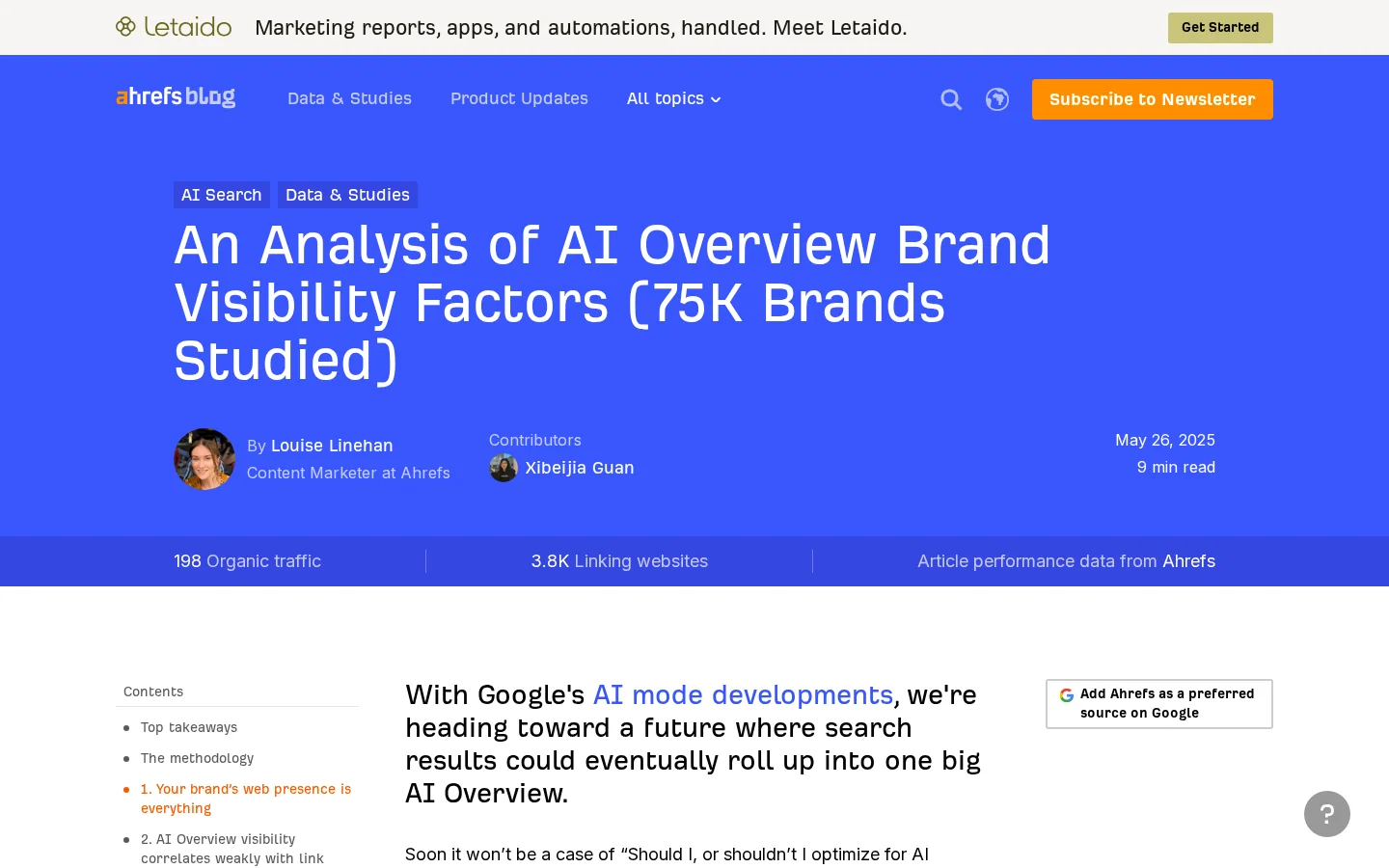
Read the chart as a warning against a single-metric plan, not as proof that links are worthless. Links still shape rankings, and many AI assistants search the web before they answer, so ranking still helps. The practical lesson is to track mentions and cited sources next to your link profile. The next sections show how.
No single method wins. The five below fit different situations, and each one has a clear effort and a clear risk. Start with the one that matches your content, then add the others.
Principle: give the assistant a number it cannot find anywhere else, with a date and a method. A unique figure is the easiest fact to cite.
When to use it: you have customer data, a benchmark or a survey, even a small one built from your own users.
Advantages: the source is you, so the citation points to your page and not to a rewrite of someone else. Other sites that quote the figure also create links back to you.
Limits: a weak sample damages trust. Say how many answers you collected and when, and avoid claims you cannot defend.
Example: for example, a B2B company surveys 200 buyers about how they choose a vendor, publishes the results with the exact question wording, and puts the three headline numbers in the first screen of the page.
Principle: state the answer in the first two sentences of each section, then expand. A clear answer is easy to lift into a generated response, and the detail after it earns the trust.
When to use it: on every page that targets a question, which covers most informational pages.
Advantages: readers who scan the page find the answer at once, and the structure costs little to add to pages you already have.
Limits: an answer that is short and generic gets skipped. The first sentence must say something specific, with a number, a condition or a named tool.
Example: a page on how long a site migration takes opens with the direct answer, which depends on how many redirects you map before launch, and then gives the steps in order.
Principle: AI assistants read community threads, reviews and directories, not only company sites. A brand named in a discussion that answers a real question can become a source for the answer.
When to use it: when your category has active forums or review sites, and your customers compare options there.
Advantages: the mention sits in a place readers already trust, and you did not write it. Our guide to UGC citations explains why forums and Reddit threads come up so often.
Limits: you cannot control the wording, and a promotional post breaks most community rules. Answer the question, disclose your role, and let the thread speak.
Example: a founder answers a detailed question in a niche forum, with the trade-offs of each option and a clear note of the tool they built. That answer can later be reused by an assistant.
Principle: label the content in a format machines read, using schema.org types for articles, FAQs, products or organizations. The label tells a crawler what each part of the page is.
When to use it: on pages with a clear type, such as a product, an article with a named author, an FAQ or a local business.
Advantages: the markup removes guesswork about who wrote the page, what it covers and when it was published. A schema checker can validate it in minutes.
Limits: markup does not make weak content citable. It must also match the visible text, because markup that describes content the page does not show goes against Google's structured data guidelines.
Example: an article page declares its headline, author, date and publisher, and the visible byline and date match the markup exactly.
Principle: an AI assistant can only cite what its crawler has read. If your robots.txt blocks the crawler, the page cannot be used, however good it is.
When to use it: check it once, and again after any change to your site or your CDN bot rules.
Advantages: a few lines of text can unlock a whole source of citations, at no cost.
Limits: allowing a crawler does not guarantee a citation. It only lets the crawler read your pages. OpenAI documents OAI-SearchBot as the crawler used to "surface websites in search results in ChatGPT's search features", so blocking it keeps your pages out of those results. Read the full list in OpenAI's crawler documentation.
Example: this robots.txt keeps OAI-SearchBot and GPTBot allowed. Check each company's documentation for current crawler names before you copy it.
User-agent: OAI-SearchBot
Allow: /

User-agent: GPTBot
Allow: /| Method | Effort | Main risk | Best for |
|---|---|---|---|
| Publish original data | High | A weak or unclear sample | Companies with their own data |
| Answer the question first | Low | Generic answers that get skipped | Any informational page |
| Get named where AI reads | Medium | Promotion that breaks community rules | Niches with active forums |
| Add structured data | Low | Markup that does not match the page | Pages with a clear type |
| Let the crawlers in | Low | An old rule that blocks crawlers by accident | Every site |
Use the table to choose, not to rank. The second and fifth methods work on pages you already have, and the other three need a plan.
Setting this up takes an hour or two, followed by a short monthly check. It works best on your top ten pages, the ones that already rank or answer a question you want to own.
Five steps for backlinks and citations
Write ten questions the way a customer would type them, for example "best tool to track AI visibility for a small team". Open a new session in each assistant, paste one question, and record four things in a sheet: whether your brand is named, its position in the answer, the URLs cited, and the competitors named. Ten questions across four assistants makes forty answers, which is enough for a first baseline.
Tip
For a first check without building a log, the free LLM citation checker shows how often AI models cite your domain. Run it before step 1, then compare the result with your sheet.
A quotable page has three traits. It gives the direct answer in its first two sentences, it summarizes the key facts in one table or list, and it attaches a source and a date to every number. Keep the sentences short, so an assistant can lift one without losing its meaning.
Backlink tools and AI tracking answer different questions. A backlink tool crawls the web and lists the links it finds. AI tracking asks the assistants themselves and records what they answered. You need both, because a link report cannot show what an assistant said last week, and a single prompt test cannot show your link profile.
| Question | Backlink tool | AI tracking |
|---|---|---|
| What it measures | Links pointing to your pages | Mentions of your brand in answers |
| Data source | A crawl of the web | The answers of each assistant |
| How often | As the tool crawls again | Each analysis, on the same prompts |
| Shows the answer text | No | Yes |
| Catches mentions with no link | No | Yes |
A good monthly routine uses both views. Compare the number of new referring pages with the change in mentions for the same prompts, and read the answer text whenever a mention disappears. The sources an assistant lists show which pages to strengthen and which sites are worth a link.
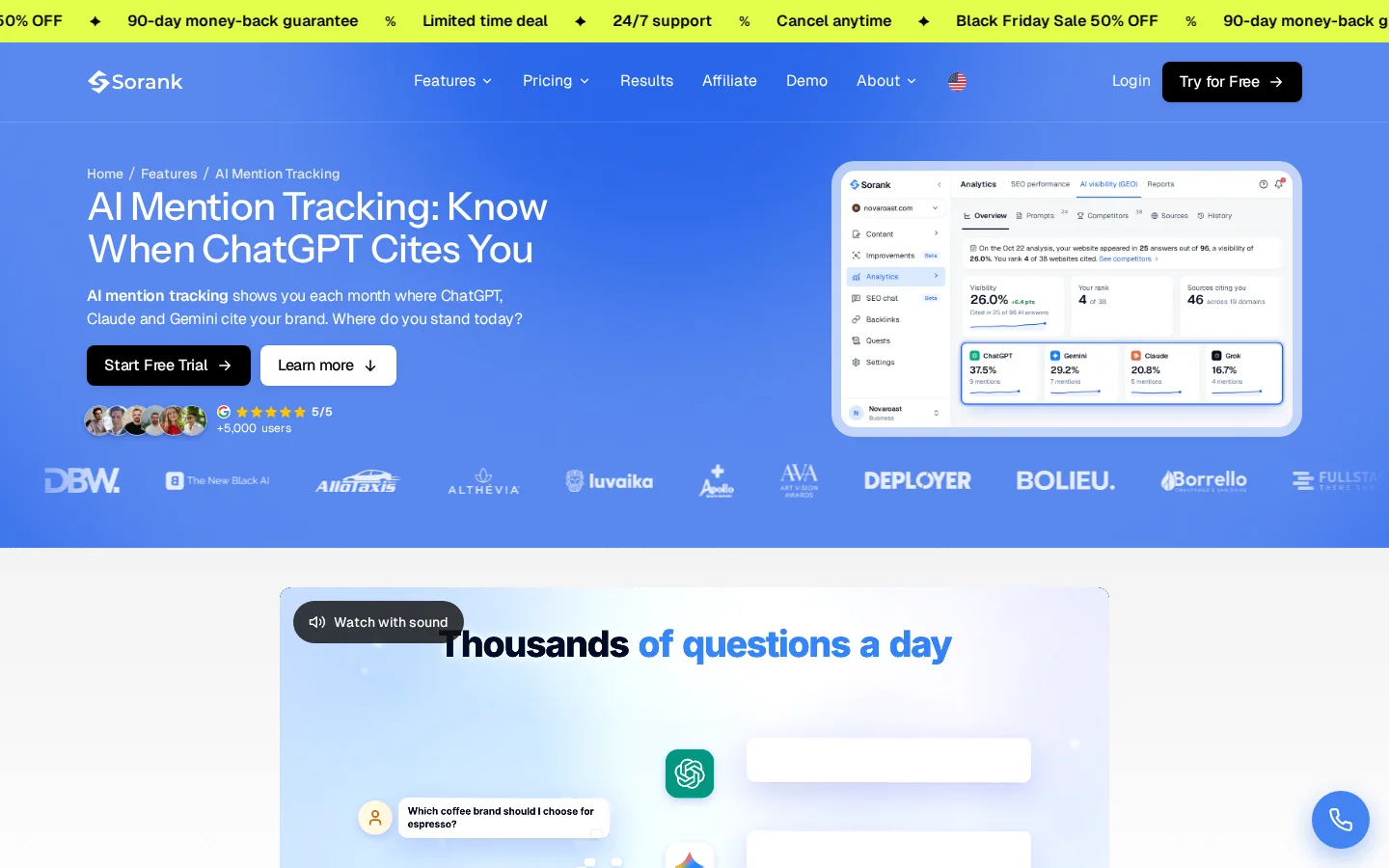
Sorank's AI Mention Tracking covers the second view. It sends your tracked prompts to ChatGPT, Claude and Gemini each month, marks each answer as mentioning you or not, and lists the reference sources behind each answer. The history is dated, so you compare periods instead of trusting one test.
For the brand side of the question, read our guide on how to check your brand in ChatGPT, Gemini and Perplexity.
Backlinks are only worth what the linking page is worth, and Google treats some ways of getting them as spam. In its spam policies, Google defines link spam as "the practice of creating links to or from a site primarily for the purpose of manipulating search rankings", and lists buying or selling links for ranking purposes as a violation. Paid links are allowed only when they carry a rel="nofollow" or rel="sponsored" attribute.
Two ways to get a backlink
The same policy names excessive link exchanges, which is the usual reciprocal swap. Our page on why buying backlinks is risky lists safer alternatives, and link building mistakes that waste your budget covers the costly errors.
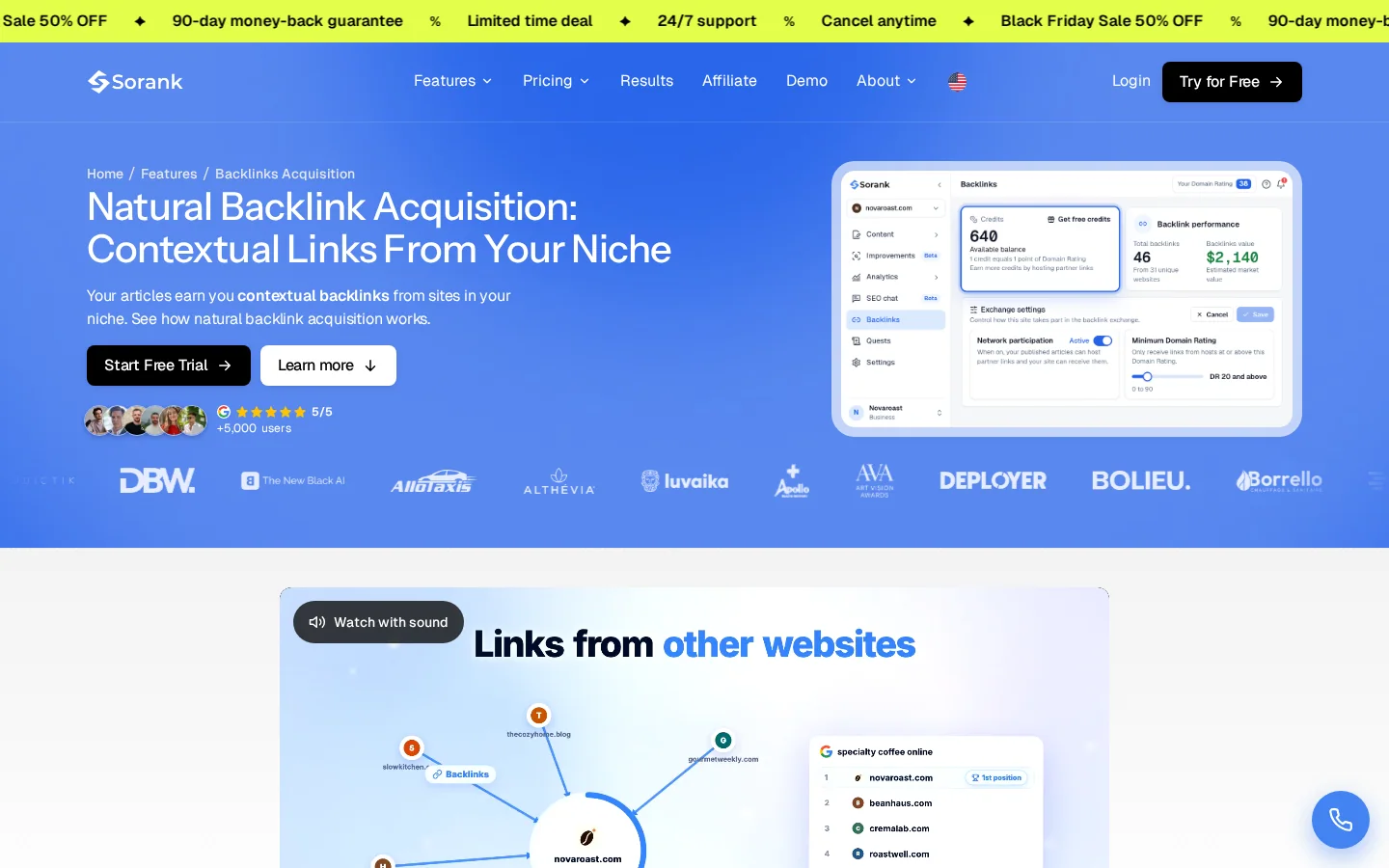
Sorank's natural backlink acquisition works one way. Sites in your niche place contextual links inside published articles, paid with credits rather than swaps, and each link stays visible with its anchor and status until it is verified. The site that links to you is never a site you link out to, so there is no reciprocal loop. You set the minimum Domain Rating a site needs to link to you, and you can refuse any link your own articles host.
These five mistakes come up most often. For each one, you can spot the symptom in data you already have.
| Mistake | Symptom | Fix |
|---|---|---|
| Counting only backlinks | Referring domains grow, but AI mentions stay flat | Track prompts next to your links |
| Pages nobody can quote | AI answers paraphrase competitors and skip you | Answer first, add a sourced table |
| Blocking AI crawlers by accident | No visits from OAI-SearchBot in your logs | Fix the robots.txt rule |
| Trading links | Reciprocal links with partners | Earn links with a reason to cite you |
| Measuring once | One screenshot drives a decision | Keep a monthly log of the same prompts |
What it is: judging your SEO by Domain Rating or referring domains alone, and assuming AI assistants will follow.
How to spot it: your report shows steady link growth, yet your brand is absent from the answers to the questions you care about. Compare both charts for the same month.
How to fix it: add prompt tracking to the same monthly report, and read the sources cited for each question you miss. Build links to the pages that the assistants actually read.
What it is: long introductions, claims with no numbers, and key tables that exist only as images.
How to spot it: open an answer an assistant gave, find the paragraph it drew on, and compare it with your page. If it quotes a competitor's sentence, your version was not clear enough to reuse.
How to fix it: move the direct answer to the first two sentences, put the key facts in an HTML table, and attach a source and a date to each number.
What it is: a broad Disallow rule for all agents, added for a scraper and left in place. A CDN bot setting can have the same effect.
How to spot it: read your robots.txt, then check your server logs for requests from OAI-SearchBot. Weeks with no hits are a warning sign, not proof, since crawl rates vary.
How to fix it: allow the crawlers you want, as in the example above, and check again after every site change. OpenAI's crawler documentation is the reference for the names.
What it is: asking partners for a link in return for yours, or joining a group that does so.
How to spot it: your link profile has many pairs of sites that link to each other, or partner pages built only to cross-link. Google lists excessive link exchanges as a violation.
How to fix it: stop the reciprocal requests, and earn links from pages that have a reason to cite you, such as original data or a tool that solves a task.
What it is: running one test in ChatGPT, seeing your brand, and assuming the result holds.
How to spot it: a decision is made from an undated screenshot, or an answer changes the next day with no explanation. AI answers vary between sessions, so one test is only a snapshot.
How to fix it: keep a dated log of the same prompts, asked the same way every month, and judge the trend over at least three months.
Start with the baseline, then fix one page. You do not need a new budget to begin, only a sheet and an hour.
This week's checklist
Once the basics are in place, go further. Our guide to AI visibility optimization covers the page-level work, and the citation gap article shows how to find the sources that name your competitors instead of you. Brand authority explains why some brands keep getting recommended, and the future of link building in AI search looks at what changes next. Start with the sheet, and let the data pick the next page.
Not in every case. Backlinks still feed the rankings Google shows in search, while AI citations decide whether ChatGPT, Gemini or Perplexity name your brand in an answer. Most sites need both, and the right balance depends on where your customers search.
Not in the same way. A backlink is a link passed from one page to another, while an AI assistant can name a brand or cite a page with no clickable link at all. Google's documentation says AI Overviews and AI Mode show relevant links, but it does not say whether those links count as links to your site for ranking.
Write ten questions your customers would ask, put each one to ChatGPT, Claude, Gemini and Perplexity, and log whether your brand appears and which sources are cited. Repeat the same test every month, because one answer is only a snapshot.
We analyse your competitors, your website and your AI visibility to create a tailored content plan for free.
 AI Content Brief Generator
 FAQ Schema Generator
 AI Blog Post Ideas Generator
 Structured Data Validator (Schema Validator)
 Alt Text Checker
 Internal Link Analyzer
 Backlink Challenge
 AI Meta Description Generator
 AI Blog Title Generator
 Google Indexability Checker
 AI Blog Outline Generator
 UTM Link Builder
 Keyword Clustering Tool
 Canonical Tag Checker
 XML Sitemap Generator
 Broken Link Checker
 AI SEO Title Generator
 Headline Analyzer
 SERP Preview Tool
 Redirect Checker
 Hreflang Tag Generator
 Heading Structure Analyzer
 HTTP Headers Checker
 Favicon Extractor
 SERP CTR Calculator
 SEO vs Paid Search Savings Calculator
 SEO Share of Voice Calculator
 SEO ROI Calculator
 SEO Traffic and Revenue Forecast Calculator
 SEO Budget Calculator
 SEO Break-Even Calculator
 SaaS SEO ROI Calculator
 ROAS Calculator
 Reading Time Calculator
 Ranking Gain Simulator
 Organic Traffic Value Calculator
 Organic Traffic Estimator and Website Traffic Checker
 LTV to CAC Ratio Calculator
 Local SEO ROI Calculator
 Link Building Cost Calculator
 Keyword Value Calculator
 Keyword Opportunity Score Calculator
 Keyword Density Calculator
 GEO ROI Calculator
 GEO Content Investment Calculator
 Ecommerce SEO ROI Calculator
 Customer Lifetime Value Calculator
 Customer Acquisition Cost Calculator
 CTR Calculator
 Cost Per Article Calculator
 Conversion Rate Calculator
 Content Marketing ROI Calculator
 ChatGPT Referral Traffic Estimator
 Bounce Rate Calculator
 Backlink ROI Calculator
 AI Visibility Score Calculator
 AI Traffic Value Calculator
 AI Share of Voice Calculator
 Cost of AI Invisibility Calculator
 AI Citation Rate Calculator
 llms.txt Validator
 AI Overview Checker and AI Overviews Rank Checker
 Robots.txt Checker
 AI SEO Audit
 LLM Readability Checker
 SearchGPT Readiness Checker
 Structured Data LLM Audit
 Website Crawlability AI Audit
 Why ChatGPT Is Not Recommending My Website
 Gemini Ranking Tool
 Perplexity Ranking Checker
 LLM Citation Checker
 Answer Engine Optimization Audit
 GEO Audit
 AI Search Visibility Test
 ChatGPT Visibility Checker
 llms.txt Generator
 URL Extractor
 Webpage to Markdown
 Sitemap Checker
 SERP Volatility Sensor
 Page Size Checker
 Word Counter
 Slug Generator
 Schema Generator
 Robots Generator
 OG Preview
 Meta Tags Generator
 Image Compressor
 Favicon Generator
 On-Page SEO Audit: SEO Checker and SEO Analyzer
 Backlink Analysis Tool
 Keyword Research Tool
 Domain Authority Checker
 “I tested Sorank on a real client site and it's insane. It does everything an agency would bill you $1500 a month for. It's going into production on that client now.”

 Guillaume Guersanguersanguillaume.com“We are an Ads agency and we wanted to get our SEO back on track once and for all. Sorank gave us a clear view of our site, helped us prioritize optimizations, and properly structure our content. The tool is easy to use, well designed for a team, and very practical for centralizing tracking without having to juggle multiple platforms. A very solid foundation to start fresh with our SEO.”
 Gaspard MadouiAds Agency
 “I just let the Sorank software do its thing, and now my DR is 25 and my page is ranking higher.”
 Lucas Flandrefoundertrace.fr“I specialized in GEO thanks to Sorank. The GEO Leaderboard allows me to show my clients their position vs competitors on ChatGPT. It’s a real commercial differentiator.”
 MélanieSEO Freelance“Great service, works well for our website and helps us understand how to improve it to rank better on Google and elsewhere. Congrats, keep going, I recommend it.”
 Hugo T.E-commerce merchant