Preferences
Privacy is important to us, so you have the option of disabling certain types of storage that may not be necessary for the basic functioning of the website. Blocking categories may impact your experience on the website. More information
Privacy is important to us, so you have the option of disabling certain types of storage that may not be necessary for the basic functioning of the website. Blocking categories may impact your experience on the website. More information

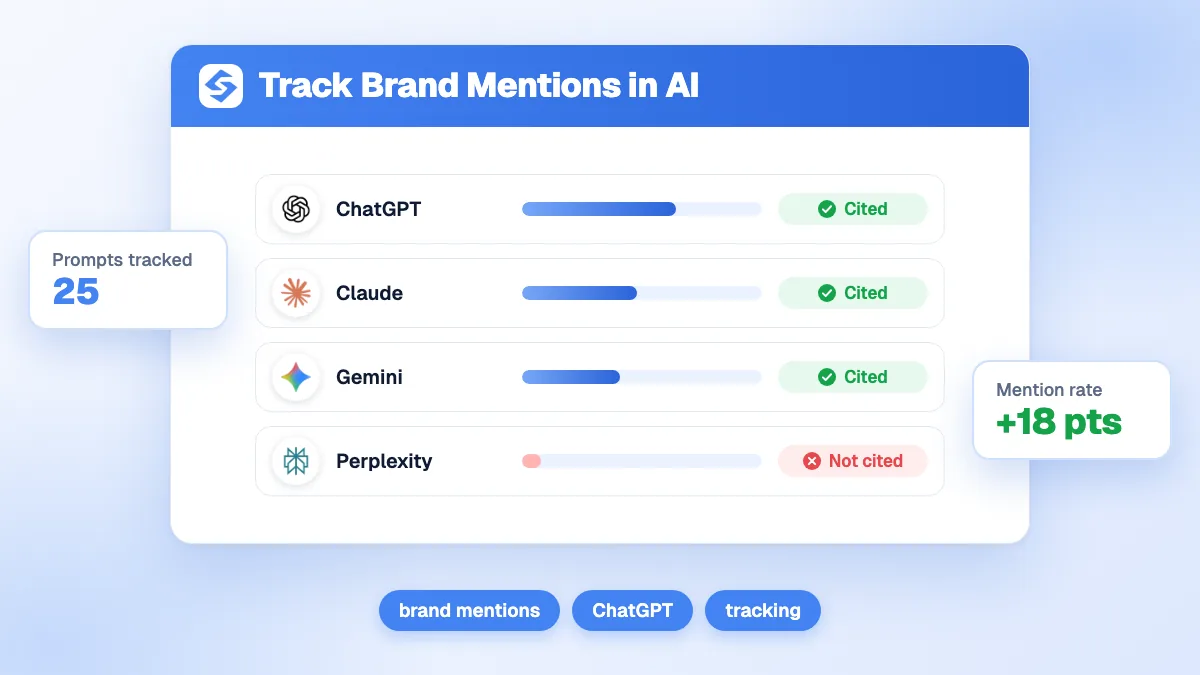
A mention is your brand named in an AI answer, a citation is the source link attached to it. Learn how they differ, why they diverge and how to track both.
In short
A mention is your brand name written in the text of an AI answer. A citation is a link to a source that the AI attaches to that answer. A brand can be named without being linked, and linked without being named, so you need to track both.
Want to go further? Ask
Quick quiz
How should you get mentioned by ChatGPT and other AI assistants?
Sorank matches your answers


Test it for 3 days on your own site and see where you stand on Google, ChatGPT and the other AIs.
Start 3-day free trial3 days free, then stop whenever you want. 90-day results guarantee, conditions apply.
A mention is your brand named in the words of an AI answer. A citation is a URL the AI attaches to that answer as a source. Both can appear in the same answer, but they are recorded and move separately. A tool that merges them into one "AI visibility" number hides what is actually happening, and that is the first mistake most teams make.
Take the question "What is a good CRM for a 10-person law firm?" If the answer says "Northwind CRM is built for small firms that need matter tracking", your brand is mentioned. (Northwind is a made-up brand used throughout this guide.) The name can sit in a sentence, a bulleted list or a comparison table. The counting rules are simple:
A citation is a source the assistant attached to the answer. It can show up as an inline number, a footnote or a card under the text. For tracking, you record the URL, its domain and its position in the list of sources. Citations only appear when the assistant searched the web to write the answer. An answer built only from training data often has no citations at all. That is normal, and it is not a fault in your tracking.
Example
Suppose the CRM answer names three tools but never names Northwind in its text, while its source list includes a page from northwind.example. That page is a citation for Northwind, not a mention. If the same answer later says "Northwind is built for small firms", the brand becomes both mentioned and cited.
The table below gives you the working definitions. Use it as a reference when you build your tracking sheet, because each row maps to a column you will need.
| Question | Mention | Citation |
|---|---|---|
| Where it appears | In the answer text | In the source list or as a link |
| What you count | Each brand, once per answer | Each cited URL and its domain |
| Needs a live web search? | No, it can come from training data | Yes, it only appears when the model searched |
| Main driver | Brand presence across the web | Crawlable pages on your own domain |
| What it signals | Recognition and a place on the shortlist | Evidence and referral potential |
Mention or citation? Where to look
For the setup itself, our guide on tracking brand mentions in ChatGPT, Claude, Gemini and Perplexity walks through the platforms. This article focuses on the difference between the two signals and on what to do with each. For short definitions, see the AI brand mentions and AI citations entries.
Mentions and citations come from different parts of the answer process, so they rarely line up one for one. In its own study of citations vs mentions, BuzzStream reports that only 23.1% of brand mentions are backed by a citation. In the other direction, 69.9% of citations include the brand's name in the response text. The two figures describe the same kind of answers from opposite sides, and neither one is a universal rate you should expect for your own category.
Two signals, two different rates
Source: BuzzStream, study of citations vs mentions (last updated 30 September 2026)
BuzzStream defines a mention as an AI platform naming a brand, company, product or term within a generated answer, with or without a link. The name can come from the model's training data or from live retrieval. A brand that many sites discuss can be named in a shortlist even when none of those sites is cited in that particular answer. In that case your brand is recognised, but the answer does not rely on your pages.
This is why a strong reputation can produce mentions long before it produces citations. Reviews, directories, press coverage and forum threads all feed the model's picture of who the category leaders are. None of them has to link to you for the name to appear.
The same source defines a citation as a reference generated alongside an answer to support or verify its findings. That is a different job from recommending. The assistant may cite your guide to explain how a feature works, then recommend a competitor for the final decision. Your page did the work, but your brand was not the answer. This happens often with informational content, where a page is strong on facts and weak on naming the company behind them.
If you publish that kind of content, you will see citations rise while mentions stay flat. That is not a failure. It tells you the page is useful evidence, and the next job is to make the brand part of the recommendation.
Treat these two figures as evidence for a pattern, not as a benchmark. The article points to a separate study page for its method, and the sample size and dates are on that page, not on this one. Check that page before you quote the figures in a report. Then use the gap between the two signals to decide where to work first.
Warning
A high citation count does not prove that people are visiting or buying. A citation shows that the model used your page as a source. Connect citations to visits and conversions in your analytics before you count them as results.
Citations are the last step of a search pipeline, so the earlier steps decide whether you can earn one. Google's documentation on AI features in Search says that AI Overviews and AI Mode use query fan-out, which means they issue several related searches for one question. Google also says these features can show a wider and more diverse set of helpful links than classic search. For you, that means a page that answers one sub-question well can earn a citation for a question you never targeted directly.
Take the question "Which CRM suits a small law firm?" The assistant may run sub-searches on pricing, data security and setup time. Each sub-search returns its own results. The page that explains matter-tracking setup clearly may get cited for the setup part, while a competitor is named in the overall recommendation. You can check this yourself by asking the same question in parts and noting which sources appear for each part.
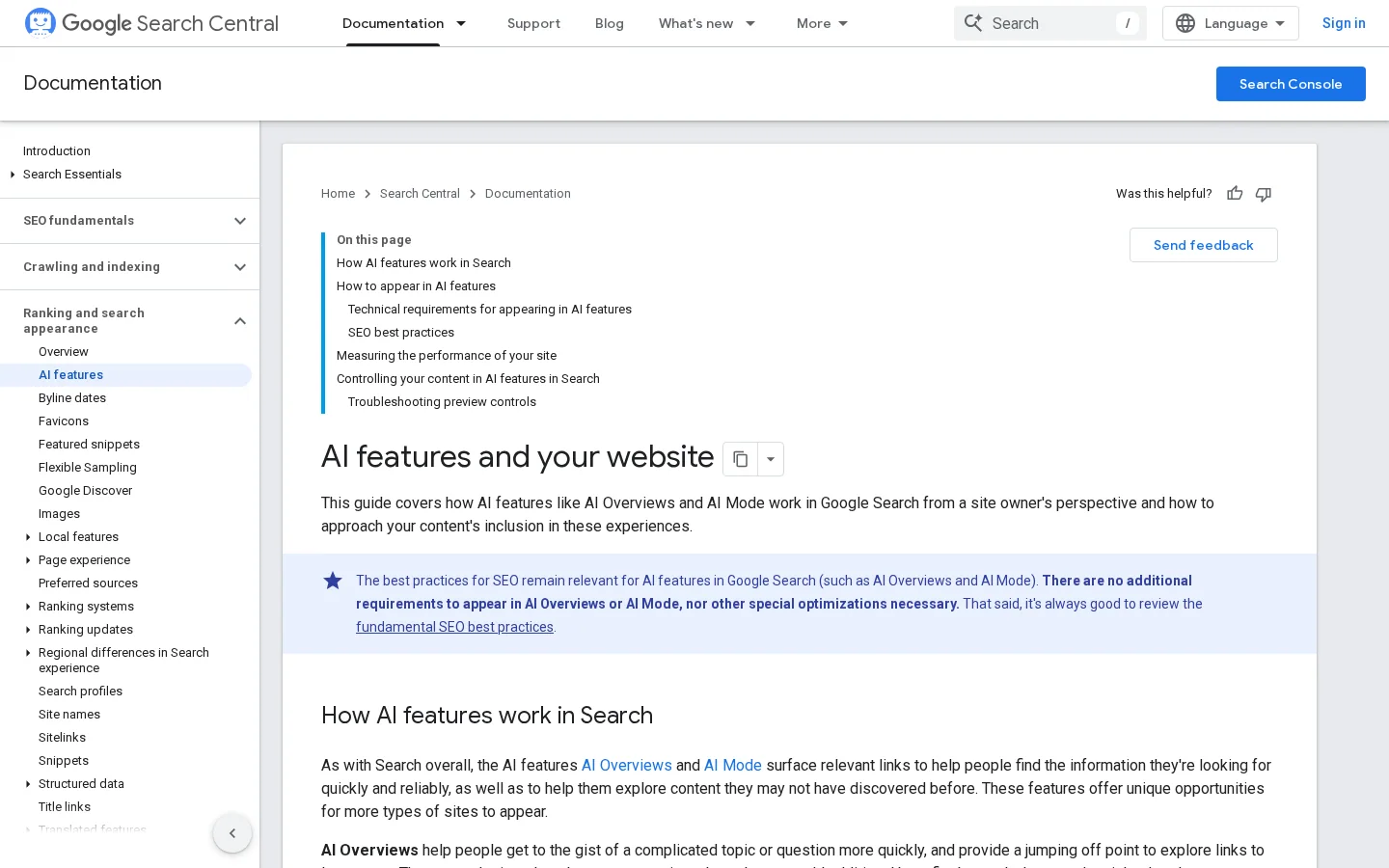
Google says a page must be indexed and eligible to be shown in Google Search with a snippet, and that there are no additional technical requirements beyond that. It also says you do not need to create new machine-readable files, AI text files or markup to appear in these features. So a llms.txt file or a special schema type is not a shortcut to citations. Crawlability, indexing and the quality of the answer on the page still decide the outcome.
In practice, check three things on every page you want cited: that it is indexed, that it answers the question in its first paragraphs, and that its facts are dated and specific enough to quote.
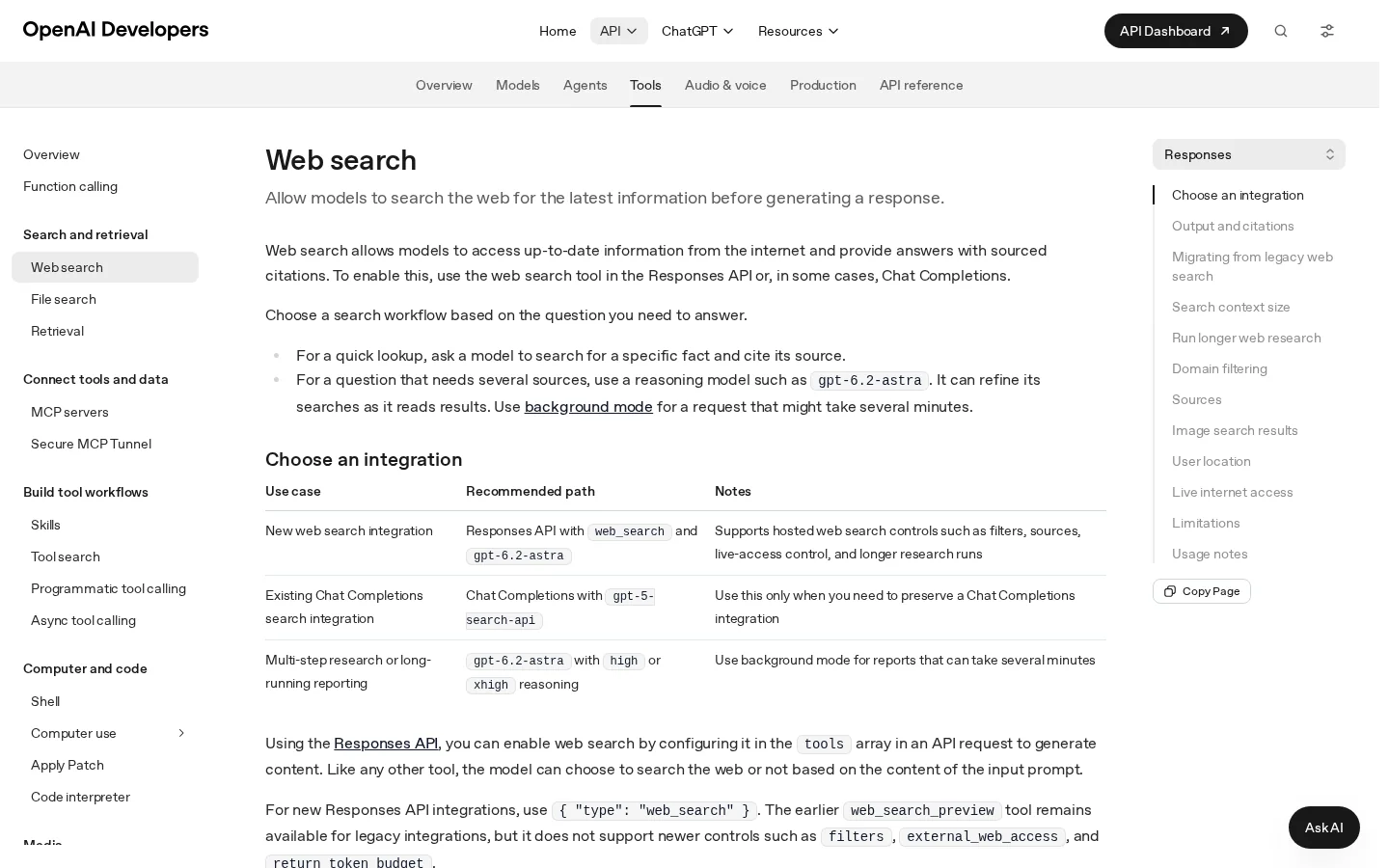
The OpenAI web search guide separates the two. It says that by default the response includes inline citations for URLs found in the search results, and that each cited source comes back as a url_citation annotation with its URL, title and location in the text. A separate sources field returns the complete list of URLs the model consulted when it formed the response. For tracking, that means a page can be read and still never be cited. A sources list is not the same as a citation list, so do not treat them as interchangeable in your data.
Each prompt you test lands in one of four states. Reading the states together tells you which problem to fix, because each state calls for different work. The table sums them up, and the sections below explain each state and the action it points to.
| Cited | Not cited | |
|---|---|---|
| Mentioned | Strongest position: named and backed by your own page | Mentioned, not cited: known from other sources |
| Not mentioned | Cited, not mentioned: your facts were used, but you were not recommended | Neither: the visibility gap |
This is the strongest state. The assistant names your brand and links to your own page as evidence. Keep those pages current, because an outdated fact on a cited page can damage the mention too. Re-run the prompts each month and read the answer text for claims that have changed.
The model knows your brand from other sources, such as reviews, directories or press, but your own pages do not support the answer. Find the third-party sources that the answer relies on. If they describe you wrongly, fix those sources first. Then publish a page that answers that exact question with specific facts, so the next time the model looks for evidence, it finds yours.
This state is common with informational articles. Your page supplied the facts, but the recommendation went to someone else. Add a clear statement of what you offer, a short comparison section and a named use case. Those give the model a reason to name you in the answer, not only to cite your facts.
You are absent from both. Start with the prompts where competitors are named and you are not, then check which sources those answers cite. The difference between their sources and yours is your work list. The idea is covered in more depth in our article on the citation gap, including how to prioritise the pages to fix.
Measure both signals on the same fixed set of prompts, on the same platforms, on the same schedule. If you change the wording or the platforms each time, you end up measuring the test rather than your work. The five steps below give you a baseline that you can repeat every month.
The five-step measurement method
Write 10 to 20 prompts that a buyer would actually type. Spread them across intents: understanding ("what is a CRM for law firms"), comparison ("Northwind vs a large suite"), selection ("best CRM for a 10-person firm") and quality ("is Northwind secure for client data"). Keep the list unchanged for at least four weeks, so that a trend means something. If you need new prompts later, add them as a second list and keep the first one running.
For each prompt and platform, store the date, the platform, the full answer text and whether a web search ran. Without the search flag, a zero citation count tells you nothing. Keep the raw answer as well, because the mention rule depends on the exact wording, and you cannot recount a mention from a summary.
Calculate the two rates on separate lines, with the same denominator for each:
mention rate = answers that name your brand / answers tested
citation rate = answers that link to your domain / answers tested
Example: out of 40 answers, 12 name the brand and 5 link to its domain. The mention rate is 30% (12 divided by 40) and the citation rate is 12.5% (5 divided by 40). The two rates measure different things, so report them on separate lines and never average them into one score.
Record the position of each cited URL and its domain. Split your own domain from third-party domains. If most of the citations in your category come from one review site, that site is your main lever for mentions as well as citations, because it is shaping the source list and the names in the answer at the same time.
Read the two rates together. Mentions going up while citations stay flat suggests that work away from your site, such as reviews and press, is paying off. Citations going up while mentions stay flat suggests your pages are used as evidence but not yet as recommendations. That points to the fixes described in the four combinations section above.
Tip
For a first read on how often AI models cite your domain, the LLM Citation Checker gives you a starting point before you build a full tracking sheet.
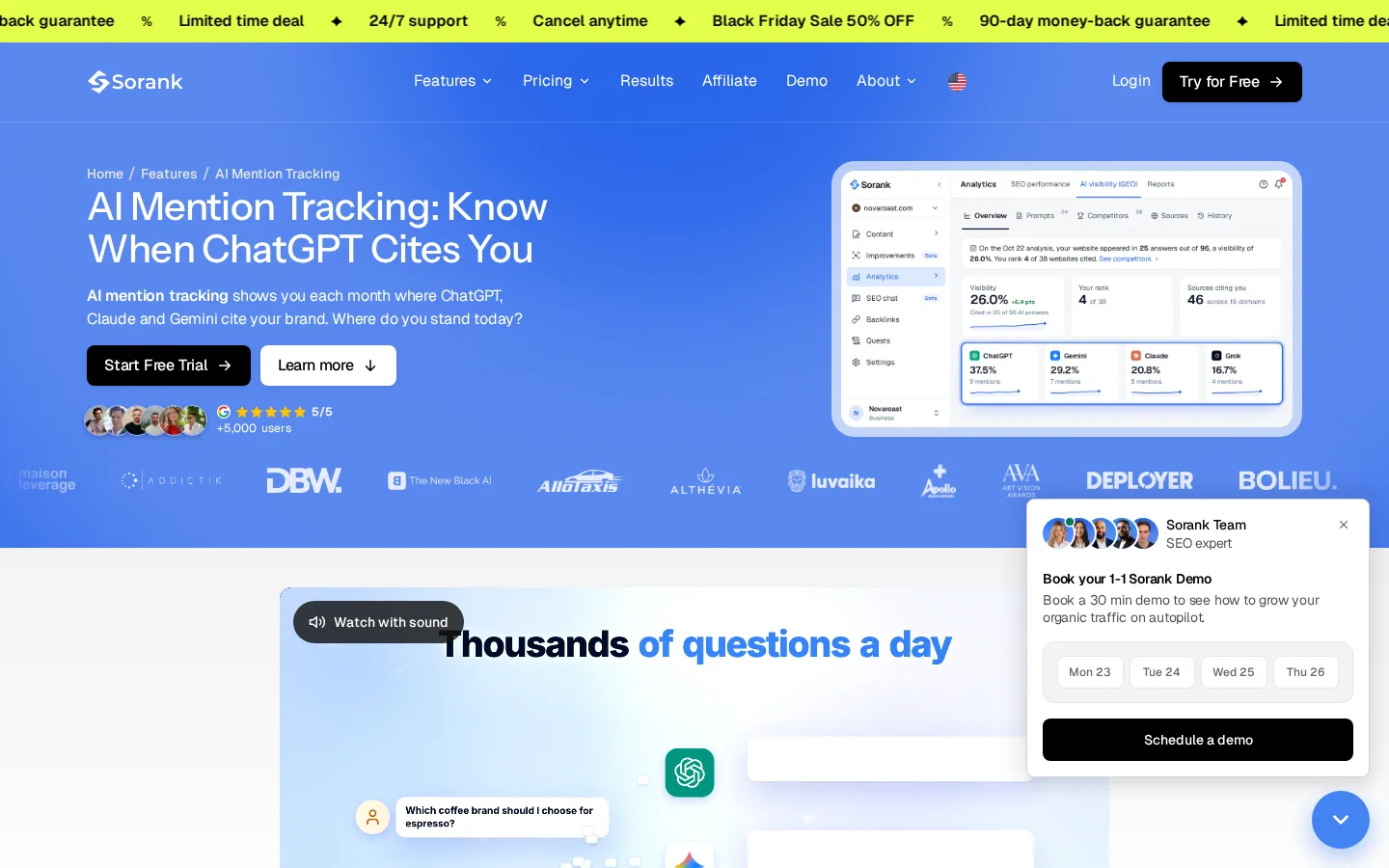
Doing this by hand is slow, so most teams move to a tracker after the first month. Sorank's AI mention tracking sends a fixed list of prompts to each assistant every month, records whether your brand is mentioned, and lists the reference sources that models rely on when they cite a brand. Whichever tool you use, check its method against the five steps above before you trust its numbers.
Four methods move these two signals. They work through different mechanisms, so choose them by the gap you measured. Low citations point to your own pages. Low mentions point to what the rest of the web says about you. Each method below has a principle, the moment to use it, its advantages, its limits and an example. The table at the end compares them side by side.
Principle: Put the question in the heading, the direct answer in the first two sentences, then the evidence and the steps. Clear, self-contained answers are easier for an assistant to quote.
When to use it: When citations are low on informational prompts.
Advantages: You control the page, and it can be crawled and indexed like any other page on your site.
Limits: A good page can be cited without naming your brand, so pair it with method 3.
Example: A page titled "How long does a CRM migration take?" with the answer in its first paragraph, the steps in order, and a table of timelines by team size.
Principle: Publish figures, definitions or a process that exist only on your site, and state the method next to them.
When to use it: When you have first-party data, such as customer surveys, usage numbers or a benchmark you ran yourself.
Advantages: Other writers quote you, which can create citations and, in some cases, third-party mentions.
Limits: It costs time, and the data must be accurate, dated and refreshed. Stale numbers are a liability.
Example: A yearly survey of your own customers, with the sample size, the question wording and the collection dates published on the same page.
Principle: Have your brand described accurately on the sites that a model reads when it builds a shortlist: reviews, comparison articles, directories and press.
When to use it: When mentions are low on selection prompts, the ones where a buyer asks for the best option.
Advantages: A brand named inside a recommendation list is the strongest form of mention.
Limits: It is slow. You do not control the wording, and a site may describe your product wrongly or out of date.
Example: Send a comparison site accurate use-case details, then check how it describes your product in its next update. To turn unlinked mentions into links, see unlinked brand mentions.
Principle: Map the pages cited for your prompts, then check which of them name your brand and what they say about it. These pages already carry weight with the model, so an accurate correction or a useful reply there can change what gets named.
When to use it: After you have the source list from step 4 of the measurement method.
Advantages: You work on sources the model already cites, so you do not have to earn a new page from zero.
Limits: You cannot edit other people's pages, and every community has its own rules about company participation.
Example: A cited forum thread compares tools in your category. A factual reply from your team, with the affiliation stated and within that community's rules, can add the correct details to the discussion.
| Method | Mainly moves | Effort | Main limit |
|---|---|---|---|
| 1. Answer-first pages | Citations | Medium | Can be cited without a name |
| 2. Original data and definitions | Citations, then mentions | High | Needs real data and upkeep |
| 3. Reviews and comparisons | Mentions | Medium | You do not control the wording |
| 4. Offsite mentions in cited pages | Mentions | Low to medium | You cannot edit other people's pages |
Most bad measurements come from a handful of errors. Each one below says what it is, how to spot it in your data and how to fix it. The figure shows the most common error, a single column for everything, next to the setup that avoids it.
One sheet, two signals
What it is: A cited URL is recorded as if the brand were named in the answer text. How to spot it: Your mention count is higher than the number of answers where you can actually find the brand name when you read them. How to fix it: Keep two columns, one for the text and one for the sources. Count a mention only when the brand name appears in the answer text, never from a source title, a URL or a publisher name.
What it is: A brand named three times in one answer adds three mentions. How to spot it: Mention counts that exceed the number of answers in your panel, or a visibility score that rises mainly on long answers. How to fix it: Count one mention per brand per answer. If you need to record intensity, store it as a separate field, not as extra mentions.
What it is: You run a prompt in a mode that answers from training data, so no citations appear. How to spot it: A citation rate of zero across the whole panel, with no search flag recorded anywhere. How to fix it: Record whether a web search ran for each answer, and calculate citation rates only over the answers where one ran. A zero is normal when there was no search, and it should not be averaged into your result.
What it is: A cited page is read as an endorsement. How to spot it: The cited page is a critical review, a comparison that ranks you last, or an article that uses your data to argue against you. How to fix it: Read the sentence around each citation before you count it as positive. Tag each citation as supporting, neutral or critical, and track each tag on its own line.
What it is: You test a single phrasing and treat that answer as the truth about your market. How to spot it: Your result changes sharply when a colleague asks the same question in other words. Query fan-out makes this worse, because one question can trigger several sub-searches with different sources. How to fix it: Write two or three variants of each prompt in your core list, and report the result across them.
What it is: You compare a month tested with 20 prompts against a month tested with 60, or you add platforms halfway through the year. How to spot it: Your trend changes at the exact moment the panel changed. How to fix it: Keep the panel fixed. If you must add prompts or platforms, restate the earlier months on the new panel before you compare them.
You can start this week without buying a tool. Work through the checklist below and keep the results in one sheet with a column for mentions and a column for citations. For the wider context on how these signals fit into AI search, see the AI search visibility entry.
Your first week
Repeat the same list next month. The first month gives you a baseline, and the gap between your mention rate and your citation rate tells you which of the four methods to start with.
A mention is your brand name written in the text of an AI answer. A citation is a link to a source that the AI attaches to the answer. A brand can have one without the other, so track them separately.
Yes. A mention can come from training data or from other sites that discuss your brand, so the answer may name you without linking to any of your pages. The reverse also happens: one of your pages can be cited while a competitor is recommended.
Use a fixed list of 10 to 20 prompts, run them on the same platforms each month, and count mentions once per answer. Log every cited URL and its domain on a separate sheet, and report the two rates on separate lines.
We analyse your competitors, your website and your AI visibility to create a tailored content plan for free.
 AI Content Brief Generator
 FAQ Schema Generator
 AI Blog Post Ideas Generator
 Structured Data Validator (Schema Validator)
 Alt Text Checker
 Internal Link Analyzer
 Backlink Challenge
 AI Meta Description Generator
 AI Blog Title Generator
 Google Indexability Checker
 AI Blog Outline Generator
 UTM Link Builder
 Keyword Clustering Tool
 Canonical Tag Checker
 XML Sitemap Generator
 Broken Link Checker
 AI SEO Title Generator
 Headline Analyzer
 SERP Preview Tool
 Redirect Checker
 Hreflang Tag Generator
 Heading Structure Analyzer
 HTTP Headers Checker
 Favicon Extractor
 SERP CTR Calculator
 SEO vs Paid Search Savings Calculator
 SEO Share of Voice Calculator
 SEO ROI Calculator
 SEO Traffic and Revenue Forecast Calculator
 SEO Budget Calculator
 SEO Break-Even Calculator
 SaaS SEO ROI Calculator
 ROAS Calculator
 Reading Time Calculator
 Ranking Gain Simulator
 Organic Traffic Value Calculator
 Organic Traffic Estimator and Website Traffic Checker
 LTV to CAC Ratio Calculator
 Local SEO ROI Calculator
 Link Building Cost Calculator
 Keyword Value Calculator
 Keyword Opportunity Score Calculator
 Keyword Density Calculator
 GEO ROI Calculator
 GEO Content Investment Calculator
 Ecommerce SEO ROI Calculator
 Customer Lifetime Value Calculator
 Customer Acquisition Cost Calculator
 CTR Calculator
 Cost Per Article Calculator
 Conversion Rate Calculator
 Content Marketing ROI Calculator
 ChatGPT Referral Traffic Estimator
 Bounce Rate Calculator
 Backlink ROI Calculator
 AI Visibility Score Calculator
 AI Traffic Value Calculator
 AI Share of Voice Calculator
 Cost of AI Invisibility Calculator
 AI Citation Rate Calculator
 llms.txt Validator
 AI Overview Checker and AI Overviews Rank Checker
 Robots.txt Checker
 AI SEO Audit
 LLM Readability Checker
 SearchGPT Readiness Checker
 Structured Data LLM Audit
 Website Crawlability AI Audit
 Why ChatGPT Is Not Recommending My Website
 Gemini Ranking Tool
 Perplexity Ranking Checker
 LLM Citation Checker
 Answer Engine Optimization Audit
 GEO Audit
 AI Search Visibility Test
 ChatGPT Visibility Checker
 llms.txt Generator
 URL Extractor
 Webpage to Markdown
 Sitemap Checker
 SERP Volatility Sensor
 Page Size Checker
 Word Counter
 Slug Generator
 Schema Generator
 Robots Generator
 OG Preview
 Meta Tags Generator
 Image Compressor
 Favicon Generator
 On-Page SEO Audit: SEO Checker and SEO Analyzer
 Backlink Analysis Tool
 Keyword Research Tool
 Domain Authority Checker
 “I tested Sorank on a real client site and it's insane. It does everything an agency would bill you $1500 a month for. It's going into production on that client now.”

 Guillaume Guersanguersanguillaume.com“We are an Ads agency and we wanted to get our SEO back on track once and for all. Sorank gave us a clear view of our site, helped us prioritize optimizations, and properly structure our content. The tool is easy to use, well designed for a team, and very practical for centralizing tracking without having to juggle multiple platforms. A very solid foundation to start fresh with our SEO.”
 Gaspard MadouiAds Agency
 “I just let the Sorank software do its thing, and now my DR is 25 and my page is ranking higher.”
 Lucas Flandrefoundertrace.fr“I specialized in GEO thanks to Sorank. The GEO Leaderboard allows me to show my clients their position vs competitors on ChatGPT. It’s a real commercial differentiator.”
 MélanieSEO Freelance“Great service, works well for our website and helps us understand how to improve it to rank better on Google and elsewhere. Congrats, keep going, I recommend it.”
 Hugo T.E-commerce merchant