Preferences
Privacy is important to us, so you have the option of disabling certain types of storage that may not be necessary for the basic functioning of the website. Blocking categories may impact your experience on the website. More information
Privacy is important to us, so you have the option of disabling certain types of storage that may not be necessary for the basic functioning of the website. Blocking categories may impact your experience on the website. More information

BrightEdge vs Raven Tools compared on price, features and fit. Get Raven's plan costs, BrightEdge's unpublished gaps, and a 5-step test before you buy.
In short
BrightEdge and Raven Tools are both SEO platforms, but they serve different buyers. BrightEdge is an enterprise platform sold on custom quotes, with no public price or free trial. Raven Tools is a cloud suite for agencies and small teams, with published plans from $49 a month and a 7-day trial.
Want to go further? Ask
Quick quiz
Which kind of SEO tool is right for you?
Sorank matches your answers


Test it for 3 days on your own site and see where you stand on Google, ChatGPT and the other AIs.
Start 3-day free trial3 days free, then stop whenever you want. 90-day results guarantee, conditions apply.
If you are choosing between the two, three things decide it: how big your team is, whether you can approve a spend without a sales process, and whether AI visibility is part of your job. This guide compares both products using what their own websites say, flags where the public numbers disagree, and gives you a test you can run before you sign anything.
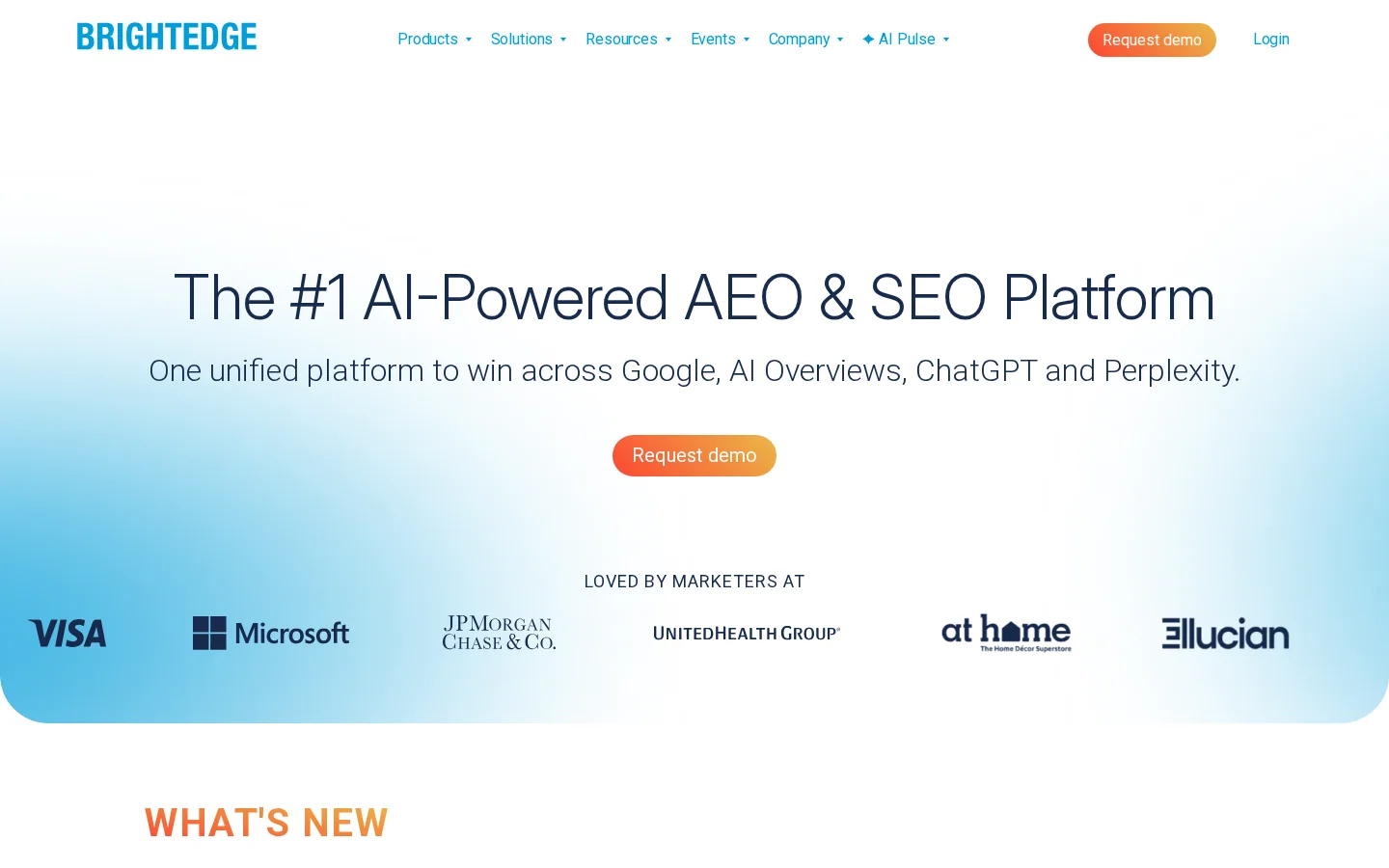
BrightEdge is an enterprise SEO and AEO platform for large brands, and you get access through a sales conversation. Its homepage calls it "The Leading AI-Powered SEO and AEO Platform" and presents one system for Google Search, AI Overviews, ChatGPT and Perplexity. The product is built for teams that manage large sites, many markets and a formal approval process.
Note
AEO (answer engine optimization) means making your pages easy for AI answer engines to find, read and quote. It overlaps with GEO (generative engine optimization), and vendors use the two terms in different ways, so check what a vendor means before you compare claims.
The homepage lists modules by name rather than giving a full feature table. Each name points to a specific job, so read them as a map of where BrightEdge puts its effort:
Two things are missing from that list. The homepage names no standalone site auditor and no share-of-voice module. It does mention "full-scale audits" under web development. If a specific feature matters to you, ask for it in writing during the demo instead of assuming it is included.
The homepage case studies cover midsize businesses, enterprise companies, global multi-market brands and local businesses. The audience is marketers and digital teams that already run SEO across many sites or countries. A solo consultant or a three-person agency will probably find the platform heavier than the job needs, and the contract will be heavier too.
On the homepage, the only call to action is to request a demo. I found no public price and no free trial there. That is the starting point of the whole comparison: you cannot put BrightEdge in a spreadsheet next to a number until a sales team sends a quote.
Raven Tools is a cloud SEO suite for agencies, small businesses and in-house marketers who need audits, rank tracking and reports in one place. It publishes its prices, lets you start a trial without a sales call, and sells the same product at several sizes, from two users to forty.
Raven Tools in four numbers
Source: Raven Tools pricing and Site Auditor pages, checked November 2026
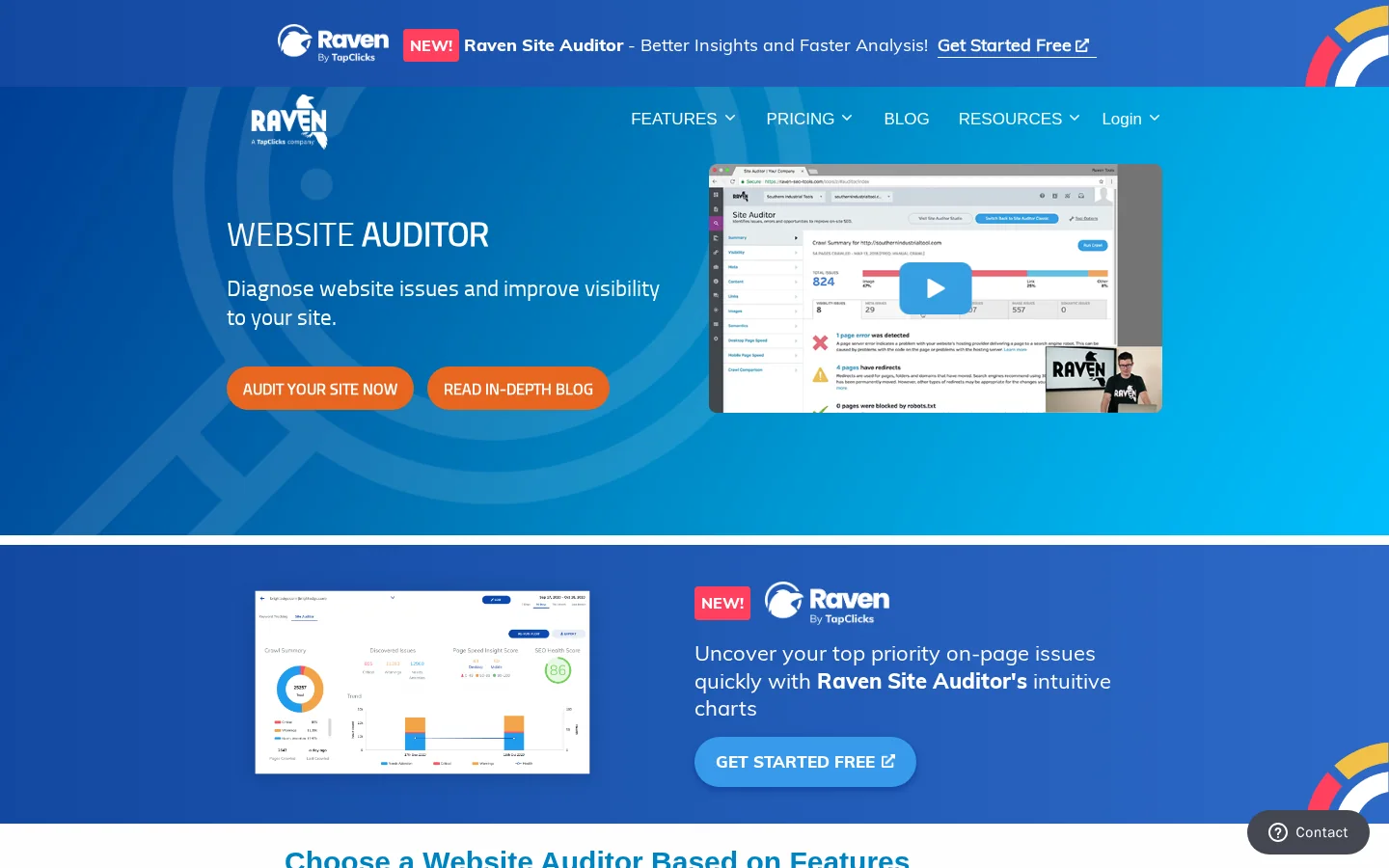
The Site Auditor is usually the first Raven feature a team uses. You choose a crawl depth from 1 to 10000 pages, schedule audits to run weekly or monthly, and receive alerts about new problems. The tool checks seven areas: visibility, meta data, content, links, images, semantic markup, and desktop and mobile page speed. Its results feed Raven's marketing report tool, so audit numbers can sit next to your other SEO KPIs.
Read Raven's claims carefully. The official Site Auditor page gives no count of checks, so a "30+ checks" figure in a comparison article does not come from Raven's own page. The crawl depth is also capped at 10000 pages. If your site is larger, decide which sections matter most and crawl those first.
Raven prices rank tracking by position checks. Each plan includes a set allowance, from 1500 on Small Biz to 30000 on Lead, and every check beyond that costs $0.003, billed monthly. The unit price is small, but it adds up quickly once you track thousands of keywords. The price section below shows how to put a number on it. If you run reporting for several clients, compare the options in our guide to white label rank trackers for agencies before you commit to one.
Raven is a weaker fit if your purchase needs a formal enterprise contract, or if AI visibility is the main reason you are buying. Its pages do not describe an AI visibility module that matches BrightEdge's AI Hyper Cube, and the features section covers that gap in more detail.
Raven publishes every plan, and BrightEdge does not publish a price, so the comparison starts with one number on one side only. The fair way to compare is to price Raven exactly, then ask BrightEdge for a quote that you can measure against the same use case.
Raven Tools monthly price by plan, billed monthly (USD)
Source: Raven Tools pricing page, checked November 2026
The chart shows the monthly price of each plan when you pay month to month. The full grid, including annual prepaid billing, is below. Figures come from Raven's pricing page, checked in November 2026.
| Plan | Billed monthly | Annual prepaid, per month | Annual total | Domains or campaigns | Users | Included position checks |
|---|---|---|---|---|---|---|
| Small Biz | $49 | $39 | $468 | 2 | 2 | 1500 |
| Start | $109 | $79 | $948 | 20 | 4 | 15000 |
| Grow | $199 | $139 | $1668 | 80 | 8 | 20000 |
| Thrive | $299 | $249 | $2988 | 160 | 20 | 25000 |
| Lead | $479 | $399 | $4788 | 320 | 40 | 30000 |
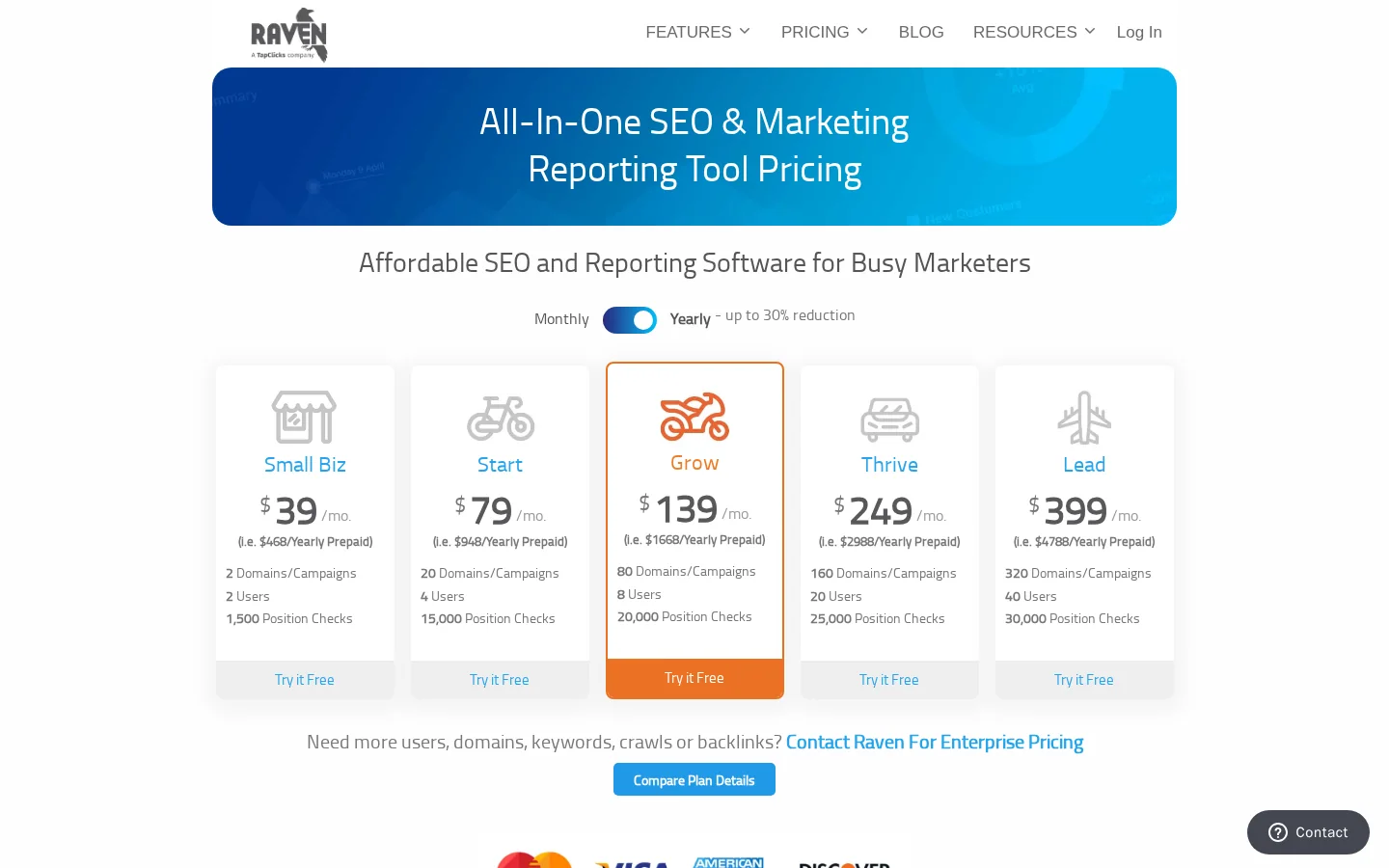
Search for Raven's prices and you will see both numbers for the top plan. Lead costs $479 a month when billed monthly and $399 a month when you prepay for a year. Both are correct, but they are different offers. Prepaying gives you $4788 for the year, which is $960 less than twelve monthly payments of $479, or $5748. Write the billing period next to every price you copy.
Raven's FAQ also says the Start annual plan "effectively costs $99 a month", which does not match the $79 shown in the pricing table. Use the table figure as the working number, but confirm the annual price with Raven before you sign, because the FAQ and the table disagree.
The plan price is the floor, not the invoice. In practice, the cost that moves is the position checks above your allowance. Estimate it with this formula for one billing month:
extra_checks = max(0, checks_used - checks_included)
monthly_total = plan_price + extra_checks * 0.003
Example
A Grow plan at $199 includes 20000 checks. In one month you run 22000 checks. The 2000 extra checks cost 2000 × 0.003 = $6, so that month's total is $205.
Because BrightEdge gives no public price, the quote is the only number you will get. Treat it like a contract draft and ask for these items in writing: the annual price, the renewal terms, what happens when you add sites or users, whether onboarding or training is charged separately, and how the AI modules are priced. Third-party price estimates exist, but they come from other buyers' contracts, so use them only to decide whether a demo is worth your time.
Tip
Set your yearly ceiling before the demo. The SEO budget calculator helps you plan monthly and annual spend, and a quote is much easier to judge when you already know that number.
On the pages I checked, BrightEdge is stronger on content and AI visibility, and Raven is more detailed on audits, rank tracking and reporting. Feature names alone hide that difference, so the table below uses only what each vendor's own pages state. Where a page is silent, the cell says so.
| Capability | Raven Tools (official pages) | BrightEdge (official homepage) |
|---|---|---|
| Public pricing | Five monthly plans, $49 to $479 when billed monthly | None listed, demo request only |
| Free trial | 7 days, with a credit card needed to continue | None listed |
| Site audit | Crawl depth 1 to 10000 pages, scheduled weekly or monthly, seven issue areas | "Full-scale audits" under web development, no standalone auditor named |
| Keyword research | Not described in detail on the pages I checked; position checks priced per plan | Data Cube X, more than 4 billion data points and 10 years of history |
| AI visibility | No AI visibility module found on the pages I checked | AI Hyper Cube covers ChatGPT and Google AI Overviews |
| Reporting | Audit results integrate with its marketing report tool | Enterprise SEO reporting, described as part of one platform |
| Scale | Enterprise above the Lead plan, contact sales for more than 300 users | Case studies for enterprise and global multi-market companies |
Read the table as a map of where to start, not as a verdict. BrightEdge puts its effort into content and AI visibility at scale. Raven puts its effort into audits, reporting and rank tracking that you can switch on this week.
Auditing is where Raven publishes the most detail. You can see the crawl depth, the schedule and the issue areas, and you can run the audit yourself during the trial. For a team that needs the same list of broken pages, duplicate titles and image problems every month, that is a concrete reason to start with Raven.
BrightEdge describes AI Hyper Cube as its way to measure brand mentions and visibility across ChatGPT and Google AI Overviews, and it presents Agent Edge as a way to increase brand recommendations. I found no equivalent module on the Raven pages I checked. That does not prove Raven lacks one, so ask Raven directly before you rule it out. If AI answers matter to you, start with the AI visibility audit guide, then ask each vendor to run the same check on your brand.
BrightEdge's keyword data is one of its main claims, and the Data Cube X name points to a large historical data set. Raven's pages I checked do not describe its keyword research in enough detail to compare depth, so I do not rank the two here. If keyword depth decides your choice, run the same 50 seed keywords through a Raven trial and a BrightEdge demo, then compare volumes, difficulty scores and the number of related terms each one returns. For the steps behind that test, see our keyword research guide.
Both products track positions. Raven's tracking has a published unit price, which makes its cost predictable. BrightEdge's pages do not show its tracking limits, so ask for them in writing. For reporting, Raven's audit results can flow into its report tool. If you want to plan the report before you buy, the SEO reporting guide sets out what a useful report contains, and the rank tracking guide explains what the positions mean.
Test both products against the same three questions, and start with Raven because its trial opens without a sales call. The Raven trial lasts seven days, so plan the audit and the cost check to fit inside that window.
Five steps to test both tools
Step 3 is where most teams learn something. A crawler and Google Search Console often disagree about what counts as a problem, for example a page the crawler flags as an error that Search Console shows with no issue. Note each disagreement and decide which tool to trust for each case. Google's Performance report help page says the default view covers the past three months, so set the date range on purpose before you compare the two.
Warning
Raven's trial ends in a charge. Every account starts with a free 7-day trial, and to continue you add a credit card, after which billing starts at once. Put the end date in your calendar on day one, and cancel before it ends if the test does not justify a plan.
For BrightEdge, the test is the demo. Ask the vendor to run your three questions on your own site, not on a sample, and to send the quote in writing before the call ends. A demo that answers the questions only with slides tells you about the sales process, not about the product.
Pick Raven Tools when budget and self-service matter most, and BrightEdge when enterprise scope and AI visibility do. The decision comes down to three questions: how much you can spend without a sales cycle, how many sites and users you manage, and whether content or AI work across many markets is part of the job.
Typical fit: Raven Tools or BrightEdge
Raven Tools fits an agency, a small business or an in-house team with a fixed budget. You need recurring audits and rank tracking, and you want to sign up, run the trial and pay without a sales call. The published plan grid makes the budget easy to set in advance.
BrightEdge fits a large content operation across many markets. You need AI visibility inside an enterprise contract, and a sales-led rollout is acceptable. Expect a longer buying process, and expect the contract, not the software on its own, to be the main cost. For the broader enterprise picture, read our enterprise SEO guide.
Neither choice is wrong by default. The common mistake is picking the bigger platform because it sounds more serious, then finding out your team uses four of its modules. Match the tool to the jobs you will do every week, not to the size of the logo on the homepage.
Most bad comparisons come from copying numbers without the context that makes them true. The table gives a quick check for each mistake, and the sections below explain how to spot and fix each one.
| Mistake | What it costs you | Quick check |
|---|---|---|
| Mixing billing periods | An $80 a month gap on Lead that is really an annual price | Is this price billed monthly or prepaid per month? |
| Reading a plan price as the total | Extra position checks, add-ons or onboarding fees added later | Calculate the bill for your real volume |
| Trusting a count with no source | A tool chosen for a feature it may not have | Find the number on the vendor's own page |
| Choosing by crawl size alone | A crawl that misses your most important section | Count your pages by section first |
| Starting a demo without questions | A long call that answers nothing you need | Send three written questions before the call |
The problem: Lead at $479 billed monthly and $399 billed annually look like two prices for one plan. How to spot it: the pricing page shows both, but many articles show only one without its billing label. How to fix it: write the billing period in every cell of your comparison, and compare annual with annual.
The problem: the entry price looks low until the extras arrive. On Raven, each position check beyond the allowance costs $0.003. On BrightEdge, a quote can include onboarding, training or add-ons that are not in the first number. How to spot it: ask what the bill would be for your real volume. How to fix it: use the formula from the price section, and get every fee in writing.
The problem: a comparison says "30+ checks" or lists features with no page to back them. How to spot it: find the official page. Raven's Site Auditor page gives the crawl depth and seven issue areas, but no count of checks. How to fix it: count only what you can verify on the vendor's page or in your trial, and turn the rest into questions for the demo.
The problem: picking a tool because its crawl limit sounds large or small. How to spot it: count your pages by section, then compare the biggest section with the limit. How to fix it: confirm that your most important section fits inside Raven's 10000 page depth, or crawl the site in parts and keep the results in one place.
The problem: a long demo that covers features you will never use. How to spot it: at the end of the call, you cannot name the decision the call was meant to support. How to fix it: send your three test questions before the call, and ask for answers on your own site, not on a sample.
Sorank is an SEO and GEO tool, not an enterprise replacement for either platform. It covers a narrower job: Google and AI traffic in one dashboard, plus competitor keywords that arrive each week. Use it when that job is the one you need done, and keep an audit tool for full site crawls if you need them.
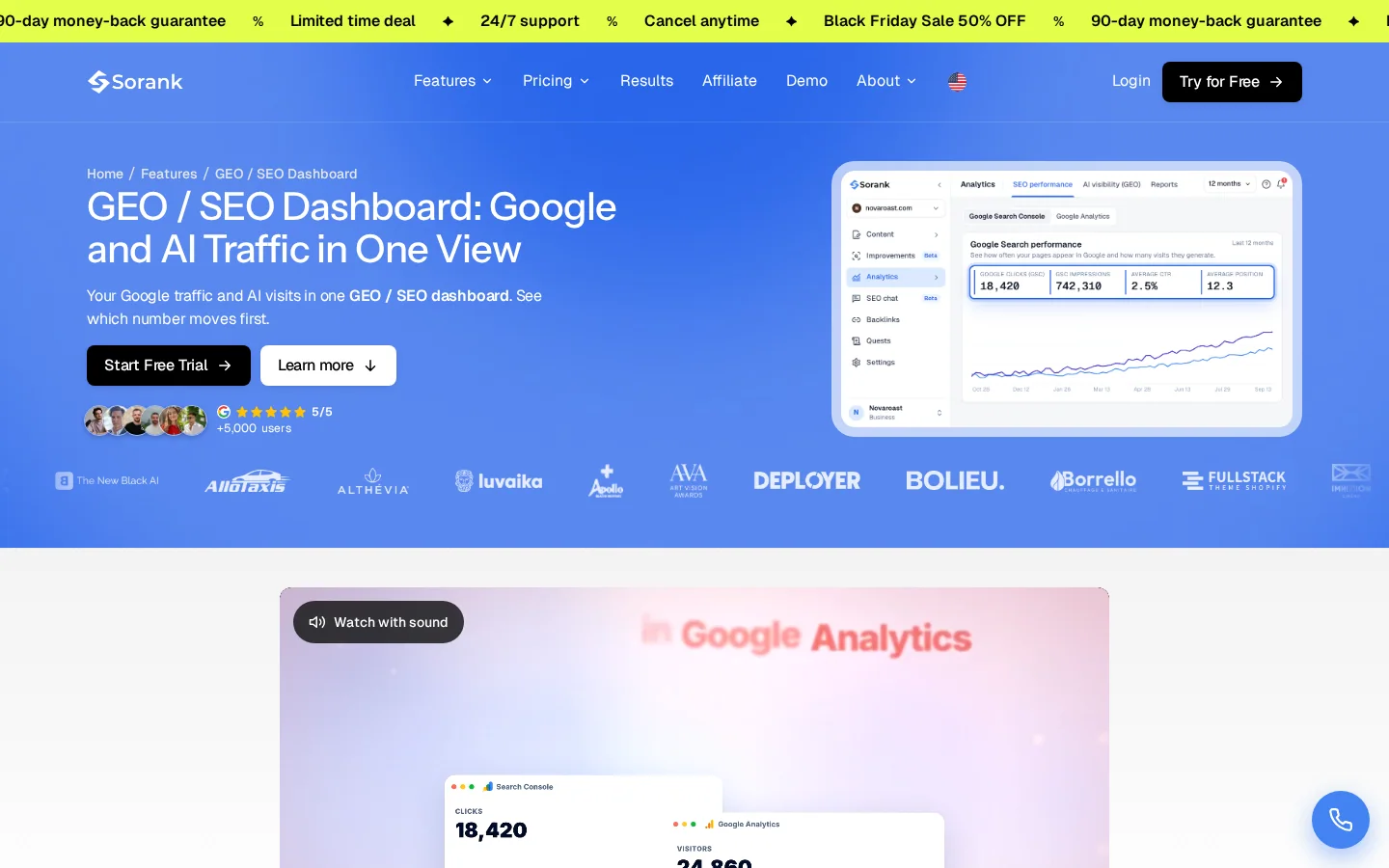
The GEO / SEO Dashboard combines three sources: Google Search Console clicks, impressions, CTR and position; Google Analytics page views from AI assistants such as ChatGPT, Claude, Gemini, Perplexity and Grok; and Sorank's monthly GEO analyses of AI visibility. Pages are sorted into Popular, Growing, Declining and Lost, for both Google and AI traffic.
The SEO Spy Tool covers the competitor side. It shows the domains AI models cite in your market, shows your own rank among them, and extracts keywords from the new pages of the competitors you choose. The keywords arrive weekly and go to your editorial calendar after a check against your existing pages.
If you want one view of Google and AI traffic, start with the GEO / SEO Dashboard. For the weekly competitor feed, see the SEO Spy Tool, and read the ranking definition first if you want a plain explanation of how positions are ordered before you read the reports.
Start with the three jobs your team must do every month, then price them. Run the Raven trial on the job that matters most, and ask BrightEdge for a written quote only if enterprise scope and AI visibility fit your situation.
Before you choose a platform
Once you have those numbers, the decision is usually clear. If it is still unclear, the Raven trial is the cheapest way to learn what your team actually uses, and it costs nothing until you add a card.
Neither is better for every team. BrightEdge suits large brands that need enterprise content, AI visibility and a sales-led contract. Raven Tools suits agencies and small teams that want audits, rank tracking and reports at a published price.
Raven Tools has five plans, from $49 a month (Small Biz) to $479 a month (Lead) when billed monthly. Prepaying for a year lowers each plan, from $39 to $399 a month. Above the Lead plan, you contact Raven for an Enterprise quote.
BrightEdge does not publish a price, and its homepage offers only a demo request. Expect a custom quote, and ask for the annual price, renewal terms and any onboarding fees in writing before you compare it with a published plan.
We analyse your competitors, your website and your AI visibility to create a tailored content plan for free.
 Duplicate Content Checker
 Mobile-Friendly Test
 Website Speed Test
 Subdomain Finder
 Domain Age Checker
 CMS Detector
 Googlebot Simulator
 Nofollow Link Checker
 Meta Tag Checker
 Keyword Cannibalization Checker
 Keyword Intent Checker
 Keyword Extractor
 Google Ads Cost Calculator
 CPC Calculator
 Local Citation Finder
 Reddit Threads Finder
 Disavow File Generator
 Redirect Generator
 Canonical Tag Generator
 Passive Voice Checker
 Google Location Changer
 Google Review Calculator
 Google Review Link Generator
 Keyword Combiner
 Podcast Show Notes Generator
 AI Content Rewriter
 AI Text Humanizer
 ChatGPT Prompt Generator
 Twitter Thread Generator
 Tweet Generator
 Landing Page Copy Generator
 Google Ads Copy Generator
 Pinterest Pin Description Generator
 Anchor Text Generator
 Social Media Post Generator
 LinkedIn Post Generator
 Free AI Writer
 Review Response Generator
 LSI Keyword Generator
 YouTube Video Ideas Generator
 YouTube Tag Generator
 YouTube Description Generator
 Product Description Generator
 CTA Generator
 Blog Introduction Generator
 Conclusion Generator
 Hook Generator
 AI Content Brief Generator
 FAQ Schema Generator
 AI Blog Post Ideas Generator
 Structured Data Validator (Schema Validator)
 Alt Text Checker
 Internal Link Analyzer
 Backlink Challenge
 AI Meta Description Generator
 AI Blog Title Generator
 Google Indexability Checker
 AI Blog Outline Generator
 UTM Link Builder
 Keyword Clustering Tool
 Canonical Tag Checker
 XML Sitemap Generator
 Broken Link Checker
 AI SEO Title Generator
 Headline Analyzer
 SERP Preview Tool
 Redirect Checker
 Hreflang Tag Generator
 Heading Structure Analyzer
 HTTP Headers Checker
 Favicon Extractor
 SERP CTR Calculator
 SEO vs Paid Search Savings Calculator
 SEO Share of Voice Calculator
 SEO ROI Calculator
 SEO Traffic and Revenue Forecast Calculator
 SEO Budget Calculator
 SEO Break-Even Calculator
 SaaS SEO ROI Calculator
 ROAS Calculator
 Reading Time Calculator
 Ranking Gain Simulator
 Organic Traffic Value Calculator
 Organic Traffic Estimator and Website Traffic Checker
 LTV to CAC Ratio Calculator
 Local SEO ROI Calculator
 Link Building Cost Calculator
 Keyword Value Calculator
 Keyword Opportunity Score Calculator
 Keyword Density Calculator
 GEO ROI Calculator
 GEO Content Investment Calculator
 Ecommerce SEO ROI Calculator
 Customer Lifetime Value Calculator
 Customer Acquisition Cost Calculator
 CTR Calculator
 Cost Per Article Calculator
 Conversion Rate Calculator
 Content Marketing ROI Calculator
 ChatGPT Referral Traffic Estimator
 Bounce Rate Calculator
 Backlink ROI Calculator
 AI Visibility Score Calculator
 AI Traffic Value Calculator
 AI Share of Voice Calculator
 Cost of AI Invisibility Calculator
 AI Citation Rate Calculator
 llms.txt Validator
 AI Overview Checker and AI Overviews Rank Checker
 Robots.txt Checker
 AI SEO Audit
 LLM Readability Checker
 SearchGPT Readiness Checker
 Structured Data LLM Audit
 Website Crawlability AI Audit
 Why ChatGPT Is Not Recommending My Website
 Gemini Ranking Tool
 Perplexity Ranking Checker
 LLM Citation Checker
 Answer Engine Optimization Audit
 GEO Audit
 AI Search Visibility Test
 ChatGPT Visibility Checker
 llms.txt Generator
 URL Extractor
 Webpage to Markdown
 Sitemap Checker
 SERP Volatility Sensor
 Page Size Checker
 Word Counter
 Slug Generator
 Schema Generator
 Robots Generator
 OG Preview
 Meta Tags Generator
 Image Compressor
 Favicon Generator
 On-Page SEO Audit: SEO Checker and SEO Analyzer
 Backlink Analysis Tool
 Keyword Research Tool
 Domain Authority Checker
 “I tested Sorank on a real client site and it's insane. It does everything an agency would bill you $1500 a month for. It's going into production on that client now.”

 Guillaume Guersanguersanguillaume.com“We are an Ads agency and we wanted to get our SEO back on track once and for all. Sorank gave us a clear view of our site, helped us prioritize optimizations, and properly structure our content. The tool is easy to use, well designed for a team, and very practical for centralizing tracking without having to juggle multiple platforms. A very solid foundation to start fresh with our SEO.”
 Gaspard MadouiAds Agency
 “I just let the Sorank software do its thing, and now my DR is 25 and my page is ranking higher.”
 Lucas Flandrefoundertrace.fr“I specialized in GEO thanks to Sorank. The GEO Leaderboard allows me to show my clients their position vs competitors on ChatGPT. It’s a real commercial differentiator.”
 MélanieSEO Freelance“Great service, works well for our website and helps us understand how to improve it to rank better on Google and elsewhere. Congrats, keep going, I recommend it.”
 Hugo T.E-commerce merchant