Preferences
Privacy is important to us, so you have the option of disabling certain types of storage that may not be necessary for the basic functioning of the website. Blocking categories may impact your experience on the website. More information
Privacy is important to us, so you have the option of disabling certain types of storage that may not be necessary for the basic functioning of the website. Blocking categories may impact your experience on the website. More information

AthenaHQ vs Evertune compared on price, credits, AI engines and data collection, plus a 30-day test to pick the right AI visibility tool for you.
In short
AthenaHQ and Evertune are AI visibility platforms that track how often ChatGPT, Gemini, Claude and Perplexity name your brand. AthenaHQ's self-serve plan starts at $295 per month, and Evertune's official page lists a $60 Starter plan and an $800 Pro plan billed annually. Pick on credits, engine coverage and data collection, not on the headline price.
Want to go further? Ask
Quick quiz
How should you get mentioned by ChatGPT and other AI assistants?
Sorank matches your answers


Test it for 3 days on your own site and see where you stand on Google, ChatGPT and the other AIs.
Start 3-day free trial3 days free, then stop whenever you want. 90-day results guarantee, conditions apply.
AthenaHQ and Evertune both send a set of buying questions to AI assistants, repeat them, and report how often your brand shows up in the answers. They differ in price structure, in the engines they cover, and in how they collect answers. The table uses the official pricing pages, checked on November 22, 2026.
| Point | AthenaHQ | Evertune |
|---|---|---|
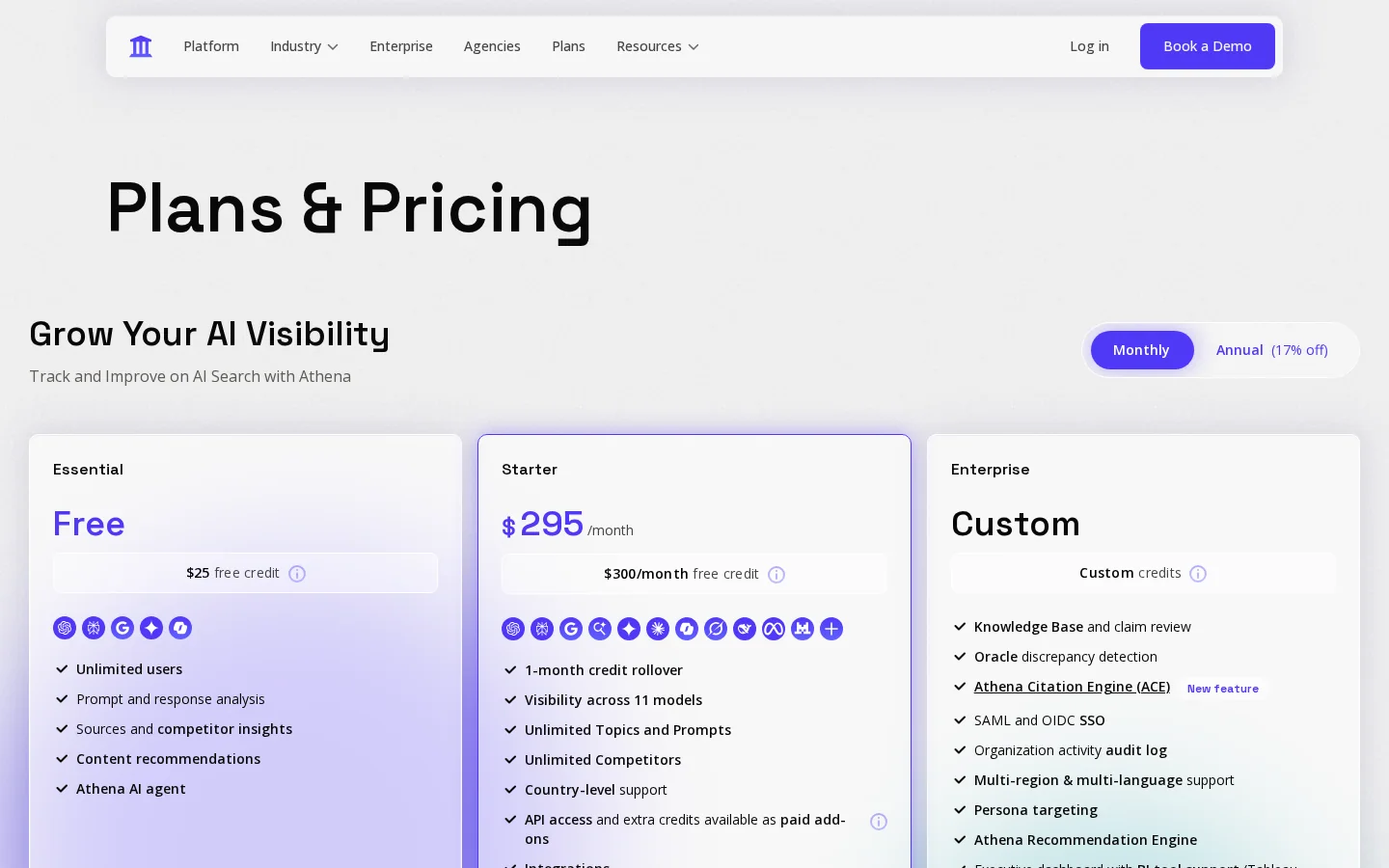
| Entry plan | Essential, free, 300 credits | Starter, $60 per month, up to 5 models, 5000 prompt credits |
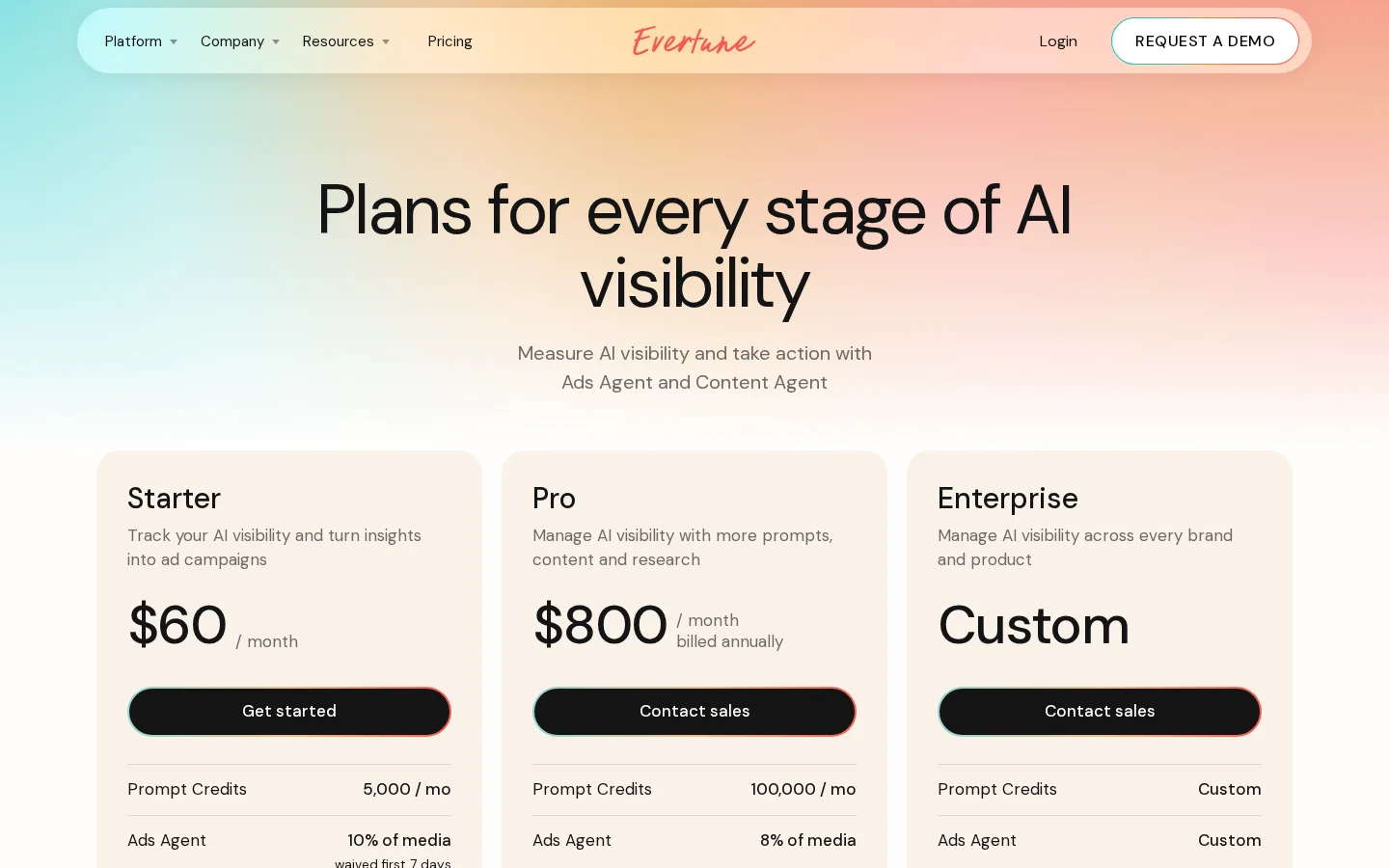
| Paid self-serve plan | Starter, $295 per month billed monthly, 3600 credits | Pro, $800 per month billed annually, 100000 prompt credits |
| Enterprise | Custom, credits set by contract | Custom, with SSO, dedicated support and data exports |
| What one credit covers | 1 credit = 1 AI response | Not defined on the pricing page |
| Models or engines per plan | No model count on the plan page | Up to 5 on Starter, all major models on Pro (11 in the comparison table) |
Some third-party comparisons call Evertune enterprise only. Its pricing page lists a $60 Starter plan, so the label is out of date or incomplete. Judge the current tiers, not the label. The same goes for AthenaHQ: a listing that still shows $95 per month or 3500 credits may be quoting an older snapshot or a promotion.
An AI visibility tool sends a fixed set of prompts to several assistants many times, then counts the share of answers that name your brand. The output is a visibility rate, not a position in a list. Everything else in this article depends on that one idea.
Three inputs drive every result. The first is the prompt set: the questions you track, such as "best payroll software for a 20-person agency". The second is the engine list: the assistants that receive those prompts. The third is the run count: how many times each prompt goes to each engine. A tool that tracks 20 prompts on 4 engines with 10 runs each produces 800 answers per check. The visibility rate is the share of those 800 answers that mention your brand.
Each input changes the number. More prompts measure a wider slice of demand. More engines show you where the brand is absent. More runs reduce the noise. If the term is new to you, the prompt monitoring definition covers the concept in short form.
AI assistants sample their answers, so the same question can return a different list each time. A study published on January 30, 2026 by Rand Fishkin of SparkToro and Patrick O'Donnell of Gumshoe.ai, as reported by Search Engine Journal, collected answers in November and December 2025. It covered 2961 prompts across ChatGPT, Claude and Google's AI Overviews. Its core brand-recommendation test used 12 prompts, each run 60 to 100 times per platform. The study was co-run with a company that sells AI tracking tools, which the authors disclosed, and it is not peer-reviewed. Its findings still matter for any tool comparison:
What the repeated-run study found
Source: SparkToro and Gumshoe.ai study, reported by Search Engine Journal, January 30, 2026
That last point should make you careful with any tool that reports a "position in AI". A single position can flip from one run to the next. A share of answers across many runs and prompts moves much less. For more on how these swings look over time, read AI search volatility.
How the study unfolded
Source: SparkToro and Gumshoe.ai study, as summarized by Search Engine Journal

Compare plans by the number of answers you can buy each month, not by the monthly fee. AthenaHQ's Starter plan costs $295 per month and includes 3600 credits, and its pricing page defines one credit as one AI response. Evertune's Starter plan costs $60 per month and includes 5000 prompt credits, but its page does not say what one credit covers. Until that is clear, the two monthly prices cannot be compared directly.
The AthenaHQ pricing page, checked on November 22, 2026, lists three tiers. Essential is free and includes 300 credits. Starter is $295 per month billed monthly, with 3600 credits per month. The annual toggle shows "17% off", but the annual price is not on the page. Enterprise is custom, and its credit allocation is set in the contract. The page also advertises free-credit offers on Essential and Starter. Read the terms before you count on them, because a free credit is not the same as a free plan. Our AthenaHQ review covers the pricing, the credits and how to test the tool before you pay.
The Evertune pricing page lists three tiers. Starter is $60 per month, covers up to 5 models, and includes 5000 prompt credits per month. Pro is $800 per month billed annually, covers all major models (the comparison table counts 11), and includes 100000 prompt credits per month. Enterprise is custom, with dedicated support, unlimited content generation, a fact checker, data exports and SSO.
The page also prices an Ads Agent as a share of media spend. It quotes "10% of media waived first 7 days" on Starter and "8% of media" on Pro. At 8%, every 10000 of media costs 800 on top of the plan. If you spend heavily on ads, that fee can outweigh the subscription, so model it before you sign.
Use the same arithmetic for every tool. Start with the number of answers one check produces, then divide your monthly credits by that number. The formula works for AthenaHQ because its page defines one credit as one answer. For Evertune, apply it only after you confirm what a prompt credit covers.
answers per check = prompts x engines x runs
checks per month  = monthly credits / answers per check
Example
Take 20 prompts on 4 engines with 10 runs each. One check produces 800 answers. On AthenaHQ's Starter plan, 3600 credits covers 4.5 checks a month, assuming every credit goes to monitoring and none to content or audits. Running the test once a week uses four of those checks, which is workable for one brand but leaves little room for a second market.
Warning
Prices and credit counts move. Third-party listings still show AthenaHQ at $95 per month and 3500 credits. Copy the numbers from the vendor page on the day you buy, and write down the date next to them.
Coverage decides whether a tool sees the answers your buyers see. Before you buy, get each vendor's engine list in writing, with the model version and whether web search is on for each engine. Two tools that both say "Gemini" can be measuring different products.
Google's AI features need a separate row in your test, because Google treats them as part of Search. Its Search Central documentation on AI features, which carried no visible update date when I checked it on November 22, 2026, states that "there are no additional requirements to appear in AI Overviews or AI Mode." The same page says both features may use "query fan-out", which issues several related searches across subtopics before writing an answer. A tracked prompt set that covers only one angle can miss the subtopics the engine searches for. Traffic from these features is also included in the overall search traffic in Search Console, so you can compare a tool's trend with your own data.
A model name is not a fixed product. Chatbots change models on their own schedule, and an answer can depend on whether the assistant searches the web while it answers. Evertune's pricing page counts models per tier, 5 on Starter and all major models on Pro. The AthenaHQ plan page I read does not give a model count. Ask both vendors the questions in the checklist below before you compare any number.
Coverage questions to put to each vendor
Three methods put AI answers into a dashboard, and each one can return a different answer for the same prompt. API calls are the most controlled, interface capture is closest to what a visitor sees, and manual checks are the cheapest way to verify a tool. The method a vendor uses matters more than most lines on a feature list.
Principle. The tool sends each prompt to the model's API and stores the response. When to use it. When you need a repeatable test with fixed model versions and high run counts. Advantages. You control the model, the settings and the volume, and the cost per answer is easy to audit. Limits. An API answer can differ from the answer in the consumer app, which may use memory, personalization, a different system prompt or a different search setting. Example. A pinned model version can show your brand missing from the API answers while the app still names it, or the reverse. Neither result is wrong, but they answer different questions.
Principle. The tool drives the consumer interface, or a browser session that behaves like one, and records what a visitor would see. When to use it. When you want to match what buyers see on screen. Advantages. The capture includes the interface layer: citations, product cards and the web search the app runs. Limits. Interfaces change without notice, and results depend on the session, the location and the account. Example. Evertune's own comparison article says AthenaHQ tracks brands "through interface-level capture" and that Evertune offers "direct API access to foundation models." That is the vendor's own characterization. Test it with AthenaHQ before you rely on either description.
Principle. You run 10 to 20 prompts by hand in each engine and record the brands named. When to use it. Before you buy, and to check a tool's numbers once a month. Advantages. It costs nothing, and it shows you the real answers, which is the fastest way to spot a broken tool. Limits. It is slow, and one manual run is one sample, which tells you very little about a rate. Example. If your manual check shows your brand in 2 of 10 answers on one engine but the tool reports 80%, one of the two is wrong. The answers you saved will show which.
| Method | Repeatable | Matches the consumer app | Cost | Main risk |
|---|---|---|---|---|
| API calls | High, with pinned model versions | Low to medium | Usage-based | Answers differ from the app |
| Interface capture | Medium | High | Included in the plan | Interface changes can break the capture |
| Manual spot checks | Low | High | Your time | One run is one sample |
Note
Ask each vendor five things in writing: the model version, the web search setting, the country and language, whether the account keeps memory or history, and how many runs each prompt gets. A vendor that cannot answer all five is not measuring what your buyers see.
Beyond the visibility rate, the plans differ in what they add: content drafting, ad tools, prompt research, exports and single sign-on. Count only the features on the plan you would actually buy. A feature listed on a higher tier does not come with the entry plan, so check each one in a demo before you assume it.
| Feature | Evertune, official pricing page | AthenaHQ, official pricing page |
|---|---|---|
| Engines covered | Up to 5 on Starter, all major models on Pro | Not on the plan page I read |
| Monthly credits | Starter 5000, Pro 100000, Enterprise custom | Starter 3600 (1 credit = 1 AI response), Enterprise custom |
| Content generation | Content Agent on Pro, unlimited on Enterprise | Not on the plan page I read |
| Ads tools | Ads Agent, quoted at 8% of media on Pro | Not on the plan page I read |
| Prompt research | On Pro | Not on the plan page I read |
| Exports and SSO | On Enterprise | Not on the plan page I read |
Third-party listings describe AthenaHQ with sentiment tracking, CMS publishing and an API. I could not confirm those on the official plan page, so treat them as claims to test in a demo rather than facts. The same rule applies to Evertune's Pro features: the page names them, but you still need to see them working on your own brand.
A dashboard is also a claim, so check it against your analytics. Open your analytics tool, filter referral traffic for the AI sources that send visits (chatgpt.com, perplexity.ai, gemini.google.com and claude.ai are the usual ones), and compare the month's trend with the visibility trend in each tool. The two will not match in size, because AI visits are a small share of most sites and a visibility rate measures mentions, not clicks. They should move in the same direction over a few months, though. If a tool shows your visibility climbing for three months while AI referral visits stay flat, ask the vendor which prompts drove the gain before you pay for more of it. For a fuller setup, the AI visibility optimization guide shows how to connect the two.
Run both tools on the same prompt set, with the same engines and the same run count, then compare visibility rates after 30 days. Setting it up takes an afternoon, and the result is a number from your own market, which no comparison page can give you. The five steps below cover the setup, the sample size and the decision.
The 30-day test in five steps
Draw your prompts from real sources: sales call notes, the queries in Search Console, and the questions your support team hears most. Split them into the four groups from the steps above, with five prompts each. Leave your brand name out of the prompts. If the prompt says "is [your brand] good", the answer will name you almost by definition, and the test will tell you nothing about the buyers who have not heard of you yet.
Tip
Before you start the 30-day test, run a one-question snapshot with our free AI Search Visibility Test. It shows whether your brand appears at all in one answer from ChatGPT, Perplexity, Gemini or Claude, which is a useful first check even though one question is only one sample.
Multiply the prompts by the runs to get the sample for each engine. Twenty prompts with 10 runs each gives 200 answers per engine. For a visibility rate near 30%, the 95% margin of error on 200 answers is about plus or minus 6 points. That calculation assumes each answer is independent, which real answers only partly are, so treat it as a floor. A 3-point gap between two tools is noise, and a 15-point gap is probably real.
margin of error = 1.96 x sqrt(p x (1 - p) / n)
p = visibility rate, n = answers per engine
20 prompts x 10 runs = n = 200
p = 0.30: 1.96 x sqrt(0.30 x 0.70 / 200) = about 0.064A single question gives you one sample. A tracked prompt set gives you a rate you can compare across time and across tools. The difference matters most when you read the results, because a tool can report a high score on a prompt set you never wrote yourself. The AI share of voice concept measures the same idea against competitors, which is the comparison that actually drives a buying decision.
One question or a tracked prompt set
The costly mistakes are comparing monthly prices, trusting a single run, and treating a comparison page as neutral. Each one can reverse the decision. The table gives the signs and the fix for each, and the sections below explain the three that cost teams the most.
| Mistake | How to spot it | Fix |
|---|---|---|
| Comparing monthly prices | You have two prices and no credit definition | Divide the price by the answers it buys, as in the pricing section |
| One run or one prompt | A single screenshot decides the choice | Run 20 prompts with 10 runs on each tool |
| Reading a vendor page as neutral | The comparison always favors the page's owner | Check each claim against the vendor's own pricing or documentation page |
| Ignoring the date | Notes show prices with no date | Date every figure and check it again on the day you sign |
What it is. Buyers see $295 next to $60 and stop there. How to spot it. The comparison has no credit definition, or the two tools count credits differently. How to fix it. Divide the plan price by the answers it includes. If one AthenaHQ credit is one answer, the Starter plan works out to about $0.08 per answer ($295 divided by 3600). For Evertune, the same division gives about $0.012 per credit ($60 divided by 5000), but that number is not comparable until you know what a credit buys. Once you know, the cheaper headline may stop being the cheaper tool.
What it is. A single prompt, run once, decides the purchase. How to spot it. The report shows a score with no run count, sample size or date range. How to fix it. Require at least 10 runs per prompt and 20 prompts per tool, as in the sample-size step above. The study mentioned earlier ran each prompt 60 to 100 times for this reason: one answer from an assistant is not a stable fact about your brand.
What it is. Comparison pages are written by someone with a stake in the outcome. Evertune's article argues its own case on access method and scale. Third-party comparisons mix in old prices, and one listing still shows AthenaHQ at $95 per month. How to spot it. The page makes claims without linking to the vendor's own pricing or documentation. How to fix it. Check every figure on the vendor's page, and keep the vendor's wording when you quote it. Sorank also sells AI visibility monitoring and wrote this article, so apply the same check to every claim here, including the ones about our own product. For the wider picture of the category, the AI visibility audit guide explains how to check a brand yourself, without buying anything.
Choose AthenaHQ if you want to start on a self-serve plan, test with the free Essential tier, and keep the monthly bill fixed and predictable. Choose Evertune if you need its Pro features, such as the Content Agent, prompt research and AI retargeting, and you can carry an $800 monthly plan billed annually or move to an enterprise contract. Run the 30-day test before you choose either, because the best fit depends on your own prompts and not on either vendor's examples.
| Your situation | Lean toward | Why |
|---|---|---|
| First purchase, small team | AthenaHQ | Self-serve Starter, and a free Essential tier to test first |
| Need content and ad tools on a higher tier | Evertune Pro | Content Agent, prompt research and AI retargeting are named on the plan |
| Tight budget | Neither yet | The $60 and $295 figures mean little until the credit definitions match |
| Need SSO, exports or dedicated support | Enterprise on either side | Both list custom enterprise plans, so get the feature list in writing |
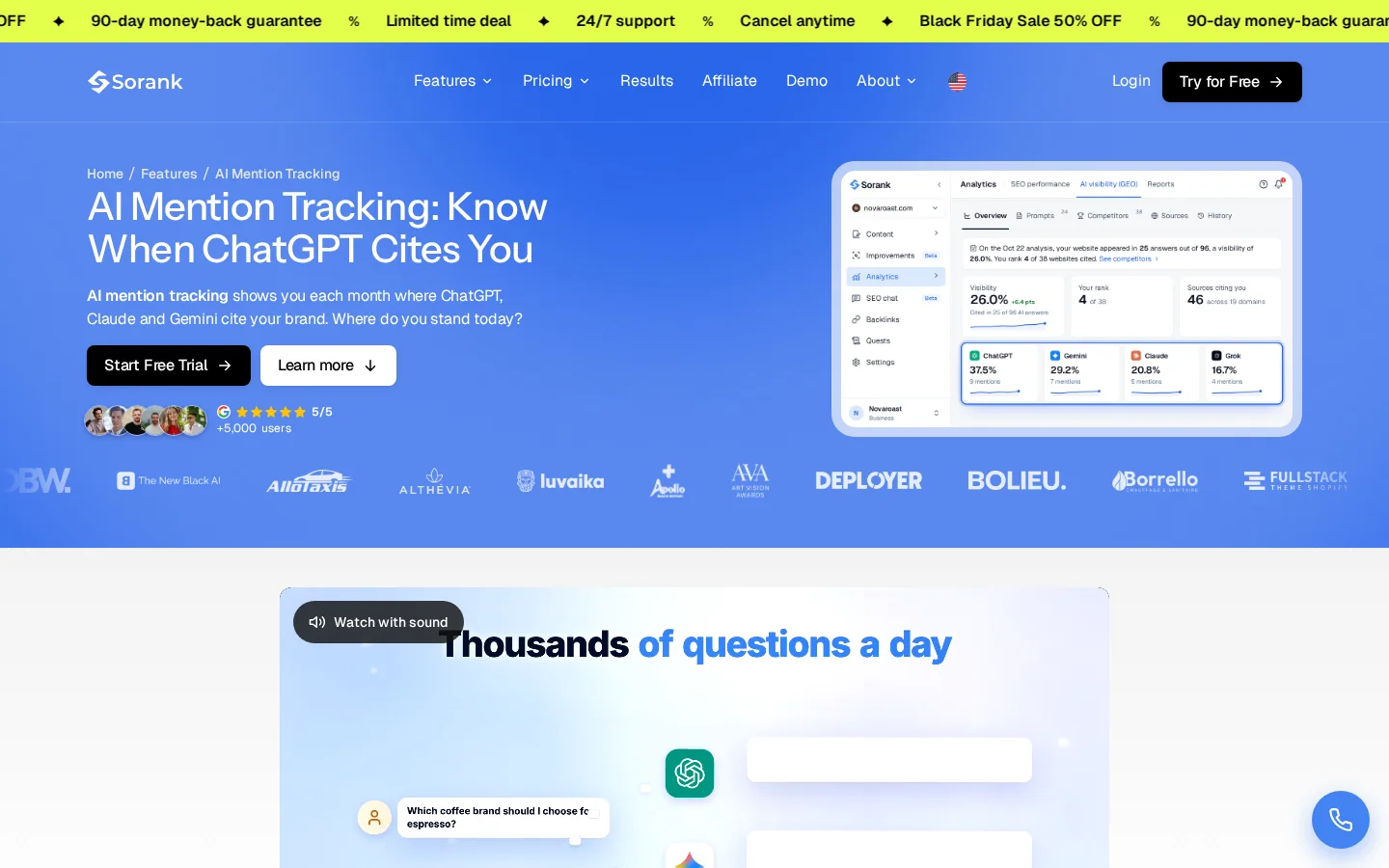
Sorank tracks AI mentions of your brand on ChatGPT, Claude and Gemini, with Grok added on higher plans, and checks each assistant every month. It lists the prompts you track by intent, flags the questions where an AI recommends someone else, and shows the sources the AI cites. Use AI mention tracking as one of the tools in your own 30-day test, and apply the same rules to it as to AthenaHQ and Evertune: check the engines, the runs, the credit or prompt limits and the date of the price.
AthenaHQ and Evertune both measure AI visibility, but they price, collect and report answers in different ways. Compare the cost per answer, check how each tool collects its data, and run the same 30-day test on both before you decide. If you want the wider field first, read our roundup of the best AI visibility tools. If you are not sure your brand appears in AI answers at all, start with the basics in the checklist below.
Before you sign
On their official pages, AthenaHQ's Starter plan costs $295 per month billed monthly, and Evertune's Starter costs $60 per month with Pro at $800 per month billed annually. The sticker price does not settle the question, because the plans include different credits, models and add-ons. Divide each plan price by the answers it buys before you compare them.
AthenaHQ's pricing page lists a free Essential plan with 300 credits, while Evertune's page lists no free plan, only a Starter tier from $60 per month. You can run a one-question snapshot with the free AI Search Visibility Test, which checks ChatGPT, Perplexity, Gemini or Claude. One question is a single sample, so run a 30-day test with 20 prompts before you decide.
AI assistants sample their answers, so the same prompt can return different brands and different orders. A 2026 study by SparkToro and Gumshoe.ai found that ChatGPT and Google's AI Overviews returned the same brand list less than 1% of the time across repeated runs. Measure a share of answers over many runs and prompts, not a single position.
We analyse your competitors, your website and your AI visibility to create a tailored content plan for free.
 Duplicate Content Checker
 Mobile-Friendly Test
 Website Speed Test
 Subdomain Finder
 Domain Age Checker
 CMS Detector
 Googlebot Simulator
 Nofollow Link Checker
 Meta Tag Checker
 Keyword Cannibalization Checker
 Keyword Intent Checker
 Keyword Extractor
 Google Ads Cost Calculator
 CPC Calculator
 Local Citation Finder
 Reddit Threads Finder
 Disavow File Generator
 Redirect Generator
 Canonical Tag Generator
 Passive Voice Checker
 Google Location Changer
 Google Review Calculator
 Google Review Link Generator
 Keyword Combiner
 Podcast Show Notes Generator
 AI Content Rewriter
 AI Text Humanizer
 ChatGPT Prompt Generator
 Twitter Thread Generator
 Tweet Generator
 Landing Page Copy Generator
 Google Ads Copy Generator
 Pinterest Pin Description Generator
 Anchor Text Generator
 Social Media Post Generator
 LinkedIn Post Generator
 Free AI Writer
 Review Response Generator
 LSI Keyword Generator
 YouTube Video Ideas Generator
 YouTube Tag Generator
 YouTube Description Generator
 Product Description Generator
 CTA Generator
 Blog Introduction Generator
 Conclusion Generator
 Hook Generator
 AI Content Brief Generator
 FAQ Schema Generator
 AI Blog Post Ideas Generator
 Structured Data Validator (Schema Validator)
 Alt Text Checker
 Internal Link Analyzer
 Backlink Challenge
 AI Meta Description Generator
 AI Blog Title Generator
 Google Indexability Checker
 AI Blog Outline Generator
 UTM Link Builder
 Keyword Clustering Tool
 Canonical Tag Checker
 XML Sitemap Generator
 Broken Link Checker
 AI SEO Title Generator
 Headline Analyzer
 SERP Preview Tool
 Redirect Checker
 Hreflang Tag Generator
 Heading Structure Analyzer
 HTTP Headers Checker
 Favicon Extractor
 SERP CTR Calculator
 SEO vs Paid Search Savings Calculator
 SEO Share of Voice Calculator
 SEO ROI Calculator
 SEO Traffic and Revenue Forecast Calculator
 SEO Budget Calculator
 SEO Break-Even Calculator
 SaaS SEO ROI Calculator
 ROAS Calculator
 Reading Time Calculator
 Ranking Gain Simulator
 Organic Traffic Value Calculator
 Organic Traffic Estimator and Website Traffic Checker
 LTV to CAC Ratio Calculator
 Local SEO ROI Calculator
 Link Building Cost Calculator
 Keyword Value Calculator
 Keyword Opportunity Score Calculator
 Keyword Density Calculator
 GEO ROI Calculator
 GEO Content Investment Calculator
 Ecommerce SEO ROI Calculator
 Customer Lifetime Value Calculator
 Customer Acquisition Cost Calculator
 CTR Calculator
 Cost Per Article Calculator
 Conversion Rate Calculator
 Content Marketing ROI Calculator
 ChatGPT Referral Traffic Estimator
 Bounce Rate Calculator
 Backlink ROI Calculator
 AI Visibility Score Calculator
 AI Traffic Value Calculator
 AI Share of Voice Calculator
 Cost of AI Invisibility Calculator
 AI Citation Rate Calculator
 llms.txt Validator
 AI Overview Checker and AI Overviews Rank Checker
 Robots.txt Checker
 AI SEO Audit
 LLM Readability Checker
 SearchGPT Readiness Checker
 Structured Data LLM Audit
 Website Crawlability AI Audit
 Why ChatGPT Is Not Recommending My Website
 Gemini Ranking Tool
 Perplexity Ranking Checker
 LLM Citation Checker
 Answer Engine Optimization Audit
 GEO Audit
 AI Search Visibility Test
 ChatGPT Visibility Checker
 llms.txt Generator
 URL Extractor
 Webpage to Markdown
 Sitemap Checker
 SERP Volatility Sensor
 Page Size Checker
 Word Counter
 Slug Generator
 Schema Generator
 Robots Generator
 OG Preview
 Meta Tags Generator
 Image Compressor
 Favicon Generator
 On-Page SEO Audit: SEO Checker and SEO Analyzer
 Backlink Analysis Tool
 Keyword Research Tool
 Domain Authority Checker
 “I tested Sorank on a real client site and it's insane. It does everything an agency would bill you $1500 a month for. It's going into production on that client now.”

 Guillaume Guersanguersanguillaume.com“We are an Ads agency and we wanted to get our SEO back on track once and for all. Sorank gave us a clear view of our site, helped us prioritize optimizations, and properly structure our content. The tool is easy to use, well designed for a team, and very practical for centralizing tracking without having to juggle multiple platforms. A very solid foundation to start fresh with our SEO.”
 Gaspard MadouiAds Agency
 “I just let the Sorank software do its thing, and now my DR is 25 and my page is ranking higher.”
 Lucas Flandrefoundertrace.fr“I specialized in GEO thanks to Sorank. The GEO Leaderboard allows me to show my clients their position vs competitors on ChatGPT. It’s a real commercial differentiator.”
 MélanieSEO Freelance“Great service, works well for our website and helps us understand how to improve it to rank better on Google and elsewhere. Congrats, keep going, I recommend it.”
 Hugo T.E-commerce merchant