Preferences
Privacy is important to us, so you have the option of disabling certain types of storage that may not be necessary for the basic functioning of the website. Blocking categories may impact your experience on the website. More information
Privacy is important to us, so you have the option of disabling certain types of storage that may not be necessary for the basic functioning of the website. Blocking categories may impact your experience on the website. More information

 Ahrefs vs Moz Accuracy: Is One More Accurate, and How to Test Both
Neither Ahrefs nor Moz is more accurate by default. Learn what DR and DA measure, then run a five-step test against  Search Console to choose one.
In short
Neither Ahrefs nor Moz is more accurate, because they score different things. Ahrefs Domain Rating (DR) measures the strength of a site's backlink profile, while Moz Domain Authority (DA) is a separate score that Google has said it does not use. Accuracy only means something against a reference, so the useful test is how many of your real referring domains each tool finds.
Want to go further? Ask
Quick quiz
Which kind of SEO tool is right for you?
Sorank matches your answers


Test it for 3 days on your own site and see where you stand on Google, ChatGPT and the other AIs.
Start 3-day free trial3 days free, then stop whenever you want. 90-day results guarantee, conditions apply.
It is tempting to put the two scores side by side and pick the higher one. That comparison breaks down quickly. The scores are built from different inputs for different purposes, so they can disagree while both are doing exactly what they were designed to do.
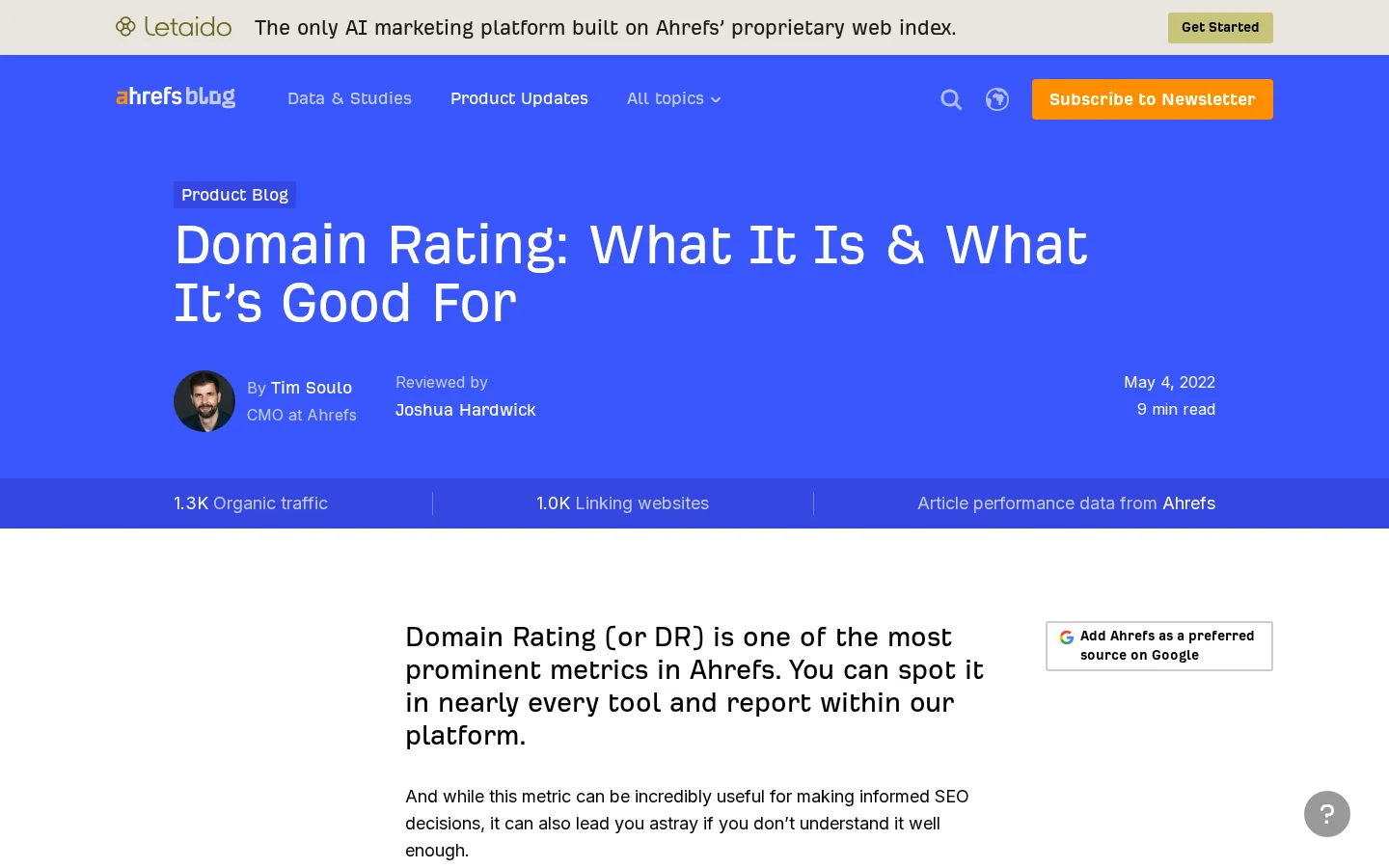
Ahrefs describes its metric in plain terms. In an article by Tim Soulo, published on May 4, 2022, Ahrefs says Domain Rating "shows the relative strength of a website's backlink profile", and adds that "Ahrefs' DR metric is purely link-based." Search traffic, domain age and the popularity of the parent brand are all left out. DR is a measure of links, and nothing else.
Moz develops DA as a search engine ranking score, and that wording has come back to bite it. In 2018, John Mueller quoted the phrase, then said that search engines do not use the score. Later he wrote "We don't use domain authority," and in 2020 "We don't use domain authority at all in our algorithms." (Search Engine Journal, collecting Mueller's posts)
So neither score measures rankings directly. A link score can be accurate about links and still tell you little about where you rank. That is the first reason the question has no clean answer.
What each score is built to measure
Sources: Ahrefs, Domain Rating article (May 4, 2022); Search Engine Journal, Mueller quotes
Domain Rating runs from 0 to 100. A higher number means a stronger backlink profile, compared with other sites. The scale is logarithmic, so each extra point costs more than the one before it. The score is also relative: a DR of 38 means little until you compare it with the sites you compete against for the same keywords.
That gives you three practical rules. First, DR is about who links to you, not how often. A site that links to you from one page is not the same as ten sites that each link once, so the count of unique linking domains matters more than the raw number of links. Second, a DR gap only matters against your real competitors on your real keywords. Third, DR cannot see whether a link brings a click. Two sites with the same score can get very different traffic, so DR is a weak forecast of visits on its own.
Ahrefs also says that DR "correlates strongly" with search traffic across a market. That makes it useful for spotting broad trends between sites. A correlation still says nothing about cause, and it does not turn DR into a ranking factor.
Ahrefs makes the same point from its side. Its article says you should not focus your efforts on growing this metric specifically. The number follows from the links you earn, so treat it as a result, not a goal. For the full definition, read our Domain Rating glossary entry. For the count that drives the score, read about referring domains, which matter more than total backlinks.

Moz calls Domain Authority a search engine ranking score. John Mueller quoted that wording in 2018 and then said that search engines do not use it. Google's position has stayed the same since then. The timeline below lists his statements in order, as collected by Search Engine Journal.
What Google said about Domain Authority, in John Mueller's words
Source: Search Engine Journal, quoting John Mueller's posts
Mueller left one door open. In a late 2020 interview, he said Google has some metrics that are "more on a site level," and that some of them "might kind of map into similar things." He did not link that remark to Moz or to any third-party score, so read it as a caveat, not as evidence that DA is used.
For you, the lesson is simple. A DA gain is not a ranking gain, and a DA gap is not a penalty. If you keep using DA, compare it only with other DA values from the same tool and the same date. Our article on what domain authority means covers the basics, and the Domain Authority glossary entry gives the short definition.
Accuracy means agreement with a reference. A tool is accurate about links only to the extent that its list matches a list you can check. The problem is that no list covers every link on the web. You have three references available, and each has a blind spot.
The limits of the best free reference for your site
Sources: Google Search Console Help, Links report; Ahrefs, Domain Rating article (May 4, 2022)
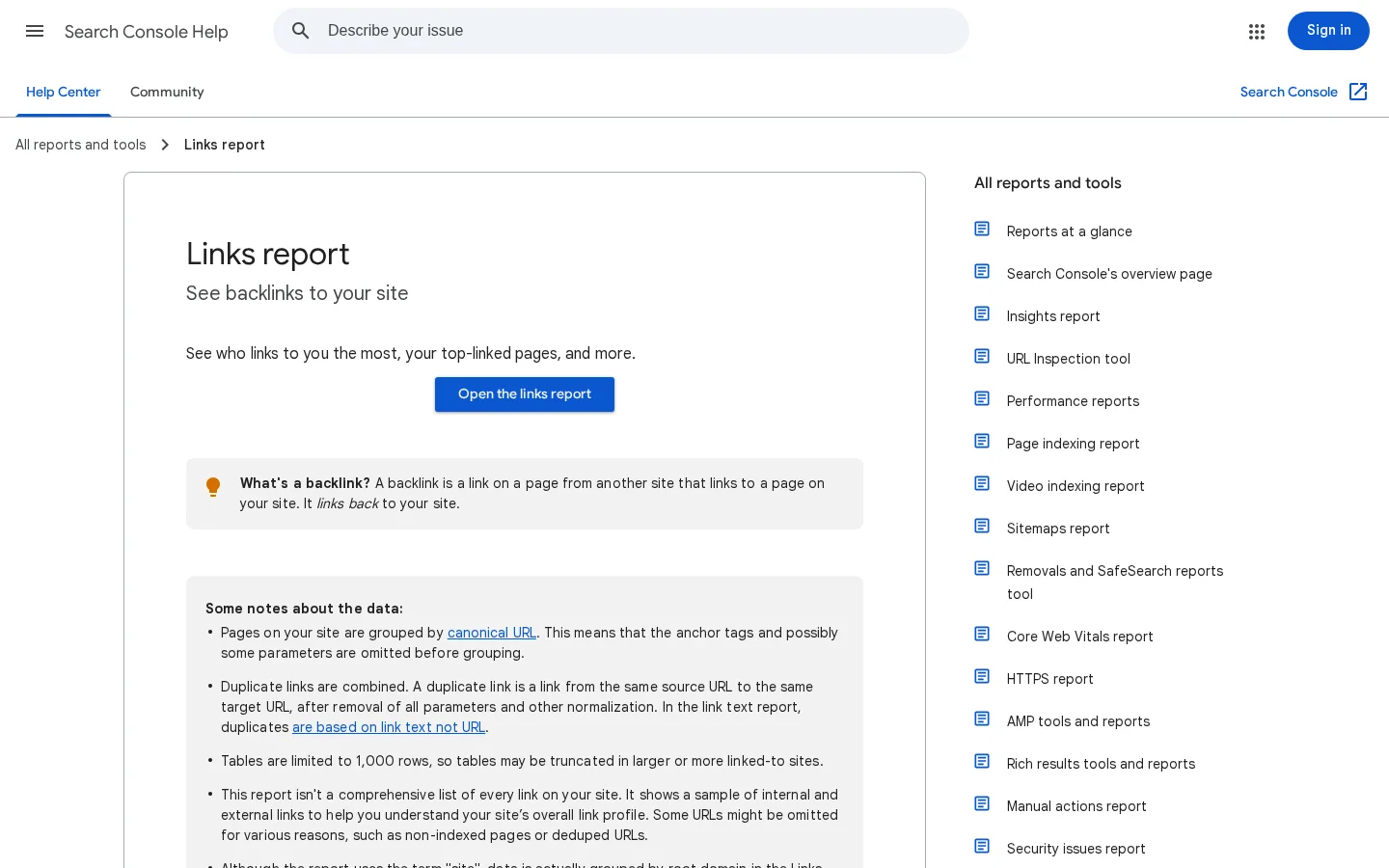
Google's own list is the strongest reference for your site, and it is not complete. The Links report shows your top linking sites, top linked pages and anchor text, but Google says it "isn't a comprehensive list of every link on your site." The Top linking sites table is limited to 1000 rows, and the report includes links Google has found over time, so some of them may already be gone. (Google Search Console Help, Links report)
Your own known links are the second reference. These are the links you placed, the ones you negotiated, and the ones a partner has confirmed. The list is small and certain, which makes it the best test of whether a tool sees your recent links. It says nothing about links you never heard of.
The third reference is another index, such as the second tool you are testing. Agreement between two indexes shows overlap, not truth, because they can miss the same link for the same reason. Use the second index to find links worth checking, not to settle the question.
Each test answers a different question, so no single test settles which tool is more accurate. Run at least two of them, and write down which reference you used each time. The table compares the four methods, and the sections after it explain each one.
| Method | Reference | What it proves | Main limit |
|---|---|---|---|
| Known-link audit | Links you placed or were told about | Whether the tool sees links you know exist | Small sample, chosen by you |
| Search Console reconciliation | Google's Links report for your site | How much of Google's view each tool covers | Capped at 1000 rows and not complete |
| Cross-tool triangulation | Other indexes | Which links several indexes agree on | Agreement is not truth |
| Competitor comparison | None | Whether each tool moves consistently over time | Consistency is not accuracy |
Principle: list the links you know exist, then check whether each tool finds them. When to use it: after a campaign, or when you want to test recent links specifically. Advantage: the reference is certain, so a miss is a real miss. Limit: the sample is small and reflects the links you chose, so a clean result does not prove coverage of the whole profile. Example, hypothetical: you placed guest articles on six sites this quarter. If Ahrefs finds five of the six and Moz finds three, you have a specific result and a reason to check how each tool covers those six domains.
Principle: export the referring domains from Google's Links report for your site, then measure how many of them each tool also lists. When to use it: as the default test for your own site, repeated every few months. Advantage: the reference comes from Google, the search engine that decides your rankings. Limit: the table is capped at 1000 rows and is not comprehensive, so a domain missing from Google's list may still link to you. Example: on a site with a long link history, the table will be truncated. Then fill the gap with the known-link audit rather than reading the missing domains as errors.
Principle: compare the lists from two or three indexes, and count the domains that appear in at least two. When to use it: when you need a shortlist of links to check by hand, or when you are judging a competitor. Advantage: it is cheap and fast, and it needs no access to the site. Limit: it measures agreement, not accuracy. Two indexes can miss the same link, and a domain that only one list contains can still be real. Example, hypothetical: a domain that both Ahrefs and Moz list is probably real. A domain that only one tool lists is a candidate for a manual check, not a verdict.
Principle: run both tools on the same competitor and track how their numbers move over time. When to use it: when you cannot access the competitor's Search Console data, which is always the case. Advantage: it shows whether each tool is consistent, which matters if you read one metric as a trend line. Limit: consistency is not accuracy. A tool can move steadily and still be wrong about the same domain every month. Example, hypothetical: if a competitor's score rises in both tools in the same month, that suggests a real gain in links. If only one tool moves, look at that tool's index before you read the change as news.
Run the test in five steps: export Google's list, export each tool's list for the same domain, match root domains, calculate recall and precision, then check the misses by hand.
The five-step test
Start with Google's list, because it is the reference that matters most for your rankings. The table is sorted by count of links, so the first rows are the sites that link to you most often, not necessarily the most valuable. Scroll the full list, and do not stop at the first screen.
Warning
On a large site, the 1000 row cap can truncate the table. Then some domains your tool finds may look like errors only because Google did not list them. Note the truncation in your results, and read precision as a floor, not a final score.
Next, export the referring domains from each tool on the same day, because indexes change and a week's delay can move your count. Match the lists on root domain only. Once the domains are matched, use these two formulas:
recall    = shared domains / domains in Search Console
precision = shared domains / domains in the tool
Recall tells you how much of Google's list the tool covers. Precision tells you how much of the tool's list Google confirms. Take a hypothetical case: Search Console lists 400 referring domains, the tool lists 520, and 310 domains appear in both. Recall is 310 divided by 400, or 77.5 percent. Precision is 310 divided by 520, or 59.6 percent. The tool finds most of what Google lists, but about two in five of its domains are absent from Google's table, which may be real links hidden by the row cap or stale links that Google no longer shows.
What counts as a good result depends on your goal. For a link budget, high recall on your own list tells you the tool will show the links you already earned. For a prospect list, high precision matters more, because every false domain is outreach you waste. Pick the figure that matches the decision you need to make, and say which one you picked.
Last, read the misses. Open each of the 20 domains that only one tool lists, check that the link is there and points to your site, and record the result. The pattern of errors matters more than the percentage. If one tool consistently misses a type of site, such as forums or press pages, you have learned something about its coverage.
Tip
You can pull a quick list for any domain, including a competitor, with the free backlink checker. It shows referring domains and link types in seconds, which is enough for a first pass at the triangulation step.
Most bad comparisons do one of two things: they read two different scales as one, or they treat a link score as a ranking forecast. Here are the four mistakes that show up most often, with the signs that reveal each one and the fix.
What it is: taking a DR of 45 and a DA of 30, for example, as proof that the second site is weaker. The two scores come from different tools and different models, so the gap has no meaning on its own.
How to spot it: one sentence, one table or one chart that puts numbers from two tools next to each other without a shared baseline.
How to fix it: pick one metric, compare each site with its competitors in that same tool, and date every number you record.
What it is: expecting a DA or DR gain to move your rankings by itself. Google has said it does not use Domain Authority. Ahrefs itself says there is no evidence that search engines use Domain Rating.
How to spot it: a report that credits a score increase with a traffic gain, with no other cause checked.
How to fix it: track referring domains and your Search Console clicks next to the score, and judge your work by rankings and visits, not by the number.
What it is: reacting to one month's drop or jump in a score. Scores can move when the index changes, not only when your site does.
How to spot it: a large move in one month, with no new or lost links in your own list to explain it.
How to fix it: compare the list of referring domains month to month. If the domains moved, the score probably followed them. If they did not, check the tool's index before you react.
What it is: a large backlink total that comes from a handful of sites, often footer or sidebar links that repeat on every page.
How to spot it: thousands of links from very few domains, which means the total says little about how many different sites vouch for you.
How to fix it: read the referring domains first, then the total. A profile with fewer links from many different sites is usually the healthier one. Our guide to a backlink audit walks through the full check.
Reading a gap in scores
Use DR for link decisions, Search Console for what Google actually shows you, and DA only as a rough comparison inside Moz. No single number predicts rankings, so the job decides the metric. The table below matches each common task with the metric that fits it best.
| Job | Better fit | Why | Watch out for |
|---|---|---|---|
| Judge a site you could get a link from | Ahrefs DR | Link-only definition, easy to read against competitors | Says nothing about traffic |
| Track your authority over months | One metric, kept consistent | A steady reference matters more than the brand | Switching tools resets your baseline |
| Forecast rankings | Neither on its own | Google does not use DA, and there is no evidence it uses DR | A higher score is not a higher rank |
| Check which links you have | Search Console plus a second index | Google's list plus an independent cross-check | Search Console is capped and incomplete |
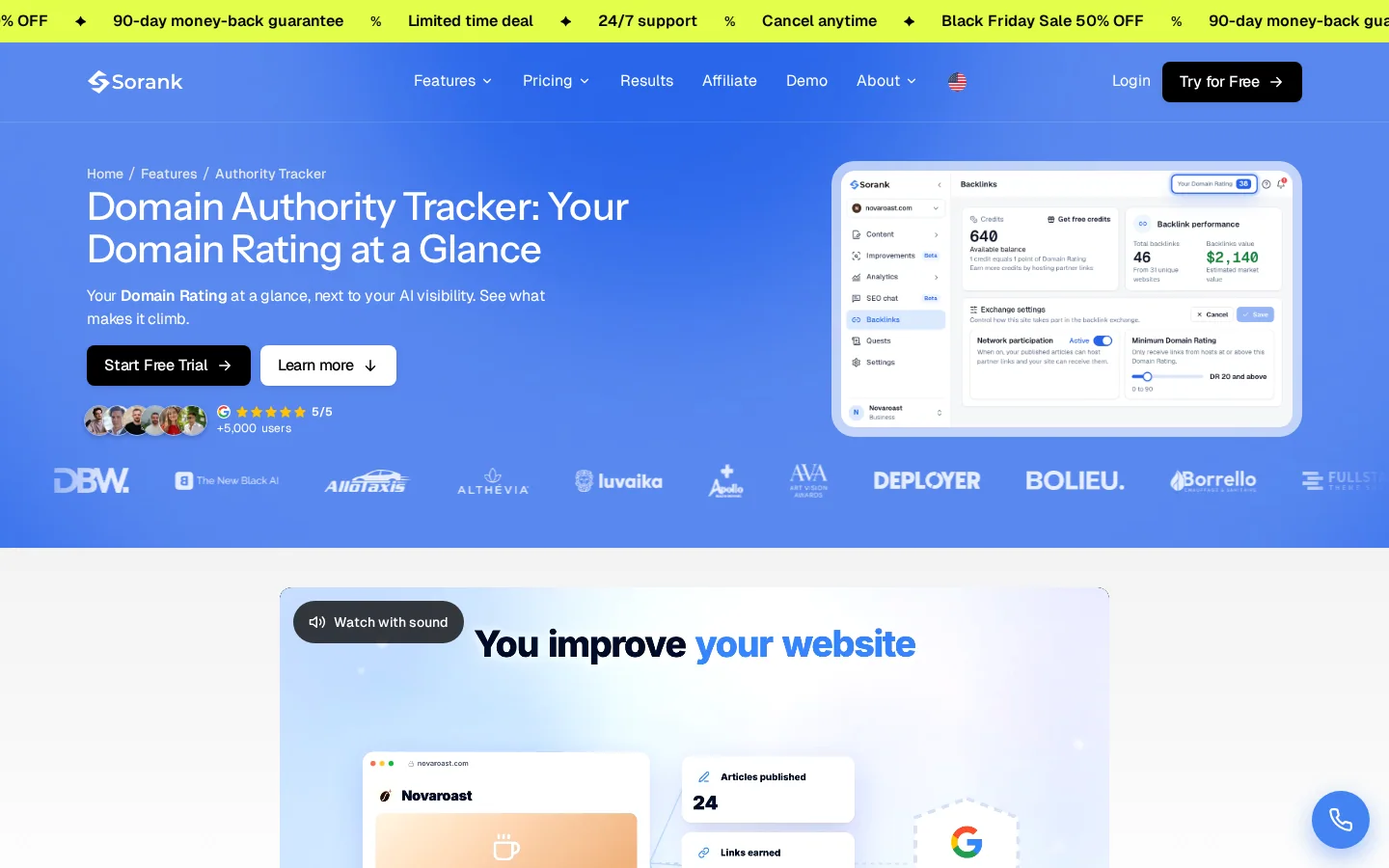
If you want one reference without running two accounts, the Domain Authority Tracker in Sorank shows your Ahrefs Domain Rating inside your Sorank account, next to your Google clicks and your AI visibility. You can see whether links and traffic move together. It is a reading tool, not a ranking forecast, and it does not replace the test above.
If your question is about prices and features rather than metrics, read our Semrush vs Moz comparison instead. It covers what each tool does, and this article covers what their scores can and cannot tell you.
Pick one reference, run the Search Console test once, and log your referring domains every month. A single run tells you little, but three months of the same method tell you whether your link work is paying off, and whether either tool follows your real growth.
Your checklist
Once the numbers are in, a step-by-step backlink review shows you what to fix first. Keep the same method each month, so your next result can be compared with this one.
Neither is more accurate in general, because they measure different things. Ahrefs Domain Rating measures the strength of a site's backlink profile, while Moz Domain Authority is a separate score that Google has said it does not use. Accuracy only means something against a reference, such as the referring domains in your own Search Console report.
Domain Rating is an Ahrefs score from 0 to 100, on a logarithmic scale, that measures link strength only. Domain Authority is a Moz score that Moz calls a search engine ranking score, and Google has said it does not use it. Neither one is a direct measure of rankings.
Export the referring domains that Google Search Console reports for your site, then compare them with each tool's list. The share of Search Console domains a tool finds is its recall, and the share of its own domains that Search Console confirms is its precision. Search Console is not a complete list, so read precision as a floor.
We analyse your competitors, your website and your AI visibility to create a tailored content plan for free.
 Duplicate Content Checker
 Mobile-Friendly Test
 Website Speed Test
 Subdomain Finder
 Domain Age Checker
 CMS Detector
 Googlebot Simulator
 Nofollow Link Checker
 Meta Tag Checker
 Keyword Cannibalization Checker
 Keyword Intent Checker
 Keyword Extractor
 Google Ads Cost Calculator
 CPC Calculator
 Local Citation Finder
 Reddit Threads Finder
 Disavow File Generator
 Redirect Generator
 Canonical Tag Generator
 Passive Voice Checker
 Google Location Changer
 Google Review Calculator
 Google Review Link Generator
 Keyword Combiner
 Podcast Show Notes Generator
 AI Content Rewriter
 AI Text Humanizer
 ChatGPT Prompt Generator
 Twitter Thread Generator
 Tweet Generator
 Landing Page Copy Generator
 Google Ads Copy Generator
 Pinterest Pin Description Generator
 Anchor Text Generator
 Social Media Post Generator
 LinkedIn Post Generator
 Free AI Writer
 Review Response Generator
 LSI Keyword Generator
 YouTube Video Ideas Generator
 YouTube Tag Generator
 YouTube Description Generator
 Product Description Generator
 CTA Generator
 Blog Introduction Generator
 Conclusion Generator
 Hook Generator
 AI Content Brief Generator
 FAQ Schema Generator
 AI Blog Post Ideas Generator
 Structured Data Validator (Schema Validator)
 Alt Text Checker
 Internal Link Analyzer
 Backlink Challenge
 AI Meta Description Generator
 AI Blog Title Generator
 Google Indexability Checker
 AI Blog Outline Generator
 UTM Link Builder
 Keyword Clustering Tool
 Canonical Tag Checker
 XML Sitemap Generator
 Broken Link Checker
 AI SEO Title Generator
 Headline Analyzer
 SERP Preview Tool
 Redirect Checker
 Hreflang Tag Generator
 Heading Structure Analyzer
 HTTP Headers Checker
 Favicon Extractor
 SERP CTR Calculator
 SEO vs Paid Search Savings Calculator
 SEO Share of Voice Calculator
 SEO ROI Calculator
 SEO Traffic and Revenue Forecast Calculator
 SEO Budget Calculator
 SEO Break-Even Calculator
 SaaS SEO ROI Calculator
 ROAS Calculator
 Reading Time Calculator
 Ranking Gain Simulator
 Organic Traffic Value Calculator
 Organic Traffic Estimator and Website Traffic Checker
 LTV to CAC Ratio Calculator
 Local SEO ROI Calculator
 Link Building Cost Calculator
 Keyword Value Calculator
 Keyword Opportunity Score Calculator
 Keyword Density Calculator
 GEO ROI Calculator
 GEO Content Investment Calculator
 Ecommerce SEO ROI Calculator
 Customer Lifetime Value Calculator
 Customer Acquisition Cost Calculator
 CTR Calculator
 Cost Per Article Calculator
 Conversion Rate Calculator
 Content Marketing ROI Calculator
 ChatGPT Referral Traffic Estimator
 Bounce Rate Calculator
 Backlink ROI Calculator
 AI Visibility Score Calculator
 AI Traffic Value Calculator
 AI Share of Voice Calculator
 Cost of AI Invisibility Calculator
 AI Citation Rate Calculator
 llms.txt Validator
 AI Overview Checker and AI Overviews Rank Checker
 Robots.txt Checker
 AI SEO Audit
 LLM Readability Checker
 SearchGPT Readiness Checker
 Structured Data LLM Audit
 Website Crawlability AI Audit
 Why ChatGPT Is Not Recommending My Website
 Gemini Ranking Tool
 Perplexity Ranking Checker
 LLM Citation Checker
 Answer Engine Optimization Audit
 GEO Audit
 AI Search Visibility Test
 ChatGPT Visibility Checker
 llms.txt Generator
 URL Extractor
 Webpage to Markdown
 Sitemap Checker
 SERP Volatility Sensor
 Page Size Checker
 Word Counter
 Slug Generator
 Schema Generator
 Robots Generator
 OG Preview
 Meta Tags Generator
 Image Compressor
 Favicon Generator
 On-Page SEO Audit: SEO Checker and SEO Analyzer
 Backlink Analysis Tool
 Keyword Research Tool
 Domain Authority Checker
 “I tested Sorank on a real client site and it's insane. It does everything an agency would bill you $1500 a month for. It's going into production on that client now.”

 Guillaume Guersanguersanguillaume.com“We are an Ads agency and we wanted to get our SEO back on track once and for all. Sorank gave us a clear view of our site, helped us prioritize optimizations, and properly structure our content. The tool is easy to use, well designed for a team, and very practical for centralizing tracking without having to juggle multiple platforms. A very solid foundation to start fresh with our SEO.”
 Gaspard MadouiAds Agency
 “I just let the Sorank software do its thing, and now my DR is 25 and my page is ranking higher.”
 Lucas Flandrefoundertrace.fr“I specialized in GEO thanks to Sorank. The GEO Leaderboard allows me to show my clients their position vs competitors on ChatGPT. It’s a real commercial differentiator.”
 MélanieSEO Freelance“Great service, works well for our website and helps us understand how to improve it to rank better on Google and elsewhere. Congrats, keep going, I recommend it.”
 Hugo T.E-commerce merchant