Preferences
Privacy is important to us, so you have the option of disabling certain types of storage that may not be necessary for the basic functioning of the website. Blocking categories may impact your experience on the website. More information
Privacy is important to us, so you have the option of disabling certain types of storage that may not be necessary for the basic functioning of the website. Blocking categories may impact your experience on the website. More information

 Semrush vs Moz: Which SEO Tool Fits Your Work and Budget
Semrush vs Moz compared on features, pricing, authority scores and cost per keyword, with a fair test you can run on your own site in one afternoon.
In short
Semrush vs Moz is a choice between a broad marketing suite and a narrower SEO tool. Semrush (SEO, paid search, content, social) has deeper keyword, backlink and competitor data. Moz is simpler to learn and best known for its Domain Authority score. Pick by workload and budget, then test both on the same site before you pay.
Want to go further? Ask
Quick quiz
Which kind of SEO tool is right for you?
Sorank matches your answers


Test it for 3 days on your own site and see where you stand on Google, ChatGPT and the other AIs.
Start 3-day free trial3 days free, then stop whenever you want. 90-day results guarantee, conditions apply.
Semrush is the broader platform and Moz is the narrower one. Both sell keyword research, site audits, rank tracking and backlink data, but Semrush puts paid advertising, content writing and social publishing in the same account, while Moz keeps its scope on search.
Two different scopes
Semrush is built for teams that want one account for the whole marketing workload. Its keyword tools go deep: the Keyword Strategy Builder groups your keywords into topic clusters, which helps when you plan a pillar page and the subpages that link to it. Its audit reports cover technical issues, Core Web Vitals and internal links, and its backlink tools include a gap analysis that shows which domains link to your competitors but not to you.
The cost of that breadth is complexity. A new user can spend a week learning where things live, and plans are limited by projects, tracked keywords and AI prompts, so you must read the limits before you buy. Our full Semrush review covers features and limits in detail; this article stays on the comparison.
Moz is built around search. Its keyword overview gives you the metrics for a term, its Domain Authority score sits on the domain overview, and its link tools show linking domains and spam signals. For one site with a short keyword list and a monthly review, that focus is an advantage: fewer menus, fewer decisions and a lower bill.
The limit is scope. Moz will not run your paid campaigns or your social calendar, and it does less than a full suite for trend research and outreach. If you need those, you will pair it with other tools, which adds cost and another login.
Note
Plans, prices and features change often. This article is a snapshot from November 21, 2026. Check each vendor's current pricing page before you buy.
Both tools cover the same core jobs: keyword research, site audits, rank tracking and backlink analysis. The real differences are in depth, in the extra tools around SEO (ads, content, local, social) and in how much data each plan unlocks at each price.
An audit crawls your site, lists errors such as 4xx and 5xx responses, redirect chains, missing titles and duplicate pages, then ranks them by severity. Semrush's audit reports go deeper on Core Web Vitals and internal links. Moz's crawl is simpler and focuses on the errors that matter most for a small site. Test both on a site you know well: if a tool reports a problem you already fixed, its crawl is stale.
Keyword tools differ most in what they do after the list. Semrush's Keyword Strategy Builder turns a seed list into clusters, each with a primary keyword and secondary keywords for one page, which saves hours of manual grouping. Moz's keyword overview gives you the metrics for each term, with a Domain Authority estimate for the domains that rank. Neither replaces a check in the search results: open the top 10 for your three best keywords and read what actually ranks.
Rank tracking is where plan limits bite. Check three things before you buy: how many keywords the plan tracks, how often it updates, and which engines it covers. Google is the baseline. Some tools also track Bing, and some track AI answers. Semrush has added AI visibility tracking, so confirm whether the plan you choose includes it rather than assuming it does.
Both tools show the domains that link to you and to your competitors, and both flag spam signals. Semrush goes further with a backlink gap report and a network graph, which helps when you want the links your competitors have and you do not. Moz's link tools are simpler, which is often enough for a focused audit. Whichever you use, read the anchor text and the linking page, not only the count: a thousand weak links are worth less than ten links from pages in your niche.
| Area | Semrush | Moz |
|---|---|---|
| Scope | Full marketing suite | SEO-focused |
| Site audits | Detailed crawl reports, Core Web Vitals, internal links | Crawl with error and content reports |
| Keyword research | Keyword Strategy Builder with topic clusters | Keyword overview with a Domain Authority estimate |
| Rank tracking | Several engines, AI visibility depending on plan | Search engines, limits set by plan |
| Backlinks | Backlink gap, network graph, outreach contacts | Link analysis, spam signals, comparisons |
| Content | Topic research and writing assistant | On-page grader for live pages |
| Paid search | Ad research and competitor ads | Limited |

The headline price hides what you actually buy. Compare plans by the number of websites, tracked keywords and AI prompts they include, then divide the price by those limits. Semrush's pricing page, checked on November 21, 2026, lists its SEO plan at £95.07 per month when billed annually, with 5 websites and 500 keywords tracked daily, and its Pro+ plan at £201.09 per month with 15 websites and 1500 keywords.
Divide the monthly price by the keywords the plan tracks. It is a rough measure, since it ignores the other features in the plan, but it makes two plans comparable at a glance. For the Semrush SEO plan, £95.07 divided by 500 keywords is about £0.19 per keyword per month. For Pro+, £201.09 divided by 1500 is about £0.13. The bigger plan costs more in total and less per keyword.
Monthly price (B2) / keywords tracked (C2)
=B2/C2

Semrush SEO plan:   95.07 / 500  = 0.19
Semrush Pro+ plan: 201.09 / 1500 = 0.13
Do the same division for every tool on your shortlist, then add the cost of the extras you would otherwise buy separately, such as a rank tracker or a content tool.
Moz also sells plans by site and keyword count, with a free tier and paid plans above it. Read its current pricing table on moz.com and run the same division. Compare plans with the same number of sites, because a cheap plan that covers one site costs more per site than it looks.
Example
A blog with 300 keywords to track across two sites. The Semrush SEO plan covers 500 keywords across 5 websites, so one plan covers both sites with room to grow. Check the price first, then the room you will need in six months, not only today.
Domain Authority (Moz), Domain Rating (Ahrefs) and Authority Score (Semrush) are each a score out of 100 that estimates a domain's strength, but each one is built from different inputs. A 40 in one tool is not a 40 in another, and none of them is a number Google uses to rank pages. Use them to compare domains inside one tool and to shortlist targets, not to predict rankings.
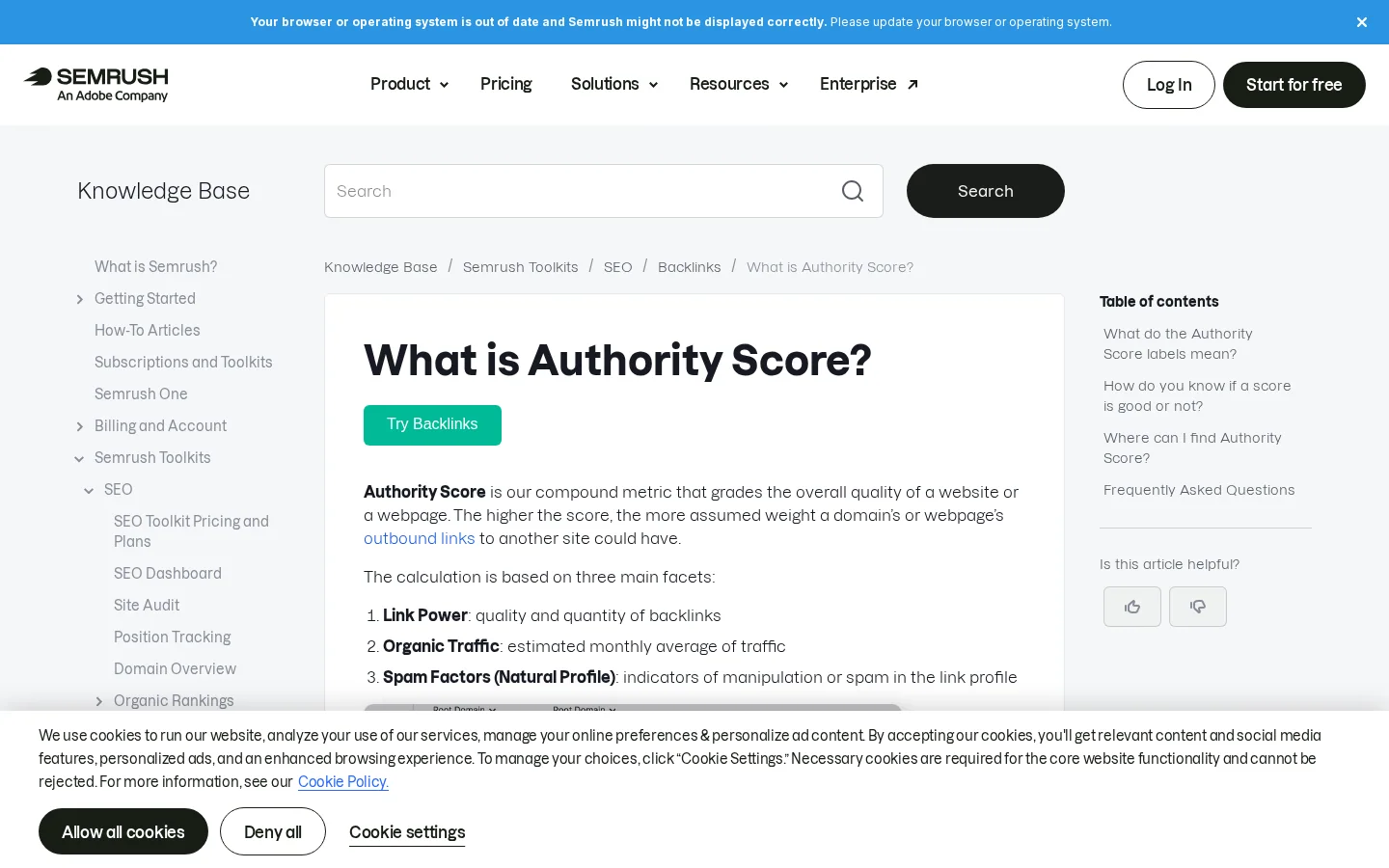
Semrush's knowledge base says its Authority Score is calculated from eight weighted factors. Two measure link power, which depends on the number and authority of followed referring domains, and organic traffic, which is estimated from the site's keyword positions and the click potential of each position (Semrush Knowledge Base, checked November 21, 2026). The other six form what Semrush calls the Natural Profile, a set of spam checks. The same page says the score is best used to compare domains, not to judge them on an absolute scale.
The spam checks are concrete. A domain loses points if it has no rankings in Google's top 100, if more than 90% of its referring domains are dofollow, if many referring domains share one IP address or network, or if another domain has a backlink profile at least 95% identical to its own. Scores refresh every two weeks, so a sudden drop may reflect a data update, not a change on your site.
Semrush Authority Score in four numbers
Source: Semrush Knowledge Base, checked November 21, 2026
The same domain can get a noticeably different score in each tool, because the inputs differ: some scores lean on links, others on traffic, and each vendor's index covers a different slice of the web. The fix is to pick one score per project and compare every domain with it. Mixing a Moz Domain Authority for one site with a Semrush Authority Score for another gives you two rulers measuring one table. For the definition of the metric, see our glossary entry on domain authority, and for the wider picture, read our guide to what domain authority is.
There is no good absolute number. A score is useful when it sits close to the domains you compete with on the same results page. Take the median of the domains that rank for your target keywords, write it down, then track the gap each month. A gap that narrows tells you more than a high score on its own.
Tip
Run your own domain and the sites ranking above you through the free Domain Authority Checker. It shows estimated organic traffic, ranking keywords and top 10 keywords, so you see the footprint behind the score.
Run both tools on the same domain, with the same keyword list and on the same day, then score each one on the tasks you actually do. A short test shows you the data you will rely on, which a feature table cannot. Keep it small: one site, 20 keywords, one audit and five backlinks to check by hand.
The one-afternoon method
Put one row per tool in a spreadsheet, with the plan price, the keyword limit and the cost per keyword. The formula does the division for you, so the numbers stay correct when you change plans.
A: Tool | B: Monthly price | C: Keywords tracked | D: Cost per keyword
D2: =B2/C2
D3: =B3/C3A dashboard can look precise and still be wrong. Check three numbers against sources you control. Compare keyword volume with the impressions that Google Search Console reports for your own queries, check two backlink reports against the pages themselves, and recheck every audit error you did not already know about. If a tool is consistently off for your site, it is off, whatever its feature list says.
Example
You test a service site of about 40 pages, and one tool reports more broken links than you can find when you open the pages. Keep the findings you can verify, and note the false positives, because that rate tells you how far to trust the tool on the next site.
You can judge a domain with a link score, with its traffic footprint, or with a manual check of its links. The link score is the fastest way to shortlist, the footprint shows whether its strength turns into traffic, and the manual check tells you whether the links are real before you depend on them. Use all three on any domain you plan to pay for or partner with.
| Method | What it measures | Best for | Main limit |
|---|---|---|---|
| Link score | Strength estimated from links | Shortlisting | An estimate from one vendor's index |
| Traffic footprint | Rankings and estimated traffic | Checking that authority converts | Depends on the keyword database |
| Manual check | The real links and their context | Pre-purchase and spam checks | Slow, so use a sample |
Pick Semrush when you run many projects, want paid, content and backlink work in one place, or report to clients every month. Pick Moz when your work is mostly SEO on one or a few sites, you want a simpler tool, and the budget is tight. Either way, the right choice comes from your workload and your plan limits, not from which name you have heard more often.
Start with the lowest plan that covers your keyword list and site count, and add a second tool only when the first one leaves a real gap. Moz suits this profile well. Keep your own Search Console data as the reference for clicks and queries, because no third-party tool sees your data as exactly as Google does.
Many projects, many people and monthly client reports make the breadth of Semrush worth more. The keyword strategy and backlink gap tools save time when you plan a new site or a new market. Check how many projects and users a plan allows, since seat and project limits often decide the price before features do.
If your work is mostly audits, redirects and indexing, test the crawl on your hardest site first. Ask whether the tool shows the URL, the status code, the source of each internal link and the history of each error. Those details decide whether a finding can be fixed in one pass.
Before you buy
The most common mistakes are comparing scores from different tools, reading a score as a ranking factor, and judging a plan by its headline price. Each one is easy to spot once you know the signs, and each has a simple fix.
What it is: comparing a Domain Authority with an Authority Score as if they were one scale. How to spot it: a spreadsheet with a column called "authority" and no note on where each number came from. How to fix it: pick one score for the whole project, name the tool in the column header, and never rank sites from two sources together.
One score per project
What it is: believing that raising Domain Authority will move your rankings directly. How to spot it: a plan that targets a score number instead of traffic or keywords. How to fix it: set goals on the outcomes you control, such as ranking keywords and clicks in Search Console, and use the score only to compare domains. Google says that third-party tools do not have access to its internal ranking data, and that their predictions may not happen (Google Search Central, guidance on third-party SEO tools).
What it is: picking the cheapest plan that looks like a bargain. How to spot it: a price compared without counting sites or keywords. How to fix it: run the cost per keyword division and check the limits you will hit in six months. A plan that is cheap today but blocks you at its keyword limit costs more than it saves.
What it is: judging a paid tool by its free account. How to spot it: a verdict based on a handful of reports. How to fix it: test on a paid trial or the smallest paid plan, with your real keyword list. The Semrush free account, for example, allows 10 reports per day across its vital tools. That is enough to try the interface, not to run a project.
What it is: paying for links, or trading them, to raise a domain score. How to spot it: a supplier who promises a higher score within a month. How to fix it: earn links that editors choose to give, and read the next section before you buy any placement.
Raise a domain's authority by earning links that people choose to give, not by buying or trading them. Google's spam policies define link spam as creating links to or from a site primarily for the purpose of manipulating search rankings, and buying or selling links for ranking counts as a violation (Google Search Central, spam policies).
The policy covers more than cash. It also lists reciprocal link swaps made mainly for cross-linking, product-for-review deals that come with a link, and automated services that create links. Paid links are acceptable when they are qualified as nofollow or sponsored. Our guide to backlink exchange explains why swaps fail the test and what to do instead.
Warning
A high score bought with links is a liability. Its authority estimate may look high for a while, but the risk lands on your site, not on the tool.
Sorank does the repetitive SEO and GEO work on autopilot: it researches keywords, writes and publishes articles, acquires contextual backlinks and tracks your presence in ChatGPT, Gemini, Claude and Perplexity. Use it alongside a metric tool, not instead of one, and keep the authority score for comparison only.
For the keyword side, automated keyword research builds the list that feeds the test above. For competitors, the SEO Spy Tool shows your competitors' keywords every week, so you see changes without rerunning the audit. For domain strength, the domain authority tracker keeps your score on one line, and natural backlink acquisition places contextual links from your niche, with a minimum Domain Rating that you set.
Choose Semrush for breadth and depth across SEO, content and paid search. Choose Moz for focused SEO work on a smaller budget. Whichever you pick, run the one-afternoon test on your own site, divide the price by the keywords you need, and keep the authority score as a comparison tool, not a target. Start with one site and one keyword list this week.
Semrush is stronger for depth and breadth: more data for keyword research and backlinks, plus paid, content and social tools in the same account. Moz is a narrower and simpler SEO tool, which can be the better choice if you only need core SEO work. Run both on your own site before you decide.
No. Both are scores out of 100 that estimate a domain's strength, but each tool builds its score from different inputs. Semrush's Authority Score mixes link power, estimated organic traffic and spam checks, so the two numbers cannot be compared directly.
No. Google says third-party tools do not have access to its internal ranking data, so their scores, including Domain Authority, are not what Google uses to rank pages. Use these scores to compare sites and shortlist targets, not to predict rankings.
We analyse your competitors, your website and your AI visibility to create a tailored content plan for free.
 Duplicate Content Checker
 Mobile-Friendly Test
 Website Speed Test
 Subdomain Finder
 Domain Age Checker
 CMS Detector
 Googlebot Simulator
 Nofollow Link Checker
 Meta Tag Checker
 Keyword Cannibalization Checker
 Keyword Intent Checker
 Keyword Extractor
 Google Ads Cost Calculator
 CPC Calculator
 Local Citation Finder
 Reddit Threads Finder
 Disavow File Generator
 Redirect Generator
 Canonical Tag Generator
 Passive Voice Checker
 Google Location Changer
 Google Review Calculator
 Google Review Link Generator
 Keyword Combiner
 Podcast Show Notes Generator
 AI Content Rewriter
 AI Text Humanizer
 ChatGPT Prompt Generator
 Twitter Thread Generator
 Tweet Generator
 Landing Page Copy Generator
 Google Ads Copy Generator
 Pinterest Pin Description Generator
 Anchor Text Generator
 Social Media Post Generator
 LinkedIn Post Generator
 Free AI Writer
 Review Response Generator
 LSI Keyword Generator
 YouTube Video Ideas Generator
 YouTube Tag Generator
 YouTube Description Generator
 Product Description Generator
 CTA Generator
 Blog Introduction Generator
 Conclusion Generator
 Hook Generator
 AI Content Brief Generator
 FAQ Schema Generator
 AI Blog Post Ideas Generator
 Structured Data Validator (Schema Validator)
 Alt Text Checker
 Internal Link Analyzer
 Backlink Challenge
 AI Meta Description Generator
 AI Blog Title Generator
 Google Indexability Checker
 AI Blog Outline Generator
 UTM Link Builder
 Keyword Clustering Tool
 Canonical Tag Checker
 XML Sitemap Generator
 Broken Link Checker
 AI SEO Title Generator
 Headline Analyzer
 SERP Preview Tool
 Redirect Checker
 Hreflang Tag Generator
 Heading Structure Analyzer
 HTTP Headers Checker
 Favicon Extractor
 SERP CTR Calculator
 SEO vs Paid Search Savings Calculator
 SEO Share of Voice Calculator
 SEO ROI Calculator
 SEO Traffic and Revenue Forecast Calculator
 SEO Budget Calculator
 SEO Break-Even Calculator
 SaaS SEO ROI Calculator
 ROAS Calculator
 Reading Time Calculator
 Ranking Gain Simulator
 Organic Traffic Value Calculator
 Organic Traffic Estimator and Website Traffic Checker
 LTV to CAC Ratio Calculator
 Local SEO ROI Calculator
 Link Building Cost Calculator
 Keyword Value Calculator
 Keyword Opportunity Score Calculator
 Keyword Density Calculator
 GEO ROI Calculator
 GEO Content Investment Calculator
 Ecommerce SEO ROI Calculator
 Customer Lifetime Value Calculator
 Customer Acquisition Cost Calculator
 CTR Calculator
 Cost Per Article Calculator
 Conversion Rate Calculator
 Content Marketing ROI Calculator
 ChatGPT Referral Traffic Estimator
 Bounce Rate Calculator
 Backlink ROI Calculator
 AI Visibility Score Calculator
 AI Traffic Value Calculator
 AI Share of Voice Calculator
 Cost of AI Invisibility Calculator
 AI Citation Rate Calculator
 llms.txt Validator
 AI Overview Checker and AI Overviews Rank Checker
 Robots.txt Checker
 AI SEO Audit
 LLM Readability Checker
 SearchGPT Readiness Checker
 Structured Data LLM Audit
 Website Crawlability AI Audit
 Why ChatGPT Is Not Recommending My Website
 Gemini Ranking Tool
 Perplexity Ranking Checker
 LLM Citation Checker
 Answer Engine Optimization Audit
 GEO Audit
 AI Search Visibility Test
 ChatGPT Visibility Checker
 llms.txt Generator
 URL Extractor
 Webpage to Markdown
 Sitemap Checker
 SERP Volatility Sensor
 Page Size Checker
 Word Counter
 Slug Generator
 Schema Generator
 Robots Generator
 OG Preview
 Meta Tags Generator
 Image Compressor
 Favicon Generator
 On-Page SEO Audit: SEO Checker and SEO Analyzer
 Backlink Analysis Tool
 Keyword Research Tool
 Domain Authority Checker
 “I tested Sorank on a real client site and it's insane. It does everything an agency would bill you $1500 a month for. It's going into production on that client now.”

 Guillaume Guersanguersanguillaume.com“We are an Ads agency and we wanted to get our SEO back on track once and for all. Sorank gave us a clear view of our site, helped us prioritize optimizations, and properly structure our content. The tool is easy to use, well designed for a team, and very practical for centralizing tracking without having to juggle multiple platforms. A very solid foundation to start fresh with our SEO.”
 Gaspard MadouiAds Agency
 “I just let the Sorank software do its thing, and now my DR is 25 and my page is ranking higher.”
 Lucas Flandrefoundertrace.fr“I specialized in GEO thanks to Sorank. The GEO Leaderboard allows me to show my clients their position vs competitors on ChatGPT. It’s a real commercial differentiator.”
 MélanieSEO Freelance“Great service, works well for our website and helps us understand how to improve it to rank better on Google and elsewhere. Congrats, keep going, I recommend it.”
 Hugo T.E-commerce merchant