Preferences
Privacy is important to us, so you have the option of disabling certain types of storage that may not be necessary for the basic functioning of the website. Blocking categories may impact your experience on the website. More information
Privacy is important to us, so you have the option of disabling certain types of storage that may not be necessary for the basic functioning of the website. Blocking categories may impact your experience on the website. More information

Real estate marketing explained: the channels that bring buyers, sellers and tenants, a step-by-step 90-day plan, lead tracking and Fair Housing rules.

In short
Real estate marketing is the work of getting buyers, sellers, tenants and investors to contact you about a property or project. It combines local search, listing portals, your own website, paid ads and follow-up, and it is judged on one number: the qualified lead, not the click. Start with the channel that already sends you calls, then measure it.
Want to go further? Ask
Quick quiz
Which way of finding customers online fits you best?
Sorank matches your answers


Test it for 3 days on your own site and see where you stand on Google, ChatGPT and the other AIs.
Start 3-day free trial3 days free, then stop whenever you want. 90-day results guarantee, conditions apply.
Real estate marketing covers every action that makes a property, a team or a development easier to find, easier to trust and easier to contact. The work changes with the audience, so first name yours. Agents sell homes and win listings. Investors look for deals and rental units. Developers sell new buildings, often before they are finished. Property managers keep owners and tenants satisfied and need new contracts to grow. Each group needs a different lead and searches in a different place.
A lead is a person who has told you something useful. A page visit is not a lead. For an agent, it is a valuation request or a seller who books a call. For a developer, it is a buyer who registers for a unit. For an investor, it is a seller who sends an address. Write that definition down before you spend anything, because every channel decision depends on it.
| Audience | What they sell or rent | The lead they need | Where they usually search |
|---|---|---|---|
| Real estate agents | Homes for sale and rent | Valuation request, seller call, buyer enquiry | Google Maps, listing portals, social media |
| Investors | Deals, off-market properties, rental units | Seller who submits a property, buyer for a deal | Google, LinkedIn, referrals |
| Developers | New build programs and units | Registered buyer, booked viewing | Google, listing portals, paid social |
| Property managers | Management contracts and tenancies | Owner asking for a proposal, tenant inquiry | Google Maps, reviews, referrals |
Most people who buy or sell a property search online first, and most still use an agent. Your online presence has to earn the first look, and your personal follow-up has to earn the call.
The National Association of Realtors reports in its 2025 Profile of Home Buyers and Sellers that 88% of home buyers used a real estate agent or broker to purchase their home. Its 2026 Profile highlights show that 92% of sellers used an agent. Your marketing has one job: be the name people find, check and trust before they call anyone else.
Agents still handle most transactions
Sources: NAR, 2025 Profile of Home Buyers and Sellers (buyers); NAR, 2026 Profile of Home Buyers and Sellers (sellers)
Someone who wants to sell next spring often types "real estate agent" plus a town name, or "what is my house worth". Google answers with a map and a short list of local businesses. Your Google Business Profile is the card on that map, so its name, categories, photos, hours and reviews are the first asset you fully control. This map block is called the local pack, and appearing in it is the goal of most local work. After the map, people read reviews and open your website. Each step should show the same name, the same service area and one clear next action.

Five channels do most of the work: listing portals, local search, your own website, paid advertising, and email with CRM follow-up. Video runs across all of them. They differ in cost, speed and how much of the audience you own. Read each one against your situation, then use the table at the end of this section.
What it is. Portals collect listings from many agents and developers and send buyers to each listing page.
When to use it. When you have active listings or units to sell, and the buyer already searches there.
Advantages. The traffic is already there, at the moment the buyer intends to act.
Limits. You pay for placement, you compete with other agents on the same page, and the platform holds the contact data first.
Example. A three-bedroom house with 20 clear photos, a floor plan and a map gives a buyer more to judge than three blurry photos, which usually means better enquiries.
What it is. The work that makes your business appear when someone searches for a service near them, led by your Google Business Profile.
When to use it. Every local agent, property manager and local developer should start here.
Advantages. The profile is free, the intent is high, and reviews give proof with each search.
Limits. Verification takes time, the profile needs upkeep, and paying does not buy a higher place on the map. Ranking depends on relevance, distance and prominence.
Example. An agent in a suburb lists the neighborhoods she covers, writes a description with real local details, adds new photos each month and answers every review. The profile then matches her website, and the map sends her calls.
What it is. The one channel you fully own. Neighborhood pages answer the questions people ask about one place: commute times, parks, shops and recent sales.
When to use it. When you want a long-term asset and a contact list you own. It is the slowest channel to start and the one that keeps working.
Advantages. You own the audience and the data. Good pages can also be cited by AI assistants when people ask about an area.
Limits. Pages take real effort. The same paragraph with a different town name looks thin to readers and to search engines.
Example. A page for one neighborhood can include the average commute to the city centre from a map tool, the local shops and parks, the last six months of sales from your records, and the questions buyers ask most.
If you sell homes, our SEO software for real estate agents page explains how this local content work is set up.
What it is. Paid search shows your ad for a query, and paid social shows it to people who match your targeting. Both stop when the budget stops.
When to use it. For a specific offer, such as a development launch, with a landing page that has a form. Do not use it to fix a page that does not convert.
Advantages. It is fast, the budget is under your control, and you can test two offers in a week.
Limits. Cost per click is high in competitive areas, and platforms restrict targeting and wording for housing ads.
Example. A developer runs two landing pages at a fixed daily budget for 14 days, one with floor plans and one with the show flat. The page with more registrations at a lower cost gets the rest of the budget.
What it is. A planned sequence of messages, calls and tasks that keeps leads warm.
When to use it. For every lead, because most people who ask about a property are not ready that week. A buyer six months away is still a lead.
Advantages. The cost per contact is low, and a good sequence turns old leads into appointments.
Limits. Messages sent without consent and poor data create complaints and wasted effort.
Example. After a valuation request: day 0 a thank you with recent sales on that street, day 3 a market update, day 14 a call request, day 30 a one-line check-in.
What it is. Short videos of properties, neighborhood walks and market updates, published where your audience watches.
When to use it. When you have a property, a neighborhood or a team member worth showing. It builds trust, and it converts only if each video ends with a call to action.
Advantages and limits. It shows an area in a way photos cannot, but filming takes time, and views are not enquiries.
Our real estate video marketing guide covers the eight formats and the equipment. This article looks at how video feeds the lead pipeline, and which numbers show whether it works.
| Channel | Cost to start | Time to first lead | You own the contact | Best for |
|---|---|---|---|---|
| Listing portals | Medium to high | Days | No | Active listings and developments |
| Local search and Google Business Profile | Low | Weeks to months | Partly | Every local business |
| Own website and neighborhood pages | Medium, mostly your time | Months | Yes | Long-term authority |
| Paid search and paid social | Medium to high | Days | Partly | Launches and tests |
| Email and CRM follow-up | Low | Weeks | Yes | Converting leads you already have |
| Video | Medium | Weeks | Partly | Trust and engagement |
Listing portal or your own site
Build the plan in three phases. First define the lead and set up tracking. Then fix your local presence. Last, test one paid channel with a follow-up sequence. Each phase has an output you can check before you move on.
Write the lead definition for each service you sell. List every place a lead can arrive, and give each one a source name in your CRM, so no new contact is saved without one. Tag every link you control with UTM parameters:
https://yourdomain.com/valuation?utm_source=newsletter&utm_medium=email&utm_campaign=spring-valuationutm_source names the sender, utm_medium names the channel type, and utm_campaign names the push. Use the same lowercase names every time, or your reports will split one channel into several rows.
Verify your Google Business Profile, then check that your name, address and phone number match your website and main listings. Write neighborhood pages for the three to five areas that bring you most business, each with facts only you can supply. Ask clients for reviews the day a deal closes.
Run one paid test with a fixed budget and two landing pages for at least two weeks. Switch on the follow-up sequence for every new lead. At month end, check the cost per qualified lead by channel, decide what to stop and what to scale, and only then add the next channel.
The 90-day method
To turn these phases into a document for your team, use the template in our marketing plan guide.
Your Google Business Profile is the local listing you control most, and verification is the first step. Verification is what lets you edit the core details and manage customer interaction, so an unverified profile limits what you can update.
Google's verification help page lists four methods: a code sent by phone or text, an email with steps to follow, a live video call within your location's business hours, or a postcard with a code mailed to your address. Google decides which methods you see. If your business is eligible for video verification, the page recommends it, and it says verification can be instant through Google Search Console.
If the postcard is the only option shown, plan for it. It travels by mail, so the rest of your local work waits for it.
A local citation is any online mention of your name, address and phone number, such as a directory entry or a portal profile. Consistent citations help search engines confirm that a business exists where it says it does. Use one format everywhere, such as "Suite 4" and never "#4", and copy it from your verified profile. Our guide to keeping business listings accurate lists the duplicates to look for.
Your primary category should match the service you sell most, such as real estate agent or property manager. The description should name the neighborhoods you cover and the property types you handle, and it should match your website word for word on the claims. Upload real photos of the office, the team and the properties you sold, and reply to every review with a short, specific answer.
Google Business Profile checklist
Real estate social media content works when it shows three things: the homes you sell, the area you know and proof that clients trust you. Plan it around a few repeatable pillars, post on a fixed rhythm and end each post with one next step, such as booking a valuation. The effort is worth it: in the National Association of Realtors' 2025 REALTORS Technology Survey (September 2025), 75% of respondents used social media, and it was the top lead-generating technology, named by 39%.
| Pillar | What to post | Next step to offer |
|---|---|---|
| Listings and sales | New listings, open house dates, “just sold” posts with one line on what made the home sell | “Find out what your home is worth” |
| Neighborhood | A timed walk from the station, a local shop owner, a park on a Saturday morning | Link to the matching neighborhood page |
| Market updates | Three numbers from your records each month, such as new listings, median price and days on market, with one sentence on what they mean | “Ask for the report for your street” |
| Process and advice | How a valuation works, what to fix before listing, what happens after an offer | Save the post, or book a call |
| Proof and people | Client reviews shared with permission, the team, the key handover | Book a call |
Consistency matters more than volume. Pick a schedule you can hold for three months, for example three posts a week: a market number on Monday, a neighborhood clip on Wednesday and a listing or sale on Friday. Film in batches. One 20-minute neighborhood walk can give you three short clips, a carousel of stills and a story sequence. Our guide to content repurposing shows how to cut one shoot into several posts, and the social media content guide covers formats and calendars in more depth.
Tip
Tag the link in your profile and in each post with UTM parameters, for example utm_source=instagram&utm_medium=social, so social leads show up as their own source in your reports.
Real estate PPC (pay-per-click) means you pay each time someone clicks your ad on Google, Bing or a social network. It pays off when each campaign targets one type of lead and sends the click to a page built for that lead. Housing ads also follow stricter targeting rules than most sectors, so check them before you write the first ad.
A single campaign that mixes sellers, buyers and renters splits the budget across searches that need different pages, and you cannot tell which intent pays. Build one campaign per lead type, then one ad group per theme inside it.
| Campaign | Keyword themes | Landing page |
|---|---|---|
| Seller leads | “home value [town]”, “sell my house [town]”, “real estate agent [town]” | Valuation form that asks for the property address |
| Buyer leads | “homes for sale [neighborhood]”, “3 bedroom house [town]” | Filtered listings with a new-listing alert sign-up |
| Development launch | Development name, “new build apartments [town]” | Development page with floor plans and a registration form |
| Property management | “property management [town]”, “rental management company [town]” | Proposal request form for owners |
Use phrase and exact match for your core terms, and add the town or neighborhood to most of them. A broad term such as “real estate” also matches job seekers, students and people studying for a license. Add a shared negative list on day one, then read the search terms report every week and extend it.
jobs
salary
career
license
course
exam
internship
definition
Our guide to negative keywords explains match types and where to apply each list.
Both large ad platforms limit who you can target with housing ads, to prevent discrimination. Plan for wider audiences: your ad copy and landing page now do the filtering that targeting used to do.
Count two conversions: the form submission, and a phone call that lasts longer than a threshold you choose. Then mark in your CRM which leads your team qualified, and send that status back to the ad platform as an offline conversion. Automated bidding then learns from qualified leads instead of every form fill, spam included. Our conversion tracking guide covers the setup in Google Ads and Meta.
Track the cost per qualified lead for each channel. Visits and impressions show that people saw you, not that anyone wanted to talk to you, so they should never be the headline of a report.
A qualified lead has passed a test you set in advance. For agents, that is a valuation request with a phone number and a property address. For developers, it is a registration with contact details and a stated unit type. For property managers, it is an owner asking for a proposal. Record the date each lead qualified, so you can see how long each step takes.
Cost per qualified lead = channel spend / qualified leads from that channel
Appointment rate = appointments booked / qualified leads
Win rate = signed listings or sales / appointments held
If you spend 900 dollars on paid search in one month and get 9 qualified leads, your cost per qualified lead is 100 dollars. If 6 of those leads book an appointment, the appointment rate is 67% (rounded). If you hold 4 appointments and sign 1 listing, the win rate is 25%. A channel with a low cost per lead and a low win rate can still lose money, so read the three numbers together.
Tip
For the cost side, our free customer acquisition cost calculator works out what you pay for each new customer from your spend and your number of new clients, so you can check the maths in a minute.
Most buyers touch more than one channel. Someone may see a portal listing, read a neighborhood page and then call after a map search. Last click gives all the credit to the final step. You cannot track every touch, so record the source on first contact, ask "how did you hear about us?" on every call and form, and compare patterns over a quarter, not a week. Then connect the sources to your search work with our guide on turning search traffic into leads.
Vanity metrics or business metrics
A monthly report should answer three questions: how many qualified leads arrived, which channel sent them, and what each one cost. Everything else is context.
One agency reporting template for real estate clients has eight sections: a cover page, a summary, Google Business Profile, Google Analytics, paid search, SEO, social media and video. It is a useful checklist of channels, but it does not explain how to connect lead data from your CRM or sales pipeline. Add those stages yourself.
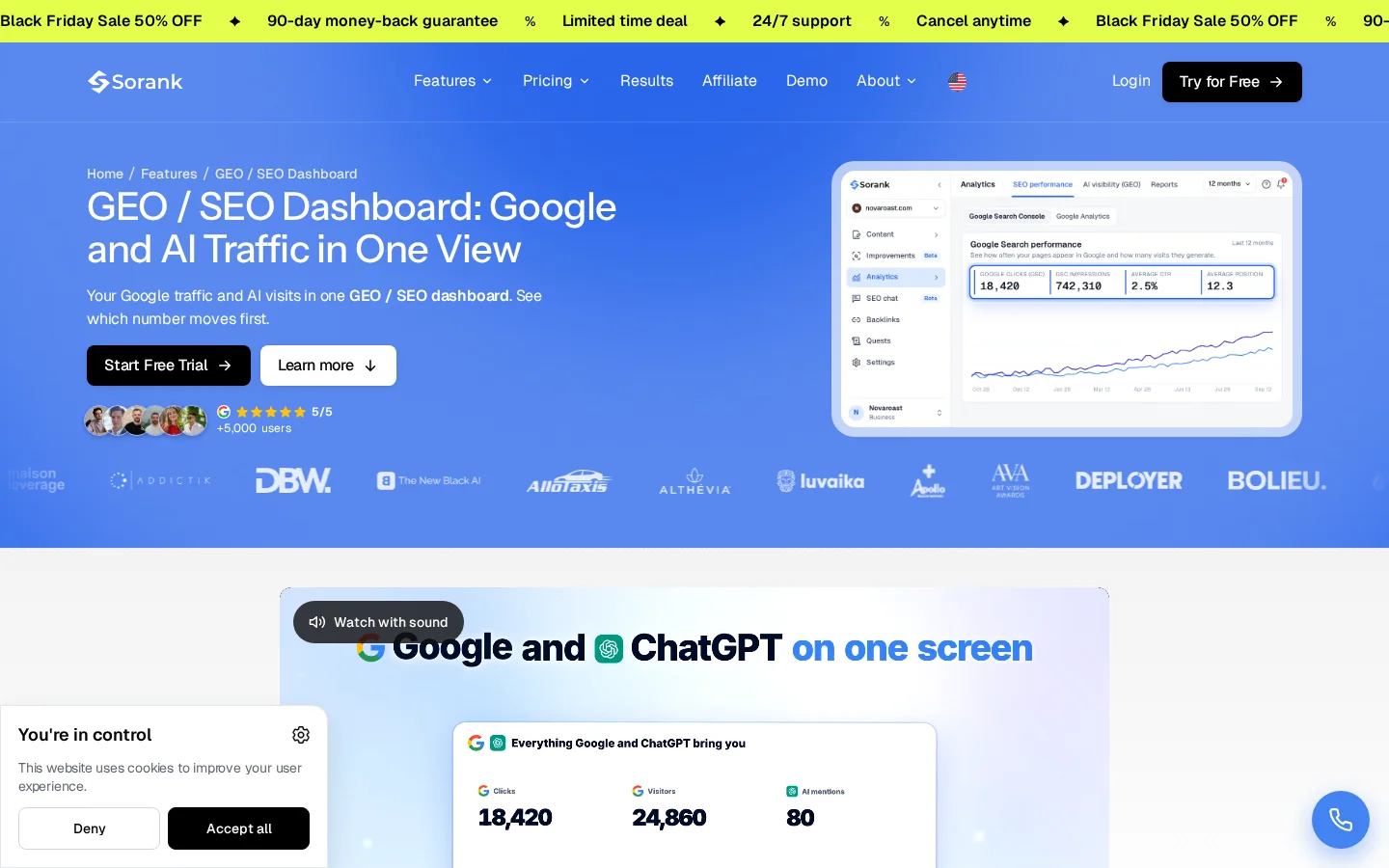
Some prospects now ask an AI assistant which agents work in a town, or which developer still has units. A report that shows only Google rankings misses that path. Sorank's GEO / SEO dashboard puts Google and AI traffic in one view, so a change in one shows up next to the other.
In the United States, a real estate ad cannot state a preference or limitation based on race, color, religion, sex, handicap, familial status or national origin. The rule covers your copy, the people in your photos and the choices you make in paid targeting.
The rule sits in subsection (c) of 42 U.S.C. 3604, published by Cornell Law School's Legal Information Institute. It makes it unlawful "to make, print, or publish, or cause to be made, printed, or published any notice, statement, or advertisement, with respect to the sale or rental of a dwelling that indicates any preference, limitation, or discrimination" based on those protected classes.
Warning
This is general information, not legal advice. State and local laws can add protected classes and stricter rules. Have a real estate attorney review your ad copy and targeting before a campaign goes live.
Most violations are friendly phrases that point at a group. The fix is almost always to describe the property, not the people who should live in it.
| Ad pattern | Why it is a risk | Safer alternative |
|---|---|---|
| "Perfect for a young couple with kids" | Points at familial status | "Three bedrooms, fenced garden, 10 minutes' walk to the train station" |
| "Close to our church, ideal for a Christian family" | Points at religion | "Quiet street, large lot, two shops within walking distance" |
| Photos showing only one group of people | Can imply a preference by race or national origin | Photos of the property, the rooms and the street |
Paid platforms restrict what you can target for housing ads, and those rules change. Do not exclude people by a protected class through audience settings, and do not rely on a platform to catch the problem for you. Read the housing advertising policy of each platform you use, and keep a written checklist that every ad passes before launch.
Most weak real estate marketing comes from five mistakes: leads with no source, a neglected profile, copied neighborhood pages, slow follow-up, and ads that break the housing rules. Each one has a sign you can check this week and a fix you can finish in a day or two.
What it is. Contacts arrive by phone, form or message, and the source field is empty or says "other".
How to spot it. Filter the last 30 days of leads by source. If more than a few rows are blank, your channel reports are guesses.
How to fix it. Make the source field required in the CRM and on every form, ask the question on every call, and review the blanks each Friday until they stop.
What it is. Holiday hours are wrong, the photos come from a previous office, and reviews sit unanswered for months.
How to spot it. Open your profile on a phone, as a stranger would, and check the last photo date, the hours and the most recent reply.
How to fix it. Set a monthly routine with one named owner and a calendar reminder: new photos, a check of hours and categories, and a reply to every review.
What it is. You wrote one page, copied it for each town and swapped the name.
How to spot it. Put two pages side by side. If only the town name differs, readers will notice, and search engines can treat the pages as near duplicates.
How to fix it. Give each page facts only you can supply: the streets people ask about, real commute times, recent sales from your records and the businesses you know. Merge the pages you cannot fill into one stronger guide.
What it is. An enquiry sits in an inbox until the next day, or the lead has already spoken to two other agents.
How to spot it. Measure the time from each enquiry to the first human reply for one week, and look at the slowest tenth.
How to fix it. Send an automatic acknowledgement within minutes, name one person for every lead, and set a call-back target for the same working day. Then start the follow-up sequence, so a missed call does not end the lead.
What it is. A campaign runs with copy or targeting that points at a protected group, often copied from a lifestyle ad.
How to spot it. Read every headline, description and image as a regulator would, and check the audience settings for exclusions by protected class.
How to fix it. Rewrite the copy around property facts, replace images that focus on people, remove the setting, and pass the ad through your pre-launch checklist.
| Mistake | Warning sign | Fix |
|---|---|---|
| Leads with no source | Blank or "other" source field | Required field, UTM tags, weekly review |
| Profile nobody updates | Old photos, wrong hours, unanswered reviews | Monthly routine with one owner |
| Copied neighborhood pages | Same paragraphs, different town name | Unique local facts, or merge the page |
| Slow follow-up | First reply the next day or later | Auto reply, named owner, sequence |
| Ads that break housing rules | Copy or targeting that describes people | Rewrite around the property, pre-launch checklist |
Pick one channel, set up its tracking and review the numbers after 30 days. Do not launch five channels in the same week, because you will not know which one produced the leads. For most local businesses, that means the Google Business Profile first, then one neighborhood page and one follow-up sequence.
This week
When the plan is on paper, our marketing plan template helps you share it. If you sell homes, see the agent-focused SEO page for the local work end to end.
Real estate marketing is the set of channels used to attract buyers, sellers, tenants and investors and turn them into leads. It includes local search, listing portals, your website, paid ads, email and video. The goal is a qualified lead you can follow up, not just traffic.
If you are an agent or property manager, start with local search and your Google Business Profile, because it is free and reaches people searching near them. Add a listing portal when you have active listings. Test paid ads only after you have a landing page with a form and a way to track each lead.
Track the cost per qualified lead by channel, plus the appointment rate and the number of signed listings or sales. Record the source of every lead in your CRM and review the numbers monthly. Clicks and impressions show reach, but they do not show business results.
We analyse your competitors, your website and your AI visibility to create a tailored content plan for free.
 Website Value Calculator
 Website Accessibility Checker
 Google Analytics Checker
 Duplicate Content Checker
 Mobile-Friendly Test
 Website Speed Test
 Subdomain Finder
 Domain Age Checker
 CMS Detector
 Googlebot Simulator
 Nofollow Link Checker
 Meta Tag Checker
 Keyword Cannibalization Checker
 Keyword Intent Checker
 Keyword Extractor
 Google Ads Cost Calculator
 CPC Calculator
 Local Citation Finder
 Reddit Threads Finder
 Disavow File Generator
 Redirect Generator
 Canonical Tag Generator
 Passive Voice Checker
 Google Location Changer
 Google Review Calculator
 Google Review Link Generator
 Keyword Combiner
 Podcast Show Notes Generator
 AI Content Rewriter
 AI Text Humanizer
 ChatGPT Prompt Generator
 Twitter Thread Generator
 Tweet Generator
 Landing Page Copy Generator
 Google Ads Copy Generator
 Pinterest Pin Description Generator
 Anchor Text Generator
 Social Media Post Generator
 LinkedIn Post Generator
 Free AI Writer
 Review Response Generator
 LSI Keyword Generator
 YouTube Video Ideas Generator
 YouTube Tag Generator
 YouTube Description Generator
 Product Description Generator
 CTA Generator
 Blog Introduction Generator
 Conclusion Generator
 Hook Generator
 AI Content Brief Generator
 FAQ Schema Generator
 AI Blog Post Ideas Generator
 Structured Data Validator (Schema Validator)
 Alt Text Checker
 Internal Link Analyzer
 Backlink Challenge
 AI Meta Description Generator
 AI Blog Title Generator
 Google Indexability Checker
 AI Blog Outline Generator
 UTM Link Builder
 Keyword Clustering Tool
 Canonical Tag Checker
 XML Sitemap Generator
 Broken Link Checker
 AI SEO Title Generator
 Headline Analyzer
 SERP Preview Tool
 Redirect Checker
 Hreflang Tag Generator
 Heading Structure Analyzer
 HTTP Headers Checker
 Favicon Extractor
 SERP CTR Calculator
 SEO vs Paid Search Savings Calculator
 SEO Share of Voice Calculator
 SEO ROI Calculator
 SEO Traffic and Revenue Forecast Calculator
 SEO Budget Calculator
 SEO Break-Even Calculator
 SaaS SEO ROI Calculator
 ROAS Calculator
 Reading Time Calculator
 Ranking Gain Simulator
 Organic Traffic Value Calculator
 Organic Traffic Estimator and Website Traffic Checker
 LTV to CAC Ratio Calculator
 Local SEO ROI Calculator
 Link Building Cost Calculator
 Keyword Value Calculator
 Keyword Opportunity Score Calculator
 Keyword Density Calculator
 GEO ROI Calculator
 GEO Content Investment Calculator
 Ecommerce SEO ROI Calculator
 Customer Lifetime Value Calculator
 Customer Acquisition Cost Calculator
 CTR Calculator
 Cost Per Article Calculator
 Conversion Rate Calculator
 Content Marketing ROI Calculator
 ChatGPT Referral Traffic Estimator
 Bounce Rate Calculator
 Backlink ROI Calculator
 AI Visibility Score Calculator
 AI Traffic Value Calculator
 AI Share of Voice Calculator
 Cost of AI Invisibility Calculator
 AI Citation Rate Calculator
 llms.txt Validator
 AI Overview Checker and AI Overviews Rank Checker
 Robots.txt Checker
 AI SEO Audit
 LLM Readability Checker
 SearchGPT Readiness Checker
 Structured Data LLM Audit
 Website Crawlability AI Audit
 Why ChatGPT Is Not Recommending My Website
 Gemini Ranking Tool
 Perplexity Ranking Checker
 LLM Citation Checker
 Answer Engine Optimization Audit
 GEO Audit
 AI Search Visibility Test
 ChatGPT Visibility Checker
 llms.txt Generator
 URL Extractor
 Webpage to Markdown
 Sitemap Checker
 SERP Volatility Sensor
 Page Size Checker
 Word Counter
 Slug Generator
 Schema Generator
 Robots Generator
 OG Preview
 Meta Tags Generator
 Image Compressor
 Favicon Generator
 On-Page SEO Audit: SEO Checker and SEO Analyzer
 Backlink Analysis Tool
 Keyword Research Tool
 Domain Authority Checker
 “I tested Sorank on a real client site and it's insane. It does everything an agency would bill you $1500 a month for. It's going into production on that client now.”

 Guillaume Guersanguersanguillaume.com“We are an Ads agency and we wanted to get our SEO back on track once and for all. Sorank gave us a clear view of our site, helped us prioritize optimizations, and properly structure our content. The tool is easy to use, well designed for a team, and very practical for centralizing tracking without having to juggle multiple platforms. A very solid foundation to start fresh with our SEO.”
 Gaspard MadouiAds Agency
 “I just let the Sorank software do its thing, and now my DR is 25 and my page is ranking higher.”
 Lucas Flandrefoundertrace.fr“I specialized in GEO thanks to Sorank. The GEO Leaderboard allows me to show my clients their position vs competitors on ChatGPT. It’s a real commercial differentiator.”
 MélanieSEO Freelance“Great service, works well for our website and helps us understand how to improve it to rank better on Google and elsewhere. Congrats, keep going, I recommend it.”
 Hugo T.E-commerce merchant