Preferences
Privacy is important to us, so you have the option of disabling certain types of storage that may not be necessary for the basic functioning of the website. Blocking categories may impact your experience on the website. More information
Privacy is important to us, so you have the option of disabling certain types of storage that may not be necessary for the basic functioning of the website. Blocking categories may impact your experience on the website. More information

Learn the difference between brand voice and tone, see real style guide examples, and define your own tone of voice with a 5-step method and a free template.
In short
Brand tone of voice is how your brand sounds in a given moment: formal or casual, serious or funny, respectful or irreverent, enthusiastic or matter-of-fact. Your voice (your personality) stays the same everywhere; your tone shifts with the channel and the reader's mood. You define it with 3 to 5 traits, examples and banned words.
Want to go further? Ask
Quick quiz
What should you work on first for your brand?
Sorank matches your answers


Test it for 3 days on your own site and see where you stand on Google, ChatGPT and the other AIs.
Start 3-day free trial3 days free, then stop whenever you want. 90-day results guarantee, conditions apply.
Brand voice is who you are when you write. Brand tone is how that same person sounds in one specific situation. A good teacher has one personality, but talks differently to a student who just failed an exam and to a class celebrating the end of the year. Your brand works the same way.
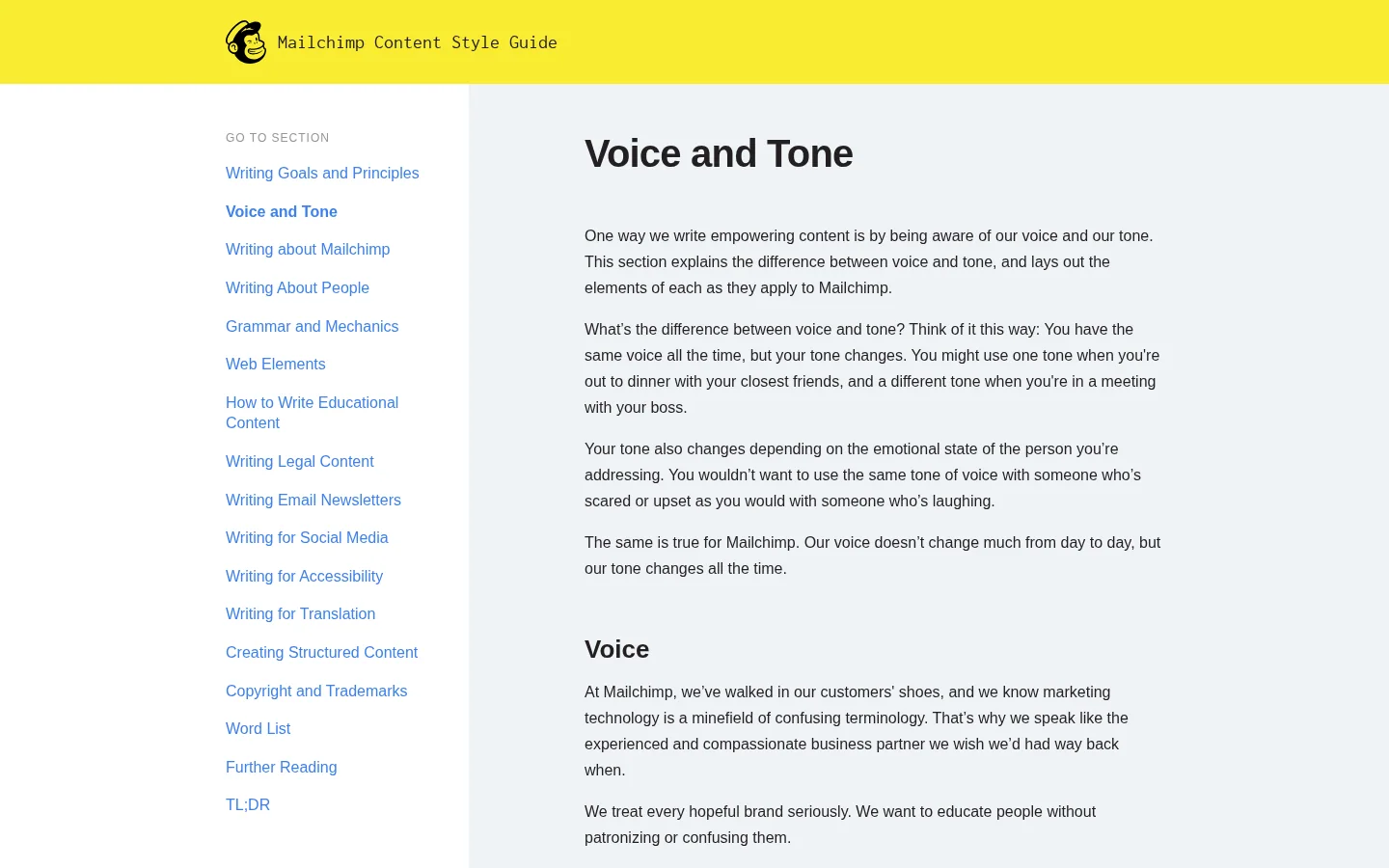
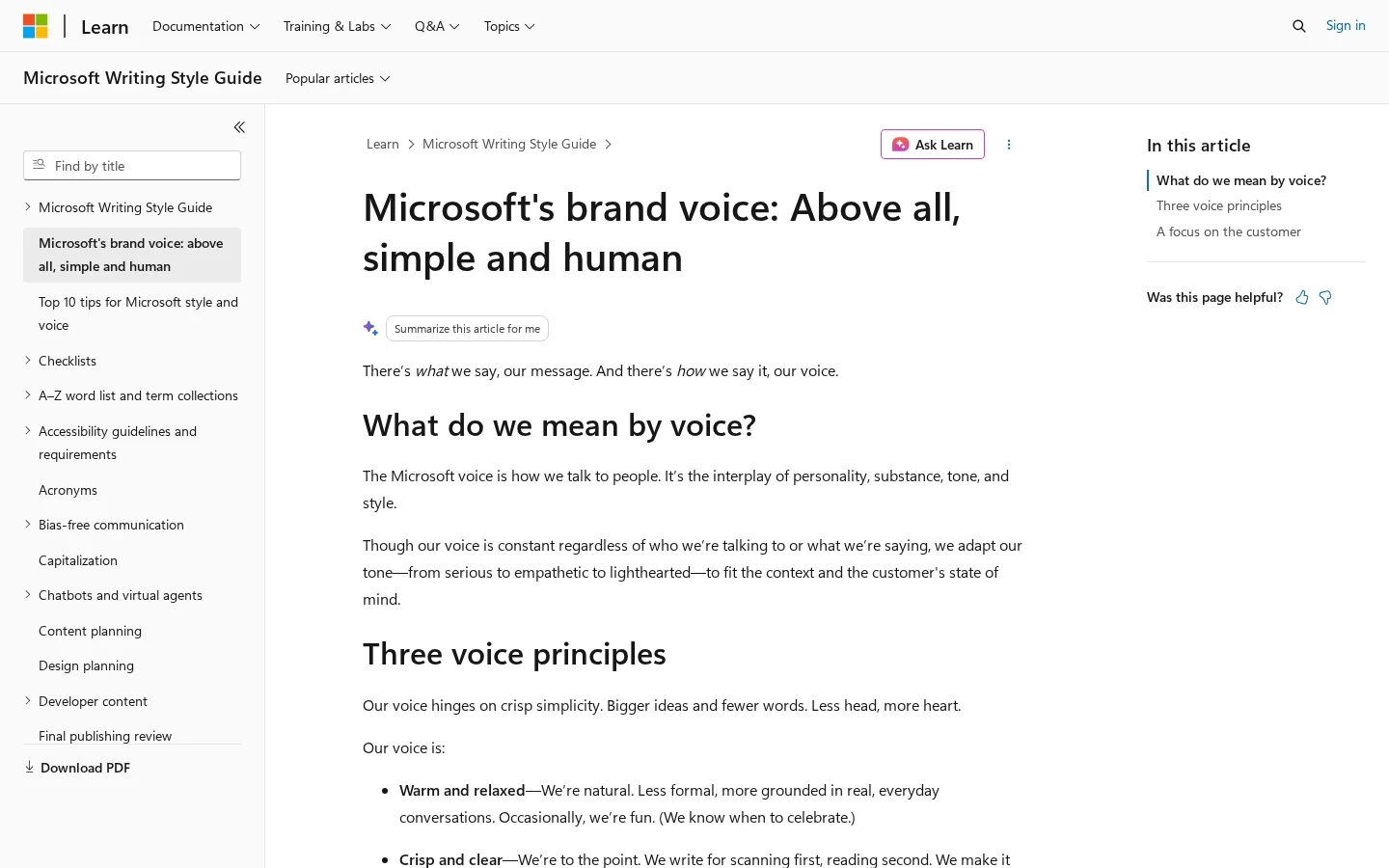
The clearest public definition comes from Mailchimp's Content Style Guide, in its voice and tone section: "You have the same voice all the time, but your tone changes." Microsoft says the same thing in its Writing Style Guide page on brand voice: the voice is constant, but the tone adapts "from serious to empathetic to lighthearted" to fit the context and the customer's state of mind.
Brand voice vs brand tone
People mix these words up, and the confusion costs time in every review meeting. Here is how they fit together.
| Layer | Question it answers | Example | How often it changes |
|---|---|---|---|
| Positioning and message | What do we say? | "We save small teams 10 hours of admin a week" | Rarely |
| Voice | Who is speaking? | Plainspoken, warm, expert | Rarely |
| Tone | How do we sound right now? | Calm and precise in a billing error email | Every piece of content |
| Style (editorial rules) | How do we write it down? | Sentence case headings, contractions allowed, no exclamation marks | When a rule causes problems |
| Visual identity | How do we look? | Colors, fonts, photo style | Rarely |
Your tone sits on top of your brand positioning. If you have not written down what you stand for and who you serve, start there: a tone with no positioning underneath is just a costume.
For a writer, tone feels like intuition. For an editor or a machine, it is a set of observable choices: sentence length, use of contractions, first or second person, emoji, exclamation marks, jargon, humor, how direct the call to action is. That matters because anything you can observe, you can write down, review and check at scale. We come back to that in the section on measuring tone.
Tone changes how much people trust you, and trust drives whether they recommend you. That is not a branding opinion: it has been tested.
In a 2016 study by Kate Moran at Nielsen Norman Group, "The Impact of Tone of Voice on Users' Brand Perception", 100 American adults rated pairs of nearly identical web pages that differed only in tone. A regression on the results found that trustworthiness explained 52% of the variation in how likely people were to recommend the brand, while friendliness added only 8%. Across the samples, "casual, conversational, and moderately enthusiastic tones performed best."
The lesson is subtle. Being friendly helps, but only when it does not cost you credibility. In the same study, a playful car insurance page was rated friendlier than the serious one, yet the serious one was rated more trustworthy, and people were no more likely to recommend the playful brand.
The other side of the coin is attitude that goes too far. In a Sprout Social survey of 1003 online respondents run by Survata in April 2017 (press release of May 24, 2017), 88% of consumers said they were annoyed when brands make fun of their followers, and only 36% said humor on social media makes them more likely to buy.
How people react to brand attitude on social media
Source: Sprout Social Index Q2 2017, survey by Survata of 1003 online respondents
Search engines do not rank "tone". But tone shapes the signals they do use. A clear, consistent voice makes pages easier to read, which keeps people on them. It also makes your content recognizable instead of interchangeable, which is the opposite of commodity content that says what every competitor says in the same flat way.
For AI models like ChatGPT, Claude and Gemini, consistency is even more important. They summarize what they read about you across many pages. If your site says "simple and affordable" on one page and "enterprise-grade platform" on the next, the summary gets blurry. Our guide to keeping a brand consistent across channels and AI answers goes deeper on that point.

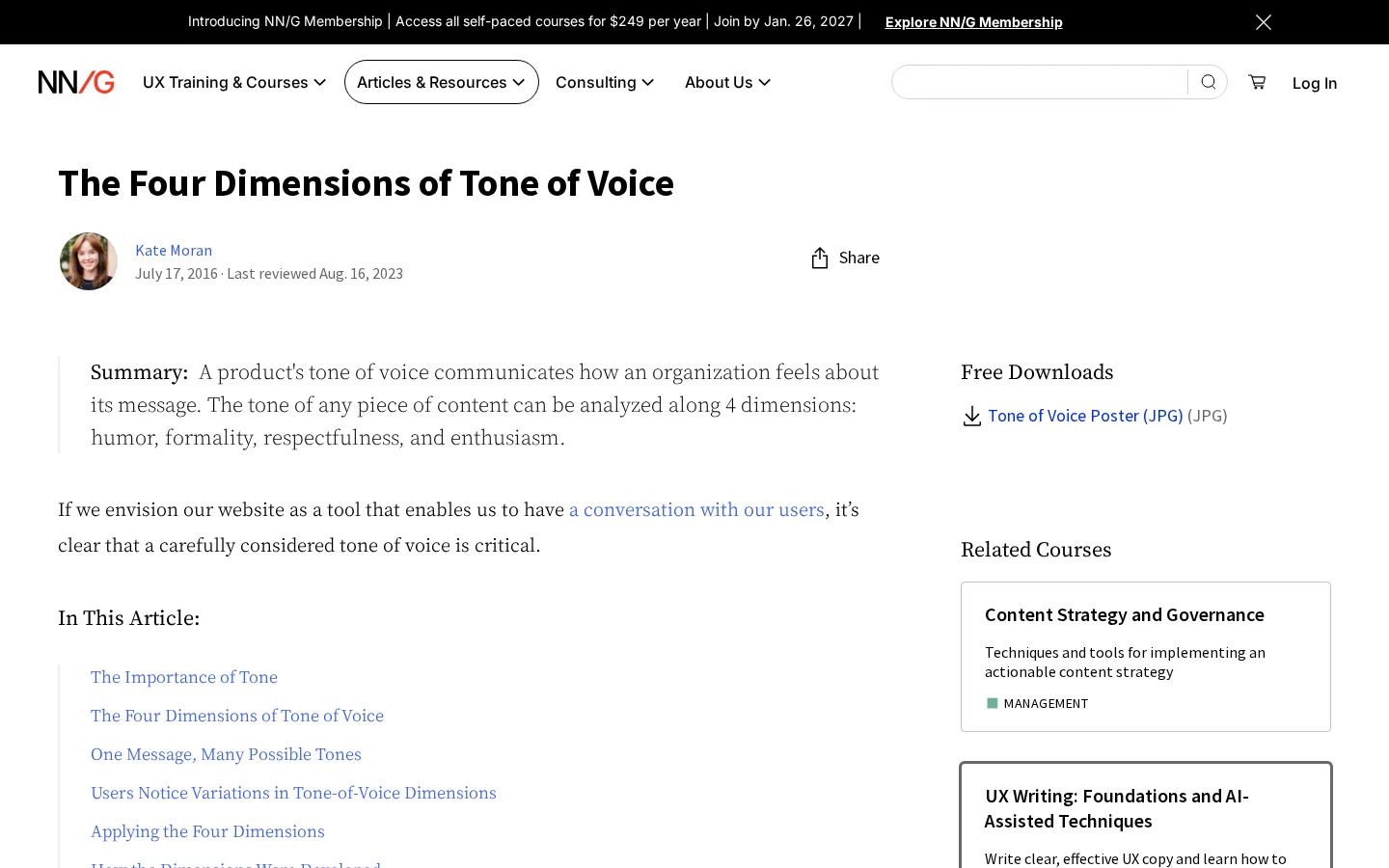
The most useful way to describe a tone is to place it on four sliders. Nielsen Norman Group proposed them in "The Four Dimensions of Tone of Voice" (Kate Moran, July 2016, reviewed in 2023), after narrowing a long list of literary tone words down to 37 words that apply to websites.
Each dimension is a slider, not a switch. Most brands sit somewhere in the middle on at least two of them. The point is to decide where, and to write it down with a number.
| Dimension | Left end example | Right end example | Observable signals |
|---|---|---|---|
| Formal / casual | "Please find attached your invoice for the period." | "Here's your invoice. All good?" | Contractions, greetings, sentence length, "we/you" vs "the company/the customer" |
| Serious / funny | "Your payment failed. Update your card to keep access." | "Your card said no. Let's find one that says yes." | Wordplay, jokes, unexpected images |
| Respectful / irreverent | "Insurance protects what you have built." | "Insurance is boring. Losing your house is worse." | Mocking conventions, provocative claims, slang |
| Matter-of-fact / enthusiastic | "The export now supports CSV." | "Big news: CSV export is here!" | Exclamation marks, superlatives, emoji |
Use a scale from 1 to 5 on each dimension, where 1 is the left end and 5 the right end. A law firm might score formal 2, serious 1, respectful 1, matter-of-fact 2. A snack brand on social media might score casual 5, funny 4, irreverent 3, enthusiastic 4. Then give each score a range per channel: "Support emails: casual 2 to 3, never funny." This turns a vague adjective into a rule that two different writers will apply the same way.
Note
The four dimensions describe tone, not voice. Your voice traits ("plainspoken", "expert") stay fixed. The sliders move within the range those traits allow.
There is no single correct method. Teams use five main approaches, and the best guides combine two or three of them.
Principle: score your tone on the four dimensions above, then set a range per channel. When to use it: when several writers need to agree fast. Pros: simple, measurable, easy to review. Limits: two brands can have the same scores and still sound different, because sliders do not capture vocabulary or personality. Example: "Blog: casual 4, serious 3, respectful 2, matter-of-fact 3."
Principle: pick 3 to 5 traits, and for each one write what it means and what it does not mean. When to use it: for any brand guide; it is the backbone of Mailchimp's and Microsoft's public guides. Pros: the "not that" line prevents the trait from being pushed too far. Limits: traits are easy to write and hard to apply without examples. Example: "Confident, not arrogant: we state facts and give our opinion, we never put competitors down."
Principle: borrow one of the 12 classic archetypes (the Sage, the Hero, the Jester, the Caregiver...) as a personality shortcut. When to use it: in workshops with founders or non-writers who find adjectives too abstract. Pros: memorable, quick to align a team. Limits: too broad to guide a sentence; it often produces clichés. Example: "We are a Sage with a bit of Jester: we teach, with a dry smile."
Principle: list 50 to 100 adjectives that could describe your brand, then sort them into three columns: who we are, who we want to be, who we are not. Keep the strongest words from the middle column. When to use it: for a rebrand or when the team disagrees on who the brand is. Pros: forces decisions, surfaces hidden disagreements. Limits: takes a half-day workshop; the result still needs examples.
Principle: list the situations your readers are in (first visit, purchase, error, complaint, cancellation, good news) and write the tone for each. When to use it: for products with support, billing and onboarding emails. Pros: the most practical method for daily writing, because it follows the reader's emotions. Limits: needs your voice to be defined first, otherwise each situation drifts.
| Method | Best for | Time to build | Main strength | Main limit |
|---|---|---|---|---|
| Four sliders | Aligning many writers | 1 hour | Measurable | Ignores vocabulary |
| "This, not that" traits | Every brand guide | 2 to 4 hours | Sets clear limits | Needs examples to work |
| Archetypes | Founder workshops | 1 hour | Memorable | Too vague for copy |
| Message architecture | Rebrands, disagreements | Half a day | Forces choices | Heavy process |
| Tone map by situation | Products with support and billing | Half a day | Follows reader emotions | Needs a voice first |
Our recommendation for most companies: traits with "not that" lines for the voice, sliders for each channel, and a tone map for the five or six most sensitive situations.
The best examples are the brands that publish their guides, because you can read their actual rules instead of guessing from a few ads.
Mailchimp describes its voice with four traits: plainspoken, genuine, translator and dry humor. Two rules from its guide are worth copying word for word: "it's always more important to be clear than entertaining" and "If you're unsure, keep a straight face." The guide also asks writers to consider whether the reader is relieved, confused or upset before choosing the tone.
Microsoft's three voice principles come with concrete style tips: start with the key takeaway, use "short everyday words, contractions, and sentence-style capitalization", shun jargon and acronyms, and "prune every excess word". It is a good model for B2B and software brands because every trait translates into a checkable rule.
| Brand | Tone in one line | What to learn | Risk if copied |
|---|---|---|---|
| Mailchimp | Plainspoken, with a wink | Humor never beats clarity | Low |
| Microsoft | Warm, crisp, helpful | Turn each trait into a style rule | Low |
| Old Spice | Absurd, over-the-top humor | A strong tone makes a commodity product memorable | High: absurd humor fails without a big creative budget |
| Duolingo on social media | Irreverent, mascot-driven | Tone can differ by channel while the voice stays recognizable | High: irreverence can read as mockery |
| Nike | Serious, powerful, motivating | Short sentences and imperatives carry emotion | Medium: sounds empty without the proof behind it |
| GOV.UK | Plain, neutral, direct | For public services, clarity is the tone | Low |
Notice the pattern: the brands with low risk are the ones whose tone serves clarity first. The high-risk tones work for brands with a big audience, a big budget and a team that can react fast when a joke lands badly.
You can build a working tone of voice in about a week, with five steps. Each step produces a document you will reuse in the guide.
The 5-step method to define your brand tone of voice
Your brand already has a tone, even if nobody chose it. Pick 20 to 30 pieces across channels: home page, two product pages, three blog posts, five emails, five social posts, two support replies, the checkout and the 404 page. Paste them in a spreadsheet with one column per slider and let two people score them separately. Where the scores differ by more than one point, you have found an inconsistency worth discussing. Mark the three pieces everyone likes best: they are the seeds of your future tone.
The words your customers use are your best raw material. Read your last 50 reviews, ten sales call notes and your support inbox. Copy exact phrases into a "customer language" list: how they describe the problem, the result they want, what they hate about alternatives. If your buyer personas are written down, add a line to each one about how that persona talks (vocabulary, level of expertise, patience). A tone that mirrors the reader's vocabulary feels natural; a tone that imposes yours feels like marketing.
More than five traits and nobody remembers them. Fewer than three and they do not differentiate you. For each trait, write four things: the trait, what it means, what it does not mean, and a pair of example sentences.
| Trait | We are | We are not | Do | Don't |
|---|---|---|---|---|
| Direct | We give the answer first | Blunt or cold | "Yes, you can cancel anytime from your account." | "We understand that flexibility is important to our valued customers..." |
| Expert | We explain the why, with facts | Jargon-heavy or condescending | "Your page loads in 6 seconds. Most visitors leave before that." | "Your LCP is suboptimal, obviously." |
| Warm | We talk like a helpful colleague | Overfamiliar or gushing | "Good question. Here is how it works." | "OMG we LOVE this question!!!" |
Take your slider scores from step 1 and set a range per channel. Then list the five or six moments where a wrong tone does real damage: payment failed, data lost, delivery late, account closed, price increase, complaint on social media. For each, write the reader's likely emotion and the tone to use. The next section gives a ready-made table.
Rewrite five real pieces with the new guide: one web page, one email, one social post, one error message, one support reply. Show the old and new versions to five customers or prospects and ask two questions: "What kind of company wrote this?" and "Would you trust it with your money?" If the answers match your traits, the tone works. Then share the guide, run a one-hour session with everyone who writes (sales and support included), and plan a review in six months.
Tip
Before you rewrite your headlines in the new tone, run the old and new versions through our free headline analyzer. It shows whether the new wording stays clear and specific, which is the first thing a fun tone tends to break.
Your voice never changes, but each channel and each moment calls for a different setting of the sliders. The reader's emotion matters more than the channel.
| Situation | Reader's likely emotion | Tone | Avoid |
|---|---|---|---|
| Home page, first visit | Curious, skeptical | Confident, clear, a little warm | Hype, vague promises |
| Blog article | Wants to learn | Expert, patient, concrete | Selling in every paragraph |
| Onboarding email | Hopeful, a bit lost | Encouraging, step by step | Long feature lists |
| Error message | Frustrated | Calm, factual, solution first | Jokes, blaming the user |
| Payment failed | Worried, embarrassed | Discreet, reassuring, precise | Threats, humor |
| Complaint on social media | Angry | Respectful, human, fast | Copy-pasted apologies, sarcasm |
| Product launch | Interested | Enthusiastic, with proof | Superlatives without facts |
| Legal and terms | Cautious | Formal but readable | Humor, ambiguity |
Here is a real-world style rewrite of a payment failure email, from a "default corporate" tone to a "direct, warm, expert" voice.
Payment failed email: before and after a tone guide
Tone does not translate word for word. French and German force a choice between the formal and informal "you" (vous/tu, Sie/du), and the right choice depends on the market and the sector, not on your English tone. Humor and irony are the first things to break in translation. Add a line per language in your guide: form of address, level of formality, and the idioms translators may adapt freely.
A tone of voice guide is a short document, ideally 2 to 6 pages, that lets anyone write like the brand without asking. Long guides are not read. Here is what it must contain.
Tone of voice guide checklist
If you plan to use AI writers, write the guide in a structured format from day one. The same file then serves humans and machines. Here is a template you can copy and fill in:
{
  "brand": "Acme Analytics",
  "audience": "Owners of small online shops, not technical, short on time",
  "voice_traits": [
    {"trait": "direct", "is": "answer first, then explain", "is_not": "blunt or cold"},
    {"trait": "expert", "is": "facts, numbers, the why", "is_not": "jargon or condescension"},
    {"trait": "warm", "is": "a helpful colleague", "is_not": "overfamiliar, gushing"}
  ],
  "sliders": {
    "blog":    {"casual": 4, "funny": 2, "irreverent": 2, "enthusiastic": 3},
    "support": {"casual": 3, "funny": 1, "irreverent": 1, "enthusiastic": 2},
    "social":  {"casual": 5, "funny": 3, "irreverent": 2, "enthusiastic": 4}
  },
  "address": {"en": "you", "fr": "vous", "de": "Sie"},
  "use_words": ["store", "dashboard", "Acme Reports"],
  "never_use": ["leverage", "synergy", "cutting-edge", "world-class", "revolutionary"],
  "grammar": {"contractions": true, "exclamation_marks": "max 1 per page", "emoji": "social only"},
  "examples": [
    {"before": "We regret to inform you...", "after": "Your payment did not go through."}
  ]
}
The "never use" list is the most underrated part of the guide. It is easy to apply, easy to check, and it removes the empty words that make every brand sound the same.
AI models write in a default tone: polite, enthusiastic, full of transitions and safe adjectives. If you give them no guide, every brand ends up sounding like that default. With a precise guide, they follow your tone surprisingly well.
Three things make the difference, in this order: examples, banned words, then adjectives. Adjectives alone ("friendly, professional") are too vague; the model fills the gap with its default tone. Two or three real paragraphs written in your voice teach it much more. Here is a prompt structure that works with ChatGPT, Claude or Gemini:
You write for [brand]. Audience: [one sentence, in their words].
Voice: direct (answer first), expert (facts, numbers), warm (a helpful colleague).
Tone for this piece: [channel], casual 4/5, funny 2/5, enthusiastic 3/5.
Address the reader as "you". Use contractions. Max 20 words per sentence on average.
Never use: leverage, synergy, cutting-edge, world-class, "in today's fast-paced world".
No exclamation marks. No emoji.
Here are 3 paragraphs in our voice. Match their rhythm and vocabulary:
[example 1]
[example 2]
[example 3]
Task: [what to write].
Our guide to writing copy with AI that still sounds like you covers the review workflow in detail.
Pasting the same prompt for each article is where most teams slip: one writer forgets the banned words, another changes the form of address. In Sorank, the Brand Voice settings hold this information once: a site brief built from your website (offers, audiences, terminology, editorial rules), the tone, the formal or informal form of address and the call to action. Every article written on autopilot then follows them.
When ChatGPT, Claude or Gemini describe your brand, they rebuild a picture from many pages: your site, reviews, articles about you. Stable terminology and a stable personality across those pages make that picture sharper. Inconsistent wording ("tool", "platform", "suite", "solution" for the same product) makes it fuzzier. Pick one name for each product and use it everywhere.
A tone guide nobody checks fades within months. You can measure tone with three simple tools: a scoring grid, a readability score and automatic checks for banned words.
For each piece of content, a reviewer answers five questions with yes or no: Does it match each voice trait? Are the slider scores within the channel range? Does it use our words and avoid the banned ones? Is the main point in the first two sentences? Would a customer understand every word? Score the share of yes answers. Track the average per writer and per channel each month: a drop shows who needs help or which channel drifts.
Readability formulas do not measure personality, but they catch the most common drift: sentences getting longer and words getting heavier. The Flesch Reading Ease score is the classic one:
Flesch Reading Ease = 206.835 - 1.015 x (words / sentences) - 84.6 x (syllables / words)Scores of 60 to 70 read as plain English for most adults; lower scores mean harder text. Set a target range per channel (for example 60 or more for emails, 50 or more for technical articles) rather than one number for everything.
If your content lives in files (a static site, a Git repository, exported posts), one command finds every banned word before publication:
grep -rniE "\b(leverage|synergy|cutting-edge|world-class|revolutionary|game-changer)\b" ./contentTo count exclamation marks per file, which is a quick proxy for over-enthusiasm:
grep -rc "!" ./content | sort -t: -k2 -nr | head -20Put these checks in your publishing workflow so they run on every new page, not once a year.
| What to measure | How | How often | Warning sign |
|---|---|---|---|
| Trait match | Review grid, 5 yes/no questions | Every piece, or a sample of 10 a month | Average below 80% yes |
| Readability | Flesch Reading Ease per channel | Every piece | Score falling over 3 months |
| Banned words | grep or editor plugin | Before publishing | Any match |
| Reader perception | 5 customers: "What kind of company wrote this?" | Every 6 months | Answers do not match your traits |
| Terminology | Count of product name variants | Every quarter | More than one name per product |
Most tone problems come from a handful of mistakes. Each one is easy to spot once you know what to look for.
What it is: traits like "professional, friendly, innovative" that describe every company. How to spot it: replace your brand name with a competitor's in the guide; if nothing feels wrong, your traits do not differentiate you. How to fix it: add the "we are not" line to each trait and pick at least one trait that a competitor would not claim.
What it is: using the same register everywhere, including in sensitive moments. How to spot it: your error messages and your launch emails sound equally cheerful. How to fix it: build the tone map by situation and start with the three moments where readers are most stressed.
What it is: jokes added because the guide says "fun". How to spot it: humor in billing, error or legal content; puns that need explaining. How to fix it: follow Mailchimp's rule ("If you're unsure, keep a straight face") and allow humor only on the channels where your slider says so.
What it is: a beautiful PDF full of words, with no real sentences. How to spot it: two writers produce very different texts from the same guide. How to fix it: add at least five before and after examples taken from your own content, one per channel.
What it is: imitating an irreverent consumer brand when you sell to cautious buyers. How to spot it: the tone clashes with your price point, your sector or the age of your customers. How to fix it: remember the Nielsen Norman Group finding: trust drives recommendation far more than friendliness. Start from your customers' language (step 2), not from someone else's ads.
What it is: a guide shared with the marketing team only. How to spot it: your blog sounds warm and your support replies sound like a contract. How to fix it: train everyone who writes to customers, and put the guide inside the tools they use: email templates, help desk macros, the instructions of your AI writer.
What it is: a tone defined once for a product or an audience that has since changed. How to spot it: writers ignore some rules because they no longer fit. How to fix it: name an owner, review the guide every six months, and log each change with its reason.
A good tone of voice is not a slogan. It is a short list of traits with clear limits, a slider setting per channel, a map for the hard moments, a list of banned words and real examples. Its job is to make people trust you, because trust is what makes them recommend you.
Here is what you can do in the next hour: collect ten pieces of your content, score them on the four sliders, and write down the three sentences you are most proud of. That is the start of your guide. Then connect it to your brand story so that what you say and how you say it point in the same direction.
Brand voice is your brand's personality, and it stays the same on every channel. Tone is how that personality sounds in one moment: calmer in an error message, more enthusiastic in a launch email. You keep one voice and adapt your tone to the channel and the reader's mood.
Nielsen Norman Group describes tone on four sliders: formal vs casual, serious vs funny, respectful vs irreverent, and matter-of-fact vs enthusiastic. Score your brand from 1 to 5 on each one, then set a range per channel so every writer applies the same tone.
Three to five traits work best. Fewer do not set you apart, and more are forgotten by the people who write. For each trait, write what it means, what it does not mean and a pair of example sentences.
We analyse your competitors, your website and your AI visibility to create a tailored content plan for free.
 Website Value Calculator
 Website Accessibility Checker
 Google Analytics Checker
 Duplicate Content Checker
 Mobile-Friendly Test
 Website Speed Test
 Subdomain Finder
 Domain Age Checker
 CMS Detector
 Googlebot Simulator
 Nofollow Link Checker
 Meta Tag Checker
 Keyword Cannibalization Checker
 Keyword Intent Checker
 Keyword Extractor
 Google Ads Cost Calculator
 CPC Calculator
 Local Citation Finder
 Reddit Threads Finder
 Disavow File Generator
 Redirect Generator
 Canonical Tag Generator
 Passive Voice Checker
 Google Location Changer
 Google Review Calculator
 Google Review Link Generator
 Keyword Combiner
 Podcast Show Notes Generator
 AI Content Rewriter
 AI Text Humanizer
 ChatGPT Prompt Generator
 Twitter Thread Generator
 Tweet Generator
 Landing Page Copy Generator
 Google Ads Copy Generator
 Pinterest Pin Description Generator
 Anchor Text Generator
 Social Media Post Generator
 LinkedIn Post Generator
 Free AI Writer
 Review Response Generator
 LSI Keyword Generator
 YouTube Video Ideas Generator
 YouTube Tag Generator
 YouTube Description Generator
 Product Description Generator
 CTA Generator
 Blog Introduction Generator
 Conclusion Generator
 Hook Generator
 AI Content Brief Generator
 FAQ Schema Generator
 AI Blog Post Ideas Generator
 Structured Data Validator (Schema Validator)
 Alt Text Checker
 Internal Link Analyzer
 Backlink Challenge
 AI Meta Description Generator
 AI Blog Title Generator
 Google Indexability Checker
 AI Blog Outline Generator
 UTM Link Builder
 Keyword Clustering Tool
 Canonical Tag Checker
 XML Sitemap Generator
 Broken Link Checker
 AI SEO Title Generator
 Headline Analyzer
 SERP Preview Tool
 Redirect Checker
 Hreflang Tag Generator
 Heading Structure Analyzer
 HTTP Headers Checker
 Favicon Extractor
 SERP CTR Calculator
 SEO vs Paid Search Savings Calculator
 SEO Share of Voice Calculator
 SEO ROI Calculator
 SEO Traffic and Revenue Forecast Calculator
 SEO Budget Calculator
 SEO Break-Even Calculator
 SaaS SEO ROI Calculator
 ROAS Calculator
 Reading Time Calculator
 Ranking Gain Simulator
 Organic Traffic Value Calculator
 Organic Traffic Estimator and Website Traffic Checker
 LTV to CAC Ratio Calculator
 Local SEO ROI Calculator
 Link Building Cost Calculator
 Keyword Value Calculator
 Keyword Opportunity Score Calculator
 Keyword Density Calculator
 GEO ROI Calculator
 GEO Content Investment Calculator
 Ecommerce SEO ROI Calculator
 Customer Lifetime Value Calculator
 Customer Acquisition Cost Calculator
 CTR Calculator
 Cost Per Article Calculator
 Conversion Rate Calculator
 Content Marketing ROI Calculator
 ChatGPT Referral Traffic Estimator
 Bounce Rate Calculator
 Backlink ROI Calculator
 AI Visibility Score Calculator
 AI Traffic Value Calculator
 AI Share of Voice Calculator
 Cost of AI Invisibility Calculator
 AI Citation Rate Calculator
 llms.txt Validator
 AI Overview Checker and AI Overviews Rank Checker
 Robots.txt Checker
 AI SEO Audit
 LLM Readability Checker
 SearchGPT Readiness Checker
 Structured Data LLM Audit
 Website Crawlability AI Audit
 Why ChatGPT Is Not Recommending My Website
 Gemini Ranking Tool
 Perplexity Ranking Checker
 LLM Citation Checker
 Answer Engine Optimization Audit
 GEO Audit
 AI Search Visibility Test
 ChatGPT Visibility Checker
 llms.txt Generator
 URL Extractor
 Webpage to Markdown
 Sitemap Checker
 SERP Volatility Sensor
 Page Size Checker
 Word Counter
 Slug Generator
 Schema Generator
 Robots Generator
 OG Preview
 Meta Tags Generator
 Image Compressor
 Favicon Generator
 On-Page SEO Audit: SEO Checker and SEO Analyzer
 Backlink Analysis Tool
 Keyword Research Tool
 Domain Authority Checker
 “I tested Sorank on a real client site and it's insane. It does everything an agency would bill you $1500 a month for. It's going into production on that client now.”

 Guillaume Guersanguersanguillaume.com“We are an Ads agency and we wanted to get our SEO back on track once and for all. Sorank gave us a clear view of our site, helped us prioritize optimizations, and properly structure our content. The tool is easy to use, well designed for a team, and very practical for centralizing tracking without having to juggle multiple platforms. A very solid foundation to start fresh with our SEO.”
 Gaspard MadouiAds Agency
 “I just let the Sorank software do its thing, and now my DR is 25 and my page is ranking higher.”
 Lucas Flandrefoundertrace.fr“I specialized in GEO thanks to Sorank. The GEO Leaderboard allows me to show my clients their position vs competitors on ChatGPT. It’s a real commercial differentiator.”
 MélanieSEO Freelance“Great service, works well for our website and helps us understand how to improve it to rank better on Google and elsewhere. Congrats, keep going, I recommend it.”
 Hugo T.E-commerce merchant