Preferences
Privacy is important to us, so you have the option of disabling certain types of storage that may not be necessary for the basic functioning of the website. Blocking categories may impact your experience on the website. More information
Privacy is important to us, so you have the option of disabling certain types of storage that may not be necessary for the basic functioning of the website. Blocking categories may impact your experience on the website. More information

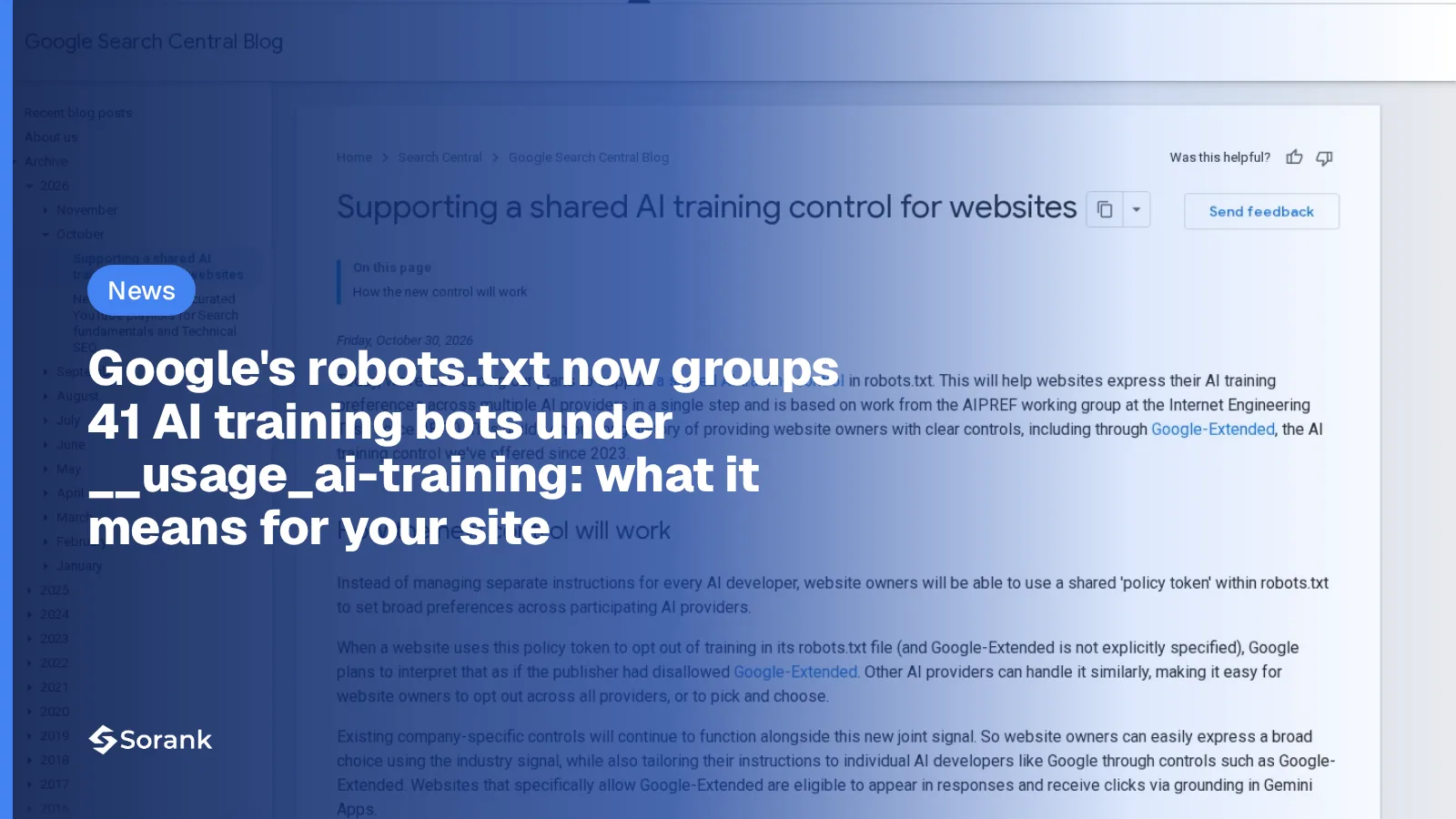
Google's robots.txt has a new __usage_ai-training group: 41 AI bots, GPTBot and ClaudeBot included. What it blocks, and how to set your own file.
In short
Between 17 and 22 November 2026, Google added a group called __usage_ai-training to the robots.txt file of google.com. It lists 41 AI crawlers, including GPTBot and ClaudeBot, and closes Google Maps to them. Nothing changes on your own site, but the file shows how to use a shared AI training opt-out that Google plans to support in early 2027, and one detail of it can cost you visibility in Gemini.
Want to go further? Ask
The change is visible in Google's own robots.txt file, which we read on 24 November 2026. A new group opens with the line User-agent: __usage_ai-training, followed by 41 crawler names.
You will see two counts in the press. Some articles say 42 bots, others say 41. Both look at the same lines: there are 42 User-agent lines, but the first one is the policy token itself, not a bot. The exact answer is 41 crawler names plus one token.
The date comes from archived copies. According to PPC Land's analysis of the file, the group was absent on 17 November 2026, and Japanese SEO specialist Masahiro Tsuji reported it on 22 November 2026. Google has published no explanation.
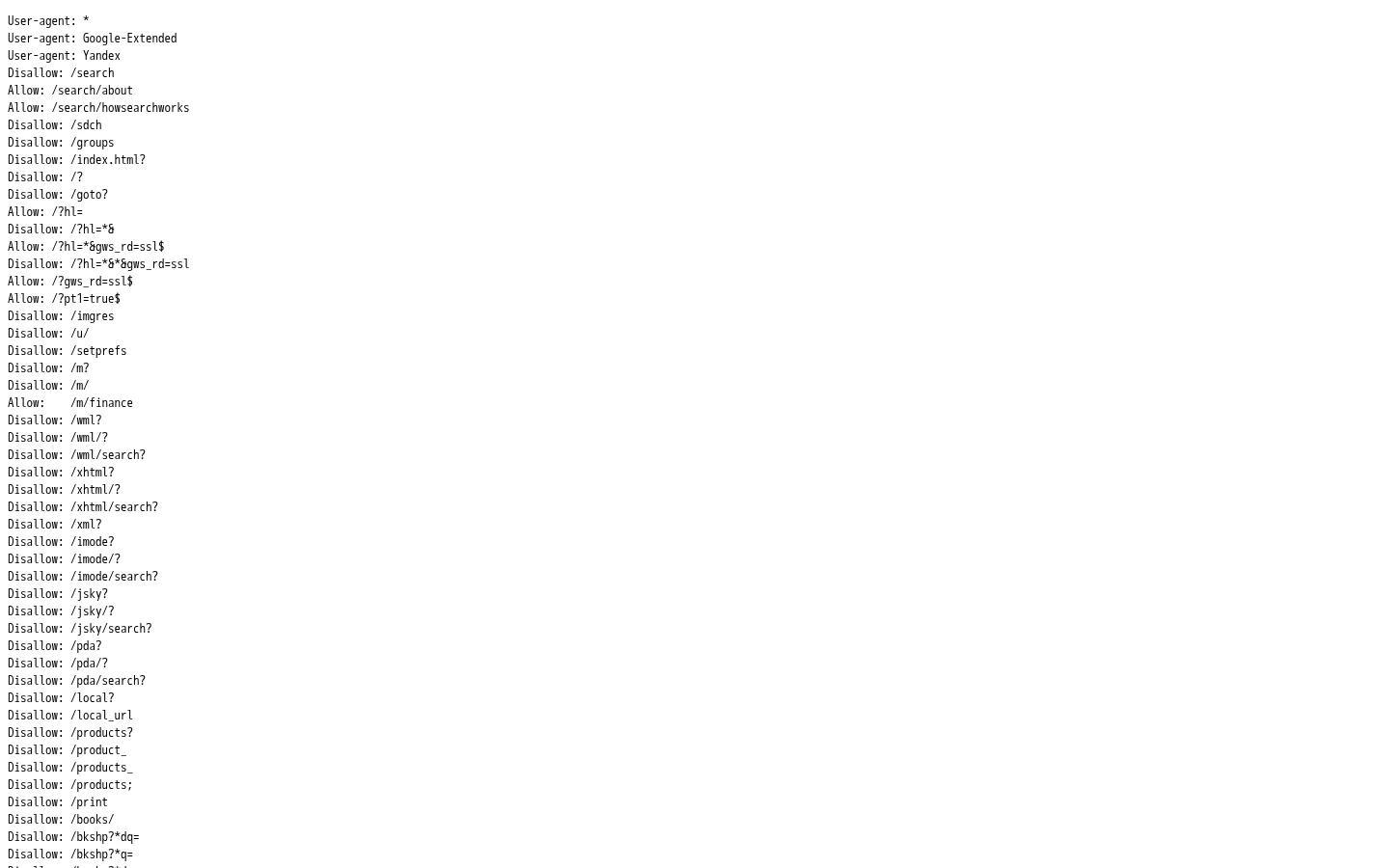
Here are the lines that open the group:
User-agent: __usage_ai-training
User-agent: AI2Bot
User-agent: Ai2Bot-Dolma
User-agent: Amazonbot
User-agent: Applebot-Extended
User-agent: bedrockbot
User-agent: Bytespider
User-agent: CCBot
User-agent: ChatGLM-Spider
User-agent: ClaudeBot
User-agent: cohere-training-data-crawler
User-agent: Cotoyogi
User-agent: DeepSeekBot
User-agent: Diffbot
User-agent: ElevenlabsCrawler
User-agent: ExaSearchBot
User-agent: FacebookBot
User-agent: FriendlyCrawler
User-agent: GPTBot
User-agent: Grok
User-agent: HySpider
User-agent: ICC-Crawler
User-agent: ImagesiftBot
User-agent: img2dataset
User-agent: KimiBot
User-agent: LCC
User-agent: Meta-ExternalAgent
User-agent: MistralAI-Training
User-agent: MistralBot
User-agent: MoonshotBot
User-agent: NagetBot
User-agent: omgili
User-agent: omgilibot
User-agent: QwenBot
User-agent: recraft-image-dataset
User-agent: Reflectionbot
User-agent: SBIntuitionsBot
User-agent: Timpibot
User-agent: VelenPublicWebCrawler
User-agent: web-image-collection-research
User-agent: Webzio-Extended
User-agent: YiBot
The new group in numbers
Sources: google.com/robots.txt, read on 24 November 2026, and PPC Land
The main new restriction is Google Maps. The default group still opens several Maps pages, such as /maps/place/ and /maps/dir/. The training group replaces those detailed rules with a single Disallow: /maps.
Search results are not a new block. /search and /goto? are closed in the default group too, so for every crawler without its own rules.
Look at who is missing from the list:
| Missing from the list | Names | Role |
|---|---|---|
| Answer and search bots | OAI-SearchBot, ChatGPT-User, Claude-SearchBot, Claude-User, PerplexityBot | They fetch pages to answer a question and show a source. |
| Classic search bots | Googlebot, Bingbot | They crawl pages for Google Search and Bing. |
| Google's own AI control | Google-Extended | It sits in the default group, next to User-agent: *. |
So Google separates training from answering. Our guide to robots.txt for AI crawlers sorts the main bots the same way.
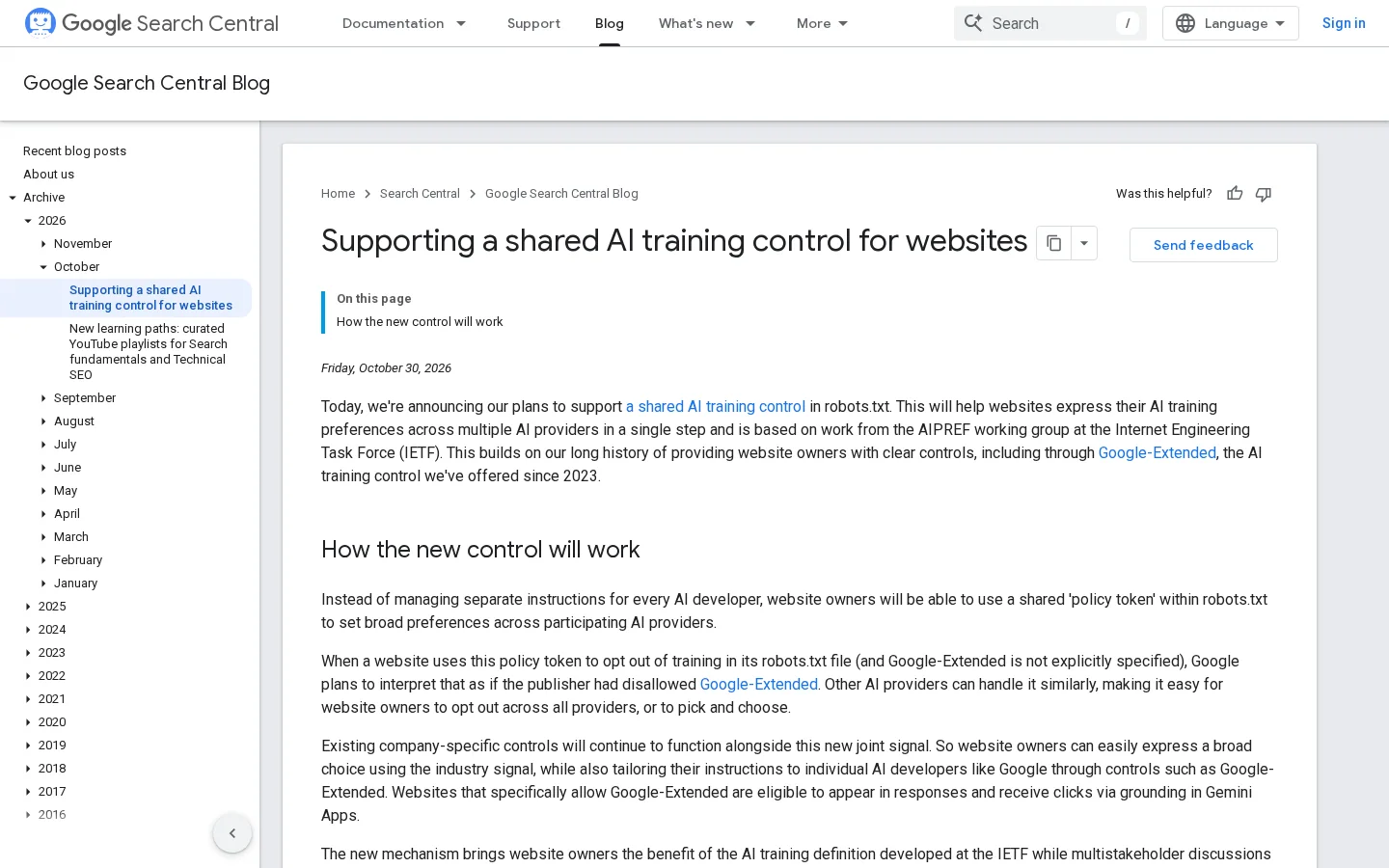
The token was announced before the file changed. On 30 October 2026, John Mueller wrote on the Google Search Central blog that Google plans to support a shared AI training control in robots.txt, with other AI providers, in 2027. You would state your choice once instead of naming every AI company.
The rules are in an IETF draft dated 30 October 2026, written by Kevin Kelley of Anthropic. Three points matter for your site:
User-agent: * says nothing about AI training.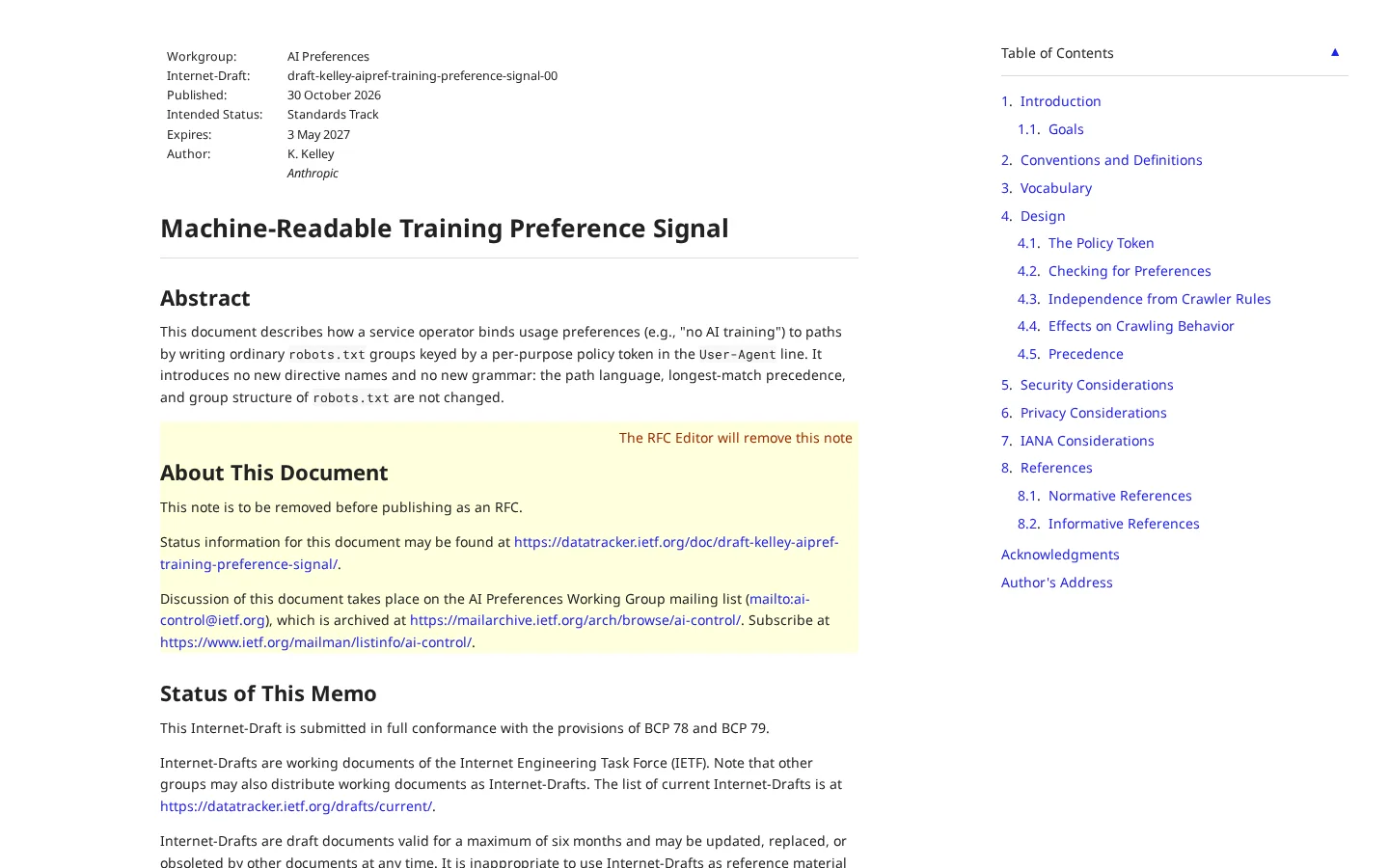
The dates to know
Read this before you copy the token. Google's post says that if you opt out with the shared token and do not name Google-Extended, Google plans to treat it as if you had disallowed Google-Extended.
That control covers more than training. Google's crawler documentation says it also covers grounding, when content from the Google Search index is given to Gemini at the moment of the answer. Sites that specifically allow Google-Extended stay eligible to appear in Gemini Apps answers and to receive clicks from them. If you want to be cited in Gemini, name it.
Google Search is separate. The same documentation says Google-Extended has no effect on inclusion in Search and is not a ranking signal.
Two ways to opt out of AI training, once Google supports the token
User-agent line. Our free robots.txt checker shows which AI crawlers are allowed or blocked.* group. If you give a bot a partial block, copy your other Disallow lines into its group. Google did exactly that in its own file.Here is an example for a site that refuses training but wants to stay eligible in Gemini Apps. Replace the paths with yours:
User-agent: *
User-agent: Google-Extended
Allow: /
Disallow: /cart/
Disallow: /account/

User-agent: __usage_ai-training
User-agent: GPTBot
User-agent: ClaudeBot
User-agent: CCBot
Disallow: /The group has 42 User-agent lines. The first one is the policy token __usage_ai-training, which is not a bot. The other 41 lines are crawler names, including GPTBot, ClaudeBot and CCBot.
No. OpenAI's documentation says GPTBot is for training and does not control search visibility. OAI-SearchBot is the one to keep open: sites that opt out of it are not shown in ChatGPT search answers.
Only if you want to refuse AI training. Keep your existing rules for each bot, because Google plans support for early 2027 and other providers have their own calendar. Name Google-Extended explicitly, otherwise Google plans to treat the opt-out as a Google-Extended block, which also covers grounding in Gemini Apps.
We analyse your competitors, your website and your AI visibility to create a tailored content plan for free.
 Duplicate Content Checker
 Mobile-Friendly Test
 Website Speed Test
 Subdomain Finder
 Domain Age Checker
 CMS Detector
 Googlebot Simulator
 Nofollow Link Checker
 Meta Tag Checker
 Keyword Cannibalization Checker
 Keyword Intent Checker
 Keyword Extractor
 Google Ads Cost Calculator
 CPC Calculator
 Local Citation Finder
 Reddit Threads Finder
 Disavow File Generator
 Redirect Generator
 Canonical Tag Generator
 Passive Voice Checker
 Google Location Changer
 Google Review Calculator
 Google Review Link Generator
 Keyword Combiner
 Podcast Show Notes Generator
 AI Content Rewriter
 AI Text Humanizer
 ChatGPT Prompt Generator
 Twitter Thread Generator
 Tweet Generator
 Landing Page Copy Generator
 Google Ads Copy Generator
 Pinterest Pin Description Generator
 Anchor Text Generator
 Social Media Post Generator
 LinkedIn Post Generator
 Free AI Writer
 Review Response Generator
 LSI Keyword Generator
 YouTube Video Ideas Generator
 YouTube Tag Generator
 YouTube Description Generator
 Product Description Generator
 CTA Generator
 Blog Introduction Generator
 Conclusion Generator
 Hook Generator
 AI Content Brief Generator
 FAQ Schema Generator
 AI Blog Post Ideas Generator
 Structured Data Validator (Schema Validator)
 Alt Text Checker
 Internal Link Analyzer
 Backlink Challenge
 AI Meta Description Generator
 AI Blog Title Generator
 Google Indexability Checker
 AI Blog Outline Generator
 UTM Link Builder
 Keyword Clustering Tool
 Canonical Tag Checker
 XML Sitemap Generator
 Broken Link Checker
 AI SEO Title Generator
 Headline Analyzer
 SERP Preview Tool
 Redirect Checker
 Hreflang Tag Generator
 Heading Structure Analyzer
 HTTP Headers Checker
 Favicon Extractor
 SERP CTR Calculator
 SEO vs Paid Search Savings Calculator
 SEO Share of Voice Calculator
 SEO ROI Calculator
 SEO Traffic and Revenue Forecast Calculator
 SEO Budget Calculator
 SEO Break-Even Calculator
 SaaS SEO ROI Calculator
 ROAS Calculator
 Reading Time Calculator
 Ranking Gain Simulator
 Organic Traffic Value Calculator
 Organic Traffic Estimator and Website Traffic Checker
 LTV to CAC Ratio Calculator
 Local SEO ROI Calculator
 Link Building Cost Calculator
 Keyword Value Calculator
 Keyword Opportunity Score Calculator
 Keyword Density Calculator
 GEO ROI Calculator
 GEO Content Investment Calculator
 Ecommerce SEO ROI Calculator
 Customer Lifetime Value Calculator
 Customer Acquisition Cost Calculator
 CTR Calculator
 Cost Per Article Calculator
 Conversion Rate Calculator
 Content Marketing ROI Calculator
 ChatGPT Referral Traffic Estimator
 Bounce Rate Calculator
 Backlink ROI Calculator
 AI Visibility Score Calculator
 AI Traffic Value Calculator
 AI Share of Voice Calculator
 Cost of AI Invisibility Calculator
 AI Citation Rate Calculator
 llms.txt Validator
 AI Overview Checker and AI Overviews Rank Checker
 Robots.txt Checker
 AI SEO Audit
 LLM Readability Checker
 SearchGPT Readiness Checker
 Structured Data LLM Audit
 Website Crawlability AI Audit
 Why ChatGPT Is Not Recommending My Website
 Gemini Ranking Tool
 Perplexity Ranking Checker
 LLM Citation Checker
 Answer Engine Optimization Audit
 GEO Audit
 AI Search Visibility Test
 ChatGPT Visibility Checker
 llms.txt Generator
 URL Extractor
 Webpage to Markdown
 Sitemap Checker
 SERP Volatility Sensor
 Page Size Checker
 Word Counter
 Slug Generator
 Schema Generator
 Robots Generator
 OG Preview
 Meta Tags Generator
 Image Compressor
 Favicon Generator
 On-Page SEO Audit: SEO Checker and SEO Analyzer
 Backlink Analysis Tool
 Keyword Research Tool
 Domain Authority Checker
 “I tested Sorank on a real client site and it's insane. It does everything an agency would bill you $1500 a month for. It's going into production on that client now.”

 Guillaume Guersanguersanguillaume.com“We are an Ads agency and we wanted to get our SEO back on track once and for all. Sorank gave us a clear view of our site, helped us prioritize optimizations, and properly structure our content. The tool is easy to use, well designed for a team, and very practical for centralizing tracking without having to juggle multiple platforms. A very solid foundation to start fresh with our SEO.”
 Gaspard MadouiAds Agency
 “I just let the Sorank software do its thing, and now my DR is 25 and my page is ranking higher.”
 Lucas Flandrefoundertrace.fr“I specialized in GEO thanks to Sorank. The GEO Leaderboard allows me to show my clients their position vs competitors on ChatGPT. It’s a real commercial differentiator.”
 MélanieSEO Freelance“Great service, works well for our website and helps us understand how to improve it to rank better on Google and elsewhere. Congrats, keep going, I recommend it.”
 Hugo T.E-commerce merchant