Preferences
Privacy is important to us, so you have the option of disabling certain types of storage that may not be necessary for the basic functioning of the website. Blocking categories may impact your experience on the website. More information

Privacy is important to us, so you have the option of disabling certain types of storage that may not be necessary for the basic functioning of the website. Blocking categories may impact your experience on the website. More information

30 SEO interview questions for 2026 with what a good answer contains, red flags, practical tests and new GEO questions, for hiring managers and candidates.

Tools

In short
A good SEO interview tests four things: fundamentals (how Google crawls, indexes and ranks), technical diagnosis, content and links, and now visibility in AI answers (GEO). The best questions ask candidates to explain a past decision or solve a real case, not to recite definitions. Pair 30 to 45 minutes of questions with a short paid practical test, and reject anyone who guarantees rankings or buys links.
Want to go further? Ask
Quick quiz
Is SEO right for you, and how should you start?
Sorank matches your answers


Test it for 3 days on your own site and see where you stand on Google, ChatGPT and the other AIs.
Start 3-day free trial3 days free, then stop whenever you want. 90-day results-or-refund guarantee.
Most lists of SEO interview questions give you 60 or 100 definitions to memorize. That helps a candidate revise, but it does not help a founder or a marketing lead tell a strong SEO from a confident one. This guide does both: 30 questions grouped by skill, what a good answer contains, the red flags to listen for, and the practical tests that reveal more than any question. Google itself publishes a short list of questions to ask before you hire an SEO, and we build on it. If you are a candidate, read the "good answer" lines as a checklist, then work through our step-by-step path to learn SEO for any gap.
Match the questions to the level of the role. A junior SEO needs solid fundamentals and curiosity; a manager needs judgment, prioritization and the ability to explain SEO to a board. One round of questions plus one practical exercise is enough for most hires.
| Role level | What to test | Question mix | Practical test |
|---|---|---|---|
| Junior / assistant | Fundamentals, tools, curiosity | Mostly foundational, 2 or 3 technical | Review 3 pages of your site (30 min) |
| SEO specialist | Diagnosis, content, links, GEO | Technical, content, GEO | Mini audit with priorities (2 hours, paid) |
| Senior / lead | Strategy, forecasting, dev collaboration | Technical cases, strategy | 90-day plan for one section of the site |
| Head of SEO / manager | Budget, team, reporting, business impact | Strategy and management | Present a quarterly report to a non-SEO |
Ask every candidate the same core questions so you can compare answers. Score each answer from 1 to 3 (vague, correct, correct with a real example) and write the score down right after the interview.
These questions check that the candidate understands how search works. Each one comes with what a good answer contains. Our guide to SEO basics covers the theory behind them.
Good answer: three stages, crawling (Googlebot discovers URLs through links and sitemaps), indexing (Google analyzes and stores the page) and ranking (hundreds of signals decide the order for each query). A strong candidate adds that a page can be crawled and still not indexed.
Good answer: on-page covers content, titles and internal links; off-page covers backlinks and brand mentions; technical SEO covers crawlability, indexing, speed, structured data and site architecture.
Good answer: the goal behind a query (information, comparison, purchase, a specific site). The candidate should explain that the format of the top results shows the intent, and that a page with the wrong format rarely ranks, however well written.
Good answer: Google Search Console first (real clicks, impressions, indexing), then GA4, a crawler such as Screaming Frog and a keyword tool such as Semrush or Ahrefs. Listen for a reason behind each tool, not a list of logos.
Good answer: named sources (Google Search Central blog, Search Status Dashboard, a few practitioners) and a recent change they tested on a real site.
Good answer: organic clicks, conversions and revenue from organic traffic, visibility on target topics, and now AI citations. Rankings and traffic alone are not business results. See our list of SEO KPIs that matter.
Tip
After each answer, ask "Can you give me an example from a site you worked on?" A candidate who knows the theory but has never applied it stops there. This single follow-up is the most reliable filter in an SEO interview.
Technical questions work best as small cases. Give the symptom, ask for the diagnosis.
Good answer: the queries it ranks for in Search Console, search intent versus page format, competition on the SERP, internal links pointing to it, and whether another page targets the same keyword.
Good answer: usually low quality or duplicate content, or weak internal linking. The fix is to improve, merge or remove pages, not to resubmit them again and again.
Good answer: a canonical tag to point duplicates to the main version, noindex to keep a page out of the index, robots.txt to stop crawling. Bonus point: blocking a page in robots.txt does not remove it from the index, and Google cannot see a noindex on a page it cannot crawl.
Good answer: according to web.dev, LCP of 2.5 seconds or less, INP of 200 milliseconds or less (INP replaced FID as a Core Web Vital in 2024) and CLS of 0.1 or less. A candidate who still cites FID has not updated their knowledge.
Good answer: crawl and export every URL before the move, map each old URL to its new one, use 301 redirects, keep the content and internal links, then monitor Search Console and server logs for several weeks.
Good answer: compare the raw HTML and the rendered HTML (URL Inspection tool), check that links are real links in the HTML and that the main content is not loaded only after a user action.
These questions show whether the candidate builds lasting results or shortcuts that Google penalizes.
Good answer: confirm the keyword cannibalization in Search Console, then merge the pages with a 301 redirect or give each one a distinct intent.
Good answer: E-E-A-T (experience, expertise, authoritativeness, trust) is a framework from Google's quality rater guidelines, not a direct ranking factor. In practice: named authors, first-hand experience, sources and accurate facts.
Good answer: yes, if it is accurate and useful. Google's spam policies target scaled content abuse, defined as many pages "generated for the primary purpose of manipulating search rankings", whatever the tool.
Good answer: linkable assets (data, tools, guides), digital PR, partners, unlinked brand mentions. The same spam policies list "buying or selling links for ranking purposes" as link spam.
Good answer: keyword research grouped into topics, one page per intent, priority based on business value and difficulty, internal linking between the pages of each topic, and a publishing rhythm the team can sustain.
Good answer: look at clicks, backlinks and conversions; update pages with potential, merge overlapping ones, delete or redirect pages with no traffic, no links and no purpose.
This is where most interview lists stop, and where the job has changed the most. GEO (generative engine optimization) is the work of getting a brand cited in answers from ChatGPT, Gemini, Perplexity and Google AI Overviews. Any SEO hired today should be able to answer these questions.
Good answer: Google's documentation on AI features and your website says there are no additional requirements: the page must be indexed and eligible to show with a snippet. Classic SEO is the entry ticket.
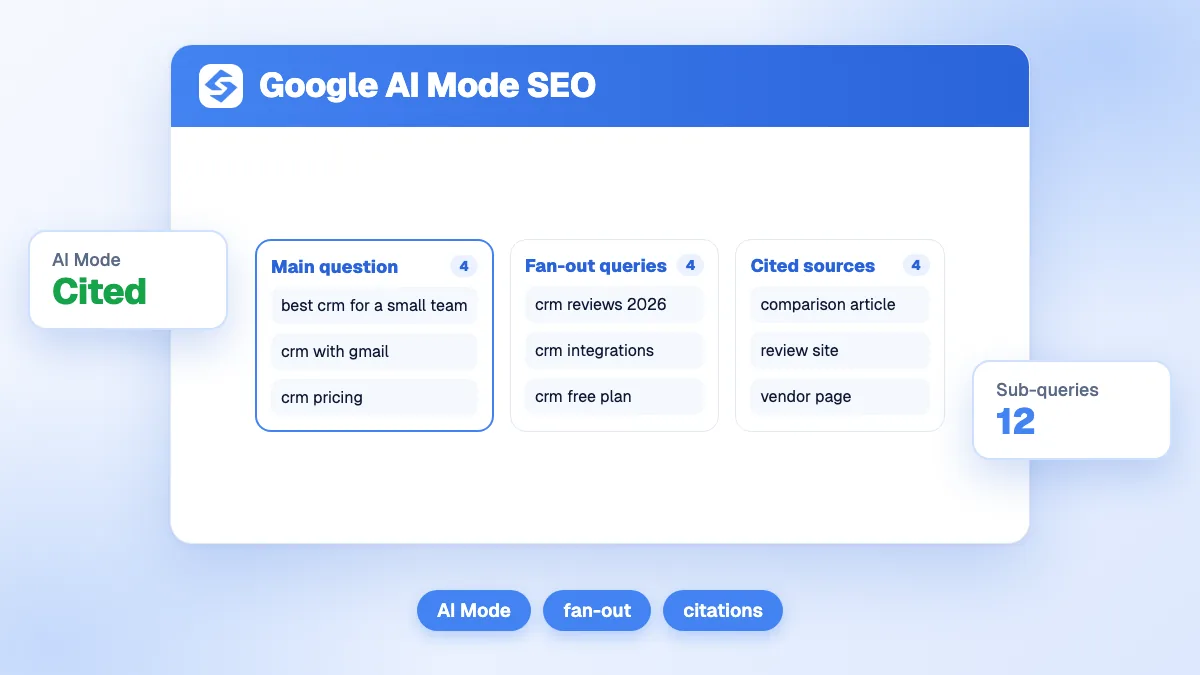
Good answer: AI Overviews and AI Mode may run several related searches on subtopics to build one answer. Content that covers the sub-questions of a topic, with clear and self-contained passages, has more chances to be picked.
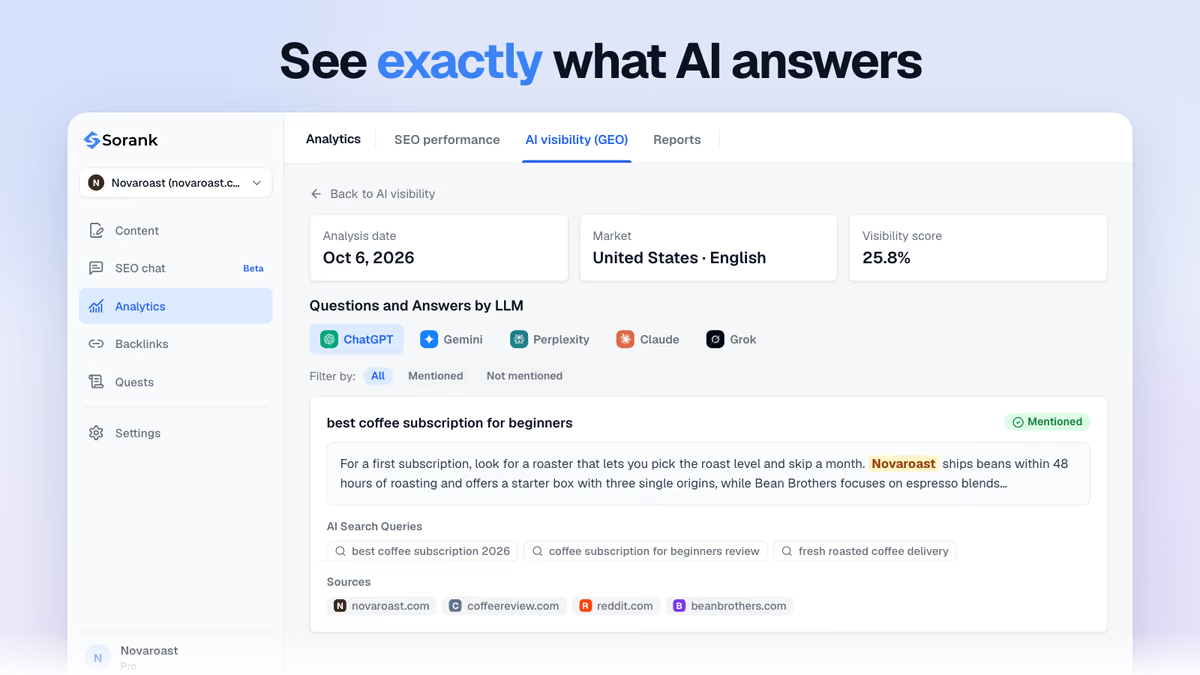
Good answer: a fixed list of prompts buyers really ask, checked regularly on several assistants, recording whether the brand is mentioned, its position and which sources are cited. Plus AI referral traffic in GA4. A tool such as AI mention tracking automates this.
Good answer: it depends on the assistant and the sector, so the candidate should look at the data rather than guess. Our study of what ChatGPT cites is a good basis for this discussion.
Good answer: distinguish training crawlers from the bots that fetch pages to answer users in real time. Blocking the latter can remove you from AI answers. Our guide to robots.txt for AI crawlers lists the main bots.
Good answer: a direct answer at the top of each section, definitions, sourced figures, comparison tables, a named author, and the brand present on third-party sites (reviews, forums, press) that assistants read.
Note
GEO is young, so few candidates have years of experience in it. Look for a method and curiosity: someone who has already tested prompts on their own site or a client's will learn faster than someone who only repeats articles about it.
Good answer: a quick audit, then a ranking of fixes by impact and effort (indexing problems first, then pages close to page one, then new content). An on-page audit is a fast starting point.
Good answer: an honest range, often several months for a new site or a new topic, with leading indicators (indexing, impressions) to track before clicks. Google warns that "no one can guarantee a #1 ranking on Google".
Good answer: tickets written in the developers' language, a business reason for each fix, a small number of priorities and a check after release.
Good answer: search volume of the target keywords, realistic click-through rates by position, a ramp-up period, and a low and a high scenario rather than one figure.
Good answer: a real case, the cause, what they measured and what they changed. A candidate with no failure has either little experience or little honesty.
Good answer: in-house for strategy and knowledge of the product, outside help for specific expertise, software for repetitive work (keyword research, content production, monitoring). It shows whether the candidate thinks in terms of return on investment.
A practical exercise reveals more than any interview question. Keep it short, based on real material, and paid if it takes more than an hour.
| Test | Duration | What it reveals |
|---|---|---|
| Review 3 pages of your site and list 5 fixes | 30 min | Eye for detail, priorities |
| Mini audit with Search Console read access | 2 hours | Diagnosis, use of real data |
| Keyword map for one product or service | 1 - 2 hours | Intent, structure, business sense |
| Ask 10 buyer prompts to ChatGPT and Gemini, summarize who is cited | 1 hour | GEO method, competitive analysis |
| Explain last month's results to a non-SEO | 15 min, live | Communication, focus on business |
Watch out
Never ask for a full audit or a 20-article content plan for free: good candidates decline, and it looks like unpaid work. Limit the scope or pay for the exercise.
An interview runs both ways. A good SEO candidate asks questions, and their absence is itself a signal for the recruiter. Useful ones: Who decides what gets published, and how fast can a technical fix go live? Do I get access to Search Console and analytics from day one? How is SEO success measured here: traffic, leads or revenue? What is the content budget, and is part of the production automated? Is the brand already tracked in AI answers? Candidates who want to strengthen their profile before the interview can look at our selection of SEO training courses or follow our free GEO course.
The role now covers two channels: ranking on Google and being cited by AI assistants. The best hires understand both, measure both and explain both in business terms. A lot of the repetitive work (keyword research, writing and publishing articles, tracking prompts) can be handled by software, which lets a small team or a single SEO focus on strategy. That is what Sorank does on autopilot for SEO teams, with a 3-day free trial. Hire for judgment and method, test with real cases, and let tools carry the volume.

The most common ones ask how search engines crawl and index pages, the difference between on-page, off-page and technical SEO, how to do keyword research, which tools the candidate uses and which metrics they track. More and more interviews now add questions on AI Overviews and visibility in ChatGPT. Recruiters also ask for a concrete example of a past result.
Build a small site or blog, connect it to Google Search Console and work on it for a few weeks. You can then answer with real examples: what you published, what got indexed, which queries brought clicks. Add a free course and a short audit of the employer's site to show initiative.
For most roles, one interview of 45 to 60 minutes plus one practical exercise is enough. Senior and management roles often add a presentation, such as a 90-day plan or a results review. Keep unpaid exercises under one hour and pay for anything longer.
We analyse your competitors, your website and your AI visibility to create a tailored content plan for free.
 AI Content Brief Generator
 FAQ Schema Generator
 AI Blog Post Ideas Generator
 Structured Data Validator (Schema Validator)
 Alt Text Checker
 Internal Link Analyzer
 Backlink Challenge
 AI Meta Description Generator
 AI Blog Title Generator
 Google Indexability Checker
 AI Blog Outline Generator
 UTM Link Builder
 Keyword Clustering Tool
 Canonical Tag Checker
 XML Sitemap Generator
 Broken Link Checker
 AI SEO Title Generator
 Headline Analyzer
 SERP Preview Tool
 Redirect Checker
 Hreflang Tag Generator
 Heading Structure Analyzer
 HTTP Headers Checker
 Favicon Extractor
 SERP CTR Calculator
 SEO vs Paid Search Savings Calculator
 SEO Share of Voice Calculator
 SEO ROI Calculator
 SEO Traffic and Revenue Forecast Calculator
 SEO Budget Calculator
 SEO Break-Even Calculator
 SaaS SEO ROI Calculator
 ROAS Calculator
 Reading Time Calculator
 Ranking Gain Simulator
 Organic Traffic Value Calculator
 Organic Traffic Estimator and Website Traffic Checker
 LTV to CAC Ratio Calculator
 Local SEO ROI Calculator
 Link Building Cost Calculator
 Keyword Value Calculator
 Keyword Opportunity Score Calculator
 Keyword Density Calculator
 GEO ROI Calculator
 GEO Content Investment Calculator
 Ecommerce SEO ROI Calculator
 Customer Lifetime Value Calculator
 Customer Acquisition Cost Calculator
 CTR Calculator
 Cost Per Article Calculator
 Conversion Rate Calculator
 Content Marketing ROI Calculator
 ChatGPT Referral Traffic Estimator
 Bounce Rate Calculator
 Backlink ROI Calculator
 AI Visibility Score Calculator
 AI Traffic Value Calculator
 AI Share of Voice Calculator
 Cost of AI Invisibility Calculator
 AI Citation Rate Calculator
 llms.txt Validator
 AI Overview Checker and AI Overviews Rank Checker
 Robots.txt Checker
 AI SEO Audit
 LLM Readability Checker
 SearchGPT Readiness Checker
 Structured Data LLM Audit
 Website Crawlability AI Audit
 Why ChatGPT Is Not Recommending My Website
 Gemini Ranking Tool
 Perplexity Ranking Checker
 LLM Citation Checker
 Answer Engine Optimization Audit
 GEO Audit
 AI Search Visibility Test
 ChatGPT Visibility Checker
 llms.txt Generator
 URL Extractor
 Webpage to Markdown
 Sitemap Checker
 SERP Volatility Sensor
 Page Size Checker
 Word Counter
 Slug Generator
 Schema Generator
 Robots Generator
 OG Preview
 Meta Tags Generator
 Image Compressor
 Favicon Generator
 On-Page SEO Audit: SEO Checker and SEO Analyzer
 Backlink Analysis Tool
 Keyword Research Tool
 Domain Authority Checker
THEY TRIED SORANK BEFORE YOU
 “I tested Sorank on a real client site and it's insane. It does everything an agency would bill you $1500 a month for. It's going into production on that client now.”

 Guillaume Guersanguersanguillaume.com“We are an Ads agency and we wanted to get our SEO back on track once and for all. Sorank gave us a clear view of our site, helped us prioritize optimizations, and properly structure our content. The tool is easy to use, well designed for a team, and very practical for centralizing tracking without having to juggle multiple platforms. A very solid foundation to start fresh with our SEO.”
 Gaspard MadouiAds Agency
 “I just let the Sorank software do its thing, and now my DR is 25 and my page is ranking higher.”
 Lucas Flandrefoundertrace.fr“I specialized in GEO thanks to Sorank. The GEO Leaderboard allows me to show my clients their position vs competitors on ChatGPT. It’s a real commercial differentiator.”
 MélanieSEO Freelance“Great service, works well for our website and helps us understand how to improve it to rank better on Google and elsewhere. Congrats, keep going, I recommend it.”
 Hugo T.E-commerce merchant