Preferences
Privacy is important to us, so you have the option of disabling certain types of storage that may not be necessary for the basic functioning of the website. Blocking categories may impact your experience on the website. More information
Privacy is important to us, so you have the option of disabling certain types of storage that may not be necessary for the basic functioning of the website. Blocking categories may impact your experience on the website. More information

Profound vs Conductor compared on data, agents, pricing and a fair two-week test, with the questions to ask each vendor before you sign a contract.

In short
Profound and Conductor both track how AI assistants mention your brand, but they are built differently. Conductor is an enterprise SEO platform that added AI visibility and expects your team to run it. Profound was built for AI answers from the start and leans toward agents. Choose by who will do the work, then test both on your prompts.
Want to go further? Ask
Quick quiz
Which kind of SEO tool is right for you?
Sorank matches your answers


Test it for 3 days on your own site and see where you stand on Google, ChatGPT and the other AIs.
Start 3-day free trial3 days free, then stop whenever you want. 90-day results guarantee, conditions apply.
Conductor is an enterprise SEO platform. Large marketing teams have used it for years, and it now includes AI visibility tracking, reporting and writing tools in the same suite. Profound is an answer engine optimization (AEO) platform. Its product was designed around AI answers, not around classic search rankings first.
The difference shows up in the first week of use. Conductor usually fits into an SEO workflow you already have: dashboards, content briefs, recommendations and analytics connections. Profound centers on monitoring AI answers and on agents that turn what they find into proposed projects.
| Question | Conductor | Profound |
|---|---|---|
| Starting point | Enterprise SEO suite, extended to AI visibility | Built for AI answer engines from the start |
| Main user | SEO, content and analytics teams | Marketing teams that want AI visibility work done for them |
| What you get | Monitoring, recommendations, a writing assistant and reports | Monitoring, prompt demand data and agents that propose projects |
| Analyst recognition | Conductor says it is a Leader in The Forrester Wave: Search Engine Optimization Solutions, Q3 2025 | Not checked for this article |
| Public list price | None found | None found for enterprise plans |
Treat vendor claims as claims. The Forrester placement above comes from Conductor's own announcements. Open the Forrester report itself before you put that line in a deck.
AI answers change from run to run, so one check of one prompt tells you very little, and that holds for both platforms. Comparing two tools on a single screenshot is the most common way to pick the wrong one.
In early 2026, Rand Fishkin (SparkToro) and Patrick O'Donnell (Gumshoe.ai) tested how stable AI brand recommendations are. They used 2961 prompts across 12 prompt types, such as questions about chef's knives or headphones. Each prompt ran 60 to 100 times per platform on ChatGPT, Claude and Google's AI results. According to Search Engine Journal's report on the study, published on 30 January 2026, ChatGPT and Google's AI returned the same brand list less than 1% of the time. Claude repeated the same list slightly more often, but it was less likely to repeat the same order.
The same report says the brands an AI names, their order and the number of items all shift between runs. This is why a rank position from one run is weak evidence. It does not mean the answers are random. Brands that appear across many runs of similar prompts show up much more consistently than brands that appear once.
What repeated runs reveal
Source: Search Engine Journal on the SparkToro and Gumshoe.ai study, 30 January 2026
Switch the question. Stop asking "what position are we in?" and ask "in how many answers do we appear?" A mention rate is a share, so it can be measured again next month and compared fairly with a competitor's share over the same prompts. A position is a snapshot that changes every time the model runs.
One check versus many runs
The formula is simple. The discipline is in the denominator. Count every answer you collected, across every prompt, assistant and run, not only the answers you expected to mention you.
visibility rate = answers that mention your brand / all answers collected

example: 10 prompts x 3 assistants = 30 answers
         9 answers mention your brand
         9 / 30 = 30%
Warning
Do not read a change from one week as a trend. Wait until the same direction shows up in at least two periods before you change content or budget.

The collection method decides what a visibility number means, so ask each vendor how it gets its answers before you compare any score. Two tools can report different rates for the same prompt because they collect answers in different ways.
Each method has trade-offs. Some tools query AI models through official APIs, which gives you repeatable settings. Others collect answers the way a person sees them in the app or on the web, which is closer to what buyers see but harder to control. The API answer and the app answer can differ, because the product layer adds its own search and citation behavior. Ask which method each vendor uses and how it explains the gap between them.
| Method | What it captures well | Question to ask |
|---|---|---|
| Official AI APIs | Repeatable queries and controlled settings | Does the API answer match what users see in the app? |
| Interface collection | What a real user sees, including web search and citations | How are locations, logins and sessions controlled? |
| Crawler data from your server or CDN | Which AI bots visit your pages and how often | Which bots are counted, and are user-triggered fetches included? |
A prompt set decides the result before any tool runs. Prompts that include your brand name tell you how the model reacts to your name, which is useful but not the same as discovery. Buyers search for the problem first. A prompt such as "best CRM for a 20-person law firm" tests discovery. A prompt such as "Acme CRM features" tests recognition. Build most of your set from buyer questions, support tickets and sales calls, and keep a smaller set of brand prompts for recognition.
Also split the set by market and language. The same question asked in English for a French company can return different brands than the French version of the question. Use one market and one language per test, and use the same settings for both tools.
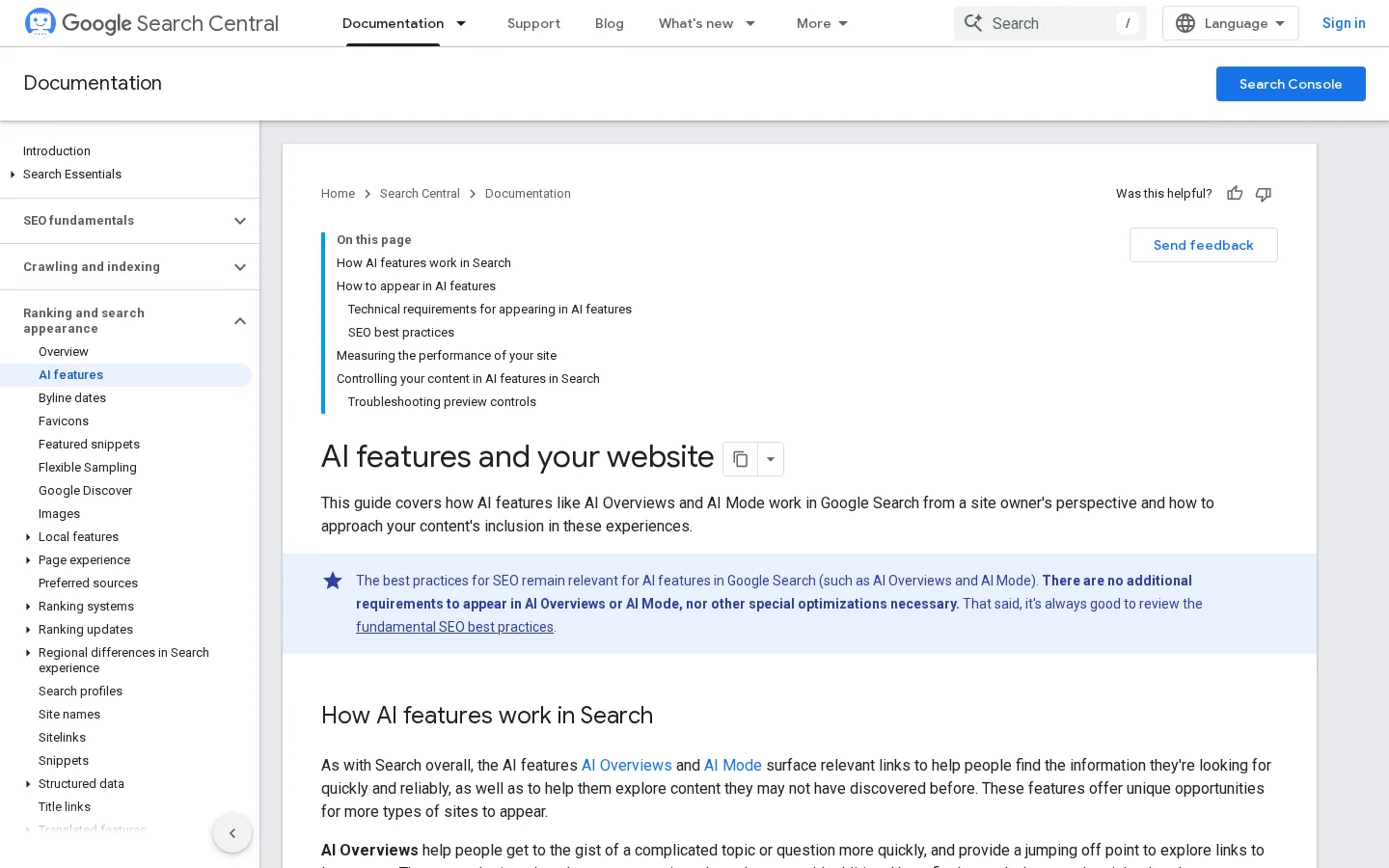
Some platforms show which AI bots fetch your pages, often through CDN logs or server integrations. That is useful, but a bot visit is not a citation. Google's documentation for its AI features is clear on the basics. It says "there are no additional requirements to appear in AI Overviews or AI Mode, nor other special optimizations necessary", and that you do not need "new machine readable files, AI text files, or markup" to appear in these features.
So read crawler data as a measure of access, and read mention data as a measure of answers. A page that bots visit daily can still be missing from every answer. If the crawl numbers rise while your mention rate stays flat, the problem is usually content, not access.
Conductor gives your team reports, recommendations and writing tools that your team acts on. Profound leans toward agents that propose and run projects and wait for your approval. Pick the model that matches how much time your team has to review and act.
Conductor's public feature set, as a 2026 comparison article describes it, includes a writing assistant, content scoring and a recommendation feature in beta that hands a suggestion straight to the writing tool. That model suits a team with writers and editors who already work inside a suite. Each recommendation still needs a person to decide whether it matters, so the work does not disappear. It moves to whoever reviews the list.
Profound describes an AI Marketer feature that proposes ranked projects covering visibility, citations, sentiment and competitors, plus agents built from templates or a drag-and-drop builder. The useful question is not whether agents are good. It is how many proposals your team can review each week without slowing down. Test that during the trial, with real proposals.
Who does the work
Ask who will set up your prompts, who answers questions in week three, and whether you get a named contact. Enterprise tools are often bought for their support as much as their data. Put the answers in writing before you sign, because a demo rarely shows the support you will get after the contract starts.
Run both tools on the same prompts, market and run count, then judge them on the decisions each one lets you make. Two weeks is enough to see whether the numbers repeat, and short enough that the team stays focused.
A two-week test in five steps
Brand matching is where many tests go wrong. Common words create false matches, and a regex finds a word, not a meaning. Both of these patterns look reasonable and both produce false positives in English text.
/\bprofound\b/i     matches "a profound change in search"
/\bconductor\b/i    matches "electrical conductor" and "choir conductor"
Read a sample of at least 20 matches by hand for each brand, mark the false ones, and tighten the pattern before you count. Use the domain name in the match when your answers include links, because a domain is much less likely to be a common word.
There are three ways to form a view before you buy, and each one answers a different question. Use all three, but weight your own test most.
| Source | Good for | Weak point |
|---|---|---|
| Analyst reports, such as The Forrester Wave | Showing which vendors an analyst reviewed and how it scored them | Dated, and built on criteria your team may not share |
| Peer review sites | Day-to-day usability and support feedback | Small samples, uneven dates and vendor influence |
| Your own test | Your prompts, your market and your team's time | Takes effort, and needs a fixed run count to be fair |
Tip
Before you buy any tracker, run a free check on your current visibility with our free AI visibility score calculator. It gives you a baseline to compare against after your trial.
Neither vendor lists a full public price for enterprise plans in the sources we checked. Trade reports from September 2026 say Profound removed its self-serve plans, so ask for a written quote that covers your cadence, engines and seats.
Note
Plans in this category change quickly. Read the vendor's current pricing page on the day you buy, and keep the quote with the contract.
In a 2026 comparison article, Profound says that daily tracking uses significantly more platform credits than weekly or monthly tracking, and that full access to its prompt volume data requires an enterprise plan. Those are the vendor's own claims, so check them in writing. The lesson holds for any tool: the cost usually depends on how often you run prompts, how many engines and markets you track, and which data is included.
| Quote item | Why it changes the cost | What to ask |
|---|---|---|
| Tracking cadence | Daily runs use more credits than weekly or monthly runs | Credits per prompt at each cadence |
| Prompt demand data | Demand data may sit behind a higher plan | Which plan includes it, and for which markets |
| Engines and markets | Each extra engine or region can add cost | Price per engine and per market |
| Seats and integrations | Analytics connectors can be limited to some tiers | Which connectors are included, such as GA4 |
| Trial and exit | A short trial limits what you can test | Trial length, search limits and cancellation terms |
Ask three things before you sign: the minimum term, whether you can export your prompt history and past answers, and what happens to your data after you leave. A tracker is only useful if its history stays with you. If the vendor cannot export the raw answers, you lose the baseline you need to prove progress.
Most bad comparisons come from one run, vendor-written benchmarks, prompts that flatter the brand, and a tool that nobody has time to review. Each mistake below has a clear sign you can check in your own data.
What it is: You judge a tool on a single report, a single run or a single screenshot.
How to spot it: A rank moves from second to sixth and back again within a week, and nobody checks the trend.
How to fix it: Set a fixed run count per prompt, report the mention share, and compare the same prompts across tools and weeks.
What it is: You take a comparison page as neutral evidence.
How to spot it: Each vendor's comparison page favors the vendor that wrote it, and each one claims the other has the weaker data.
How to fix it: Use vendor pages only to learn what to test. Verify each claim in your own trial, and treat review sites with the same caution, because their samples are small.
What it is: Most of your prompts include your brand name.
How to spot it: Your mention rate is high on the brand prompts and near zero on the buyer prompts, and nobody notices the gap.
How to fix it: Build most of the set from buyer questions, support tickets and sales calls. Keep a smaller set of brand prompts to check recognition separately.
What it is: You treat crawl volume as proof of visibility.
How to spot it: Bot visits rise for a month, but your mention rate does not move at all.
How to fix it: Keep crawl data and mention data on separate reports. Use crawl data to find access problems, and use mention data to measure results.
What it is: One tool reports a position and another reports a share, and you compare them as if they were the same metric.
How to spot it: Your deck says "second in tool A" and "30% in tool B" on the same slide.
How to fix it: Convert both results to the same metric, which is the share of answers that mention you, on the same prompts.
What it is: The tool is bought, the reports arrive, and nobody acts on them.
How to spot it: Proposals or reports sit unread for weeks, and the last content change dates from before the purchase.
How to fix it: Name one owner and a weekly review slot before the contract starts. If you cannot name the owner, the tool is too heavy for your team.
Before you sign
Choose Conductor if your SEO team already runs it and you want AI visibility added to that work. Choose Profound if AI visibility is your main goal and someone on your team can review agent proposals every week. If neither fits your budget yet, start with a smaller tracker and read our guide to the best AI visibility tools before you commit.
Keep the work where it lives. Conductor's strength is that recommendations can reach writers and analysts without a new workflow. Compare it with other suites on the same test before you extend the contract. Our comparison of AirOps vs Conductor and Conductor against seoClarity covers the trade-offs from other angles.
Give the agent model a fair trial with real proposals. If the proposals are specific and your team approves them within a day, the model fits. If they pile up unread, the tool costs more in attention than it saves in work. A useful first step is an AI visibility audit that defines the prompts before any tool runs.
You can measure before you buy an enterprise platform. Sorank's AI Mention Tracking checks how ChatGPT, Claude and Gemini mention your brand for the prompts you choose. It runs a monthly analysis, saves each one in your history, and shows the visibility rate for each assistant, so you can see the share of answers that name you.
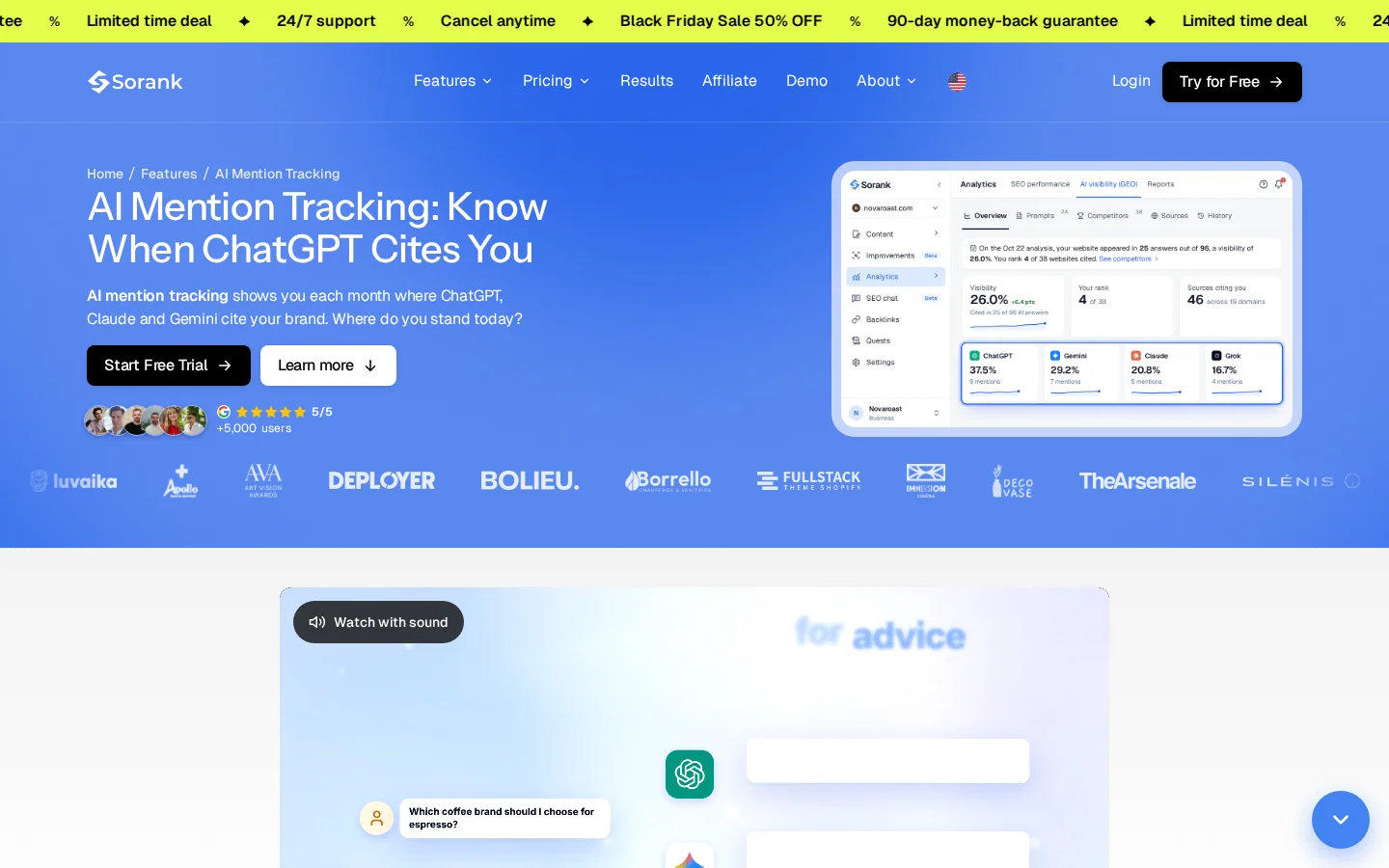
If the gap turns out to be content rather than measurement, the work is in the pages themselves. Our GEO optimization page covers that side, and the generative engine optimization entry defines the terms used across this article. Whichever tool you pick, run the same test twice, read the mention share, and decide from the trend rather than from one report.
It depends on who does the work. Conductor suits an SEO team that already runs an enterprise suite and wants AI visibility added to it. Profound suits teams where AI visibility is the main goal and someone can review its agent proposals every week.
Their numbers vary from run to run, because AI answers rarely repeat exactly. Judge a tool on the share of answers that mention your brand across many runs, not on a single rank position. Also ask how the vendor collects its answers.
Neither vendor publishes a full list price for enterprise plans in the sources we checked. Trade reports from September 2026 say Profound removed its self-serve plans, so ask for a written quote that covers your tracking cadence, engines and seats.
We analyse your competitors, your website and your AI visibility to create a tailored content plan for free.
 Duplicate Content Checker
 Mobile-Friendly Test
 Website Speed Test
 Subdomain Finder
 Domain Age Checker
 CMS Detector
 Googlebot Simulator
 Nofollow Link Checker
 Meta Tag Checker
 Keyword Cannibalization Checker
 Keyword Intent Checker
 Keyword Extractor
 Google Ads Cost Calculator
 CPC Calculator
 Local Citation Finder
 Reddit Threads Finder
 Disavow File Generator
 Redirect Generator
 Canonical Tag Generator
 Passive Voice Checker
 Google Location Changer
 Google Review Calculator
 Google Review Link Generator
 Keyword Combiner
 Podcast Show Notes Generator
 AI Content Rewriter
 AI Text Humanizer
 ChatGPT Prompt Generator
 Twitter Thread Generator
 Tweet Generator
 Landing Page Copy Generator
 Google Ads Copy Generator
 Pinterest Pin Description Generator
 Anchor Text Generator
 Social Media Post Generator
 LinkedIn Post Generator
 Free AI Writer
 Review Response Generator
 LSI Keyword Generator
 YouTube Video Ideas Generator
 YouTube Tag Generator
 YouTube Description Generator
 Product Description Generator
 CTA Generator
 Blog Introduction Generator
 Conclusion Generator
 Hook Generator
 AI Content Brief Generator
 FAQ Schema Generator
 AI Blog Post Ideas Generator
 Structured Data Validator (Schema Validator)
 Alt Text Checker
 Internal Link Analyzer
 Backlink Challenge
 AI Meta Description Generator
 AI Blog Title Generator
 Google Indexability Checker
 AI Blog Outline Generator
 UTM Link Builder
 Keyword Clustering Tool
 Canonical Tag Checker
 XML Sitemap Generator
 Broken Link Checker
 AI SEO Title Generator
 Headline Analyzer
 SERP Preview Tool
 Redirect Checker
 Hreflang Tag Generator
 Heading Structure Analyzer
 HTTP Headers Checker
 Favicon Extractor
 SERP CTR Calculator
 SEO vs Paid Search Savings Calculator
 SEO Share of Voice Calculator
 SEO ROI Calculator
 SEO Traffic and Revenue Forecast Calculator
 SEO Budget Calculator
 SEO Break-Even Calculator
 SaaS SEO ROI Calculator
 ROAS Calculator
 Reading Time Calculator
 Ranking Gain Simulator
 Organic Traffic Value Calculator
 Organic Traffic Estimator and Website Traffic Checker
 LTV to CAC Ratio Calculator
 Local SEO ROI Calculator
 Link Building Cost Calculator
 Keyword Value Calculator
 Keyword Opportunity Score Calculator
 Keyword Density Calculator
 GEO ROI Calculator
 GEO Content Investment Calculator
 Ecommerce SEO ROI Calculator
 Customer Lifetime Value Calculator
 Customer Acquisition Cost Calculator
 CTR Calculator
 Cost Per Article Calculator
 Conversion Rate Calculator
 Content Marketing ROI Calculator
 ChatGPT Referral Traffic Estimator
 Bounce Rate Calculator
 Backlink ROI Calculator
 AI Visibility Score Calculator
 AI Traffic Value Calculator
 AI Share of Voice Calculator
 Cost of AI Invisibility Calculator
 AI Citation Rate Calculator
 llms.txt Validator
 AI Overview Checker and AI Overviews Rank Checker
 Robots.txt Checker
 AI SEO Audit
 LLM Readability Checker
 SearchGPT Readiness Checker
 Structured Data LLM Audit
 Website Crawlability AI Audit
 Why ChatGPT Is Not Recommending My Website
 Gemini Ranking Tool
 Perplexity Ranking Checker
 LLM Citation Checker
 Answer Engine Optimization Audit
 GEO Audit
 AI Search Visibility Test
 ChatGPT Visibility Checker
 llms.txt Generator
 URL Extractor
 Webpage to Markdown
 Sitemap Checker
 SERP Volatility Sensor
 Page Size Checker
 Word Counter
 Slug Generator
 Schema Generator
 Robots Generator
 OG Preview
 Meta Tags Generator
 Image Compressor
 Favicon Generator
 On-Page SEO Audit: SEO Checker and SEO Analyzer
 Backlink Analysis Tool
 Keyword Research Tool
 Domain Authority Checker
 “I tested Sorank on a real client site and it's insane. It does everything an agency would bill you $1500 a month for. It's going into production on that client now.”

 Guillaume Guersanguersanguillaume.com“We are an Ads agency and we wanted to get our SEO back on track once and for all. Sorank gave us a clear view of our site, helped us prioritize optimizations, and properly structure our content. The tool is easy to use, well designed for a team, and very practical for centralizing tracking without having to juggle multiple platforms. A very solid foundation to start fresh with our SEO.”
 Gaspard MadouiAds Agency
 “I just let the Sorank software do its thing, and now my DR is 25 and my page is ranking higher.”
 Lucas Flandrefoundertrace.fr“I specialized in GEO thanks to Sorank. The GEO Leaderboard allows me to show my clients their position vs competitors on ChatGPT. It’s a real commercial differentiator.”
 MélanieSEO Freelance“Great service, works well for our website and helps us understand how to improve it to rank better on Google and elsewhere. Congrats, keep going, I recommend it.”
 Hugo T.E-commerce merchant