Preferences
Privacy is important to us, so you have the option of disabling certain types of storage that may not be necessary for the basic functioning of the website. Blocking categories may impact your experience on the website. More information
Privacy is important to us, so you have the option of disabling certain types of storage that may not be necessary for the basic functioning of the website. Blocking categories may impact your experience on the website. More information

 Gemini Statistics: Users, Traffic and Market Share
Gemini statistics with sources: over 1 billion monthly app users, Gemini's share of AI web traffic, and how to check each figure before you quote it.
In short
Gemini is Google's AI model. Google says its app passed 1 billion monthly users on August 11, 2026. Similarweb measured Gemini at about 27% of generative AI web traffic in May 2026, up from under 9% in June 2025. These figures count different things, so check the metric before you quote one.
Want to go further? Ask
Quick quiz
How should you get mentioned by ChatGPT and other AI assistants?
Sorank matches your answers


Test it for 3 days on your own site and see where you stand on Google, ChatGPT and the other AIs.
Start 3-day free trial3 days free, then stop whenever you want. 90-day results guarantee, conditions apply.
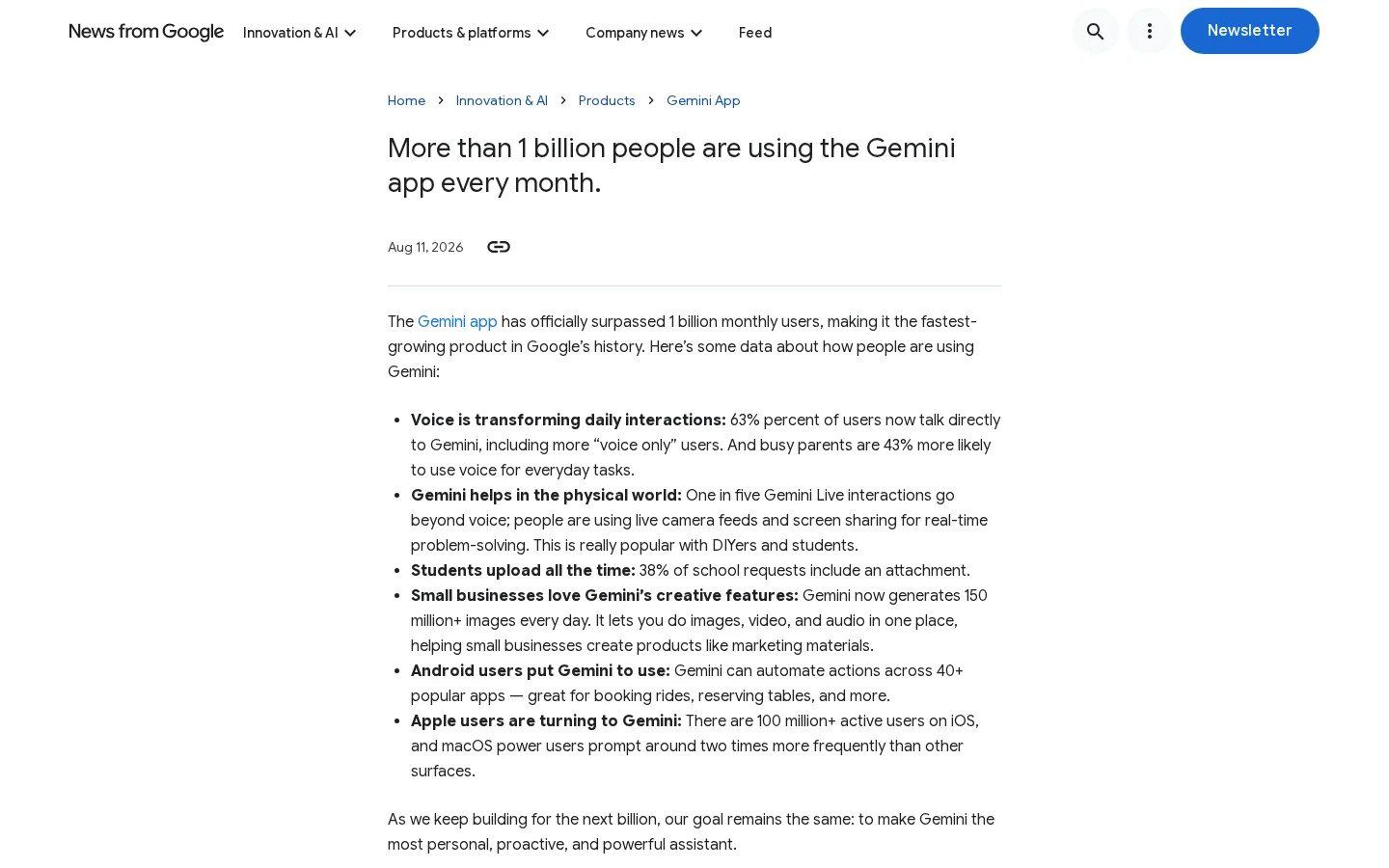
Google says the Gemini app has more than 1 billion monthly users. The company announced this on its blog on August 11, 2026. Google's announcement is the primary source for this number, so quote it from there, not from a roundup post.
The figure covers the Gemini app. It does not measure every place where Google uses Gemini-powered features, such as its search tools. That difference matters when you write about reach. If you say "Gemini has 1 billion users", a reader may think Google Search is included. It is not.
Gemini app, August 2026
Source: Google, "The Gemini app has officially surpassed 1 billion monthly users", August 11, 2026
Monthly users, or monthly active users, is a standard count of the people who use an app during a calendar month. It tells you how many people came back, not how often they used it or how much time they spent. A person who opened Gemini once in a month counts the same as a person who used it every day.
Treat the number as Google's own count. Google is measuring its own product, and it has not handed the method to an outside auditor. That does not make the figure wrong. It means you should say "according to Google" when you use it.
Google says 63% of users talk directly to Gemini. This tells you how people use the product. A large share is not only typing questions into a box. For a business, this is a signal that spoken questions are part of the way people look for answers.
Use this number as a sign of direction, not as proof of how much voice search your site will get. A product can have a large voice audience and still send very few visits to your pages.
If you need a plain explanation of the model behind the app before you write about it, read our Gemini glossary entry. It explains what Gemini is and how it fits into the wider group of AI models. The glossary is the right place for definitions. The statistics in this article are for reach and usage.
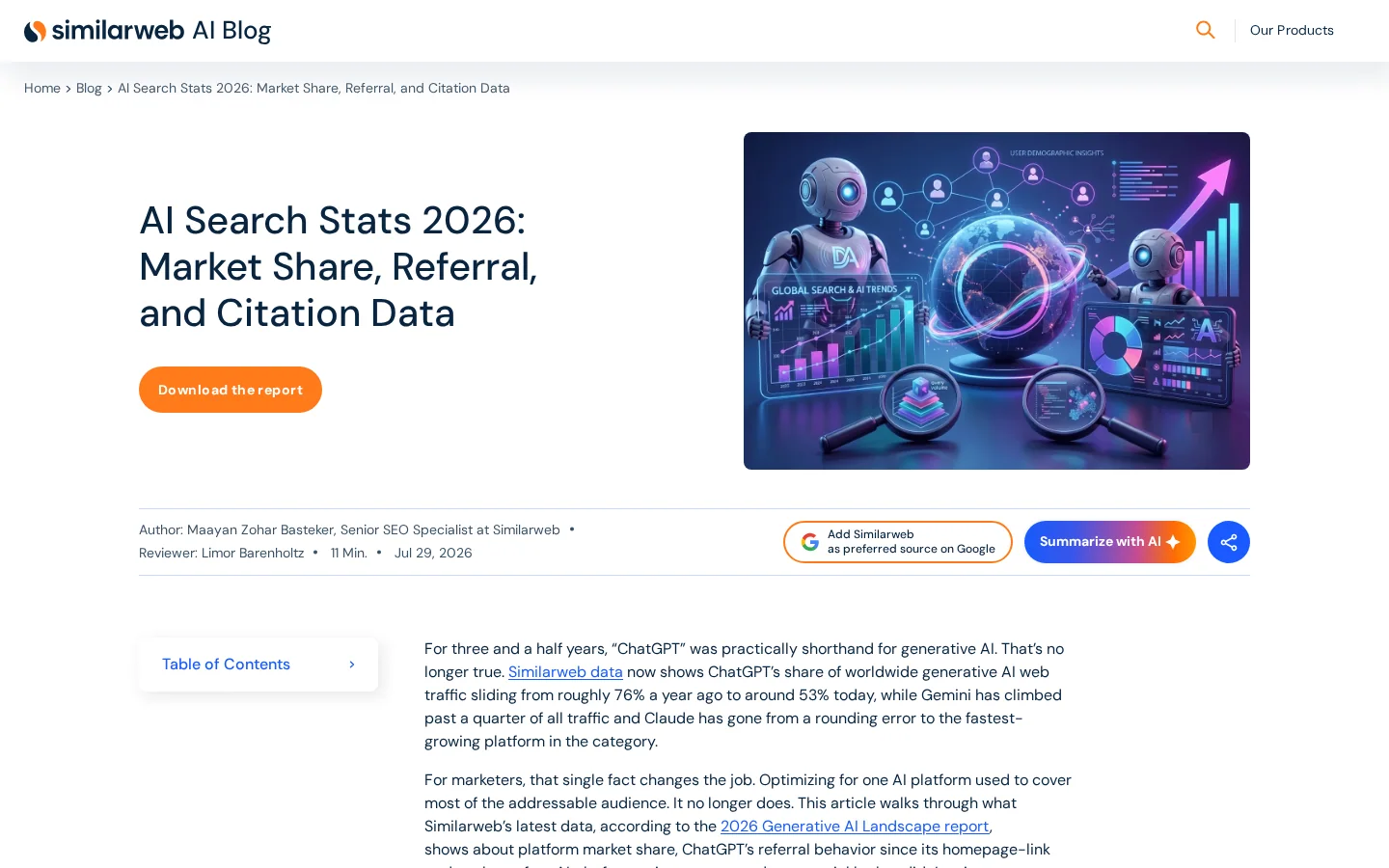
Similarweb measured Gemini at about 27% of worldwide generative AI web visits in May 2026. A year earlier, in June 2025, its share was under 9%. Over the same period, ChatGPT's share fell from about 76% to about 53%. These figures come from Similarweb's generative AI statistics page, published on July 29, 2026.
The same Similarweb page reports that average monthly web visits across generative AI platforms reached 9.5 billion between June 2025 and May 2026. Use this total to size the market. Use the shares to see who is taking a bigger part of it. A share can rise while the total market grows, so a rising share does not always mean more visits for that product.
Keep the two numbers next to each other when you write. "Gemini has 27% of AI web traffic" is accurate only if the reader also knows the total is 9.5 billion visits a month on average over the year.
Web traffic counts visits to websites where people use generative AI. It does not count people who use an app on their phone, and it does not count people who use the same product through another Google service. This is the main reason the traffic share and the user count can point in different directions.
For example, a product can have many app users and few website visits, or the reverse. Neither number is wrong. They answer different questions. The first asks "how many people use this?" The second asks "where do people go on the web to use AI?"

ChatGPT still leads on website visits, with about 53% against Gemini's 27% in May 2026. On app users, you cannot compare the two directly, because Google counts people who use its app and Similarweb counts visits to websites. A fair comparison uses one source, one metric and one month.
| Metric | Source | Gemini | ChatGPT | Date |
|---|---|---|---|---|
| Share of generative AI web visits | Similarweb | about 27% | about 53% | May 2026 |
| Share of generative AI web visits | Similarweb | under 9% | about 76% | June 2025 |
| Monthly users of the app | over 1 billion | not in this comparison | August 2026 | |
| Users who talk to it directly | 63% | not stated | August 2026 |
Two different counts
Gemini's share rose from under 9% to about 27% in one year, while ChatGPT's share fell from about 76% to about 53%. That is a fast change. It is also one year of data from one measurement company. If you write about the trend, say how long it has run and which source measured it.
A trend needs more than two points. Check the source's own chart if it has one. If you only have a start and an end value, describe it as a change between two dates, not as a steady growth rate.
Put both products on the same chart, from the same source, with the same dates. Label the metric in the chart title. A reader who sees "Gemini vs ChatGPT" with no metric will assume the chart shows users, and that is the most common way these numbers are misread.
In the study we can check, yes. Pew Research found that when Google showed an AI summary, users clicked a regular search result in 8% of visits. When there was no AI summary, they clicked in 15% of visits. This study is about AI summaries in Google Search. It does not measure the Gemini app.
| Google results page | Visits with a click on a regular result | Source |
|---|---|---|
| AI summary shown | 8% | Pew Research, July 22, 2025 |
| No AI summary | 15% | Pew Research, July 22, 2025 |
Pew Research surveyed 900 US adults through its KnowledgePanel Digital. Their browsing was tracked from March 1 to 31, 2025. Search results were collected from April 7 to 17, 2025. The article was published on July 22, 2025. The sample is American and the time window is short, so treat the result as one useful view, not a global rule.
The lesson for your own work is the method, not the headline. If you want to know how AI summaries affect your clicks, you need your own data for your own queries. Compare the clicks on your pages for queries where an AI summary appears and where it does not.
Google's own documentation says a page does not need special work to appear in AI Overviews or AI Mode. The page must be indexed and eligible to show in Google Search. According to Google Search Central's guidance on AI features, you do not need to create new machine-readable files, AI text files or special schema markup. Standard SEO practice still applies.
Myth and fact about AI features
Check four things: who measured the number, what they counted, when they measured it, and whether they explained the method. If one of these is missing, quote the number with a clear caveat, or leave it out. A number with no source is a rumor in a chart.
The five-step check
A traffic share is one division. Take the visits to one product and divide them by the total visits to all products in the same group, then multiply by 100. You can use the formula to check any share a source reports, as long as the source gives you both counts.
share (%) = visits to Gemini / total visits to generative AI sites x 100For example, 270 million visits out of a total of 1 billion gives a share of 27%. If a page reports a share but not the total, ask for the total before you repeat the share.
A statistic needs a sentence around it, or readers will fill the gap themselves. Compare these two versions. The first is "Gemini has 1 billion users." The second is "Google said in August 2026 that the Gemini app had more than 1 billion monthly users, a count of the app only." The second sentence gives the reader the date, the owner of the number and the scope. It takes ten more words and removes the three most common misreadings.
Use the same pattern for every figure in your article. Put the number, the metric, the date and the source in one paragraph, and link the source in the sentence that uses it.
Sources often round. The Similarweb page gives a range of 27 to 28% for Gemini in May 2026, and other pages repeat 27%. Quote the range or the source's own wording. Do not invent a more precise number to make a sentence look stronger.
The four most common mistakes are mixing users with visits, quoting an old number as current, quoting a roundup instead of the source, and mixing up the Gemini app with Google's AI features in search. Each one is easy to fix once you know what to look for.
This mistake sounds like "Gemini has 27% of users". The 27% comes from web visits, not from users. To spot it, look for the word "share" with no metric next to it. To fix it, write the full phrase: "27% of worldwide generative AI web visits in May 2026."
Many articles repeat figures from a year or more ago. A 2025 number in a 2026 article is not wrong, but it is not current either. To spot it, look for a missing date. To fix it, add the month of the data, and look for a newer figure from the same source.
Roundup posts copy each other. One wrong figure can spread across dozens of pages in a week. To spot it, check whether the post links to the original, or only to another roundup. To fix it, trace the number back to Google, to Similarweb, or to the earnings report where it first appeared.
This mistake sounds like "Gemini in Google Search has 1 billion users". The 1 billion figure refers to the Gemini app. Search features and the app are different products with different counts. To fix it, name the product in every sentence: "the Gemini app" or "AI Mode in Google Search".
Warning
Many roundup pages list a Gemini figure with no link at all. If you cannot find the original within a few minutes, leave the number out. A wrong figure in your article will be quoted again by others.
Before you publish a Gemini figure
Gemini can only name pages that Google can index and show, and it works best with pages that state their facts clearly. Google says there is no special file or markup to add. The work is standard SEO plus claims that a reader, or a model, can check.
Begin with a crawl of your own site. Check that the pages you want named are indexable, that they load, and that other pages link to them inside your site. Then check which pages already rank for the questions your buyers ask. A page that is not indexed cannot be named by any AI model that depends on search results.
Write each important fact as one short sentence with its date and its source. For example: "The Gemini app passed 1 billion monthly users on August 11, 2026, according to Google." This pattern is easy for a reader to check, and it gives an AI model a clear sentence to repeat. Keep one claim per sentence, and keep the source next to the claim, not at the bottom of the page.
If you want to see which sources Gemini tends to cite, read our study of what Gemini cites. Use it to plan which kinds of pages to publish, not as a rule that applies to every query.
You cannot improve what you do not measure. Start with a list of prompts your buyers would type, then check whether Gemini names your brand for each one. Our guide to how to rank in Gemini covers the content side, and the AI visibility audit covers the checking side in more detail.
Sorank tracks whether ChatGPT, Claude and Gemini name your brand, and writes the articles that can earn those mentions. You can see how it works on our GEO optimization page.
Use three methods: test prompts by hand, use a tracking tool, or check your analytics for visits from AI sources. Each method misses something, so use at least two of them and compare the results.
The principle is simple. You ask Gemini the questions your buyers ask, write down the answer, and record whether your brand is named. Use it at the start, with a list of 20 to 30 prompts that match real buyer questions. It is free and it shows the actual answer, which is useful for editing your pages.
The limit is that answers change from one run to the next. Your location, your login and the time of day can all change the result. Run the same prompts every week for at least four weeks, and record the date and the account type each time.
A tracking tool runs a fixed set of prompts on a schedule and counts how often your brand appears. Use it when you have many prompts, several AI models to follow, or a team that needs a shared history. The advantage is repetition: the same prompts, run the same way, every time.
The limit is that the tool's prompts may not match your buyers' real questions. Check the prompt list before you trust the score, and ask how often the tool runs each prompt.
This method counts visits from AI sources in your own analytics. The principle is that a visit from an AI answer is a real visit that can be tied to revenue. Use it when your analytics are clean and you already track referral sources. The advantage is that the data is real visits, not a simulated test.
The limit is large. Many visits from AI tools arrive with no referrer, so they look like direct traffic. Your count will be lower than the real number. Treat it as a floor, not as the full picture.
| Method | Cost | Repeatable | What it misses |
|---|---|---|---|
| Manual prompt checks | Free, takes time | Only if you repeat it carefully | Answers change between runs |
| Tracking tool | Paid, usually monthly | Yes | Prompts that differ from your buyers' questions |
| Analytics for AI referrals | Free if analytics exist | Yes | Visits with no referrer |
Tip
To check one query at a time, try the free Gemini Ranking Tool. It shows whether your brand appears in Gemini for the query you enter. Run it on your top five prompts before you change a page, then run it again after the change.
Use these five rules when you quote or write about Gemini. Each one protects your article from the most common errors.
Google says the Gemini app passed 1 billion monthly users on August 11, 2026. That count covers the app only, not every place Google uses Gemini-powered features.
It depends on the metric. In May 2026, Similarweb measured about 53% of worldwide generative AI web visits for ChatGPT and about 27% for Gemini. Google's app user counts and Similarweb's website visit counts cannot be compared directly.
Find the original publisher, check what the number measures (users, visits, share or revenue), confirm the date, and read the method. If a figure appears only on a roundup page with no link, leave it out.
We analyse your competitors, your website and your AI visibility to create a tailored content plan for free.
 Duplicate Content Checker
 Mobile-Friendly Test
 Website Speed Test
 Subdomain Finder
 Domain Age Checker
 CMS Detector
 Googlebot Simulator
 Nofollow Link Checker
 Meta Tag Checker
 Keyword Cannibalization Checker
 Keyword Intent Checker
 Keyword Extractor
 Google Ads Cost Calculator
 CPC Calculator
 Local Citation Finder
 Reddit Threads Finder
 Disavow File Generator
 Redirect Generator
 Canonical Tag Generator
 Passive Voice Checker
 Google Location Changer
 Google Review Calculator
 Google Review Link Generator
 Keyword Combiner
 Podcast Show Notes Generator
 AI Content Rewriter
 AI Text Humanizer
 ChatGPT Prompt Generator
 Twitter Thread Generator
 Tweet Generator
 Landing Page Copy Generator
 Google Ads Copy Generator
 Pinterest Pin Description Generator
 Anchor Text Generator
 Social Media Post Generator
 LinkedIn Post Generator
 Free AI Writer
 Review Response Generator
 LSI Keyword Generator
 YouTube Video Ideas Generator
 YouTube Tag Generator
 YouTube Description Generator
 Product Description Generator
 CTA Generator
 Blog Introduction Generator
 Conclusion Generator
 Hook Generator
 AI Content Brief Generator
 FAQ Schema Generator
 AI Blog Post Ideas Generator
 Structured Data Validator (Schema Validator)
 Alt Text Checker
 Internal Link Analyzer
 Backlink Challenge
 AI Meta Description Generator
 AI Blog Title Generator
 Google Indexability Checker
 AI Blog Outline Generator
 UTM Link Builder
 Keyword Clustering Tool
 Canonical Tag Checker
 XML Sitemap Generator
 Broken Link Checker
 AI SEO Title Generator
 Headline Analyzer
 SERP Preview Tool
 Redirect Checker
 Hreflang Tag Generator
 Heading Structure Analyzer
 HTTP Headers Checker
 Favicon Extractor
 SERP CTR Calculator
 SEO vs Paid Search Savings Calculator
 SEO Share of Voice Calculator
 SEO ROI Calculator
 SEO Traffic and Revenue Forecast Calculator
 SEO Budget Calculator
 SEO Break-Even Calculator
 SaaS SEO ROI Calculator
 ROAS Calculator
 Reading Time Calculator
 Ranking Gain Simulator
 Organic Traffic Value Calculator
 Organic Traffic Estimator and Website Traffic Checker
 LTV to CAC Ratio Calculator
 Local SEO ROI Calculator
 Link Building Cost Calculator
 Keyword Value Calculator
 Keyword Opportunity Score Calculator
 Keyword Density Calculator
 GEO ROI Calculator
 GEO Content Investment Calculator
 Ecommerce SEO ROI Calculator
 Customer Lifetime Value Calculator
 Customer Acquisition Cost Calculator
 CTR Calculator
 Cost Per Article Calculator
 Conversion Rate Calculator
 Content Marketing ROI Calculator
 ChatGPT Referral Traffic Estimator
 Bounce Rate Calculator
 Backlink ROI Calculator
 AI Visibility Score Calculator
 AI Traffic Value Calculator
 AI Share of Voice Calculator
 Cost of AI Invisibility Calculator
 AI Citation Rate Calculator
 llms.txt Validator
 AI Overview Checker and AI Overviews Rank Checker
 Robots.txt Checker
 AI SEO Audit
 LLM Readability Checker
 SearchGPT Readiness Checker
 Structured Data LLM Audit
 Website Crawlability AI Audit
 Why ChatGPT Is Not Recommending My Website
 Gemini Ranking Tool
 Perplexity Ranking Checker
 LLM Citation Checker
 Answer Engine Optimization Audit
 GEO Audit
 AI Search Visibility Test
 ChatGPT Visibility Checker
 llms.txt Generator
 URL Extractor
 Webpage to Markdown
 Sitemap Checker
 SERP Volatility Sensor
 Page Size Checker
 Word Counter
 Slug Generator
 Schema Generator
 Robots Generator
 OG Preview
 Meta Tags Generator
 Image Compressor
 Favicon Generator
 On-Page SEO Audit: SEO Checker and SEO Analyzer
 Backlink Analysis Tool
 Keyword Research Tool
 Domain Authority Checker
 “I tested Sorank on a real client site and it's insane. It does everything an agency would bill you $1500 a month for. It's going into production on that client now.”

 Guillaume Guersanguersanguillaume.com“We are an Ads agency and we wanted to get our SEO back on track once and for all. Sorank gave us a clear view of our site, helped us prioritize optimizations, and properly structure our content. The tool is easy to use, well designed for a team, and very practical for centralizing tracking without having to juggle multiple platforms. A very solid foundation to start fresh with our SEO.”
 Gaspard MadouiAds Agency
 “I just let the Sorank software do its thing, and now my DR is 25 and my page is ranking higher.”
 Lucas Flandrefoundertrace.fr“I specialized in GEO thanks to Sorank. The GEO Leaderboard allows me to show my clients their position vs competitors on ChatGPT. It’s a real commercial differentiator.”
 MélanieSEO Freelance“Great service, works well for our website and helps us understand how to improve it to rank better on Google and elsewhere. Congrats, keep going, I recommend it.”
 Hugo T.E-commerce merchant