Preferences
Privacy is important to us, so you have the option of disabling certain types of storage that may not be necessary for the basic functioning of the website. Blocking categories may impact your experience on the website. More information
Privacy is important to us, so you have the option of disabling certain types of storage that may not be necessary for the basic functioning of the website. Blocking categories may impact your experience on the website. More information

 ChatGPT Statistics: The Verified Numbers on Users, Usage and Demographics
ChatGPT statistics traced to their source: 900M weekly users, 2.5B daily prompts, Pew demographics, NBER usage data, and how to measure your own ChatGPT traffic.

In short
OpenAI said on February 27, 2026 that ChatGPT has 900 million weekly active users and 50 million paying subscribers. In July 2025 those users sent about 2.5 billion prompts a day, and more than 70% of messages were not about work. Most "ChatGPT statistics" pages mix these verified numbers with estimates that have no source. This guide keeps only figures we traced back to their origin, explains how each one is measured, and shows you how to turn them into your own ChatGPT numbers.
Want to go further? Ask
Quick quiz
How should you get mentioned by ChatGPT and other AI assistants?
Sorank matches your answers


Test it for 3 days on your own site and see where you stand on Google, ChatGPT and the other AIs.
Start 3-day free trial3 days free, then stop whenever you want. 90-day results guarantee, conditions apply.
Start with the numbers you can quote in a board meeting without being caught out. Each one below comes from OpenAI itself, a peer-reviewed style working paper or a large survey institute. We read every source before writing this page.
ChatGPT in four verified numbers
Sources: OpenAI via TechCrunch, February 27, 2026 and July 21, 2025; NBER Working Paper 34255, September 2025
According to TechCrunch's report of February 27, 2026, OpenAI announced 900 million weekly active users, up from 800 million in October 2025. The same announcement gave 50 million paying subscribers and came with a 110 billion dollar private funding round at a 730 billion dollar pre-money valuation.
Two details matter here. First, "weekly active" is OpenAI's own metric: it counts a person once if they used ChatGPT at least once in seven days. Second, 50 million paying subscribers out of 900 million weekly users means roughly 1 user in 18 pays (our calculation). The large majority of the audience uses the free tier, which matters if you wonder which model and which features your customers actually see.
In July 2025, OpenAI told Axios that ChatGPT handled about 2.5 billion prompts a day, with about 330 million of them from the United States, as TechCrunch reported on July 21, 2025. Sam Altman had cited more than 1 billion daily queries in December 2024, so volume more than doubled in about seven months.
For scale, the same article notes that Alphabet reported 5 trillion Google searches a year, just under 14 billion a day. ChatGPT prompts were therefore about one sixth of Google's daily search volume in mid 2025 (our calculation). Careful: a prompt is not a search. A single conversation can contain ten prompts, and many prompts are writing requests, not questions. We come back to this comparison in the errors section.
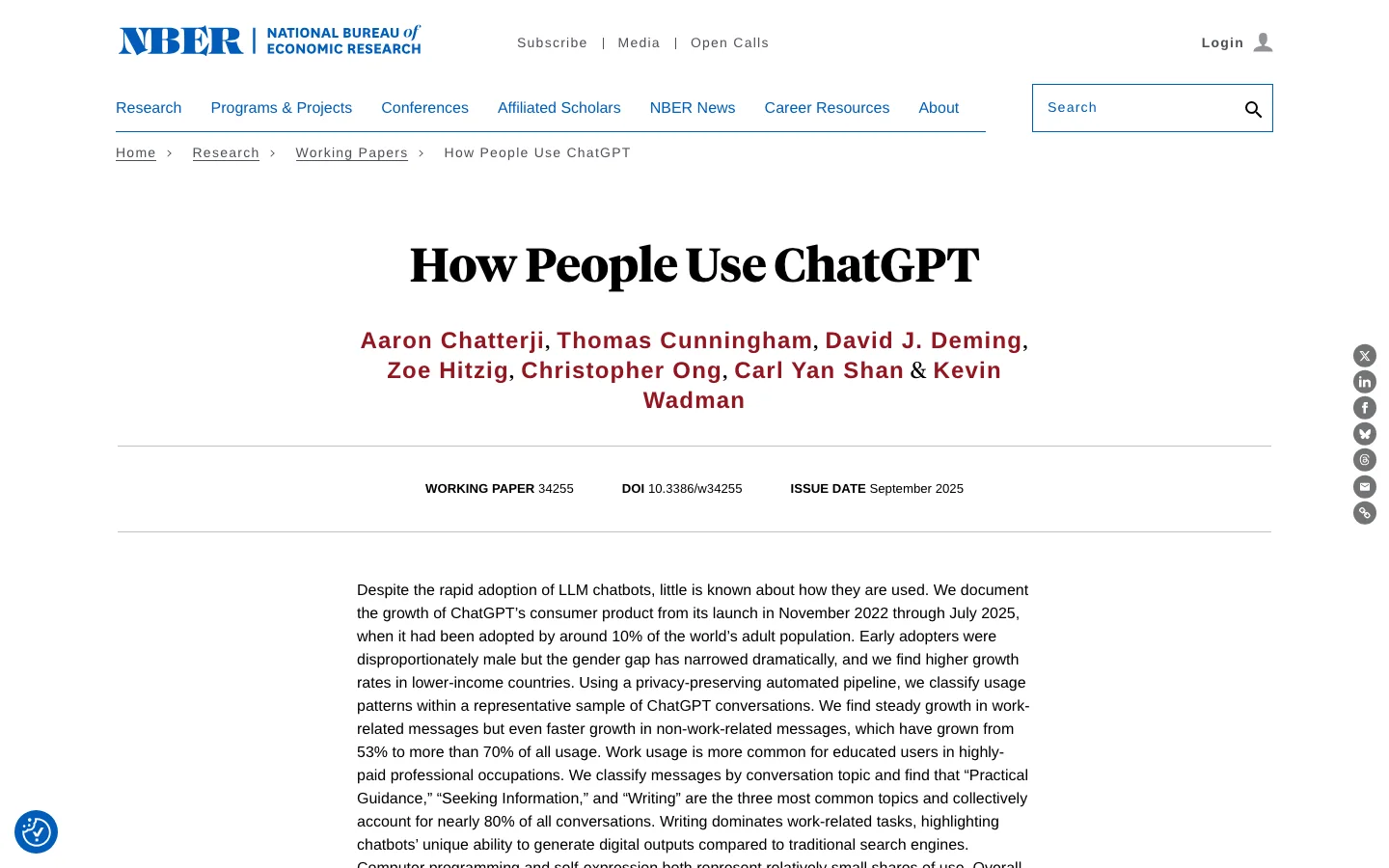
The most solid study on usage is NBER Working Paper 34255 "How People Use ChatGPT" (Chatterji, Cunningham, Deming, Hitzig, Ong, Shan and Wadman, September 2025). It analyzed real conversations with privacy-preserving classifiers. Its key findings: about 10% of the world's adult population had adopted ChatGPT by July 2025; non-work messages rose from 53% to more than 70% of all usage; and three topics, Practical Guidance, Seeking Information and Writing, account for nearly 80% of conversations.
Note
We left out figures you will see elsewhere (daily active users, monthly visits, market share percentages, energy per request) because we could not trace them to a primary source we could read. When a figure has no named origin, treat it as an estimate, not a statistic.
Growth curves for ChatGPT circulate everywhere, often with monthly points nobody published. Here are only the milestones that come with a dated public statement.
ChatGPT milestones with a public source
From October 2025 to February 2026, ChatGPT added 100 million weekly users in about four months. That is a slower relative pace than in 2025, when daily prompts doubled in seven months. This is normal: once a product reaches a tenth of the world's adults, each new 100 million is a smaller percentage. For you, the practical meaning is that ChatGPT is no longer an early adopter channel. Your customers are on it whatever your sector.
You will find articles quoting 1 billion or 1.2 billion weekly users later in 2026. At the time of writing we could not find those numbers in a statement from OpenAI that we could read directly, so we do not use them. If you need the latest figure, check OpenAI's own announcements and quote the date with the number.

For audience questions (age, education, uses), the most reliable source is the Pew Research Center, which runs large probability-based panels. Its survey of 5123 US adults, conducted February 24 to March 2, 2025, is summarized in Pew's short read of June 25, 2025.
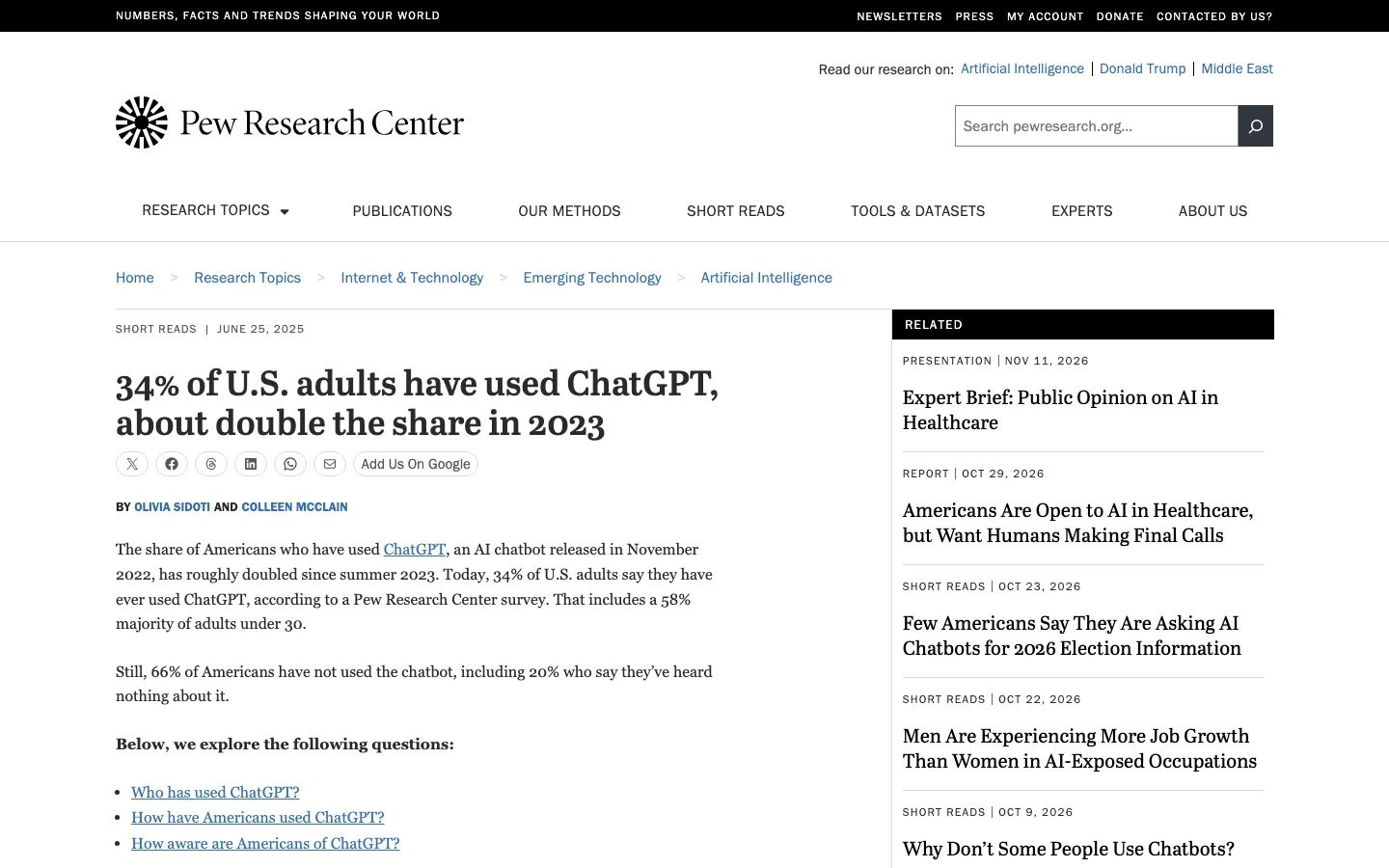
34% of US adults had used ChatGPT, roughly double the 2023 share. The age gap is large and shrinking slowly.
Among adults under 30, use went from 33% in 2023 to 43% in 2024 and 58% in 2025. If your buyers are under 40, ChatGPT is already a mainstream research tool for them. If they are over 65, it is still a minority habit, and Google, reviews and word of mouth weigh more.
Use climbs with education: 52% of adults with a postgraduate degree and 51% with a bachelor's degree had used ChatGPT, against 33% with some college and 18% with a high school diploma or less. B2B buyers, consultants, engineers and doctors sit in the top two groups. That is why ChatGPT visibility tends to matter earlier for B2B and professional services than for mass retail.
What US adults use ChatGPT for
Source: Pew Research Center, 2025
Work use is highest among employed adults aged 18 to 29 (38%), then 30 to 49 (30%) and 50 and older (18%). It also rises with education: 45% of employed postgraduates use ChatGPT for work, against 17% of those with a high school education or less. Awareness keeps growing too: 79% of US adults had heard at least a little about ChatGPT in 2025, against 58% in March 2023.
Pew covers the United States only. For other countries, you will mostly find traffic panel shares by country, which measure visits to chatgpt.com, not people. Do not apply US percentages to France or Germany without saying so.
The NBER paper is the closest thing to a census of ChatGPT conversations. Its conclusion is simple: ChatGPT is mostly a personal advisor, not a work tool. More than 70% of messages are non-work, and Practical Guidance, Seeking Information and Writing make up nearly 80% of conversations.
"Seeking Information" is the search-like part of ChatGPT: questions about facts, products, places, people. "Practical Guidance" is advice: how to do something, what to choose, which approach fits. These two families are exactly where a model names a brand. A prompt like "which accounting software for a 10 person agency" or "best physiotherapist for a knee injury in Lyon" produces a short list, and you are either on it or not.
Writing requests (draft an email, fix this paragraph, translate this text) are a large share of use but rarely mention third-party brands. That is one reason why raw prompt counts overstate the "search" opportunity. Only part of the 2.5 billion daily prompts are questions where a recommendation can appear.
The NBER figures are global averages. In your market, the share of recommendation-style prompts can be much higher (travel, software, local services) or lower (heavy industry). The only way to know is to test the real questions your customers ask. Our guide on how to rank in ChatGPT explains how answers are built and what makes a brand appear in them, and how ChatGPT works covers the technical side, from training data to live web search.
Tip
Want to know if ChatGPT already names your brand? Run your main buying question through the free ChatGPT Visibility Checker before you read further. It takes a minute and gives you a baseline.
Every ChatGPT statistic comes from one of five measurement methods. Each one answers a different question, and mixing them is the root of most contradictions you see online.
Principle: OpenAI counts its own users from its logs and publishes a headline figure (weekly active users, paying subscribers, daily prompts). When to use it: for the size of the audience. Advantages: the most complete data, since it comes from the servers. Limits: OpenAI chooses the metric, the timing and the definition, often during a funding round; no independent audit. Example: 900 million weekly active users, announced alongside a 110 billion dollar raise.
Principle: researchers classify a sample of real conversations with automated classifiers that protect privacy. When to use it: to know what people do with ChatGPT. Advantages: real behavior, not declared behavior; a published method. Limits: authors include OpenAI staff; categories are defined by the researchers. Example: NBER Working Paper 34255.
Principle: a survey institute questions a representative sample of the population. When to use it: for demographics and the share of a population that uses ChatGPT. Advantages: independent, comparable year after year, margins of error published. Limits: declared behavior; one country at a time; a few months of delay. Example: Pew's 5123 US adults.
Principle: a panel of browsers and devices is extrapolated to estimate visits to chatgpt.com. When to use it: to compare websites with each other or follow monthly trends. Advantages: monthly, by country, comparable across competitors. Limits: counts visits, not people; misses most app usage; extrapolation errors. Example: the monthly visit figures quoted on many statistics pages.
Principle: you measure the visits ChatGPT sends to your site, and you test how often ChatGPT names you. When to use it: for every decision about your own marketing. Advantages: the only data about your business. Limits: undercounts (some visits arrive with no referrer); needs a setup. Example: the GA4 method in the next section.
| Method | Answers the question | Who publishes | Reliability | Main trap |
|---|---|---|---|---|
| Company-reported | How big is ChatGPT? | OpenAI | High on volume, no audit | Metric chosen by the company |
| Log-based research | What do people do with it? | Researchers (NBER) | High, published method | Categories defined by authors |
| Probability survey | Who uses it? | Pew and other institutes | High, margins of error known | One country, declared behavior |
| Traffic panel | How much web traffic? | Panel vendors | Medium, estimates | Visits are not users |
| Your analytics | What does ChatGPT do for me? | You | High for you, partial | Traffic without referrer |
Company figures vs independent figures
Our recommendation: quote OpenAI for size, Pew for who, NBER for what. Use traffic panels only to compare sites, and use your own analytics for every budget decision.
Global statistics tell you the channel is large. They do not tell you if it works for you. Here is how to get your own numbers in about an hour with Google Analytics 4. Our AI visibility audit guide goes further on the citation side.
Measure what ChatGPT brings you in 5 steps
In GA4, open Explore, create a free-form exploration, add the dimension "Session source" and the metrics Sessions, Engaged sessions and Key events. Add a filter on Session source, with "matches regex" and this expression:
^(chatgpt\.com|chat\.openai\.com)$ChatGPT often adds the parameter utm_source=chatgpt.com to the links it cites, so these visits usually appear with "chatgpt.com" as the source. The older domain chat.openai.com still shows up in historical data.
In Admin, Data display, Channel groups, copy the default group and add a new channel above "Referral". Set the condition "Session source matches regex" with an expression that covers the main assistants:
^(chatgpt\.com|chat\.openai\.com|perplexity\.ai|www\.perplexity\.ai|gemini\.google\.com|claude\.ai|copilot\.microsoft\.com)$Order matters: GA4 applies the first matching rule, so the new channel must sit above Referral, otherwise the visits stay classified as referral. The new group applies to past data in reports, which lets you see your history immediately.
In the exploration, add the dimension "Landing page + query string". Sort by sessions. The pages at the top are those ChatGPT already cites: usually comparison pages, pricing pages, detailed guides and pages with clear figures. Check that these pages are up to date, because the model sends people to them with expectations it set itself.
Compare engagement rate, key events per session and revenue per session between the AI assistants channel and Organic Search. Many sites see small volumes with high intent, because the visitor already read a summary and comes to act. If you want an order of magnitude before you have data, the free ChatGPT Referral Traffic Estimator gives a projection from your current organic traffic.
Analytics only counts clicks. Most ChatGPT users read the answer and never click, so you also need to know how often you are named. Write down your 20 main buying questions, ask them in ChatGPT every month in a fresh session, and log whether your brand appears, at which rank and next to which competitors. Our comparison of ChatGPT tracking tools covers the ways to automate this. In Sorank, AI mention tracking runs these questions in ChatGPT, Gemini, Claude and Perplexity and shows the trend, and the GEO / SEO dashboard puts Google and AI traffic side by side.
Warning
Part of ChatGPT traffic arrives with no referrer at all (app links, copied URLs, some browsers) and lands in "Direct". Your GA4 number is a floor, not the full figure. Watch the trend, not the absolute value.
You will keep meeting new ChatGPT figures in reports, decks and posts. Before you put one in a presentation, run it through this checklist. It takes two minutes and saves you from quoting a number that dissolves under one question.
Checklist before quoting a ChatGPT figure
Rank sources in this order: 1. the company's own statement, quoted with its date; 2. research papers with a published method; 3. survey institutes; 4. traffic panels; 5. press articles quoting one of the above; 6. statistics pages without sources. Only use levels 5 and 6 to find the original, never as a reference. Our pages on GEO statistics and AI marketing statistics follow the same rule if you need figures on AI citations or marketing adoption.
These are the mistakes we see most often in client decks, competitor articles and even agency reports. Each one has a quick way to spot it and a fix.
What it is: putting "900 million users" next to "billions of monthly visits" from a traffic panel as if they measured the same thing. How to spot it: the figure has no unit of time or mixes "users" and "visits". How to fix it: always write the full metric: "900 million weekly active users (OpenAI, February 2026)". A user can generate dozens of visits a month; visits are not people.
What it is: concluding that ChatGPT has "one sixth of Google's market" because of 2.5 billion prompts against about 14 billion searches. How to spot it: a slide that puts both numbers on the same bar chart. How to fix it: say that prompts include writing, translation and follow-ups, and that one conversation holds several prompts. The fair conclusion is that ChatGPT handles a large volume of questions, part of which replaces search. Our Google search statistics give the other side of the comparison.
What it is: repeating in late 2026 a user count announced in early 2025. How to spot it: no date next to the number, or a date more than six months old. How to fix it: always write the month and year, and check OpenAI's latest statement before publishing. In a fast-growing product, a figure loses value every quarter.
What it is: saying "34% of adults use ChatGPT" in a presentation about the Spanish market. How to spot it: the source is Pew, which surveys the United States. How to fix it: say "34% of US adults", and look for a local survey institute in your country, or use your own analytics as a proxy.
What it is: copying a figure from a statistics page where the source column reads "various" or "estimates". How to spot it: you cannot click through to the original. How to fix it: drop the figure. If it matters, search for the original statement; if you cannot find it, the number does not exist for you.
What it is: launching (or refusing) a ChatGPT visibility project because "900 million users" sounds big or because "only 1% of my traffic" sounds small. How to spot it: no test of your own buying questions has been run. How to fix it: run the five GA4 steps above and the monthly citation test. Global scale tells you the channel exists; your own data tells you if you are present. Our ChatGPT page sums up what the current models do with web search and how a business gets recommended.
Put together, the verified numbers say three things. ChatGPT reaches about a tenth of the world's adults every week. Most of its use is personal advice and information seeking, the exact moments when people choose a product, a supplier or a professional. And its audience skews young and educated, which is the profile of many B2B buyers and high-value consumers.
1. Set up the AI assistants channel in GA4 so you have a baseline from today. 2. Write down your 20 main buying questions and test them in ChatGPT. 3. Look at which competitors are named instead of you and which pages ChatGPT cites for them. 4. Update the pages that ChatGPT already sends visitors to, starting with figures and dates.
Build pages that answer the Practical Guidance and Seeking Information questions of your buyers with precise, sourced facts: comparisons, prices, methods, local details. Earn mentions on the sites the model already trusts in your niche. Then track the result monthly: share of questions where you are named, rank in the answer, and visits from the AI assistants channel. If you want this work done on autopilot, Sorank's GEO optimization finds the questions, writes the pages and tracks your presence in the main AI assistants.
We update the figures on this page when OpenAI, NBER-style research or Pew publish new data, and we only add a number once we have read its source. If you quote a figure from here, quote the original source and its date, not this page.
OpenAI announced on February 27, 2026 that ChatGPT has 900 million weekly active users, up from 800 million in October 2025. It also reported 50 million paying subscribers. Later figures circulate, but check OpenAI's own statements before quoting them.
According to NBER Working Paper 34255 (September 2025), more than 70% of ChatGPT messages are not work related. Practical Guidance, Seeking Information and Writing account for nearly 80% of conversations.
OpenAI told Axios in July 2025 that ChatGPT handles about 2.5 billion prompts a day, about 330 million of them from the United States. A prompt is not a search: one conversation often contains several prompts, and many are writing requests.
We analyse your competitors, your website and your AI visibility to create a tailored content plan for free.
 AI Content Brief Generator
 FAQ Schema Generator
 AI Blog Post Ideas Generator
 Structured Data Validator (Schema Validator)
 Alt Text Checker
 Internal Link Analyzer
 Backlink Challenge
 AI Meta Description Generator
 AI Blog Title Generator
 Google Indexability Checker
 AI Blog Outline Generator
 UTM Link Builder
 Keyword Clustering Tool
 Canonical Tag Checker
 XML Sitemap Generator
 Broken Link Checker
 AI SEO Title Generator
 Headline Analyzer
 SERP Preview Tool
 Redirect Checker
 Hreflang Tag Generator
 Heading Structure Analyzer
 HTTP Headers Checker
 Favicon Extractor
 SERP CTR Calculator
 SEO vs Paid Search Savings Calculator
 SEO Share of Voice Calculator
 SEO ROI Calculator
 SEO Traffic and Revenue Forecast Calculator
 SEO Budget Calculator
 SEO Break-Even Calculator
 SaaS SEO ROI Calculator
 ROAS Calculator
 Reading Time Calculator
 Ranking Gain Simulator
 Organic Traffic Value Calculator
 Organic Traffic Estimator and Website Traffic Checker
 LTV to CAC Ratio Calculator
 Local SEO ROI Calculator
 Link Building Cost Calculator
 Keyword Value Calculator
 Keyword Opportunity Score Calculator
 Keyword Density Calculator
 GEO ROI Calculator
 GEO Content Investment Calculator
 Ecommerce SEO ROI Calculator
 Customer Lifetime Value Calculator
 Customer Acquisition Cost Calculator
 CTR Calculator
 Cost Per Article Calculator
 Conversion Rate Calculator
 Content Marketing ROI Calculator
 ChatGPT Referral Traffic Estimator
 Bounce Rate Calculator
 Backlink ROI Calculator
 AI Visibility Score Calculator
 AI Traffic Value Calculator
 AI Share of Voice Calculator
 Cost of AI Invisibility Calculator
 AI Citation Rate Calculator
 llms.txt Validator
 AI Overview Checker and AI Overviews Rank Checker
 Robots.txt Checker
 AI SEO Audit
 LLM Readability Checker
 SearchGPT Readiness Checker
 Structured Data LLM Audit
 Website Crawlability AI Audit
 Why ChatGPT Is Not Recommending My Website
 Gemini Ranking Tool
 Perplexity Ranking Checker
 LLM Citation Checker
 Answer Engine Optimization Audit
 GEO Audit
 AI Search Visibility Test
 ChatGPT Visibility Checker
 llms.txt Generator
 URL Extractor
 Webpage to Markdown
 Sitemap Checker
 SERP Volatility Sensor
 Page Size Checker
 Word Counter
 Slug Generator
 Schema Generator
 Robots Generator
 OG Preview
 Meta Tags Generator
 Image Compressor
 Favicon Generator
 On-Page SEO Audit: SEO Checker and SEO Analyzer
 Backlink Analysis Tool
 Keyword Research Tool
 Domain Authority Checker
 “I tested Sorank on a real client site and it's insane. It does everything an agency would bill you $1500 a month for. It's going into production on that client now.”

 Guillaume Guersanguersanguillaume.com“We are an Ads agency and we wanted to get our SEO back on track once and for all. Sorank gave us a clear view of our site, helped us prioritize optimizations, and properly structure our content. The tool is easy to use, well designed for a team, and very practical for centralizing tracking without having to juggle multiple platforms. A very solid foundation to start fresh with our SEO.”
 Gaspard MadouiAds Agency
 “I just let the Sorank software do its thing, and now my DR is 25 and my page is ranking higher.”
 Lucas Flandrefoundertrace.fr“I specialized in GEO thanks to Sorank. The GEO Leaderboard allows me to show my clients their position vs competitors on ChatGPT. It’s a real commercial differentiator.”
 MélanieSEO Freelance“Great service, works well for our website and helps us understand how to improve it to rank better on Google and elsewhere. Congrats, keep going, I recommend it.”
 Hugo T.E-commerce merchant