Preferences
Privacy is important to us, so you have the option of disabling certain types of storage that may not be necessary for the basic functioning of the website. Blocking categories may impact your experience on the website. More information
Privacy is important to us, so you have the option of disabling certain types of storage that may not be necessary for the basic functioning of the website. Blocking categories may impact your experience on the website. More information

Verified Mistral AI statistics: €21B valuation, $400M+ run rate, 125+ enterprise customers, Large 4 specs, each figure with its date and primary source.
In short
Mistral AI is a Paris AI lab valued at more than €21 billion after a €3 billion Series D on 8 September 2026. Its CEO reported an annualized revenue run rate above $400 million in February 2026, with a $1 billion target for the end of 2026. It serves 125+ global enterprises in 20 countries.
Want to go further? Ask
Quick quiz
How should you use AI in your marketing?
Sorank matches your answers


Test it for 3 days on your own site and see where you stand on Google, ChatGPT and the other AIs.
Start 3-day free trial3 days free, then stop whenever you want. 90-day results guarantee, conditions apply.
Every figure below comes with its date and the source that published it first. Figures were checked on 25 November 2026. When a number is an estimate or a claim about the future, we say so. When Mistral has not published a number (monthly users, headcount, audited revenue), we say that too, instead of filling the gap with a guess.
The short version: Mistral AI is three years old, has raised about €5.8 billion in equity over five rounds, is valued at more than €21 billion and reported more than $400 million in annualized revenue in early 2026. Those four numbers answer most searches. The rest of this page explains where each one comes from and how to read it.
Mistral AI in four numbers
Sources: Mistral AI Series D announcement (September 2026); Financial Times via The Decoder (February 2026)
The table below is the reference sheet. Each line says who published the figure and when. If you quote Mistral in a report, a pitch deck or an article, copy the source column with the number.
| Metric | Figure | Date | Source | Type |
|---|---|---|---|---|
| Founded | April 2023, Paris | 2023 | Company | Fact |
| Founders | Arthur Mensch (CEO), Guillaume Lample, Timothée Lacroix | 2023 | Company | Fact |
| Latest round | €3 billion Series D | 8 September 2026 | Mistral AI announcement | Fact |
| Valuation | More than €21 billion post-money | 8 September 2026 | Mistral AI announcement | Fact (round price) |
| Previous valuation | €11.7 billion post-money | 9 September 2025 | Mistral AI Series C announcement | Fact (round price) |
| Total equity raised | About €5.8 billion over five rounds | June 2023 to September 2026 | Orrick (law firm on the deals) | Sum of disclosed rounds |
| Debt | $830 million from seven banks | 30 March 2026 | TNW, Bloomberg | Reported |
| Revenue run rate | Above $400 million | February 2026 | Arthur Mensch to the Financial Times | Company statement, not audited |
| Revenue run rate a year earlier | About $20 million | Early 2025 | Arthur Mensch to the Financial Times | Company statement |
| Revenue target | $1 billion ARR by end of 2026 | Stated in 2026 | Arthur Mensch | Forecast |
| Enterprise customers | 125+ global enterprises (Airbus, ASML, HSBC named) | September 2026 | Mistral AI announcement | Company statement |
| Countries of operation | 20 | September 2026 | Mistral AI announcement | Company statement |
| Largest model | Mistral Large 4, about 1 trillion parameters, 49B active per token | October 2026 | Hugging Face model card | Fact |
| Mobile app launch | 1 million downloads in about 14 days | February 2025 | Mistral to Le Parisien, reported by TechCrunch | Company statement |
| Monthly active users | Not published | November 2026 | None | Unknown |
| Headcount | Not published in an official filing | November 2026 | None | Unknown |
Two lines say "not published". That matters. Many statistics pages print a monthly user count or a headcount for Mistral. We could not trace either to a statement by Mistral, so we do not print one. If you need a user figure, the closest verified proxies are the app download milestone and the traffic share studies covered further down.
If you only want the product side (which model to use, how its chat app searches the web), our guide to Mistral models, Mistral Vibe and how it recommends businesses covers it. This page sticks to the numbers.
Mistral AI has raised five equity rounds since June 2023, from €105 million to €3 billion, and its valuation went from about €2 billion at the end of 2023 to more than €21 billion in September 2026. The round amounts come from Orrick, the law firm that advised Mistral on its Series D (September 2026), which lists every round it worked on.
Amount raised per equity round (€ million)
Source: Orrick, Series D announcement, September 2026
| Round | Date | Amount | Lead investor | Valuation |
|---|---|---|---|---|
| Seed | June 2023 | €105 million | Lightspeed | About €240 million (press estimate) |
| Series A | December 2023 | €385 million | Andreessen Horowitz | About €2 billion (press reports) |
| Series B | June 2024 | €600 million | General Catalyst | About €5.8 billion (press reports) |
| Series C | September 2025 | €1.7 billion | ASML (about €1.3 billion, roughly 11% stake) | €11.7 billion post-money (Mistral) |
| Series D | September 2026 | €3 billion | Samsung Electronics; co-leads Scaleup Europe Fund (managed by EQT) and PSG Equity | More than €21 billion post-money (Mistral) |
The last two valuations come from Mistral itself. The first three were never announced by the company: they come from press reports at the time, so treat them as approximate.
Mistral's own Series D announcement (September 2026) gives the key facts: €3 billion raised, a post-money valuation of "more than €21 billion", and the claim that it is "the largest equity fundraising round ever completed by a European technology company". New investors include Advent, funds managed by BlackRock and the Grand Duchy of Luxembourg. Existing backers that came back include a16z, ASML, Bpifrance, BNP Paribas CIB, General Catalyst, Index Ventures, Lightspeed, NVIDIA and Salesforce Ventures.
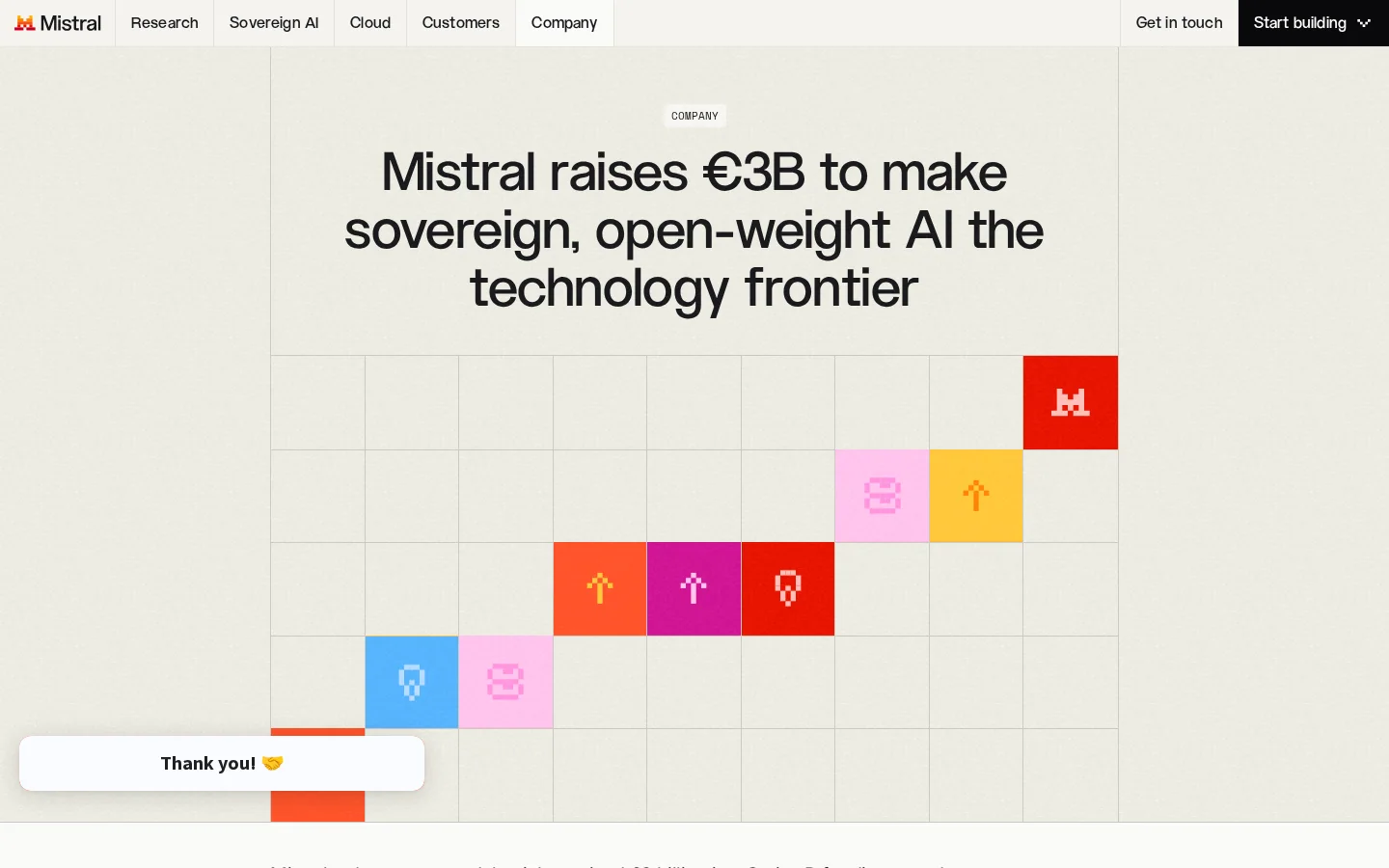
Between the Series C (€11.7 billion, September 2025) and the Series D (more than €21 billion, September 2026), the post-money valuation grew about 1.8 times in twelve months. Over the same period, the revenue run rate grew far faster (about twenty times, see the next section). That gap is why investors paid a higher price per share even though the multiple on revenue went down.
Three details that analysts often miss:

Mistral AI's last on-record revenue figure is an annualized run rate above $400 million, given by CEO Arthur Mensch to the Financial Times in February 2026, up from about $20 million a year earlier. As reported by The Decoder on 11 February 2026, citing the Financial Times, Mensch also set a target of $1 billion in annual recurring revenue by the end of 2026.
A run rate takes the revenue of a recent month and multiplies it by 12. ARR (annual recurring revenue) does the same with recurring contracts only. Neither is the revenue Mistral will book in its accounts for the year. A company that grows fast books much less revenue over the year than its end-of-year run rate, because the early months were smaller.
So when a statistics page says "Mistral revenue 2026: $400 million", it mixes two things. The honest phrasing is: "Mistral reported an annualized revenue run rate above $400 million in February 2026."
Mistral does not publish a revenue split. What it does publish points to enterprise contracts: the Series D announcement highlights 125+ global enterprises, with Airbus, ASML and HSBC named. The ASML partnership signed with the Series C also includes integrating Mistral models into ASML's chip equipment. The consumer side (paid plans of the chat app) exists but has no public figure.
Take the Series D valuation (about $24 billion) and divide it by the last reported run rate ($400 million). You get roughly 60 times run-rate revenue. Two caveats before you quote that multiple:
Note
Some data firms publish monthly revenue estimates for Mistral (for example $312 million in December 2025). These are models built from interviews and public signals. Label them "estimate" with the name of the firm, and never mix them in one chart with figures the company gave.
Mistral has not published a monthly active user count. The verified adoption figures are: 125+ global enterprise customers in 20 countries (September 2026), 1 million downloads of its mobile app in about 14 days (February 2025), and a small but growing share of AI referral traffic to websites, strongest in France.
Verified adoption figures
Sources: TechCrunch (19 February 2025); Mistral AI (September 2026); SE Ranking AI traffic study (16 June 2026)
Mistral's chat app launched on the web in February 2024 and on iOS and Android on 6 February 2025. Mistral told Le Parisien that the app passed 1 million downloads a couple of weeks later, and TechCrunch reported on 19 February 2025 that it reached the top of the free iOS charts in France. At the end of May 2026, Le Chat was renamed Mistral Vibe and refocused on work: a Work Mode connected to business tools and a Code Mode for developers.
A download is not a user. Downloads count installs, including people who opened the app once. If you need a usage figure, say "1 million downloads in about two weeks", not "1 million users".
The 125+ figure is the one Mistral put in its Series D announcement. It counts "global enterprises", not every paying account, so small teams on paid plans are not in it. The three customers named are Airbus, ASML and HSBC. In France, Mistral also signed a framework agreement in January 2026 for the defence ministry's AI agency to use its technology.
One way to measure real use is to count the visits that AI apps send to websites. A study by SE Ranking published on 16 June 2026, based on Google Analytics data from about 101500 websites, found that Mistral sent 0.85% of AI-referred visits in France between January and May 2026 (about 1 in 118), and 0.24% in the EU. It ranked sixth among AI tools in both. The same study found branded searches for "Mistral AI" in France jumped from about 47500 in March 2026 to about 246000 in April 2026.
Read those shares with the right scale. ChatGPT sends most AI referral traffic in every market, so a sixth place at under 1% is normal for a newer player. For context on the leaders, see our verified ChatGPT usage statistics and the figures on Gemini users and market share.
Mistral's flagship today is Mistral Large 4: about 1 trillion parameters in total, 49 billion active per token, a 1 million token context window, open weights published in October 2026. The family grew from a 7 billion parameter model in September 2023 to a trillion-scale model three years later.
The Mistral Large 4 model card on Hugging Face is the primary source for the flagship. It lists:
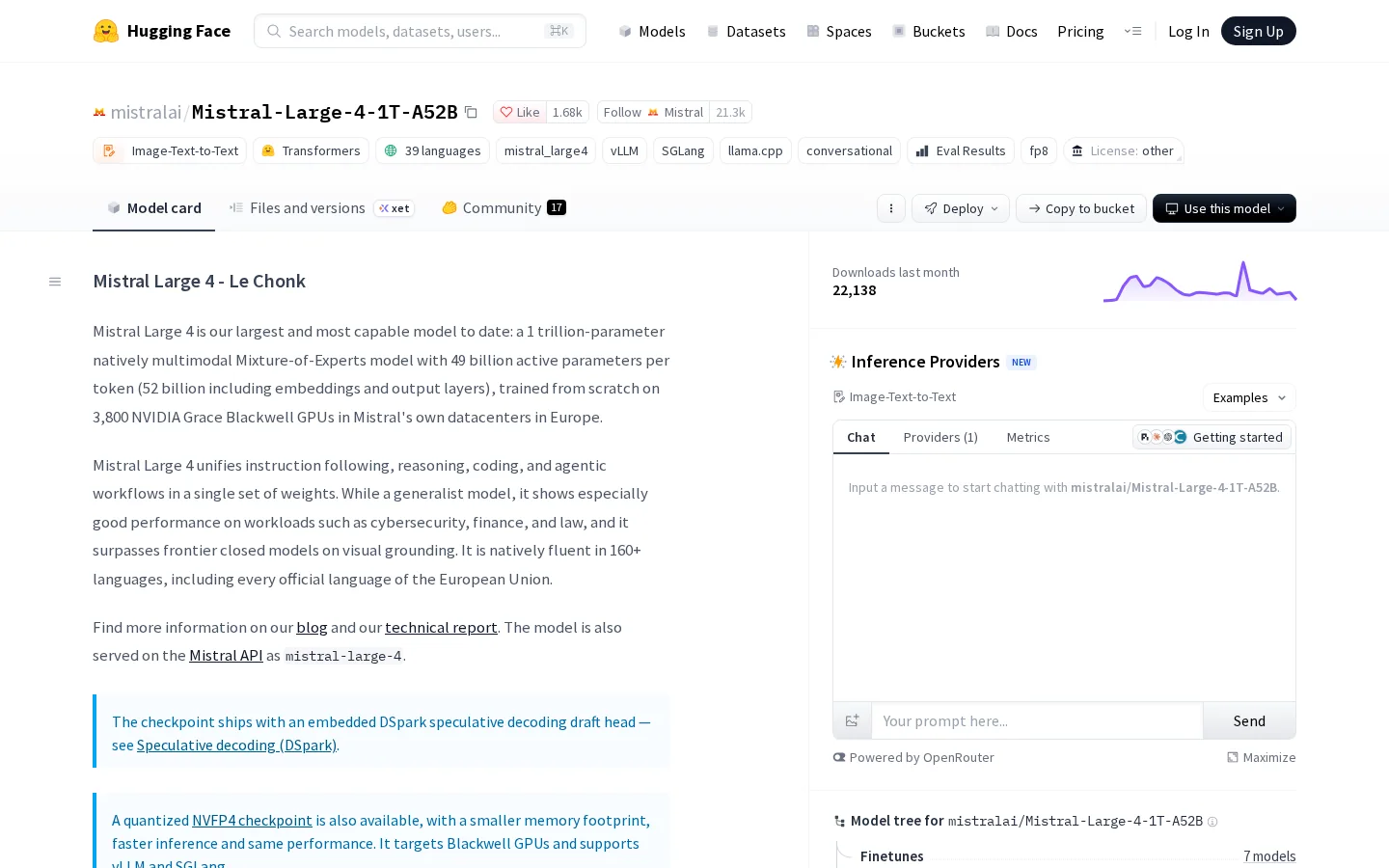
Since Mixtral 8x7B, Mistral's large models are mixtures of experts. For each token, a router picks a few "experts" (small sub-networks) and only those run. Total parameters tell you how much memory you need to load the model. Active parameters tell you how much compute each token costs, so they drive speed and price. Large 3 has 675 billion total parameters but only 41 billion active; Large 4 has about 1 trillion total and 49 billion active. A dense model like Medium 3.5 (128 billion) runs all its parameters on every token.
This is why "Mistral Large 4 is 8 times bigger than Medium 3.5" is true for memory and false for cost per token. Always say which count you quote.
Mistral AI milestones, 2023 to 2026
Open weights are a big part of Mistral's reach: companies download and run the models on their own servers, which no traffic panel can see. If the term is new, our glossary entry on open source LLMs and open-weight models explains the difference between open source and open weights.
Mistral is building its own compute in Europe: a data centre at Bruyères-le-Châtel, south of Paris, financed by $830 million of debt for 13800 Nvidia chips (March 2026), a planned 1.4 gigawatt campus near Paris, and a site in Sweden. The goal is to stop renting all of its compute from American clouds.
Mistral compute in numbers
Sources: TNW (30 March 2026); Mistral Large 4 model card on Hugging Face (October 2026)
Why it matters for the other numbers: compute is the biggest cost line of an AI lab. Owning chips turns part of that cost into an asset financed by debt, which changes how you should read revenue multiples and margins in the years ahead.
Every Mistral figure falls into one of five families: company announcements, executive interviews, data firm estimates, traffic panels and referral studies. Each has its use and its blind spots. Knowing which family a number comes from tells you how far you can trust it and how to word it.
Principle: what Mistral publishes on its news page or model cards. When to use it: funding, valuation at the round, customer counts, model specs. Advantages: exact wording, exact date. Limits: the company picks what it shows (no monthly users, no audited revenue). Example: "125+ global enterprises" in the Series D announcement.
Principle: numbers the CEO gives to a newspaper. When to use it: revenue run rate and targets, which Mistral does not put on its site. Advantages: on the record, attributable. Limits: often rounded ("above $400 million"), often a forecast. Example: the February 2026 Financial Times interview.
Principle: research firms model revenue from interviews and signals. When to use it: to fill months between official figures. Advantages: monthly granularity. Limits: estimates, sometimes far from later official numbers; often behind a paywall. Example: a December 2025 run rate estimate of $312 million.
Principle: tools estimate visits to mistral.ai from browser panels and clickstream data. When to use it: trends over time, comparison with other AI websites. Advantages: free tiers, monthly updates. Limits: miss mobile apps, the API and self-hosted models, which is most of Mistral's enterprise use. Example: "10.8 million desktop visits in March 2026" circulates without a clear method.
Principle: measure the visits AI apps send to a sample of websites, from analytics data. When to use it: to compare how much Mistral matters as a traffic source against ChatGPT, Gemini or Claude. Advantages: real visits, not panels. Limits: sample bias, and they only see the share of answers that include a clickable link. Example: the June 2026 SE Ranking study (0.85% in France).
| Source type | Best for | Reliability | Freshness | Main blind spot | How to word it |
|---|---|---|---|---|---|
| Company announcement | Funding, valuation, customers, models | High | At each event | Only what the company chooses to show | "Mistral said..." |
| Executive interview | Revenue run rate, targets | High for the quote, medium for the number | A few times a year | Rounding, forecasts | "CEO Arthur Mensch told the FT..." |
| Data firm estimate | Monthly revenue trend | Medium | Monthly | Model assumptions | "[Firm] estimates..." |
| Traffic panel | Website visits trend | Low to medium | Monthly | Apps, API, self-hosted use | "[Tool] estimates mistral.ai received..." |
| Referral study | Share of AI traffic to websites | Medium to high | Per study | Sample, linked answers only | "In a study of X websites, [firm] found..." |
Company figure vs third-party estimate
To cite a Mistral figure safely, find the first publisher, note the date and the exact wording, check if it is a fact, a company claim or an estimate, then write it with its unit and source. It takes ten minutes and protects you from the most common errors on statistics pages.
Verify a Mistral statistic in 5 steps
Most statistics pages copy each other. Search the figure in quotes, open the oldest result, and follow its link. For Mistral, the primary sources are few: the news section of mistral.ai, the model cards on Hugging Face, the documentation on docs.mistral.ai, and interviews in the Financial Times, Bloomberg or Reuters. If a page gives no link at all, do not quote it.
Write down the exact sentence. Example of a good note: "Mistral, 8 September 2026: 'raised €3 billion in a Series D funding round at a post-money valuation of more than €21 billion'." This one note gives you the amount, the currency, the round, the type of valuation and the date.
Use four labels: fact (a closed round, a published model), company claim (customer counts, run rate), forecast (the $1 billion target), estimate (anything from a data firm or a panel). Put the label in your spreadsheet next to the number so nobody upgrades an estimate to a fact by mistake.
If you publish statistics, you want AI models to cite you. Mistral uses three crawlers, documented on Mistral's crawler page on docs.mistral.ai: MistralAI-User fetches a page when a Vibe user asks a question and may link to it as a source; MistralAI-Index crawls for Mistral search; MistralAI-Training collects data to train models.
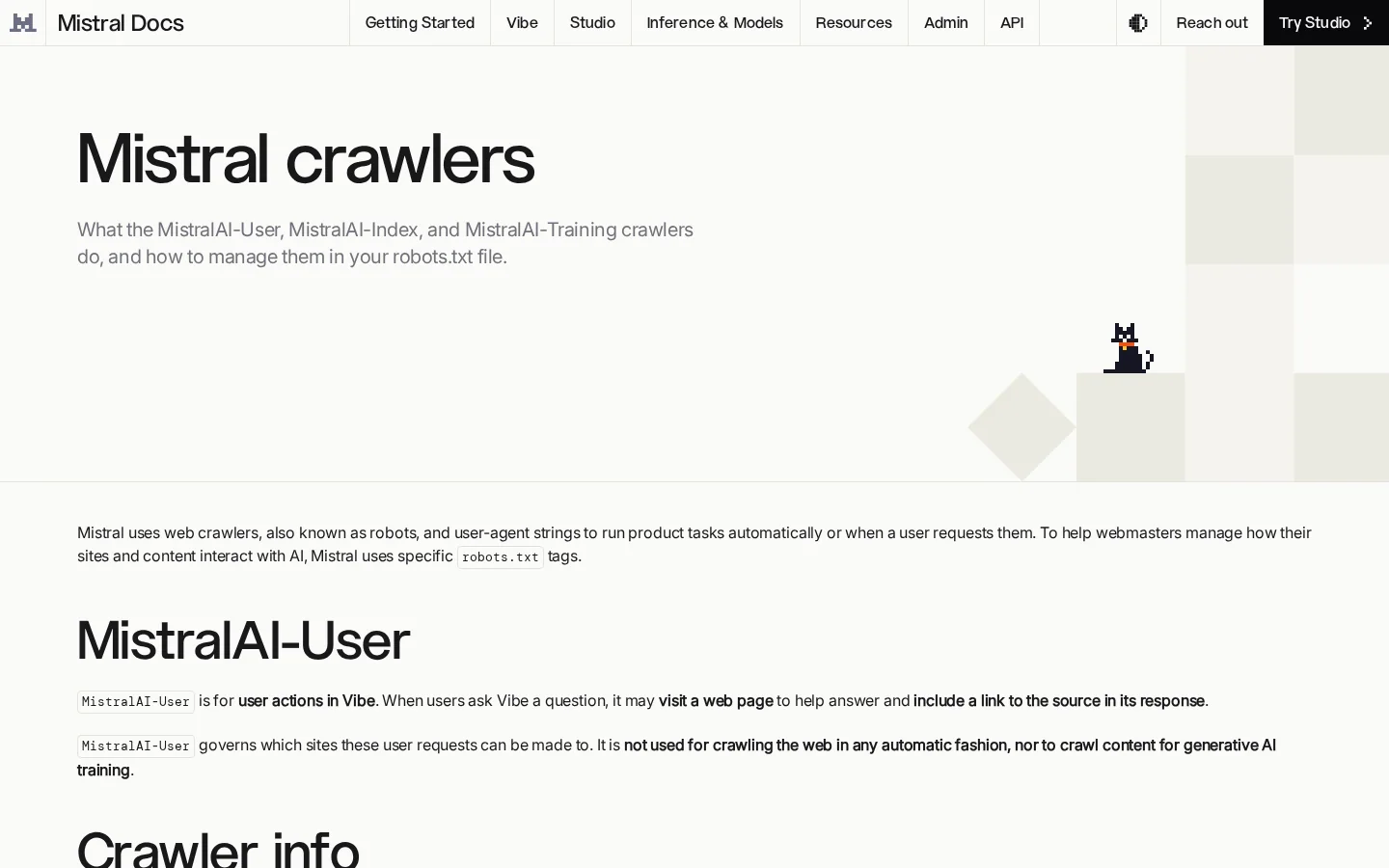
A robots.txt that lets Mistral read and cite your pages, but keeps your content out of training, looks like this:
User-agent: MistralAI-User
Allow: /

User-agent: MistralAI-Index
Allow: /

User-agent: MistralAI-Training
Disallow: /
Each token needs its own group. A single User-agent: * block with Disallow: / blocks all three, including the one that cites you. Our guide to robots.txt rules for AI crawlers covers the other bots.
Tip
Paste your domain in the free robots.txt checker for AI crawler access to see in a few seconds which AI bots your file lets in.
To see if Mistral actually visits you, search your server logs for its user agents. On a standard Nginx or Apache log:
grep -E "MistralAI-(User|Index|Training)" /var/log/nginx/access.log | awk '{print $1, $4, $7}' | sort | uniq -c | sort -rn | head -50Mistral publishes the IP ranges of MistralAI-User and MistralAI-Index on its crawler page. Check the IPs before you trust a log line: anyone can fake a user agent.
To count the visitors Mistral sends you in Google Analytics 4, build an exploration with a filter on "Session source" that matches this regular expression:
(^|\.)mistral\.ai$Keep it next to your other AI sources (chatgpt.com, gemini.google.com, claude.ai) so you can compare their share on your own site, the same way referral studies do on large samples.
The most frequent mistakes are mixing currencies, confusing run rate with revenue, quoting an old valuation as current, counting downloads as users and comparing total parameters as if they were cost. Each one is easy to spot once you know it.
Before you publish a Mistral figure
What it is: using "€2 billion" (end of 2023) or "€6 billion" (2024) as Mistral's valuation today. Even recent studies make this mistake. How to spot it: any valuation under €21 billion is from before September 2026. How to fix it: use "more than €21 billion post-money (September 2026)", and if you show history, give each valuation its round and date.
What it is: a chart with the Series C in euros and the Series D in dollars, or a growth rate computed across currencies. How to spot it: "$3.5 billion" and "€3 billion" appear for the same round. How to fix it: keep euros for Mistral rounds, since that is how Mistral announces them, and add the dollar conversion in brackets with its date if your readers need it.
What it is: "Mistral made $400 million in 2026". How to spot it: the figure has no period, or the period is a full year. How to fix it: "annualized revenue run rate above $400 million (February 2026)". Mistral has not published audited annual revenue.
What it is: "Mistral has $1 billion ARR". How to spot it: look for "on track", "expects", "target" in the source. How to fix it: write "targets $1 billion ARR by the end of 2026" until Mistral confirms it.
What it is: turning "1 million downloads in 14 days" into "1 million users". How to spot it: the source says downloads or installs. How to fix it: keep "downloads", and add that Mistral has not published monthly active users.
What it is: "Large 4 is 8 times more expensive to run than Medium 3.5". How to spot it: a comparison between a mixture of experts and a dense model on total parameters. How to fix it: compare active parameters for cost and speed, total parameters for memory.
What it is: calling the chat app "Le Chat" in a page dated after May 2026. How to spot it: check the date of your source against the renaming. How to fix it: "Mistral Vibe (formerly Le Chat)" the first time, "Mistral Vibe" afterwards.
What it is: saying "Mistral is small" because mistral.ai gets fewer website visits than chatgpt.com. How to spot it: the conclusion is about business adoption, the data is about website visits. How to fix it: remind the reader that API calls, cloud platforms and self-hosted open-weight models do not show up in panels.
Mistral is a small source of website traffic next to ChatGPT, but it weighs more in France and among European companies that run its models in-house. If you sell in Europe, you should let its crawlers in, publish in your customers' languages, and track where AI models mention you.
Three practical consequences of the figures above:
If you compare labs, the same method applies to the others: our Claude AI statistics and how to read them follows the same "first publisher, date, type" rule. And if the vocabulary is new, start with the glossary definition of an LLM, the engine behind AI search.
Mistral AI is valued at more than €21 billion after a €3 billion Series D (8 September 2026), reported a revenue run rate above $400 million in February 2026 with a $1 billion target for the end of the year, and serves 125+ global enterprises in 20 countries. Its flagship, Mistral Large 4, has about 1 trillion parameters with 49 billion active per token.
What to do today: copy the reference table at the top of this page, keep the source column with every number you reuse, and open your robots.txt to check that MistralAI-User can read the pages you want cited.
Mistral AI is valued at more than €21 billion post-money (about $24 billion) after its €3 billion Series D, announced on 8 September 2026 and led by Samsung Electronics. The previous valuation was €11.7 billion after the Series C led by ASML in September 2025.
CEO Arthur Mensch told the Financial Times in February 2026 that Mistral's annualized revenue run rate was above $400 million, up from about $20 million a year earlier. He set a target of $1 billion in annual recurring revenue by the end of 2026. Mistral has not published audited annual revenue.
Mistral has not published a monthly active user count. The verified figures are 1 million mobile app downloads in about 14 days after the February 2025 launch and 125+ global enterprise customers in 20 countries as of September 2026.
We analyse your competitors, your website and your AI visibility to create a tailored content plan for free.
 Duplicate Content Checker
 Mobile-Friendly Test
 Website Speed Test
 Subdomain Finder
 Domain Age Checker
 CMS Detector
 Googlebot Simulator
 Nofollow Link Checker
 Meta Tag Checker
 Keyword Cannibalization Checker
 Keyword Intent Checker
 Keyword Extractor
 Google Ads Cost Calculator
 CPC Calculator
 Local Citation Finder
 Reddit Threads Finder
 Disavow File Generator
 Redirect Generator
 Canonical Tag Generator
 Passive Voice Checker
 Google Location Changer
 Google Review Calculator
 Google Review Link Generator
 Keyword Combiner
 Podcast Show Notes Generator
 AI Content Rewriter
 AI Text Humanizer
 ChatGPT Prompt Generator
 Twitter Thread Generator
 Tweet Generator
 Landing Page Copy Generator
 Google Ads Copy Generator
 Pinterest Pin Description Generator
 Anchor Text Generator
 Social Media Post Generator
 LinkedIn Post Generator
 Free AI Writer
 Review Response Generator
 LSI Keyword Generator
 YouTube Video Ideas Generator
 YouTube Tag Generator
 YouTube Description Generator
 Product Description Generator
 CTA Generator
 Blog Introduction Generator
 Conclusion Generator
 Hook Generator
 AI Content Brief Generator
 FAQ Schema Generator
 AI Blog Post Ideas Generator
 Structured Data Validator (Schema Validator)
 Alt Text Checker
 Internal Link Analyzer
 Backlink Challenge
 AI Meta Description Generator
 AI Blog Title Generator
 Google Indexability Checker
 AI Blog Outline Generator
 UTM Link Builder
 Keyword Clustering Tool
 Canonical Tag Checker
 XML Sitemap Generator
 Broken Link Checker
 AI SEO Title Generator
 Headline Analyzer
 SERP Preview Tool
 Redirect Checker
 Hreflang Tag Generator
 Heading Structure Analyzer
 HTTP Headers Checker
 Favicon Extractor
 SERP CTR Calculator
 SEO vs Paid Search Savings Calculator
 SEO Share of Voice Calculator
 SEO ROI Calculator
 SEO Traffic and Revenue Forecast Calculator
 SEO Budget Calculator
 SEO Break-Even Calculator
 SaaS SEO ROI Calculator
 ROAS Calculator
 Reading Time Calculator
 Ranking Gain Simulator
 Organic Traffic Value Calculator
 Organic Traffic Estimator and Website Traffic Checker
 LTV to CAC Ratio Calculator
 Local SEO ROI Calculator
 Link Building Cost Calculator
 Keyword Value Calculator
 Keyword Opportunity Score Calculator
 Keyword Density Calculator
 GEO ROI Calculator
 GEO Content Investment Calculator
 Ecommerce SEO ROI Calculator
 Customer Lifetime Value Calculator
 Customer Acquisition Cost Calculator
 CTR Calculator
 Cost Per Article Calculator
 Conversion Rate Calculator
 Content Marketing ROI Calculator
 ChatGPT Referral Traffic Estimator
 Bounce Rate Calculator
 Backlink ROI Calculator
 AI Visibility Score Calculator
 AI Traffic Value Calculator
 AI Share of Voice Calculator
 Cost of AI Invisibility Calculator
 AI Citation Rate Calculator
 llms.txt Validator
 AI Overview Checker and AI Overviews Rank Checker
 Robots.txt Checker
 AI SEO Audit
 LLM Readability Checker
 SearchGPT Readiness Checker
 Structured Data LLM Audit
 Website Crawlability AI Audit
 Why ChatGPT Is Not Recommending My Website
 Gemini Ranking Tool
 Perplexity Ranking Checker
 LLM Citation Checker
 Answer Engine Optimization Audit
 GEO Audit
 AI Search Visibility Test
 ChatGPT Visibility Checker
 llms.txt Generator
 URL Extractor
 Webpage to Markdown
 Sitemap Checker
 SERP Volatility Sensor
 Page Size Checker
 Word Counter
 Slug Generator
 Schema Generator
 Robots Generator
 OG Preview
 Meta Tags Generator
 Image Compressor
 Favicon Generator
 On-Page SEO Audit: SEO Checker and SEO Analyzer
 Backlink Analysis Tool
 Keyword Research Tool
 Domain Authority Checker
 “I tested Sorank on a real client site and it's insane. It does everything an agency would bill you $1500 a month for. It's going into production on that client now.”

 Guillaume Guersanguersanguillaume.com“We are an Ads agency and we wanted to get our SEO back on track once and for all. Sorank gave us a clear view of our site, helped us prioritize optimizations, and properly structure our content. The tool is easy to use, well designed for a team, and very practical for centralizing tracking without having to juggle multiple platforms. A very solid foundation to start fresh with our SEO.”
 Gaspard MadouiAds Agency
 “I just let the Sorank software do its thing, and now my DR is 25 and my page is ranking higher.”
 Lucas Flandrefoundertrace.fr“I specialized in GEO thanks to Sorank. The GEO Leaderboard allows me to show my clients their position vs competitors on ChatGPT. It’s a real commercial differentiator.”
 MélanieSEO Freelance“Great service, works well for our website and helps us understand how to improve it to rank better on Google and elsewhere. Congrats, keep going, I recommend it.”
 Hugo T.E-commerce merchant