Preferences
Privacy is important to us, so you have the option of disabling certain types of storage that may not be necessary for the basic functioning of the website. Blocking categories may impact your experience on the website. More information

Privacy is important to us, so you have the option of disabling certain types of storage that may not be necessary for the basic functioning of the website. Blocking categories may impact your experience on the website. More information

Publisher SEO guide: Top Stories, Discover, news sitemaps, article and paywall markup, plus how to stay cited by AI and decide on licensing.

Tools

In short
Publisher SEO is the set of practices that help news and media sites earn traffic from Google Search, Top Stories, Google News, Discover and, now, AI assistants. It rests on four pillars: fast indexing of fresh articles (news sitemap, clean URLs, internal links), trust signals (bylines, dates, corrections, author pages), technical markup (Article, paywall and image requirements) and a deliberate policy toward AI crawlers and licensing. Evergreen content and direct audience channels protect the business when search referrals drop.
Want to go further? Ask
Quick quiz
Is SEO right for you, and how should you start?
Sorank matches your answers


Test it for 3 days on your own site and see where you stand on Google, ChatGPT and the other AIs.
Start 3-day free trial3 days free, then stop whenever you want. 90-day results-or-refund guarantee.
Publisher SEO differs from classic SEO because a news site publishes dozens or hundreds of pages a day, most of which lose their value within 48 hours, while its evergreen archive keeps earning visits for years. The stakes have grown: the Reuters Institute's Journalism, Media and Technology Trends and Predictions 2026 report (January 2026) cites Chartbeat data showing that Google search traffic to more than 2,500 news sites fell by 33% year on year between November 2024 and November 2025, and the 280 media leaders surveyed expect search referrals to drop by a further 43% over three years. Optimizing well is now a matter of keeping the traffic that remains and being cited where readers go next. This guide covers what changes for publishing and media companies, from news surfaces to AI answers.
Publisher SEO applies search optimization to sites whose product is editorial content: newspapers, magazines, digital-native media, trade publications and large blogs that live on advertising or subscriptions. Three constraints set it apart.
A publisher also depends on surfaces that most sites never see: Top Stories carousels, the News tab, the Google News app and Discover, a feed that pushes content to users without any query.
Each surface has its own selection logic. The table summarizes what drives visibility and where to measure it.
| Surface | How content gets in | Main levers | Where to measure |
|---|---|---|---|
| Search results (blue links) | Standard crawl and ranking | Relevance, depth, links, page experience | Search Console, Search type: Web |
| Top Stories | Automatic, for queries with news intent | Freshness, authority on the topic, original reporting | Search Console, Search appearance filters |
| Google News app and News tab | Automatic, subject to Google News content policies | Transparency, dates, bylines, policy compliance | Search Console, Google News report |
| Discover | Automatic, based on user interests | Large images, honest titles, timely or unique stories | Search Console, Discover report |
| AI Overviews and AI assistants | Retrieval from indexed or crawled pages | Clear facts, structured answers, crawler access, brand authority | Prompt tracking, referral analytics |
Google states in its Publisher Center help that there is no application form: sites found through the normal crawl are automatically considered for Top Stories and the News tab if they produce high-quality content and comply with the Google News content policies. Publisher Center remains useful to manage the publication's name, logo and sections in the Google News app.
A news sitemap lists only fresh articles. Google's news sitemap documentation asks publishers to include only URLs of articles created in the last two days, with up to 1,000 news:news entries per file, and requires the tags news:publication (name and language), news:publication_date and news:title. The publication name must match the one shown on Google News. Keep a regular XML sitemap for the full archive alongside it.
Googlebot revisits the homepage and section pages often. Linking every new story from these hubs, and from related live pages, gets it crawled faster than any sitemap ping. Topic pages (one per recurring subject, person or team) gather links and give Google a stable URL to rank on recurring queries.
Update a developing story on the same URL instead of publishing a new article for each development, and show both the publication date and the last update. When several outlets in a group syndicate the same piece, a canonical tag pointing to the original avoids competing duplicates.
Infinite tag combinations, internal search pages, calendar archives and tracking parameters dilute crawling. Block or noindex what has no search value, and audit thin tag pages (a tag with two articles helps nobody).
Tip
Check the Crawl stats report in Search Console after a big news day. If the average response time climbs, Googlebot slows down, and your fresh stories wait in line behind archive pages.
Three types of markup do most of the work for publishers.
datePublished, dateModified and author with a link to the author page. It helps Google show the right date and attribute the story.isAccessibleForFree to false and point hasPart to the gated section with a cssSelector. This lets Googlebot read the full text while Google distinguishes your paywall from cloaking, which violates its spam policies.Structured data does not make an article rank by itself, but it removes ambiguity about who wrote what and when, for Google and for the language models that parse your pages. Our guide to structured data for AI search explains which properties AI systems actually use.
Discover is a major traffic source for many news and lifestyle publishers, and also the most volatile one. Google's Discover documentation (updated March 2026) sets clear conditions:
max-image-preview:large robots setting;The Discover report in Search Console shows clicks, impressions and CTR over 16 months once a minimum threshold is reached, and it includes traffic from Chrome. Our dedicated guide to Google Discover optimization goes deeper into image and title tests.
Watch out
Sensational headlines may lift Discover clicks for a week, then cut your reach. Google explicitly lists misleading titles and tactics that exploit outrage or curiosity as reasons to show less of a site's content.
Trust is built page by page and site-wide.
Monetization sections need care too. Google's spam policies define site reputation abuse as third-party content published mainly to benefit from the host's ranking signals. Coupon, product review or sponsored sections run by outside partners without editorial integration expose the whole domain, while an editorially curated and clearly disclosed section is not targeted.
Breaking news brings spikes, evergreen content brings a floor. A healthy publisher plans both.
AI Overviews, ChatGPT, Perplexity and Gemini summarize the news and answer factual questions directly, which reduces clicks on many informational queries (see Google AI Overviews). Publishers now make three decisions.
Robots.txt lets you allow or block each AI crawler separately: GPTBot for OpenAI training, OAI-SearchBot for ChatGPT search, PerplexityBot, ClaudeBot and others. Google-Extended is a separate token that controls the use of your content for Gemini training and grounding; Google states that it does not affect inclusion or ranking in Google Search. Blocking search-oriented bots removes you from their answers, so many publishers block training bots and allow search bots. Our guide to robots.txt for AI crawlers lists the user agents.
Large AI companies have signed content agreements with publishers (OpenAI with the Associated Press and Axel Springer, for example), and new pay-per-crawl models are appearing. Publisher licensing is a business decision as much as an SEO one: a deal can bring revenue and attribution, while a blanket block protects exclusivity at the cost of visibility.
AI assistants cite sources that state facts clearly, near the top, with dates and named sources. Original data, exclusive quotes and well-structured explainers get cited more than rewritten wires. Our media AI citation study shows which outlets AI assistants quote most often.
Split reporting by surface and by content type: breaking news, evergreen, topic hubs. Track in Search Console the Web, Discover and Google News reports separately, indexing delay for new articles (time between publication and first impressions), and the share of traffic from evergreen pages. For AI visibility, follow a fixed list of questions about your topics and check whether your publication is cited, and which competitor is cited instead.
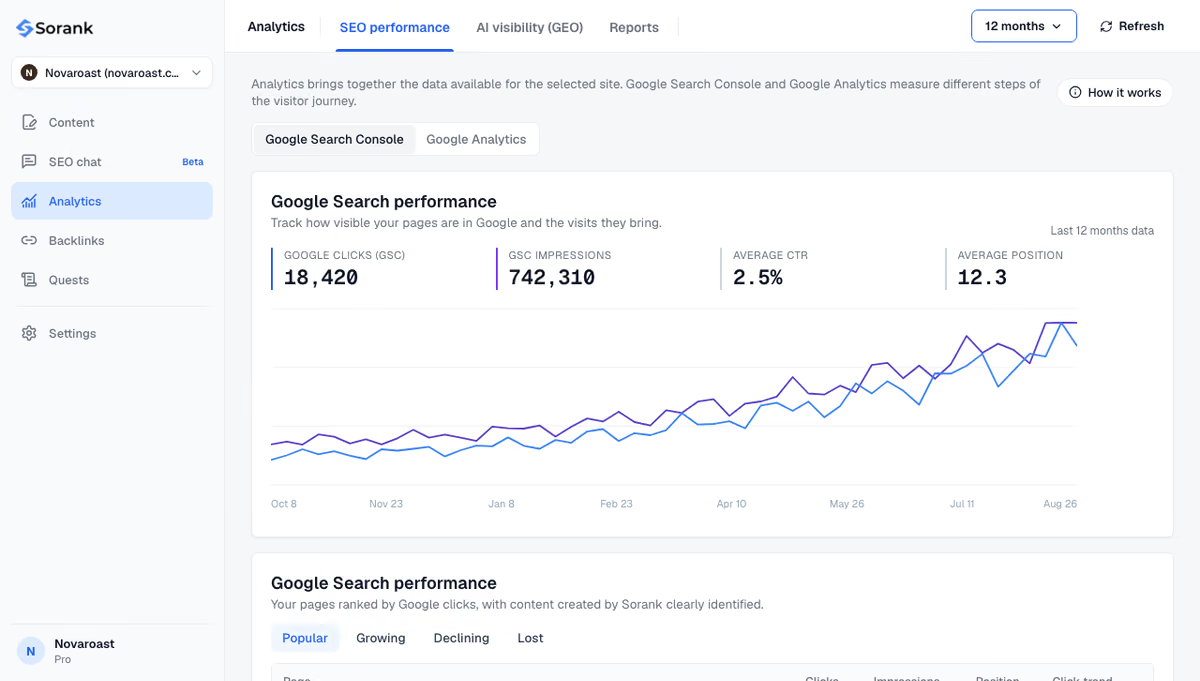
Sorank brings these signals together: the GEO and SEO dashboard follows your Search Console clicks, impressions and positions, and AI mention tracking checks every month whether ChatGPT, Claude and Gemini cite your publication on the questions your readers ask. The software also writes and publishes evergreen articles on autopilot, which fits the explainer side of a newsroom rather than breaking news.
Publisher SEO now means being found fast on Google and being the source AI assistants quote. Fix indexing and trust first, protect evergreen traffic, then decide your AI crawler and licensing policy with the business. To track both Google and AI visibility in one place, see the Sorank plans, with a 3-day free trial.

No. Google finds news sites through its normal crawl and automatically considers them for Top Stories, the News tab and the Google News app if they publish high-quality content and follow the Google News content policies. Publisher Center is optional and helps manage the publication name, logo and sections.
It depends on the business model. Blocking training crawlers such as GPTBot protects content from model training, while blocking search crawlers such as OAI-SearchBot or PerplexityBot removes the site from those assistants' answers and citations. Many publishers block training bots, allow search bots and negotiate licensing separately.
Well-linked articles on established news sites are often crawled and indexed within minutes, while new or slow sites can wait hours or days. Linking new stories from the homepage and section pages, listing them in a news sitemap and keeping server response times low shortens the delay.
We analyse your competitors, your website and your AI visibility to create a tailored content plan for free.
 AI Content Brief Generator
 FAQ Schema Generator
 AI Blog Post Ideas Generator
 Structured Data Validator (Schema Validator)
 Alt Text Checker
 Internal Link Analyzer
 Backlink Challenge
 AI Meta Description Generator
 AI Blog Title Generator
 Google Indexability Checker
 AI Blog Outline Generator
 UTM Link Builder
 Keyword Clustering Tool
 Canonical Tag Checker
 XML Sitemap Generator
 Broken Link Checker
 AI SEO Title Generator
 Headline Analyzer
 SERP Preview Tool
 Redirect Checker
 Hreflang Tag Generator
 Heading Structure Analyzer
 HTTP Headers Checker
 Favicon Extractor
 SERP CTR Calculator
 SEO vs Paid Search Savings Calculator
 SEO Share of Voice Calculator
 SEO ROI Calculator
 SEO Traffic and Revenue Forecast Calculator
 SEO Budget Calculator
 SEO Break-Even Calculator
 SaaS SEO ROI Calculator
 ROAS Calculator
 Reading Time Calculator
 Ranking Gain Simulator
 Organic Traffic Value Calculator
 Organic Traffic Estimator and Website Traffic Checker
 LTV to CAC Ratio Calculator
 Local SEO ROI Calculator
 Link Building Cost Calculator
 Keyword Value Calculator
 Keyword Opportunity Score Calculator
 Keyword Density Calculator
 GEO ROI Calculator
 GEO Content Investment Calculator
 Ecommerce SEO ROI Calculator
 Customer Lifetime Value Calculator
 Customer Acquisition Cost Calculator
 CTR Calculator
 Cost Per Article Calculator
 Conversion Rate Calculator
 Content Marketing ROI Calculator
 ChatGPT Referral Traffic Estimator
 Bounce Rate Calculator
 Backlink ROI Calculator
 AI Visibility Score Calculator
 AI Traffic Value Calculator
 AI Share of Voice Calculator
 Cost of AI Invisibility Calculator
 AI Citation Rate Calculator
 llms.txt Validator
 AI Overview Checker and AI Overviews Rank Checker
 Robots.txt Checker
 AI SEO Audit
 LLM Readability Checker
 SearchGPT Readiness Checker
 Structured Data LLM Audit
 Website Crawlability AI Audit
 Why ChatGPT Is Not Recommending My Website
 Gemini Ranking Tool
 Perplexity Ranking Checker
 LLM Citation Checker
 Answer Engine Optimization Audit
 GEO Audit
 AI Search Visibility Test
 ChatGPT Visibility Checker
 llms.txt Generator
 URL Extractor
 Webpage to Markdown
 Sitemap Checker
 SERP Volatility Sensor
 Page Size Checker
 Word Counter
 Slug Generator
 Schema Generator
 Robots Generator
 OG Preview
 Meta Tags Generator
 Image Compressor
 Favicon Generator
 On-Page SEO Audit: SEO Checker and SEO Analyzer
 Backlink Analysis Tool
 Keyword Research Tool
 Domain Authority Checker
THEY TRIED SORANK BEFORE YOU
 “I tested Sorank on a real client site and it's insane. It does everything an agency would bill you $1500 a month for. It's going into production on that client now.”

 Guillaume Guersanguersanguillaume.com“We are an Ads agency and we wanted to get our SEO back on track once and for all. Sorank gave us a clear view of our site, helped us prioritize optimizations, and properly structure our content. The tool is easy to use, well designed for a team, and very practical for centralizing tracking without having to juggle multiple platforms. A very solid foundation to start fresh with our SEO.”
 Gaspard MadouiAds Agency
 “I just let the Sorank software do its thing, and now my DR is 25 and my page is ranking higher.”
 Lucas Flandrefoundertrace.fr“I specialized in GEO thanks to Sorank. The GEO Leaderboard allows me to show my clients their position vs competitors on ChatGPT. It’s a real commercial differentiator.”
 MélanieSEO Freelance“Great service, works well for our website and helps us understand how to improve it to rank better on Google and elsewhere. Congrats, keep going, I recommend it.”
 Hugo T.E-commerce merchant