Preferences
Privacy is important to us, so you have the option of disabling certain types of storage that may not be necessary for the basic functioning of the website. Blocking categories may impact your experience on the website. More information

Privacy is important to us, so you have the option of disabling certain types of storage that may not be necessary for the basic functioning of the website. Blocking categories may impact your experience on the website. More information

Google News SEO: how Google News chooses articles, the policies to follow, news sitemaps, Article structured data and the practices that get you into Top stories.

Tools

In short
Google News and the Top stories carousel in Search show recent, newsworthy articles from sites that follow Google News policies. There is no fee and no ranking you can buy; eligibility depends on original reporting, clear dates and bylines, transparency about who publishes, and the absence of policy violations. Technically, help Google with a news sitemap of recent articles, Article structured data, fast pages and stable URLs. Speed of publication on fresh topics and expertise on a beat do the rest.
Want to go further? Ask
Quick quiz
Is SEO right for you, and how should you start?
Sorank matches your answers


Test it for 3 days on your own site and see where you stand on Google, ChatGPT and the other AIs.
Start 3-day free trial3 days free, then stop whenever you want. 90-day results-or-refund guarantee.
Google News SEO is the work of making news content visible in Google News, in the Top stories carousel of Search and in the News tab. It concerns media, but also companies that publish real news in their field: product launches, studies, market updates. This guide covers the rules, the technical setup and the editorial practices that matter, based on Google's own documentation.
Google's systems select and rank news content automatically, looking at relevance to the query, freshness, prominence of the story, and the expertise and trustworthiness of the source. Publishers do not pay to appear. To be eligible at all, content must comply with the Google News policies, which add news-specific rules to Google Search's general and spam policies.
| Signal | What it means for you |
|---|---|
| Freshness | Publish quickly on news, and update with clear dates |
| Relevance | Precise headlines that match how people search the story |
| Expertise on a topic | Cover a beat consistently rather than everything once |
| Transparency | Bylines, author pages, publisher information, contact details |
| Originality | Original reporting and analysis, not rewritten wire copy |
Google's policies ask news sources to help readers understand who wrote and published the content: clear publication dates and bylines, information about authors, the publication and the publisher, the company or network behind it, and contact information. They prohibit dangerous, deceptive, harassing or hateful content, manipulated media, sexually explicit and violent extremist content, among others. Ads must not exceed editorial content, sponsored material must be clearly disclosed, and headlines or previews must not promise what the article does not deliver.
Watch out
Sponsored articles presented as independent journalism break Google News policies. Label sponsored content clearly, and keep it a minority of what you publish, or the whole site can lose eligibility.
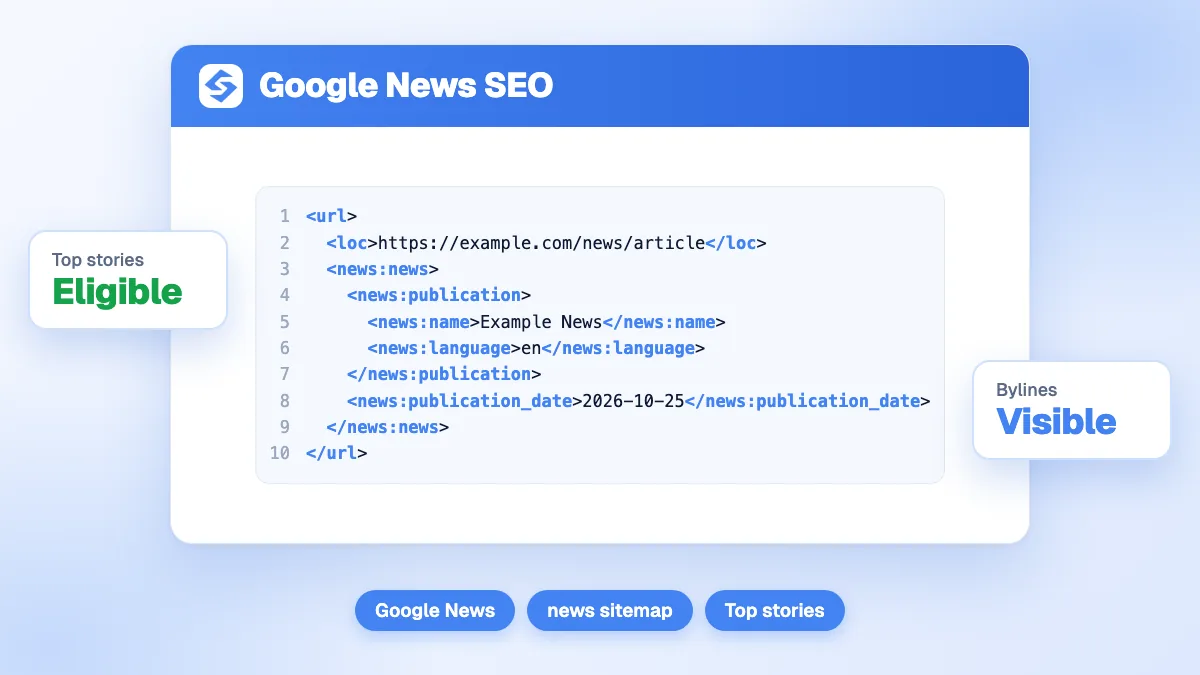
A news sitemap lists only articles published in the last two days, with up to 1,000 news entries per file. Required tags: the publication name (matching your name on Google News) and language, the original publication date and the article title. Update the same file as you publish, rather than creating new ones. The free sitemap checker validates the file.
Mark up articles with Article structured data (NewsArticle where relevant): headline, images, datePublished, dateModified and author. It helps Google understand dates and authorship. The schema generator writes the code.
Show the publication date and, when relevant, the update date visibly near the headline, and link each byline to an author page with the person's background. Avoid changing dates without a real update.
News readers are often on mobile. Keep pages light, images optimized, and URLs stable once published.
Google recommends large, high-quality images for Discover, at least 1,200 pixels wide, and news surfaces display them too; reference the image in your markup. See our guide to Google Discover, which shares many signals with news surfaces.
Tip
Write the headline you would search for. News readers type the names of people, companies and events: put them at the start of the headline, and keep the clever wordplay for the subtitle.
Yes, if it publishes genuine news with editorial standards: dated announcements, studies with data, analyses of events in its industry, with named authors and transparent ownership. Promotional posts and evergreen guides are not news; they belong in classic SEO (see evergreen content). Companies with announcements can also reach journalists through press releases, which often end up in news results through the media that cover them.
AI assistants that browse the web lean on recent, authoritative sources for current events, and news articles are frequent citations. A clear, factual lead paragraph and named sources make your articles easier to quote. Read GEO vs SEO for the method and track mentions with AI mention tracking.
Google News rewards transparent, original and fast reporting, supported by clean technical signals. Follow the policies, publish a news sitemap and Article markup, show dates and bylines, and cover a beat consistently. For evergreen content alongside your news, Sorank, SEO and GEO software that runs on autopilot, writes and publishes optimized articles; see the Sorank plans, with a 3-day free trial.

Google selects news content automatically from sites that comply with its policies, and there is no fee. Google News Publisher Center lets publishers manage how their publication appears, but following the content and transparency policies is what makes a site eligible.
A news sitemap is an XML sitemap with extra news tags that lists articles published in the last two days, with the publication name, language, original publication date and title. It helps Google find fresh articles quickly. Each file can contain up to 1,000 news entries.
Google News is the dedicated news app and site, plus the News tab in Search. Top stories is a carousel of recent articles inside regular Google Search results for newsworthy queries. Both draw on news content that follows Google's policies.
We analyse your competitors, your website and your AI visibility to create a tailored content plan for free.
 AI Content Brief Generator
 FAQ Schema Generator
 AI Blog Post Ideas Generator
 Structured Data Validator (Schema Validator)
 Alt Text Checker
 Internal Link Analyzer
 Backlink Challenge
 AI Meta Description Generator
 AI Blog Title Generator
 Google Indexability Checker
 AI Blog Outline Generator
 UTM Link Builder
 Keyword Clustering Tool
 Canonical Tag Checker
 XML Sitemap Generator
 Broken Link Checker
 AI SEO Title Generator
 Headline Analyzer
 SERP Preview Tool
 Redirect Checker
 Hreflang Tag Generator
 Heading Structure Analyzer
 HTTP Headers Checker
 Favicon Extractor
 SERP CTR Calculator
 SEO vs Paid Search Savings Calculator
 SEO Share of Voice Calculator
 SEO ROI Calculator
 SEO Traffic and Revenue Forecast Calculator
 SEO Budget Calculator
 SEO Break-Even Calculator
 SaaS SEO ROI Calculator
 ROAS Calculator
 Reading Time Calculator
 Ranking Gain Simulator
 Organic Traffic Value Calculator
 Organic Traffic Estimator and Website Traffic Checker
 LTV to CAC Ratio Calculator
 Local SEO ROI Calculator
 Link Building Cost Calculator
 Keyword Value Calculator
 Keyword Opportunity Score Calculator
 Keyword Density Calculator
 GEO ROI Calculator
 GEO Content Investment Calculator
 Ecommerce SEO ROI Calculator
 Customer Lifetime Value Calculator
 Customer Acquisition Cost Calculator
 CTR Calculator
 Cost Per Article Calculator
 Conversion Rate Calculator
 Content Marketing ROI Calculator
 ChatGPT Referral Traffic Estimator
 Bounce Rate Calculator
 Backlink ROI Calculator
 AI Visibility Score Calculator
 AI Traffic Value Calculator
 AI Share of Voice Calculator
 Cost of AI Invisibility Calculator
 AI Citation Rate Calculator
 llms.txt Validator
 AI Overview Checker and AI Overviews Rank Checker
 Robots.txt Checker
 AI SEO Audit
 LLM Readability Checker
 SearchGPT Readiness Checker
 Structured Data LLM Audit
 Website Crawlability AI Audit
 Why ChatGPT Is Not Recommending My Website
 Gemini Ranking Tool
 Perplexity Ranking Checker
 LLM Citation Checker
 Answer Engine Optimization Audit
 GEO Audit
 AI Search Visibility Test
 ChatGPT Visibility Checker
 llms.txt Generator
 URL Extractor
 Webpage to Markdown
 Sitemap Checker
 SERP Volatility Sensor
 Page Size Checker
 Word Counter
 Slug Generator
 Schema Generator
 Robots Generator
 OG Preview
 Meta Tags Generator
 Image Compressor
 Favicon Generator
 On-Page SEO Audit: SEO Checker and SEO Analyzer
 Backlink Analysis Tool
 Keyword Research Tool
 Domain Authority Checker
THEY TRIED SORANK BEFORE YOU
 “I tested Sorank on a real client site and it's insane. It does everything an agency would bill you $1500 a month for. It's going into production on that client now.”

 Guillaume Guersanguersanguillaume.com“We are an Ads agency and we wanted to get our SEO back on track once and for all. Sorank gave us a clear view of our site, helped us prioritize optimizations, and properly structure our content. The tool is easy to use, well designed for a team, and very practical for centralizing tracking without having to juggle multiple platforms. A very solid foundation to start fresh with our SEO.”
 Gaspard MadouiAds Agency
 “I just let the Sorank software do its thing, and now my DR is 25 and my page is ranking higher.”
 Lucas Flandrefoundertrace.fr“I specialized in GEO thanks to Sorank. The GEO Leaderboard allows me to show my clients their position vs competitors on ChatGPT. It’s a real commercial differentiator.”
 MélanieSEO Freelance“Great service, works well for our website and helps us understand how to improve it to rank better on Google and elsewhere. Congrats, keep going, I recommend it.”
 Hugo T.E-commerce merchant