Preferences
Privacy is important to us, so you have the option of disabling certain types of storage that may not be necessary for the basic functioning of the website. Blocking categories may impact your experience on the website. More information
Privacy is important to us, so you have the option of disabling certain types of storage that may not be necessary for the basic functioning of the website. Blocking categories may impact your experience on the website. More information

Digital advertising explained: the main channels, how ad auctions set your price, the three ways to buy, and a first campaign you can launch this week.

In short
Digital advertising is paid promotion that runs on search engines, websites, social platforms, apps and video services. You pay to show a message to a chosen audience, and most platforms sell that space through an auction. It works when you have a clear offer, a page that converts and a way to measure sales.
Want to go further? Ask
Quick quiz
Which way of finding customers online fits you best?
Sorank matches your answers


Test it for 3 days on your own site and see where you stand on Google, ChatGPT and the other AIs.
Start 3-day free trial3 days free, then stop whenever you want. 90-day results guarantee, conditions apply.
Digital advertising is any paid message delivered through a digital channel. The channel can be a search results page, a news site, a social feed, a mobile app, a YouTube video or a podcast. The defining feature is that you pay for the placement, and the platform can measure what happens after people see or click the ad.
Digital marketing is the larger field. It also includes SEO, email, content and social posts that you do not pay to place. Paid ads buy attention today. SEO and content earn attention over months, and that attention stays after you stop spending. Most businesses need both, but they answer different questions. Ads tell you quickly whether an offer sells. Organic channels build traffic that keeps arriving. For the wider picture, read our guide to digital marketing.
The market is large. The IAB and PwC report, published April 16, 2026, shows that U.S. digital ad revenue reached $294.6B in 2025, up 13.9% on the year before. Social advertising alone reached $117.7B, up 32.6%. These categories overlap, so do not add them up to get a total.
U.S. digital ad revenue, full year 2025
Source: IAB and PwC, Internet Advertising Revenue Report: Full Year 2025, published April 16, 2026
Digital ads differ from TV or print in three ways that matter to a small budget:
Those three advantages are also the source of most mistakes. Targeting that is too wide wastes money, measurement that is missing hides the waste, and a small budget can be spent before anyone learns what works. The rest of this guide shows how to avoid each of these.
Each channel has its own format, audience and cost model. Pick a channel by the job you need done. Search captures demand that already exists. Display, social and video create demand among people who are not looking for you yet. Affiliate and influencer deals pay for an outcome or for content.
Search ads are short text ads shown on results pages when someone types a query. You choose the keywords, the platform matches them to queries, and in most search campaigns you pay when someone clicks. Search has the clearest intent of any channel, because the person has already described what they want. Google Ads is the main platform. Read our guides to Google Ads and paid search for the mechanics.
Search also has a limit. It only reaches people who search for your category, so the volume is capped by search demand. If you sell something nobody searches for, search will show you very few impressions no matter the budget.
Display ads are banners and image units on websites and apps, bought through ad networks. They reach people who are not searching for you, so they suit awareness and retargeting. Retargeting shows ads to people who already visited your site. It works best with a frequency cap, because without one the same person sees the same banner many times a day.
Video ads, for example on YouTube, follow the same logic with moving images and a longer message. They take more work to produce, but they carry more story per impression. Measure video by the actions it drives, not by views alone. A view that does not lead to a visit or a sale cost you money for nothing.
Social ads run in feeds and stories on platforms such as Meta, LinkedIn, TikTok and Pinterest. Targeting uses profile data, interests and behavior on the platform. The creative matters more than the copy: the first second of a video or the first line of an image decides whether anyone stops scrolling. Expect to test many versions, because the same ad can perform very differently across audiences.
In affiliate marketing you pay a commission on a sale or a lead, so the cost only appears when a result exists. In influencer deals you pay a creator for content, often with a fixed fee and sometimes with a discount code you can track. Both need clear disclosure. The rules differ by country and by platform, so check them before you sign. See affiliate marketing and AI influencer marketing for the details.
Some AI assistants now show ads in or next to their answers. The formats are new, the rules change often and the reporting is still limited. Read ChatGPT Ads and AI ads explained for what is live today and how it is measured.
| Channel | Where the ad appears | Best for | Usual cost model |
|---|---|---|---|
| Search | Results pages for typed queries | Buyers who already search for your offer | Cost per click |
| Display | Banners on websites and apps | Awareness and retargeting | Cost per thousand impressions (CPM) or per click |
| Social | Feeds and stories on social platforms | Demand creation and audience building | CPM, cost per click or cost per result |
| Video | Before, during or next to online video | Brand building and storytelling | CPM or cost per view |
| Affiliate | Partner sites, reviews and coupon pages | Paying only for results | Commission per sale or lead |
Your first test: search or display

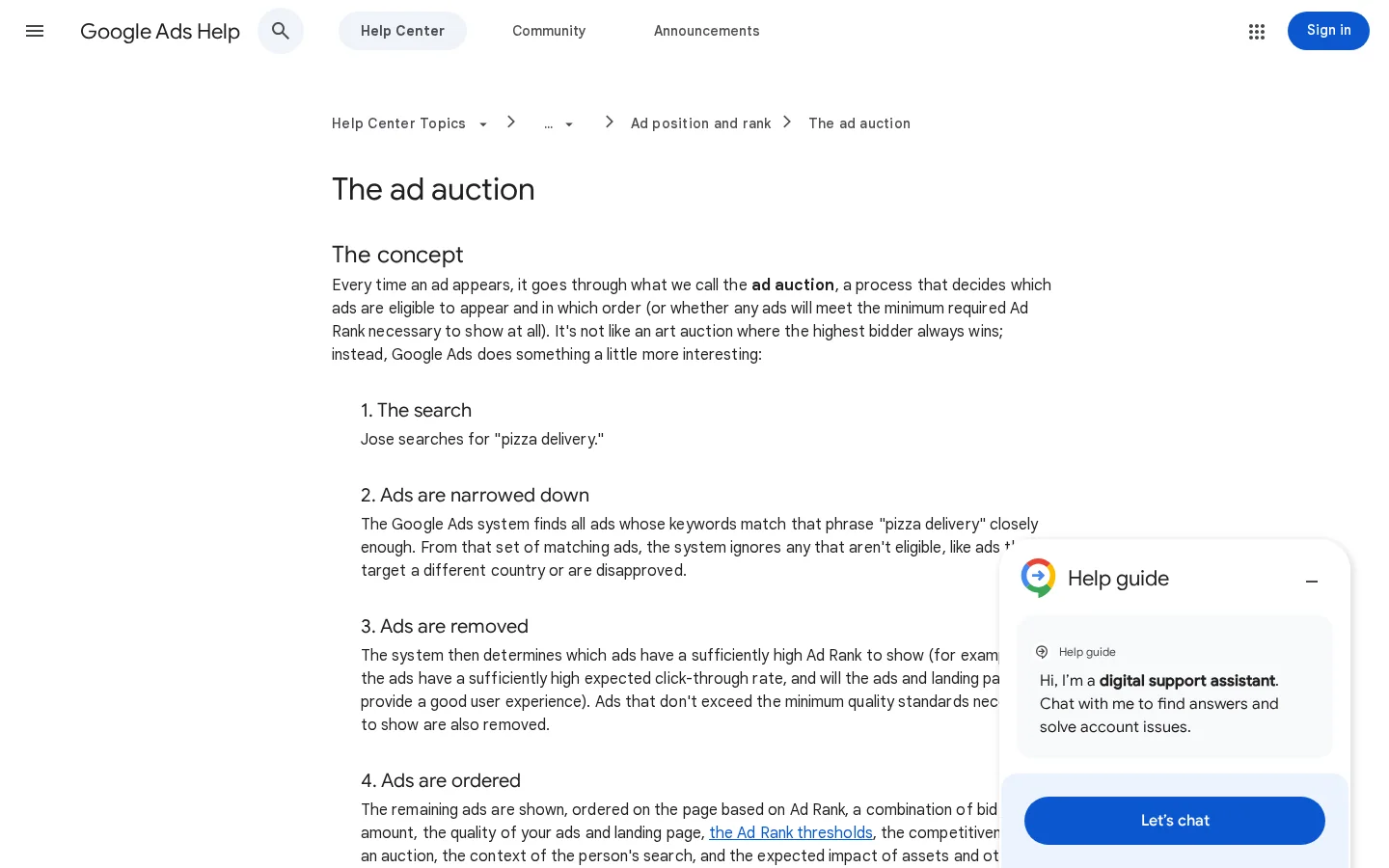
Most paid platforms sell ad space through an auction. Each time a slot is available, the platform checks which advertisers entered that auction for this person, this query or this page. Google describes two steps in its Ads Help article on the auction. First the system decides which ads are eligible to show. Then it ranks the eligible ads against each other.
Google's ad auction page lists the inputs it uses to rank ads. They are your bid, the quality of your ads and landing page, the Ad Rank thresholds, how competitive the auction is, the context of the search, and the expected impact of your assets and other ad formats. The same help center also has an article on how the auction works as a whole.
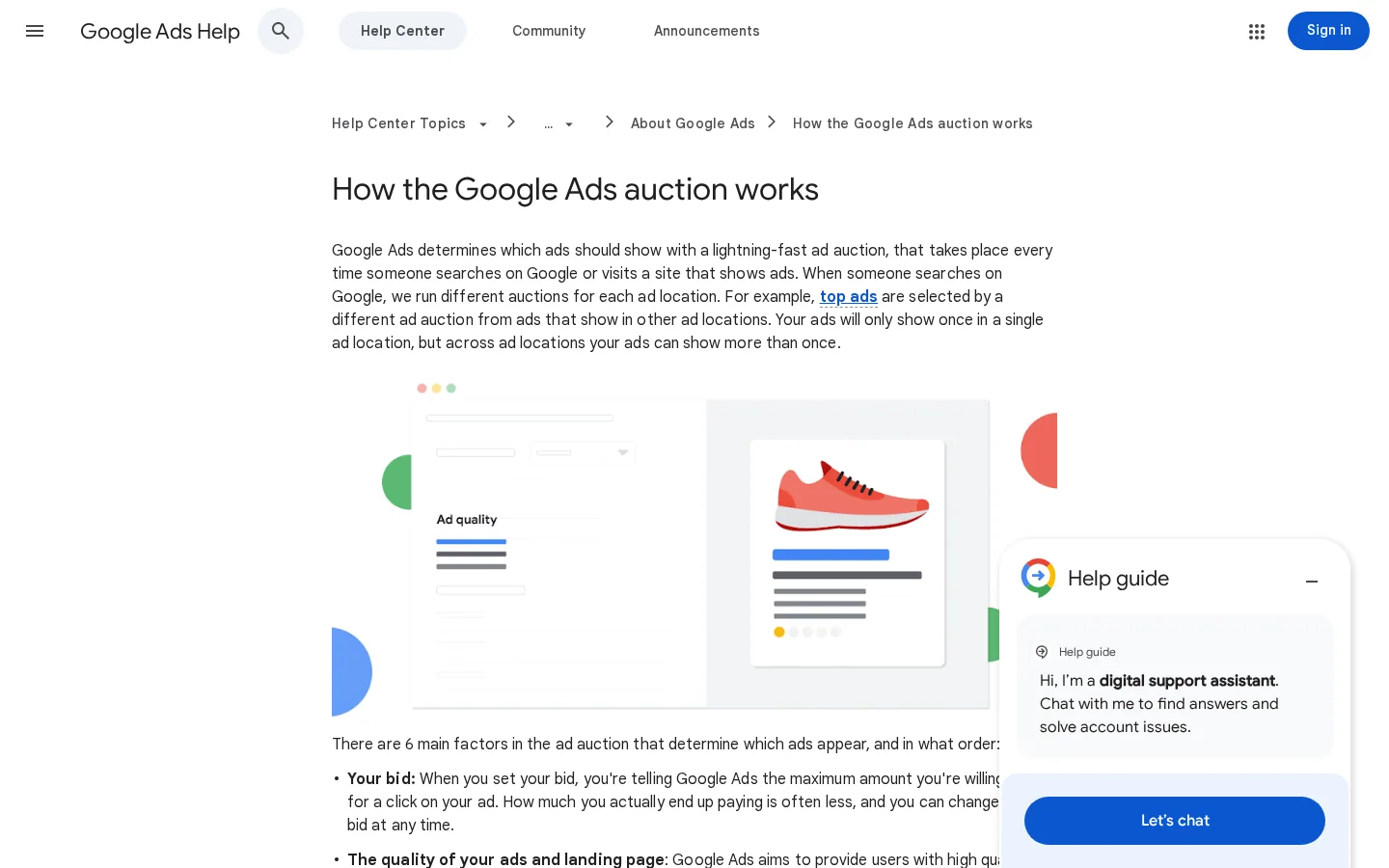
A higher bid does not guarantee the top slot. Ad quality and the landing page count too, so an ad that matches the query and sends people to a clear page can win a slot against a higher bid. Google does not publish a formula, so do not build your plan on one. Test a change, measure it for two weeks and keep what works.
Quality Score is a diagnostic you see in your account. It is not in Google's list of auction inputs above. Use it to find weak keywords, ads or pages, and read Google Ads Quality Score for how to raise it.
How one search auction runs
Most platforms let you choose a pricing model. The three you will meet most are these.
Each model moves risk to a different place. CPC pays for curiosity as well as intent, so a weak landing page costs you every time. CPM pays for exposure, not action, so it only makes sense when the goal is awareness. CPA shifts the optimization work to the platform, but the platform optimizes toward whatever conversion data you send. If that data is wrong, the platform will chase the wrong people with a precise aim.
There are three common ways to buy digital ads. They differ in who sets the price, how much control you keep and how much volume you need. Choose one by the goal and the budget, not by what sounds modern.
You negotiate directly with a publisher or a media seller for a fixed placement: a homepage takeover, a sponsored newsletter or a podcast episode. The principle is a fixed price for a fixed slot over a fixed period. Use it for brand moments, launches and sites with a loyal audience. Its advantage is that you know where the ad runs and roughly who sees it. Its limits are slow buying, a high entry cost and very little room to test. A software company that buys a two-week sponsorship in an industry newsletter to launch a product is a typical case.
You buy through an ad manager such as Google Ads or Meta Ads. You set the budget, the targeting and the bids, and the auction does the rest. The principle is an automated auction with your rules. Use it for small and mid-sized budgets, quick tests and campaigns you can measure by a result. Its advantages are a fast start, control over spend and detailed reports. Its limit is that you compete in the same auction as much larger advertisers, and you must manage the account yourself. A local bakery that sets a daily budget and targets people searching for bread delivery in its city is a typical case.
Programmatic buying automates the purchase of ad impressions through demand-side platforms, supply-side platforms and ad exchanges. Software buys impressions one by one, often in real time, against audience rules you define. Use it for large budgets, many sites and audience segments across the open web. Its advantages are scale and fine-grained targeting. Its limits are the fees added along the chain, placement quality that is hard to control and a steep learning curve. Read our guide to programmatic advertising before you commit a budget to it.
| Method | Who sets the price | What you control | Best budget | Main risk |
|---|---|---|---|---|
| Direct buying | Negotiated with the seller | Placement and timing | Large, for brand moments | Slow to buy and hard to test |
| Self-serve | Auction on each click or impression | Budget, targeting and bids | Small to large | Management time and competition |
| Programmatic | Real-time auction on each impression | Audience rules at scale | Large | Fees along the chain and placement quality |
The first campaign is for learning, not for a big return. Set it up so you can read a clear result in two to four weeks. Keep one goal, one offer and one landing page. Adding more at the start makes the data impossible to read.
Launch sequence for a first campaign
For search, start with exact and phrase match on terms that describe your offer. Broad match finds more queries, and so more waste, so add it only once you have a list of negative keywords. Each week, open the search terms report and add the queries that bring clicks but no interest. Typical waste words are free, jobs, course, template and login, but the list depends on your market. Add them as negatives, and review the list again the next week.
For social and display, start with two or three audiences and a broad interest group. Narrow the audience only after you see which group converts. Each extra filter lowers the audience size, so a campaign can stall when the audience becomes too small to deliver.
Tag every link so your analytics can tell the sources apart. Use one format across all campaigns, and keep the names lowercase with hyphens. Here is an example for a Google search campaign:
https://example.com/pricing?utm_source=google&utm_medium=cpc&utm_campaign=audit-launchTip
Build tagged links without typos with our free UTM link builder. Use the same campaign name in the ad platform and in your analytics, or the two reports will never match.
Once the campaign runs, three things decide the result: who sees the ad, what the ad says and where the click lands. Most teams spend their time on targeting and forget the landing page, which is where the money is lost. Work through the three in that order of effect, and check each one before you change the budget.
Where an ad campaign loses people
Targeting is the set of rules that decide who can see your ad. On search it is the keyword and the match type. On social it is the audience, location, age range, device and interest. Targeting narrows the pool, but it does not make a bad offer sell. If click-through is low, the problem is often the ad copy or the audience, not the bid. If clicks are high and sales are low, the problem is usually the page.
A good ad makes three things clear: the promise, the proof and the next step. The promise is what the person gets. The proof is a number, a review or a guarantee. The next step is the action you want, such as "Get the audit" or "Start the trial". Read ad copywriting for the platform-by-platform rules, and do not paste the same text into every channel.
Watch for ad fatigue. When the same person sees an ad many times, the click rate falls and the cost rises. Check frequency and click-through together every week. If the frequency keeps rising while clicks fall, rotate in new creative and pause the tired ad.
The landing page must repeat the promise of the ad in the first screen. If the ad says "free audit", the page should show the audit, not a generic home page with a menu. Keep the form short, with only the fields you need, and load the page fast on mobile, where many paid clicks happen. Each of these choices changes the conversion rate, and the conversion rate changes what you pay per sale.
Note
Send a test visitor through the full path on a phone. Click the ad, land on the page, fill the form and check the confirmation. Most broken campaigns fail at this step, not in the ad platform.
A campaign report shows many numbers, and each one answers a different question. Pick a small set and read them in order. Click-through rate tells you whether the ad earns attention. Cost per click tells you the price of traffic. Conversion rate tells you whether the page sells. Cost per acquisition and return on ad spend tell you whether the whole chain pays.
| KPI | Formula | What it tells you | Warning sign |
|---|---|---|---|
| Click-through rate (CTR) | Clicks / impressions | Whether the ad earns attention | Falling for weeks with a stable audience |
| Cost per click (CPC) | Spend / clicks | The price of one visit | Rising while CTR falls |
| Conversion rate | Conversions / clicks | Whether the page sells | Many clicks and almost no conversions |
| Cost per acquisition (CPA) | Spend / conversions | The price of one sale or lead | Above your margin per sale |
| Return on ad spend (ROAS) | Revenue / ad spend | Revenue returned per unit spent | Below your break-even ROAS |
Break-even ROAS is the number you must reach before a campaign makes money on the product itself. It depends on your gross margin, not on your revenue. The formula is short:
break-even ROAS = 1 / gross marginIf your gross margin is 40%, break-even ROAS is 2.5. Each unit of ad spend must bring back 2.5 units of revenue before the campaign covers the product cost. A ROAS of 2 looks healthy in a dashboard, but it loses money on that product. Set the break-even figure before you launch, so the decision to pause is made on numbers and not on hope.
Tip
Calculate your own break-even point with the ROAS calculator. Enter your margin and your target, and see the return you need before you spend a single euro or dollar.
Each ad platform reports the sales it thinks it caused, and the reports often overlap. A customer who clicked a search ad, then a social ad, then bought from an email can be counted three times. Compare the platform numbers with your own sales data every month. Use the platform's numbers to compare campaigns inside the same platform, and your own data to judge the total. For the full list of metrics and warning signs, read PPC metrics.
Ad targeting depends on tracking, and tracking has become harder. Browsers, operating systems and privacy laws keep changing how much data reaches ad platforms, so plan for less. In the EU and UK, most non-essential advertising cookies need the user's consent under the cookie and ePrivacy rules. Check with your legal adviser and your consent platform before you add a new tag.
Your strongest data is the data your customers give you directly. First-party data is the list of buyers, the form submissions and the account holders that you collect with consent and store yourself. You can use it for your own emails, for matched audiences on platforms and to measure real sales.
Where to put your effort
Some platforms offer conversion APIs or server-side tagging. These send events from your server rather than from the visitor's browser, so they lose less data when browsers block scripts. The setup needs a developer, and you must still respect consent and keep the data minimal. Start with the purchase event, because it is the one that matters most for the budget. Add the other events only when the purchase event is reliable.
These six mistakes waste most early budgets. For each one, read what it is, how to spot it and how to fix it. Check them in this order before you change the bids.
The same ad, sent to two pages
What it is: the ad promises one offer, but the click lands on a general home page with a menu, several offers and no clear next step.
How to spot it: the campaign reports clicks, but the analytics show a high bounce rate and few conversions for the ad traffic compared with the rest of the site.
How to fix it: build one page per ad group. Repeat the headline of the ad on the page, keep the form short and remove the navigation that leads away from the offer.
What it is: the platform reports no conversions while sales happen, or it reports double the sales because the tag fires on every page load of the confirmation page.
How to spot it: compare the conversion count in the ad platform with the orders in your shop or CRM for the same week. A large gap in either direction is a sign of a broken tag.
How to fix it: install the tag once, complete a test purchase and check that the event fires one time. Reload the confirmation page to see whether the count rises.
Warning
A tag that fires twice on the confirmation page doubles your reported conversions. The platform then bids more aggressively for the wrong result, and the cost per sale looks better than it is.
What it is: the campaign matches many queries that have nothing to do with your offer, and each one costs a click.
How to spot it: the search terms report is full of job seekers, students or people looking for free versions. The average cost per click looks fine, but the conversion rate is near zero.
How to fix it: add the irrelevant queries as negative keywords, and review the list every week. Keep exact and phrase match for the core terms until you know which broad queries convert.
What it is: you keep a campaign because its click-through rate is high, even though it brings no sales.
How to spot it: the dashboard shows strong CTR and cheap clicks, but the cost per acquisition is far above your margin.
How to fix it: read the chain in order: CTR, CPC, conversion rate, CPA, ROAS. Decide on the last link that matches your goal, and use the others to explain why the result moved.
What it is: the same audience sees the same creative too many times, and the ad stops earning clicks.
How to spot it: frequency rises week after week while click-through falls and cost per click climbs.
How to fix it: set a frequency cap where the platform offers one, rotate in new creative every few weeks and pause the ad that no longer earns clicks.
What it is: you pay for clicks on your own brand name, even when your organic result already sits at the top.
How to spot it: many of the paid clicks on your brand would have come to your site anyway, through the organic result. Check your branded traffic in the analytics before and after you pause the brand bids.
How to fix it: run a short test that pauses brand bids in one region or on one set of days, and compare the total branded traffic. Keep brand bids where the organic result is weak or where competitors bid on your name. Read branded keywords for how to separate the two.
Paid search and SEO fight for the same click on the same results page. A paid ad can push the organic result below the fold, and a strong organic ranking can reduce how much you need to bid. Treat them as one search strategy, not as two teams that do not talk. The paid results show what people click, and the organic results show what you can keep without a budget.
| Factor | Paid search | Organic search (SEO) |
|---|---|---|
| Speed to first result | Often within days | Usually takes months |
| Cost of each visit | Set by the auction and your bids | No click fee, but content and tools have a cost |
| What happens when you stop | Traffic stops with the budget | Rankings can hold for a long time |
| Control of the message | High: you write the ad and the page | Lower: the search engine picks the snippet |
AI answers add a third place where people meet your brand. To see the paid, organic and AI traffic side by side, use a single dashboard. Sorank's GEO / SEO dashboard shows Google and AI traffic in one view, so you can compare the channels without exporting three reports.
Digital advertising rewards a short cycle: one goal, one page, one test, one review. Use this list to start, and change it only when the data tells you to.
Start this week
When the first test works, the next questions are about cost and scale. Our guide to Google Ads cost explains how to set a realistic budget, and the channel guides above show when a second platform is worth the effort.
Digital advertising is the paid part of digital marketing. You pay for each placement, click or impression. Digital marketing also covers unpaid work such as SEO, email and social posts, which build results over time.
There is no fixed price. Costs depend on the channel, the auction, the pricing model and how competitive your market is. Set a daily budget you can afford for two to four weeks, then judge the result on cost per acquisition or return on ad spend.
It can be, if you have an offer that sells and you can track the sales. Without tracking, you cannot tell whether the ad or the product is failing. Start with one channel, one landing page and a small test budget.
We analyse your competitors, your website and your AI visibility to create a tailored content plan for free.
 AI Content Brief Generator
 FAQ Schema Generator
 AI Blog Post Ideas Generator
 Structured Data Validator (Schema Validator)
 Alt Text Checker
 Internal Link Analyzer
 Backlink Challenge
 AI Meta Description Generator
 AI Blog Title Generator
 Google Indexability Checker
 AI Blog Outline Generator
 UTM Link Builder
 Keyword Clustering Tool
 Canonical Tag Checker
 XML Sitemap Generator
 Broken Link Checker
 AI SEO Title Generator
 Headline Analyzer
 SERP Preview Tool
 Redirect Checker
 Hreflang Tag Generator
 Heading Structure Analyzer
 HTTP Headers Checker
 Favicon Extractor
 SERP CTR Calculator
 SEO vs Paid Search Savings Calculator
 SEO Share of Voice Calculator
 SEO ROI Calculator
 SEO Traffic and Revenue Forecast Calculator
 SEO Budget Calculator
 SEO Break-Even Calculator
 SaaS SEO ROI Calculator
 ROAS Calculator
 Reading Time Calculator
 Ranking Gain Simulator
 Organic Traffic Value Calculator
 Organic Traffic Estimator and Website Traffic Checker
 LTV to CAC Ratio Calculator
 Local SEO ROI Calculator
 Link Building Cost Calculator
 Keyword Value Calculator
 Keyword Opportunity Score Calculator
 Keyword Density Calculator
 GEO ROI Calculator
 GEO Content Investment Calculator
 Ecommerce SEO ROI Calculator
 Customer Lifetime Value Calculator
 Customer Acquisition Cost Calculator
 CTR Calculator
 Cost Per Article Calculator
 Conversion Rate Calculator
 Content Marketing ROI Calculator
 ChatGPT Referral Traffic Estimator
 Bounce Rate Calculator
 Backlink ROI Calculator
 AI Visibility Score Calculator
 AI Traffic Value Calculator
 AI Share of Voice Calculator
 Cost of AI Invisibility Calculator
 AI Citation Rate Calculator
 llms.txt Validator
 AI Overview Checker and AI Overviews Rank Checker
 Robots.txt Checker
 AI SEO Audit
 LLM Readability Checker
 SearchGPT Readiness Checker
 Structured Data LLM Audit
 Website Crawlability AI Audit
 Why ChatGPT Is Not Recommending My Website
 Gemini Ranking Tool
 Perplexity Ranking Checker
 LLM Citation Checker
 Answer Engine Optimization Audit
 GEO Audit
 AI Search Visibility Test
 ChatGPT Visibility Checker
 llms.txt Generator
 URL Extractor
 Webpage to Markdown
 Sitemap Checker
 SERP Volatility Sensor
 Page Size Checker
 Word Counter
 Slug Generator
 Schema Generator
 Robots Generator
 OG Preview
 Meta Tags Generator
 Image Compressor
 Favicon Generator
 On-Page SEO Audit: SEO Checker and SEO Analyzer
 Backlink Analysis Tool
 Keyword Research Tool
 Domain Authority Checker
 “I tested Sorank on a real client site and it's insane. It does everything an agency would bill you $1500 a month for. It's going into production on that client now.”

 Guillaume Guersanguersanguillaume.com“We are an Ads agency and we wanted to get our SEO back on track once and for all. Sorank gave us a clear view of our site, helped us prioritize optimizations, and properly structure our content. The tool is easy to use, well designed for a team, and very practical for centralizing tracking without having to juggle multiple platforms. A very solid foundation to start fresh with our SEO.”
 Gaspard MadouiAds Agency
 “I just let the Sorank software do its thing, and now my DR is 25 and my page is ranking higher.”
 Lucas Flandrefoundertrace.fr“I specialized in GEO thanks to Sorank. The GEO Leaderboard allows me to show my clients their position vs competitors on ChatGPT. It’s a real commercial differentiator.”
 MélanieSEO Freelance“Great service, works well for our website and helps us understand how to improve it to rank better on Google and elsewhere. Congrats, keep going, I recommend it.”
 Hugo T.E-commerce merchant